


What authority do bail bond agents have? 7 Powerful Facts 2025
What Authority Do Bail Bond Agents Have? The Legal Reality
What authority do bail bond agents have is a question that often arises when people encounter these private contractors in the criminal justice system. Many people confuse bail bond agents with police officers, but their powers are actually quite different and much more limited.
Quick Answer: Bail Bond Agent Authority
– Arrest Power: Can only arrest defendants who have skipped bail on their specific bond
– Documentation Required: Must have proper warrant or “bail piece” (certified bond copy)
– Property Entry: Limited rights to enter homes – defendant’s residence vs. third-party property
– Use of Force: May use reasonable force but cannot exceed what’s necessary
– Not Law Enforcement: Cannot investigate crimes, make traffic stops, or enforce other laws
– State Variations: Authority differs significantly by state – some ban commercial bail entirely
The confusion is understandable. Television shows like “Dog the Bounty Hunter” dramatize bail enforcement, making it seem like agents have broad police powers. In reality, about 1 in 4 felony defendants released pretrial fails to appear in court, and bail bond agents are responsible for tracking down only those who used their services.
The legal foundation for their authority comes from an 1872 Supreme Court case, Taylor v. Taintor, which established that accepting a bail bond creates a “custody” relationship. This gives agents narrow arrest powers, but only for their specific clients who violate bond conditions.
As someone who has worked extensively in the surety industry, including roles at Palmetto Surety Corporation and other major bonding companies, I’ve seen how what authority do bail bond agents have varies dramatically by state and situation.
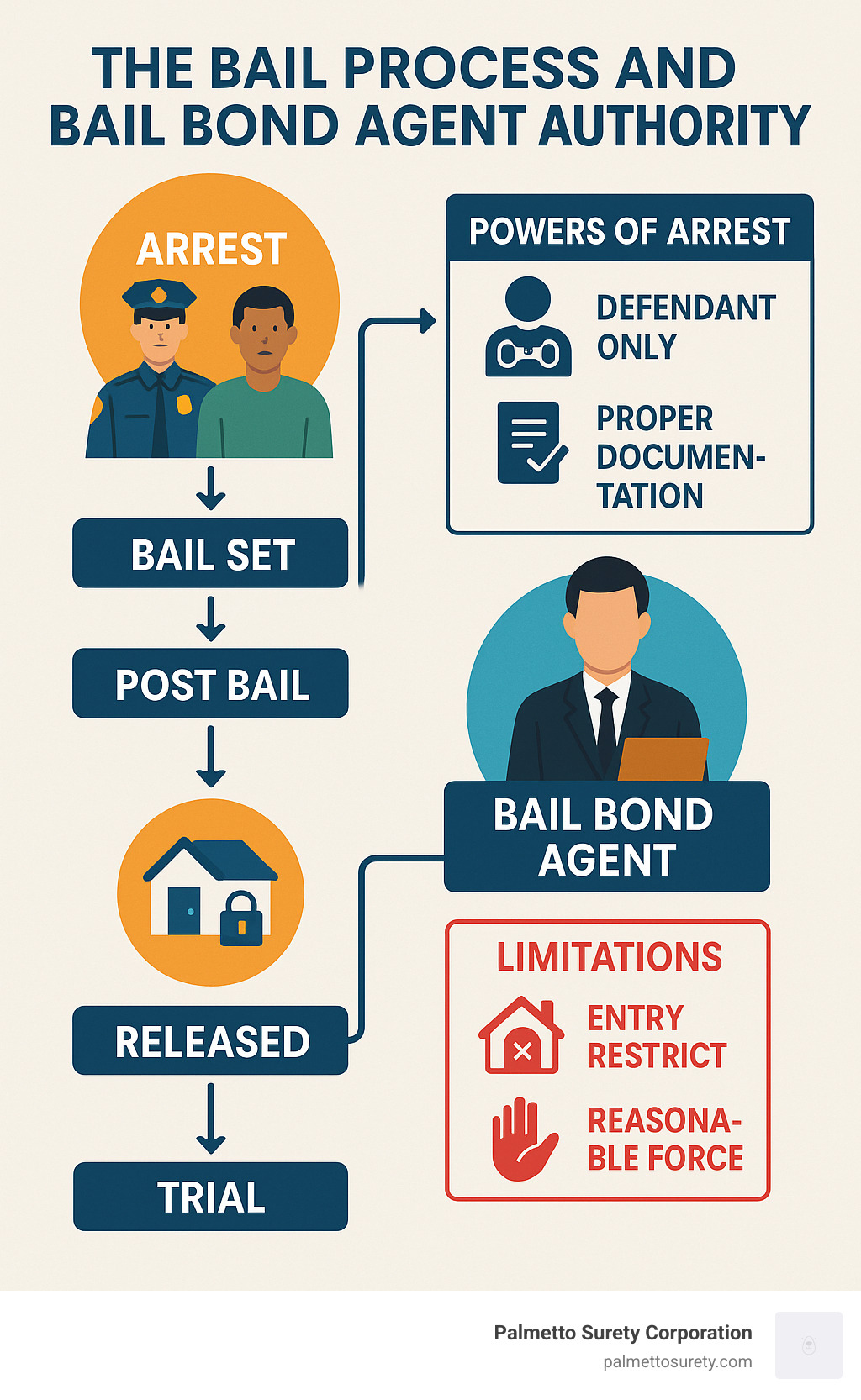
Terms related to what authority do bail bond agents have:
– can a bail bonds agent arrest you
– are bail bonds agents cops
– what is a bail bonds agent
Bail Bond Agents 101 – Roles, Incentives, Everyday Work


To understand what authority do bail bond agents have, we first need to see what they do every day. Most people think of dramatic TV shows when they hear “bail bondsman,” but the reality is much more mundane—and frankly, much more helpful to defendants and their families.
A bail bond agent is a licensed professional who acts as a bridge between defendants who can’t afford their full bail amount and the court system. They work with surety insurance companies to guarantee a defendant’s appearance in court, charging a premium of 10-15% of the total bail amount as their fee.
Think of it like this: if your bail is set at $10,000 and you don’t have that kind of cash lying around, a bail agent will post the full amount with the court. You pay them $1,000 (10%), and they’re on the hook for the remaining $9,000 if you don’t show up.
What Does a Bail Bond Agent Actually Do?
Here’s something that might surprise you: most bail agents spend more time on the phone than they do chasing people down. The dramatic car chases you see on TV? That’s maybe 5% of the job on a busy week.
The paperwork side takes up most of their day. Agents are constantly posting bonds with courts, coordinating with surety insurers, and handling collateral like car titles or property deeds.
Court reminders are actually their secret weapon. Smart agents send text messages, make phone calls, and even use robocall systems to remind defendants about upcoming court dates. A simple reminder prevents about 95% of potential problems.
Monitoring is where things get more interesting. Depending on the bond conditions, agents might require defendants to check in regularly, follow curfews, or wear GPS ankle monitors. Some agents use social media to keep tabs on their clients—not in a creepy way, but to make sure they’re still in town.
When defendants do skip out, that’s when skip tracing kicks in. Modern agents use database searches, social media monitoring, and good old-fashioned detective work to locate people. The surrender process is usually much less dramatic than TV makes it look—most of the time, it’s a phone call that ends with “Meet me at the courthouse tomorrow morning.”
How the Bail Bond Business Works
The bail bond business runs on a simple but nerve-wracking financial model. Agents collect their nonrefundable fee upfront—typically 10% for state charges and 15% for federal cases. That fee is their profit, but they’re also gambling their own money on every single client.
When someone fails to appear in court, the clock starts ticking. Most states give agents a 90-180 day window to locate and return the defendant before they forfeit the full bond amount. That’s why understanding what authority do bail bond agents have becomes so crucial.
Collateral is often part of the equation for larger bonds. Agents might hold car titles, property deeds, or other valuable assets to secure the bond. The financial risk is real and immediate. When an agent writes a $50,000 bond and collects a $5,000 fee, they’re risking $45,000 of their bonding company’s money.
Surety insurers like us back these bonds, but we expect our agents to be professional and effective. At Palmetto Surety Corporation, we’ve been in this business for over 20 years, and we’ve learned that the best agents are the ones who treat their clients with respect and focus on getting them to court rather than hunting them down later.
What Authority Do Bail Bond Agents Have?
Now we get to the heart of the matter: what authority do bail bond agents have in practice? The answer might surprise you—it’s both more specific and more limited than most people realize.
Think of bail agents as having a very narrow but powerful authority. They’re not police officers who can investigate crimes or make traffic stops. Instead, they have one focused job: bringing back defendants who’ve skipped bail on their specific bonds.
Common-Law Foundation & Key Court Cases
The story of bail agent authority begins in 1872 with a Supreme Court case called Taylor v. Taintor (83 U.S. 366). This landmark decision created what lawyers call the “bounty hunter lineage” of authority that still governs bail agents today.
Here’s what the Court decided: when you accept a bail bond, you’re essentially agreeing to let the bondsman have contractual custody over you. It’s like giving them permission to come get you if you don’t show up to court.
The Taylor v. Taintor ruling gave bondsmen some pretty broad powers, including the right to cross state lines to find fugitives, enter premises when necessary, and use reasonable force during arrests. But here’s the key—this 150-year-old case is just the foundation. Modern state laws have added lots of restrictions and requirements that didn’t exist back then.
Statutory Authority Across States
While Taylor v. Taintor provides the basic framework, what authority do bail bond agents have varies dramatically depending on which state you’re in. Some states give agents broad powers, while others have strict limitations.
Take Mississippi’s § 99-5-27, for example. This law lets agents arrest their clients “at any time” and “anywhere.” They can even authorize other people to make arrests on their behalf. But they must provide proper surrender notice to discharge their liability.
Nevada’s Chapter 697 takes a much more restrictive approach. Agents need 80 hours of training, must notify local police before making arrests, and face strict rules about entering property and using force.
California requires 20 hours of pre-licensing training and a $1,000 surety bond for individual agents. They also have detailed notification requirements and property entry rules.
At Palmetto Surety Corporation, we work with agents across the Southeast, and understanding these state-by-state differences is crucial for staying within legal boundaries.
When Can They Make an Arrest?
Here’s where things get very specific. Bail agents can’t just decide to arrest someone on a whim. Several conditions must be met before they have arrest authority.
First, there must be a bench warrant issued by a judge. This usually happens when someone fails to appear in court. The agent also needs to be within the forfeiture window—typically 90 to 180 days from when the defendant first missed court.
Bond violations that can trigger arrest authority include missing scheduled court appearances, violating curfew or travel restrictions, removing court-ordered monitoring devices, or committing new crimes while on bail.
But here’s what agents cannot do: they can’t pull you over for speeding, investigate crimes they didn’t witness, or arrest people for other companies’ bonds. Their authority is laser-focused on their own clients who’ve violated bail conditions.
According to latest research on bail recovery, most bail violations are actually resolved through phone calls and voluntary surrender rather than dramatic arrests.
Required Documentation – The “Bail Piece”
Before making any arrest, bail agents must have their paperwork in order. This documentation package is called a “bail piece,” and it’s absolutely essential.
The bail piece includes a certified copy of the original bail bond, a court-issued bench warrant or failure-to-appear notice, the agent’s valid license and identification, and power of attorney from the surety company.
Without this documentation, any arrest would be considered unlawful detention. The surrender process involves presenting this documentation to local law enforcement, completing formal surrender paperwork, transferring custody to the appropriate authorities, and filing required notices with courts and insurance companies.
At Palmetto Surety Corporation, we make sure our network of bail agents understands these documentation requirements completely. Getting the paperwork wrong isn’t just embarrassing—it can end careers and result in serious legal consequences.
Limits, Rights & Comparisons With Police Powers

Here’s where things get interesting—and where most people get confused. What authority do bail bond agents have compared to police officers? The short answer is: much less than you might think.
The biggest myth floating around is that bail agents are basically private police officers. That’s completely wrong. They’re private contractors with very specific, very limited powers.
| Authority | Police Officers | Bail Bond Agents |
|---|---|---|
| Arrest Powers | Anyone for any crime with probable cause | Only their specific clients who violated bail |
| Warrant Requirements | Can arrest with or without warrants in many situations | Must have bench warrant or bail piece |
| Property Entry | Can enter with warrants, hot pursuit, or exigent circumstances | Limited to defendant’s residence, usually need warrant for third-party property |
| Traffic Enforcement | Full authority to stop and cite drivers | No authority over traffic violations |
| Investigation Powers | Can investigate any crime | Cannot investigate crimes unrelated to bail |
| Use of Force | Authorized deadly force in specific situations | Limited to reasonable force for apprehension |
Entry Into Private Property
Property entry is where things get legally messy—and where bail agents often run into trouble if they don’t know the rules.
When it comes to the defendant’s own home, many states give agents broader authority. The legal theory is that when someone accepts a bail bond, they’re essentially giving the agent permission to come get them if they skip court.
But here’s the catch: third-party property is completely different. If you’re hiding out at your friend’s house, the bail agent can’t just barge in. They need permission from the homeowner or a warrant, just like anyone else would.
In our experience at Palmetto Surety Corporation, the smartest agents avoid forced entry altogether. Most professional agents prefer negotiation over confrontation—it’s safer, cheaper, and creates fewer legal headaches.
Use of Force, Weapons & Miranda
Use of force is limited to what’s “reasonable” for making an arrest. They can restrain someone who’s resisting, but they can’t go overboard. Cross that line, and they’re looking at criminal charges and civil lawsuits.
When it comes to firearms, bail agents have no special privileges. They can carry guns like any other private citizen (where legally allowed), but they don’t get law enforcement exemptions.
Miranda rights are usually not required because bail agents aren’t law enforcement officers gathering evidence for criminal prosecution. They’re private contractors trying to return someone to court.
Rights of Defendants and Bystanders
If a bail agent shows up at your door, you’re not powerless. You have specific rights, and knowing them can protect you from agents who might be overstepping their authority.
You can demand identification from any bail agent who approaches you. They should have a valid license and proper documentation. If they can’t produce these documents, something’s wrong.
If you’re not the defendant, you can absolutely refuse entry to your home. Non-defendants have full property rights, and agents who persist without proper warrants are trespassing.
Legal recourse is available if agents exceed their authority. You can file complaints with state insurance departments, pursue civil lawsuits for false imprisonment or trespass, and report criminal misconduct to local law enforcement.
Working With—Not As—Law Enforcement
Professional bail agents understand they’re not law enforcement officers—they work with police, not as police.
Notification protocols in many states require agents to notify local police before making arrests. This prevents dangerous misunderstandings and helps ensure everyone’s safety.
Joint operations sometimes occur for high-risk situations. Police might assist with arrests in dangerous areas or help coordinate timing to minimize public safety risks.
The bottom line? What authority do bail bond agents have is much more limited than most people think. They’re not police officers, they can’t investigate random crimes, and they have to follow strict rules about property entry and use of force.
State Laws, Licensing & Training Requirements
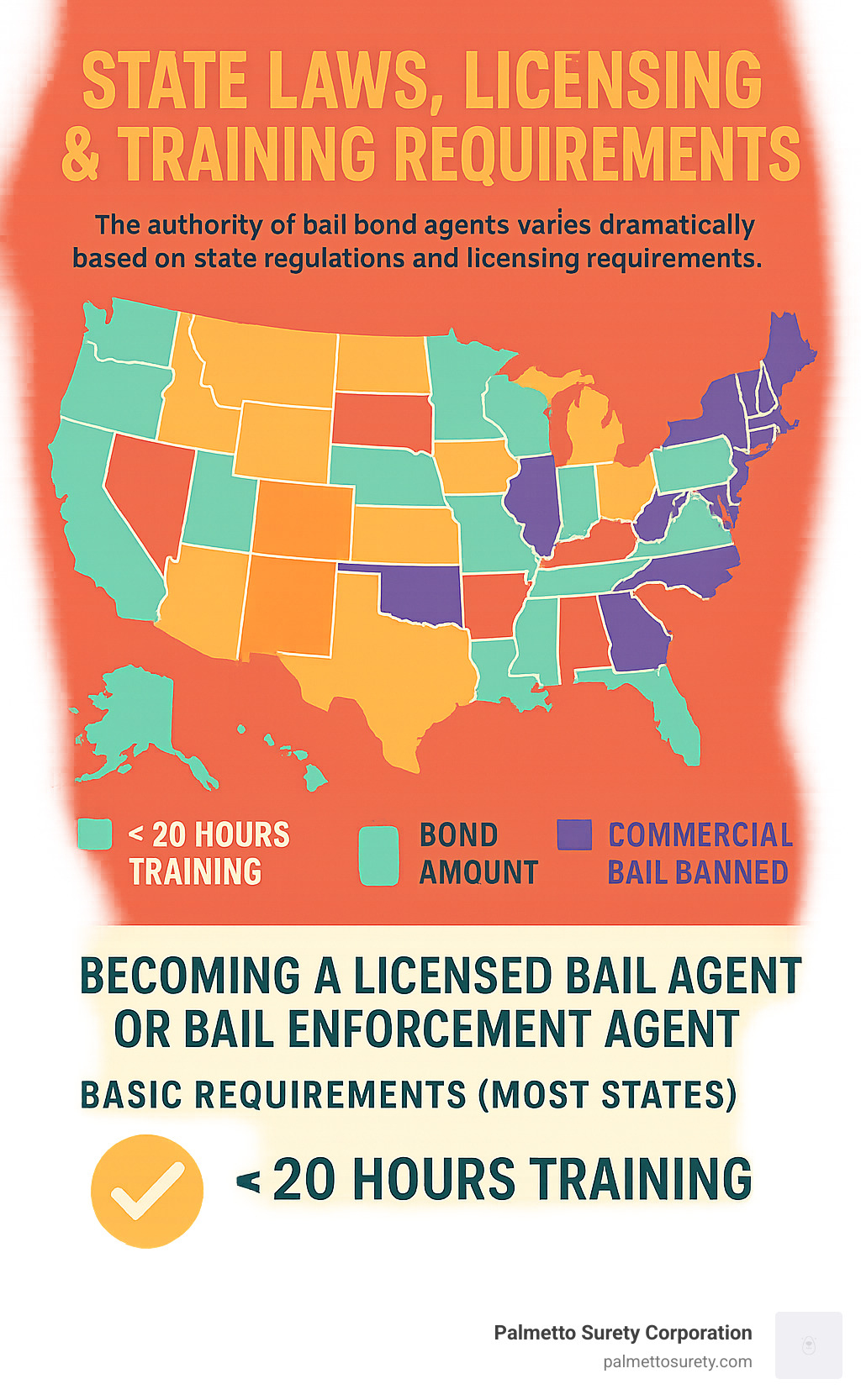
The authority of bail bond agents varies dramatically based on state regulations and licensing requirements.
Becoming a Licensed Bail Agent
Basic Requirements (Most States)
– Minimum age 18-21 years old
– U.S. citizenship or legal residency
– High school diploma or equivalent
– Clean criminal background (no felony convictions)
– Pass written examination on state laws and procedures
Training Requirements by State
– California: 20 hours pre-licensing, $1,000 surety bond
– Florida: 120 hours pre-licensing education
– Georgia: 40 hours pre-licensing training
– Nevada: 80 hours for enforcement agents, 6 hours for regular agents
– New York: $50,000 surety bond, extensive background checks
Continuing Education
– Most states require 8-20 hours annually
– Topics include ethics, law updates, de-escalation techniques
– Failure to complete CE can result in license suspension
At Palmetto Surety Corporation, we work only with properly licensed agents who meet all state requirements in our coverage areas across the Southeast.
States Where Commercial Bail Is Banned
Four states have completely banned commercial bail bonding:
Illinois – Eliminated cash bail entirely in 2023
Kentucky – Banned commercial bail bonds, uses court-administered system
Oregon – Prohibited commercial bail bonding, relies on pretrial services
Wisconsin – Banned commercial bail, uses signature bonds and court supervision
In these states, what authority do bail bond agents have is a moot question—they simply don’t exist.
Bail Bond Agent vs. Bounty Hunter Credentials
There’s often confusion between bail bond agents and bounty hunters (bail enforcement agents):
Bail Bond Agents
– Licensed by state insurance departments
– Post bonds and handle financial transactions
– May or may not have arrest authority depending on state
– Focus on business operations and client management
Bounty Hunters/Bail Enforcement Agents
– May require separate licensing (18 states allow anyone to become one)
– Specialize in locating and apprehending fugitives
– Work as contractors for bail bond companies
– Subject to specific training requirements (where regulated)
California Example (PC 1299)
– Requires separate licenses for bail agents vs. enforcement agents
– Enforcement agents must notify police before arrests
– Specific training requirements for each type of license
– Different insurance and bonding requirements
Criticisms, Reforms & The Future of Bail Enforcement

The bail bond industry often sits at the center of criminal-justice debates. Supporters point out that agents help ensure defendants return to court; critics say some practitioners exceed their limited authority. Both views matter because each legislative change can reshape the business overnight.
Common Misconduct & Consequences
A few highly publicized incidents—unlawful entry, excessive force, or operating without a license—have harmed the profession’s reputation. When abuse occurs, the fallout is swift: civil lawsuits for false imprisonment or trespass, criminal charges for assault or impersonating police, and administrative penalties such as license suspension or revocation.
Reform Trends That Shrink Traditional Bail
Many jurisdictions are adopting risk-assessment tools, automated reminder systems, and court-run pre-trial programs that reduce or eliminate cash bail for lower-level offenses. Research like this primer on bail reform shows these alternatives can cut failure-to-appear rates, steadily narrowing the market for private surety bonds.
Technology & Professionalization
Agents who succeed today rely on technology rather than confrontation: GPS monitors, smartphone check-ins, social-media skip tracing, and body-worn cameras to document arrests. Liability-insurance minimums now reach $1 million in some states, and continuing-education classes on ethics and de-escalation are becoming the norm.
At Palmetto Surety Corporation we’ve learned that agencies thriving under heightened scrutiny share three traits: they respect legal limits, invest in modern tools, and treat clients professionally. Those standards are likely to define the future of bail enforcement.
Frequently Asked Questions about Bail Bond Agents’ Authority
When people encounter bail bond agents, they often have urgent questions about their rights and the agent’s authority. These situations can be stressful, so let’s clear up the most common concerns with straightforward answers.
Can a bail bond agent arrest me without a warrant?
The short answer is no—but there’s an important caveat. What authority do bail bond agents have depends entirely on whether you’re their client and whether proper documentation exists.
Bail agents cannot arrest random people based on suspicion or their own investigation. They need a bench warrant issued by a judge or proper court documentation showing you failed to appear for your scheduled court date. This warrant must specifically name you as the defendant in their bail bond contract.
If you’re not their client—meaning you didn’t sign a bail bond agreement with their company—they have zero authority to arrest you. They can’t pull you over for traffic violations, investigate crimes, or detain you for any reason.
Do bail bond agents have to read me my Miranda rights?
Generally speaking, no. Miranda rights apply when law enforcement officers interrogate suspects to gather evidence for criminal prosecution. Since bail agents are private contractors whose goal is returning you to court rather than building a criminal case, Miranda warnings typically don’t apply.
Think of it this way: police officers read Miranda rights because they’re trying to get confessions or statements that could be used against you in court. Bail agents aren’t investigating crimes or gathering evidence—they’re simply trying to get you back to your scheduled court appearance.
However, some states have specific notification requirements that agents must follow. They might need to identify themselves, show their license, or explain why they’re taking you into custody.
What can I do if a bail bond agent exceeds their authority?
If a bail agent steps outside their legal boundaries, you have several options for holding them accountable. What authority do bail bond agents have to face consequences is significant—they can lose their licenses, face criminal charges, and be held financially liable.
Document everything immediately. Record video if it’s safe to do so, take detailed notes about what happened, and get contact information from any witnesses. If agents won’t show proper identification or seem threatening, call 911 right away.
File regulatory complaints with your state’s insurance department or licensing board. These agencies take violations seriously because licensed agents represent their regulatory oversight. Complaints can result in license suspension, fines, or permanent bans from the industry.
Consider civil lawsuits for false imprisonment, trespass, assault, or civil rights violations. Many attorneys specialize in these cases and work on contingency, meaning you don’t pay unless you win.
Report criminal behavior to local police if agents used excessive force, entered property illegally, or impersonated law enforcement officers. These are serious crimes that can result in jail time and permanent criminal records for the agents involved.
At Palmetto Surety Corporation, we work only with licensed professionals who understand these boundaries and operate within the law.
Conclusion
Understanding what authority do bail bond agents have is crucial in today’s criminal justice system, and frankly, it’s a lot more complicated than most people think. These private contractors serve an important role in ensuring defendants appear for court, but their powers are far more limited than what you see on reality TV shows.
Here’s what really matters: Bail agents can only arrest defendants who have skipped bail on their specific bonds. They’re not roaming the streets looking for random criminals—they have a very narrow job focused on their own clients. They must have proper documentation and follow state-specific procedures, and their authority comes from contract law, not the same criminal law enforcement powers that police officers have.
The landscape varies dramatically depending on where you live. Some states have banned commercial bail entirely, while others give agents significant authority to track down fugitives. Professional standards and training requirements continue to evolve as the industry faces increased scrutiny and reform efforts.
At Palmetto Surety Corporation, we’ve worked with licensed bail agents across the Southeast for over 20 years. Our experience shows that the most successful agents are those who understand their legal limitations, maintain professional standards, and focus on helping defendants meet their court obligations rather than dramatic enforcement actions.
The future of bail enforcement will likely involve more technology, stricter professional standards, and continued legal reforms. We’re already seeing GPS monitoring, social media tracking, and automated court reminders replace many traditional enforcement methods. It’s becoming a more professional, less confrontational industry.
Whether you’re a defendant working with a bail agent or simply curious about the system, understanding these legal boundaries protects everyone involved. You have rights when dealing with bail agents—they can’t just do whatever they want because they have a badge and attitude.
For more information about our commercial surety bonds and bail bond services, visit our commercial surety bonds page. If you need assistance with bail bonds in Georgia, Florida, South Carolina, Tennessee, Mississippi, Louisiana, or Texas, our network of licensed agents is ready to help within hours of your call.
Remember: knowledge is your best protection when dealing with any aspect of the criminal justice system, including bail bond agents and their authority. The more you understand about what authority do bail bond agents have, the better you can protect your rights and steer the system successfully.


