


Bail Bond Agent Commission: 10 Powerful Truths in 2025
Understanding Bail Bond Agent Commission: What You Need to Know
Bail bond agent commission is the fee charged by licensed agents to post bail on behalf of defendants, typically ranging from 8% to 15% of the total bail amount set by the court. This non-refundable fee compensates agents for assuming financial risk and providing 24/7 bail services.
Key Facts About Bail Bond Agent Commissions:
– Standard Rate: 10% of bail amount in most states
– State Caps: Range from 6.5% (Ohio) to 15% (Colorado)
– Non-Refundable: Fee is kept even if charges are dropped
– Additional Costs: Processing fees ($50-$100) often apply
– Minimum Charges: Usually $100-$500 regardless of bail size
When someone gets arrested, their family often scrambles for answers about bail costs. Understanding how bail bond agent commissions work can help families make informed decisions during stressful situations.
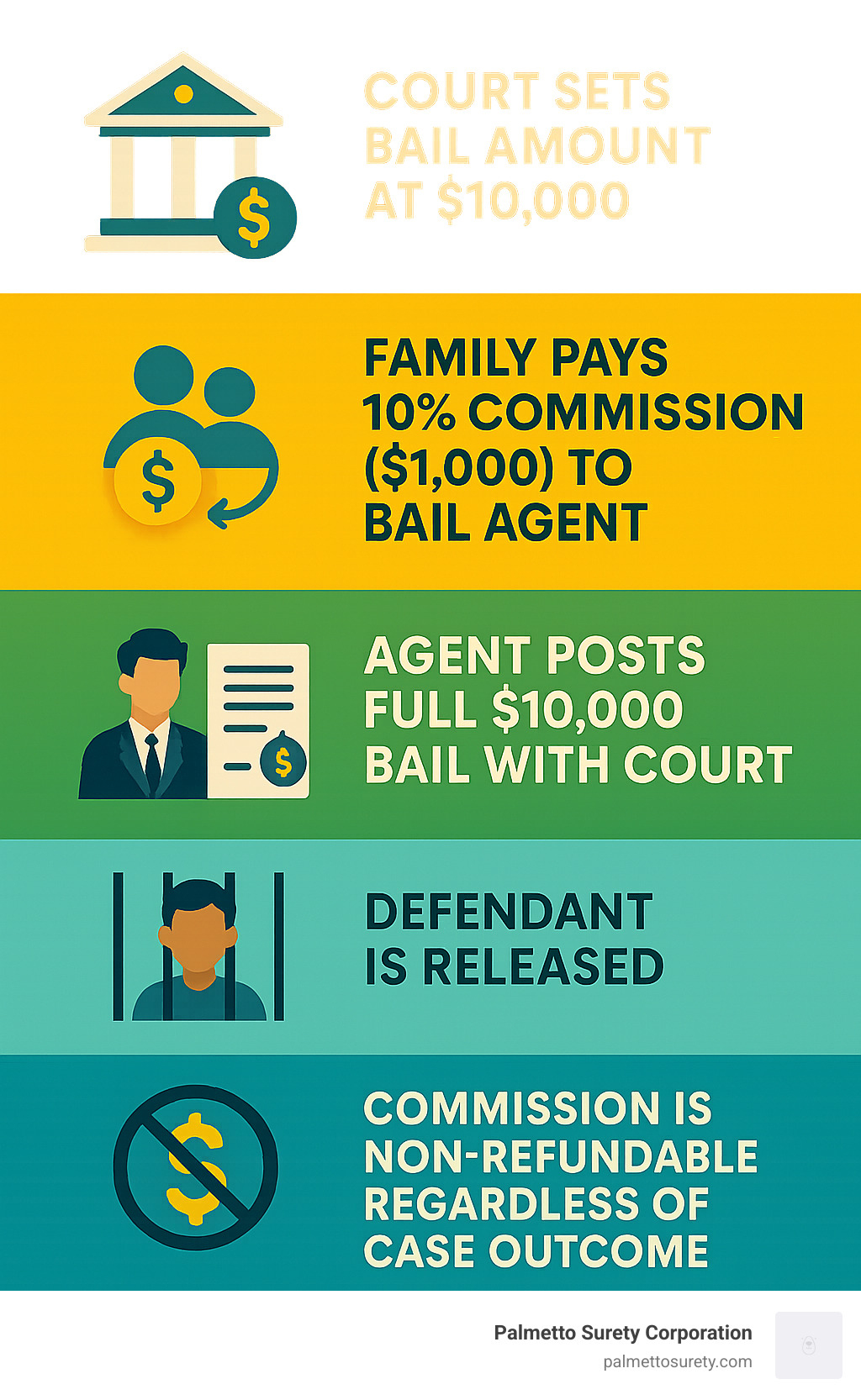
The bail bond industry operates on a commission-based model where agents charge a percentage of the court-set bail amount. For example, on a $10,000 bail, the typical agent fee would be $1,000 (10%). This fee allows defendants to secure release without paying the full bail amount upfront.
I’m Haiko de Poel Jr, and through my work with Palmetto Surety Corporation and other companies in the surety industry, I’ve gained extensive experience with bail bond agent commission structures and regulations across the southeastern United States. This guide will break down everything you need to know about how these commissions work, what factors influence pricing, and how to steer the bail bond process effectively.
How Bail Bond Agents Make Money
Bail bond agents act as financial middlemen who take on significant risk for their clients. When someone gets arrested and can’t afford the full bail amount, agents step in to help—but they’re running a business, not a charity.
The bail bond agent commission is where agents make their primary income. This premium fee typically runs 8% to 15% of the total bail amount, and it’s completely non-refundable. Whether your loved one is found innocent, guilty, or charges get dropped entirely, the agent keeps that fee.

Agents don’t pocket the entire premium. They work with surety insurance companies who actually back the bonds. When an agent posts a $50,000 bond and collects a $5,000 premium (at 10%), they typically split that money 50/50 with their surety company. So the agent keeps $2,500 while the surety gets the other half.
Here’s how these splits look at different bond amounts:
| Bond Amount | Client Premium (10%) | Agent Share (50%) | Surety Share (50%) |
|---|---|---|---|
| $10,000 | $1,000 | $500 | $500 |
| $25,000 | $2,500 | $1,250 | $1,250 |
| $50,000 | $5,000 | $2,500 | $2,500 |
| $100,000 | $10,000 | $5,000 | $5,000 |
The risk element is real. If a defendant skips court, the agent becomes liable for the full bond amount. That’s where collateral comes into play—agents can seize cars, homes, or other valuable items to recover their losses.
Revenue Streams Beyond the Premium
Smart agents don’t rely solely on premium fees. Late payment fees are common when agents offer payment plans. Most charge around $20 or 5% of the missed payment, whichever is less.
Payment plan interest is another revenue source. When families can’t pay the full premium upfront, agents often add 2-5% to the total cost for extended payment terms.
Recovery fees come into play when defendants fail to appear in court. Agents can charge clients for actual skip-tracing expenses—mileage, hotel stays, meals, and bounty hunter services. These costs can quickly add up to thousands of dollars.
Commission vs. Salary: What’s the Difference?
Most bail bond agents work on straight commission rather than receiving a steady salary. Your income directly depends on how many bonds you write and their size.
This commission-only structure means agents can have feast-or-famine months. Write several large bonds, and you might earn more in a week than some people make in months. Have a slow period, and you might struggle to pay bills.
Some larger bail bond companies offer hybrid models with a small base wage plus commission bonuses. However, the industry standard remains that 50/50 split between agent and surety company on premium fees.
Bail Bond Agent Commission: National Rules of Thumb
Across the United States, bail bond agent commission rates normally sit between 10 % and 15 % of the court-set bail. That range, confirmed by sources like Investopedia, tries to balance consumer protection with the real risk agents assume when they guarantee a defendant’s appearance.
Put simply, a $10,000 bail usually costs families $1,000–$1,500. The payment is non-refundable because the service is completed the moment the agent posts the bond.
Most jurisdictions also allow modest booking or administrative fees ($50–$100) on top of the percentage, and even the smallest bonds carry minimum charges ($100–$500) because every file requires the same paperwork.
Bail Bond Agent Commission in High-Cap States
Some legislatures give agents more pricing flexibility. Colorado, for example, allows commissions up to 15 % with a $50 minimum, while Louisiana lets agents add flat processing fees. Many of these states also permit felony surcharges to offset the extra work and higher skip rates tied to serious charges.
Bail Bond Agent Commission in Low-Cap States
Other states tighten the reins. Ohio caps commissions at just 6.5 % and forces agents to file detailed fee schedules with the Department of Insurance. Because margins are slim, Ohio agents often compete with collateral-based discounts or payment-plan incentives approved by regulators.
State Regulation and Regional Variations
State regulation of bail bond agent commission varies significantly across the United States. Most states assign oversight to their Department of Insurance, which regulates licensing, fee structures, and operational standards.
Licensing requirements typically include passing a comprehensive exam covering insurance law, criminal procedure, and ethical standards. The licensing exam for bail bond agents is considered one of the most challenging in the insurance industry. Candidates must demonstrate knowledge of:
– State insurance codes
– Criminal procedure laws
– Collateral handling requirements
– Skip-tracing regulations
– Bounty hunting limitations
Collateral laws differ significantly between states. Some jurisdictions allow agents to hold any reasonable collateral, while others specify acceptable types and require detailed documentation.
Bounty hunting rules vary dramatically. Some states require separate licensing for skip-tracing activities, while others prohibit bounty hunting entirely, requiring agents to work through law enforcement for defendant recovery.

Is the Commission Refundable?
The bail bond agent commission is explicitly non-refundable in all states. This policy exists because agents earn their fee by assuming financial risk and providing immediate bail services, regardless of the case outcome.
State statutes consistently specify that bail bond premiums are non-refundable, even if charges are dropped, the defendant is found not guilty, the case is dismissed, or plea agreements are reached.
This non-refundable nature often surprises clients who assume they’ll receive refunds if their case concludes favorably. However, agents earn their commission by posting the full bail amount and assuming liability for the defendant’s court appearance.
Additional Fees You Should Expect
Beyond the standard commission, clients should budget for several additional fees:
Jail Processing Fees: Range from $20 to $100, covering the administrative costs of coordinating with detention facilities.
Court Filing Fees: Typically $25 to $75, covering the paperwork required to file bonds with court clerks.
Credit Card Convenience Fees: Usually 3-5% of the transaction amount when clients pay premiums via credit card.
GPS Monitoring Fees: For high-risk defendants, electronic monitoring can add $10-15 per day to the total cost.
Factors That Influence the Bail Bond Agent Commission
When it comes to bail bond agent commission rates, not all cases are created equal. While state regulations set the basic framework, several factors can push your rate higher or lower than the standard 10% fee.
Flight risk tops the list of concerns for any bail bond agent. If you have strong ties to the community – a steady job, family nearby, and roots in the area – you’ll likely qualify for standard rates. But if you’re new to town, unemployed, or have a history of missing court dates, expect to pay more.
Charge severity plays a major role too. A simple misdemeanor like a traffic violation carries much less risk than a serious felony charge. Felony cases often involve higher bail amounts, longer court processes, and defendants who face significant jail time if convicted.
Your criminal record tells a story that agents read carefully. First-time offenders usually get the benefit of the doubt with standard rates. But if you’ve been arrested multiple times or have a history of failing to appear in court, agents will charge premium rates to offset the increased risk.
Credit scores matter more than you might think. Some agents offer discounts for clients with excellent credit, reasoning that people who pay their bills on time are more likely to show up for court.
The type and value of collateral you can provide makes a huge difference. Strong collateral gives agents peace of mind, knowing they can recover their money even if things go wrong. This security often translates into lower commission rates for you.
How Bail Amount Size Alters the Percentage
Bail bond agent commission rates often work on a sliding scale based on the bail amount.
Small bonds under $5,000 typically get charged the full percentage rate, sometimes even higher. Why? Because agents have minimum fees to cover their basic costs.
Medium-sized bonds between $5,000 and $25,000 represent the bread and butter of the bail bond business. These cases usually get charged standard rates – that familiar 10% you hear about most often.
Large bonds from $25,000 to $100,000 might qualify for slightly reduced rates, perhaps 8-12% instead of the full 15%. The math works out because even at a lower percentage, the agent is still making substantial money.
Mega bonds over $100,000 often involve serious negotiations. Rates can drop as low as 5-8% because the sheer dollar amounts involved make these cases very profitable for agents.
What Role Does Collateral Play in Earnings?
Collateral is like an insurance policy for bail bond agents. The stronger your collateral, the more comfortable they feel taking on your case – and that comfort often translates into better rates for you.
Real estate represents the gold standard of collateral. Property doesn’t walk away, and agents can place liens to protect their interests. If you own your home outright or have significant equity, you’re in the strongest negotiating position.
Vehicle titles offer moderate security but come with complications. Cars depreciate quickly, can be damaged or destroyed, and are mobile by nature. Still, a clear title to a valuable vehicle is better than no collateral at all.
Cash deposits provide the ultimate security for agents, but they tie up money you might need for legal expenses.
When defendants skip court, agents typically have 90 to 120 days to locate and surrender them before facing bond forfeiture. During this critical window, they can liquidate collateral to cover their potential losses.

Earning Potential, Risks, and Responsibilities for Agents
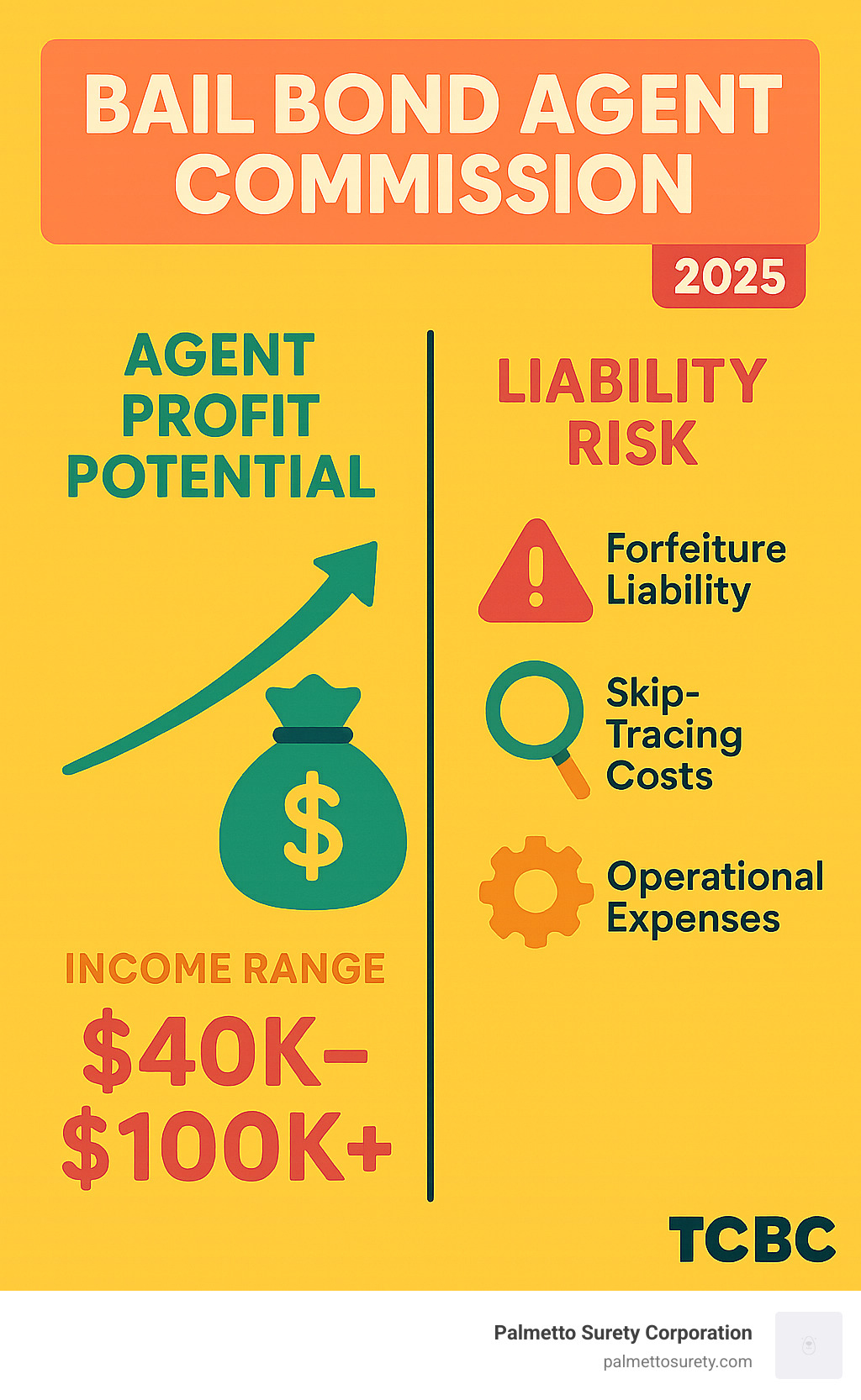
A career in bail bonding can pay well—most agents earn $40,000–$80,000 a year, and top performers clear six figures—but that income is entirely commission-driven. When you stop writing bonds, the paycheck stops too.
The upside is balanced by real hazards. A single forfeiture can erase months of income, and skip-tracing expenses (fuel, hotels, bounty hunters) come out of your pocket. Agents must also complete mandatory continuing-education courses and remain on call 24/7, a schedule that leads to frequent burnout.
Payment Plans & Zero-Down Options
Payment plans help families who can’t pay the full premium; agents usually charge 2–5 % interest or raise the commission from 10 % to 12 % to cover added risk. When clients default, agents must chase both the defendant and the unpaid balance, so zero-down deals are reserved for customers with excellent collateral or credit.
How Commission Is Split Between Agents and Surety Companies
Most surety companies, including Palmetto Surety, use a 50/50 split on the premium. High-volume producers can negotiate 60–70 %, and managers often earn small overrides on the agents they supervise.
How Clients Can Evaluate and Negotiate Bail Bond Agent Commissions
When you’re facing a bail situation, it’s natural to feel overwhelmed and rushed. However, taking time to evaluate bail bond agent commission rates can save you hundreds or even thousands of dollars while ensuring you receive quality service.
Start by contacting at least three licensed agents to compare their rates and services. While commission rates are often similar due to state regulations, you’ll find that additional fees and service quality can vary significantly between agents. Don’t just focus on the percentage rate – ask about all the extras that might be added to your bill.
Before you start shopping around, research your state’s maximum allowable commission rates. Most state insurance departments publish these limits online, and knowing them protects you from agents who might try to overcharge. If an agent quotes you a rate above the state cap, that’s a red flag worth noting.
When you contact agents, request itemized quotes that break down all fees. This should include the premium percentage, processing charges, and any potential additional costs like GPS monitoring or payment plan fees. A reputable agent will provide this information clearly and without hesitation.
If you have valuable collateral like real estate or vehicles, mention this upfront. Many agents offer reduced commission rates when they have strong collateral to secure their risk. It’s worth asking if your collateral qualifies you for any discounts.
Always verify that agents hold current licenses through your state’s regulatory database. This simple step protects you from unlicensed operators who cannot legally write bonds and may engage in fraudulent activities. For more information about professional bail bond services, visit our bail surety bonds page.
Red Flags and Due-Diligence Checklist
Knowing what to watch out for can protect you from unscrupulous agents who might take advantage of your stressful situation.
Unlicensed agents represent the biggest risk. These individuals cannot legally write bonds and often disappear when problems arise. Always verify licensing status before handing over any money or signing contracts.
Be cautious of agents who pile on excessive add-on fees beyond standard commissions and processing charges. While some additional fees are normal, a long list of mysterious charges should raise concerns about the agent’s integrity.
Vague contracts are another warning sign. Legitimate agents provide clear, written agreements that detail all fees, collateral requirements, and your obligations as a client. If an agent rushes you through paperwork or refuses to explain terms clearly, consider looking elsewhere.
Watch out for pressure tactics designed to force quick decisions. Reputable agents understand that bail situations are stressful and allow clients reasonable time to review contracts and ask questions.
Finally, be skeptical of agents who make unrealistic promises about your case. No bail bond agent can guarantee that charges will be dropped or predict court outcomes. Their job is to secure release from jail, not to influence legal proceedings.

Frequently Asked Questions about Bail Bond Agent Commission
When families face the stress of a loved one’s arrest, questions about costs come up immediately. Let me address the most common concerns about bail bond agent commission rates and policies.
What percentage of bail is a typical commission?
The typical bail bond agent commission sits right around 10% of the total bail amount in most states. If the court sets bail at $10,000, you’ll pay about $1,000 to the bail bond agent.
However, this rate varies by state. State regulations create quite a range – Ohio keeps things tight at just 6.5%, while Colorado allows agents to charge up to 15%. Most southeastern states where we operate fall into that comfortable 10-12% range.
Don’t forget about those extra processing fees either. Almost every agent charges an additional $50 to $100 for paperwork and administrative costs, regardless of your bail amount.
Can I get my commission payment refunded if charges are dropped?
Bail bond agent commissions are completely non-refundable – and that’s true in every single state.
Here’s why this policy exists: agents earn their fee the moment they post your bail and assume financial responsibility for the full bond amount. They’re essentially saying “I’ll guarantee this person shows up to court” to the judge. That guarantee and the immediate service of getting your loved one released is what you’re paying for.
The commission stays with the agent even if charges get dropped, your family member is found not guilty, or you work out a plea deal. It might seem unfair, but agents provide that 24/7 availability and take on serious financial risk from day one.
Do larger bail amounts lower the commission percentage?
Yes, larger bail amounts often qualify for reduced percentage rates through what we call tiered pricing.
Small bonds under $5,000 typically get charged the full state rate because agents have minimum fees to cover their basic costs. But once you hit $25,000 or higher, many agents start offering breaks – sometimes dropping rates to 8-10% instead of the standard rate.
The real savings come with those mega bonds over $100,000. We’ve seen negotiated rates as low as 5-8% for these cases. It makes sense when you think about it – a 5% commission on a $200,000 bond still puts $10,000 in the agent’s pocket, which is substantial income for a single case.
The defendants who can secure these large bonds also tend to have strong community ties and lower flight risk, making them attractive clients for agents willing to negotiate on price. According to the Bureau of Justice Statistics, defendants with higher bail amounts are statistically less likely to fail to appear in court.
Conclusion
Navigating bail bond agent commission can feel overwhelming when you’re dealing with a loved one’s arrest, but understanding how these fees work empowers you to make informed decisions during one of life’s most stressful moments.
Throughout this guide, we’ve explored how commission rates typically range from 8-15% of the bail amount, with most states settling around that 10% mark. This fee is non-refundable – it’s the price you pay for getting your family member home while they await trial, regardless of how their case turns out.
The additional fees we discussed – those processing charges, payment plan interest, and recovery costs – might seem frustrating, but they reflect the real costs of operating in this high-risk industry. When agents offer payment plans or chase down defendants who skip court, they’re providing services that go well beyond just posting bail.
Collateral plays a huge role in determining your final costs. If you own property or have other valuable assets to secure the bond, you’ll likely qualify for better rates and give yourself more negotiating power with agents.
For families facing bail situations, the most important advice I can give is to shop around among licensed agents. While rates are often similar due to state regulations, service quality and additional fees can vary significantly. Take time to understand exactly what you’re paying for, even when emotions are running high.
If you’re considering a career as a bail bond agent, the commission-based earning potential is real – many agents earn $40,000 to $80,000 annually, with top performers exceeding $100,000. But remember, this income comes with substantial financial risks and the responsibility of being available 24/7 for families in crisis.
At Palmetto Surety Corporation, our 20+ years serving the Southeast have taught us that transparency and reliability matter most when families need help. Whether you’re dealing with an immediate bail situation or exploring our comprehensive commercial surety services, we’re here to provide the expertise and support that comes from two decades in the surety business.
The bail bond industry serves a crucial role in our justice system, allowing defendants to maintain their lives and prepare their defense while awaiting trial. Understanding how bail bond agent commission works helps ensure this system operates fairly for everyone involved.


