


Cost of a Bonded Title: 7 Powerful Ways to Save in 2025
Why Understanding Bonded Title Costs Matters for Vehicle Owners
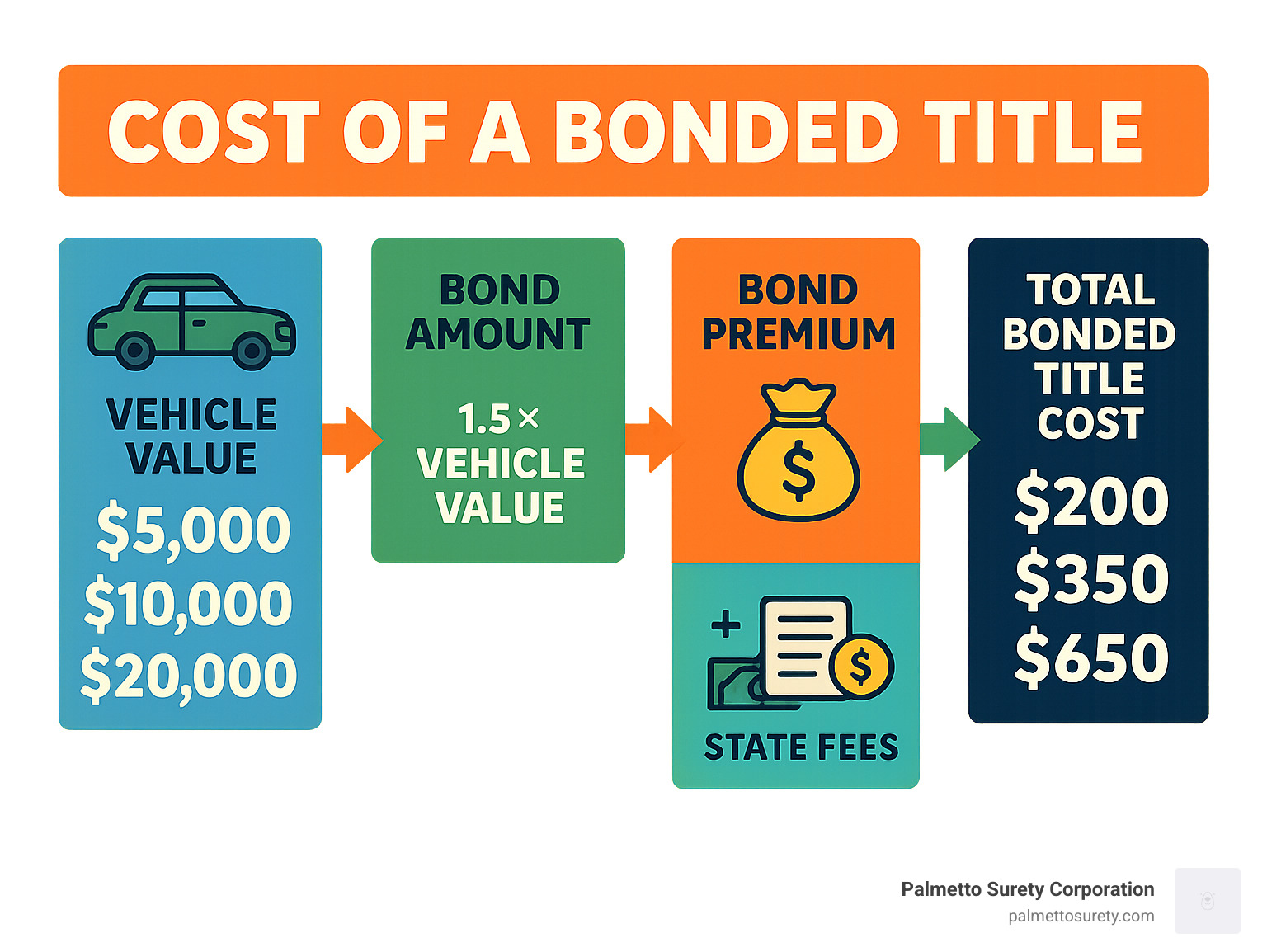
The cost of a bonded title typically ranges from $100 to $300 for most vehicles, but the total expense includes additional state fees that can add $15 to $75 depending on your location. Here’s what you’ll actually pay:
Quick Cost Breakdown:
– Bond Premium: $100 flat rate for vehicles valued up to $6,000
– Higher Value Vehicles: 1-3% of the bond amount (usually 1.5× your vehicle’s value)
– State Filing Fees: $10-$75 depending on your state
– Additional Costs: VIN inspection ($53 in Colorado), administrative fees ($15-$18), expedited shipping
When you’re stuck without a proper vehicle title – whether it’s lost, damaged, or never received – a bonded title becomes your pathway to legal ownership. This process involves purchasing a surety bond that protects the state and any future claimants if someone later proves they have a legitimate claim to your vehicle.
The bond acts as insurance, guaranteeing funds are available to cover damages up to the bond amount (typically 1.5 to 2 times your vehicle’s value). Most people only pay about $100 for the actual bond premium, even when the bond amount is $10,000 or more.
I’m Haiko de Poel Jr, and through my work with Palmetto Surety Corporation – one of the fastest-growing surety bond companies in the US – I’ve helped countless clients steer the cost of a bonded title and secure affordable coverage.
Glossary for cost of a bonded title:
– indemnity bond for car title
– how to get a bonded title in texas
– purchase a lost title bond
Bonded Title Basics: What, When & Why
Think of a bonded title as your vehicle’s backup plan when the usual paperwork falls through. It’s essentially proof of ownership with an insurance policy attached – your way of telling the DMV “I own this car, and I’m willing to put money behind that claim.”

The process involves purchasing a title bond, which creates a three-party safety net. You’re the principal (the person claiming ownership), the DMV is the obligee (the one requiring protection), and the surety company provides the financial guarantee. If someone shows up later with a legitimate claim to your vehicle, the bond ensures money is available to make things right.
Here’s where a bonded title differs from a regular title: it comes with a “bonded” notation and stays contestable during a specific claim window – usually three to five years. Once that window closes without challenges, your bonded title automatically becomes a regular title.
Before you can get a bonded title, you’ll need to pass a lien check. This protects everyone involved by ensuring there aren’t any outstanding loans or debts tied to the vehicle.
When Do You Need One?
The most common scenario is a missing title – maybe it got lost during your last move, destroyed in a flood, or simply vanished. Sometimes the problem isn’t a lost title but an incorrect assignment – you buy a car, but the seller made a mistake filling out the paperwork.
Out-of-state purchases can create their own headaches when paperwork gets lost between DMVs. Inherited vehicles often present the most emotionally charged situations – Grandpa’s old truck has been in the family for decades, but nobody can find the title.
What Is a Title Bond (Certificate of Title Bond)?
A title bond is your surety guarantee to the state that you’re the rightful owner. The DMV obligee requires this financial protection before they’ll issue your bonded title. The bond amount – typically 1.5 to 2 times your vehicle’s value – represents the maximum payout available if someone successfully challenges your ownership.
Here’s the important part: the bond amount isn’t what you pay. That $15,000 bond on your $10,000 car? You’re only paying a small percentage as your premium – often just $100 for vehicles under $6,000 in value.
How the Bond Amount Is Determined

Understanding how states calculate bond amounts helps you predict the cost of a bonded title before you start the process. Most states multiply your vehicle’s current market value by 1.5 to 2 times.
Your state’s DMV will determine your vehicle’s current market value using their preferred system. Texas makes this easy with their Texas Standard Presumptive Value Calculator, where you enter your vehicle’s year, make, model, and mileage for instant valuation. Other states rely on Kelley Blue Book or NADA Guide values.
Many states set minimum thresholds that can override the calculation. Georgia requires at least $5,000 in bond coverage even if your old pickup truck is only worth $2,000. Texas sets a $4,000 minimum for vehicles over 25 years old.
The multiplier varies by state, with Texas using 1.5 times the vehicle value while Georgia requires 2 times the average retail value.
Disagree With the Valuation?
Most states allow you to hire a licensed appraiser to provide an independent assessment of your vehicle’s actual condition and value. This professional appraisal can significantly reduce your bond amount if your car is worth less than the DMV’s initial assessment.
The appeal process typically involves submitting the licensed appraiser’s report along with a formal request for DMV review. The appraisal must come from someone licensed in your state, and the DMV has the final say on whether to accept the revised valuation.
Is the Bond Amount the Same as the Cost of a Bonded Title?
The bond amount is NOT what you pay – it’s the maximum coverage amount, like the face value of an insurance policy. Your actual cost of a bonded title comes from the bond premium, which typically runs 1% to 3% of the total bond amount.
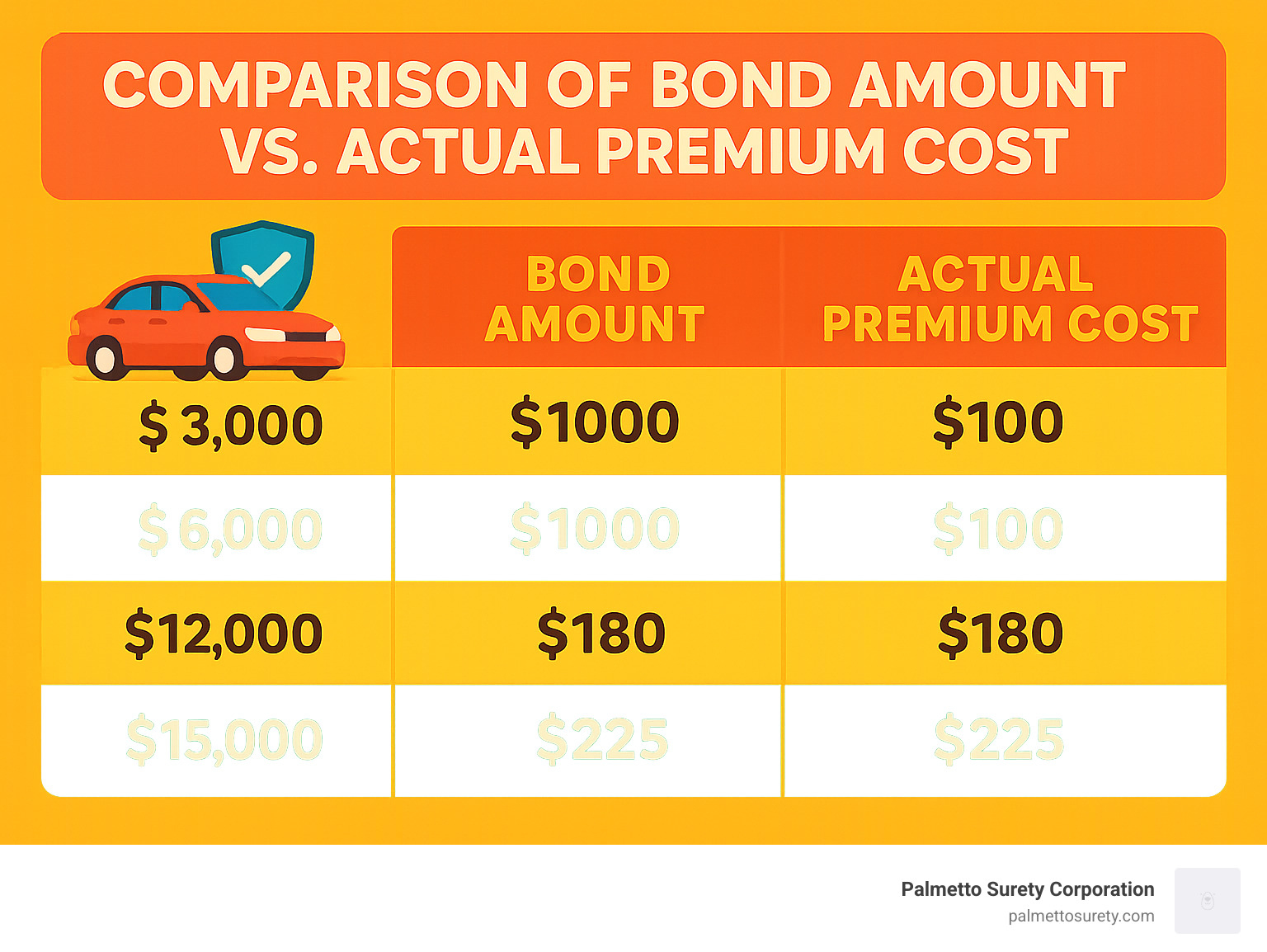
Here’s a real-world example: if your vehicle is worth $6,000 and your state requires 1.5 times that value, your bond amount would be $9,000. But you’d only pay around $100-150 as your premium, not the full $9,000.
We use a flat $100 rate for most bonds covering vehicles valued at $6,000 or less, regardless of whether the actual bond amount is $3,000 or $6,000.
Cost of a Bonded Title: What You’ll Actually Pay
Here’s the good news about the cost of a bonded title: it’s probably much less than you’re worried about. Most people expect to pay thousands based on the bond amount, but the reality is far more affordable.
The pricing works on a simple tier system that keeps costs predictable. For vehicles requiring bonds up to $6,000 in coverage, you’ll pay a flat rate of $100 – period. This covers the majority of everyday cars and trucks, whether your bond amount is $3,000 or $6,000.
Once you move beyond that threshold, the pricing shifts to percentage-based calculations. Bonds covering $6,001 to $25,000 typically cost around 1% to 2% of the bond amount, with most falling closer to the lower end. Higher-value bonds over $25,000 require individual underwriting, where we look at your specific situation and credit profile to determine fair pricing.
At Palmetto Surety Corporation, we’ve streamlined this process so you can get approved within hours rather than waiting days for underwriting decisions. Even applicants with poor credit histories can usually secure approval, though they might pay slightly higher rates depending on the bond amount.
Here’s what real customers actually pay:
Vehicle worth $4,000 (bond amount $6,000): $100 premium
Vehicle worth $8,000 (bond amount $12,000): $150 premium
Vehicle worth $15,000 (bond amount $22,500): $225 premium
Vehicle worth $30,000 (bond amount $45,000): $675 premium
Factors that Influence the Cost of a Bonded Title
Several factors determine your final cost of a bonded title, though the bond amount remains the biggest driver of your premium.
Your vehicle’s appraised value directly impacts the required bond amount, which in turn affects your premium once you exceed the flat-rate tier. A $10,000 car requires a much smaller bond than a $30,000 truck, so the premium difference can be significant.
State filing fees add another layer to your total cost, ranging from as little as $10 in New York to $75 in Massachusetts for the actual title processing. These aren’t optional – every state charges something for issuing the bonded title itself.
Administrative costs vary by location too. Some states require VIN inspections that can cost $53 in Colorado, while others bundle these services into their standard fees. Texas charges a $15 administrative fee, while Georgia adds $18 for title processing.
Your credit score becomes relevant for higher bond amounts over $25,000, where individual underwriting is required. We use soft credit pulls that don’t affect your credit score, and we’ve found that most people still qualify for reasonable rates even with credit challenges.
Vehicle type can also influence pricing. Standard passenger cars typically get the best rates, while commercial vehicles or specialty equipment might require slightly different pricing structures based on risk factors.
Typical Additional Fees Beyond the Bond Premium
Beyond the bond premium itself, you’ll encounter several additional costs that add to your total cost of a bonded title.
State title fees are unavoidable and vary significantly by location. New York keeps it simple at $10, while Massachusetts charges $75 for the same service. Most states fall somewhere in the $15-25 range for processing your bonded title application.
VIN inspection requirements add another expense in many states. Colorado’s $53 fee is among the highest we see, though some states include this verification in their administrative costs rather than charging separately.
Sales tax collection can surprise some applicants, especially if you haven’t already paid taxes on your vehicle purchase. Some states collect this during the bonded title process to ensure all tax obligations are current.
Expedited shipping for your bond documents adds $15-30 if you need everything processed quickly. While most applications move fast, sometimes you need that extra speed to meet DMV deadlines or get your vehicle registered sooner.
The key is budgeting for these additional costs upfront so there are no surprises when you’re ready to submit your application. Most people find the total cost – bond premium plus state fees – falls well within their budget for resolving title issues.
State-by-State Variations & Hidden Fees

State fees vary wildly, and some states have sneaky charges that aren’t always mentioned upfront. Here’s what you’ll actually pay in different states:
Texas keeps things reasonable with a $15 administrative fee plus standard title costs. They use Form VTR-130-SOF for applications and set bond amounts at 1.5 times your vehicle’s value. Vehicles over 25 years old have a $4,000 minimum bond amount regardless of actual value.
Georgia hits you with an $18 title fee and requires bonds at 2 times the average retail value with a hefty $5,000 minimum.
New York is straightforward with just a $10 filing fee and bonds at 1.5 times appraised value, making it one of the more affordable states overall.
Colorado will shock you with their $53 VIN inspection fee – among the highest we see anywhere. You’ll need a certified inspection by the State Patrol, and they only accept exact cash or check.
Alabama keeps it simple with a $15 application fee for regular vehicles and $20 for manufactured homes.
Massachusetts takes the prize for highest fees with a $75 certificate fee, though they accept NADA clean trade-in values for bond calculations.
Watch out for local tag office charges too. Some counties tack on $5-15 processing fees that aren’t always disclosed when you call ahead.
How Long Does It Take to Get the Cost-Sensitive Bonded Title?
Getting an online quote takes just minutes with our system. At Palmetto Surety Corporation, we issue most bonds the same day, often within hours of approval. This speed can save you money by avoiding extended vehicle storage fees or registration penalties.
Once you submit your application with the bond to the DMV, expect 3-5 weeks for processing in most states. Your three-year bond term starts when we issue the bond, not when the DMV processes your application.
Can You Get a Bonded Title With Poor Credit?
Absolutely. Most bonded title applications don’t require hard credit checks, especially for bonds under $25,000. We use soft-pull underwriting that doesn’t ding your credit score.
Poor credit might bump you into a higher rate band, but increases are usually reasonable. A bond that costs $100 with good credit might run $125-150 with poor credit. If your credit is severely damaged, consider having a co-signer step in to get back to standard rates.
Step-by-Step Guide to Obtaining a Bonded Title
Getting your bonded title doesn’t have to be complicated. Here’s the streamlined process:
Step 1: Eligibility Check – Verify that you and your vehicle meet your state’s requirements. Most states require you to be a resident and the vehicle to be complete – not salvaged or missing major components.
Step 2: Gather Documentation – Collect every piece of paper showing your connection to the vehicle. Bills of sale, old registration attempts, insurance records, or repair receipts all help establish your ownership claim.
Step 3: DMV Application – Submit your state’s bonded title application along with required fees. This typically includes a vehicle inspection and administrative processing, so budget $15-75 depending on your state.
Step 4: Purchase Your Bond – Once the DMV tells you the required bond amount, buy your surety bond. At Palmetto Surety Corporation, this process typically takes less than an hour for standard applications. More info about bond services
Step 5: Submit Within 30 Days – Most states require you to submit your bond and complete application within 30 days of bond issuance. Missing this deadline often means purchasing a new bond, which doubles your costs.
Step 6: Wait Period – The DMV processes your application over 3-5 weeks. During this time, your bond is active and protecting against any ownership claims.
Step 7: Bond Expiry and Conversion – After three years in most states, your bond expires and your title automatically converts to a regular title with no additional fees.
Selling or Buying a Vehicle With a Bonded Title
Disclosure rules require you to tell potential buyers about the bonded title status. The bond actually provides future buyer protection during the remainder of the bond period – if ownership issues arise, funds are available to resolve them.
Once the bond period expires, your title undergoes clean title conversion, removing the bonded notation completely and typically increasing your vehicle’s resale value.
What Happens If Someone Files a Claim?
Actual claims against bonded titles are surprisingly rare. When claims do arise, our surety investigation process is thorough but fair. We review all documentation and determine claim validity based on legal ownership standards.
If a claim proves valid, we payout up to the bond amount to protect you from immediate financial impact. However, you do have a reimbursement obligation to pay us back for any valid claims we cover. Most bonded title holders never face ownership challenges – the bond simply expires after three years with no drama.
Frequently Asked Questions About the Cost of a Bonded Title
How much does the bond itself cost if my vehicle is worth $8,000?
For a vehicle worth $8,000, you’re looking at a bond amount of around $12,000 in most states (they typically multiply your vehicle’s value by 1.5). But here’s the key point that confuses many people – you don’t pay that $12,000.
Your actual cost of a bonded title premium would be approximately $150-180 for this scenario. This falls into our tiered pricing structure since it’s above the flat-rate tier that covers bonds up to $6,000.
When you add your state’s filing fees – which range from $15 in Texas to $75 in Massachusetts – your total cost of a bonded title would land somewhere between $165-255. That’s still a fraction of what many people expect to pay when they first hear about bond amounts.
Can I lower the premium by choosing a smaller bond amount?
Unfortunately, you can’t just pick a smaller bond amount to save money – the bond amount is set by state law based on your vehicle’s assessed value. It’s not negotiable in the traditional sense.
However, you do have one potential avenue to reduce costs: challenging the vehicle valuation itself. If you believe the DMV’s assessment is too high, you can hire a licensed appraiser to provide an independent evaluation of your vehicle’s worth.
This strategy works particularly well for vehicles with high mileage, accident damage, or mechanical issues that standard valuation guides don’t account for properly. A professional appraisal might reveal that your vehicle is actually worth significantly less than the DMV’s initial assessment.
The appraisal fee (usually $200-400) can pay for itself if it reduces your bond amount substantially. Just remember that the appraiser must be licensed in your state, and the DMV has final say on whether to accept the revised valuation.
What happens to the cost if a claim is filed within the 3-year period?
Your original premium cost stays exactly the same regardless of whether someone files a claim against your bonded title. The $150 you paid upfront doesn’t change – that money is gone whether claims arise or not.
Here’s where it gets more serious, though. If someone files a claim and we determine it’s valid, you become responsible for reimbursing us for whatever amount we pay out, plus any associated investigation costs. This reimbursement obligation is completely separate from your original premium.
Let’s say someone proves they have a legitimate ownership claim and we pay them $5,000 to settle the matter. You’d owe us that $5,000 back, regardless of what you originally paid for the bond premium.
The silver lining? Claims against bonded titles are genuinely uncommon in our two decades of experience at Palmetto Surety Corporation. Most of our clients sail through the three-year bond period without anyone challenging their ownership, and their titles convert to regular titles automatically.
When claims do occur, they’re usually resolved quickly because we maintain thorough investigation procedures. Invalid claims get denied at no cost to you, while valid claims – though rare – get handled professionally to protect everyone involved.
Conclusion
Understanding the cost of a bonded title doesn’t have to be overwhelming when you know what to expect. Most vehicle owners pay between $115 to $300 total – that’s your bond premium starting at just $100 plus reasonable state fees.
Here at Palmetto Surety Corporation, we’ve spent over 20 years helping folks across the southeastern United States steer these exact situations. Whether you’re dealing with a lost title in Atlanta, inherited a vehicle in Charleston without proper paperwork, or bought a car in Texas with title transfer complications, we’ve seen it all.
What sets us apart is our fast approval process – we typically approve applications within hours, not days or weeks. We understand that when you need a bonded title, you usually need it quickly.
Our budget-friendly premiums reflect our commitment to making bonded titles accessible across Georgia, Florida, Louisiana, Mississippi, South Carolina, Tennessee, and Texas. We’ve structured our pricing to keep the cost of a bonded title reasonable because we know that most people pursuing bonded titles aren’t in this situation by choice.
The reality is that you’re not paying thousands of dollars – you’re paying a small premium for significant protection and legal peace of mind. That $100 to $300 investment gets you a legitimate title, legal ownership documentation, and protection against future ownership disputes.
Remember: you’re only paying the premium, not the full bond amount. That $12,000 bond amount for your $8,000 vehicle? You’re only paying about $150, not twelve thousand dollars.
Ready to move forward with confidence? More info about our bonded-title solutions can help you get started today. We’re committed to making this process as straightforward and cost-effective as possible – because getting legal ownership of your vehicle shouldn’t break the bank or take forever.


