


are bail bonds agents cops 7 Powerful Truths Debunked 2025
Understanding Who Has Arrest Authority: Bail Agents vs. Police
Are bail bonds agents cops? No, bail bonds agents are not law enforcement officers. They are private contractors who work for bail bond companies with limited authority to apprehend defendants who have skipped bail.
| Question | Answer |
|---|---|
| Are bail bonds agents police officers? | No, they are private citizens working for bail bond companies |
| Can they make arrests? | Only people who have skipped bail on their bond and only with proper documentation |
| Do they have police powers? | No, they cannot investigate crimes, enforce traffic laws, or make arrests unrelated to bail |
| What authority do they have? | Limited to the terms of the bail agreement and often require a warrant |
Television shows like “Dog the Bounty Hunter” have created confusion about the role of bail bonds agents in the criminal justice system. While these agents may sometimes wear badges and carry firearms in some states, they operate under completely different legal authority than police officers.
Bail bonds agents function as private contractors who provide a financial service – posting bail for defendants who can’t afford the full amount set by the court. Their primary job is ensuring defendants appear for court dates after being released from jail.
When a defendant fails to appear in court after posting bail through an agent, the bail bonds company faces significant financial loss. This is the only circumstance where a bail agent might be involved in an “arrest” situation – and even then, their authority is strictly limited by:
- State-specific regulations
- The terms of the bail contract
- The requirement for proper documentation (often a warrant)
- Restrictions on entry to private property
I’m Haiko de Poel Jr, and through my experience at Palmetto Surety Corporation, I’ve helped explain the distinction between bail agents and law enforcement to countless clients confused about whether are bail bonds agents cops and what authority they actually possess. This misconception often leads to confusion about legal rights during interactions with bail recovery agents.
What Does a Bail Bond Agent Actually Do?
When someone gets arrested, they often face a tough situation: pay the full bail amount (which can be thousands of dollars) or stay in jail until their court date. This is where bail bond agents step in, and it’s quite different from police work.
A bail bond agent provides a financial guarantee to the court, promising that a defendant will show up for their scheduled court dates. Think of it as a safety net for the justice system – and a lifeline for defendants who can’t afford bail.

“Most people don’t have $10,000 sitting around when a loved one calls from jail at 2 AM,” says a veteran bail agent at Palmetto Surety Corporation. “We bridge that gap by posting a surety bond that lets them go home while their case proceeds.”
In exchange for this service, bail agents typically charge a non-refundable fee of about 10% of the total bail amount. They may also require collateral – like property deeds or vehicle titles – to secure larger bonds. Throughout the case, agents actively monitor defendants to ensure court appearances.
It’s worth noting that commercial bail bonds are almost exclusively an American system. Most other countries consider the practice problematic and rely on different pretrial release methods.
Daily Duties Behind the Desk and in the Field
Despite what TV shows might suggest, the day-to-day work of a bail agent involves more filing cabinets than car chases.
Most mornings start with paperwork – processing new bonds, updating case files, and submitting documents to courts. Throughout the day, agents conduct check-ins with clients, reminding them of court dates and verifying they’re following bail conditions.
When defendants miss court appearances, agents shift into recovery mode. This might involve skip-tracing – using databases, social media, and contact networks to locate the missing person. Agents also serve as a court liaison, communicating with judges and clerks about case status.
“The most important tool in my job isn’t handcuffs – it’s my phone,” explains one agent. “Those phone reminders about upcoming court dates prevent 95% of potential problems. Most people want to comply; they just need help staying organized during a stressful time.”
Are Bail Bonds Agents Cops? Short Version
Are bail bonds agents cops? No – not even close. Bail bonds agents are private contractors working for surety companies or bail agencies. They don’t have police commission, badges (though some wear company identification that might look similar), or general law enforcement powers.
Their authority has a very limited scope. A bail agent can’t pull you over for speeding, investigate crimes, arrest people for new offenses, or detain individuals unrelated to their bail contracts.
The only authority a bail agent has relates specifically to defendants who’ve signed a bail agreement and then failed to appear in court. Even then, this authority varies significantly by state, with strict limitations on how and when they can take action – which is why professional agents work closely with actual law enforcement whenever possible.
Are Bail Bonds Agents Cops? Debunking the Myth
Let’s clear the air once and for all: bail bonds agents are not cops. This confusion has persisted for years, partly because both can technically take people into custody under certain circumstances. But the similarities pretty much end there.
The legal foundation for a bail agent’s limited authority comes from a 150-year-old Supreme Court case. In 1872, Taylor v. Taintor established that bail bondsmen have the right to pursue and apprehend defendants who skip bail. This isn’t police power – it’s more like a specialized form of citizen’s arrest that’s tied to a specific contract.

“I’ve been in this business for over 15 years,” says John Martinez, a senior bail agent at Palmetto Surety Corporation, “and the biggest misconception I face is people thinking I’m some kind of police officer. I always explain that I’m more like a contract enforcer with very specific limits on what I can do.”
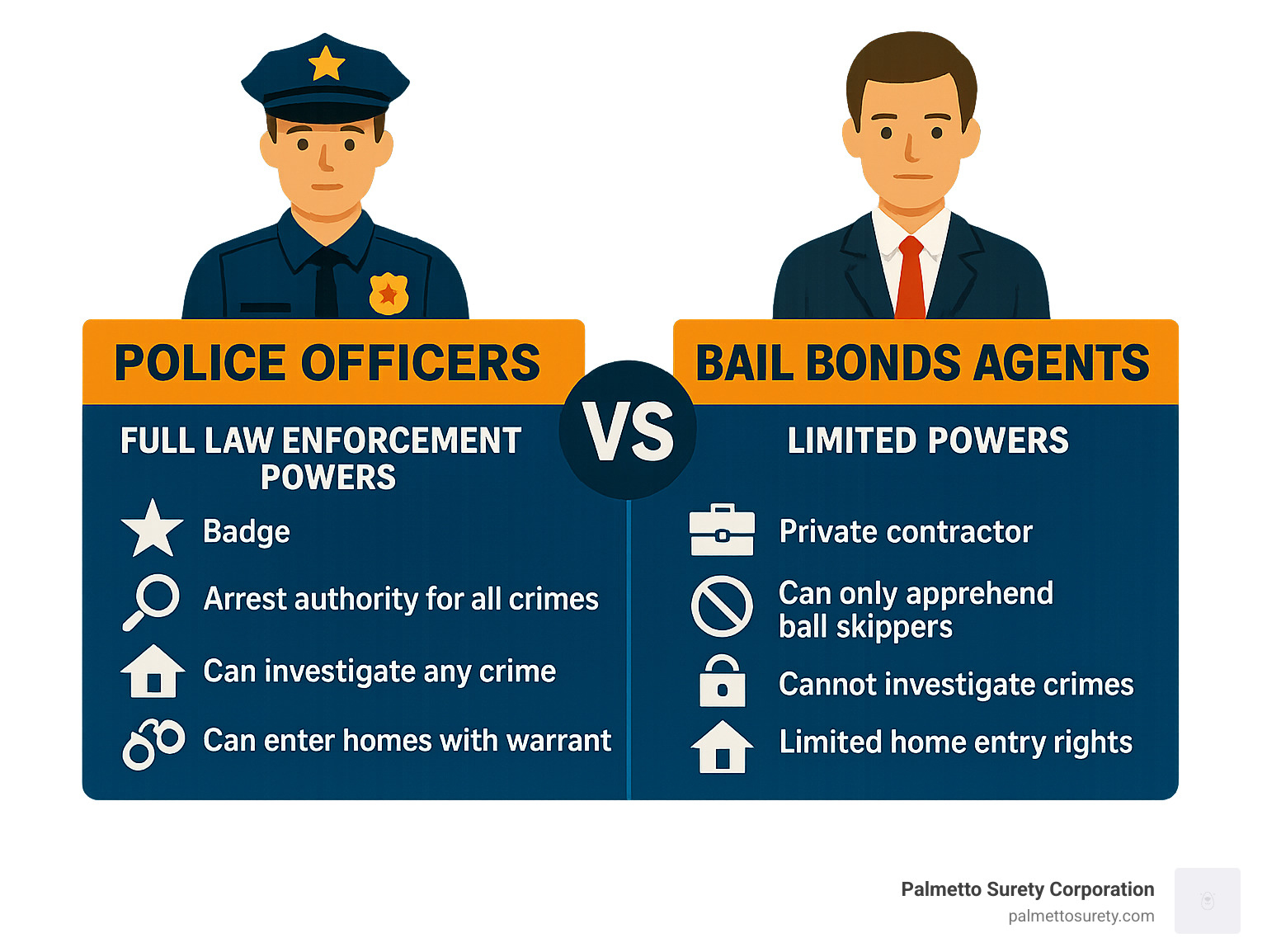
Here’s a straightforward comparison that shows the dramatic differences:
| Police Officers | Bail Bonds Agents |
|---|---|
| Government employees | Private contractors |
| Can arrest for any crime | Can only apprehend bail skippers |
| Can investigate criminal activity | No investigative authority |
| Can enforce all laws | Limited to bail contract enforcement |
| Can enter homes with a warrant | Can only enter with permission or warrant |
| Can use force as needed for any arrest | Limited use of force only for bail recovery |
| Can carry weapons by virtue of position | Weapon carrying varies by state laws |
| Can stop and detain anyone on reasonable suspicion | Cannot detain anyone except their bail clients |
The constitutional limits on bail agents are strict. Unlike police officers who represent the government, bail agents work for private companies. Their authority begins and ends with the bail contract, giving them none of the broad powers that actual law enforcement officers possess.
Legal Authority in Black-and-White Statutes
If you want to know what bail agents can and can’t do, don’t look to police manuals – look to state insurance codes and licensing boards.
In California, for example, bail agents are licensed by the Department of Insurance, not the police academy or sheriff’s department. Most states require bail agents to get a specific warrant from a judge before trying to apprehend someone who’s skipped bail. This isn’t a criminal arrest warrant – it’s a special document that only authorizes returning that specific person to court custody.
“The paperwork is everything in this business,” explains a regulatory compliance officer at Palmetto Surety. “Without the proper documentation, a bail recovery could quickly turn into a kidnapping charge. That’s why we’re so strict about following every requirement to the letter.”
Extradition rules also highlight the difference. Police officers must steer complex interstate procedures to bring suspects back across state lines. Bail agents operating under Taylor v. Taintor historically had more flexibility to cross state lines to find fugitives, though many states have started tightening these rules with specific regulations.
Are Bail Bonds Agents Cops in My State?
The short answer: bail bonds agents are not cops in any state. They don’t have law enforcement status anywhere in America. But their specific powers and limitations do vary depending on where you live.
Four states have completely banned commercial bail bonding:
– Illinois
– Kentucky
– Oregon
– Wisconsin
If you live in one of these states, you won’t encounter private bail agents at all.
In states where commercial bail is legal, the licensing requirements can be quite different:
California takes bail agent licensing seriously, requiring 20 hours of pre-licensing education, a passing exam score, and a $1,000 surety bond. Florida sets an even higher bar with 120 hours of coursework plus an exam. Georgia splits the difference with 40 hours of classroom instruction before you can take their state test.
Down in Louisiana, you’ll need to complete a prelicensing program and pass a state examination before writing your first bond. And in Texas, requirements vary by county on top of needing a state surety license.
“Every state has its own rulebook,” notes a veteran agent from Palmetto Surety Corporation’s network. “When I moved from Georgia to South Carolina, I had to basically start over with my certification. The fundamentals of the job are similar, but the legal details matter tremendously.”
These varying standards reflect an important truth: bail agents aren’t cops with standardized national training. They’re private contractors operating under state-specific insurance and surety regulations, with powers that are narrowly defined and strictly limited to enforcing the terms of bail agreements.
Arrest Authority: When and How Can a Bail Bond Agent Detain You?
Let’s clear up one of the biggest misconceptions in the bail industry. A bail bond agent can’t just grab anyone off the street like some TV shows might suggest. Their authority to detain someone is actually quite narrow and comes with strict rules.
For a bail agent to legally detain you, three specific conditions must be met:
- You must have signed a bail bond agreement with that particular agent
- You failed to show up for your scheduled court date
- A judge has issued a warrant for your arrest
When someone skips bail, the court typically gives the bail bond company what’s called a “forfeiture window.” This is basically a grace period—usually 90 to 180 days depending on the state—during which they can find you and bring you back before they have to pay the full bail amount. That’s why they’re motivated to find you if you skip court.
“Most folks don’t realize we’re not out there hunting random people,” explains one of our recovery specialists at Palmetto Surety. “We’re simply trying to fulfill a contract that the defendant signed. Our job is to get them back to court with as little drama as possible.”
In most states, bail agents must follow a four-step protocol when apprehending someone:
Identification: They must clearly identify themselves as bail agents, not police officers.
Explanation: They need to explain why they’re detaining you and show proper documentation.
Reasonable Force: They can only use force proportionate to any resistance encountered—excessive force is never authorized.
Delivery: After apprehension, they must promptly deliver you to law enforcement or court officials.
Each state has its own specific requirements. In California, for example, the Department of Insurance requires bail recovery agents to be at least 18, complete required training, pass a background check, carry proper ID, and notify local police before attempting to apprehend someone.
Your Rights During a Bail Agent Encounter
If someone approaches you claiming to be a bail agent, you have several important rights that you should know about.
First, you can demand identification. Any legitimate bail agent should be carrying their license and proper ID. Don’t be shy about asking to see it.
Second, you can verify the warrant. You have every right to see the documentation that authorizes them to take you into custody.
If something feels off, you can call 911. If you believe the person might be impersonating a bail agent or using excessive force, contact law enforcement immediately.
You also have the right to record the encounter, which can provide valuable evidence if there are any disputes later about how the detention was handled.
Finally, beyond identifying yourself, you can remain silent. The Fifth Amendment still applies—you don’t have to answer questions beyond confirming your identity.
“The Fourth Amendment doesn’t disappear just because you signed a bail agreement,” notes a civil rights attorney who specializes in these cases. “While bail agents do have certain authority, they must still respect your constitutional protections.”
Legal Recourse if an Agent Oversteps
What happens if a bail agent goes too far? You have several options for legal recourse:
You can file a complaint with your state’s licensing board that oversees bail agents. These boards take misconduct seriously and have the power to suspend or revoke licenses.
For serious violations, you might pursue a civil lawsuit for false imprisonment, assault, or other applicable claims. Courts have awarded damages in cases where bail agents clearly exceeded their authority.
In cases involving violence or serious misconduct, you can report criminal conduct to local police. Just because someone is a bail agent doesn’t mean they’re above the law.
Finally, it’s always wise to consult a defense attorney who can advise you about potential violations of your rights and help steer the legal system.
“At Palmetto Surety Corporation, ethical standards aren’t optional,” says our compliance director. “We expect our network of bail agents to operate within the law at all times. One agent who crosses the line damages trust in the entire industry.”
Are bail bonds agents cops? No, they’re not—and that means they have much more limited authority than police officers. Understanding those limitations is your best protection during any encounter with a bail agent.
Bail Bond Agents vs Bounty Hunters: Same Badge? Not Quite
If you’ve ever watched reality TV shows about fugitive recovery, you might think bail agents and bounty hunters are one and the same. They’re not – and understanding the difference matters if you ever find yourself dealing with either one.

Think of it this way: a bail bond agent is like your mortgage broker, handling paperwork and finances, while a bounty hunter is more like a repo agent who only shows up if you default. They work together but have very different day-to-day roles.
The bail bond agent (that’s us at Palmetto Surety) spends most days in an office handling the business side of things. We’re the folks who:
Write the actual bail bonds that get you or your loved one out of jail
Collect the premium payments (typically 10% of the bail amount)
Secure any needed collateral like property deeds or vehicle titles
Maintain regular contact with defendants to ensure court appearances
Handle mountains of paperwork (seriously, you wouldn’t believe how much)
Bounty hunters (or fugitive recovery agents, as they prefer to be called professionally) come into the picture only when something goes wrong. They’re typically:
Independent contractors rather than employees of the bail company
Paid on commission – usually 10-20% of the bond amount when they successfully bring someone in
More likely to be armed and trained in physical apprehension techniques
Focused solely on the “hunt” rather than the administrative side of bail
Specialists in investigation and tracking down people who don’t want to be found
“I’ve been writing bail bonds for over 15 years,” says one of our veteran agents at Palmetto Surety, “and I’ve never personally had to track down and apprehend anyone. That’s just not what most bail agents do, despite what you see on TV.”
Working Together to Recover Fugitives
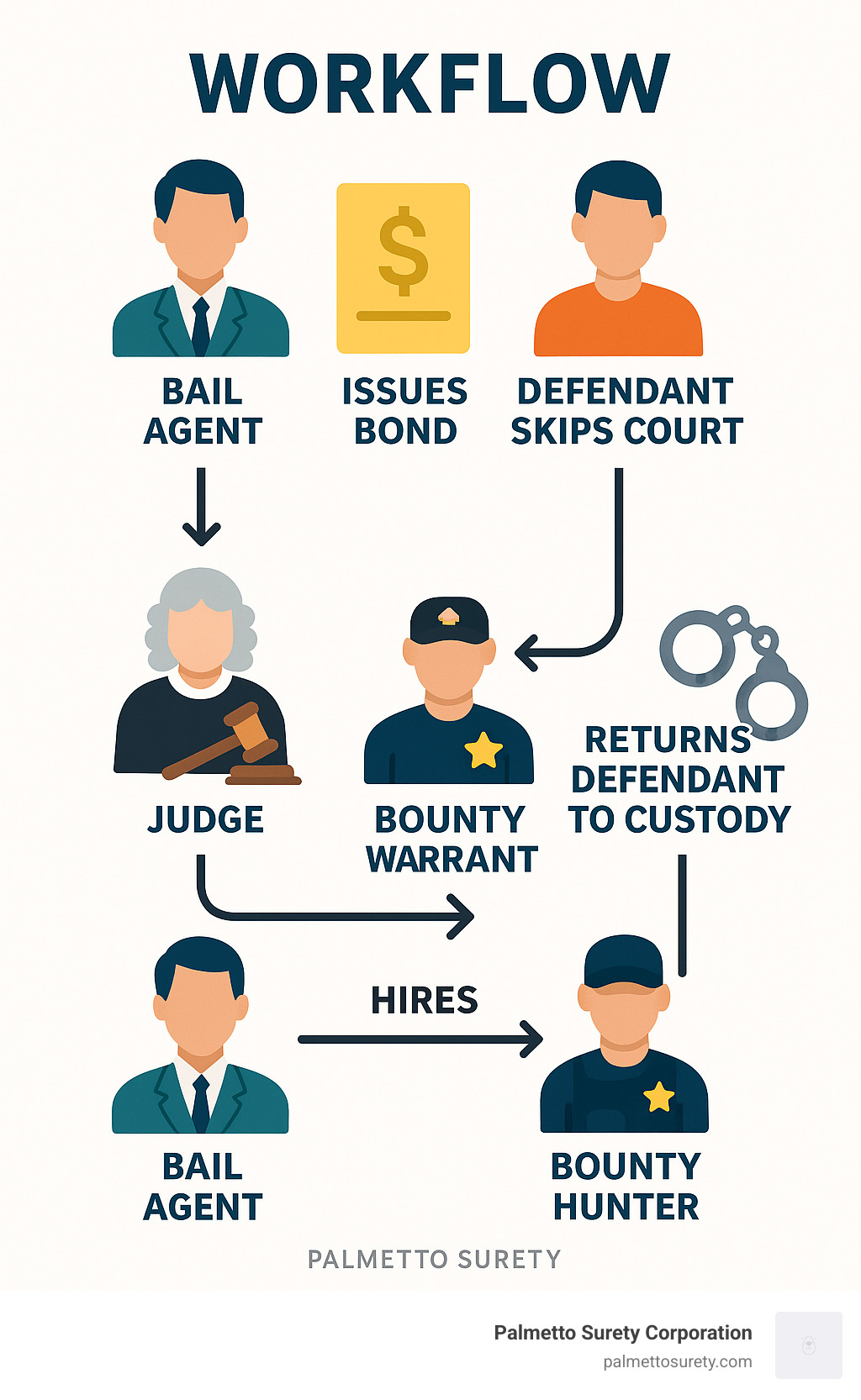
When someone misses court (we call them “skips” in the industry), there’s a process that unfolds – and it’s a lot less dramatic than Hollywood makes it seem.
First, we’ll try the simple approach: phone calls, text messages, and emails. Most missed court dates are honest mistakes or misunderstandings, not actual attempts to flee. Sometimes people get dates mixed up, transportation falls through, or life emergencies happen.
If we can’t make contact that way, we’ll check known addresses and reach out to the family members or friends who co-signed the bond. Again, most situations resolve at this stage.
It’s only when all these efforts fail that a recovery agent enters the picture. At Palmetto Surety, we work with professional recovery specialists who know how to locate people while following the law. Before they begin work, we provide them with:
All the defendant’s personal information we gathered during the bail application
A copy of the bail agreement showing the person’s obligations
The court’s bench warrant authorizing the apprehension
Known associates and locations where the person might be found
In most states, we’re also required to notify local law enforcement before any recovery attempt is made. This helps prevent dangerous misunderstandings and ensures police know what’s happening in their jurisdiction.
Modern fugitive recovery relies heavily on technology rather than door-kicking. Today’s recovery agents are as likely to be tracking digital footprints as physical ones:
GPS tracking through ankle monitors or vehicle trackers
Social media monitoring to spot location check-ins or communications
Database searches that can reveal everything from utility hookups to rental applications
Cell phone tracking when legally authorized
“The days of bounty hunters randomly knocking on doors in the middle of the night are mostly gone,” explains a recovery specialist who works with Palmetto Surety. “Now we do our homework first, locate the person digitally, and plan a safe, controlled recovery. It’s better for everyone that way.”
The bottom line? Are bail bonds agents cops? Definitely not. And most aren’t bounty hunters either. We’re financial professionals who occasionally need to call in specialists when someone breaks their promise to appear in court.
Licensing, Training & Ethical Standards Across States
Becoming a bail bond agent isn’t as simple as filling out an application and hanging a shingle. Across the country, states have established rigorous standards to ensure those in this profession understand their responsibilities and limitations.
Most states require bail agents to be at least 18 years old, pass a comprehensive background check, and complete a pre-licensing education course. These courses range dramatically in length – some states require just 8 hours of training while others, like Florida, demand a whopping 120 hours of classroom time. After hitting the books, prospective agents must pass a state examination that tests their knowledge of relevant laws and procedures.

“The licensing process is designed to weed out those who aren’t serious about the profession,” explains a veteran agent at Palmetto Surety Corporation. “You can’t just walk in off the street and start working as a bail agent.”
Beyond education, most states require agents to put their money where their mouth is by posting a surety bond (typically $1,000 to $5,000) and obtaining liability insurance. This financial commitment helps ensure agents have skin in the game and can cover potential claims against them.
It’s worth noting that four states have completely banned commercial bail bonding: Illinois, Kentucky, Oregon, and Wisconsin. Several others, including Maine, Nebraska, and Washington, have placed severe restrictions on the practice. In these jurisdictions, the courts handle pretrial release differently, often through government-administered programs.
For those working in states where commercial bail is permitted, continuing education is typically required to maintain licensure. These ongoing requirements help agents stay current with changing laws and best practices.
“Professional standards are essential to maintaining the integrity of the bail system,” says a Palmetto Surety Corporation representative. “We support comprehensive training and ongoing education for all bail agents in our network.”
Keeping Force Reasonable and Rights Intact
One of the most critical aspects of bail agent training focuses on appropriate use of force and respect for constitutional rights. Are bail bonds agents cops? No – and that distinction means they must be especially careful about how they conduct themselves when apprehending someone.
Ethical standards emphasize using only proportional force necessary to safely apprehend defendants who’ve skipped bail. Agents receive training in de-escalation techniques specifically designed to reduce confrontation and avoid physical altercations whenever possible.
“The goal is always safe apprehension,” explains a bail recovery trainer with over two decades of experience. “The best recovery is one where no force is needed at all, and the defendant voluntarily returns to custody.”
Proper identification is another crucial element – agents must clearly identify themselves as bail agents, not police officers, to avoid any confusion about their role and authority. They’re required to carry appropriate documentation, including any necessary warrants, and present these documents when apprehending someone.
The rules around firearms vary dramatically by state. Some jurisdictions prohibit bail agents from carrying firearms entirely, while others require special permits beyond standard concealed carry licenses. Many states that do allow armed bail agents mandate additional training specific to bail recovery situations.
At its core, bail agent training emphasizes respect for constitutional rights. While are bail bonds agents cops is a common question, the answer is a clear “no” – and that means bail agents have more limited authority than law enforcement. Understanding these limitations is essential for anyone working in the profession.
“At Palmetto Surety, we emphasize that our network of agents must operate within the boundaries of the law,” says a company trainer. “The moment an agent oversteps their authority, they put themselves, their clients, and our company at risk.”
Know Your Rights if a Bail Agent Knocks
If you hear that knock at the door and find bail agents standing there, knowing your rights can make all the difference in how the situation unfolds.
Verify their identity first and foremost. Don’t just take their word for it—ask to see their bail agent license and proper identification. A legitimate bail agent will have no problem showing you their credentials.
Request documentation showing their authority. This isn’t just a formality—it’s your right. Bail agents should carry paperwork that specifically outlines their authority to apprehend someone.
When it comes to home entry rules, in most states, bail agents face significant restrictions. They cannot legally enter your home without one of these three conditions:
– Your explicit permission
– A warrant specifically authorizing entry to your property
– “Hot pursuit” circumstances (extremely rare)
For homes where the defendant doesn’t actually live (third-party residences), bail agents generally have even fewer rights. They typically cannot enter without the resident’s permission or a specific warrant mentioning that address.

Real-world situations highlight why knowing these rights matters. Consider this troubling case from North Carolina: a homeowner reported that bail agents arrived around midnight with guns drawn, destroyed their doorbell camera, and demanded entry without showing any warrant. Law enforcement experts who reviewed this incident noted that without proper documentation, these actions resembled a home invasion more than lawful bail enforcement.
“We’ve seen situations where people let agents in simply because they didn’t know they could refuse,” explains Haiko de Poel Jr. of Palmetto Surety Corporation. “Understanding your rights helps ensure everyone’s safety and prevents potential abuses.”
Safety Checklist for Defendants & Bystanders
If you’re the defendant who missed court or simply a bystander when bail agents arrive, handling the situation properly is crucial for everyone’s safety.
For defendants, stay calm and identify yourself—running or resisting typically makes things worse. Ask to see their credentials and documentation, and consider contacting your attorney immediately. If you plan to surrender (often the wisest choice), arrange to do so safely and on your terms when possible. Document any misconduct, but avoid physical resistance which can escalate the situation dangerously.
Are you a bystander? You are not obligated to help bail agents locate someone. You can refuse entry to your home without a warrant—this isn’t being difficult, it’s exercising your constitutional rights. If possible, record the interaction (many states allow this without notification). Don’t hesitate to call local police if agents become threatening or violent, but also avoid physically obstructing agents who have proper documentation.
“The safest resolution for everyone involves clear communication and respect for legal boundaries,” notes a veteran bail industry expert. “When defendants arrange voluntary surrender through their attorney or bail agent, it eliminates risks for all parties involved.”
At Palmetto Surety Corporation, we believe that understanding these rights and procedures helps maintain the integrity of the bail system while protecting individual rights—a balance that serves the interests of justice, public safety, and personal dignity.
Frequently Asked Questions about Bail Agents and Police Powers
Can a Bail Bond Agent Arrest Me Without a Warrant?
The short answer is no – and this highlights another key difference between bail agents and police officers. In nearly all states, bail bond agents need proper documentation before they can legally take you into custody. This usually means having a bench warrant issued by a judge after you’ve missed your court date.
“I’ve had to explain this countless times to clients,” says James, a bail agent with Palmetto Surety Corporation. “We’re not roaming around looking for random people to arrest. We can only apprehend someone who has skipped bail on our bond, and even then, we need the right paperwork to do it legally.”
This stands in stark contrast to police officers, who can make arrests based on probable cause without a warrant in many situations. If a bail agent ever attempts to detain you without showing proper documentation, you absolutely have the right to refuse and should immediately contact your local police department.
Do Bail Agents Have to Read Miranda Rights?
You’ve probably heard the familiar “you have the right to remain silent” speech on TV shows, but are bail bonds agents cops who need to read you these rights? Generally, no.
Miranda warnings are specifically required when law enforcement officers conduct custodial interrogations that might lead to criminal charges. Since bail agents are private contractors, not law enforcement, and aren’t gathering evidence for prosecution, they typically don’t have this obligation.
The relationship between a bail agent and defendant is fundamentally different from police-suspect interactions. “What we have is essentially a contractual relationship, not a criminal investigation,” explains a legal expert familiar with bail practices. “The bail agent is enforcing a private agreement, not investigating a new crime.”
That said, if the bail agent is working directly with police or if your failure to appear has resulted in new criminal charges beyond the original case, Miranda warnings may become relevant. Some states have also implemented specific requirements for what bail agents must tell defendants during apprehension.
What Happens if I Refuse to Open the Door?
This is where things get a bit complicated, and the answer depends on who you are and where you live.
If you’re the defendant who skipped bail: In some states, agents may have limited authority to make forcible entry if they have proper documentation showing you’ve skipped bail. They might also surveil your property and wait for you to leave, or contact local law enforcement for assistance. The specific rules vary significantly by state.
If you’re not the defendant (perhaps a family member or roommate): Bail agents generally cannot legally force entry to your home. You can refuse entry without a specific warrant, and you should contact local police if they become threatening or refuse to leave.
“I always train our recovery partners to prioritize safety and legal compliance,” shares a bail recovery specialist who works with Palmetto Surety Corporation. “Forcing entry creates unnecessary risks for everyone involved. The best practice is to contact local law enforcement if we encounter significant resistance. A confrontation isn’t worth the liability or safety concerns in most situations.”
Even though bail agents aren’t police officers, they do have certain legal authorities when properly documented. The smartest approach is to verify their identity, ask to see their paperwork, and if you have concerns about their conduct, call your local police department for assistance.
If you have questions about bail bonds or the recovery process, reaching out to an established company like Palmetto Surety Corporation can help clarify your rights and options before a difficult situation arises.
Conclusion
Are bail bonds agents cops? No, they are not. While bail bonds agents play an important role in the criminal justice system, they are private contractors with limited authority derived from contractual agreements, not police powers.
The key takeaways from our exploration:
- Bail agents are not law enforcement officers and lack general police powers
- Their authority is limited to apprehending specific defendants who have skipped bail on their bonds
- In most states, they need proper documentation (often a warrant) to apprehend someone
- They cannot investigate crimes, make traffic stops, or arrest people for new offenses
- Their authority stems from the bail contract and court orders, not general law enforcement statutes
- Both defendants and bystanders have specific rights during interactions with bail agents
At Palmetto Surety Corporation, we believe in upholding the highest ethical standards in the bail industry. Our network of bail agents across the southeastern United States is committed to operating within the law while fulfilling the important role of ensuring defendants appear for court proceedings.
Understanding the distinction between bail agents and law enforcement helps protect everyone’s rights while maintaining the integrity of the pretrial release system. If you have questions about bail bonds or the role of bail agents, we’re here to provide clear, accurate information based on over 20 years of experience in the surety bond industry.
For more information about court surety services, visit Palmetto Surety Corporation or contact one of our offices in Georgia, Florida, Louisiana, Mississippi, South Carolina, Tennessee, or Texas.


