


How to Get a Bonded Title in Texas: 5 Easy Steps 2025
When Missing Paperwork Blocks Your Vehicle Ownership
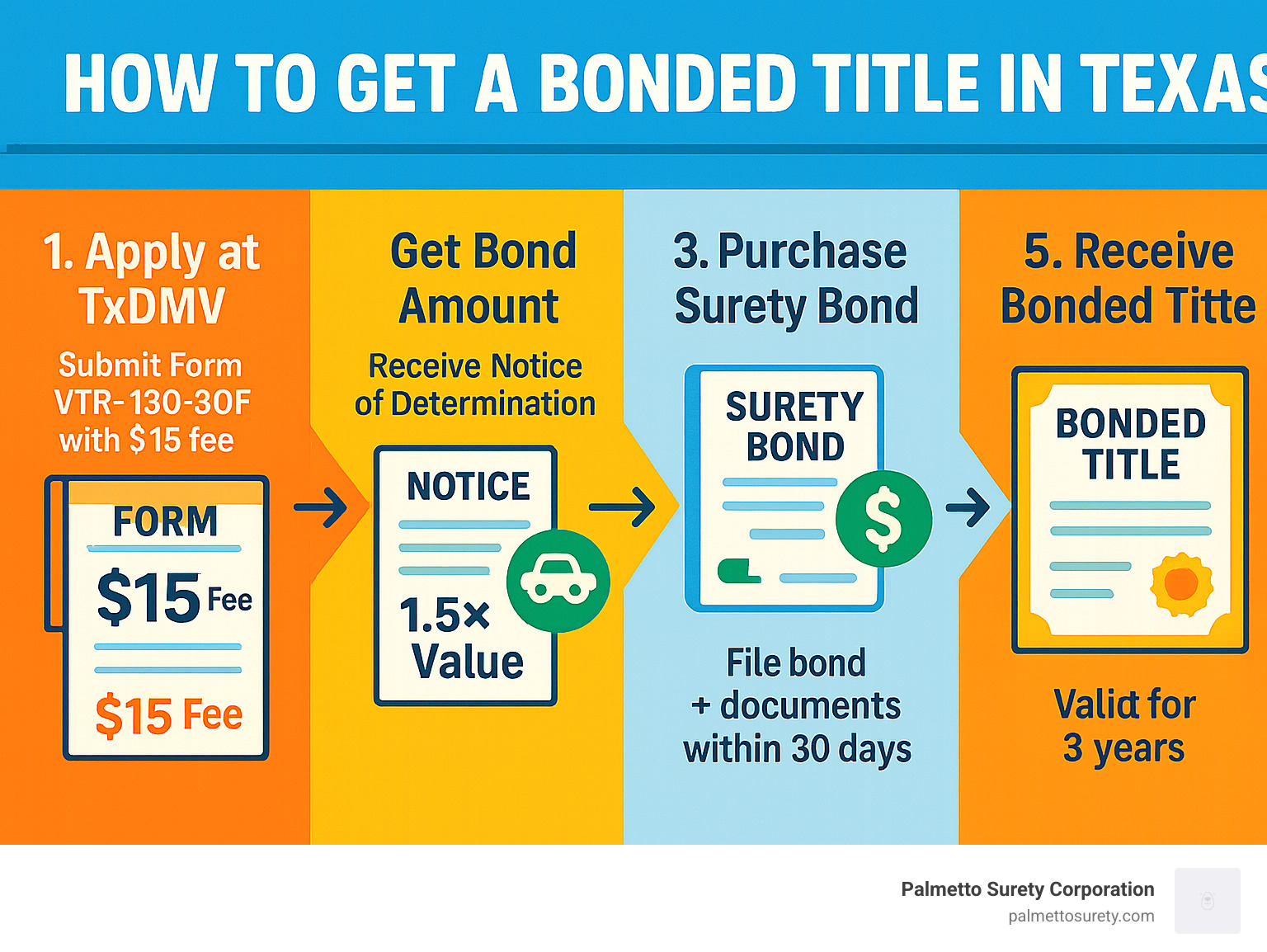
How to get a bonded title in texas is a common search for anyone who owns a vehicle but lacks proper title paperwork. Texas lets you solve that problem in just five key steps, usually within 2–5 weeks:
- Apply at TxDMV – File Form VTR-130-SOF + $15 fee.
- Get bond amount – TxDMV sends your Notice of Determination (1.5× vehicle value).
- Purchase surety bond – Buy from a licensed agent (cost starts at $100).
- Submit to county – File the bond and paperwork within 30 days.
- Receive bonded title – Valid 3 years, then converts to a regular title.
A bonded title gives you the same rights as a regular title—registration, insurance, resale—while a surety bond protects anyone who might still have a claim on the vehicle. Bond amounts equal 1.5 times the appraised value, but you only pay a small premium (as little as $100 for vehicles valued up to $6,000).
Through my work at Palmetto Surety Corporation, I’ve guided hundreds of Texans through this exact process and seen how a bonded title quickly restores peace of mind when paperwork disappears.
Helpful terms while you research:
– indemnity bond for car title
– surety bond for car title cost
– purchase a lost title bond
Bonded Title 101: What It Is & Who Needs One
Think of a bonded title as your safety net when paperwork goes missing. When you can’t produce the original title or proper ownership documents, Texas gives you a second chance through the bonded title process. It’s like having a financial backup plan that says “I really do own this vehicle” when the paperwork trail has gone cold.
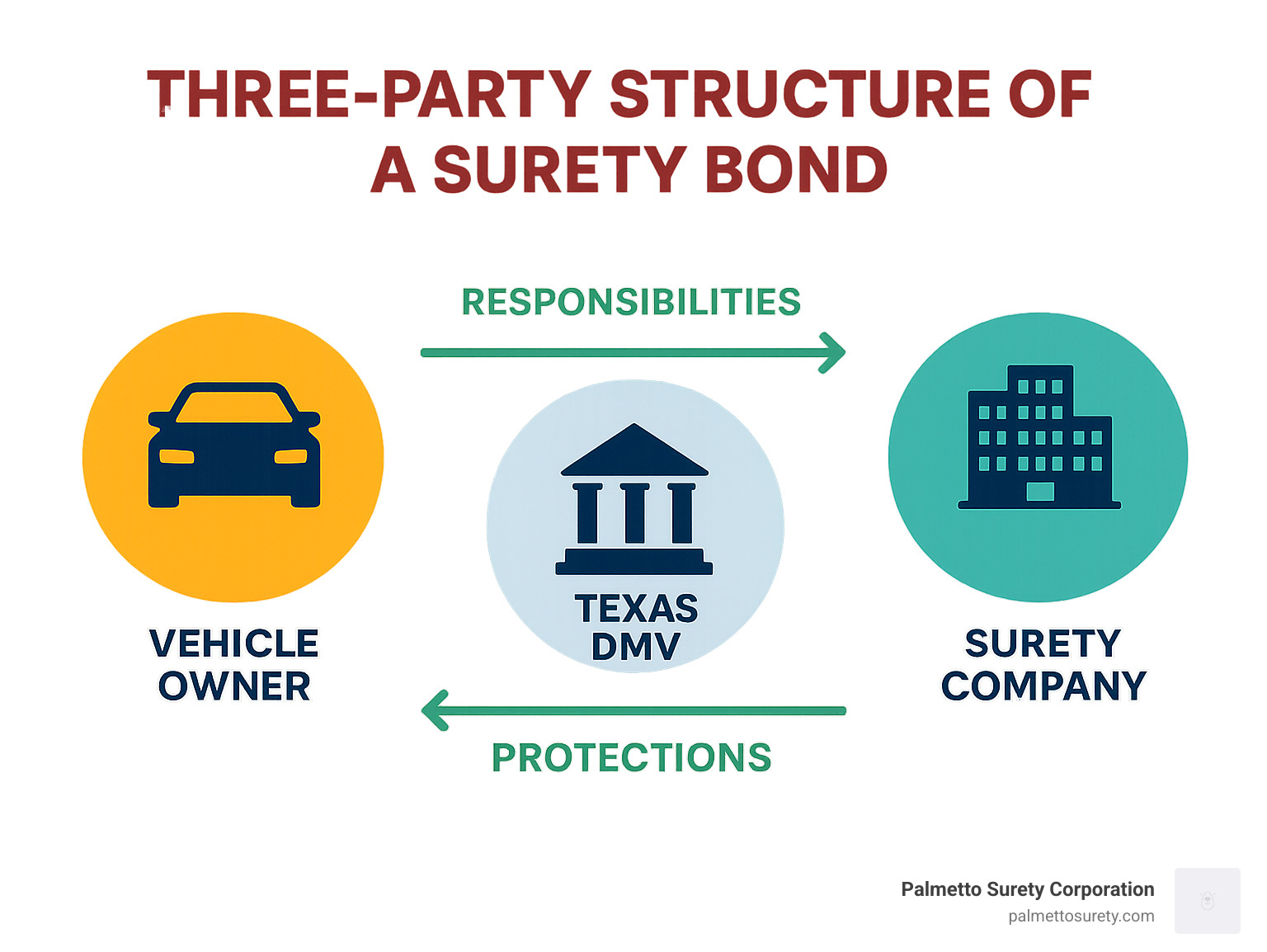
Here’s how it works: you purchase a surety bond that acts as insurance for anyone who might have a legitimate claim to your vehicle. This creates a three-party safety system between you, the Texas Department of Motor Vehicles, and the surety company. If someone later proves they have a valid claim to your car, they can file against the bond for compensation up to the bond amount.
Lost paperwork happens more often than you’d think. Maybe you bought a car from someone who inherited the vehicle but never got proper title documentation. Or perhaps you made a private-party purchase and the seller promised to mail the title but disappeared instead. Sometimes people recover stolen vehicles or deal with lenders who went out of business before transferring titles.

Not every vehicle qualifies, though. Texas has junk and nonrepairable exclusions – you can’t get a bonded title for vehicles classified as salvage without proper rebuilt documentation. The state also takes lien concerns seriously, so vehicles with active liens less than 10 years old need lien releases or letters of no interest before you can move forward.
Regular vs. Bonded Title
The main difference between these title types is simple: a bonded title comes with extra protection attached. Both give you the same legal rights to own, register, and insure your vehicle. The bond attachment just provides a safeguard during the first three years when someone could potentially challenge your ownership.
| Feature | Regular Title | Bonded Title |
|---|---|---|
| Legal Rights | Full ownership rights | Full ownership rights |
| Registration | Standard process | Standard process |
| Insurance | No restrictions | No restrictions |
| Selling | No disclosure required | Must disclose bonded status |
| Duration | Permanent | 3 years, then converts |
| Claims Risk | None | Potential claims during bond period |
A regular title shows a clear ownership history from day one. A bonded title includes a notation about the surety bond, but after three years of no claims, it automatically converts to a regular title.
When a Bonded Title Becomes Necessary
Sometimes there’s no duplicate title available because you were never the legal owner on record in the first place. This happens when someone sells you a vehicle they never properly titled in their name.
What if the seller is unreachable or has passed away? Their estate might not have the proper documentation, or you might not even know how to contact their heirs. These situations leave you stuck with a vehicle you legally purchased but can’t title through normal channels.
Out-of-state transfers create their own headaches, especially when the vehicle was never properly titled in its previous state. The abandonment risk becomes real when these title problems drag on for months or years – you could lose your investment entirely without a way to establish legal ownership.
Understanding how to get a bonded title in texas becomes crucial in these situations. It’s often the cleanest path forward when traditional title solutions hit dead ends.
Eligibility Checklist & Required Documents
Getting started with how to get a bonded title in texas means first making sure you qualify for the process. Most people who genuinely own their vehicle can meet the basic requirements, even when their paperwork situation feels hopeless.
You must be a Texas resident or active military stationed in Texas to apply for a bonded title. The vehicle itself needs to be complete – meaning it has a motor, body, and frame all present. Your vehicle cannot be stolen, junked, or involved in any pending lawsuits. If there’s an active lien on the vehicle that’s less than 10 years old, you’ll need to get that cleared up first with a proper lien release or letter of no interest from the lender.
The paperwork might look intimidating at first, but it’s really just a few key forms. Form VTR-130-SOF is your Statement of Fact for the bonded title application – this is where you tell your story about how you came to own the vehicle. You’ll also need Form 130-U, which is the standard Texas title and registration application.
Beyond the forms, gather your valid photo ID, any bill of sale or proof of purchase you have, and any lien release letters if your vehicle ever had financing. If you’re dealing with an out-of-state vehicle, you’ll need a vehicle inspection report to verify everything checks out.
The state needs to figure out how much your vehicle is worth to set the bond amount. They use their Standard Presumptive Value calculator first, then check NADA guides if needed. Sometimes they’ll accept appraisals from licensed dealers or insurance adjusters when the standard methods don’t capture your vehicle’s true value.
For the most current requirements and forms, the TxDMV website has all the official details that might change from time to time.
Out-of-State or Classic Vehicles
Bringing a vehicle from another state adds one more step to your bonded title journey. You’ll need a VIN inspection using Form VTR-68-A, which sounds fancier than it is. Any certified Texas safety inspection station or law enforcement officer can complete this verification for you.
Classic vehicles that are 25 years or older get special treatment when it comes to valuation. Even if your vintage ride appraises for less than $4,000, Texas automatically sets the minimum bond value at $4,000.
Gathering Proof of Ownership
Think of proof of ownership as building your case for why you legitimately own this vehicle. Canceled checks showing payment to the seller are gold – they prove money changed hands for the vehicle.
Repair receipts with your name and the vehicle’s VIN show you’ve been maintaining and investing in the car. Insurance records listing you as the owner demonstrate you’ve been treating it as your property. If you have registration documents from other states or an affidavit from witnesses to your purchase, include those too.
Don’t worry if your documentation isn’t perfect – many people in bonded title situations have gaps in their paperwork. That’s exactly why the bonded title process exists.
How to Get a Bonded Title in Texas—Step-by-Step

Learning how to get a bonded title in texas doesn’t have to feel overwhelming when you break it down into manageable steps. The entire process involves five clear stages that typically take between 2-5 weeks from start to finish. Think of it like following a recipe – each step builds on the previous one, and timing matters.
The key to success lies in understanding the deadlines. You’ll face a one-year window to complete everything after your initial approval, but the final submission must happen within just 30 days of getting your bond. Missing these deadlines means starting over, which nobody wants to do twice.
Step 1: Pre-Screen—Can you start “how to get a bonded title in texas”?
Before you spend any money or fill out paperwork, take a moment to make sure you actually qualify. This simple check can save you from wasting the $15 application fee and hours of your time.
The most important question is whether you’re a Texas resident or military personnel stationed in Texas. Out-of-state residents can’t use Texas bonded titles – you’ll need to work with your home state instead. Next, confirm that your vehicle was last titled in Texas and that you have legal possession of it.
Your vehicle also needs to be complete and roadworthy. This means it has an engine, body, and frame all attached. Junked vehicles, those marked as nonrepairable, or cars involved in active lawsuits don’t qualify for bonded titles.
If you’re unsure about any of these requirements, contact your local TxDMV Regional Service Center before moving forward. The staff there can review your specific situation and tell you whether a bonded title is the right solution.
Step 2: File Form VTR-130-SOF & Pay $15 Fee
Once you’ve confirmed your eligibility, it’s time to submit your Statement of Fact form (VTR-130-SOF) along with all your supporting documents. This is where all that paperwork gathering pays off – the stronger your documentation, the smoother this step goes.
The $15 administrative fee might seem small, but remember it’s non-refundable. Double-check that your form is completely filled out and that you’ve included everything requested. Missing signatures or incomplete sections are the most common reasons for rejection at this stage.
You can either mail your application or visit a TxDMV Regional Service Center in person. If you choose to mail it, consider using certified mail so you have proof of delivery. The processing time varies, but most applicants hear back within 1-2 weeks.
If the TxDMV approves your application, you’ll receive a Notice of Determination that includes your required bond amount. If they reject it, don’t panic – the rejection letter will explain exactly what additional documentation you need to provide.
Step 3: Vehicle Appraisal & Bond Amount Notice
This step happens automatically once the TxDMV approves your application. They’ll determine your vehicle’s value using their Standard Presumptive Value (SPV) calculator, which pulls data from various automotive databases. If your vehicle doesn’t show up in their system, they’ll use NADA guide values as a backup.
For unusual vehicles or those without standard market data, the TxDMV might require a professional appraisal from a licensed dealer or insurance adjuster. This adds time and cost to your process, but it’s necessary to establish a fair market value.
Your bond amount will equal 1.5 times the determined vehicle value. So if your car is worth $10,000, you’ll need a $15,000 bond. The Notice of Determination form (VTR-130-ND) will spell out your exact bond amount and remain valid for one full year from the issue date.
This 1.5 multiplier might seem high, but it’s designed to provide adequate protection for anyone who might have a legitimate claim to your vehicle. The good news is that you don’t pay the full bond amount – just a small percentage as a premium.
Step 4: Buy the Surety Bond (Fast!)

Now comes the part where you actually purchase your surety bond from a licensed company. The word “fast” in this step’s title isn’t just for emphasis – once you get your bond, you only have 30 days to submit everything to your county office.
Bond costs follow a straightforward structure that makes budgeting easy. For vehicles requiring bonds up to $6,000, you’ll pay a flat $100 premium. Bonds from $6,001 to $25,000 cost $15 per $1,000 of coverage. Larger bonds over $25,000 require individual underwriting review, which can take longer but often results in lower rates.
At Palmetto Surety Corporation, we understand that timing is critical in the bonded title process. That’s why we’ve streamlined our approval process to issue most bonds within hours of receiving your application. Our online system makes it easy to apply, get approved, and receive your bond documents quickly.
The underwriting process for most vehicle bonds is straightforward since the amounts are relatively small and the risk is limited. You’ll need to provide basic information about yourself and the vehicle, but most applicants with decent credit get approved without any issues.
For detailed pricing information, you can check the Scientific research on surety bond costs on the TxDMV website.
Step 5: Submit Everything Within 30 Days—”how to get a bonded title in texas” finalized
This final step is where everything comes together, but it’s also where the tightest deadline kicks in. You have exactly 30 days from receiving your surety bond to submit all required documents to your county tax assessor-collector’s office. Not 31 days, not “around a month” – exactly 30 days.
Your county office will need the original surety bond (not a copy), your Notice of Determination from TxDMV, and a completed Form 130-U (Application for Texas Title and/or Registration). You’ll also need current proof of financial responsibility (insurance), and depending on your vehicle type, possibly a weight certificate for commercial vehicles or customs documentation for imported ones.
The county office staff will review everything to make sure it’s complete and properly executed. If something is missing or incorrect, they’ll let you know right away so you can fix it before your deadline expires. Once they accept your submission, you’ll typically receive your bonded title within a few days.
Missing this 30-day deadline is costly because you’ll need to purchase a new bond and restart the submission process. The original bond becomes void, and you’re out whatever premium you paid for it. This is why we always recommend submitting your documents as soon as possible after getting your bond.
Once you receive your bonded title, you can register, insure, and drive your vehicle just like any other titled vehicle owner. The bonded status will automatically convert to a regular title after three years, assuming no one files a claim against your bond during that period.
Costs, Timeframes & Surety Bond Shopping

Budgeting for how to get a bonded title in texas requires understanding all the costs involved. Most expenses are predictable and relatively affordable for most vehicle owners.
Your biggest expense will be the surety bond premium, which starts at just $100 for vehicles requiring bonds up to $6,000. If your vehicle is worth more, you’ll pay $15 for every $1,000 of bond coverage. So a $15,000 vehicle (requiring a $22,500 bond) would cost about $337 for the bond premium.
The TxDMV administrative fee is a flat $15 that you’ll pay regardless of your vehicle’s value. If you need a vehicle appraisal because standard valuation tools don’t cover your car, expect to pay $50-$100 to a licensed appraiser. VIN inspections for out-of-state vehicles typically cost $20-$40 at certified inspection stations.
Most people complete the entire process within 2-5 weeks from start to finish. However, applications can take longer when documentation is incomplete or when unusual circumstances require additional review. You have one full year to purchase your surety bond after receiving your Notice of Determination from TxDMV. Once you buy the bond, though, you have exactly 30 days to submit everything to your county office.
After you receive your bonded title, the three-year bond period begins. During this time, anyone with a legitimate claim to your vehicle can file against the bond. Once those three years pass without any claims, your bonded title automatically converts to a regular title with no restrictions.
Avoiding Rejections & Delays
The most frustrating part of how to get a bonded title in texas is when simple mistakes cause delays or rejections. Missing signatures on forms probably cause more headaches than any other issue – double-check that you’ve signed everywhere required.
Incomplete VIN inspections for out-of-state vehicles trip up many applicants. Make sure the inspection is done by an authorized facility and that all information matches your other documents perfectly. Uncleared liens will stop your application dead in its tracks, even if the lien is old or the company is out of business.
The 30-day submission deadline after bond purchase catches people off guard more often than you’d think. Mark your calendar immediately when you receive your bond, and don’t wait until the last minute.
At Palmetto Surety Corporation, we’ve helped thousands of Texans steer this process smoothly. Our quick approval times mean you won’t lose precious days waiting for your bond, giving you more time to focus on getting your other documents in order.
Life After Your Bonded Title: Registration, Sale & Conversion + FAQs

Once you’ve successfully completed how to get a bonded title in texas, you can breathe easy knowing you have legal proof of ownership. Your bonded title works exactly like a regular title for all practical purposes – you can register your vehicle, get insurance, and even sell it if needed.
The three-year bond period is really just a waiting period where everything settles down. During this time, your surety bond stays active in case anyone comes forward with a legitimate ownership claim. After three years pass without any claims, your bonded title automatically converts to a regular Texas title. No additional paperwork, no extra fees – it just happens.
Your registration process works the same as any other vehicle. Take your bonded title to your county tax office, show proof of insurance, pay your registration fees, and you’re good to go. Insurance companies treat bonded titles the same as regular titles, so you won’t face any coverage restrictions or higher premiums.
FAQ 1: Can I sell or trade a vehicle during the 3-year bond period?
Absolutely! You have full ownership rights with a bonded title, which means you can sell or trade your vehicle anytime during the three-year period. However, you must disclose the bonded title status to any potential buyer – it’s both legally required and the right thing to do.
When you sell, the new owner receives the bonded title with the remaining time left on the bond period. Some buyers might be nervous about this, but you can explain that it’s simply a waiting period and that thousands of bonded titles convert to regular titles every year without issues.
FAQ 2: What happens if someone files a claim against my bond?
This is probably the biggest worry people have about bonded titles, but legitimate claims are actually quite rare. If someone does file a claim, the surety company investigates thoroughly before paying anything. They don’t just hand out money – they verify that the claim is valid and that the person has legitimate ownership rights.
If a claim proves to be legitimate, the surety company pays the claimant up to the bond amount, then seeks reimbursement from you. This is why it’s so important to be completely honest during your bonded title application and make sure you have legitimate ownership of the vehicle.
False claims happen too, and surety companies are experienced at spotting them. They’ll fight invalid claims on your behalf since they don’t want to pay out money unnecessarily.
FAQ 3: Are there situations where the TxDMV will deny my bonded title?
Yes, the TxDMV can and will deny applications that don’t meet their requirements. The most common reasons include stolen vehicles (even if you didn’t know), vehicles classified as junk or nonrepairable, and cases where you can’t provide sufficient proof of ownership.
Unresolved liens are another common problem. If there’s still an active lien on the vehicle and you can’t get a proper release, your application will be denied. Residency requirements matter too – you must be a Texas resident or military personnel stationed in Texas.
If your application gets denied, don’t panic. The TxDMV provides a detailed rejection letter explaining exactly what’s wrong and what you might be able to do to fix the issues.
At Palmetto Surety Corporation, we’ve helped Texas residents steer the bonded title process for over 20 years. Our quick approval process means you can get your surety bond within hours once your TxDMV application is approved, helping you meet those tight 30-day deadlines.
Conclusion
Getting a bonded title in Texas might seem daunting at first, but it’s actually a straightforward process when you know the steps. Thousands of Texans successfully steer how to get a bonded title in texas every year, and you can too with the right preparation and guidance.
The five-step process we’ve outlined gives you a clear roadmap: apply with the TxDMV, get your bond amount determination, purchase your surety bond, and submit everything to your county office within 30 days. While the timeline is tight and the paperwork detailed, the end result is worth it—you’ll have a legal title that gives you all the same rights as any other vehicle owner.
What I’ve learned from helping countless Texans through this process is that preparation makes all the difference. Having your documents organized, understanding the deadlines, and working with experienced professionals can turn what feels like a bureaucratic maze into a manageable task.
At Palmetto Surety Corporation, we’ve been helping vehicle owners secure bonded title surety bonds for over 20 years. Our team understands the urgency of meeting those 30-day deadlines, which is why we can approve most bond applications within hours. We’ve seen how relieved our clients feel when they finally have that title in hand.
A bonded title isn’t just a temporary fix—it’s a legitimate path to clear ownership that protects everyone involved. After three years without any ownership claims, your bonded title automatically converts to a regular Texas title, and the whole process becomes just a memory.
Whether you’re dealing with a lost title from a private sale, inherited a vehicle without proper paperwork, or found yourself in any other title predicament, the bonded title process offers a trustworthy solution. It’s designed to be fair to previous owners while giving you the legal ownership you need.
Don’t let missing paperwork keep you from legally owning and driving your vehicle. The path to clear title ownership is available, and with the right support, it’s more manageable than you might think.
For more information about our agent services and how we can help streamline your bonded title process, visit More info about agent services.


