


Bounty Hunt: 5 Powerful Facts You Must Know in 2025
What Is a Bounty Hunt and Why Does It Matter?
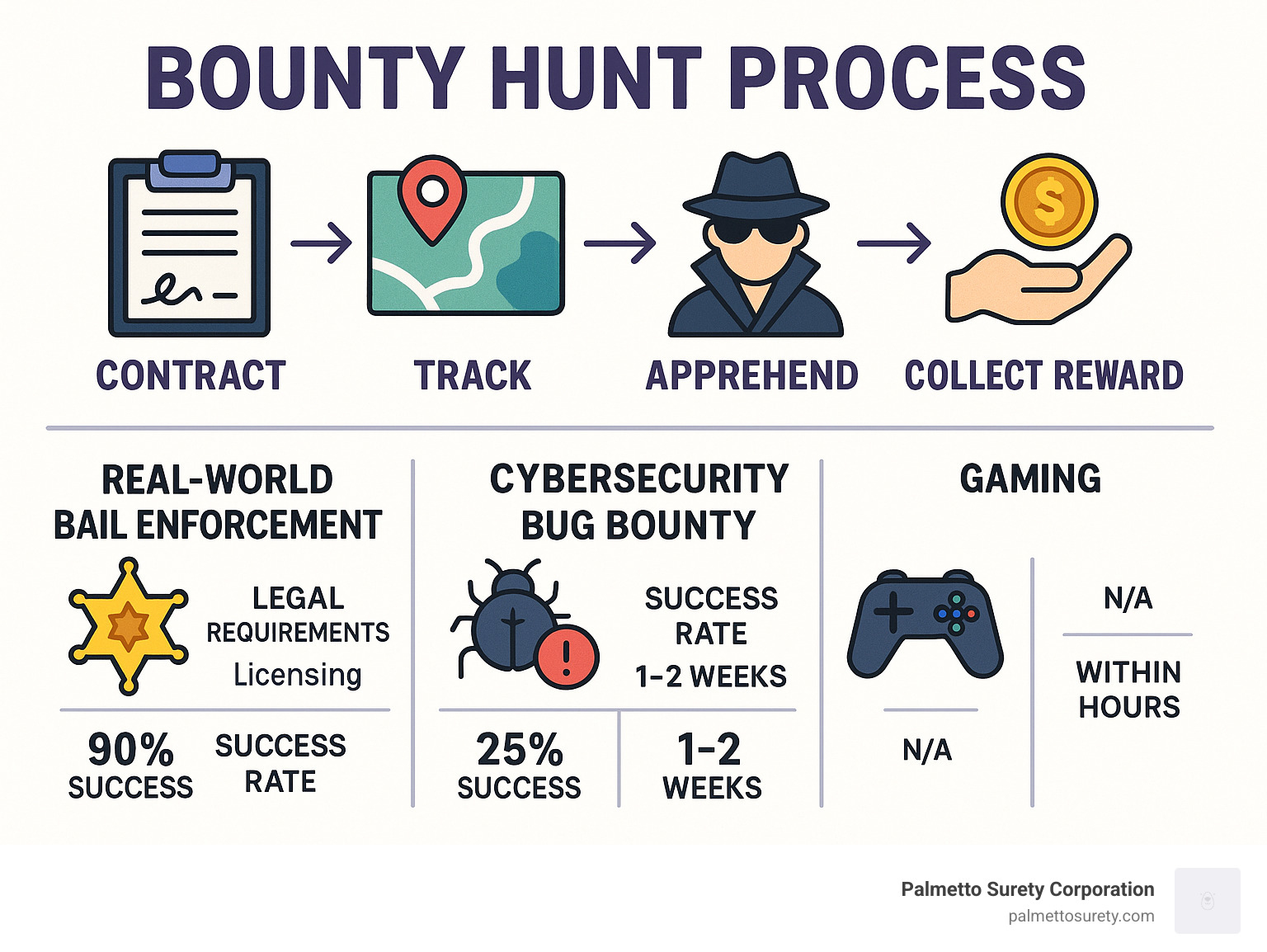
A bounty hunt is the pursuit and capture of fugitives, targets, or objectives in exchange for a reward. This practice spans multiple domains in modern America:
Real-World Bounty Hunting:
– Bail enforcement agents capture fugitives who skip court dates
– Typically earn 10% commission on bail amounts
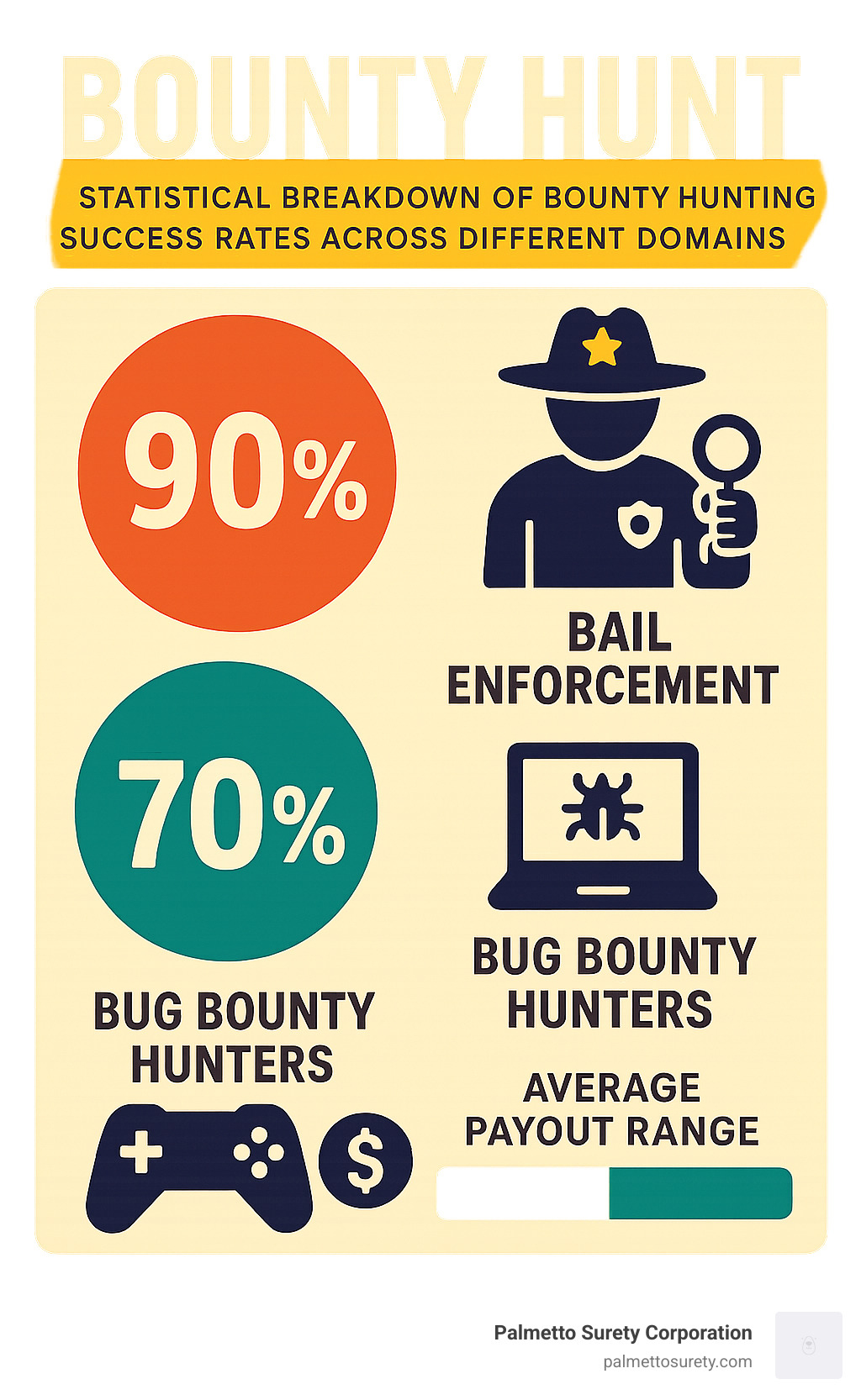
– Catch about 31,500 bail jumpers annually with 90% success rate
– Banned in Illinois, Kentucky, Oregon, and Wisconsin
Cybersecurity Bug Bounties:
– Ethical hackers find vulnerabilities in software systems
– Top hunters earn 70% of income from private programs
– Platforms like HackerOne and Bugcrowd facilitate these hunts
– Can generate full-time income for skilled professionals
Gaming and Entertainment:
– Video games feature bounty hunting mechanics with rewards
– Popular in titles like Hunt: Showdown and Monster Legends
– Tabletop RPGs use reputation systems and contracts
– Often inspired by Old West and sci-fi themes
The concept traces back to common law and the 1873 Taylor v. Taintor Supreme Court case, which still governs modern bail enforcement. Today’s bounty hunting requires proper licensing, insurance, and adherence to state regulations.
I’m Haiko de Poel Jr., and through my work at Palmetto Surety Corporation, I’ve seen how surety bonds protect both bounty hunters and the communities they serve. My experience in the bail bond industry has given me deep insights into how bounty hunt operations function within America’s legal framework.
Easy bounty hunt word list:
– are bounty hunters legal
– how much do bounty hunters earn
– bail enforcement agent badge

Bounty Hunt in the Real World: History, Law & Practice

When you think of a bounty hunt, you might picture dusty Old West towns and wanted posters on saloon doors. But the reality is that bounty hunting has grown into a sophisticated, regulated profession that’s deeply woven into America’s modern justice system.
The legal foundation comes from Taylor v. Taintor (1873), which gave bail bondsmen extraordinary powers to capture fugitives. When someone posts bail, they’re essentially giving up some freedom to the bondsman. If they run, the bondsman has the legal right to bring them back.
Today’s bounty hunt industry operates under this same principle with modern safeguards. The numbers are impressive: bounty hunters catch about 31,500 bail jumpers annually with a 90% success rate – far better than most government agencies.
The money side is straightforward. Bounty hunters typically earn 10% commission on the total bail amount. Catch someone who skipped on a $50,000 bond, and you’ve earned $5,000.
Four states – Illinois, Kentucky, Oregon, and Wisconsin – have completely banned commercial bail bonds and bounty hunting. They’ve decided the risks outweigh the benefits and moved to different pretrial systems.
Other states have acceptd regulation instead. Requirements for licensing, firearms, and insurance vary dramatically – what’s legal in one state might land you in jail in another.
The latest research on bail-for-profit systems has sparked debates about ethics and effectiveness. Critics worry about civil rights violations. Supporters point to impressive success rates.
At Palmetto Surety Corporation, we’ve spent over 20 years helping bail enforcement agents operate legally. Our commercial surety bonds protect both professionals and communities through accountability.
Bounty Hunt Workflow: Track, Apprehend, Return
A successful bounty hunt isn’t like the movies. It’s methodical work that relies more on detective skills than dramatic confrontations. Most professional bounty hunters say the job is 90% paperwork and phone calls, 10% actual pursuit.
Skip tracing is where real detective work happens. Modern fugitives leave digital footprints everywhere: social media posts, credit card transactions, cell phone pings. A good skip tracer pieces together someone’s movements like a puzzle.
Interviews with family and friends require a delicate touch. Experienced bounty hunters know how to build rapport. Sometimes a grandmother reveals more than intended just because someone listened to her concerns.
Negotiation often works better than confrontation. Many fugitives surrender voluntarily when approached professionally. A good bounty hunter explains: “You can come with me now and face just the original charges, or run and add failure to appear.”
Arrest protocols must be followed precisely. Positive identification is crucial – mistaken identity cases have destroyed careers. The hunter must use only necessary force, document everything, and transport the fugitive directly to authorities.
Legal & Ethical Boundaries
The bounty hunt profession walks a tightrope between effectiveness and accountability. The powers granted to bail enforcement agents are broad but not unlimited.
State licensure requirements create a patchwork of regulations. Some states treat bounty hunting like any business license. Others require extensive criminal justice training and ongoing education.
Firearms rules present tricky legal challenges. Even in states allowing armed bounty hunters, regulations are complex. You might need separate permits, additional training, or weapon restrictions.
Insurance isn’t optional – it’s survival. Professional liability coverage protects against inevitable lawsuits. When dealing with people’s freedom and constitutional rights, stakes are too high to operate without proper protection.
The four-state prohibitions reflect serious concerns about due-process risks. Even in states allowing bounty hunting, ethical boundaries constantly evolve through court rulings on mistaken identity, excessive force, and constitutional violations.
Bug Bounty Hunt: Securing Cyberspace

The digital world has created a fascinating new frontier for bounty hunt activities – tracking down software vulnerabilities before criminals find them. This modern twist has grown into a legitimate career that can pay as well as traditional tech jobs.
Bug bounty hunters are digital detectives who probe websites, mobile apps, and software systems for security holes. Companies actually want them to do this – it’s better to have a friendly hacker find weak spots than a criminal.
The two big platforms are HackerOne and Bugcrowd. Companies post their systems and essentially say “hack us, please – but nicely.” When hunters find real problems, they write detailed reports and get paid.
Experienced hunters earn about 70% of their income from private programs – invitation-only hunts where companies specifically ask skilled hunters to test their systems. The remaining 30% comes from public programs anyone can join.
Modern hunters use nuclei automation tools to scan for known vulnerability patterns and cloud scanning infrastructure to test hundreds of targets simultaneously. It’s like having a digital army working around the clock.
Report writing is crucial but often overlooked. A great vulnerability finding is worthless if you can’t explain it clearly. Companies need to understand the risk, reproduction steps, and fixes.
Reputation points on platforms work like credit scores. Higher reputation opens private program invites, where real money lives. Top hunters treat platform reputation as carefully as professional credentials.
Scientific research on cybersecurity incentives shows well-run bounty programs often outperform traditional security audits.
At Palmetto Surety Corporation, we see cybersecurity’s importance across all industries. Our bond services include coverage for technology professionals doing security consulting work.
Launching Your First Bounty Hunt on HackerOne
Starting your cybersecurity bounty hunt journey requires strategy. HackerOne offers the clearest path for beginners, but success depends on smart choices from day one.
Program filtering should be your first priority. New hunters often jump into the biggest programs where thousands of experienced hunters have picked the low-hanging fruit. Instead, look for platform-managed programs where HackerOne’s professional staff handles reports.
Disclosure policies vary dramatically. Some companies want immediate notification of critical issues, others prefer coordinated disclosure with specific timelines. Reading policies prevents awkward violations.
Payout tiers usually follow standard severity ratings: Critical, High, Medium, and Low. Understanding how each program calculates severity helps focus efforts where they’ll pay off.
Essential Tools & Skills
The modern cybersecurity bounty hunt landscape demands both technical expertise and smart tool selection. Automation separates successful hunters from weekend hobbyists.
Command-line mastery starts with tools like ffuf for directory and parameter fuzzing. Burp Suite Pro remains the gold standard for web application testing.
reNgine has revolutionized reconnaissance automation. This framework continuously monitors target scope and automatically finds new subdomains. Smart hunters set up reNgine instances on cloud servers for 24/7 monitoring.
Custom wordlists provide competitive advantages. Everyone has access to the same SecLists repository, but hunters who build wordlists from their own findings find vulnerabilities others miss.
Chaining exploits – combining multiple smaller vulnerabilities into bigger impacts – often transforms low-paying findings into high-value reports. The ability to see these connections separates experienced hunters from beginners.
Bounty Hunts in Games & RPGs

The bounty hunt concept has found fertile ground in gaming, providing compelling risk-versus-reward mechanics that keep players engaged. From mobile games to complex tabletop RPGs, bounty hunting systems tap into fundamental human drives for pursuit and achievement.
Monster Legends and Mobile Gaming
In Monster Legends, the Bounty Hunt event creates collaborative gameplay where random groups work together to defeat Fugitive monsters. The game features Bounty Hunt Specialists that deal triple damage through the “Fugitive Hater” trait, creating strategic depth.
Since the Alpine Era, players can purchase Bounty Hunt Specialists with in-game coins rather than real money, democratizing access to powerful hunting tools.
Hunt: Showdown’s Tactical Approach
Hunt: Showdown presents a complex bounty hunt system where players track clues across a 1 km² map to locate boss monsters. After banishing a monster, the successful team becomes visible to all other players, creating intense showdown scenarios.
The extraction system adds tension. Teams must reach extraction points and survive countdown timers while potentially facing other hunters who want to steal their bounty tokens.
STAR WARS: Bounty Hunter Legacy
The STAR WARS: Bounty Hunter game, with its 85% positive rating from over 834 Steam reviews, demonstrates the enduring appeal of the bounty hunting fantasy.
Traveller RPG’s Systematic Approach
Tabletop RPGs like Traveller have developed sophisticated bounty hunting systems. The game uses reputation as the core mechanic determining a hunter’s pay, available contracts, and support levels.
Iconic video game fugitives include:
– Boba Fett and Mandalorian hunters from Star Wars games
– Various monsters from Monster Legends events
– Player-versus-player targets in Hunt: Showdown
– Procedurally generated marks in Traveller campaigns
– Notorious outlaws in Red Dead Redemption series
Risk-vs-Reward Loops
Gaming bounty hunt systems excel at creating compelling risk-versus-reward loops that maintain long-term player engagement.
Token and Currency Systems
Most games use specialized currencies for bounty hunting. Hunt: Showdown’s Bounty Tokens and Monster Legends’ Bounty Hunt coins create dedicated economies around hunting activities.
Experience and Progression
XP systems typically reward both successful hunts and near-misses. This prevents frustration from all-or-nothing systems while providing meaningful progression.
Rare Loot and Exclusive Rewards
Many games tie their rarest items to bounty hunting activities, creating long-term engagement as players pursue exceptional prizes unavailable through other means.
Designing a Tabletop Bounty Hunt
Creating engaging bounty hunt scenarios for tabletop RPGs requires balancing mechanical systems with narrative opportunities.
Contract Systems and Reputation
Reputation systems work well because they provide long-term consequences. A bounty hunter who consistently brings in targets alive might gain access to higher-paying contracts.
In-Universe Surety Bonds
Some RPGs incorporate surety bond mechanics similar to real-world systems. Players might need to post bonds before taking certain contracts, creating financial stakes that mirror real bounty hunting.
Starship Repossession and Asset Recovery
Science fiction settings often expand bounty hunting beyond person-to-person to include vehicle recovery, creating opportunities for space-based trips.
Frequently Asked Questions about bounty hunt
Through our decades of experience at Palmetto Surety Corporation, I’ve encountered countless questions about bounty hunt operations across all domains. Whether you’re curious about the legal landscape, potential earnings, or the historical connections, these are the questions that come up most often in my conversations with clients and industry professionals.
What states forbid commercial bounty hunting?
Four states have taken a firm stance against commercial bounty hunting: Illinois, Kentucky, Oregon, and Wisconsin. These states didn’t just add more regulations – they eliminated commercial bail bonds entirely, choosing government-managed pretrial systems instead.
Each state had its own reasons for the ban, but the concerns were surprisingly similar. Constitutional due process issues topped the list, along with worries about inadequate training requirements and potential conflicts with state law enforcement authority. Some legislators were particularly concerned about civil rights violations when bounty hunters crossed state lines.
The remaining states have taken various approaches to regulation. Nevada requires a hefty 80 hours of training, while other states might just require basic registration with the attorney general’s office. Some states mandate coordination with local law enforcement before any bounty hunt operation begins.
Here’s what really matters: if you’re considering this profession, you absolutely must research your specific state’s laws. What’s perfectly legal in one state could land you in serious legal trouble in another. I’ve seen too many well-intentioned people get into hot water because they assumed the rules were the same everywhere.
How much can a full-time bug bounty hunter earn?
The earning potential for cybersecurity bounty hunt professionals varies dramatically, but the numbers can be quite impressive for those who approach it strategically. Industry data shows that experienced hunters typically earn about 70% of their income from private programs and 30% from public programs during a full-time year.
The key differentiator is reputation. When you’re starting out, you’ll be competing with thousands of other hunters on public programs for relatively modest payouts. But as you build your reputation through consistent, high-quality vulnerability reports, you’ll start receiving invitations to private programs where the competition is much lighter and the payouts are significantly higher.
Specialization makes a huge difference too. Hunters who focus on specific technologies like mobile application security or cloud infrastructure often command premium payouts compared to generalists. The most successful hunters also leverage automation tools effectively, allowing them to monitor hundreds of programs simultaneously and scale their efforts.
Entry-level hunters might earn modest supplemental income while building their skills, but established hunters with strong platform reputations can earn six-figure incomes comparable to traditional cybersecurity roles. The added benefits of flexible scheduling and diverse challenges make it an attractive career path for the right personality type.
Are game bounty hunts inspired by real history?
Absolutely! Gaming bounty hunt systems draw heavily from real historical precedents, and there’s a good reason for that – players connect more deeply with mechanics that feel authentic and grounded in familiar concepts.
The American Old West era provides the most obvious inspiration. That romanticized image of frontier justice and individual pursuit of outlaws appears in countless games. The visual iconography is unmistakable too – wanted posters, “Dead or Alive” rewards, and the moral ambiguity that creates interesting player choices all trace back to this historical period.
Modern games have also started incorporating contemporary elements from today’s bail enforcement industry. Some RPGs include licensing and bonding requirements similar to what we see in real bounty hunt operations. The reputation systems that determine available work and pay rates mirror how the actual industry operates.
Even cyberpunk and sci-fi games have drawn inspiration from bug bounty concepts, creating futuristic scenarios where hackers hunt digital targets for rewards. The core mechanics remain the same – pursuit, risk, and reward – but adapted for different settings and technologies.
The most successful game systems balance historical authenticity with gameplay needs. They capture the essence of what makes bounty hunting compelling while adapting the mechanics to create engaging interactive experiences. This historical grounding helps explain why bounty hunting remains such a popular gaming theme across genres and platforms.
At Palmetto Surety Corporation, we understand that whether you’re dealing with real-world bail enforcement or exploring these concepts in other domains, proper bonding and insurance protection remains essential for professional operations.
Conclusion
The fascinating world of bounty hunt operations reaches into corners of American life that most people never consider. From the dusty trails of the Old West to the digital highways of cyberspace, from intense gaming scenarios to calculated pursuits of real bail enforcement agents, bounty hunting represents something deeply human – our drive to pursue, capture, and claim what we’ve earned.
What strikes me most after examining these diverse applications is how the fundamental principles remain unchanged across centuries and contexts. Whether you’re tracking a bail jumper through Atlanta neighborhoods, hunting software vulnerabilities for a tech company, or planning your next move in a tabletop RPG campaign, you’re engaging with the same core mechanics: systematic investigation, calculated risk assessment, and the satisfaction of successful capture.
The legal landscape continues evolving, with four states having banned commercial bounty hunting entirely while others accept new technologies and methods. The cybersecurity field has created entirely new categories of bounty hunt operations that didn’t exist twenty years ago. Gaming has liftd bounty hunting from simple mechanics to complex social systems that mirror real-world professional networks.
At Palmetto Surety Corporation, we’ve had the privilege of supporting the bail enforcement industry throughout the southeastern United States for over two decades. Our network stretches from the busy streets of Atlanta to the historic squares of Savannah, from the Gulf Coast communities of Louisiana to the mountain towns of Tennessee. We’ve seen how the industry has professionalized, how technology has transformed operations, and how proper bonding protects everyone involved.
Our ability to approve most applications within hours isn’t just about efficiency – it’s about understanding that licensed professionals need reliable partners who comprehend the unique challenges of their work. When a bail enforcement agent needs coverage to operate legally, or when a bond agency requires bail surety bonds to protect their clients, timing matters.
The future of bounty hunt operations will undoubtedly bring new challenges and opportunities. Technology will continue reshaping how hunters track their targets, legal frameworks will adapt to address emerging concerns, and gaming will find new ways to capture the excitement of the chase. But the core appeal – that satisfaction of a successful hunt – will endure as long as humans value justice, security, and fair rewards for honest work.
Whether you’re considering a career change into bail enforcement, exploring bug bounty hunting as a path into cybersecurity, or simply trying to understand the mechanics behind your favorite gaming experiences, success in any bounty hunt domain requires the same fundamental qualities: patience, persistence, respect for legal boundaries, and unwavering commitment to professional standards.
The hunt continues, and we’re proud to be part of the network that makes it possible safely and legally across the American Southeast.


