


how much does a 100 000 bail bond cost: 5 Shocking Facts 2025
Understanding Bail Bond Costs
So you’re wondering, how much does a 100 000 bail bond cost? The short answer: you’ll typically pay between $7,000 to $10,000 – about 7-10% of the total bail amount. This fee varies because different states have different regulations on what bail bond agents can charge.
When a judge sets bail at $100,000, they’re essentially saying, “We need this much money as insurance that you’ll show up to court.” It’s a hefty sum that most people simply don’t have sitting in their bank account, which is where bail bonds become a financial lifeline.
| Bail Bond Cost Breakdown | Amount |
|---|---|
| Total Bail Amount | $100,000 |
| Standard Fee (10%) | $10,000 |
| California Fee Range | $7,000-$10,000 |
| Connecticut Set Fee | $7,150 |
| With Military/Union Discount (20% off) | $8,000 |
Think of a bail bond as a financial promise. The bail bondsman tells the court, “I’ll guarantee this person will appear for their court dates, and I’m backing that promise with $100,000.” This allows your loved one to go home instead of waiting in jail until their trial date, which could be months away.
Here’s the part people sometimes misunderstand: the premium you pay to the bail bond agent (that $7,000-$10,000) is non-refundable. Even if the charges get dismissed the very next day or your loved one attends every single court date perfectly, that money compensates the bondsman for taking on the significant financial risk of the full bail amount.
I’m Haiko de Poel Jr, and through my work with Palmetto Surety Corporation, I’ve gained extensive knowledge about bail bond costs. Palmetto is one of the fastest-growing surety bond companies in the US, working with bail bond agents throughout the southeastern United States.
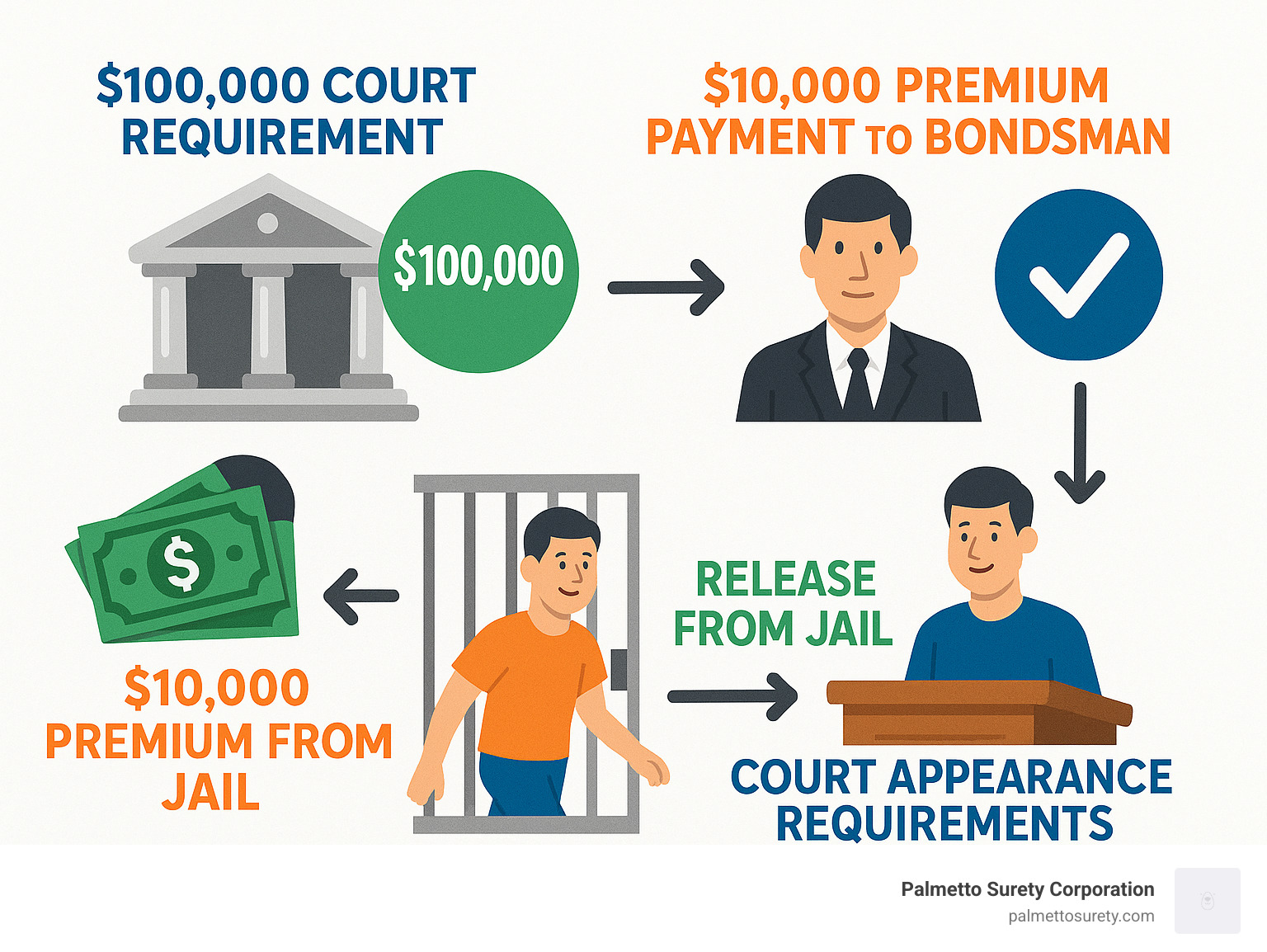
If you’re navigating this process for the first time, you might encounter some unfamiliar terms. Here’s a quick reference to help you understand the bail bond landscape:
– Bail bond South Carolina – State-specific information about how bail works in SC
– Immigration bail bond cost – Special considerations for immigration cases
– How Bail Bonds Work – A comprehensive guide to the bail bond process
While the cost of a bail bond isn’t small, it makes the impossible possible – allowing someone to return home, continue working, and prepare for their case while awaiting trial.

What Is a $100,000 Bail Bond?
A $100,000 bail bond is essentially a financial promise made between three parties. Think of it as a high-stakes agreement where a bail bondsman pledges to the court that a defendant will show up for all their court dates. When a judge sets bail this high, they’re making a serious statement about either the nature of the alleged crime or their concerns about the defendant potentially fleeing.
“A bail bond is technically a surety bond guaranteed by a licensed bondsman and backed by an insurance company,” as industry professionals often explain. This means when you work with a bondsman, they’re putting their financial reputation on the line, with support from larger surety companies like Palmetto Surety Corporation.
In bail bond terminology, that $100,000 figure is called the “penal sum” – it’s the maximum amount the bail bond company would have to pay the court if the defendant decides to disappear. When bail reaches six figures, it’s a clear indicator that the court views the situation with significant gravity.
Being “Held on $100,000 Bond” Explained
When you hear someone is “held on $100,000 bond,” it means they’re sitting in jail until they can arrange this substantial amount for their release. Without posting bail, they’ll remain behind bars throughout their entire case – which could stretch into months or even years depending on court backlogs.
This high bail amount isn’t just about keeping someone detained – it creates a powerful financial motivation to return to court. As one experienced bail agent with over 15 years in the business puts it, “The court sets bail high enough to create a financial incentive for appearance but not so high that it becomes punitive.”
For most families, hearing that $100,000 figure triggers immediate panic. Few people have that kind of cash readily available, which is precisely why bail bondsmen provide such a crucial service within our criminal justice system – they make release possible when the full amount would be completely out of reach.
Types of Crimes That Reach Six-Figure Bail
When bail reaches the $100,000 mark, you’re typically looking at serious offenses. Based on our experience working with bondsmen throughout the Southeast, these commonly include:
Violent felonies like aggravated assault or armed robbery often command high bail amounts due to public safety concerns. Drug trafficking or manufacturing charges frequently reach six figures, especially with larger quantities. Multiple DUI offenses, particularly those involving injuries, can easily push bail to $100,000. White-collar crimes involving significant fraud or embezzlement often see high bail amounts proportional to the alleged financial damage. Serious property crimes with substantial monetary losses and felonies committed while on probation also typically warrant higher bail determinations.
The severity of the charge isn’t the only consideration, though. Courts carefully weigh the defendant’s prior criminal history, their ties to the community, employment stability, and their perceived flight risk when determining the appropriate bail amount. Someone with no criminal record might receive a lower bail for the same offense compared to someone with multiple prior convictions.
How much does a 100 000 bail bond cost ultimately depends on numerous factors, but understanding what this bail amount represents is the first step in navigating this challenging situation.
How Much Does a $100,000 Bail Bond Cost?
When your loved one is facing a $100,000 bail amount, the first question that comes to mind is likely: how much does a 100 000 bail bond cost? The good news is you won’t need the full $100,000.
Typically, you’ll pay a premium of 10% of the total bail amount – which means $10,000 for a $100,000 bail bond. This fee compensates the bail bondsman for taking on the significant financial risk of guaranteeing the full amount to the court.
“Most families are relieved when they learn they don’t need the entire $100,000 up front,” explains a veteran bail agent. “That 10% premium makes freedom possible when it otherwise wouldn’t be.”
However, this percentage isn’t set in stone and varies based on where you live:

States regulate bail bond fees differently:
In California, you might pay between 7-10% ($7,000-$10,000) for a $100,000 bond, as state law allows for some negotiation within this range.
Connecticut uses a unique formula: 10% on the first $5,000 and 7% on the remainder. For a $100,000 bail, that’s $500 (10% of $5,000) plus $6,650 (7% of $95,000), totaling $7,150.
In most southeastern states where Palmetto Surety Corporation operates, the standard rate sits firmly at 10%.
This premium is non-refundable. Even if your case is dismissed the next day or you’re found not guilty after trial, the bail bond fee has been earned by the bondsman for taking on the risk and securing your release.
How Much Does a 100 000 Bail Bond Cost in Different States
The cost of a $100,000 bail bond can vary dramatically depending on which state you’re in. This isn’t just about different business practices – it’s often strictly regulated by state law.
In California, the Department of Insurance permits bail agents to charge between 7-10%. This means your how much does a 100 000 bail bond cost answer ranges from $7,000 to $10,000. Some California bondsmen may negotiate within this range for clients with strong credit or substantial collateral.
Connecticut has perhaps the most specific formula in the country. State statute requires: “No professional bondsman… shall charge a fee, commission or premium of more than ten per cent on the first five thousand dollars of the amount of the bond… and seven per cent on the excess of the amount of the bond over five thousand dollars.” This precise calculation brings the total to exactly $7,150 for a $100,000 bond. You can read the full Connecticut bail bond fee statute for more details.
Throughout the Southeast – Florida, Georgia, South Carolina, Louisiana, Mississippi, Tennessee, and Texas – where Palmetto Surety Corporation operates, you’ll typically find the standard rate holding steady at 10% ($10,000).
Kansas maintains a straightforward 10% rate with no state-mandated caps, resulting in a $10,000 premium.
Interestingly, some states have moved away from commercial bail bonds entirely. Maine, Kentucky, Illinois, Wisconsin, and Oregon have largely eliminated this system in favor of different pretrial release mechanisms.
If You Pay the Full $100,000 to Court Instead
If you happen to have $100,000 available, you might consider posting the full bail amount directly with the court. Unlike the non-refundable premium paid to a bondsman, this approach offers a significant advantage: the money comes back to you.
When you post the full cash bail, you’ll receive a refund after the case concludes – regardless of whether the outcome is guilty, not guilty, or dismissed – as long as the defendant makes all required court appearances.
However, there are practical considerations to weigh:
The court typically deducts administrative fees from your refund. These vary by jurisdiction but can be substantial.
The timing of refunds can test your patience. Many courts take weeks or even months to process bail refunds after case resolution.
Having $100,000 tied up for the duration of a criminal case represents a significant financial burden for most families. That’s money unavailable for legal fees, living expenses, or other pressing needs.
You’ll need to carefully maintain all receipts and documentation to ensure proper processing of your refund.
As one court administrator puts it: “Posting the full amount gives you the best financial outcome in the long run, but most people simply don’t have that kind of liquidity, which is precisely why bail bondsmen provide such an essential service.”
For most families facing a $100,000 bail situation, working with a reputable bail bond agent remains the most practical solution, despite the non-refundable premium.
Key Factors That Shape Your $100K Bail Bond Premium
When it comes to high-value bail bonds, the standard 10% rate is just a starting point. Your actual premium for a $100,000 bail bond can vary based on several important factors that bail bond agents consider before setting your final cost.
State regulations create the framework, but your personal circumstances fill in the details. As one experienced bail bondsman puts it, “Every case is unique, and so is every premium calculation.”
Credit & Financial History
Your financial profile plays a significant role in determining your premium cost. Think of it as similar to applying for a loan – bail bond companies are taking on financial risk, and they price accordingly.
Based on industry patterns, your credit score can substantially impact what you’ll pay:
- Excellent credit (675+) might qualify you for premiums as low as 0.5%-3% ($500-$3,000)
- Average credit (600-675) typically means premiums in the 3%-5% range ($3,000-$5,000)
- Poor credit (below 600) usually results in the standard 5%-10% rate ($5,000-$10,000)
But your credit score is just one piece of the puzzle. “We look at the whole picture,” explains a veteran bail agent with 15 years in the industry. “The charge severity, past offenses, appearance history, available collateral, co-signer strength, and stable employment all factor into our decision.”
Bringing documentation to support your application can make a significant difference. Recent bank statements, tax returns, proof of assets, and employment verification can strengthen your case and potentially lower your premium. These documents help the bondsman assess your stability and ability to fulfill obligations.

Discounts & Surcharges
Good news – you might qualify for significant discounts that can substantially reduce how much does a 100 000 bail bond cost. Many bail agencies offer special rates for certain groups:
Military members and veterans often receive the most generous discounts, up to 20% off the standard premium. This could reduce a $10,000 premium to a more manageable $8,000. Union members typically qualify for 10-20% discounts, while AARP members might see 10-15% reductions.
If you were referred by an attorney, ask about referral discounts, which commonly range from 5-10%. First-time defendants with clean records can sometimes negotiate 5-15% off the standard rate.
On the flip side, certain factors might increase your premium cost. Previous failures to appear in court are major red flags for bondsmen. Serious felony charges, living out-of-state, having minimal community ties, or being assessed as a high flight risk can all push your premium toward the higher end of the spectrum.
Be aware of potential additional fees that might be added to your premium:
– Processing or paperwork fees ($25-$100)
– After-hours service for late-night or weekend bail assistance ($50-$200)
– Payment plan arrangements that include financing charges
“We try to be upfront about all costs,” says a bail agent working with Palmetto Surety Corporation in South Carolina. “The last thing someone needs during a stressful bail situation is surprise fees.”
Understanding these factors can help you prepare financially and potentially negotiate a better rate when securing a $100,000 bail bond. While saving money is important, the most critical factor is working with a reputable, licensed bail bond agency that will handle your case professionally and efficiently.
Collateral, Co-Signers & Payment Plans for High Bail
When facing a $100,000 bail situation, most families don’t have that kind of cash sitting around. This is where collateral, co-signers, and payment plans become essential lifelines. Let me walk you through how these options work in the real world.
Collateral Requirements
For a bail bond of this size, bondsmen need some financial security. Think of collateral as your “skin in the game” that helps protect the bondsman if things go sideways.
“Collateral is often required for high-value bail bonds like $100,000 to secure the bond and protect the bondsman against loss,” explains a bail industry expert with over 20 years of experience.
Most commonly, people use:
- Real estate like homes or investment properties (bondsmen typically want to see equity worth about 150% of the bond amount)
- Vehicles with clear titles – cars, boats, motorcycles, RVs
- Valuable personal items such as jewelry, fine art, or collectibles
- Financial assets including stocks, bonds, or certificates of deposit

Payment Plans
The good news? You don’t need to come up with the entire premium in one lump sum. Most bail agencies understand this is an unexpected expense and offer flexible payment options.
“We appreciate that getting a loved one out of jail can be incredibly stressful, especially financially. We understand that not everybody can pay the full fee upfront,” one bail agent told me recently.
Typical payment arrangements include:
Down payments usually start at 30-50% of the premium. In Connecticut, regulations actually allow for just a 35% down payment (about $2,500 on their $7,150 premium). The rest can be spread over 3-12 months, and some agencies even offer 0% interest financing if you qualify.
Payment methods have modernized too – while cash is still king, most bondsmen now accept credit cards, electronic transfers, and even digital payment platforms like Cash App, Venmo, PayPal, and Apple Pay. This flexibility can be a huge relief when you’re trying to help someone get released quickly.
Responsibilities for Co-Signers on a $100,000 Bond
Being a co-signer on a $100,000 bail bond isn’t a decision to take lightly. When you sign those papers, you’re taking on serious responsibilities.
First and foremost, you accept full financial liability if things go wrong. If the defendant skips court, you’re on the hook for the entire $100,000 – not just the premium. Any collateral you’ve provided can be seized and sold to cover the bond amount.
You also take on monitoring obligations – essentially promising to keep tabs on the defendant and ensure they make all court appearances. The indemnity agreement you sign creates legally binding obligations that could result in lawsuits, wage garnishment, or property liens if the defendant disappears.
“If the defendant fails to show up in court on a $100,000 bond, the bondsman must pay the full $100,000, and you and your co-signers may face wage garnishment, lawsuits, and bounty hunter action,” warns a bail bond professional I interviewed.
Your credit score could take a massive hit from a bail bond forfeiture, potentially affecting your financial life for years to come.
Getting Approved Without Perfect Credit
Don’t panic if your credit isn’t stellar – there are still pathways to getting that $100,000 bail bond approved.
The most effective approach is finding a strong co-signer with excellent credit and substantial assets who can balance out your credit weaknesses. Providing additional documentation that demonstrates stability – like proof of long-term employment, established residence, and community connections – can significantly strengthen your application.
Offering increased collateral often compensates for credit concerns. Some agencies, including those working with Palmetto Surety Corporation, offer specialized “Bad Credit Surety Bonding Programs” with approval rates reaching 99%.
Another practical strategy is proposing a higher down payment – offering 50% or more upfront shows good faith and can tip the scales toward approval.
Many bail agencies now use sophisticated bail bond calculators to estimate premiums based on these various risk factors. These tools help determine fair payment plans and appropriate collateral requirements custom to each specific situation. You can learn more about how these calculators work at How Bail Bonds Work: Bail Bond Calculator.
The bottom line? Even with a $100,000 bail amount, there are options. The key is being upfront about your situation and working closely with an experienced bondsman who can guide you through the process.
What Happens If the Defendant Skips Court?
When someone fails to show up for court after posting a $100,000 bail bond, things get serious fast. It’s not just about missing an appointment – it kicks off a chain of events that affects everyone involved.
First, the court immediately declares the bond forfeited and issues a bench warrant for the defendant’s arrest. Think of this as the court saying, “You promised to be here, you weren’t, and now there are consequences.”
Most courts do provide a grace period – typically anywhere from 30 to 180 days – for the defendant to be brought back before the full $100,000 must be paid. This window gives the bail bond company time to locate the missing person.
“When a defendant skips court, the clock starts ticking immediately,” explains a veteran bail recovery agent. “Every day they’re missing increases the risk for everyone involved financially.”

During this time, the bail bond company springs into action, often hiring fugitive recovery agents (sometimes called bounty hunters) to track down and return the defendant. These professionals specialize in locating people who don’t want to be found.
If the recovery efforts fail, the financial hammer drops. The bail bond company must pay the court the full $100,000 bail amount. They don’t simply absorb this loss – they come after the co-signers and any collateral provided.
“You forfeit any payment or collateral provided, the bondsman or court retains the funds, and you may be pursued legally, including possible rewards for capture,” explains one bail bond agent with 15 years in the business.
This is where co-signers feel the real pain. Their assets get seized, their collateral gets liquidated, and they may face civil lawsuits, wage garnishment, and property liens. That house, car, or jewelry put up as collateral? It’s now being sold to cover the bond.
Steps for Indemnitors After a Missed Appearance
If you’ve co-signed (or served as an indemnitor) on a $100,000 bail bond and suddenly learn the defendant missed court, don’t panic – but do act quickly.
Contact the bail bondsman immediately. Minutes matter in these situations. A quick call can sometimes prevent the full forfeiture process from starting if arrangements can be made quickly.
Help locate the defendant if possible. If you have any information about where they might be, share it. Your cooperation can make a huge difference in resolving the situation without financial catastrophe.
If you can reach the defendant, encourage voluntary surrender. This is almost always the best outcome – it stops the recovery process, may prevent full forfeiture, and shows good faith to the court.
Take time to review your indemnity agreement. This document spells out exactly what you’re on the hook for. Understanding your obligations helps you make better decisions under pressure.
It’s also wise to prepare financially for potential demands. The bail bond company may require immediate payment if the defendant can’t be located.
“The worst thing a co-signer can do is ignore the situation or refuse to cooperate,” says a bail recovery specialist. “That virtually guarantees they’ll face the maximum financial consequences.”
There is some good news: if the defendant missed court for a legitimate reason – like a documented medical emergency or natural disaster – the bond may be reinstated without requiring full payment. But you’ll need solid proof to convince the court.
How much does a 100 000 bail bond cost in the end if someone skips court? Potentially the full $100,000, plus recovery costs, legal fees, and lasting damage to your credit and financial standing. This is why bail bond companies are so careful about who they approve and why co-signers should think very carefully before putting their assets on the line.
State Regulations, Timeline & The Bail Process
The world of bail bonds isn’t just about money – it’s a carefully regulated system that varies significantly across state lines. Understanding these regulations can make a big difference when you’re trying to steer the bail process for a loved one.

State Regulatory Framework
In the southeastern states where Palmetto Surety Corporation operates, each state has its own regulatory approach to bail bonds:
In Georgia, the Department of Insurance keeps a watchful eye on bail bond practices, maintaining the standard 10% premium rate. This means how much does a 100 000 bail bond cost in Georgia is typically right at that $10,000 mark.
Florida’s Department of Financial Services enforces strict 10% premium caps, ensuring consumers aren’t charged excessive fees. They’re particularly vigilant about upholding these standards.
Down in South Carolina, the Department of Insurance not only regulates rates but also imposes specific licensing requirements for bail agents. This helps ensure that only qualified professionals are handling these significant financial transactions.
The other southeastern states – Louisiana, Mississippi, Tennessee, and Texas – each have their unique regulatory frameworks, though they generally stick to the 10% standard for bail bond premiums. This consistency makes it easier for companies like Palmetto Surety Corporation to operate across state lines.
“Each state has its own regulatory quirks,” explains one veteran bail agent. “But the good news is that most southeastern states maintain similar standards for how much does a 100 000 bail bond cost, which helps families understand what to expect.”
The Bail Timeline
When someone you care about is arrested and facing a $100,000 bail, time suddenly becomes incredibly precious. Here’s what the typical timeline looks like:
After the arrest and booking process (which takes 2-8 hours), there’s usually a bail hearing within 24-48 hours. This is when the judge sets the bail amount based on the alleged crime, the defendant’s history, and flight risk assessment.
Once bail is set, you can immediately contact a bail bondsman – many, including those working with Palmetto Surety Corporation, offer 24/7 service because they understand that arrests don’t just happen during business hours.
The application and approval process typically takes between 30 minutes to several hours, depending on how complex the collateral verification is. For a $100,000 bond, expect a more thorough review process.
Paperwork completion usually takes 30-60 minutes, and the good news is that much of this can be done remotely these days via email, fax, or online systems. This is especially helpful when family members live in different cities.
After the paperwork is complete and payment arranged, the bond posting process takes about 1-2 hours. Then comes the waiting game – defendant release typically happens 1-6 hours after the bond is posted, depending on how busy the jail is and their processing procedures.
As one agency proudly notes, “Average bail bond time: 45 minutes,” though this can vary widely based on circumstances and jail procedures. In our experience, managing expectations about release times helps reduce family stress during an already difficult situation.
From Arrest to Collateral Return
The journey of a $100,000 bail bond has a beginning, middle, and end – understanding the full cycle helps everyone involved know what to expect.
It all starts with an initial consultation where the bondsman explains the fees, requirements, and responsibilities. This is your chance to ask questions about how much does a 100 000 bail bond cost and what will be expected of you as a co-signer.
Next comes the application and underwriting phase, where credit checks are performed, collateral is verified, and co-signers are approved. For a bond of this size, expect a thorough review.
The premium payment – that non-refundable fee of $7,000-$10,000 – is then collected. This is the cost of the service and isn’t returned regardless of case outcome.
Once payment is arranged, the bond posting happens – the bondsman physically posts the bond with the court or jail, triggering the release process.
After defendant release, the real work begins – ensuring the defendant attends all court proceedings. This might stretch over months or even years for complex cases.
When the case reaches its resolution (whether through dismissal, plea, or verdict), the bond is officially exonerated by the court. This is the signal that the bondsman’s liability has ended.
Finally, any collateral return happens, typically within 30 days of bond exoneration. “Collateral is returned typically within 30 days after case resolution,” confirms an industry professional, though timeframes can vary based on agency policies and court procedures.
Throughout this process, Palmetto Surety Corporation’s network of bail agents provides guidance and support, helping families steer what can be a confusing and stressful system. Their 20+ years of experience in the southeastern United States means they’ve seen virtually every situation and can help you understand exactly what to expect when facing a $100,000 bail bond.
Frequently Asked Questions about How Much Does a 100 000 Bail Bond Cost
Are bail bond fees ever refundable?
No, bail bond premiums are non-refundable. When you pay that $7,000-$10,000 premium for a $100,000 bond, that money is considered fully earned by the bondsman the moment they post your bond. This remains true regardless of what happens with your case—even if charges get dismissed the very next day.
I’ve had many clients ask about this, hoping for at least a partial refund when their case wraps up quickly. Unfortunately, that’s not how bail bonds work. The premium compensates the bondsman for taking on what could be a $100,000 risk on your behalf.
“Think of it like car insurance,” one bail agent explained to me. “If you don’t have an accident during your policy period, you don’t get your premiums back. The bail premium works the same way—you’re paying for the service and the risk coverage, not for a loan.”
The only situation where you might see a refund is if you paid the premium but the bondsman failed to post the bond due to their own negligence or issues on their end—but this is extremely rare.
Can I negotiate the 10% premium on a $100,000 bond?
In most cases, no. Bail bond premiums aren’t like car prices—you can’t typically haggle them down. State regulations generally set fixed rates that bondsmen must follow. In states where Palmetto Surety Corporation operates, these rates are strictly enforced by state insurance departments.
That said, legitimate discounts are available in many situations:
Military personnel and veterans often qualify for up to 20% off (bringing a $10,000 premium down to $8,000). Union members, AARP members, and clients referred by attorneys may also receive discounts ranging from 5-20%.
I always caution clients to be extremely wary of any bail agency offering significantly discounted rates. As one veteran bondsman told me, “If someone’s offering you a 5% rate in a state with a mandated 10% premium, they’re either breaking the law or planning to hit you with hidden fees later.”
Does using property as collateral mean I lose my home?
No, not initially. Putting up your home as collateral doesn’t transfer ownership to the bail bond company. Instead, it creates a security interest—similar to a second mortgage—against your property.
Your property only becomes at risk if a series of unfortunate events unfolds: the defendant skips court, the bond gets forfeited, recovery efforts fail, and you can’t cover the $100,000 liability. Only then might foreclosure proceedings begin.
“The collateral is just security—like a safety deposit,” explained a seasoned bail agent. “As long as the defendant makes all court appearances, your property remains yours, with the lien removed once the case concludes.”

When using property as collateral, most bondsmen require the property to have equity of at least 150% of the bond amount. For a $100,000 bond, you’d need property with approximately $150,000 in equity (value minus any existing mortgages).
The good news is that once the case concludes and the bond is exonerated, your collateral is returned to you—typically within 30 days. The bail bond company will file a release of lien, removing their claim against your property.
While providing property as collateral comes with some risk, it often allows families to secure a loved one’s release when they don’t have the cash for the full premium upfront.
Conclusion
When you’re facing a $100,000 bail situation, understanding the true costs and responsibilities is crucial during what’s already an incredibly stressful time. Throughout this guide, we’ve explored the answer to how much does a 100 000 bail bond cost – typically between $7,000 and $10,000 depending on your state – but the full picture involves much more than just the premium.
Think of a bail bond as a financial safety net during a crisis. While the upfront cost may seem steep, it’s the difference between waiting in jail for months or returning home to your family, job, and the ability to properly prepare your defense.
Working with an established provider like Palmetto Surety Corporation can make all the difference in your bail bond experience. With over two decades serving the southeastern United States, our network of professional bail agents understands both the urgency of your situation and the importance of compassionate service during difficult times.
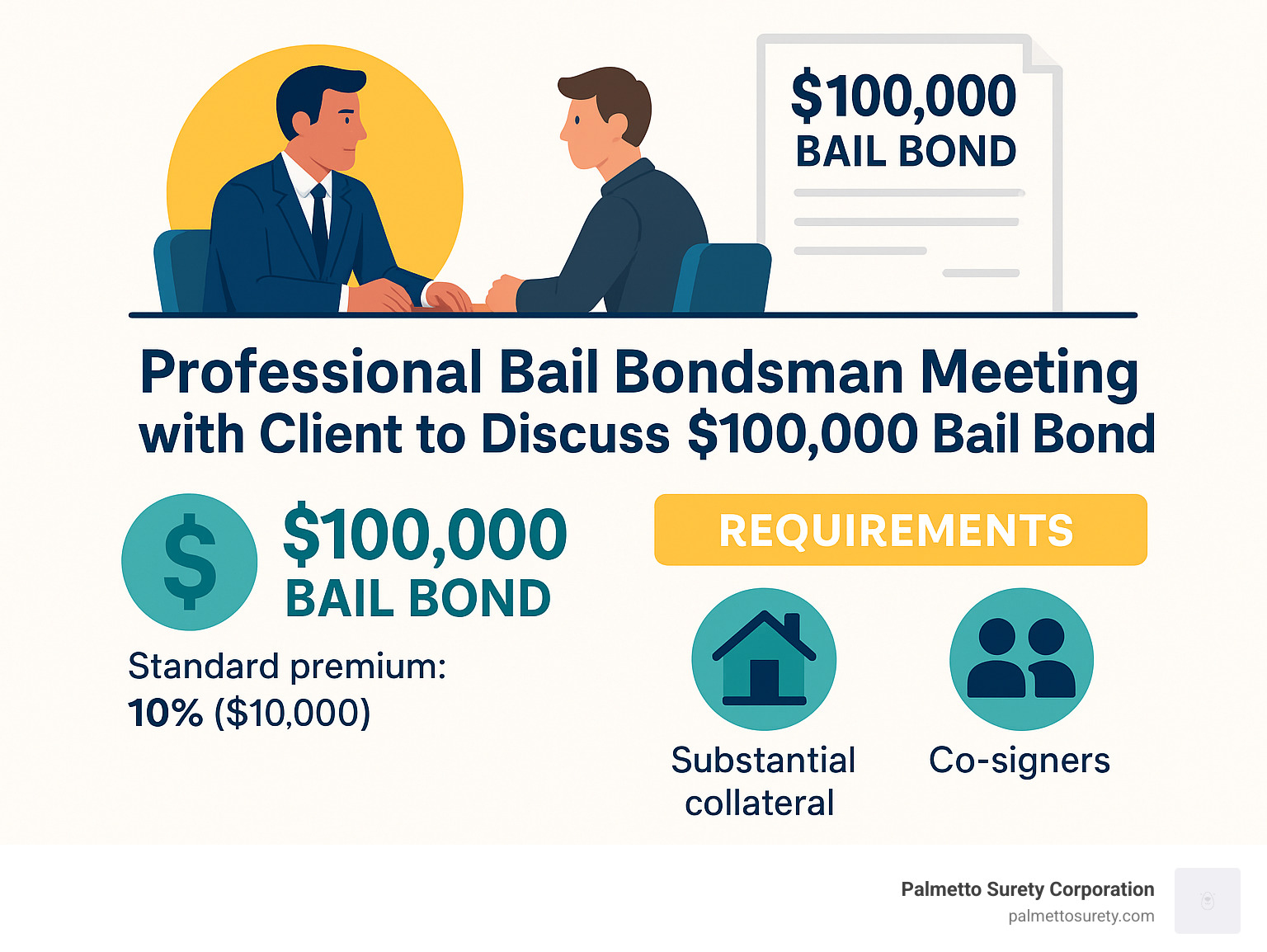
Remember these essential points about how much does a 100 000 bail bond cost:
The standard premium is typically 10% ($10,000), though you might pay less in states with regulated rates like California (7-10%) or Connecticut ($7,150). This fee compensates the bondsman for taking on significant financial risk on your behalf, which is why it remains non-refundable regardless of your case outcome.
For bonds of this size, you’ll likely need to provide substantial collateral (property, vehicles, or valuables) and/or reliable co-signers. These co-signers should understand they’re accepting serious financial responsibility if the defendant misses court.
The good news is that most bail bond agencies offer payment plans to make the immediate financial burden more manageable. Qualifying for discounts (military, union membership, attorney referrals) can further reduce your costs.
By planning carefully and working with experienced professionals, you can steer this challenging process with confidence. Our bail bond agents across Georgia, Florida, South Carolina, Louisiana, Mississippi, Tennessee, and Texas are available around the clock to answer your questions and provide the assistance your family needs during this difficult time.
For more information about our surety bond services, visit Palmetto Surety Corporation.


