


bounty hunter equipment list: 10 Essential Powerful Tools 2025
Essential Gear for Success in Fugitive Recovery
When it comes to fugitive recovery, having the right tools isn’t just about convenience—it’s about safety and success. As someone who’s worked with recovery agents across the Southeast, I’ve seen how a well-prepared bounty hunter equipment list can make all the difference between a smooth apprehension and a risky situation.
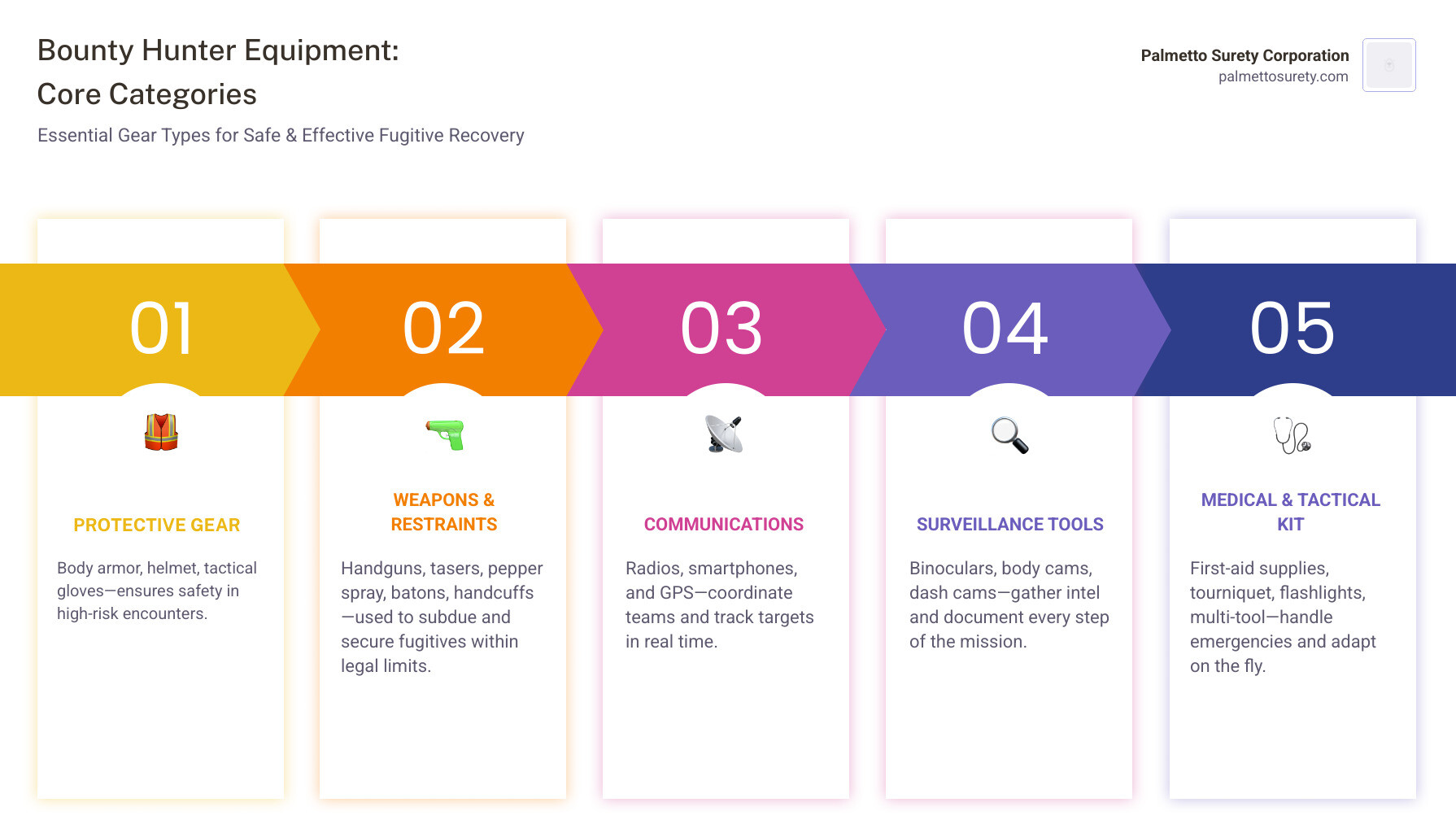
The modern fugitive recovery professional needs to balance protection with mobility. Your protective gear forms your first line of defense—a quality bullet-proof vest, helmet, and tactical gloves that won’t restrict movement during those crucial moments. You can’t complete a recovery if you can’t protect yourself first.
For restraint and control, you’ll need reliable tools like handcuffs, zip ties, and leg shackles. These essentials ensure that once you’ve located your subject, you can secure them safely for transport. Pair these with legally-permitted weapons and deterrents such as handguns, tasers, pepper spray, or batons—all depending on your jurisdiction’s regulations and your personal certification level.
Clear communication saves lives in this business. A dependable two-way radio and smartphone with GPS tracking capabilities keep you connected to your team and help steer unfamiliar territory. These tools work hand-in-hand with quality surveillance equipment like binoculars and body cameras that provide both intelligence and documentation of your actions.
Speaking of documentation, never leave home without your identification, proper arrest paperwork, and bail agreements. These papers aren’t just formalities—they’re your legal protection and authority to perform recoveries.
When situations get intense, tactical gear like a powerful flashlight, versatile multi-tool, and appropriate breach equipment can turn a potential standoff into a controlled situation. And because safety doesn’t end with the capture, a comprehensive medical kit with first-aid supplies, tourniquets, and trauma equipment is non-negotiable.
I’ve watched many recovery agents debate the merits of covert versus overt gear. Truth is, there’s no one-size-fits-all answer. Covert vests blend in during surveillance and allow for the element of surprise, while overt armor provides superior protection when you’re facing known high-risk situations. The smart approach is having options for different scenarios.

The capture tools in your arsenal should reflect a commitment to minimizing risk. Non-lethal options give you the ability to control situations without escalation, protecting both yourself and the subject you’re apprehending. A professional recovery isn’t measured just by success, but by how safely it was conducted.
As Haiko de Poel Jr, working with Palmetto Surety Corporation has given me unique insights into what makes for successful recoveries. I’ve seen that the agents who maintain a complete and well-maintained bounty hunter equipment list consistently achieve better outcomes with fewer complications.
In the following sections, we’ll dive deeper into each category of equipment, helping you build a comprehensive kit that meets the demands of modern fugitive recovery while staying within legal boundaries. Because in this business, being prepared isn’t just professional—it’s essential.
Ultimate Bounty Hunter Equipment List (Quick Glance)
Let’s face it—when you’re in the field tracking down a fugitive, the last thing you want is to realize you left a critical piece of gear back at the office. I’ve seen it happen too many times, and it’s why I’m passionate about proper preparation.
Having the right bounty hunter equipment list isn’t just about looking professional—it’s about coming home safely after every recovery operation. Whether you’re working covert or going in with a show of force, your gear selection can make all the difference.
Here’s what you need to have ready before you hit the streets:
| Category | Covert Operations | Overt Operations |
|---|---|---|
| Body Armor | Concealable vest with Coolmax® technology | Overt bullet & stab-proof vest with plate carrier |
| Weapons | Compact handgun, concealed taser | Full-size handgun, visible taser, baton |
| Restraints | Concealable handcuffs, zip ties | Standard handcuffs, leg shackles |
| Communications | Bluetooth earpiece, smartphone | Shoulder mic radio, smartphone |
| Surveillance | Mini cameras, covert audio recorders | Body cameras, dash cameras |
| Documentation | Digital copies on smartphone | Physical copies in weatherproof case |
| Tactical | Pocket flashlight, compact multi-tool | Tactical flashlight, full breach kit |
| Medical | Compact IFAK (Individual First Aid Kit) | Full trauma kit with tourniquet |
I always tell new agents that your equipment choices should reflect three things: your mission profile, local legal requirements, and your personal operating style. There’s no one-size-fits-all approach in this business.
As our friends at SafeGuard Clothing wisely point out, “The element of surprise is crucial for a bounty hunter to capture a target successfully. A bounty hunter can never be sure who is watching them, or who may pose a threat.”
This is especially true when working in unfamiliar territories. At Palmetto Surety, we’ve seen recovery agents face wildly different scenarios across the southeastern states we serve. What works in an urban Charleston environment might need adjustments for rural Georgia.
Safety and compliance should always trump convenience or cost. The best gear is the gear that helps you complete the job and return safely—everything else is just window dressing.
When building your kit, start with protection, then move to apprehension tools, and finally add your support equipment. This priority system ensures you’ve covered the essentials before moving on to the nice-to-haves.
Weapons & Non-Lethal Options
Let’s talk about what’s in the holster and on the belt. When it comes to the tools of the trade, bounty hunters walk a fine line between being prepared and staying legal. I’ve seen how the right equipment can make all the difference when things get tense.

Lethal Force Items on the bounty hunter equipment list
The reality is that bounty hunting can be dangerous work. While we always hope for peaceful surrenders, being prepared for worst-case scenarios is just good business.
Handguns remain the standard sidearm for most recovery agents. I typically recommend 9mm pistols to my colleagues for their ideal balance of stopping power, magazine capacity, and manageable recoil. Don’t skimp on your holster either—a quality retention holster can prevent a fugitive from accessing your weapon during a struggle.
Rifles aren’t everyday carry for most of us, but for high-risk recoveries, an AR-platform carbine offers versatility that’s hard to beat. They’re familiar, reliable, and provide accuracy at distances that handguns simply can’t match. That said, I’ve rarely needed one in 15 years of recoveries.
Choosing the right caliber matters more than many realize. In apartment buildings or dense neighborhoods, over-penetration is a serious concern. Quality hollow-point defensive ammunition expands on impact, reducing the risk of bullets passing through walls and endangering bystanders.
Remember those suppressors you see in movies? In reality, they’re heavily regulated NFA items requiring special permits. Most bounty hunters skip these entirely, as the paperwork and restrictions rarely justify their limited practical use in our line of work.
Non-Lethal Picks from the bounty hunter equipment list
I’ve found that non-lethal options often lead to smoother apprehensions with less paperwork and fewer legal headaches afterward.
Stun guns and tasers have become standard equipment on the bounty hunter equipment list. These devices temporarily incapacitate through neuromuscular disruption, giving you precious seconds to secure handcuffs. Models with distance deployment capabilities offer a significant advantage when subjects turn combative.
OC spray (pepper spray) remains effective for close-quarters situations. I personally prefer gel formulations over traditional spray—they’re less likely to blow back in your face on windy days, something I learned the hard way early in my career.
The humble expandable baton deserves more credit than it gets. It’s versatile for self-defense, creates distance between you and an aggressor, and can be used to control resistant subjects without causing permanent injury. Just be sure you’re trained in proper striking zones to avoid causing unnecessary harm.
For specialized operations, bean-bag shotgun rounds offer incapacitation at a distance. These less-lethal projectiles deliver a stunning blow without penetrating the skin, though they can still cause serious injury if misused or fired at close range.
Some recovery teams also carry restraint rounds designed to entangle rather than injure. While these specialized munitions have their place, they require significant practice to deploy effectively.
The truth is, my most valuable weapon has always been my mouth. Strong verbal de-escalation skills prevent physical confrontations more effectively than any gadget. As we always say at Palmetto Surety Corporation, “The best recovery is the one where nobody gets hurt.”
Weapons laws vary dramatically between states. What’s perfectly legal in South Carolina might land you in serious trouble in neighboring states. Always research local regulations before crossing state lines on a recovery operation.
Armor & Protective Gear
Let’s face it – when you’re tracking down someone who doesn’t want to be found, your safety has to come first. As a bounty hunter, your body armor isn’t just another piece of equipment – it’s your lifeline in unpredictable situations.
Covert Protection for Low-Profile Takedowns
Sometimes, the element of surprise is your greatest asset. When you need to blend in at the local coffee shop where your skip frequents, covert protection is your best friend:
Concealable vests have come a long way in recent years. These slim-profile options slide right under regular clothing without giving away your profession. As one experienced agent told me, “The best bounty hunters are the ones nobody realizes are bounty hunters until the cuffs come out.”
Modern vests featuring Coolmax® technology are a game-changer for those long surveillance operations. I remember my first stakeout with old-school gear – I was practically swimming in sweat by hour three. Today’s moisture-wicking fabrics keep you dry and comfortable, even during those humid southern summers we know all too well in Palmetto territory.
The trade-off with covert gear is always mobility versus protection. These lighter options will stop most handgun rounds, but don’t expect them to handle rifle fire or determined knife attacks. For many routine pickups, though, this balance of protection and freedom of movement is exactly what you need.
Body armor considerations should always match your specific operation. As our partners at SafeGuard Clothing explain, “A covert vest fits under clothing and remains undetectable, preserving the element of surprise” – crucial when you’re trying to casually approach someone at their workplace or family gathering.
Overt Protection for High-Risk Entries
When intelligence suggests your fugitive won’t come quietly, it’s time to gear up properly:
Plate carriers are the workhorses of high-risk recovery. These tactical vests hold rigid armor plates and can be quickly donned when a situation escalates. Many of our experienced agents keep them ready in their vehicles, just in case.
Rifle plates come in various materials – ceramic, steel, or modern composites. Level III and IV plates offer serious protection against rifle rounds, though they’ll definitely add some weight to your frame. After a full day wearing these, you’ll know you’ve had a workout!
Don’t forget your head! Tactical helmets protect against both bullets and that doorframe you didn’t see coming during a dynamic entry. Your brain is kind of important, so this isn’t the place to cut corners on your bounty hunter equipment list.

The industry wisdom holds true: “Overt vests offer higher ballistic and stab protection for known high-risk captures involving heavy ammunition.” While you’ll sacrifice stealth looking like you’re ready for a tactical operation, sometimes that visible show of force actually prevents violence – nobody wants to test whether your gear works as advertised.
At Palmetto Surety, we’ve seen how proper protective gear has saved our agents from serious injury numerous times over our 20+ years in the business. We always tell our new bondsmen – you can’t make a successful recovery if you don’t make it home safely first.
High-Tech Tracking & Surveillance Tools
The days of bounty hunters relying on instinct and paper trails are long gone. Today’s fugitive recovery agents leverage cutting-edge technology that would make old-school manhunters green with envy. From digital tracking to thermal imaging, the modern bounty hunter equipment list includes tech that transforms how bail jumpers are located and apprehended.
Covert Tech Picks from the bounty hunter equipment list
When you need to stay under the radar, these tools let you gather intel without tipping off your target:
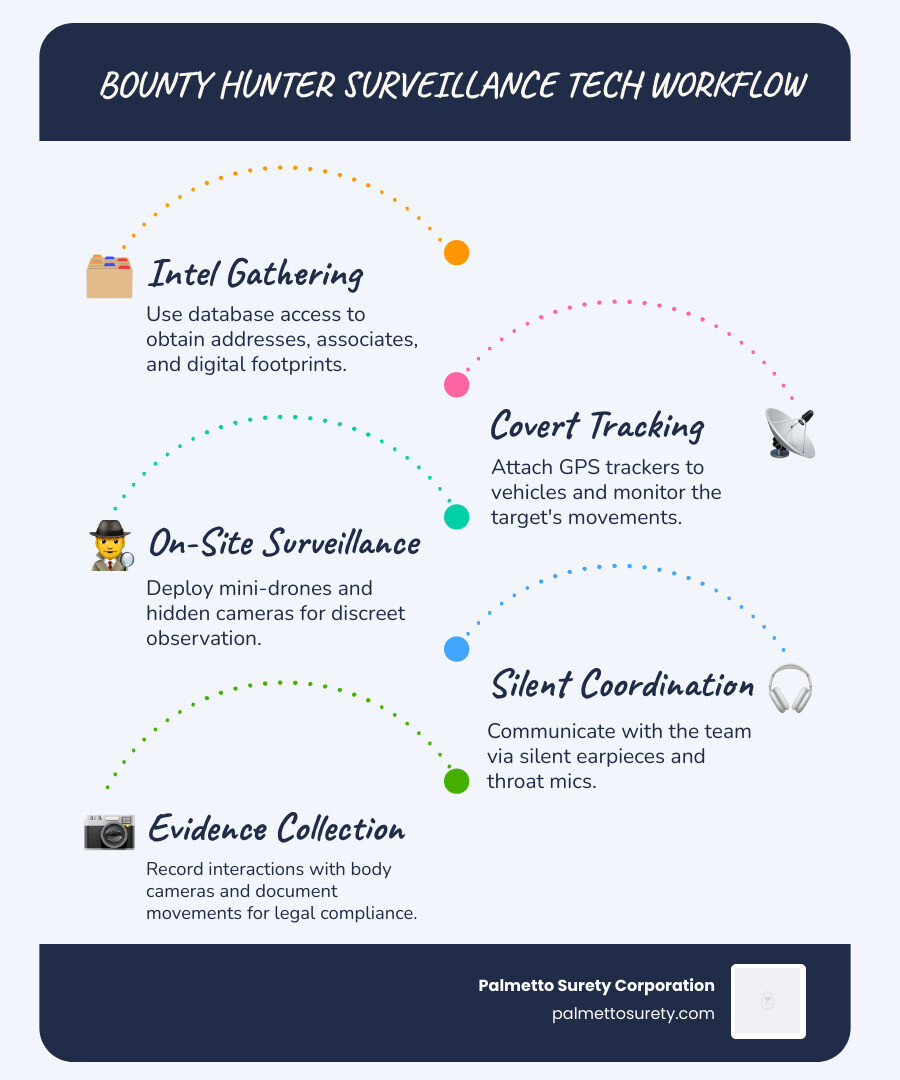
Mini-drones have revolutionized surveillance work. These palm-sized flying cameras can scout locations from above, giving you eyes where you can’t physically go. The best models include thermal capabilities for nighttime operations, letting you spot a target’s heat signature through windows or dense foliage.
Hidden cameras disguised as everyday objects—smoke detectors, wall clocks, even phone chargers—can be strategically placed to monitor locations your fugitive might visit. I once placed a camera in a birdhouse outside a girlfriend’s house, which caught our bail jumper visiting at 2 AM three days later.
Silent communication systems keep your team coordinated without obvious equipment. Bluetooth earpieces and throat mics that transmit vibrations directly from your vocal cords mean you can maintain constant contact without speaking above a whisper.
GPS trackers with strong magnets and long battery life can be quickly attached to vehicles, giving you real-time location data and movement patterns. The best models now offer geofencing alerts that notify you when the target enters certain areas.
While technology provides incredible advantages, remember what veteran recovery agents always say: “Keen observational skills can be as critical as physical tools and training.” The tech improves your abilities—it doesn’t replace good old-fashioned detective work.
Overt Tech for Show-of-Force Operations
Sometimes, visibility is an asset. When stealth isn’t required or when you want to project authority:
Loudhailers (bullhorns) provide clear communication during high-stress situations. They allow you to issue commands that can be heard inside buildings or across distances, reducing the need to physically approach potentially dangerous situations.
Body cameras serve dual purposes—protecting you from false accusations while gathering evidence of the apprehension. Most professional recovery agents now consider these mandatory equipment, especially in today’s litigious environment.
Shoulder radios might seem old-school, but they’re reliable, hard to jam, and their visible presence signals professional authority. The psychological impact of seeing a coordinated team with communications equipment can sometimes convince a fugitive to surrender without resistance.
Vehicle-mounted spotlights turn night into day during operations, disorienting subjects while providing tactical advantages for your team. A 3000-lumen LED spotlight can illuminate an entire property from the safety of your vehicle.
Modern bounty hunters use various database services that function somewhat like the fictional Kill-Warrant scanner from gaming culture. These comprehensive search tools reveal outstanding warrants across jurisdictions, compile court records, scan social media, and analyze known associates to build detailed target profiles.
At Palmetto Surety, we’ve seen how the right technology can dramatically improve capture rates while reducing risks for everyone involved. The fugitive recovery landscape continues to evolve, with new tools emerging regularly that balance effectiveness with legal compliance.
Medical, Survival & Support Kit
When you’re out tracking fugitives, you’ll often find yourself miles from help when things go sideways. Having the right medical and survival gear isn’t just smart—it could save your life or someone else’s.

Field Medical Must-Haves
I’ve seen enough bounty hunters learn the hard way that medical training and equipment are non-negotiable in this line of work. Your IFAK (Individual First Aid Kit) should be compact but comprehensive.
Modern tourniquets like the CAT or SOFT-T can be literal lifesavers when dealing with serious bleeding. Just make sure you’ve practiced applying them—fumbling with unfamiliar equipment during an emergency isn’t a great plan.
Hemostatic agents like QuikClot or Celox deserve a spot in your kit too. These miracle products can control bleeding in places where tourniquets won’t work, like neck or torso wounds. Pair these with chest seals for penetrating injuries, and you’re prepared for worst-case scenarios.
Don’t overlook the basics either. Quality bandages and dressings in various sizes handle everything from minor scrapes to more serious wounds. And some over-the-counter pain relievers can make the difference between finishing your operation or having to call it quits.
As industry guidance notes, “Physical fitness and self-defense training are considered crucial for bounty hunters, as the job may require running, scaling obstacles, and engaging in physical altercations.” Your medical kit should reflect these physical demands of the job.
Survival Gear & Vehicle Load-Out
Long stakeouts and rural pursuits mean you need to be self-sufficient. Start with a well-stocked go-bag—essentially a 24-48 hour survival kit you can grab in seconds if you need to move fast.
Staying hydrated is critical, especially during extended operations. Keep bottled water in your vehicle, but also pack a portable water filter for emergencies. I once spent three days tracking a skip through rural Tennessee, and that little filter saved me from some questionable water sources.
High-calorie rations that don’t need cooking are worth their weight in gold. Energy bars, jerky, and trail mix will keep you going when there’s no time for proper meals.
Your vehicle is your mobile command center, so set it up right. A good jump starter can save your operation when your battery dies miles from civilization. Add basic recovery equipment like tow straps and a shovel—I’ve pulled myself out of more muddy parking spots than I care to admit.
Don’t forget climate-appropriate gear. Extra layers, rain gear, or cooling equipment depending on your region can mean the difference between comfort and misery (or worse, hypothermia or heat stroke).
Some basic climbing gear like rope, carabiners, and a simple harness might seem excessive until you need to access a second-story window or secure a perimeter. The bounty hunter equipment list should always include these basics for unexpected obstacles.
The best bounty hunters I know organize their vehicles with modular storage systems—everything has its place and can be accessed quickly, but doesn’t scream “law enforcement” to casual observers. A clean, organized system means you’ll have what you need when you need it most.
Legal, Maintenance & Transport Essentials
The gear is only half the battle in bounty hunting – knowing how to transport it legally and keep it in top condition is what separates professionals from amateurs in this high-stakes field.
Staying Compliant Across Jurisdictions
The patchwork of laws governing bounty hunters varies dramatically as you cross state lines, creating potential legal landmines for the unprepared.
“I learned this lesson the hard way,” shares a veteran recovery agent who works with Palmetto Surety Corporation. “What’s perfectly legal in South Carolina can land you in jail in Florida if you don’t know the local statutes.”
Always carry both digital and physical copies of relevant laws for every jurisdiction where you operate. This is particularly crucial in the Southeast where Palmetto Surety Corporation provides bail bonds across Georgia, Florida, Louisiana, Mississippi, South Carolina, Tennessee, and Texas – each with their own unique legal frameworks.
The bounty hunter equipment list should include a legal reference guide based on the landmark 1872 Supreme Court case Taylor v. Tainter, which established the foundation for modern bounty hunting. This ruling gives bail recovery agents certain authorities that even police officers don’t have in some states, including the ability to cross state lines in pursuit of fugitives.
When it comes to warrantless entry – one of the most powerful and controversial tools in a bounty hunter’s arsenal – proper documentation is non-negotiable. Keep copies of the bail bond agreement, court documents, and any other paperwork establishing your legal authority to apprehend the subject. These documents aren’t just formalities – they’re your legal shield.
Your professional credentials should always be readily accessible. Many jurisdictions require immediate presentation of licenses and identification upon request, and failure to produce them can invalidate an otherwise lawful apprehension.
Maintaining & Transporting Your Kit Safely
Even the best gear fails when poorly maintained, and in this profession, equipment failure can be life-threatening.
“I clean my firearms after every use, check my body armor weekly, and test all electronic equipment before each operation,” notes a successful recovery agent. “When your life depends on your gear, maintenance isn’t optional.”
Develop a regular cleaning schedule for all equipment, particularly for items that see heavy use or exposure to the elements. Your bounty hunter equipment list should include maintenance supplies for each piece of gear you carry.
Body armor requires special attention – regularly inspect it for damage, compression, or deformation that could compromise its protective capabilities. Most manufacturers recommend replacement every five years, even without visible damage.
Transporting your equipment safely isn’t just about preventing theft – it’s about legal compliance. Use lockable, tamper-evident cases for weapons and sensitive gear. The image above shows a professional-grade equipment trunk that provides both security and organization.
Vehicle security deserves special consideration. Many recovery agents install hidden compartments or bolted lockboxes in their vehicles to secure equipment during surveillance operations. An unsecured weapon in your vehicle could create serious legal problems if finded during a routine traffic stop.
Documentation systems aren’t the most exciting part of the bounty hunter equipment list, but they’re among the most important. Maintain detailed logs of equipment purchases, maintenance schedules, and deployments – these records are invaluable for both tax purposes and potential legal challenges.
At Palmetto Surety Corporation, we’ve seen how proper equipment maintenance and legal compliance directly correlate with successful fugitive recovery operations and reduced liability issues for our bail agents. The most successful recovery professionals understand that their equipment is only as good as their knowledge of how to use it legally and their commitment to keeping it in optimal condition.

Frequently Asked Questions about Bounty Hunter Gear
What gear is legally restricted for bounty hunters?
When I talk to new bail recovery agents, this is often their first question—and for good reason. The legal landscape for bounty hunters varies dramatically depending on where you’re working.
Military-grade weapons are almost universally off-limits. This includes fully automatic firearms, explosives, and specialized weapons that even law enforcement might need special permissions to use.
Anything that looks like police identification is asking for trouble. I’ve seen new agents make this mistake, purchasing badges or ID cards that could be confused with official law enforcement credentials. This can lead to serious legal consequences including impersonation charges.
Certain restraint devices fall into a gray area. TASER devices, for instance, are permitted for bounty hunters in some states but strictly controlled or prohibited in others. The same applies to chemical agents like CS gas.
Surveillance equipment is perhaps the trickiest category. What’s perfectly legal in Georgia might violate wiretapping laws in Florida. One-party consent for recording conversations is the rule in some states, while others require all parties to consent.
At Palmetto Surety, we’ve been helping bail agents steer these complex requirements for over 20 years. We always recommend consulting with a local attorney who specializes in bail enforcement before purchasing equipment for a new jurisdiction.
How do I balance protection, mobility, and stealth?
The eternal triangle of bounty hunting—protection, mobility, and stealth—requires thoughtful consideration based on your specific situation.
Start with a solid risk assessment for each recovery operation. When apprehending a first-time offender who missed court for a non-violent offense, you might prioritize stealth and mobility. For a fugitive with a history of violence, protection should take precedence even if it means sacrificing some mobility.
I recommend developing mission-specific loadouts rather than using the same gear for every situation. This approach has served me well throughout my career. What works for surveillance in an apartment complex won’t necessarily be ideal for an apprehension in a rural setting.
Many successful recovery agents use a layered approach. I often wear covert armor during initial surveillance, with additional protective gear readily accessible in my vehicle. This gives me the flexibility to adapt as the situation evolves.
Regular training with your gear is absolutely essential. I’ve seen agents purchase top-quality equipment only to find during an operation that they can’t move effectively or access their tools quickly enough. Practice until your equipment feels like a natural extension of yourself.
“The most common essential equipment for bounty hunters includes a bullet-proof vest, handcuffs, and at least one defense weapon such as a Taser, pepper spray, baton, or firearm (depending on local laws),” as industry guidance explains. The real skill comes in knowing which tools to deploy in each specific situation.
What are common rookie mistakes when buying equipment?
After two decades in this industry, I’ve seen new bounty hunters make the same equipment mistakes time and again.
Overbuying tops the list. That shiny catalog of tactical gear can be tempting, but loading yourself down with unnecessary equipment will only slow you down and complicate your operations. Start with the essentials and add items as you identify specific needs.
Many rookies prioritize the “tactical look” over function. The most effective recovery agents I know often blend in completely with their surroundings rather than dressing like they’re storming a compound. Your goal is to locate and apprehend, not to intimidate the general public.
Neglecting quality when it comes to safety equipment is a potentially deadly mistake. Your body armor, restraints, and weapons are not the places to cut corners. I’ve seen cheap handcuffs fail during transport and budget holsters release weapons at the worst possible moments.
Ignoring training requirements for specialized equipment is surprisingly common. That advanced surveillance system or less-lethal option is only effective if you know how to use it properly under stress. Budget for training alongside any significant equipment purchase.
Many new agents overlook maintenance needs for their gear. Quality equipment requires regular inspection, cleaning, and occasional replacement of components. Factor these ongoing costs into your budget from the beginning.
At Palmetto Surety Corporation, we’ve built our reputation on supporting bail agents throughout the southeastern United States. We’ve consistently seen that the most successful bounty hunters focus on quality over quantity and function over appearance when building their bounty hunter equipment list.
Conclusion
When it comes to success in the bail enforcement world, having the right bounty hunter equipment list isn’t just about looking the part—it’s about staying safe, operating legally, and bringing fugitives to justice efficiently.
Throughout this guide, we’ve walked through the essential gear that professional bounty hunters rely on daily. From body armor that might save your life to the surveillance tech that helps you locate your target, each piece serves a crucial purpose in this challenging profession.
At Palmetto Surety Corporation, we’ve spent over two decades watching what works (and what doesn’t) for bail agents across the Southeast. Our experience shows that the most successful fugitive recovery specialists aren’t necessarily those with the most expensive gear—they’re the ones who thoughtfully select quality equipment that matches their specific needs and jurisdiction requirements.
Your equipment is only as good as your training. Even the best body armor or most advanced surveillance system won’t compensate for poor judgment or lack of proper technique. That’s why ongoing education and skills development should be considered essential “equipment” for any serious professional.
For bail agents working with us throughout Georgia, Florida, Louisiana, Mississippi, South Carolina, Tennessee, and Texas, we offer more than just surety bonds. Our team provides guidance on legal compliance, risk management, and professional development to help you build a sustainable career in this challenging field.
Balance is everything in this profession. The right mix of protection, mobility, and legal awareness creates the foundation for success. Whether you’re just starting out or looking to upgrade your current gear, focus on building a kit that serves your specific operating environment and the types of fugitives you typically pursue.
The most valuable tools in your arsenal aren’t physical at all—they’re your knowledge, judgment, communication skills, and professional network. As one experienced bounty hunter told me, “The best capture is the one where I never had to touch my weapon or restraints because I talked them into surrendering peacefully.”
If you’re working in the bail enforcement field and looking for a reliable surety partner, our team at Palmetto Surety Corporation is ready to support your business with fast bond approvals—often within hours—and the backing of our decades of industry experience.
For more information about our surety bonds and services for bail agents, visit Palmetto Surety Corporation or contact one of our offices throughout the southeastern United States. We’re here to help you succeed in this challenging but rewarding profession.


