


freight forwarder bond requirements: 7 Powerful 2025 Secrets Revealed
Understanding Freight Forwarder Bond Requirements
So you’re diving into freight forwarding and wondering what all this talk about bonds is about? Let me break it down for you in plain English.
Freight forwarder bond requirements are essentially your ticket to legally operate in this industry. At their core, these bonds are a $75,000 financial guarantee required by the Federal Motor Carrier Safety Administration (FMCSA). Think of them as a promise that you’ll play by the rules and fulfill your obligations to shippers and carriers.
The government doesn’t mess around with these requirements – they were established through the MAP-21 Act and are spelled out in federal regulations (49 CFR Part 387). Every domestic surface freight forwarder needs this bond, and you’ll need to renew it annually to keep your operating authority active.
I’ve seen many newcomers to the industry surprised by these requirements, but they serve an important purpose. Unlike insurance (which protects you), these bonds protect everyone else doing business with you. If you fail to pay carriers or mishandle shipments, the bond provides a financial safety net for those who might otherwise be left holding the bag.
“A freight forwarder is an individual or entity that has been issued an operating authority as a forwarder in interstate or foreign commerce.” – FMCSA
Hi there! I’m Haiko de Poel Jr, a fractional Chief Marketing Officer who’s helped numerous surety companies steer these regulations. After years in this industry, I’ve seen how these bonds create trust in the transportation ecosystem and keep everyone accountable.
You’ll often hear these terms thrown around when discussing freight forwarder bond requirements:
– bmc-84 bond (the surety bond option)
– broker bond cost (what you’ll pay for coverage)
– freight broker insurance cost (related expenses)

Why This Guide Matters
Let’s be honest – understanding freight forwarder bond requirements isn’t exactly the most exciting part of starting your business. But it might be one of the most critical.
I’ve seen too many freight forwarders learn the hard way what happens when you don’t have your bonding in order. The FMCSA oversees roughly 16,000 freight forwarders and brokers across the country, and they don’t take compliance lightly. Operating without proper bonding can stop your business dead in its tracks – with penalties that include complete revocation of your operating authority.
Whether you’re just getting started or you’ve been in the business for years, having a clear understanding of these requirements helps you protect what you’ve built. The regulations can change, and staying informed is your best defense against unexpected compliance issues.
This guide cuts through the confusing regulatory language to give you exactly what you need to know – in terms that actually make sense. Because at the end of the day, you want to focus on growing your business, not worrying about whether your paperwork is in order.
Freight Forwarder Bond Requirements Explained
The legal foundation for freight forwarder bond requirements wasn’t always what it is today. Back in 2012, the transportation industry saw a significant shift when President Obama signed the Moving Ahead for Progress in the 21st Century Act (MAP-21). This legislation raised the minimum bond amount from $10,000 to $75,000—a substantial increase that reflected growing financial risks in the transportation world.
If you’re looking for the nitty-gritty details, you’ll find them in 49 CFR Part 387. This section of federal regulations spells out exactly what financial responsibility looks like for motor carriers, brokers, and freight forwarders. Think of it as the rulebook that keeps everyone financially accountable.
Not all freight forwarders face identical requirements, though. If you’re handling household goods, you’ll need the standard $75,000 bond plus additional cargo insurance (either a BMC-34 or BMC-83) covering $5,000 per vehicle and $10,000 per occurrence. Property freight forwarders, on the other hand, just need the standard $75,000 bond without those extra insurance requirements.
To operate legally, you must obtain proper operating authority through the FMCSA’s Unified Registration System (URS) and keep your bond or trust fund active at all times. No exceptions!
What Is a Freight Forwarder Bond?
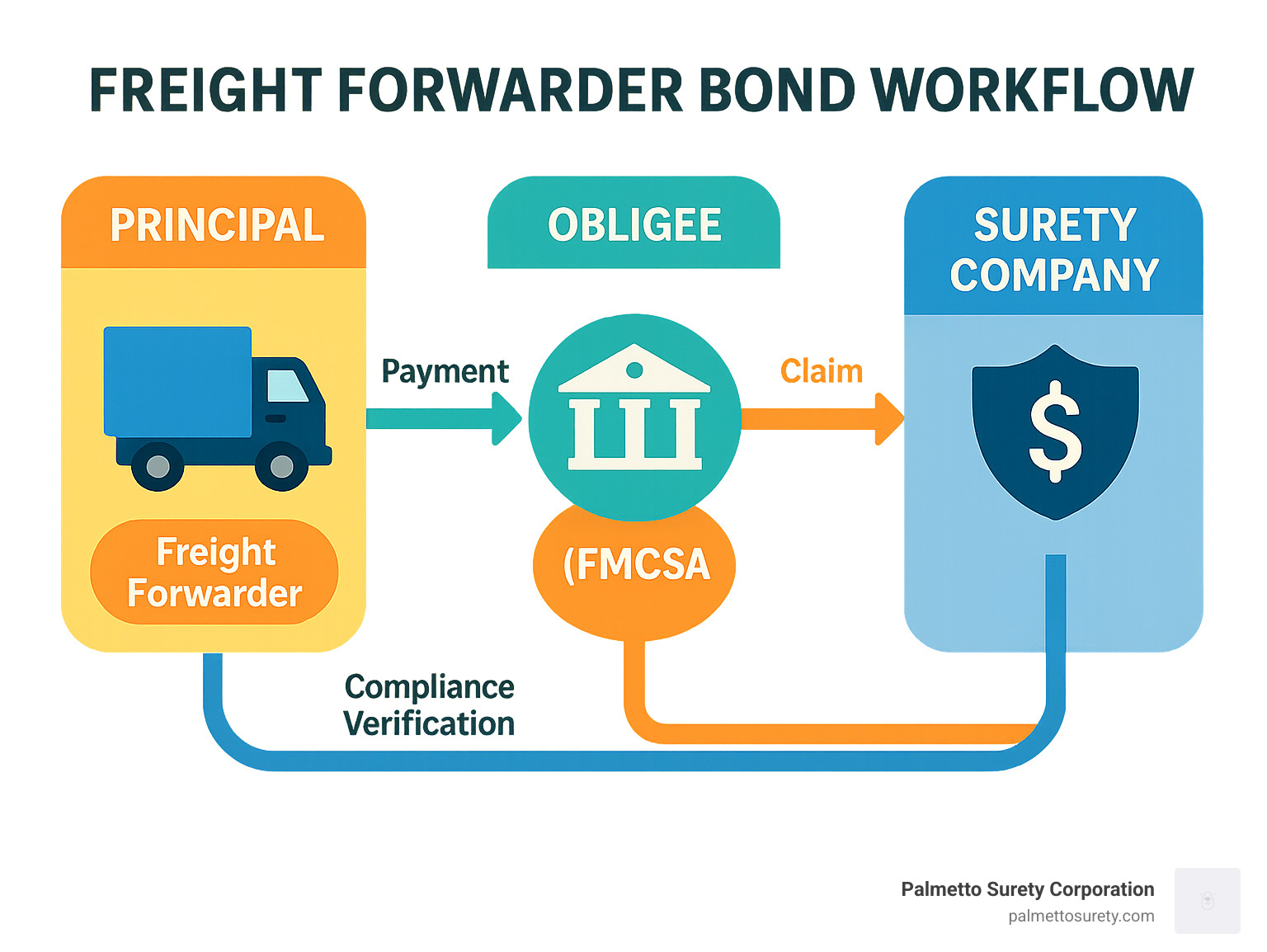
Think of a freight forwarder bond (BMC-84) as a three-way promise between:
- The Principal (that’s you, the freight forwarder)
- The Obligee (the FMCSA, which requires the bond)
- The Surety (a company like Palmetto Surety Corporation that issues the bond)
This arrangement isn’t just paperwork—it’s a financial guarantee that you’ll play by the rules and honor your contracts. If something goes wrong and you don’t fulfill your obligations, the surety company steps in to cover valid claims up to the bond amount. Of course, they’ll then turn to you for reimbursement.
As one industry expert puts it: “Securing a surety bond should not be a hassle. It should be a process that supports your business’s growth and success.”
Why the Requirement Exists
You might wonder why the government insists on these freight forwarder bond requirements. The answer is simple: protection for everyone involved.
These bonds protect shippers by giving them somewhere to turn if their cargo is damaged or lost. They protect carriers by ensuring they’ll get paid for the transportation services they provide. And they protect the industry as a whole by discouraging fly-by-night operators who might otherwise enter the business with no intention of playing fair.
Let me share a real example: A freight forwarder in Georgia failed to pay several motor carriers for services they had provided in good faith. Those carriers weren’t left high and dry, though—they filed claims against the forwarder’s bond. After investigation, the surety company paid the valid claims, ensuring the carriers didn’t suffer financial losses while holding the freight forwarder accountable.
Who Must Comply with Freight Forwarder Bond Requirements?
If you fall into any of these categories, you need to comply with freight forwarder bond requirements:
Domestic surface freight forwarders who arrange for property transportation by motor carrier in interstate commerce need a bond. Property brokers who connect shippers with authorized motor carriers need one too. And if you’re one of those versatile companies with dual authority as both a broker and freight forwarder, you’ll need to be bonded as well.
Here’s a money-saving tip: If your company holds both Property Broker and Freight Forwarder authority issued in the same corporate name, you only need one $75,000 bond to satisfy the FMCSA. That’s a significant cost saving for businesses that wear multiple hats.
It’s worth noting that ocean freight forwarders and air freight forwarders operate under different regulatory frameworks (the Federal Maritime Commission and Federal Aviation Administration, respectively) and have their own distinct bonding requirements.

Minimum Bond Amount and Other Freight Forwarder Bond Requirements
The cornerstone of freight forwarder bond requirements is the $75,000 minimum bond amount. This isn’t just an arbitrary number—it represents the maximum financial protection available to claimants through the bond.
Beyond that minimum amount, there are several other key requirements you should know about. First, your bond funds must be readily available to pay claims. This means no relying on personal guarantees or collecting pledged accounts receivable when a claim comes in. Second, bonds can’t be cancelled until 30 days after the FMCSA receives written notice. And third, you must maintain appropriate public liability insurance in addition to your bond.
These requirements ensure that your bond isn’t just a checkbox—it’s genuine financial protection for everyone you do business with.
2024 FMCSA Improvements
The FMCSA didn’t just set requirements and walk away. In 2024, they implemented significant improvements to strengthen the freight forwarder bond requirements framework. These changes aim to provide better financial security while protecting motor carriers from non-payment risks.
The new rules tighten up asset liquidity requirements. Now, trust assets must consist only of cash, FDIC-insured irrevocable letters of credit, or Treasury bonds—all of which must be liquid within seven calendar days. By January 16, 2026, entities serving as BMC-85 trustees must be FDIC-insured depository institutions, insurance companies, or Federal Reserve members. And if your available security falls below $75,000, you have just seven calendar days to replenish it.
The FMCSA now has the authority to suspend a broker’s or freight forwarder’s operating authority when available security falls below $75,000 and isn’t replenished within that seven-day window. This proactive approach helps ensure continuous compliance with financial responsibility requirements—keeping everyone safer and more secure.
BMC-84 vs BMC-85: Picking the Right Vehicle
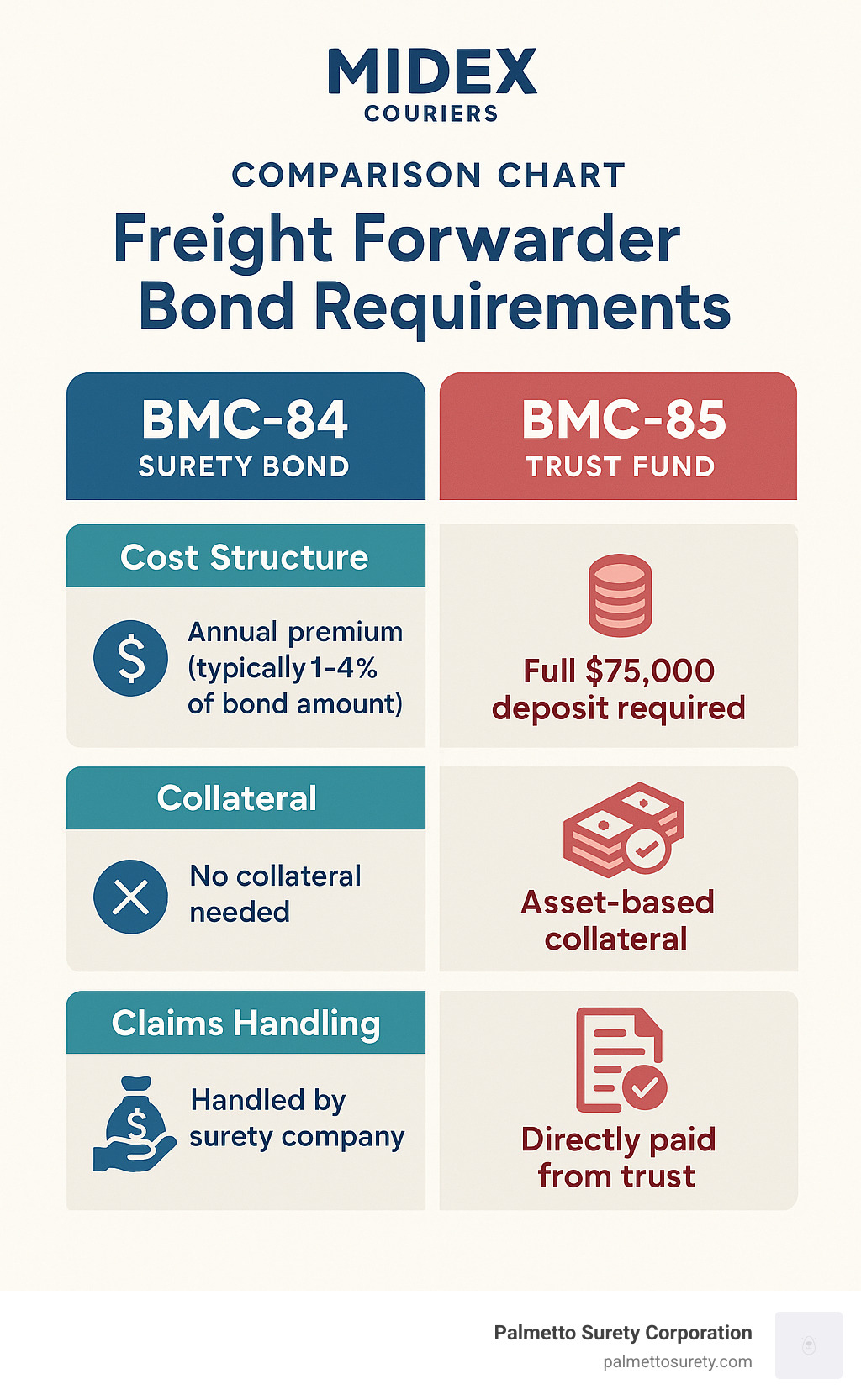
When meeting freight forwarder bond requirements, you have two primary options: the BMC-84 surety bond or the BMC-85 trust fund agreement. While both satisfy the FMCSA’s financial responsibility requirement, they function very differently.

How a BMC-84 Surety Bond Works
The BMC-84 surety bond functions as a credit facility extended by the surety company. Here’s how it works:
- The freight forwarder pays an annual premium (typically 1-15% of the bond amount)
- The surety company provides a guarantee to the FMCSA for the full $75,000
- If valid claims arise, the surety pays them (up to $75,000)
- The freight forwarder must reimburse the surety for any claims paid
Key advantages of the BMC-84 include:
- No Full Collateral Required: Unlike trust funds, surety bonds don’t require posting the full $75,000
- Working Capital Preservation: Your operating capital remains available for business growth
- Claims Expertise: Surety companies typically have specialists who can help evaluate and resolve claims
All surety companies issuing BMC-84 bonds must be listed on the Department of Treasury’s Circular 570, which ensures they meet federal financial stability requirements.
Mechanics of a BMC-85 Trust Fund
The BMC-85 trust fund agreement works quite differently:
- The freight forwarder deposits the full $75,000 into a trust account
- A qualified trustee manages these funds
- The money remains in trust as long as the freight forwarder maintains operating authority
- Claims are paid directly from the trust fund
Under the 2024 FMCSA rules, trust assets must consist only of:
* Cash
* FDIC-insured irrevocable letters of credit
* Treasury bonds
All assets must be liquidatable within seven calendar days to ensure claims can be paid promptly.
Choosing Between Them
When deciding between a BMC-84 bond and a BMC-85 trust fund, consider these factors:
Capital Impact:
* BMC-84: Requires only an annual premium (typically $938-$9,000)
* BMC-85: Requires the full $75,000 deposit
Speed:
* BMC-84: Can often be approved within hours through companies like Palmetto Surety Corporation
* BMC-85: May take longer to establish the trust relationship and deposit funds
Ongoing Costs:
* BMC-84: Annual premium payments, which may decrease with good credit and claims history
* BMC-85: Opportunity cost of $75,000 in restricted funds, plus trustee fees
For most freight forwarders, especially smaller operations or startups, the BMC-84 surety bond offers the most cost-effective solution. However, large, well-established companies with ample cash reserves might prefer the BMC-85 option to avoid recurring premium payments.
As one industry expert notes: “Unlike alternatives, our freight broker bonds usually don’t require collateral to obtain, which is crucial for smaller freight brokers.”
Application, Cost & Renewal Roadmap
Navigating the application, cost, and renewal process for meeting freight forwarder bond requirements doesn’t have to give you a headache. I’ve helped hundreds of freight forwarders through this journey, and I’m happy to break it down into manageable steps that make sense.

Step-by-Step to Obtain Your Bond
Getting your freight forwarder bond doesn’t have to be complicated. Think of it as a recipe with specific ingredients that need to be added in the right order.
First, you’ll need to obtain your FF Number through the FMCSA’s Unified Registration System. This is your unique identifier in the system and the foundation for everything that follows.
Next, you’ll submit Form OP-1(FF) to apply for your freight forwarder authority. This paperwork tells the FMCSA exactly what services you plan to provide.
Don’t forget to designate a process agent by filing Form BOC-3. This might sound technical, but it’s simply naming someone who can accept legal documents on your behalf in each state where you operate. Think of it as having a designated recipient for important mail.
Now comes the actual bond application. You’ll need to provide your personal or business information, credit details, and your newly acquired FMCSA/MC number. At Palmetto Surety, we’ve simplified this step to take just minutes, not days.
Once approved, you’ll pay your premium to activate your bond. The final step is the electronic filing – we handle this for you by submitting your bond information directly to the FMCSA’s database.
Here in the Southeast – whether you’re in sunny Florida, the mountains of Tennessee, or anywhere in Georgia, Louisiana, Mississippi, South Carolina, or Texas – we understand the local business landscape and can steer any state-specific requirements that might apply to your operation.
How Much Will It Cost?
The million-dollar question (or rather, the $75,000 question): what will your bond actually cost? The answer depends largely on a few key factors.
Your credit score plays a significant role – better credit means lower premiums, just like with most financial products. Your business experience also matters; established companies with a proven track record typically qualify for better rates than newcomers.
The overall financial strength of your business can make a difference too. Strong balance sheets and healthy cash flow statements tell sureties you’re a lower risk. And if you’ve had previous bond claims, that history will likely affect your future premiums (not always in your favor, unfortunately).
For most freight forwarders, premium costs typically fall within these ranges:
If you have excellent credit, expect to pay around $938-$1,500 annually (roughly 1.25%-2% of the bond amount). With good credit, premiums typically run $1,500-$3,750 (about 2%-5%). Those with fair credit might pay $3,750-$7,500 (approximately 5%-10%), while challenging credit situations could see premiums of $7,500-$9,000 (about 10%-12%).
At Palmetto Surety, we’ve been helping freight forwarders find competitive rates for over 20 years. Even if your credit isn’t perfect, we often have solutions that other providers might not offer. We believe everyone deserves a fair shot at building their business.
Renewal & Ongoing Compliance
Meeting your freight forwarder bond requirements isn’t a one-and-done affair – it requires staying on top of annual renewals to maintain compliance. Think of it as regular maintenance that keeps your business running smoothly.
Your BMC-84 bond is valid for one year from the filing date. As that expiration approaches, your surety company will send you a renewal notice – but it’s wise to mark the date in your calendar as well.
Timely payment of your renewal premium is crucial. Any gap in coverage could result in the suspension of your operating authority, which can bring your business to a screeching halt. When you renew, your surety company will handle the electronic filing with the FMCSA, confirming your continued compliance.
One recent change worth noting: the FMCSA portal now requires using Login.gov with multi-factor authentication. While this adds an extra step to the login process, it significantly improves security for your sensitive business information.
At Palmetto Surety Corporation, we take care of the entire renewal process for our clients. We’ll send timely reminders, process your renewal efficiently, and handle all the electronic filing with the FMCSA. Our goal is to make this annual requirement as painless as possible so you can focus on what matters most – running your freight forwarding business.
Claims, Cancellations, Penalties & FAQs
Understanding how claims work, what happens if your bond is cancelled, and the penalties for non-compliance is essential for any freight forwarder. Let’s walk through these critical aspects of freight forwarder bond requirements together.

How Claims Are Filed and Resolved
When someone files a claim against your freight forwarder bond, you’re entering a structured process that protects all parties involved.
It typically starts with a claim notice – usually from a motor carrier who hasn’t been paid or a shipper whose goods were mishandled. They’ll contact your surety company directly to start the process.
Once received, your surety kicks off an investigation to determine if the claim is valid. This is where having a reputable surety partner really pays off. At Palmetto Surety Corporation, our experienced claims team digs into the details, gathering documentation and statements from all parties.
If the claim is found valid, the surety pays the claimant (up to the $75,000 bond limit) and then turns to you for reimbursement. This is where that indemnity agreement you signed comes into play – it legally obligates you to pay back every penny the surety paid out on your behalf.
Here’s a real-world example: A freight forwarder in Alabama arranged for a carrier to transport machinery from Birmingham to Nashville. When the carrier wasn’t paid the $3,200 owed after 60 days, they filed a claim against the forwarder’s bond. After verifying the legitimate service and lack of payment, the surety paid the carrier and then collected reimbursement from the forwarder.
What Happens if the Bond Is Cancelled or Falls Below $75k
The consequences of bond cancellation or insufficient coverage are swift and serious.
First, there’s the 30-day notice requirement – your bond can’t be cancelled until 30 days after the FMCSA receives written notice. This gives the agency time to notify you and ensure you secure replacement coverage.
Under the 2024 FMCSA rules, if your bond falls below the required $75,000 threshold – perhaps due to a claim payout – you have just seven calendar days to replenish it. The clock starts ticking immediately, and it moves fast.
If you don’t replenish in time, the FMCSA can automatically suspend your operating authority. No hearing, no grace period – just an immediate stop to your legal ability to operate.
The new rules also require surety providers to notify the FMCSA electronically within two business days of any payment or even anticipated drawdown that would affect your security amount. This means the FMCSA can act proactively when they know a pending claim might drop your coverage below the minimum.
“The seven-day replenishment rule has fundamentally changed how freight forwarders must manage their financial responsibilities,” notes one of our bond specialists. “There’s simply no room for delay when your bond is compromised.”
Consequences of Non-Compliance
Failing to meet freight forwarder bond requirements creates a cascade of business problems that can be devastating.
The most immediate impact comes in the form of civil penalties – monetary fines that can quickly add up. But the real damage is the revocation of your operating authority. Without this authority, every load you arrange is effectively illegal, exposing you to even greater liability.
Beyond the legal consequences, there’s the reputational damage. Word travels fast in the transportation industry. Carriers who learn you’ve had bond compliance issues may refuse to work with you, or demand payment upfront, creating cash flow challenges.
The resulting business interruption can be fatal to your operation. Every day without proper bonding is a day you can’t legally conduct business.
FMCSA data shows the real-world impact: approximately 1.3% of brokers (about 429 in 2022) experienced a drawdown on their bond or trust fund. While the average claim was around $1,900, about 18% of cases involved claims exceeding the $75,000 bond amount – a sobering reminder of what’s at stake.
Frequently Asked Questions about Freight Forwarder Bond Requirements
Do I need separate bonds for broker and forwarder authority?
Good news – if your company holds both Property Broker and Freight Forwarder authority issued in the same corporate name, you only need one $75,000 bond. This single bond satisfies the freight forwarder bond requirements for both authorities, representing a significant cost saving for diversified transportation businesses.
Can I switch from a BMC-85 trust to a BMC-84 bond mid-year?
Absolutely! You can switch between a BMC-85 trust fund and a BMC-84 surety bond at any time. The critical factor is ensuring there’s no gap in coverage. Make sure your new security is firmly in place before cancelling the old one. At Palmetto Surety, we often help clients make this transition smoothly, coordinating with their trust fund provider to ensure continuous compliance.
How do I check the status of my bond online?
Checking your bond status is straightforward through the FMCSA’s License & Insurance website. Simply enter your MC or USDOT number, and the system displays your insurance and bond information, including the effective date and status.
For our clients at Palmetto Surety Corporation, we also provide easy access to bond information through our customer portal. We believe in transparency throughout the bonding process – you should never have to wonder about the status of something so critical to your business.
With over 20 years in the surety bond industry, our team at Palmetto has guided countless freight forwarders through the claims process, helped them maintain continuous compliance, and provided peace of mind during regulatory changes. We’re particularly attuned to the unique needs of forwarders in the Southeast region, including Georgia, Florida, Louisiana, Mississippi, South Carolina, Tennessee, and Texas.
Conclusion
Navigating freight forwarder bond requirements doesn’t have to feel like sailing through stormy seas. With the right partner by your side, securing your bond becomes a smooth voyage rather than a regulatory headache.
At Palmetto Surety Corporation, we’ve spent over two decades helping freight forwarders just like you secure the bonds they need to operate legally and confidently. What sets us apart? Our ability to approve most applications within hours – because we understand that in your business, time truly is money.
Our deep roots in the Southeast region give us unique insights into the local challenges freight forwarders face. From our Charleston, SC headquarters to our presence across Georgia, Florida, Louisiana, Mississippi, South Carolina, Tennessee, and Texas, we bring a personalized touch to every interaction.
Whether you’re a seasoned freight forwarding veteran or just starting your journey, we’re here to help you steer through the complexities of freight forwarder bond requirements with confidence. Our team takes pride in making the process as painless as possible – explaining options in plain English, finding competitive rates, and handling the paperwork so you can focus on what you do best.
Many of our clients tell us they appreciate our one-stop service approach. Need help understanding the difference between a BMC-84 and BMC-85? Wondering how to handle the renewal process? Concerned about potential claims? We’ve got answers to all these questions and more, delivered with the warmth and clarity you deserve.
For more information about how we can help with your freight forwarder bond needs, visit our website or reach out to one of our friendly surety experts today. We’re not just selling bonds – we’re building relationships that help your business thrive.
The right bond isn’t just about meeting regulations – it’s about protecting your business and giving you peace of mind. Let us help you find that perfect fit.


