


Surety Bond for Lost Title: 3 Easy Steps
Why a Surety Bond for Lost Title is Your Path to Legal Vehicle Ownership
A surety bond for lost title is a financial guarantee protecting the state and previous owners when you need to register a vehicle without the original title. Here’s what you need to know:
Quick Answer:
- What it is: A three-party agreement between you, the DMV, and a surety company
- When you need it: Lost, stolen, or damaged titles; inherited vehicles; bill of sale only
- Cost: Typically 1-3% of the bond amount (usually 1.5-2x vehicle value)
- Duration: Usually 3 years, then converts to standard title
- Purpose: Allows legal registration, insurance, and sale of your vehicle
Common situations requiring a surety bond for lost title:
- You bought a car but never received the title from the seller
- Your original title was lost, stolen, or destroyed
- You inherited a vehicle without proper title documentation
- The title is damaged or illegible
- You only have a bill of sale
The bond amount is typically 1.5 to 2 times your vehicle’s current market value. For example, if your car is worth $10,000, you’ll need a $15,000-$20,000 bond but only pay a small percentage as your premium.
The process is straightforward:
- Contact your local DMV to confirm bond requirements
- Get your vehicle appraised for current value
- Apply for the surety bond with required documentation
- Submit the bond to DMV to receive your bonded title
I’m Haiko de Poel Jr. of Palmetto Surety Corporation. I’ve helped countless clients steer the complexities of lost title bonds across the southeastern United States. My experience helps simplify the bonding process for our clients.
What is a Lost Title Bond and Why is it Necessary?
If you’ve bought a car without a title or inherited a vehicle with missing paperwork, a surety bond for lost title is your path to legal ownership. Also known as a Certificate of Title Bond or Defective Title Bond, this financial guarantee allows you to prove ownership when the original title is gone.

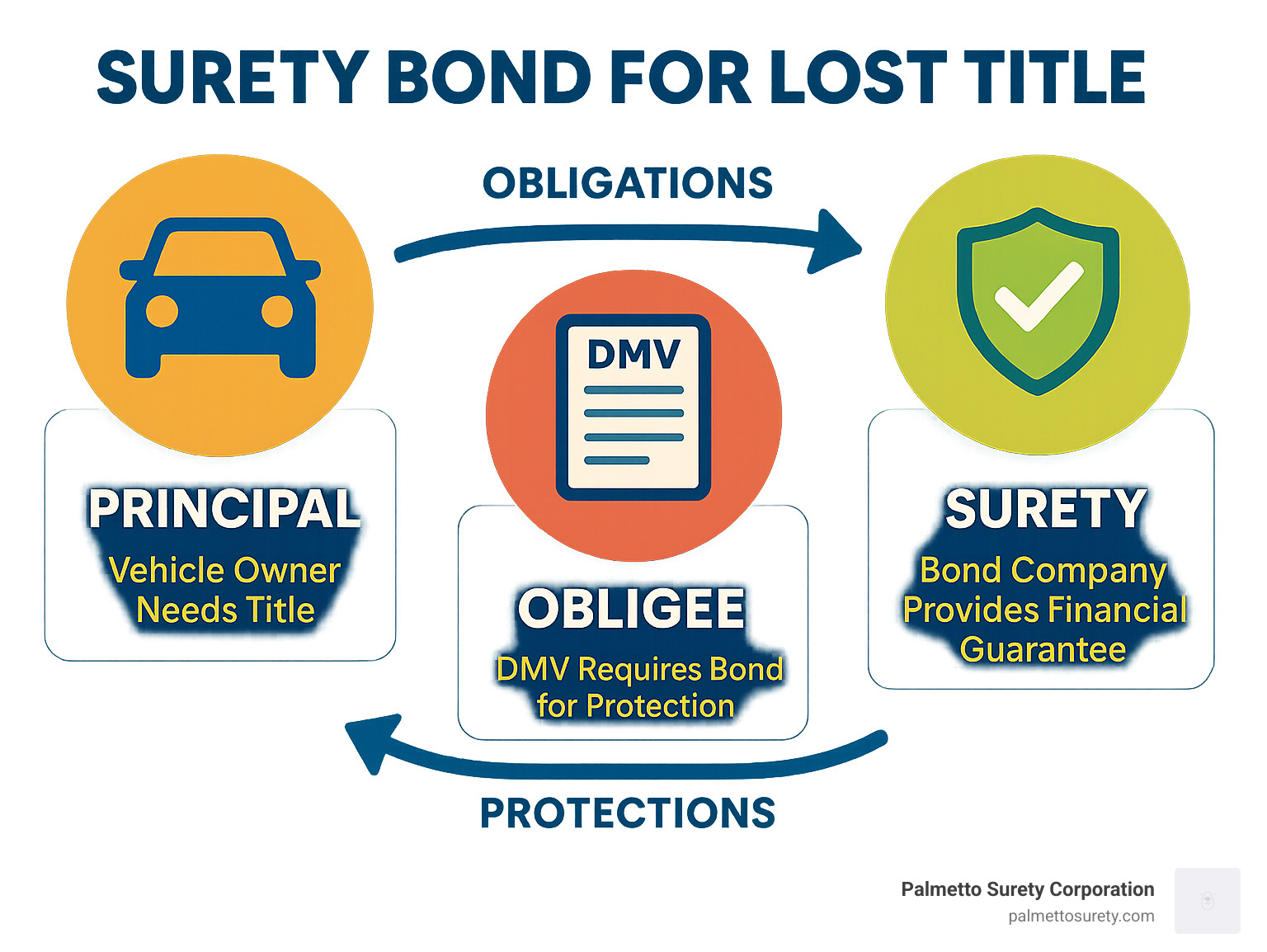
Think of it as an insurance policy for the DMV. They can’t just take your word that you own the vehicle; they need protection against future claims. A lost title bond provides that protection. It’s a three-party agreement between you (the principal), the DMV (the obligee), and a surety company. The surety financially guarantees that if a prior owner makes a valid claim, they will be compensated.
This protection is vital. Without a title, you can’t register, insure, or legally sell your car. The bond bridges this gap, giving the DMV the confidence to issue you a bonded title, protecting the state and any previous owners.
For more detailed information about how these bonds work and what’s involved in the process, you can visit our comprehensive guide: More info about surety bonds for lost titles.

Common Scenarios Requiring a Bonded Title
Over our 20+ years in business, we’ve seen many situations that require a surety bond for lost title. The most common include:
Title never received is a frequent issue. You bought a vehicle, but the seller never provided the title. This often happens with older vehicles or when previous lenders have gone out of business.
Title lost or stolen situations are when your original title was misplaced, stolen, or destroyed in a disaster like a fire or flood, leaving you without proof of ownership.
Damaged or illegible titles present another challenge. If the DMV can’t read crucial information on a damaged title, they can’t process a normal transfer.
Inherited vehicles without titles create unique problems. You’ve inherited a vehicle, but the title is missing, and the previous owner is unavailable to help with paperwork.
Bill of sale only scenarios occur when you have a receipt for your purchase but no actual title document was provided.
If any of these situations sound familiar, a bonded title is likely your path forward.
The Key Difference Between a Bonded Title and a Standard Title
A bonded title gives you the same rights as a standard title—you can register, insure, and sell your vehicle. The key difference is its provisional nature.
A standard title represents clear, undisputed ownership. It’s issued with no questions about who owns the vehicle.
A bonded title is provisional ownership backed by financial protection. It’s issued when the original title is missing, and the surety bond provides indemnification against potential future claims.
The most significant difference is the ownership challenge period. A bonded title typically has a 3-5 year window during which a prior owner could make a claim against the bond. During this time, your ownership is valid, but the “bonded” status acknowledges potential questions about the vehicle’s history.
Transferability works similarly for both, though buyers will be aware of the bonded status. The bond remains in effect for its full term regardless of who owns the vehicle.
After the bond period expires (usually three years) with no claims, the “bonded” designation is typically removed, and your title converts to a standard, clear title. The bonded title process is a legal pathway to establish ownership while protecting all parties.
The Step-by-Step Process to Obtain a Surety Bond for a Lost Title
Getting a surety bond for lost title is a straightforward process when broken down into manageable steps. Following this guide will help you get a legitimate title from your state’s motor vehicle department, allowing you to legally register, insure, and drive your vehicle.
In most states, a bonded title converts to a standard, clear title after a few years, making it a temporary solution that becomes permanent.
For a comprehensive walkthrough of this process, check out our detailed guide: More info on how to get a lost title bond.

Step 1: Contact Your Local DMV and Determine Requirements
Your first step is to contact your local Department of Motor Vehicles (DMV). Every state has unique requirements, so this step is crucial. Explain your situation clearly—whether your title was lost, never received, or destroyed—so they can confirm if you need a bonded title.
The DMV will also determine your required bond amount, usually calculated as 1.5 to 2 times your vehicle’s current value. An $8,000 car, for example, might require a $12,000 to $16,000 bond. You only pay a small premium, not the full bond amount.
Ask about specific forms and any additional requirements, such as certified letters to previous owners or a vehicle inspection. Getting this information upfront will save you time.
Can’t find your local office? Use this helpful resource: Find your local DMV office.
Step 2: Find Your Vehicle’s Value
Next, you must determine your vehicle’s value. This is crucial as it directly affects your bond amount and premium. Your DMV might require you to use the state’s Standard Presumptive Value, get an appraisal from a licensed dealer, or use recognized resources like the NADA Guide.
I recommend starting with Kelley Blue Book or the National Auto Dealers Association (NADA) for a realistic estimate based on your vehicle’s year, make, model, mileage, and condition.
Be honest about your vehicle’s condition. Accuracy protects you in the long run if your title is ever challenged. Most states require a bond equal to 1.5 times the vehicle’s worth. A $10,000 car typically needs a $15,000 bond, but you’ll only pay a small percentage of that as your premium.
Step 3: Apply for Your Surety Bond for a Lost Title
With 20 years in the business, we’ve streamlined our application. We can typically approve your surety bond for lost title application within hours.
You’ll need basic information: your contact details, the vehicle’s year, make, and model, the Vehicle Identification Number (VIN), and the bond amount specified by the DMV. Include any ownership documentation you have, like a bill of sale or insurance records.
The VIN is critical and can be found on the dashboard near the windshield, on the driver’s side door jamb, or on insurance and registration documents.
Our team prides itself on quick approvals and efficient service to get you back on the road legally.
For detailed information about what documentation you’ll need, visit: More info on lost title bond requirements.
Once approved, take the bond and required forms to the DMV. They will process everything and issue your bonded title.
Understanding the Costs and Terms of Your Bond
Understanding the cost of a surety bond for lost title requires knowing the difference between the “bond amount” and the “premium.” The bond amount is the total coverage, like an insurance policy limit. The premium is the much smaller, one-time fee you pay to get the bond.
Your premium depends on your state’s requirements, your vehicle’s value, and sometimes your credit history. For many vehicles, we offer simple flat rates, making the cost predictable.
For a comprehensive breakdown of what you can expect to pay, check out our detailed guide: More info on lost title bond cost.

How the Bond Amount is Determined
Your state’s DMV sets the bond amount using a specific method to ensure adequate protection. Most states use a vehicle value multiplier system, taking the vehicle’s current fair market value and multiplying it by 1.5 or 2. A $10,000 car might need a $15,000 or $20,000 bond.
This multiplier creates a financial cushion for potential costs beyond the vehicle’s value, such as legal fees or storage costs, if a rightful owner makes a claim.
Your DMV will specify how to determine the vehicle’s value, whether through Kelley Blue Book, the NADA guide, or an official appraisal. Following their requirements is key to avoiding delays.
Calculating the Cost: Your Premium for a Surety Bond for a Lost Title
The premium for a surety bond for lost title is an affordable, one-time cost that permanently solves your title problem. Most premiums are between 1% and 3% of the total bond amount. Your credit score can influence this rate, but many lost title bonds don’t require a credit check, especially for smaller amounts.
We offer flat rate pricing for vehicles with lower values. For instance, bonds up to $6,000 are available for a minimum premium of just $100. Many surety companies offer similar flat rates from $100 to $250 for smaller bonds.
In real terms, a $15,000 bond at a 1.5% premium rate would cost you just $225. This is a single payment for legal ownership of your vehicle, with no monthly fees.
Bond Validity and What Happens if a Claim is Made
Your surety bond for lost title has a specific lifespan, typically three to five years. This acts as a “waiting period” for anyone with a legitimate ownership claim to come forward. If no one makes a claim during this period, your bonded title usually converts to a standard, clear title.
What if someone does make a claim? While rare, the process is as follows:
First, we investigate the claim’s validity. If it is legitimate, we compensate the rightful owner up to the bond’s full value.
Surety bonds include an indemnity agreement. This means if we pay a claim on your behalf, you are responsible for reimbursing us, plus any legal costs. This sounds intimidating, but claims are uncommon because applicants genuinely believe they are the rightful owners.
The bond protects others and deters fraudulent claims, creating a fair system for everyone.
Frequently Asked Questions about Lost Title Bonds
After helping thousands of clients over 20 years, we’ve heard every question about getting a surety bond for lost title. Here are answers to the most common ones.
For even more detailed answers, visit our comprehensive FAQ page: More info on lost title bond FAQs
Can I sell a vehicle that has a bonded title?
Yes, you can sell a vehicle with a bonded title. To ensure a smooth process, there are a few key things to remember.
Be upfront with potential buyers about the bonded status, which is marked on the title. Honesty is legally important.
When you sell the vehicle, the bonded status transfers with the title. The new owner will have a bonded title for the remainder of the bond period (usually three years from its issue date). The bond remains in effect until it expires.
State rules can vary, so check with your local DMV. Most states treat the sale like any other vehicle transaction, but some may require additional paperwork.
Are there states that do not require a lost title bond?
Yes, not every state uses the bonded title process. Some have different procedures for missing titles.
Several states don’t allow bonded titles, including Delaware, Kansas, Kentucky, Louisiana, Maryland, New Jersey, North Dakota, Oklahoma, Oregon, Pennsylvania, South Carolina, South Dakota, and Virginia. These states typically have alternative procedures.
Some states like Indiana and Ohio prefer court-ordered titles, meaning you go through the court system instead of getting a bond.
This is why you must contact your local DMV first. They are the ultimate authority on your state’s specific and current requirements.
What are the consequences of not getting a bond when it’s required?
If your state requires a surety bond for lost title and you don’t get one, you cannot legally use your vehicle.
You won’t get a title, which means you can’t register the vehicle or get license plates. Without registration, you cannot legally drive on public roads.
Selling becomes impossible. No legitimate buyer will purchase a vehicle without a clear title, and you cannot legally transfer ownership without one. You would likely only be able to sell it for parts, losing most of your investment.
Insurance companies often won’t provide full coverage for untitled vehicles, leaving you financially exposed.
State penalties for driving an unregistered vehicle can include fines and impoundment, making the bond cost seem minor in comparison.
The bottom line: if the DMV requires a surety bond for lost title, it’s the only way to make the vehicle legally yours.
Conclusion
Obtaining a vehicle title when the original is missing doesn’t have to be a roadblock. A surety bond for lost title is your solution to this common problem. Without a clear title, you can’t register, insure, or sell your vehicle. A lost title bond provides a legitimate path to ownership while protecting all parties.
As we’ve covered, the process involves contacting your DMV, valuing your vehicle, and applying for the bond. The cost is not the full bond amount, but a small, one-time premium, typically 1% to 3% of the bond’s value.
At Palmetto Surety Corporation, we have over 20 years of experience helping clients in the southeastern United States with these situations. Our team understands the need for speed and has streamlined our process to approve most applications within hours.
If you’re in Georgia, Florida, South Carolina, Tennessee, Louisiana, or Mississippi, we can help you get bonded quickly and legally back on the road. Don’t let missing paperwork keep your vehicle parked. Our experienced team is ready to help you move forward today.
Get your commercial surety bond today


