


Statement of Fact: Crucial 2025 Guide
Why Understanding Statement of Fact Forms Matters
A statement of fact is a formal declaration asserting verifiable information as true. It’s a critical part of countless official transactions, from registering a vehicle to filing legal documents. These forms require you to certify that the information you provide is accurate and complete.
Quick Answer for Statement of Fact Forms:
- Definition: A legal document where you declare specific information to be true under penalty of law
- Common Uses: Vehicle registration, court proceedings, business licensing, property transfers
- Key Requirement: Must be verifiable and objective (not opinions or beliefs)
- Legal Weight: Often signed “under penalty of perjury” with serious consequences for false information
- Examples: DMV title forms, affidavits, contractor license applications, court declarations
From vehicle title transfers to sworn testimony, these documents form the backbone of our legal and commercial systems. Providing false information can have severe consequences. In Texas, for example, knowingly providing incorrect information is a third-degree felony under Transportation Code 501.155.
Understanding how to complete these forms accurately protects you from legal trouble and ensures smooth transactions. The principles are simple: be truthful, specific, and prepared to back up your claims with evidence.
I’m Haiko de Poel Jr. of Palmetto Surety Corporation. I’ve helped countless clients steer official documentation and the bonds that often accompany them. My experience shows that understanding these forms upfront saves time, money, and potential legal issues.
What is a Statement of Fact?

A statement of fact is your official way of saying “this information is true, and I can prove it.” It deals only with information that can be verified as true or false through evidence. The power of a statement of fact lies in its verifiability and objectivity—it must be based on provable data, not personal preference or belief. For a deeper understanding of what constitutes a fact, this resource provides excellent insights.

Distinguishing Facts from Opinions and Claims
It’s crucial to distinguish facts from opinions and unsubstantiated claims, as only facts belong on these official forms.
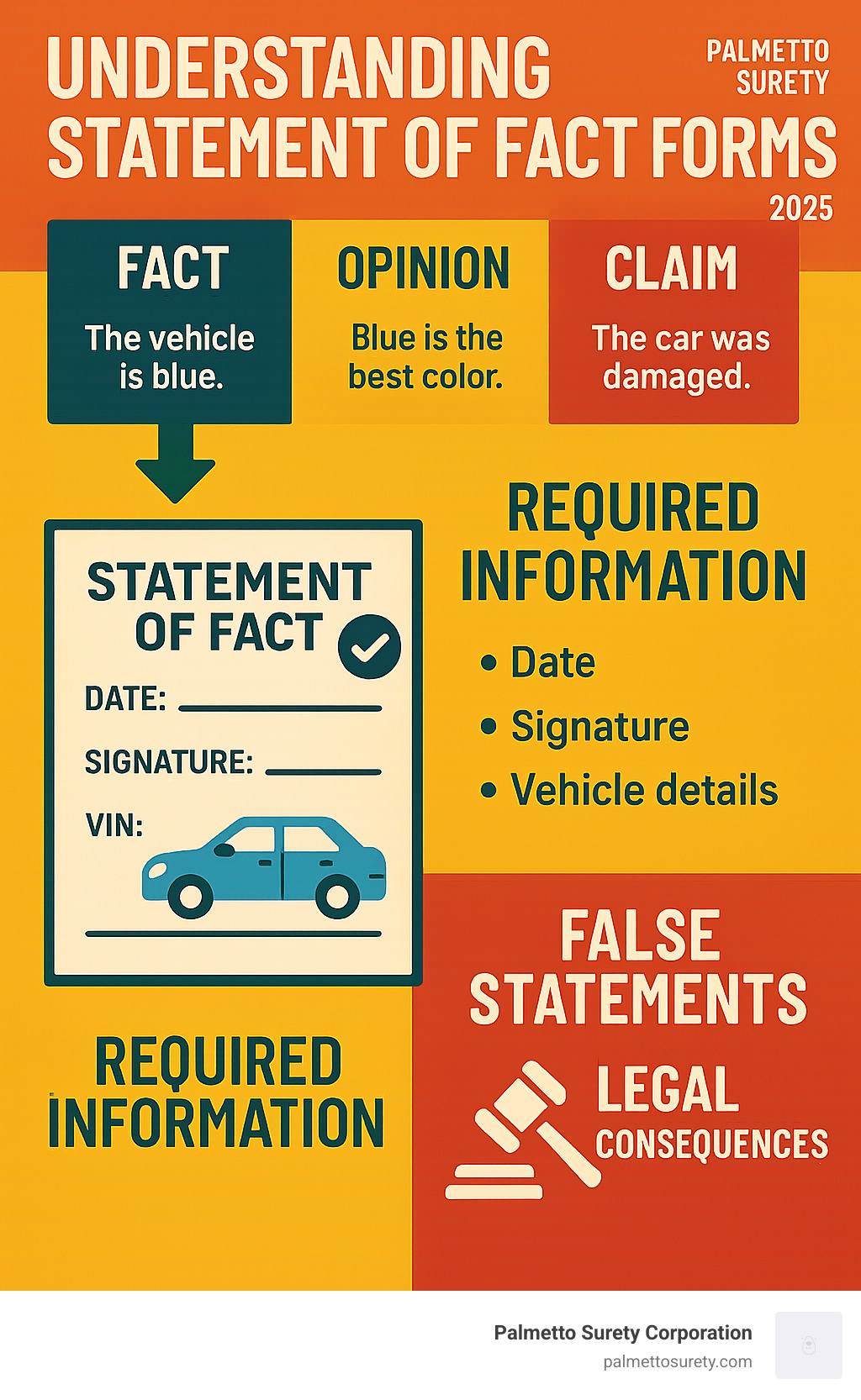
- Facts are objective and verifiable. For example, a car’s Vehicle Identification Number (VIN) is a fact.
- Opinions are subjective beliefs. “This is a great car” is an opinion, not a fact. Opinions reflect personal feelings, not verifiable evidence, and are unsuitable for official documents.
- Claims are assertions presented as facts but lack substantiation. A claim like “this bond will be approved” is not a fact until it is verified.
Legal documents require substantiation—proof to back up your statements. The goal is to provide reliable information, not persuasion.
Key Components of a Statement of Fact Form
Statement of fact forms consistently include several key components to ensure legal clarity.
- Dates: When events occurred and when the statement is made.
- Subject or Topic: A clear description of what the statement covers (e.g., vehicle information, residency details).
- Material Facts: The specific, relevant information. For vehicles, this includes the Vehicle Identification Number (VIN), year, make, model, and title number.
- Names of All Parties: Full legal names are required.
- Signature: Your certification that the information is true, carrying legal weight.
- Penalty of Perjury Clause: Most forms include language stating you are providing information “under penalty of perjury,” changing it into a legally binding document with serious consequences for false statements.
The Role of Factual Statements in Different Contexts
Statements of fact are the foundation of countless official and commercial interactions. From registering a vehicle to legal proceedings and business licensing, these declarations provide the reliable, concrete information needed to make decisions. In vehicle transactions, for example, forms requiring the Vehicle Identification Number (VIN) and Title Number create an official record that protects all parties involved.
In Legal and Official Documents
The legal world runs on statements of fact. When filing official paperwork or appearing in court, truth is a legal requirement.
- Affidavits, declarations, and sworn statements are formal factual statements that serve as building blocks for legal arguments and official records. They are often signed under penalty of perjury.
- Case briefs distill complex situations down to essential facts.
- Testimony in court relies on witnesses and experts providing factual information.
At Palmetto Surety Corporation, we regularly help clients steer these legal requirements. Our Court Bonds and Their Importance often support processes that rely on accurate factual statements. Understanding The Role of Surety in Legal Matters shows how financial backing reinforces the trust that these declarations create.
In Business and Commercial Transactions
Business relationships also depend on statements of fact for a foundation of trust.
- Contractor license bonds require applicants in states like Georgia, Florida, and Texas to make factual declarations about their experience and financial stability.
- Financial statements are factual claims about a company’s financial health that investors and lenders rely on.
- Performance bonds in construction are backed by factual information about a contractor’s capabilities and past performance.
- Business registration involves factual declarations about company ownership and structure.
Our experience at Palmetto Surety Corporation with Commercial Surety Bonds Explained across many industries highlights how critical accurate statements are to business success. Our ability to approve most applications within hours helps businesses quickly transform their factual declarations into the bonds they need to operate.
How to Write and Verify a Statement of Fact

Writing an effective statement of fact requires attention to detail and honesty. Use clear, concise language and present information in chronological order when possible. Every claim must be backed by supporting evidence like official documents or public records. For those interested in the philosophical nature of facts, A philosophical view on facts offers deeper insights.
Step-by-Step Guide to Completing a Form
Following these steps can prevent rejections and delays.
- Read the Instructions: Before writing, read all instructions carefully. Many forms, like the vehicle-related MV100, warn that alterations may lead to rejection.
- Gather Information: Collect all required details beforehand. For vehicles, this includes the Vehicle Identification Number (VIN) or Hull Identification Number (HIN), year, make, model, title number, and license plate. Also have your full legal name, address, and other personal details ready.
- Fill Out Accurately: Take your time filling out each section. Double-check numbers, as a single wrong digit in a VIN can cause major issues.
- State the Reason: Be specific about the reason for your statement. Instead of “vehicle issue,” write “correcting odometer reading on title application.”
- Review Carefully: Before signing, review the entire form for typos, incorrect dates, or missing information.
- Sign and Date: Sign and date the form as instructed. Your signature certifies that everything is true, often “under penalty of perjury.”
How to Verify Factual Claims
Knowing how to verify facts is as important as knowing how to write them.
- Cross-Reference Sources: Don’t rely on a single source. Confirm information with multiple independent, reputable sources.
- Seek Primary Documents: Whenever possible, consult primary sources like court records or official government publications.
- Consult Experts: For complex topics, seek advice from a qualified professional. Expert testimony carries significant weight.
- Watch for Misinformation: Be wary of sensational language, claims without citations, or information that seems too extreme.
- Use Critical Thinking: Question assumptions, evaluate evidence, and assess the credibility of the source. Responsible verification is key to ensuring the statements you rely on are trustworthy.
Legal Implications: Getting the Facts Wrong

Let’s be completely honest here – getting the facts wrong on a statement of fact form isn’t just embarrassing. It can land you in serious legal trouble, and I mean the kind that involves criminal charges, hefty fines, and potentially even jail time.
When you sign that official document, you’re not just filling out paperwork. You’re making a legal declaration that carries real weight in our justice system. The courts take these documents seriously because they form the foundation of countless legal and commercial transactions across the country.
The most serious consequence you might face is perjury. This isn’t just about making a mistake – perjury specifically means you knowingly provided false information. There’s an important distinction here: false testimony (information that turns out to be wrong) isn’t automatically perjury unless you intentionally lied. The law recognizes that honest mistakes happen, but deliberate deception is a different story entirely.
Fraud is another major concern. If your false statement of fact was designed to deceive someone or gain something you weren’t entitled to, you could face fraud charges. This is particularly serious in business transactions or when dealing with government agencies.
Here’s a real-world example that shows just how seriously states take this: In Texas, knowingly providing false information on a Statement of Fact form violates Texas Transportation Code 501.155 and constitutes a felony of the third degree. That’s not a slap on the wrist – that’s a serious criminal charge that can follow you for life.
The “Penalty of Perjury” Clause
You’ve probably seen those intimidating words at the bottom of official forms: “under penalty of perjury.” If you’re like most people, you might have glossed over this phrase, but it’s actually one of the most important parts of any statement of fact form.
When you sign your name next to these words, you’re doing much more than just completing paperwork. You’re making a sworn statement that transforms your simple form into a legally binding declaration. It’s like taking an oath in court, except you’re doing it with a pen instead of raising your right hand.
This clause exists for a simple reason: it puts you on notice that lying has serious consequences. The legal weight of your signature means that every piece of information you’ve provided is now certified as true under the full force of the law. If investigators later find that you knowingly provided false information, you can face criminal prosecution.
The beauty of this system is that it relies on trust while providing strong deterrents against dishonesty. Most people are honest, and the penalty of perjury clause helps ensure that the small percentage who might be tempted to lie think twice before doing so.
Your Statement of Fact in Court Proceedings
Here’s where things get really interesting – and potentially nerve-wracking. That statement of fact you filled out months or even years ago might suddenly become center stage in a courtroom drama you never saw coming.
Courts can admit your statement of fact as evidence in legal proceedings, and when that happens, every word you wrote gets examined under a legal microscope. Lawyers will scrutinize your declarations, looking for inconsistencies or contradictions that might help their case.
The impact on case outcome can be dramatic. If your statement is accurate and well-supported, it can be a powerful piece of evidence that strengthens your position. But if there are problems – if facts don’t line up or if information appears contradictory – it can seriously damage your credibility as a witness.
Think about it this way: if you’re involved in a legal dispute and the court finds that you provided inaccurate information on a previous statement of fact, how likely are they to trust your current testimony? Your credibility becomes questionable, and that can undermine your entire case.
This is particularly important in complex legal matters involving estates, business disputes, or situations requiring specialized bonds. For instance, cases involving Understanding Probate Bonds often rely heavily on sworn statements and factual declarations to establish the integrity of the process.
The bottom line is simple: accuracy isn’t just good practice when completing a statement of fact – it’s a legal necessity that can protect you from serious consequences down the road.
Frequently Asked Questions about Statement of Fact Forms
When it comes to statement of fact forms, we hear the same questions from clients time and again. These documents can feel intimidating at first, but understanding the basics helps everything fall into place. Let’s walk through the most common concerns people have.
What is the difference between a statement of fact and an affidavit?
Think of an affidavit as a statement of fact that’s gotten all dressed up for court. An affidavit is indeed a written statement of fact, but it goes through a formal process where you swear or affirm its truthfulness before a notary public or other authorized officer. This sworn oath gives the affidavit special legal weight and makes it admissible as evidence in court proceedings.
Here’s the key difference: while every affidavit contains a statement of fact, not every statement of fact needs to become an affidavit. For instance, when you fill out a vehicle registration form declaring your car’s details, you’re making a statement of fact. But unless the form specifically requires notarization, it doesn’t need the formal sworn process that creates an affidavit.
The distinction matters because affidavits carry extra legal weight due to that formal oath. Both documents require truthfulness, but affidavits have that additional layer of solemnity that comes with swearing before an official.
Can an opinion ever be considered a statement of fact in a legal context?
This is where things get interesting. Generally speaking, opinions stay in their own lane – they’re subjective beliefs that can’t be proven true or false. However, the legal world sometimes treats certain opinions as if they were factual statements, particularly in defamation and misrepresentation cases.
The trouble starts when someone presents an opinion that implies they know certain facts that they’re not sharing. For example, if someone says, “In my opinion, that contractor is dishonest,” without any factual basis, and it turns out the contractor has a spotless record, that “opinion” might be treated as a false statement of fact because it suggests the speaker knows something damaging that simply isn’t true.
There’s also the special case of expert testimony. When a qualified expert offers their professional opinion in court, it’s treated as factual evidence because it’s grounded in verifiable facts and established scientific principles. The expert isn’t just sharing a personal belief – they’re applying their specialized knowledge to factual observations.
Where can I get a statement of fact form?
The good news is that statement of fact forms are usually easy to find once you know where to look. The requesting agency typically provides them, and most have moved online to make the process smoother for everyone.
Your state’s Department of Motor Vehicles (or equivalent agency like the Department of Revenue) is your go-to source for vehicle-related forms. In states where we work – including Georgia, Florida, Louisiana, Mississippi, South Carolina, Tennessee, and Texas – these forms are readily available for download from official state websites.
For legal matters, court clerk’s offices maintain the forms you’ll need for court filings, affidavits, and legal declarations. Many courts now offer these documents online, saving you a trip to the courthouse.
Government websites at both state and federal levels house forms for business registration, licensing, and other official purposes. The key is going directly to the official source rather than third-party sites that might have outdated versions.
When in doubt, legal professionals can provide the right forms or create custom ones for your specific situation. They’ll ensure you have the most current version and help you understand any special requirements.
Always get your form from the official source or their website. Using an outdated or incorrect form can delay your process or, in some cases, invalidate your submission entirely.
Conclusion: The Importance of Accuracy and Honesty
Getting a statement of fact right isn’t just about following rules – it’s about maintaining the trust that keeps our entire legal and commercial system running smoothly. Think about it: every time someone buys a car, applies for a business license, or provides testimony in court, they’re relying on these forms to tell the truth. When we all do our part to be accurate and honest, everything works better for everyone.
The consequences of getting it wrong, though, are no joke. We’ve walked through how a simple mistake can cause delays and headaches, while deliberately providing false information can land you with serious criminal charges. Perjury and fraud aren’t just legal terms – they’re felony offenses that can follow you for life. In states like Texas, knowingly providing incorrect information on a statement of fact form is a third-degree felony. That’s a reality check that should make anyone pause before signing.
But here’s the good news: when you approach these forms with honesty and care, you’re not just protecting yourself – you’re contributing to a system that works for everyone. Your truthful statement of fact becomes part of a reliable record that others can depend on. Whether it’s a future car buyer checking vehicle history or a judge making important decisions, your accuracy matters.
For businesses and individuals dealing with complex legal and commercial requirements, having the right support makes all the difference. That’s where surety bonds come into play – they provide the financial backing that demonstrates your commitment to following through on your official declarations.
At Palmetto Surety Corporation, we’ve spent over 20 years helping people steer these requirements across the Southeast. Our ability to approve most bond applications within hours means you can move forward quickly once you’ve completed your statement of fact forms correctly. Whether you need a contractor license bond in Georgia, a court bond in South Carolina, or any other commercial surety bond, we’re here to provide the financial assurance that backs up your word.
The bottom line is simple: accuracy and honesty aren’t just legal requirements – they’re the foundation of doing business and living in a society where people can trust each other. When you take the time to get your statement of fact right, you’re upholding your end of that social contract. Learn more about Commercial Surety Bonds.


