


Requirements for bail bondsman: 5 Crucial Steps
Why Understanding Bail Bondsman Requirements Matters for Your Career
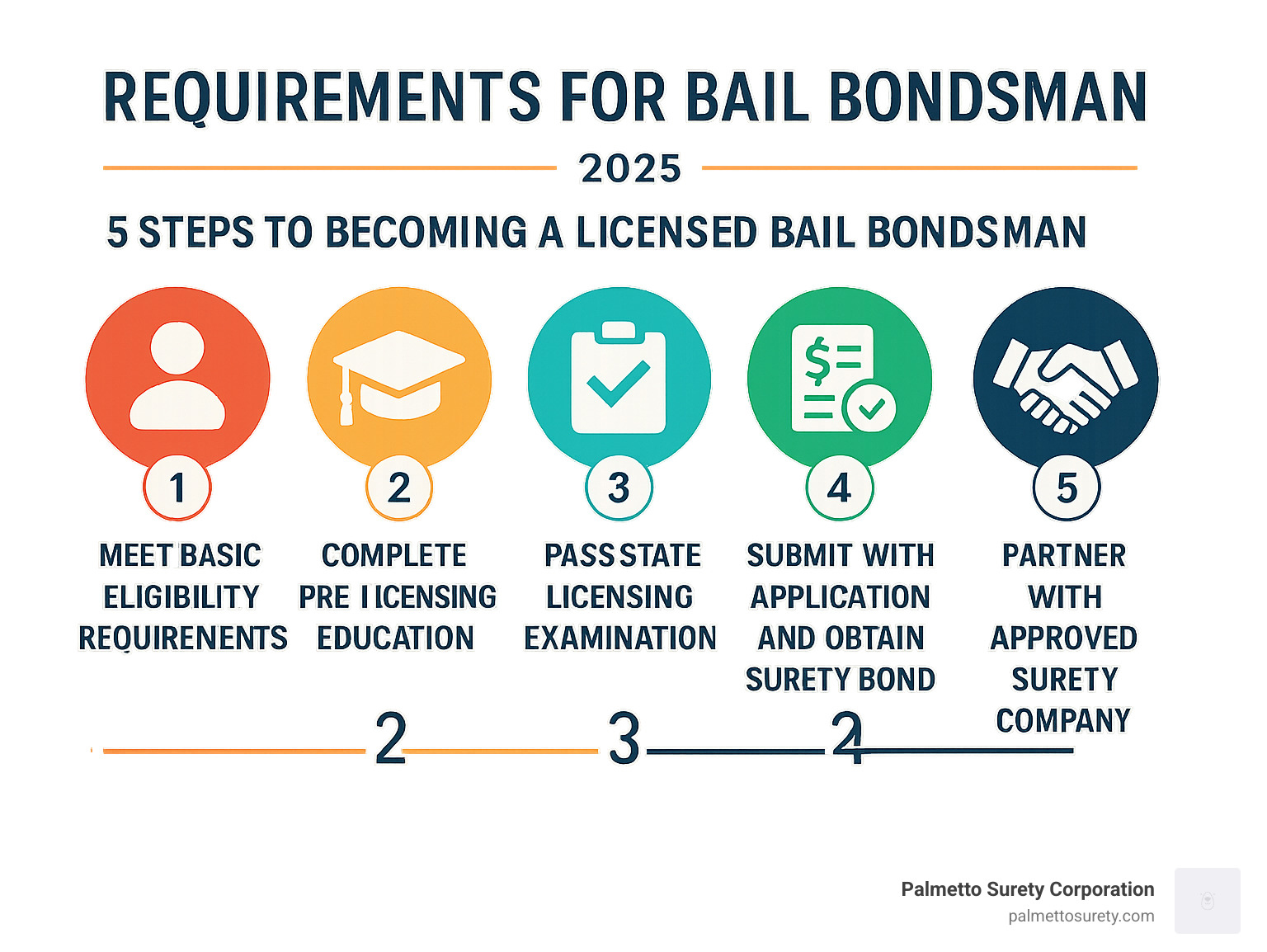
The requirements for bail bondsman licensing can seem complex, but they follow a clear path that varies by state. Here are the essential requirements most aspiring bail bondsmen must meet:
Basic Eligibility Requirements:
- Minimum age of 18 years old
- High school diploma or GED
- U.S. citizenship or legal residency
- Clean criminal background
- Pass fingerprinting and background checks
Education and Licensing Steps:
- Complete pre-licensing education (12-40 hours depending on state)
- Pass state licensing examination
- Submit application with required documents
- Obtain surety bond backing
- Partner with an approved surety company
The bail bond industry generates over $2 billion annually and offers an average salary of $72,480 for licensed professionals. With projected job growth of 4.9% over the next decade, becoming a bail bondsman can provide stable career opportunities in the criminal justice system.
However, requirements vary significantly by state. For example, Pennsylvania requires 24 hours of pre-licensing education, while North Carolina only requires 12 hours. Some states like Illinois and Massachusetts have banned for-profit bail bonding entirely.
Whether you’re drawn to helping families during difficult times or building a recession-proof business, understanding these requirements is your first step toward success.
I’m Haiko de Poel Jr., and through my work at Palmetto Surety Corporation, I’ve helped countless professionals steer the requirements for bail bondsman licensing across the southeastern United States. My experience in the surety industry has shown me that proper preparation and understanding of state regulations are crucial for anyone entering this field.

The Groundwork: Foundational Eligibility and Education
Becoming a bail bondsman requires a solid foundation. Before you can help families during stressful times, you must meet specific eligibility and educational requirements.
At Palmetto Surety Corporation, our 20+ years in business have shown us that proper preparation is the key to thriving in this industry.

General Eligibility: The Foundational Requirements for a Bail Bondsman
Before taking classes or exams, you must meet basic requirements for bail bondsman eligibility. These standards ensure that only trustworthy, capable individuals enter the profession.
Age is the first checkpoint. Most states require you to be at least 18, though some, like New York, set the age at 21. This reflects the significant responsibility of the role.
Education comes next. A high school diploma or GED is the minimum in nearly every state, ensuring you have the basic skills to handle contracts, calculate fees, and communicate clearly.
Your legal status matters. You must be a U.S. citizen or legal resident, as you’ll work closely with courts and law enforcement.
Your criminal background will be thoroughly examined. States typically prohibit licensing for anyone with felony convictions, especially those involving dishonesty. Some misdemeanors can also be disqualifying. This is crucial, as courts and families entrust you with significant financial and personal responsibility.
The background check includes fingerprinting and a comprehensive review of your history to protect everyone involved.
Pre-Licensing Education and Training
Once you clear eligibility, pre-licensing education provides the essential skills for a successful and legally compliant career.
State requirements vary dramatically. North Carolina requires 12 hours, Pennsylvania requires 24, and Virginia demands 40 hours of entry-level training. California’s requirements differ by license type.
These courses cover legal principles, ethics, financial management, and industry regulations.
Finding approved training providers is crucial. Only use state-sanctioned institutions; the Professional Bail Agents of the United States (PBUS) is an excellent resource for finding legitimate programs.
While not always required, additional college coursework in criminal justice, psychology, or accounting offers a significant advantage. Bilingual skills, such as Spanish, are also valuable.
Exceeding the minimum requirements in law, finance, and human behavior will better equip you to make smart decisions when freedom and finances are at stake.
Ongoing Requirements for License Renewal
Licensure is an ongoing commitment, requiring you to stay current with regulations.
Continuing education is mandatory in most states. Pennsylvania requires 24 hours every two years, California and North Carolina require 12, and Virginia requires 8. This is necessary as laws, procedures, and ethical challenges evolve.
License renewal fees are a standard business cost. Pennsylvania charges $100, and other states have similar fees. Most licenses are valid for 24 months; letting them expire is far more costly and time-consuming than staying current.
Continuing education is professional insurance in a heavily regulated industry. Knowledge leads to better decisions, more profit, and fewer complications.
For those interested in learning more about the various bonds involved in this business, you can explore more info about different types of surety bonds. Court bonds, which are central to bail bonding, are explained in detail at our court bonds page.
This industry rewards professional development. The requirements for bail bondsman licensing and renewal are not obstacles but the foundation for a legitimate, profitable career helping people in need.
The Core Requirements for Bail Bondsman Licensing
After meeting foundational qualifications, you can tackle the core licensing process. This phase combines your education, preparation, and commitment.
The process involves detailed paperwork, exams, and a partnership with a reliable surety company. These requirements for bail bondsman licensing ensure every professional can handle the job’s significant financial and legal responsibilities.

The Application Process: Documents and Fingerprints
The application process is manageable if broken down into steps. Most states handle licensing through their Department of Insurance, often using streamlined online platforms like the National Insurance Producer Registry (NIPR) at https://nipr.com/.
Your journey begins with gathering necessary documentation. The completed application form is the primary document. You’ll also need proof of pre-licensing education, proving you’ve completed the required training hours for your state.
Fingerprint cards are critical for the thorough criminal background check. You’ll also submit a valid government-issued ID and proof of residency (e.g., utility bills or bank statements).
Don’t forget the passport-style photos. Some states require extra documents like credit reports or letters from the District Attorney’s office confirming no outstanding judgments.
Attention to detail is key. Missing information can cause significant delays. Double-check your application and contact the licensing authority with any questions.
Securing a Surety Company Partnership
Unlike many professions, you can’t operate alone. A partnership with a reputable surety company is the foundation of your business.
Your surety company is your financial backbone. They provide the financial guarantee to the court, promising to pay the full bail amount if a defendant fails to appear. This is why courts accept bail bonds.
The partnership is more than financial. A quality surety provides power of attorney documents authorizing you to write bonds and helps you file the necessary Action Notice forms with the state’s Department of Insurance.
Choosing the right partner is crucial for success. Look for a financially stable company that understands the industry and offers genuine support. At Palmetto Surety Corporation, we’ve spent over 20 years building these partnerships with our agents. We offer quick approvals and dedicated support because your success is our success.
If you’re ready to explore this partnership, learn more about becoming an agent with us at https://www.palmettosurety.com/become-an-agent/. Understanding surety bond insurance is crucial, and our resources at https://www.palmettosurety.com/2023/09/what-is-surety-bond-insurance/ can help.
Understanding Different License Types
Newcomers are often surprised by the variety of license types. The term ‘bail bondsman’ covers several roles, each with specific requirements for bail bondsman licensing and responsibilities.
The Surety Bail Bondsman is the most common path. They work as agents for surety insurance companies, using the surety’s financial backing. Some states, like Virginia, also require a property and casualty insurance license.
Property Bail Bondsmen use their own real estate as collateral instead of working with a surety. Virginia requires them to prove $200,000 in collateral for their own bonds, plus more for each agent under them.
Bail Agent and Bail Solicitor roles vary by state. Agents typically handle all bond activities, while Solicitors are often employees with more limited authority. California requires 20 hours of study and a $1,000 bond for both.
Bail Permittees, found in states like California, can handle all aspects of bail bonds but need a higher bond amount ($5,000 in California).
Bail Fugitive Recovery Agents specialize in apprehending defendants who skip bail. Some states require separate credentials for this role. California, for example, mandates 20 hours of study, a $1,000 bond, proof of $1,000,000 liability insurance, and a 40-hour power of arrest course.
Understanding these distinctions helps you choose the career path that best aligns with your goals. For more details on bail bond insurance and these roles, visit https://www.palmettosurety.com/2023/09/bail-bond-insurance-provider/.
The Business of Bail: Costs, Duties, and Career Outlook
Becoming a bail bondsman is a unique business that involves navigating the legal system, managing clients, assessing risk, and handling finances. Understanding the costs, duties, and career outlook provides a realistic picture of this demanding but rewarding profession.

What Are the Costs to Get Started?
Starting as a bail bondsman requires a manageable upfront investment. These expenses are an entry ticket into a lucrative field.
Immediate costs include licensing and application fees. Pennsylvania charges $100, while Virginia requires $900. California’s fees vary by license type, from $622 to $1,248. These fees are typically non-refundable.
Budget for examination fees (e.g., $62 in California) and pre-licensing course tuition, which can range from a few hundred to over a thousand dollars depending on your state.
Your surety bond premium is another key investment. This guarantees your compliance with state laws. Costs vary by location and bond amount; for example, a $1,000 bond in California might cost $100 annually, while New York’s required $50,000 bond has a much higher premium.
Opening your own agency involves significant business startup costs: office space, utilities, insurance, marketing, and legal fees. You’ll also need specialized, high-risk merchant services for payment processing.
These costs are an investment in a recession-proof industry. For details on surety bond costs, visit https://www.palmettosurety.com/2023/09/the-cost-of-surety-bonds/.
A Day in the Life: Job Duties and Responsibilities
A bail bondsman’s work is varied, combining customer service, financial analysis, legal knowledge, and detective skills. Your day can range from 3 AM calls from frantic families to quiet afternoons reviewing court schedules.
Client interviews are central to the job. You’ll meet with defendants and their families, explaining the bail process with empathy and business acumen.
Risk assessment is critical. Before posting a bond, you must evaluate a defendant’s likelihood of appearing in court by reviewing their history, employment, and community ties. Your financial future and that of your surety partner depend on these decisions.
Paperwork and contracts can be complex. You’ll prepare legal documents like promissory notes and collateral agreements, where attention to detail is crucial.
Posting bonds at jails requires traveling to correctional facilities and courts to complete release paperwork, building a professional network with staff.
Court appearances and case monitoring are ongoing duties. You’ll track court dates and communicate with officials, sometimes appearing in person.
When a defendant skips bail, tracking defendants becomes necessary. This “skip tracing” involves investigation and coordination with law enforcement. Many hire fugitive recovery agents for this specialized work.
Financial management is a daily duty. You’ll handle payments, manage collateral, and maintain accurate records, as your compensation is typically a 10% non-refundable fee.
Job Outlook and Salary Expectations
Financial prospects are encouraging for dedicated and ethical bail bondsmen. The average annual salary is $72,480, with experienced professionals often earning six-figure incomes.
Starting salaries are around $55,000, but earning potential grows with experience. The industry has a projected job growth of 4.9% over the next decade, adding about 7,100 new positions due to consistent demand.
The bail bondsman industry generates over $2 billion annually. It’s considered ‘recession-proof’ because arrests occur regardless of the economy, ensuring steady demand.
Several factors influence income. Experience, location, and reputation within the legal community are key. A strong professional network can lead to valuable referrals.
Business acumen is vital. Skills in marketing, finance, and management directly increase profitability, especially for agency owners.
At Palmetto Surety Corporation, we’ve supported bail bondsmen across the southeastern U.S. for over 20 years, seeing how dedication to ethics and excellence leads to thriving careers.
State-by-State Breakdown: How Requirements Vary
The state where you practice is the most significant variable in becoming a bail bondsman. Specific requirements for bail bondsman, including pre-licensing hours, exams, bonding, and continuing education, differ dramatically. Understanding these state-specific nuances is crucial for licensure.

Comparing Bail Bondsman Requirements
This table compares key requirements in three states to illustrate the variations you might encounter:
| Requirement | California | Pennsylvania | Virginia |
|---|---|---|---|
| Pre-Licensing Hours | 20 hours | 24 hours | 40 hours |
| Exam Required | Yes | Yes | Yes |
| Bond Amount | $1,000-$5,000 (varies by license type) | $10,000 | $5,000-$200,000 (varies by type) |
| Continuing Education | 12 hours every 2 years | 24 hours every 2 years | 8 hours every 2 years |
As shown, Virginia requires the most initial training (40 hours), while Pennsylvania demands the most continuing education. These differences reflect each state’s unique regulatory approach to public protection.
State-by-State Breakdown: Navigating Different Requirements for a Bail Bondsman
Here’s a deeper look at how specific states structure their requirements. At Palmetto Surety Corporation, our experience across the southeastern U.S. has shown us how these variations impact aspiring bondsmen.
North Carolina requires a straightforward 12 hours of pre-licensing education, making it an accessible state for entry with a focus on practical knowledge and ethics.
Pennsylvania requires 24 hours of pre-licensing education, plus extra documents like credit reports. The state also mandates 24 hours of continuing education every two years, emphasizing high professional standards.
Virginia has the highest initial training requirement at 40 hours. It also has different license types, like Property Bail Bondsmen who need $200,000 in collateral, ensuring all are thoroughly prepared.
California offers multiple license types (Agent, Permittee, Fugitive Recovery Agent), each with distinct training and bonding requirements to match the state’s complexity.
Some states, including Illinois, Massachusetts, Oregon, and Nebraska, have banned commercial bail bonding entirely, using other pretrial release methods instead.
Our southeastern focus at Palmetto Surety Corporation means we’re particularly knowledgeable about states like Georgia and Florida. For specific information about surety bond requirements in these states, you can explore our resources on Florida surety bonds and Georgia surety bonds.
Legal and Ethical Considerations
Regardless of your state, core legal and ethical principles are constant. Adherence to state law is non-negotiable, with violations leading to severe penalties, including license revocation and criminal charges.
You have a fiduciary duty to clients and the court, requiring good faith, transparency, and integrity. Client confidentiality is paramount due to the sensitive nature of criminal cases.
Avoiding conflicts of interest is also critical to ensure your professional judgment remains uncompromised.
For those interested in North Carolina specifically, detailed licensing information is in Chapter 58 Article 71 of the state statutes.
Success in this field requires understanding that while state requirements vary, the core principles of integrity, competence, and service are universal. Palmetto Surety Corporation helps bail bondsmen steer these complexities while upholding the highest ethical standards.


