


Colorado general contractor license lookup: 10 Powerful Ways 2025
Navigating the Colorado Contractor License Maze
To quickly verify a Colorado general contractor license:
- For state-licensed trades (electricians, plumbers): Visit the DORA License Lookup Tool
- For general contractors in Denver: Use the Denver Contractor License Search
- For Aurora contractors: Check the Aurora Building Division
- For Jefferson County: Visit the Jefferson County Contractor License Information
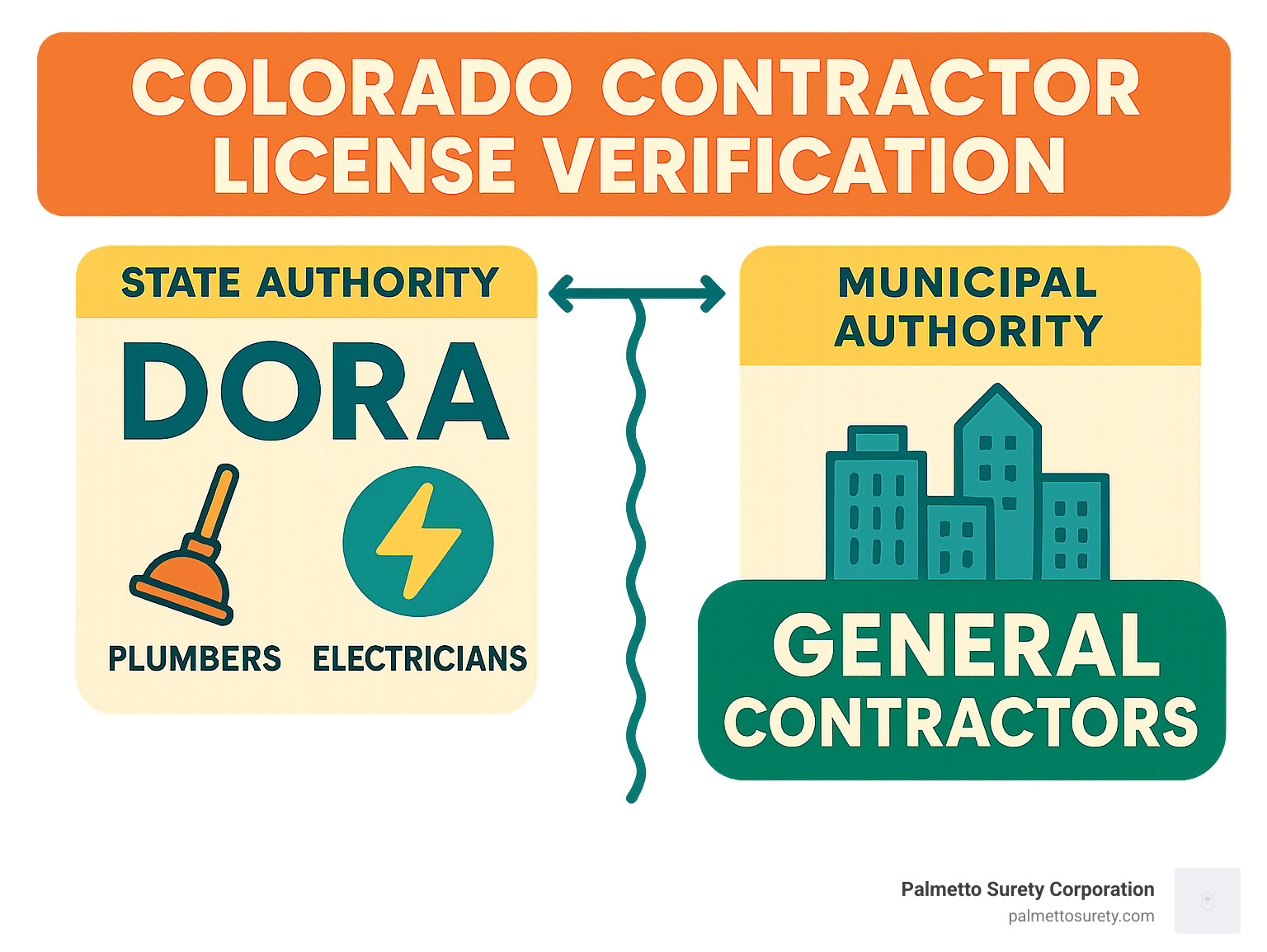
Colorado general contractor license lookup is not as straightforward as in many other states. Unlike states with centralized licensing, Colorado has no statewide general contractor license. Instead, each municipality manages its own licensing requirements, creating a patchwork system that can be confusing for homeowners and businesses alike.
This decentralized approach means you’ll need to check with the specific city or county where the work will be performed. With Colorado reporting the highest rate of contractor fraud in the US—6.1 victims per 10,000 homeowners annually—verifying credentials before hiring is essential.
The Department of Regulatory Agencies (DORA) handles state-level licensing for specialized trades like electricians and plumbers, but general contractors must obtain licenses from individual municipalities such as Denver, Aurora, or Jefferson County.
I’m Haiko de Poel Jr, and through my work with Palmetto Surety Corporation, I’ve helped hundreds of contractors steer the complex Colorado general contractor license lookup process while securing the bonds they need to operate legally throughout the state.
Learn more about colorado general contractor license lookup:
– alabama general contractor license lookup
– check license of contractor
– general contractor license lookup california
The Colorado Contractor Licensing Landscape
Colorado’s approach to contractor licensing isn’t your typical setup, and that’s putting it mildly. If you’ve ever tried to do a colorado general contractor license lookup, you know it can feel like searching for a needle in a haystack—while blindfolded.

At the state level, the Department of Regulatory Agencies (DORA) handles licensing for specialized trades. These folks are the gatekeepers for:
- Electrical contractors (both master and journeyman levels)
- Plumbing contractors (master, journeyman, and residential levels)
These professionals don’t get their licenses by sending in cereal box tops. They must pass tough exams, show substantial experience, and keep up with continuing education to maintain active licenses. When you need to verify these credentials, at least there’s a central database to check.
But here’s where things get tricky. For general contractors—the folks building your home, renovating your kitchen, or constructing commercial buildings—Colorado has no statewide licensing system. Zero. Nada.
Instead, each city or county runs its own licensing show, with requirements typically including:
Local requirements typically include passing ICC exams relevant to your work type, securing proper surety bonds (amounts that would make your wallet weep), maintaining adequate insurance coverage (liability and workers’ comp), paying local fees (because governments love fees), and demonstrating relevant experience (because nobody wants a YouTube-trained contractor building their dream home).
This municipal patchwork means your colorado general contractor license lookup must be targeted to the specific city or county where your project is located. What’s valid in Denver might not fly in Colorado Springs.
Why No Statewide “GC” License?
Colorado’s decision to let municipalities handle general contractor licensing reflects the state’s love affair with local control. This approach lets cities and counties tailor requirements to their specific building codes, climate challenges, and community needs.
Take Denver, for instance. They’ve created a comprehensive system with multiple classifications based on project complexity. Their Class A contractors can build skyscrapers, while Class C contractors stick to smaller residential projects. Denver also requires a hefty $50,000 surety bond—that’s where companies like Palmetto Surety Corporation come in, helping contractors secure these bonds quickly so they can get to work.
Aurora takes a different approach. Rather than issuing separate licenses, they require contractors to file their credentials with the Aurora Building Division. It’s less a license and more a registration system.
Meanwhile, Jefferson County requires specific licenses for work in unincorporated areas, with annual renewals and particular ICC exam requirements that must be met.
This municipal control means a contractor could be perfectly legal in one Colorado city but unauthorized in the neighboring town. For you as a homeowner or business, this means you absolutely must verify a contractor’s credentials with the specific municipality where your project is located.
The upside? This system allows for local innovation and adaptation. The downside? Your colorado general contractor license lookup just got a whole lot more complicated. But don’t worry—in the next section, we’ll walk you through exactly how to steer this process in just ten minutes.
colorado general contractor license lookup: Your 10-Minute Walk-Through
Looking up a contractor’s license in Colorado can feel like trying to solve a puzzle with pieces scattered across different tables. Don’t worry—I’ve got you covered with this straightforward guide that’ll save you time and potential headaches.
When verifying credentials in Colorado, your path will differ depending on whether you’re checking a state-licensed trade professional or a general contractor licensed by your local city or county. Let’s break it down into simple steps:

For electricians and plumbers (state-licensed trades), head over to the DORA License Lookup Tool. Enter the contractor’s first and last name (this works better than partial searches), select the appropriate license type from the dropdown, type in that pesky security code (remember, it’s case sensitive!), and click “Search.” Within seconds, you’ll see their license status, when it expires, and any disciplinary red flags you should know about.
For general contractors, you’ll need to do a bit more detective work since they’re licensed at the municipal level. First, figure out which city or county has jurisdiction over your project. Then visit that specific municipality’s contractor licensing website, enter the business name or license number, and review what pops up. You’ll typically see the license status, classification, expiration date, and contact information all in one place.
colorado general contractor license lookup via State Tools
Even though Colorado doesn’t license general contractors at the state level, there are still some valuable state resources that can help you verify a contractor’s legitimacy:
The DORA Database is your go-to for checking state-licensed professionals like electricians and plumbers. For best results, enter only the first and last name (the search is surprisingly picky and case-sensitive), and be sure to check both their active status and disciplinary history. One contractor told me he always recommends clients check this because “it’s like getting a background check on your home’s electrical system.”
The Colorado Secretary of State’s business search is another goldmine of information. It confirms whether a contractor’s business is legally established in Colorado (a must-have before they can get municipal licenses). You can verify their business registration status, trade name, and whether they’re in “good standing” with the state.
DORA’s Public Documents System goes a step further by providing access to disciplinary records and enforcement actions. This can be particularly revealing if a contractor has a history of operating without proper credentials—something you definitely want to know before signing any contracts.
colorado general contractor license lookup for Major Cities
Each Colorado city maintains its own verification system, and they’re not all created equal. Here’s how to steer the most common municipal lookup tools:
In Denver, the Denver Contractor License Search is wonderfully comprehensive. You can search by company or individual name, and view their license classification, expiration date, and any restrictions. Denver’s system is particularly robust because the city takes contractor licensing very seriously.
Aurora takes a different approach. Rather than issuing separate licenses, they require contractors to file their credentials with the Building Division. To verify someone in Aurora, you’ll need to call 303.739.7420 and ask if they’re authorized to pull permits. It’s a bit more old-school, but still effective.
Jefferson County serves its unincorporated areas through their Contractor Licensing Information page. Their Citizen Portal lets you search for licensed contractors and verify their status and expiration date with just a few clicks.
If you’re in the Colorado Springs area, the Pikes Peak Regional Building Department offers online contractor searches, license verification, and permit history review all in one place.
A colorado general contractor license lookup only confirms a contractor’s standing in that specific jurisdiction. Just because they’re licensed in Boulder doesn’t mean they can legally work in Fort Collins without additional credentials. This is why proper verification is so important—and why contractors who maintain proper licensing and bonding through services like Palmetto Surety Corporation demonstrate their commitment to operating legally wherever they work.
Decoding Search Results & Beyond the License
So you’ve completed your colorado general contractor license lookup – great first step! But what exactly are you looking at? Let’s break down those search results in plain English and explore what else you need to check before signing on the dotted line.
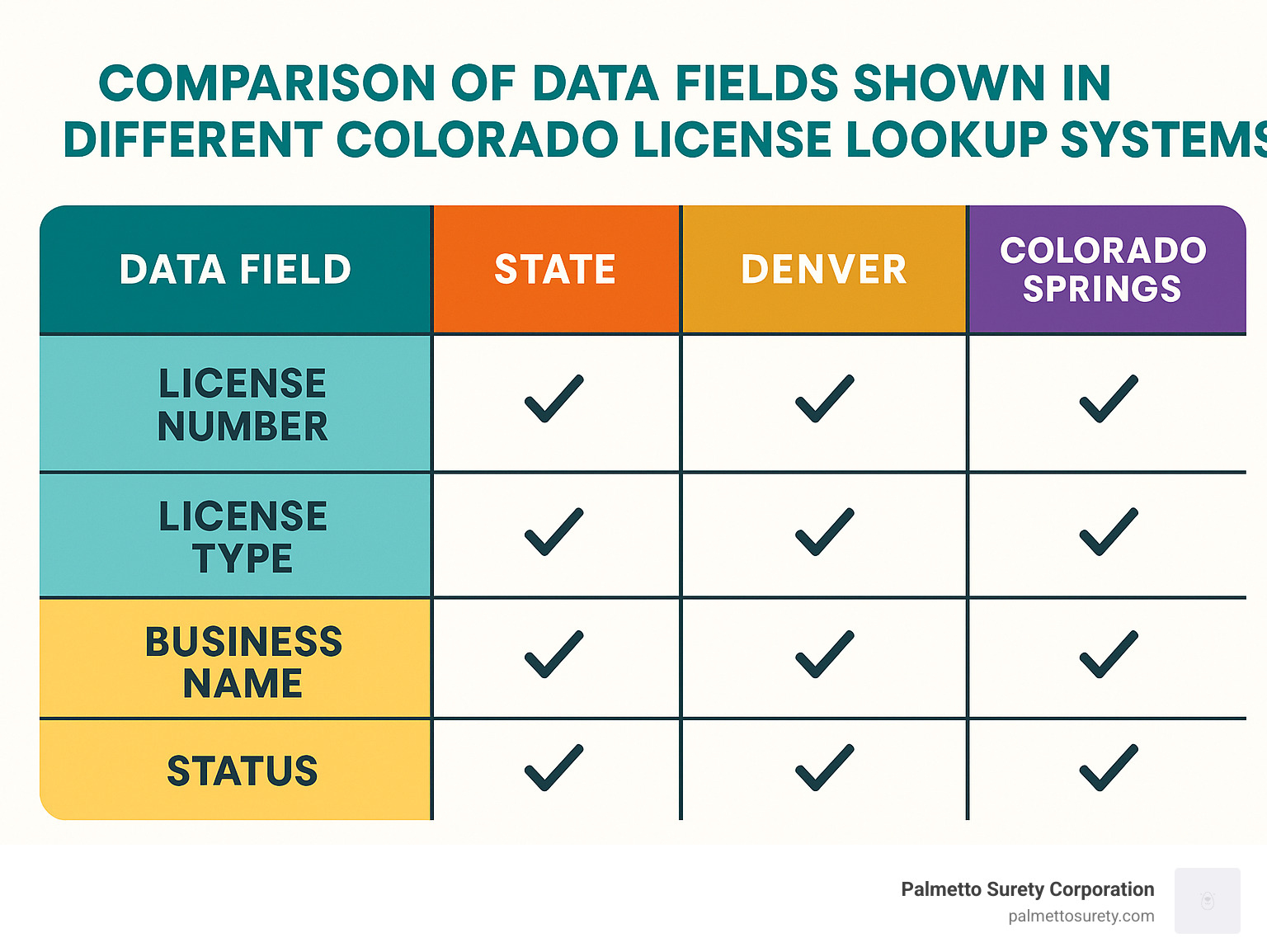
When you pull up a contractor’s record, you’ll see various status indicators that tell an important story:
Active means you’re good to go – their license is current and in good standing. If you see Active (In Renewal), don’t worry – they’re just in the process of updating their paperwork. However, Expired is a definite red flag – this contractor can’t legally perform work until they renew. Even more concerning are Suspended (temporarily revoked, often due to violations), Revoked (permanently canceled for serious issues), or Surrendered (voluntarily given up, sometimes during an investigation).
Finding an active license is just the beginning of your homework, though. Think of it as the foundation – necessary, but not the whole house!
You’ll want to verify their insurance situation next. A valid license doesn’t guarantee they’re properly insured. Ask for proof of general liability insurance (this protects your property if something gets damaged) and workers’ compensation if they have employees (without this, you could be on the hook if someone gets hurt on your property).
The surety bond is another crucial protection. Most Colorado cities require contractors to maintain these bonds as a financial safety net for homeowners. If your contractor disappears halfway through your kitchen remodel or does shoddy work, this bond helps make things right. Bond requirements vary widely – Denver demands a hefty $50,000 for general contractors, while smaller towns might require between $5,000 and $25,000.
What Else to Verify Before You Hire
A license check is just the appetizer – now it’s time for the main course of contractor verification.
First, get serious about that liability insurance. Don’t just take their word for it – request a certificate directly from their insurance provider. Most reputable contractors carry at least $1 million in coverage. Make sure the policy won’t expire mid-project, or you could find yourself in a precarious situation.
Next, double-check their bonding capacity. For small home repairs, the standard municipal bond might be sufficient. But if you’re building an addition or remodeling your entire home, you’ll want to ensure their bond can cover a project of your size. A quick call to the surety company can confirm this information – and yes, it’s perfectly normal to ask!
References are worth their weight in gold. Ask for at least three from similar projects, and actually call them! I’m always amazed how many people skip this step. Ask specific questions: Did they finish on time? Stay on budget? Communicate well? Clean up after themselves? If possible, drive by or visit some of their completed work.
The digital trail also tells a story. Check their Better Business Bureau rating and look for patterns in online reviews. One negative review might be a fluke, but multiple complaints about the same issues should raise eyebrows.
Finally, get familiar with lien waivers. These documents protect you from subcontractors or suppliers placing liens on your property if the main contractor doesn’t pay them. Request these waivers as you make payments throughout the project.
Your colorado general contractor license lookup is just the first piece of a larger verification puzzle. Taking the time to complete all these checks might seem tedious, but it’s far less painful than dealing with an unqualified contractor. A thorough verification process is your best insurance against becoming another contractor fraud statistic in Colorado.
How to Get (and Keep) a Colorado Contractor License
Understanding the licensing process helps you better evaluate the credentials of contractors you’re considering. Here’s what legitimate contractors must do to obtain and maintain their licenses in Colorado:

State-Licensed Trades (Plumbers and Electricians)
For electrical and plumbing contractors, getting licensed isn’t a weekend project. It’s a journey that takes years of dedication.
First, aspiring professionals must accumulate 4-6 years of hands-on experience under supervision. Think of it as the apprenticeship days of old, but with modern code requirements! Once they’ve logged those hours, they face the state licensing exam administered by PSI – a test that separates the truly knowledgeable from those who aren’t ready for the responsibility.
With exam success under their belt, they submit their application to DORA, complete with proof of experience, exam results, and a criminal history check. The application fee ($120-$140) is just one more hurdle to clear. But the journey doesn’t end with license in hand – regular renewals and continuing education keep these professionals at the top of their game.
Municipal General Contractor Licenses
When it comes to general contractors, Colorado’s patchwork approach means the process varies depending on where you’re standing. Denver, for example, uses a tiered classification system that tells you exactly what a contractor is qualified to build:
Class A contractors can tackle virtually anything – from skyscrapers to single-family homes. These are the heavy hitters of the construction world.
Class B license holders can build commercial structures up to 4 stories tall and any residential project. They handle most of the mid-range construction work throughout the city.
Class C contractors focus on residential buildings up to 2 stories – perfect for home renovations and smaller residential projects.
Before obtaining any of these licenses, contractors must first secure a Supervisor Certificate, proving they understand building codes and construction standards.
The typical municipal process starts with passing the appropriate International Code Council (ICC) exam – a comprehensive test of construction knowledge. Then comes the paperwork: business registration documents, proof of insurance, a surety bond (which protects you as the consumer), and the application fee.
Once licensed, contractors must keep up with renewal cycles that vary by location. Denver requires renewal every three years with a $250 fee, while Jefferson County contractors renew annually for $50. Aurora requires yearly filing updates, and Fort Collins follows an annual renewal schedule as well.
While not universal yet, continuing education is becoming more common as municipalities recognize the importance of keeping contractors current with evolving building codes and industry best practices.
City-by-City Snapshot of Key Requirements
The licensing landscape changes dramatically as you cross municipal boundaries in Colorado. Here’s what legitimate contractors need in major areas:
In Denver, contractors must secure a hefty $50,000 surety bond – that’s your protection against poor workmanship or abandoned projects. Before even applying for a license, they need a supervisor certificate ($60), and once licensed, they’re good for three years. Denver’s multiple license classifications are designed to match contractor capabilities with project complexity. And don’t expect reciprocity – a Denver license won’t help in Aurora.
Aurora takes a different approach with no separate municipal license. Instead, contractors register their state credentials with the Building Division and update their filing annually. If you’re hiring a plumber or electrician, their state license is recognized without additional requirements.
Over in Jefferson County, contractors renew annually for $50 and must have passed an ICC exam within the past three years. Their license only covers unincorporated areas, and they can’t have any unresolved code violations when renewal time comes. Homeowners get a break with an exemption for building one dwelling every 24 months.
Fort Collins uses a contractor registration system rather than formal licensing. Contractors must provide an affidavit of lawful presence along with proof of insurance and bonding, then renew annually.
This patchwork of requirements is precisely why thorough colorado general contractor license lookup is essential before hiring anyone. A contractor properly licensed in Boulder might not be authorized to swing a hammer in neighboring Louisville.
At Palmetto Surety Corporation, we’ve seen how this complex system can slow down legitimate contractors. That’s why we work to approve most surety bond applications within hours – helping qualified professionals get to work faster while ensuring homeowners have the protection they deserve.
Protecting Yourself: Red Flags, Penalties & Reporting
Let’s face it – hiring a contractor can feel like a leap of faith. That’s why the colorado general contractor license lookup process is so important. As someone who’s helped contractors secure bonds for years, I’ve seen what happens when homeowners skip this crucial step.
Colorado unfortunately leads the nation in contractor fraud with 6.1 victims per 10,000 homeowners – that’s more than three times the national average. This sobering statistic makes thorough verification absolutely essential.
When you hire an unlicensed contractor, you’re not just breaking the law – you’re putting yourself at serious risk. You could suddenly find yourself considered their “employer,” making you responsible for injuries, damages, and even payroll taxes. Your homeowner’s insurance likely won’t cover damages caused by unlicensed work, and any contracts you sign may not hold up in court.
The quality issues alone should give you pause. Licensed contractors have demonstrated their knowledge of building codes and safe practices. Without that verification, you’re rolling the dice on whether your project will be built safely and correctly.
Colorado takes these violations seriously. For unlicensed plumbing or electrical work, first offenses are Class 2 misdemeanors, punishable by 3-12 months in jail and fines up to $1,000. Second offenses jump to Class 6 felonies with potential prison time of 12-18 months and fines up to $10,000. Even homeowners can face consequences for knowingly hiring unlicensed contractors.
How to Report a Bad Actor
If you’ve already fallen victim to an unlicensed or fraudulent contractor, there are several ways to report them and potentially help others avoid the same fate:
The Department of Regulatory Agencies (DORA) handles complaints for licensed trades like plumbers and electricians. File a detailed complaint with documentation, photos, and a timeline of events. For significant fraud cases, your local District Attorney’s office should be contacted with all your contracts and payment evidence.
The Better Business Bureau provides another avenue for reporting problematic contractors, helping alert other consumers to potential issues. Don’t hesitate to file a police report for theft or project abandonment – request a case number you can reference later.
For patterns of fraudulent behavior, the Colorado Attorney General’s Office accepts consumer complaints through their online form. Throughout this process, keep meticulous records of all communications, photos of the work (before, during, and after), copies of payments, and documentation of your license verification attempts.
Trust your instincts when interviewing contractors. Be wary of anyone who seems reluctant to provide license information for your colorado general contractor license lookup. Other red flags include high-pressure sales tactics, demands for large upfront payments (more than 10% or $1,000), cash-only payment requests, or vague contract terms.
Be especially cautious of contractors with no physical business address, unmarked vehicles, or those who solicit door-to-door, particularly after storms or natural disasters. These are classic signs of potential fraud.
By taking these precautions and performing a thorough colorado general contractor license lookup, you’re not just protecting your own project – you’re helping maintain the integrity of Colorado’s construction industry and preventing others from becoming victims of the same fraudulent actors.
Legitimate contractors welcome verification. They’ve worked hard to obtain their licenses and bonds, and they want you to know they’re qualified. Palmetto Surety Corporation helps these honest contractors secure the bonds they need quickly, typically approving applications within hours so they can keep your Colorado projects moving forward on schedule.
Frequently Asked Questions about Colorado License Verification
Do general contractors need a state license in Colorado?
Unlike many states, Colorado doesn’t have a one-size-fits-all approach to contractor licensing. There’s no state-level license for general contractors in Colorado. Instead, these professionals must obtain licenses from each individual city or county where they plan to work.
This creates what I like to call a “licensing quilt” across Colorado – each patch representing a different municipality with its own unique requirements. That’s why the colorado general contractor license lookup process can feel like a treasure hunt that takes you to different city websites rather than one central database.
Only specialized trades – electricians and plumbers – need state-level licenses through DORA. So if you’re building a home in multiple jurisdictions, your general contractor might need:
A Class B license to build in Denver, filed credentials with Aurora’s Building Division, and potentially different insurance and bonding requirements for each city. It’s a bit like needing different passes for different ski resorts – one won’t work at them all!
How often do contractor licenses renew?
Renewal schedules in Colorado vary widely depending on who issued the license. Think of it like subscription services – some renew monthly, others annually, and some every few years.
For state-licensed specialists, both electrical and plumbing contractors enjoy a 3-year renewal cycle. This gives these professionals a good stretch of time before dealing with renewal paperwork.
Municipal licenses for general contractors follow different calendars:
– Denver contractors get a 3-year break between renewals (with a $250 fee)
– Jefferson County contractors mark their calendars annually ($50 fee)
– Aurora contractors need to update their filings yearly
– Fort Collins contractors face annual renewal too
When you’re doing a colorado general contractor license lookup, always check the expiration date. An expired license offers no more protection than no license at all – it’s like trying to get into a concert with last year’s ticket.
What penalties apply for hiring or operating without a license?
Colorado takes unlicensed contracting very seriously, with penalties that can make your head spin.
For contractors working without proper credentials, the consequences are steep:
– First-time offenders performing unlicensed electrical or plumbing work face Class 2 misdemeanor charges, which could mean 3-12 months behind bars and fines between $250-$1,000
– Get caught again? That jumps to a Class 6 felony with potential prison time of 12-18 months or fines from $1,000-$10,000
– Projects can be shut down immediately, and contractors may be required to pay for fixing non-compliant work
Homeowners aren’t off the hook either. If you skip the colorado general contractor license lookup and hire someone unlicensed, you might face:
– Personal liability if workers or neighbors get hurt
– Major headaches when trying to sell your property later
– Nasty surprises if your insurance company denies claims related to the unlicensed work
– The potential heartbreak of having to tear out and redo work that doesn’t meet code
These serious consequences highlight why verifying credentials through proper colorado general contractor license lookup isn’t just a good idea – it’s essential protection for your property and peace of mind.
At Palmetto Surety Corporation, we’ve seen how proper licensing and bonding keeps projects on track and protects everyone involved. That’s why we work hard to approve most contractor bond applications within hours, helping legitimate Colorado contractors get to work quickly and legally.
Conclusion
The colorado general contractor license lookup journey might feel like navigating a maze, but it’s truly worth every step you take. Colorado’s unique split approach—with state oversight for specialized trades and city control for general contractors—means a bit more homework for all of us, but that extra effort protects your home, your wallet, and your sanity.
After helping countless contractors and homeowners through this process, I’ve seen how a simple verification can prevent major headaches. Here’s what I hope you’ll take away:
Always verify before you hire. Whether it’s a quick roof repair or a complete home renovation, take ten minutes to use the appropriate lookup tool for your city or county. That small investment of time can save you thousands of dollars and months of stress.
Don’t stop at just the license. A piece of paper alone doesn’t tell the whole story. Make sure to verify insurance coverage (get it directly from their insurer), check their bond status, call those references, and look into their complaint history. A truly professional contractor will appreciate your thoroughness.
Colorado’s municipal differences matter. Just because your contractor has a valid Denver license doesn’t mean they can legally work in Aurora or Jefferson County. Each city has its own requirements, and crossing boundaries without proper credentials puts both of you at risk.
Pay attention to those warning signs. If a contractor seems nervous about providing license information, asks for a large chunk of money upfront, or pressures you to “sign today,” those aren’t just quirks—they’re red flags waving in your face.
If you do encounter a bad actor, report them. By alerting authorities to unlicensed or fraudulent contractors, you’re not just protecting yourself—you’re helping shield your neighbors and community from potential harm.
At Palmetto Surety Corporation, we’ve spent over two decades helping legitimate contractors secure the bonds they need to operate legally throughout Colorado. We take pride in approving most bond applications within hours, keeping projects on schedule and contractors in good standing with local regulations.
For contractors working to steer Colorado’s municipal licensing requirements, having a reliable surety bond provider isn’t just convenient—it’s essential. Learn more about our surety bonds and how we can help you meet local licensing requirements quickly and efficiently.
Taking the time to perform a thorough colorado general contractor license lookup is like wearing a seatbelt—it might feel unnecessary until the moment it saves you. With Colorado leading the nation in contractor fraud, that verification process isn’t just paperwork—it’s your protection against becoming another statistic.
The house you’re improving is probably your biggest investment. The extra hour you spend verifying credentials upfront can save you from months of contractor nightmares down the road. Trust me, I’ve seen both sides of that story, and the happy endings always start with proper verification.


