


Check License of Contractor: 7 Essential Steps to Avoid Costly Mistakes 2025
Why Every Smart Homeowner Must Check License of Contractor Before Hiring
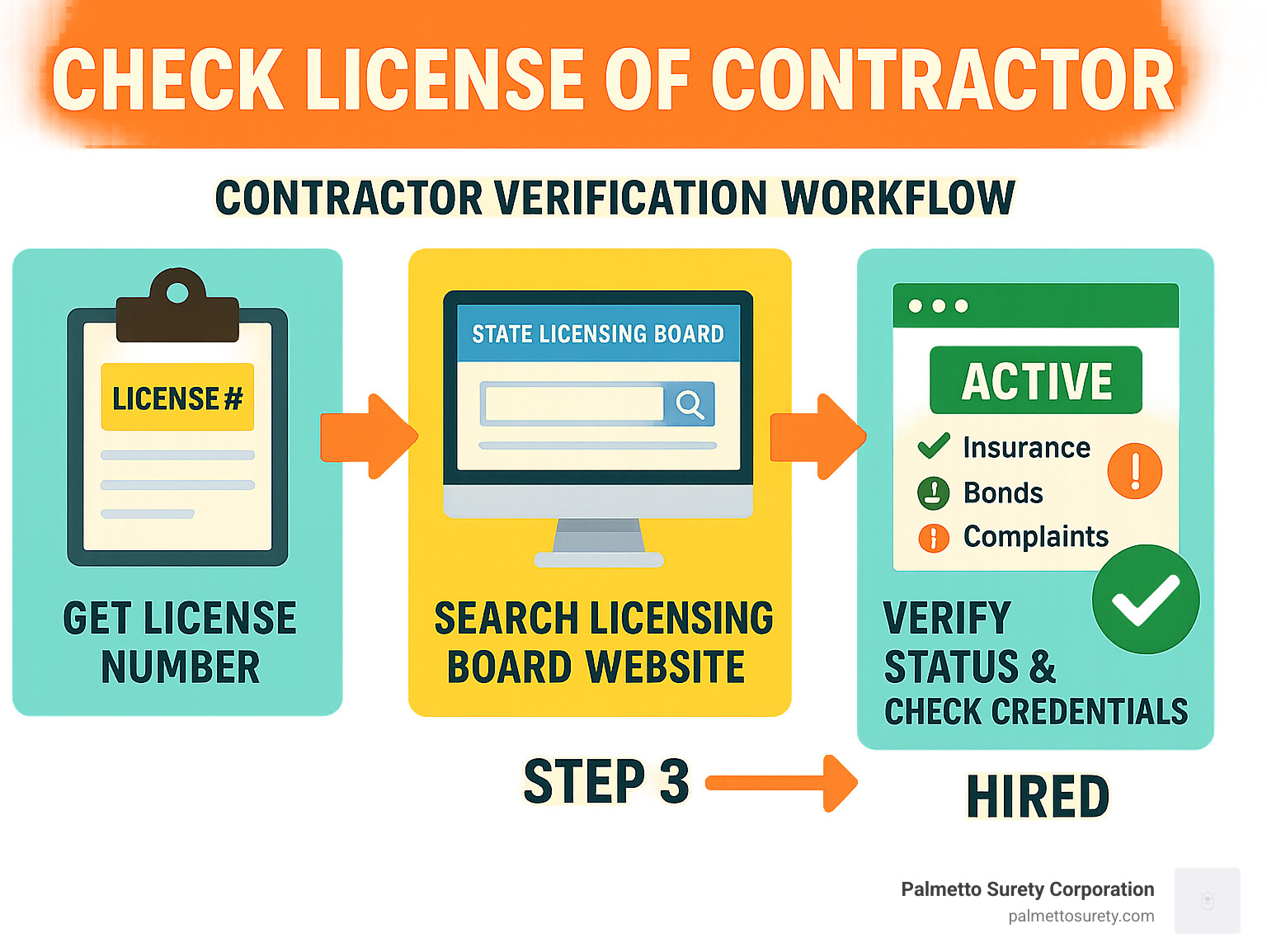
When you check license of contractor credentials, you protect yourself from costly mistakes, legal liability, and substandard work. Here’s the fastest way to verify any contractor’s license status:
Quick Verification Steps:
- Get the license number from their website, business card, or truck
- Visit your state’s licensing board website (CSLB for California, L&I for Washington)
- Search by license number or business name
- Verify status is “Active” and matches the work type
- Check complaint history and insurance coverage
- Call 800-321-2752 for phone verification if needed
Most licensed contractors are honest and skilled professionals. But the problems that do occur—like the $15,000 down payment scams or uninsured workers getting hurt on your property—could easily be prevented if homeowners knew how to verify credentials properly.
The stakes are high. In California, contractors need valid licenses for any project over $500. They can’t legally ask for more than 10% down payment or $1,000 (whichever is less). And if they’re not properly insured, you could be liable for accidents.
Whether you’re hiring someone for a kitchen remodel or just someone who saw a contractor doing something shady at a neighbor’s house, knowing how to verify licensing protects everyone involved.
I’m Haiko de Poel Jr, and through my work at Palmetto Surety Corporation—one of the fastest-growing surety bond companies in the US—I’ve helped thousands of contractors secure proper licensing bonds while educating consumers on how to check license of contractor credentials safely. This guide will walk you through every step to verify any contractor’s license, insurance, and complaint history before you sign anything.
Simple guide to check license of contractor terms:

Why Hiring a Licensed and Insured Contractor Saves You Money and Stress
When you check license of contractor credentials, you’re not just checking a box—you’re protecting yourself from financial disasters that could cost tens of thousands of dollars. A contractor license represents real training, verified experience, and most importantly, financial protections that shield you from liability.
Understanding the licensing thresholds is crucial for homeowners. In California, any project combining labor and materials that costs $500 or more requires a licensed contractor. South Carolina has the same $500 threshold for residential work. These aren’t arbitrary numbers—they reflect the point where even “small” jobs can spiral into expensive problems if handled improperly.
Think about it this way: that $800 bathroom repair might seem harmless, but what happens if the unlicensed handyman accidentally breaks a water line inside your wall? Suddenly you’re looking at thousands in water damage, mold remediation, and structural repairs.
Licensed contractors carry three layers of financial protection that unlicensed workers simply don’t have. General liability insurance covers property damage and injuries that occur during the work. If your contractor accidentally puts a hammer through your new hardwood floor or knocks over your expensive landscaping, this insurance pays for repairs.
Workers’ compensation coverage protects you from one of the biggest financial risks homeowners face. If an unlicensed worker falls off your roof and breaks his back, guess who might be responsible for his medical bills and lost wages? Without workers’ comp, that could easily reach $200,000 or more. Licensed contractors in California must carry this coverage if they have employees.
The third protection is the contractor license bond—typically $15,000 in California. This isn’t insurance for the contractor; it’s a financial guarantee for you. If they take your money and disappear, perform substandard work, or violate contract terms, you can file a claim against this bond to recover your losses.
The hidden costs of hiring unlicensed contractors extend far beyond the immediate work. Your homeowner’s insurance might refuse to cover damage caused by unlicensed work. Building departments often require licensed contractors for permits, and unpermitted work can create nightmares when you try to sell your home.
We’ve worked with thousands of contractors over our 20+ years in the surety business, and we’ve seen the aftermath when homeowners skip the license verification step. The $100-200 you might save hiring someone cheaper disappears quickly when you’re dealing with shoddy work, no recourse for problems, and potential legal liability.
The penalties for unlicensed contracting are severe for a reason. In California, unlicensed contractors face fines up to $15,000 and potential jail time. But here’s the thing—those penalties don’t help you if your project goes wrong. The only real protection is making sure you check license of contractor status before any work begins.
Most licensed contractors are skilled professionals who take pride in their work. The licensing system exists to protect both good contractors and smart homeowners like you.
How to Check License of Contractor Online in Any State
Finding out whether your contractor is properly licensed used to mean driving to government offices and waiting in long lines. Today, you can check license of contractor credentials from your kitchen table in under five minutes—and it’s completely free.
Every state maintains online databases that update regularly with current license information. California’s Contractors State License Board (CSLB) runs the gold standard system that other states model their portals after. Their license check page lets you search by license number, business name, or individual contractor name.
Washington state takes a slightly different approach with their Department of Labor & Industries Verify tool. What I love about Washington’s system is how it shows everything in one place—active registration status, workers’ comp coverage, safety violations, and even bond claims.
South Carolina keeps things straightforward through their Department of Labor, Licensing, and Regulation database. You’ll find bond and insurance information right alongside the basic license details.
Most state licensing boards update their databases every weekday morning by 5:00 a.m., so you’re getting current information when you search. Some states even participate in multi-state lookup directories, though I always recommend going straight to the official state portal for the most reliable results.
Gather the Right Info Before You Start
You wouldn’t start a recipe without checking what ingredients you need first. Same principle applies when you check license of contractor status—having the right information ready makes everything smoother.
The license number is your golden ticket. Any legitimate contractor will display this prominently on their website, business cards, truck signage, and written quotes. If someone can’t provide their license number immediately, that’s a massive red flag. Stop the conversation right there.
Get the exact business name as it appears on their registration, not just their “doing business as” name. Sometimes contractors operate under different names than what’s on their license, which can make searches tricky.
Know the contractor’s full legal name if you’re dealing with an individual license holder. This helps you verify that the person standing in your driveway actually matches the license holder’s identity.
Have their city or ZIP code handy along with notes about their specific trade—general contractor, electrical, plumbing, HVAC, roofing, or whatever specialty work you need done.
I also recommend having their photo ID ready to compare against the license information. It sounds paranoid, but we’ve seen cases where unlicensed workers use someone else’s license number to appear legitimate.
Step-by-Step: Using Official License Look-Up Portals
Let me walk you through the actual search process using California’s system, since it’s the most comprehensive and user-friendly portal available.
Start by visiting the CSLB License Check Page. The site works perfectly on phones, tablets, and computers, so you can even do this while the contractor is standing there waiting for an answer.
Choose your search method carefully. If you have the license number, use that—it’s the fastest and most accurate option. Business name searches work well too, but make sure you’re using the exact registered name. Individual contractor name searches help when you’re dealing with smaller operators who license under their personal names.
The results page tells the whole story. You’ll see the license status right at the top—Active, Expired, Suspended, or Revoked. Only “Active” is acceptable. The license classification shows exactly what type of work they’re authorized to perform, and this needs to match your project perfectly.
Pay attention to the expiration date. A license that expires next week could leave you in a tough spot if your project runs longer than expected.
The bond and workers’ compensation sections are crucial. These tabs show whether the contractor has proper financial protections in place. Click through each one to verify coverage is current.
Don’t skip the complaint disclosure section. This shows any formal complaints filed against the contractor and how they were resolved. A few minor complaints over many years might not be concerning, but patterns of serious violations should send you looking elsewhere.
Print or screenshot your results for your records. This documentation proves you did your homework if any issues arise later.
For Washington state, their Verify a Contractor, Tradesperson or Business tool shows additional details like safety violations and surety bond lawsuits all in one comprehensive view. It’s incredibly thorough.
Offline Options to Check License of Contractor
Sometimes you need to verify credentials when you don’t have internet access, or maybe you prefer talking to a real person. Fortunately, you have several offline options to check license of contractor status.
California makes phone verification simple with their 800-321-CSLB hotline (800-321-2752). What’s amazing is this service runs 24 hours a day, seven days a week. You can call at midnight on Sunday and still get current license information.
Most other states offer phone verification during regular business hours. The wait times are usually reasonable, and the staff can walk you through the same information you’d see online.
Your local county building department often maintains lists of licensed contractors in your area. These folks deal with contractors every day and can quickly verify license status. They’re also great resources for understanding local permit requirements.
City halls can confirm business license status and sometimes have additional information about contractors who’ve worked on municipal projects. Public libraries provide free internet access if you need to use the online portals but don’t have reliable internet at home.
Licensed contractors should carry a pocket license—a small card issued by the state licensing board. Ask to see this along with photo ID to verify the person matches the license holder. It’s a simple but effective way to spot problems before they start.
The key is using multiple verification methods when something feels off. Trust your instincts and don’t rush the process just because someone is offering you a great deal that expires today.
What to Look For in the License Details—And Red Flags to Avoid

Once you check license of contractor information online, you’ll see a results page packed with details. Think of this as your contractor’s report card—and knowing how to read it could save you thousands of dollars and months of headaches.
The most important thing to look for is the license status. If it shows “Active,” you’re good to proceed. But “Expired” means they can’t legally work until they renew. “Suspended” is a major red flag—their license was temporarily pulled due to violations or non-compliance. “Revoked” means their license was permanently cancelled, and they can’t work at all. Some contractors show “Inactive,” which means they voluntarily suspended their own license.
Here’s something many homeowners miss: classification codes matter hugely. A plumbing contractor can’t legally do electrical work, and a roofing contractor shouldn’t be installing your new HVAC system. We’ve seen contractors try to operate under the wrong classification to perform unauthorized work—this is a massive warning sign.
Pay close attention to the dates on the license. The issue date tells you how long they’ve been in business (I prefer contractors with at least 5-10 years of experience). The expiration date must be current for legal operation. The bond expiration should match or exceed the license expiration.
The financial information section reveals crucial protection details. California requires a $15,000 minimum bond amount, though some contractors carry higher amounts. Workers’ compensation status must show “Yes” or “Current” if they have employees. General liability coverage should be verified separately with their insurance carrier.
Verify Insurance, Bonds, and Business License in One Pass
Smart homeowners check all three layers of protection in one efficient sweep. Think of it as building a financial safety net under your project.
General liability insurance is your first line of defense. Ask for a Certificate of Insurance showing coverage amounts of typically $1 million minimum, current policy dates, and—this is key—your specific project listed as “additional insured.” Get the insurance company’s contact information so you can verify coverage directly.
Workers’ compensation is required by law in California if the contractor has employees. The license lookup shows compliance status, but don’t hesitate to request proof directly from the contractor. If someone gets hurt on your property and there’s no workers’ comp coverage, you could be facing massive liability.
The contractor license bond isn’t insurance for the contractor—it’s protection for you. All licensed contractors in California must carry a $15,000 license bond. This gives you financial recourse if they breach contract terms, misuse your deposit, or perform substandard work. The bond information appears right in the license lookup results.
Don’t forget about city and county business licenses. Many municipalities require separate business licenses beyond the state contractor license. Check with your local building department to verify these local requirements. Some cities even maintain online active business license lists.
From our experience at Palmetto Surety Corporation, contractors who maintain proper bonding and insurance typically run more professional operations overall. It’s a reliable indicator of business stability and compliance awareness.
Check Complaints, Lawsuits, and Safety Violations
The license lookup reveals complaint history, but you should dig deeper to get the full picture of who you’re hiring.
California’s CSLB complaint disclosure shows open complaints under investigation, closed complaints and their resolution, disciplinary actions taken, and any license suspensions or revocations. But here’s what many homeowners don’t realize: the CSLB only publishes construction-related judgments, not arbitrations unless there was non-compliance. This means some disputes might not appear in their database.
That’s why you need to check additional complaint sources. The Better Business Bureau shows local ratings and complaint history. Online review sites like Yelp and HomeAdvisor provide customer feedback, though remember that online reviews can be manipulated. Court records searches can reveal liens, lawsuits, or judgments that might not show up elsewhere.
If you’re in Washington state, their Verify tool shows OSHA-style safety violations right alongside license information—incredibly useful for understanding a contractor’s safety track record.
Watch for red flag patterns like multiple complaints about the same issue (poor workmanship or payment disputes), recent disciplinary actions, suspended or revoked licenses in other states, or unwillingness to provide references or proof of insurance. These patterns often predict future problems.
Quick Checklist to Check License of Contractor Before Signing

Before you sign any contract, run through this final verification checklist. Think of it as your last line of defense against contractor problems.
License verification starts with confirming the status shows “Active” and the classification matches your project type. The license number should appear on all quotes and contracts, the expiration date must be current, and photo ID should match the license holder’s name.
Insurance and bonding verification means confirming general liability insurance with the carrier directly, ensuring workers’ compensation is current if they have employees, verifying the contractor license bond is in place with at least $15,000 coverage in California, and checking that bond expiration dates are current.
Background checking involves confirming no major unresolved complaints, no recent disciplinary actions, an acceptable BBB rating, and positive references when you actually call them.
Business verification rounds out your due diligence. Verify their business address and phone number, confirm local business license status, ensure their office location is accessible (not just a P.O. box), and confirm they’re responsive to calls and emails.
If any part of this checklist fails, seriously reconsider hiring that contractor. The few extra hours you spend on verification could save you thousands of dollars and months of stress down the road.
Payment Rules and Your Rights Under Home-Improvement Laws
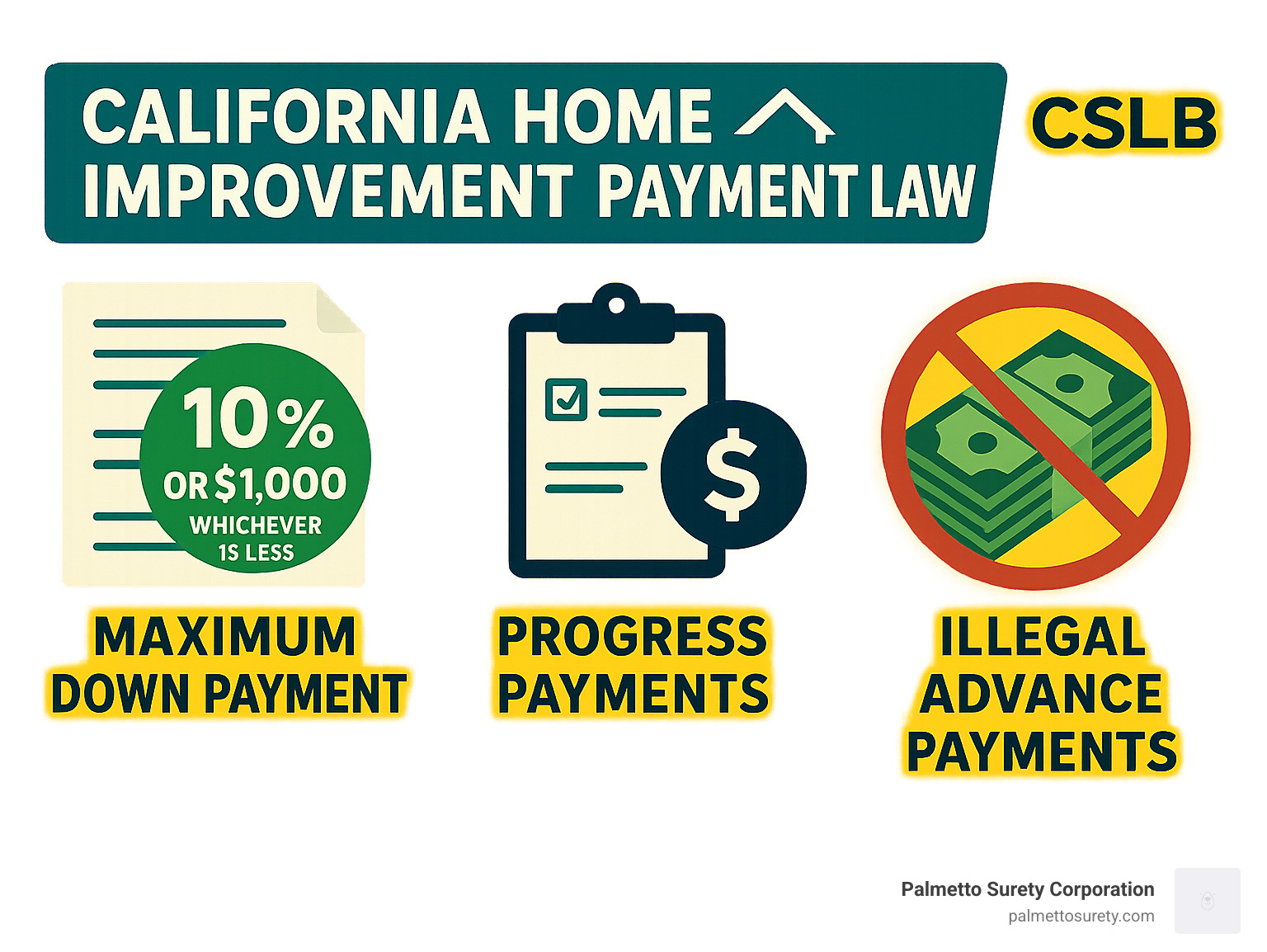
The moment you check license of contractor credentials, you should also understand the payment laws that protect your wallet. These rules exist because down payment scams cost homeowners millions of dollars every year—but they’re completely preventable when you know your rights.
California has some of the strictest contractor payment laws in the country, and for good reason. Licensed contractors cannot legally ask for more than 10% of the contract price or $1,000 as a down payment, whichever is less. This simple rule protects you from the classic scam where contractors collect large sums upfront and then disappear.
These payment protections apply to virtually every home improvement project you can imagine: kitchen and bathroom remodels, roofing and siding projects, accessory dwelling units (ADUs), solar energy system installations, and even home repairs in declared disaster areas. If someone is asking for $5,000 upfront on a $20,000 kitchen remodel, they’re either unlicensed or breaking the law.
The beauty of this system is its simplicity. You don’t need to negotiate or wonder what’s fair—the law sets clear boundaries that legitimate contractors understand and follow.
Know the Caps: 10% or $1,000 Up Front Only
Let me walk you through how these payment caps work in real-world scenarios, because understanding the math could save you thousands.
For a $5,000 kitchen remodel, the maximum legal down payment is $500 (10% of the total). For a $15,000 roof replacement, you’d think 10% would be $1,500, but the $1,000 cap kicks in—so that’s your maximum. On a $50,000 home addition, that same $1,000 cap applies, even though 10% would be $5,000.
There’s only one exception to these rules, and it’s rare. Contractors with a Blanket Performance and Payment Bond on file with the CSLB can legally request higher down payments. Only about two dozen licensees in California hold such bonds, and you can verify this when you check license of contractor status in the official database.
The Solar Smart program through the CSLB offers specialized guidance for residential solar installations, but the same payment rules apply. Don’t let solar contractors convince you that clean energy projects have different payment requirements—they don’t.
If you’re a service member, you have additional protections. The federal Skillbridge program participants can access Expedited Licensure Application Processing for Service Members, ensuring qualified contractors can get licensed quickly to serve military families.
Protect Yourself with Written Contracts and Surety Bonds

Smart payment structuring keeps you in control throughout your project. After that initial down payment, all subsequent payments should correspond to completed work or delivered materials. This isn’t just good practice—it’s the law.
A proper payment schedule looks like this: down payment of 10% or $1,000 maximum, progress payments tied to specific completion milestones, and a final payment of about 10% retained until the project is completely finished and any punch list items are resolved. This structure ensures you always have leverage.
The $15,000 license bond that every licensed contractor carries provides your safety net if things go wrong. If a contractor breaches their contract, takes your money without completing work, or performs substandard work, you can file a claim against this bond. However, $15,000 might not cover large projects or situations where multiple homeowners have claims, which is why some contractors carry additional contract bonds.
In our experience at Palmetto Surety Corporation, contractors who maintain proper bonding demonstrate a commitment to professional standards. Over our 20+ years in the surety business, we’ve seen how adequate bonds protect both contractors and consumers—it’s a win-win arrangement.
Your written contract should prominently display the license number, include detailed scope of work and materials specifications, outline the payment schedule tied to milestones, establish change order procedures, set completion timelines, and specify lien waiver procedures. A contractor who resists putting these details in writing is probably someone you don’t want to hire.
The surety claim process provides recourse when contractors fail to meet their obligations, but prevention through proper vetting when you check license of contractor credentials remains your best protection. Remember: legitimate contractors welcome scrutiny because they have nothing to hide.
Frequently Asked Questions About How to Check License of Contractor
Why is it risky to hire an unlicensed contractor?
When you skip the step to check license of contractor credentials, you’re essentially gambling with your home and your wallet. I’ve seen too many homeowners learn this lesson the hard way.
The financial risks alone should make you think twice. Without a license, there’s no bond protection if your contractor takes your $5,000 down payment and vanishes. There’s no state licensing board to file complaints with when the work goes sideways. And here’s the kicker—if an uninsured worker gets hurt on your property, you could be on the hook for their medical bills and lost wages.
Your homeowner’s insurance might refuse to cover damage from unlicensed work. I’ve heard of cases where insurance companies denied claims because the homeowner hired someone without proper credentials. That $200 you saved by going with the cheaper, unlicensed guy suddenly doesn’t seem worth it when you’re facing a $50,000 insurance claim denial.
The legal headaches multiply quickly. Unlicensed contractors often don’t pull proper permits, which can create problems when you try to sell your home. Building inspectors might require you to tear out and redo work that doesn’t meet code standards. Plus, you have no recourse through state disciplinary boards when things go wrong.
At Palmetto Surety Corporation, we’ve bonded thousands of contractors over the years. The ones who maintain proper licensing and bonding consistently deliver better results because they understand they’re accountable to regulatory authorities and their customers.
How can I verify insurance coverage after I check the license?
Finding an active license is just the first step—you need to dig deeper into their insurance coverage. The license lookup shows basic compliance, but smart homeowners verify everything directly with the insurance companies.
Start by requesting a Certificate of Insurance from your contractor. This document should show their general liability coverage, policy numbers, and effective dates. Don’t just accept this certificate at face value though—call the insurance company directly using the phone number on the certificate (not one the contractor gives you).
When you call, verify that the policy is current and covers your project dates. Ask about coverage amounts—you want at least $1 million in general liability protection. For extra security, request to be listed as “additional insured” on their policy during your project.
Watch for red flags like contractors who won’t provide certificates, insurance companies with no record of the policy, or coverage that expires before your project finishes. We’ve seen cases where contractors provided fake insurance certificates, so that direct phone call to the carrier is crucial.
If they have employees working on your property, make sure their workers’ compensation coverage is current too. This protects you from liability if someone gets injured while working on your home.
What should I do if the contractor’s license comes up suspended?
This one’s simple: walk away immediately. Don’t pass go, don’t collect $200, don’t sign anything. A suspended license is a giant red flag waving in your face.
Stop all negotiations right now and don’t make any payments, no matter what sob story they give you about “temporary paperwork issues” or “processing delays.” Contractors with suspended licenses legally cannot work, period. Hiring them makes you complicit in unlicensed contracting.
Licenses get suspended for serious reasons—failure to maintain insurance or bonding, unresolved complaints, violations of state contracting laws, or unpaid penalties. These aren’t minor administrative hiccups. They indicate fundamental problems with how the contractor runs their business.
You should report any contractor trying to work with a suspended license to your state licensing board. They take this seriously because it protects other consumers from potential problems.
Now, database errors do occasionally happen. If you really want to double-check, call the licensing board directly to verify the status. Sometimes there are processing delays when contractors renew their licenses. But in my experience, suspended licenses usually mean exactly what they say—this contractor has compliance problems that make them unsuitable for hire.
Find a different contractor with an active, valid license. There are plenty of properly licensed professionals who would love to earn your business the right way.
Conclusion
Taking the time to check license of contractor credentials is one of the smartest investments you can make as a homeowner. Those five minutes spent verifying their status through official state portals could prevent thousands of dollars in losses and save you from months of legal headaches down the road.
The process really is straightforward once you know what to look for. Get that license number upfront – any legitimate contractor will proudly display it on their website, business cards, and marketing materials. Verify their status through your state’s official licensing board website, not third-party directories that might be outdated. Dig into their complaint history and disciplinary actions to spot potential red flags before they become your problem.
Don’t forget to confirm their insurance and bonding coverage separately from the license lookup. A license tells you they’re authorized to work, but insurance and bonds protect you financially if something goes wrong. And always follow those legal payment limits – no more than 10% down or $1,000, whichever is less, regardless of what sob story they might tell you about needing money for materials.
At Palmetto Surety Corporation, we’ve spent over two decades in the trenches of the construction industry, helping contractors maintain proper licensing bonds while educating homeowners about the importance of verification. Our Charleston-based team has processed thousands of contractor license bonds across the Southeast, and we’ve seen how proper bonding protects both sides of the equation.
What makes us proud is our ability to approve most bond applications within hours, helping legitimate contractors stay compliant so they can focus on what they do best – quality construction work. When contractors can get bonded quickly, and homeowners know how to verify those bonds, the whole industry works better.
Whether you’re dealing with contractors in our home states of Georgia, Florida, Louisiana, Mississippi, South Carolina, Tennessee, or Texas, or anywhere else across the country, these verification principles remain the same. Licensed, bonded, and insured contractors represent the gold standard of the construction industry, and now you know exactly how to identify them.
The bottom line is simple: always verify, always bond. When contractors maintain proper credentials and homeowners know how to check them, everyone benefits from safer, more professional construction projects.
For more information about contractor license bonds and how they protect consumers like you, visit us at palmettosurety.com. We’re here to help both contractors maintain compliance and homeowners understand their protections – because a well-informed construction industry is a safer one for everyone involved.


