


how does a construction bond work: 7 Powerful Facts 2025
The Essential Framework of Construction Surety
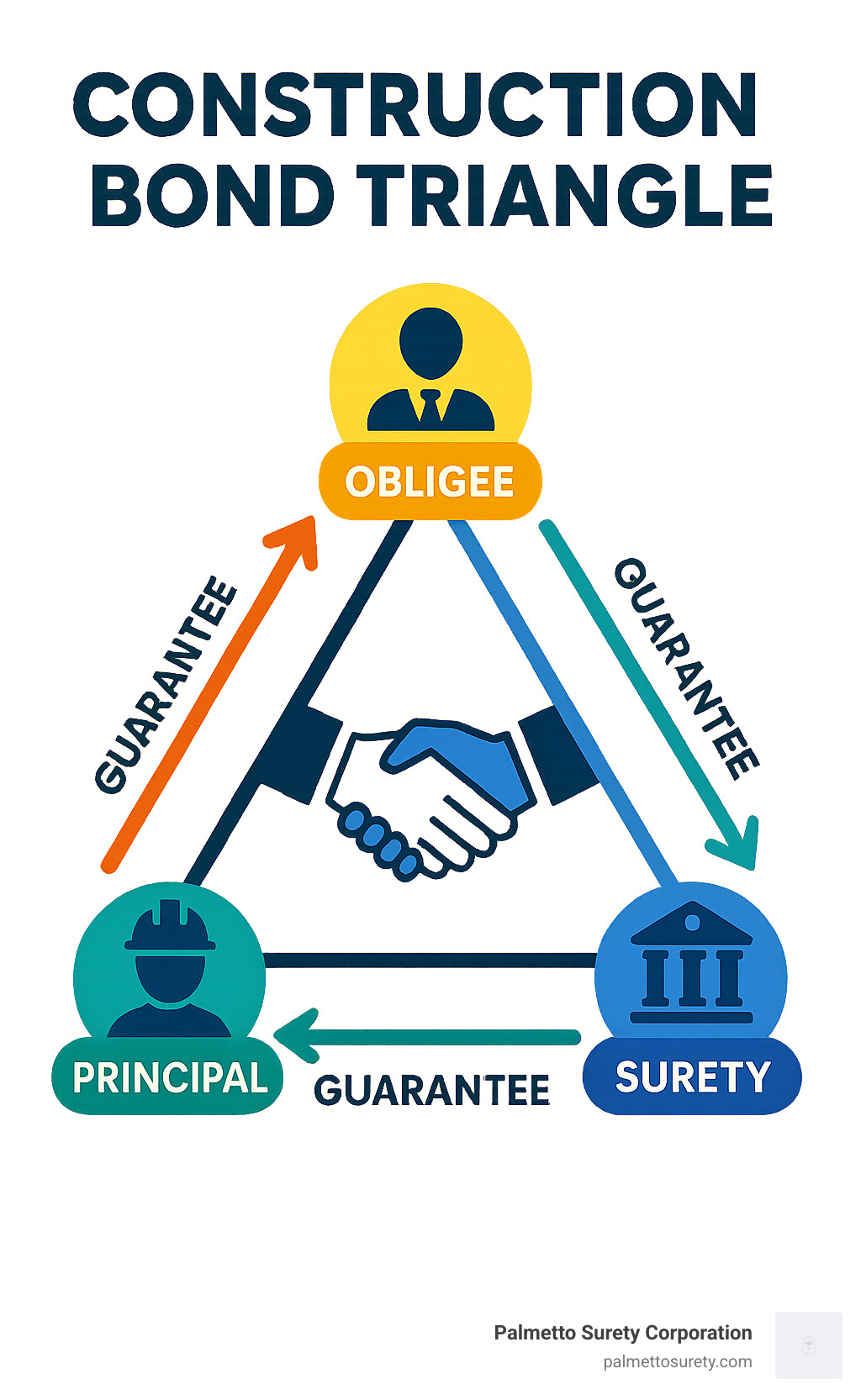
How does a construction bond work? A construction bond is a three-party agreement where a surety company guarantees to a project owner (obligee) that a contractor (principal) will fulfill their contractual obligations. If the contractor fails to meet these obligations, the surety steps in to ensure project completion or compensate for damages.
Here’s how construction bonds work in simple terms:
- Contractor purchases bond from a surety company
- Surety evaluates contractor’s financial health, experience, and character
- Bond guarantees project completion according to contract terms
- If contractor defaults, the surety fulfills the obligation or compensates the owner
- Surety then seeks reimbursement from the contractor under the indemnity agreement
Construction bonds provide crucial protection for project owners while helping qualified contractors win projects. They’re essentially a risk transfer mechanism that ensures projects get completed even when problems arise.
These bonds are often mandatory for public projects but are increasingly common in private construction as well. The cost typically ranges from 1-3% of the contract value for contractors with good credit, though rates can be higher based on risk factors.
I’m Haiko de Poel Jr, a marketing and branding expert who has worked extensively with surety bond companies including designing and launching digital platforms that streamline how construction bonds work for contractors and project owners alike. My experience includes managing bond programs and developing educational resources for the construction industry.
How does a construction bond work terminology:
– performance and payment bonds
– what is a bid bond in construction
– types of construction bonds
Construction Bonds 101: Definition, Parties & Main Types
Construction bonds have quite the history—dating back to 2,750 BC—though today’s framework comes from Roman surety principles established around 150 AD. At their heart, construction bonds are financial guarantees that shield project owners when contractors fail to perform or default.

Unlike insurance (which protects the policyholder), construction bonds protect the project owner against a contractor’s failure. This distinction matters tremendously in the real world of construction projects.
I remember a conversation with a school board member after they awarded a time-sensitive elementary school project to an unfamiliar contractor. She told me, “Without the construction bond, we’d never have taken the risk. The bond gave us confidence that either the work would get done or we’d be compensated.”
The Three Key Parties
Every construction bond brings together three essential participants in a relationship of accountability:
The Principal is the contractor who purchases the bond and promises to fulfill their obligations. This might be your general contractor, a subcontractor, or even a supplier depending on the specific bond.
The Obligee is the project owner who requires the bond and receives its protection. Typically, this is a government agency, private property owner, or sometimes a general contractor when they require bonds from their subs.
The Surety is the company (like Palmetto Surety Corporation) that issues the bond and stands behind the contractor’s promises. If things go sideways, the surety steps in.
This three-way relationship creates powerful accountability. As one contractor candidly shared with me, “Having a surety looking over my shoulder keeps me honest. I know if I mess up, they’ll pay, but then they’ll come after me for every penny.”
At-a-Glance Bond Categories
Construction bonds come in several varieties, each serving a specific purpose in the building process:
A Bid Bond guarantees that a contractor will honor their bid price and provide required performance and payment bonds if awarded the project. These typically cost nothing or just a small flat fee.
The Performance Bond ensures the contractor will complete the project according to specifications. If they fail, the surety will arrange completion or compensate the owner for losses.
A Payment Bond protects subcontractors, suppliers, and laborers by ensuring they’ll be paid for their work and materials. This keeps the project free from mechanics liens and moving forward smoothly.
Warranty Bonds (also called maintenance bonds) guarantee against defects in materials and workmanship for a specified period after project completion—typically 1-2 years.
Beyond these common types, specialized bonds include Subdivision Bonds for infrastructure improvements in new developments, Supply Bonds ensuring timely delivery of materials, Completion Bonds covering entire projects rather than individual contracts, and Retention Bonds that help contractors improve cash flow by receiving retainage earlier.

How does a construction bond work?
How does a construction bond work in real life? Think of it as a financial safety net that catches everyone if the contractor falls. Here’s the simple breakdown:
- Guarantee Mechanism: The surety company evaluates a contractor’s ability to handle the job—checking their experience, finances, and track record. Once satisfied, they issue a bond that essentially tells the project owner: “We believe this contractor can do the job, and we’re backing them financially.”
When Jane, a contractor in South Carolina, won her first major government project, she remembered how thorough the surety’s evaluation was: “They looked at everything—my books, my equipment, even called past clients. It felt invasive at first, but I realized they needed to be confident in me before putting their money on the line.”
-
Indemnity Agreement: This is the contractor’s promise to pay back the surety if things go south. By signing this agreement, contractors essentially pledge their business (and sometimes personal) assets as collateral.
-
Premium Payment: Just like insurance, contractors pay a premium for bond protection. This typically ranges from 1-15% of the total bond amount, with better-qualified contractors enjoying lower rates. A contractor with strong finances and a solid track record might pay just 1-3%, while those with shakier histories might pay considerably more.
-
Default Scenarios: If a contractor can’t finish the job, the surety steps in. They might bring in another contractor to complete the work, provide financial help to the original contractor, or pay the project owner directly (up to the bond amount).
As Mike, a project manager for a municipal building in Charleston, told me: “Our contractor hit financial trouble halfway through our community center project. Within days of notifying the surety, they had experts on-site assessing options. They ended up bringing in another local contractor, and our project finished just a month behind schedule. Without that bond, we’d have been in court for years.”
How does a construction bond work during the project lifecycle?
Construction bonds play different roles as a project moves from bidding to completion:
Pre-Bid Phase: Before submitting a bid, contractors secure a bid bond. This shows project owners they’re serious and financially capable. For owners, it’s like pre-screening candidates—only qualified contractors can get bonds.
Contract Award Phase: Once a contractor wins the job, they replace their bid bond with performance and payment bonds. The performance bond guarantees they’ll complete the work as specified, while the payment bond ensures they’ll pay all subcontractors and suppliers.
Completion Phase: As the project wraps up, the performance bond remains active until the owner accepts the work. The payment bond protects subcontractors and suppliers even after completion, typically for a statutory period.
Warranty Phase: Some projects require a maintenance bond for the warranty period (usually 1-2 years). This protects the owner against defects that might show up after completion. As one school district facilities manager put it: “That maintenance bond saved us when our new gymnasium floor buckled six months after installation.”
How does a construction bond work when the contractor defaults?
When a contractor can’t finish the job, how does a construction bond work to save the project? Here’s the rescue process:
The project owner notifies the surety company about the problem. This triggers an investigation where the surety reviews the situation, often sending representatives to the site and examining project documentation.
If they confirm a legitimate default, the surety has several options:
- They might provide financial or technical assistance to help the original contractor finish the job
- They could bring in a replacement contractor to complete the work
- They might pay the bond amount directly to the owner
- Sometimes they negotiate an alternative solution that works for everyone
After resolving the issue for the project owner, the surety then turns to the contractor for reimbursement under the indemnity agreement.
“When our contractor walked off our highway expansion project,” shared a DOT official from Georgia, “Palmetto Surety had their team on-site within 48 hours. They brought in a qualified replacement contractor who already understood the project specs, and coordinated with the original subcontractors to keep things moving. What could have been a disaster was just a minor hiccup.”

Why & When Bonds Are Required — Plus Cost, Benefits, Insurance Comparison
Ever wonder why some projects absolutely require bonds while others don’t? The answer reveals a lot about how construction bonds work in the real world.
Public Projects and Legal Requirements
If you’re bidding on government work, bonds aren’t optional—they’re the law. The Miller Act requires performance and payment bonds on all federal construction projects over $150,000. This isn’t bureaucratic red tape; it’s protection for taxpayer dollars invested in our nation’s infrastructure.
Each state has its own version—affectionately called Little Miller Acts—that apply similar requirements to state and local government projects. Here in South Carolina, where Palmetto Surety Corporation calls home, bonds kick in at the $100,000 threshold. Our neighbors in Georgia maintain the same $100,000 requirement for state projects.
As a county commissioner once told me: “When we’re spending public money, bonds aren’t just nice to have—they’re essential. They ensure taxpayers don’t foot the bill if something goes wrong.”
Private Projects
While not legally required, many savvy private owners insist on bonds too. You’ll typically see them required for:
- Large commercial developments where financial stakes are high
- Institutional projects like hospitals and universities
- Time-sensitive projects where delays would be catastrophic
- High-profile developments where reputation is on the line
“My first bonded private project seemed like overkill until our main subcontractor went bankrupt,” shared a commercial developer. “The bond saved us from a financial nightmare and kept the project on schedule.”
Cost Factors and Premium Rates
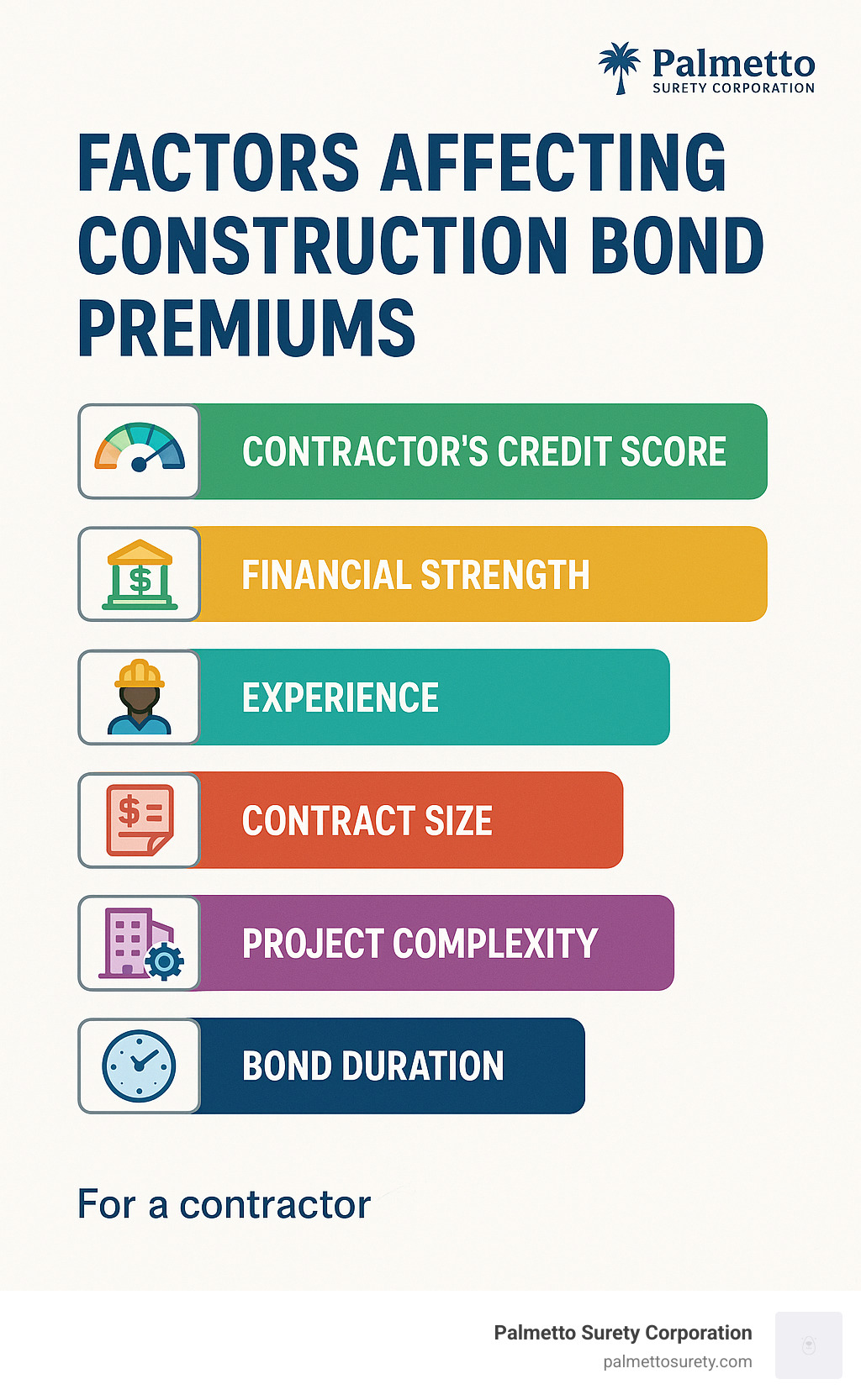
The million-dollar question: what will your bond cost? Like most things in life, it depends on several factors:
Your credit score carries significant weight—contractors with stellar credit typically pay just 1-3% of the bond amount. Your company’s financial strength matters too; a healthy balance sheet and strong working capital signal lower risk to sureties.
Your experience with similar projects can dramatically affect rates. A proven track record speaks volumes about your ability to deliver. Contract size can work in your favor too, as larger contracts may qualify for volume discounts.
The complexity of your project and bond duration also influence pricing. A simple six-month project carries less risk than a complex three-year endeavor.
For perspective, a contractor with strong credentials might pay $10,000-$30,000 for a $1 million performance bond. However, if your credit is challenging, that same bond could cost up to $150,000—a compelling reason to maintain strong financials.
Benefits and Limitations
Construction bonds offer powerful protection, but they’re not magic. Understanding their scope helps set proper expectations.
Benefits extend far beyond simple financial protection. Bonds prequalify contractors through rigorous surety underwriting—essentially giving owners a free financial assessment of potential contractors. They ensure project completion according to specifications and guarantee payment to subcontractors and suppliers, preventing disruptive liens. When problems arise, sureties often provide valuable technical and financial support, and their involvement significantly reduces litigation risk.
However, bonds do have limitations. They typically don’t cover force majeure events unless specifically included. Many exclude certain ESG and pandemic-related disruptions. Unlike insurance policies, bonds cannot be unilaterally canceled—they must be released by the owner. They don’t cover loan guarantees, and most U.S. sureties won’t bond overseas projects or those on Indian reservations.
Bonds vs. Insurance: Key Differences
Though often confused, bonds and insurance serve fundamentally different purposes:
| Feature | Construction Bonds | Insurance |
|---|---|---|
| Primary beneficiary | Project owner (Obligee) | Policyholder (Contractor) |
| Claims expectation | Zero claims expected | Claims anticipated |
| Recovery | Surety recovers from contractor | No recovery from insured |
| Underwriting approach | Credit-based (like a loan) | Risk-based (actuarial) |
| Purpose | Guarantees performance | Covers specified losses |
| Term | Project duration | Annual renewal |
Research by the Surety and Fidelity Association of America (conducted by Ernst & Young) confirms what we’ve seen at Palmetto Surety: bonded projects experience lower contractor default rates, lower completion costs when defaults do occur, and faster completion times compared to unbonded projects.
“The overall value of surety bonds more than covers their cost for a standard portfolio of construction projects,” the research concludes. In other words, bonds aren’t just a safety net—they’re a smart business decision that improves project economics.
Want to learn more about how construction bonds work for your specific situation? The experts at Palmetto Surety can help you steer the complexities of the bonding process with our 20+ years of experience serving the Southeast. Check out our research on The Value of Bonding for even more insights.
Securing Your Bond: Application, Underwriting & Capacity
Getting a construction bond doesn’t have to be complicated. I’ve seen countless contractors stress over the process, but with the right preparation, it’s actually quite straightforward. Let me walk you through how it all works.
Prequalification and Preparation
Before jumping into a specific project bond, it’s smart to establish a relationship with a surety provider through prequalification. Think of it as getting pre-approved for a mortgage before house hunting.
Most successful contractors start by gathering their financial documentation – preferably CPA-prepared statements that show your business in the best light. You’ll also want to document your work history, especially completed projects similar to what you’re bidding on now. A clear business plan that outlines your company structure and growth strategy goes a long way too.
One of our underwriters at Palmetto Surety Corporation often says, “Working with a construction-specialized CPA is like having a secret weapon.” These specialized accountants understand how to present your financials in ways that maximize your bonding capacity. They speak the language of surety underwriters.
Having solid banking relationships doesn’t hurt either. A established line of credit shows you’ve already been vetted by another financial institution.

Step-by-Step Bond Application
When you’re ready to apply, the process typically flows like this:
First, reach out to a surety provider like Palmetto Surety Corporation. We’ll help you complete the bond application form with your project details. The financial documentation you’ll need varies by bond size – for smaller bonds under $250,000, personal financial statements might be enough. Larger bonds require more comprehensive documentation including business financials, tax returns, and work-in-progress schedules.
You’ll sign an indemnity agreement, which is a fancy way of saying you’re personally responsible if claims arise. Don’t worry – this is standard practice and protects the surety company.
During underwriting, we evaluate what we call the “Three Cs”: Character (your personal and business integrity), Capital (your financial strength), and Capacity (your ability to actually do the work). Once approved, you’ll receive a premium quote. Pay that, and we’ll issue your bond documents ready for submission to the project owner.
At Palmetto Surety Corporation, we’ve spent over 20 years streamlining this process. Most applications are approved within hours, not days or weeks. This quick turnaround has saved many contractors from missing tight bid deadlines.
Underwriting Factors & Capacity Growth
Your bonding capacity is like a credit limit for your construction business. It includes both your single limit (the largest individual project you can bond) and your aggregate limit (the total value of all bonded projects you can have at once).
For example, with a $500,000 single limit and a $1,000,000 aggregate limit, you could take on two $500,000 projects simultaneously, or several smaller projects totaling $1,000,000.
Growing your bonding capacity happens naturally over time if you follow some basic principles. Start with smaller projects (under $350,000) to build your track record. Reinvest profits back into your business to strengthen your working capital. Keep both personal and business credit scores clean – they matter more than you might think.
Successfully completing projects without claims is perhaps the most powerful way to increase capacity. Our senior underwriter often shares stories of contractors who started with modest $250,000 bonding capacity and grew to multi-million dollar capacity in just a few years through consistent performance and financial discipline.
Regular communication with your surety agent helps build trust too. At Palmetto Surety, we love seeing our contractors grow – your success is our success.
Want to learn more about navigating the bonding process? Check out these construction bond courses that many of our clients have found helpful.
How does a construction bond work for new contractors versus established ones? The process is similar, but experience does streamline things. Either way, we’re here to guide you through each step of securing the bonds you need to win projects and grow your business.
Managing Risk: Claims, Defaults & Dispute Resolution
Sometimes even the best-planned projects hit rough patches. Understanding how construction bonds work when problems arise can save everyone headaches, time, and money.
Preventing Claims Before They Happen
The construction industry has a saying: “The cheapest claim is the one that never happens.” And it’s absolutely true. Most successful contractors I’ve worked with over the years build claim prevention into their daily operations.
Take scheduling, for instance. Smart contractors build realistic timelines with breathing room for the inevitable surprises. As one veteran contractor told me, “I add 15% to whatever timeline I think is reasonable—I’ve never regretted having that buffer.”
Payment management is another crucial area. When you pay your subs and suppliers on time, they keep working, materials keep flowing, and the project stays on track. It sounds simple, but cash flow issues are behind countless bond claims.
Documentation is your best friend when it comes to preventing claims. Every change order, every communication, every schedule adjustment should leave a paper trail. As one contractor who’s never had a claim in 15 years put it: “Document everything, communicate early about problems, and never surprise your client or your surety.”
Regular, honest communication with project owners about challenges goes a long way too. Most owners can handle bad news—they just can’t handle surprises. The same applies to quality control measures that catch issues before they become problems.
Processing a Claim If One Arises
Despite everyone’s best efforts, sometimes claims do happen. Here’s how a construction bond works when things go sideways:
First comes the notice of default, where the project owner formally notifies the surety that the contractor has violated specific contract terms. This kicks off an investigation process that’s thorough but fair.
During this investigation, the surety reviews contracts, interviews all parties, visits the project site, analyzes financials, and often consults with construction experts. They’re looking to understand what went wrong and who’s responsible.
“Claims are a rather extreme measure,” explains our claims specialist at Palmetto Surety Corporation. “Most contractors, even when facing difficulties, don’t encounter them. When they do occur, we work to find the most efficient resolution for all parties.”
If the surety determines the claim is valid, they have several options. They might provide technical or financial assistance to help the original contractor finish the job. In more serious cases, they might bring in a replacement contractor to complete the work. Sometimes they’ll tender the penal sum of the bond or negotiate an alternative solution.
The investigation typically takes 30-60 days, though urgent situations may move faster. Throughout this process, Palmetto Surety Corporation remains neutral, evaluating everything based on contract terms and documentation rather than taking sides.
After resolving the claim, the surety will seek reimbursement from the contractor under the indemnity agreement—which is why contractors should do everything possible to avoid reaching this stage.

Dispute resolution doesn’t always mean formal claims, though. Many potential issues get resolved through arbitration or mediation before reaching claim status. These alternative approaches often save time and preserve relationships better than litigation.
The best contractors view their surety as a partner in risk management. They maintain open lines of communication, address problems early, and leverage the surety’s expertise to steer challenging situations. This partnership approach often prevents small issues from ballooning into formal claims.
How construction bonds work in claim situations largely depends on the documentation and relationships established long before problems arise. Building strong foundations in both areas is your best insurance against claims—even better than the bond itself.
Frequently Asked Questions about Construction Bonds
What does a construction bond cost on average?
When contractors ask me about bond costs, I always tell them it’s like buying a car – the price depends on your credit, history, and what you’re looking for.
For contractors with good credit and strong financials, you’re typically looking at 1-3% of the contract amount. So that $500,000 performance bond might cost between $5,000-$15,000. It’s an investment that helps you win larger projects and provides peace of mind to your clients.
If your credit is more in the “fair” category, rates might climb to 5-10%. And for those with credit challenges, rates could reach 10-15% or even higher.
I remember working with a contractor in Augusta who was rebuilding after bankruptcy. His rates started at 12%, but after two years of successful projects, we got him down to 4%. How does a construction bond work in terms of pricing? It rewards reliability and improvement over time.
At Palmetto Surety Corporation, we leverage our two decades of regional expertise to find competitive rates for Southeast contractors. We understand the local market and can often find better solutions than national providers who don’t know our region’s unique construction landscape.
Can a contractor get bonded with less-than-perfect credit?
Absolutely! I’ve helped hundreds of contractors with credit challenges secure the bonds they need. It might cost more initially, but there are several pathways:
Small Bond Programs can be your best friend if you need bonds under $350,000. These often have more flexible credit requirements and can help you establish a track record.
Providing collateral (typically 25-100% of the bond amount) can open doors when your credit score won’t. One contractor I worked with used a certificate of deposit as collateral for his first three projects, then qualified for standard rates after completing them successfully.
Sometimes strong business financials can offset personal credit issues. I’ve seen contractors with past bankruptcies get bonded because their current business showed excellent cash flow and working capital.
“We believe in second chances,” our underwriting director often says. “If you’ve had credit problems but are on the path to recovery, we can usually find a solution that works.”
How long does it take to get bonded?
Time is money in construction, and waiting weeks for bond approval can cost you valuable opportunities. How does a construction bond work in terms of timing? It varies by size and complexity:
For small bonds under $350,000, Palmetto Surety Corporation can often provide same-day approval when you have your documentation ready. We’ve saved countless bids for contractors who called us in the morning needing a bond by that afternoon’s deadline.
Medium-sized bonds ($350,000-$1,000,000) typically take 1-3 business days for a thorough underwriting review.
Larger bonds over $1,000,000 might require 3-5 business days or longer, especially for first-time applicants. The surety needs to perform more due diligence as the risk increases.
You can speed things up by:
– Getting prequalified before you start bidding
– Keeping your financial statements current
– Building a relationship with a surety provider
– Having your documentation organized and ready
“For contractors in a hurry, we offer same-day approvals for many bond requests,” our operations manager proudly notes. “Our ability to approve most applications within hours is why contractors throughout the Southeast choose us when time is tight.”
This responsive approach has saved countless bids for contractors facing tight deadlines – like the roofing company in Columbia who called us at 9am needing a bond for a 2pm bid submission. We had their bond in hand by noon.
Conclusion
Understanding how construction bonds work isn’t just helpful—it’s essential for success in today’s construction industry. These bonds serve as powerful safety nets that give everyone involved the confidence to move forward with major projects, even when the stakes are high.
For contractors, bonds are both a responsibility and a gateway to opportunity. They’re your chance to showcase your financial stability and performance capabilities while open uping access to larger, more profitable projects that might otherwise be out of reach. For project owners, these bonds deliver peace of mind, ensuring your investment remains protected even when things don’t go according to plan.
Here at Palmetto Surety Corporation, we’ve spent over two decades helping contractors across the Southeast steer the sometimes complex world of construction bonds. Our deep roots in Georgia, Florida, Louisiana, Mississippi, South Carolina, Tennessee, and Texas give us unique insights into local requirements and regional challenges that national providers might miss.
“We see ourselves as partners in your success,” as our senior underwriter often says. “When you win, we win—and that relationship is built on trust that goes both ways.”
Whether you’re a contractor preparing for your first bonded project or a seasoned builder looking to expand your bonding capacity, our team stands ready to help with quick approvals, competitive rates, and the kind of personalized service that only comes from a regional specialist who understands your specific needs.
Construction bonds aren’t merely financial products—they’re relationships founded on trust and performance. By mastering how construction bonds work and teaming up with an experienced surety provider who knows your market, you can build the confidence needed to win projects and grow your construction business from the ground up.
Ready to take the next step? For more information about our surety solutions or to begin your bond application process today, visit our website or reach out to our Charleston, SC office. With most applications approved within hours—not days or weeks—we’ll help you get back to doing what you do best: building quality projects that stand the test of time.


