


how much does a 50 000 bail bond cost: 3 Shocking Facts 2025
Understanding Bail Bond Costs: What You Need to Know
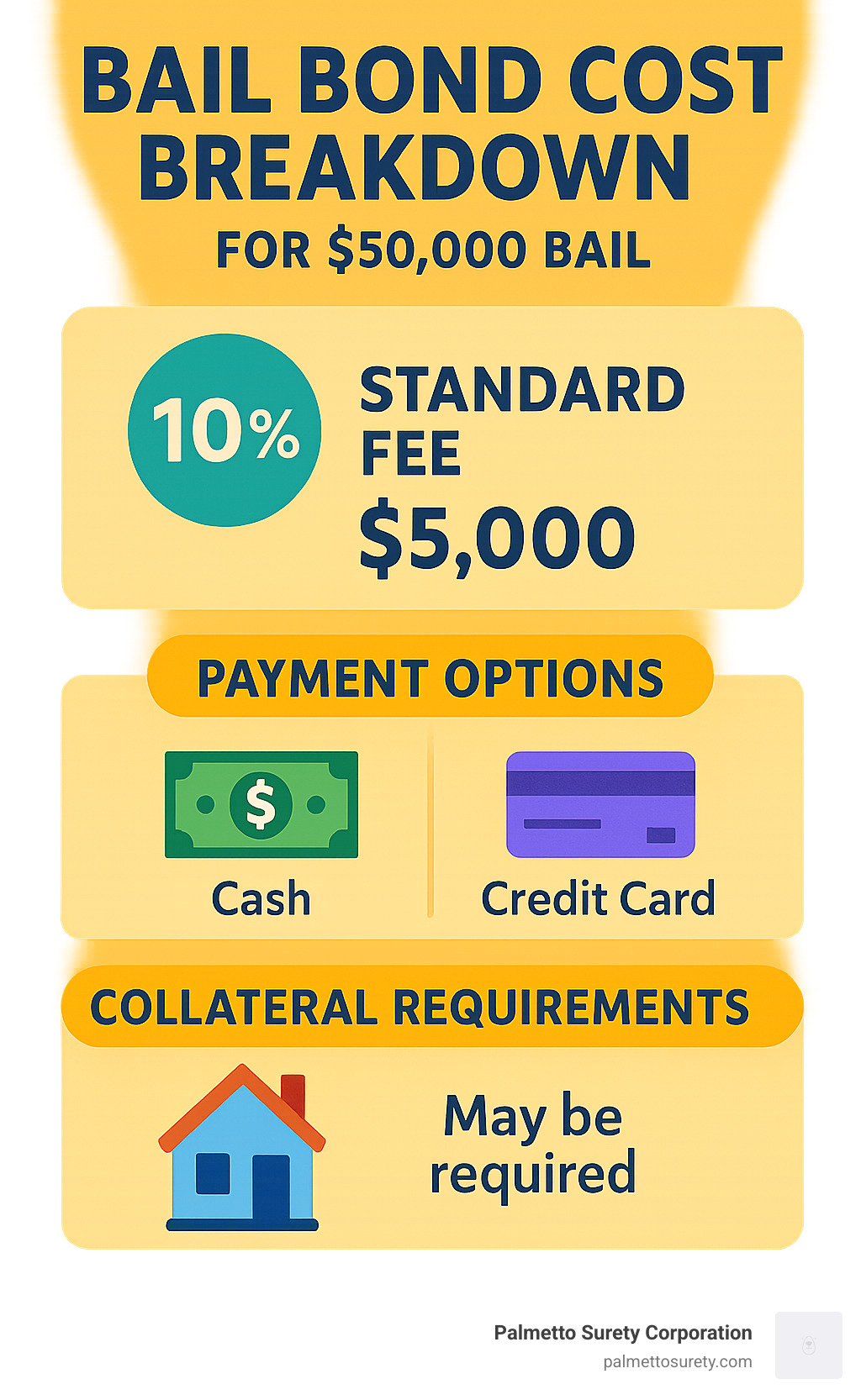
If you’re wondering how much does a 50 000 bail bond cost, the simple answer is typically $5,000, which is 10% of the total bail amount. This fee is generally non-refundable and is paid to a bail bond company for their service of posting the full bail amount with the court.
| Bail Bond Cost Breakdown for $50,000 Bail |
|---|
| Standard Rate: $5,000 (10% of bail amount) |
| Discounted Rate: $3,500-$4,000 (7-8% with attorney referral or military/union discount) |
| Higher Risk Rate: Up to $7,500 (15% in states without caps) |
| Refundable: No – premium is the bail bondsman’s fee for service |
| Collateral: May be required in addition to premium |
When someone is arrested and bail is set at $50,000, most people don’t have that kind of cash readily available. This is where bail bonds come in – they’re essentially a financial guarantee to the court that the defendant will appear for all scheduled court dates.
The cost of a bail bond varies based on several factors including:
- State regulations – some states cap fees at 10%, others allow up to 15%
- Discount eligibility – military, union members, or attorney referrals may qualify for reduced rates
- Risk assessment – defendant’s criminal history and flight risk
- Collateral requirements – higher bail amounts often require property or assets as security
As Haiko de Poel Jr, I’ve overseen the marketing and digital change for one of America’s fastest-growing surety bond companies, giving me unique insight into how much does a 50 000 bail bond cost and the factors that influence pricing in this specialized financial service.
Must-know how much does a 50 000 bail bond cost terms:
– Bail bond South Carolina
– immigration bail bond cost
– how much does a 100 000 bail bond cost
How Courts Decide Your Bail Amount
Ever wonder why a judge picks $50,000 instead of $30,000 or $100,000? It’s not random—courts follow specific guidelines while still exercising their judgment in each case.
Bail Schedules
Most counties maintain what’s essentially a “price list” for different offenses called a bail schedule. Think of it as a menu where different crimes come with different price tags.

“Bail schedules provide consistency but are just starting points,” explains one of our senior bail agents at Palmetto Surety. “Judges can and do deviate from these guidelines based on individual case factors.”
In Sacramento County, California, for example, their detailed bail schedule spells out standard amounts for everything from minor misdemeanors to serious felonies. This helps create some consistency in the system, but it’s far from the whole story.
Factors That Influence Bail Amounts
When you’re facing a $50,000 bail amount, the judge has likely weighed several important factors about you and your case:
Your flight risk plays a huge role—do you have strong community ties, stable employment, and family nearby? Or does your history suggest you might disappear before your court date?
Your criminal history speaks volumes. Previous failures to appear in court or a lengthy record can significantly bump up your bail amount.
Public safety concerns cannot be ignored. The more a judge believes you might pose a danger to others, the higher your bail tends to be.
The severity of the charges naturally affects bail—more serious allegations command higher amounts to ensure you’ll return to face them.
Finally, the judge considers your financial resources. The amount needs to be meaningful enough that you won’t simply walk away from it, but not so excessive that it becomes impossible.

County and State Variations
Here’s something many people don’t realize: identical charges can result in dramatically different bail amounts depending on where you’re arrested. A charge that might trigger a $50,000 bail bond cost in Georgia could be significantly higher in Florida or much lower in Tennessee.
At Palmetto Surety Corporation, we’ve seen these regional differences across the southeastern United States. These variations directly impact not just the bail amount but consequently how much you’ll pay for a bail bond.
The judge’s discretion also plays a significant role. Two judges in the same courthouse might set different bail amounts for similar cases based on their assessment of the factors mentioned above.
Understanding these variables helps explain why bail amounts can seem unpredictable. While $50,000 might seem like an arbitrary number, it’s actually the result of a complex calculation based on local guidelines, the nature of the alleged offense, and your personal circumstances.
How Much Does a 50,000 Bail Bond Cost?
When you’re facing a $50,000 bail amount, the burning question is: how much does a 50 000 bail bond cost to actually get out of jail? The standard industry rate is 10% of the bail amount, which translates to $5,000 for a $50,000 bail.
This $5,000 premium is non-refundable – it’s the fee you pay to the bail bond company for their service of posting the full $50,000 with the court on your behalf. Think of it like an insurance premium where you’re essentially paying for the bail bond company to shoulder the financial risk of your $50,000 court obligation.
“Most folks are surprised to learn the premium isn’t returned, even if they make every court date,” says one of our veteran agents at Palmetto Surety. “That fee is what allows us to take on the considerable risk of guaranteeing your full bail amount to the court.”
According to the California Department of Insurance, these rates are typically regulated by state law and cannot exceed certain percentages. In California, for instance, the maximum allowable rate is capped at 10%.
Standard 10% Rule: How Much Does a 50 000 Bail Bond Cost Everywhere?
Across most states, including many where Palmetto Surety Corporation operates, the standard rate is a straightforward 10%. This means:
Your $50,000 bail translates to a $5,000 non-refundable premium, regardless of how long your case takes to resolve. The bail bond company earns this premium as soon as you’re released from jail.
“While the 10% premium is fairly standard across most jurisdictions,” our operations manager explains, “what really varies from case to case is when collateral becomes necessary and what payment options we can offer.”
For a $50,000 bail bond, most bail bond companies classify this as a medium-risk bond. This often means some form of collateral will be required in addition to the premium, especially if there are concerns about flight risk or the nature of the charges.
State Exceptions: How Much Does a 50 000 Bail Bond Cost in New York, NC & Beyond?
While 10% is the norm in most places, some states march to the beat of their own drum:
New York uses a tiered fee formula that can actually save you money on higher bail amounts. For a $50,000 bail bond in New York, the math works out to approximately $3,260 (about 6.5% overall) based on their sliding scale:
– 10% of the first $3,000 ($300)
– 8% of the next $7,000 ($560)
– 6% of the remaining $40,000 ($2,400)
North Carolina gives bail agents more flexibility, allowing charges between 10% and 15% of the total bail amount. This means your $50,000 bail bond could cost anywhere from $5,000 to $7,500 depending on the agent’s assessment of your risk factors.
South Carolina, where Palmetto Surety is headquartered in Charleston, generally follows the 10% standard but allows some wiggle room based on individual risk assessment. Our local expertise here gives us particular insight into how these regulations work in practice.

The bottom line? While how much does a 50 000 bail bond cost varies somewhat by location, you can generally expect to pay around $5,000 for the bond service – with the understanding that this fee won’t come back to you even after your case concludes.
Paying the Premium: Discounts, Financing & Collateral
So you’re facing a $50,000 bail and wondering about that $5,000 premium? I’ve got good news – there are several ways to make this more affordable or manageable for your family during what’s already a stressful time.
Available Discounts
Life happens, and bail bond companies understand that $5,000 isn’t pocket change for most folks. That’s why many agencies, including those working with Palmetto Surety Corporation, offer meaningful discounts:
Military discount is one of our most popular options. If you or your loved one served our country, you might qualify for a reduced rate of around 8% – bringing your how much does a 50 000 bail bond cost figure down to $4,000 instead of $5,000.
Attorney referrals can be incredibly valuable. When an attorney sends you our way, we often can offer rates as low as 7% ($3,500) when paid upfront. This happens because attorney-referred clients typically make all their court dates.
Union members and AARP cardholders frequently qualify for special pricing too. These discounts can shave up to 20% off the standard rate, making a difficult situation a bit more manageable.
One of our clients, a veteran arrested near Atlanta, shared his experience: “When they told me I qualified for the military discount, I felt a weight lift off my shoulders. That $1,000 savings meant my wife could still pay our mortgage that month while dealing with my situation.”
Payment Methods and Financing Options
Coming up with thousands of dollars overnight isn’t realistic for most families. We get it. That’s why payment flexibility matters:
Most bail agencies accept all major credit cards, making it easy to secure release quickly. Many families split the payment across multiple cards when necessary.
Payment plans are a lifeline for many clients. Some of our partner agencies offer financing with as little as 5% down – that’s just $250 initial payment on a $5,000 premium. The remaining balance is typically paid in weekly or monthly installments.
Traditional payment methods like cash, checks, and money orders are always welcome too, of course.
As our finance manager often tells clients, “Our primary goal is getting your loved one home while ensuring they make their court dates. We’ll work with you to find a payment solution that works for your unique situation.”
Collateral Requirements
For a $50,000 bail bond, you’ll likely need to provide some form of collateral in addition to the premium. Think of collateral as a safety net that protects the bail agency if the defendant skips court.

Common collateral options include:
Real estate with sufficient equity (typically 150% of the bond amount) is the preferred form of collateral for larger bonds. This might be your home or a piece of land.
Vehicles with clear titles often work well for $50,000 bonds. Cars, trucks, boats, and RVs can all serve as collateral, though they usually need to be paid off or have substantial equity.
Jewelry and valuable assets with verifiable value might be accepted, though these require professional appraisals in most cases.
Cash deposits sometimes can serve as both premium and collateral, depending on the situation.
Down Payment vs. Collateral—Which Do You Need?
This confusion trips up many first-time bail bond customers, so let’s make it crystal clear:
Premium/down payment is the non-refundable fee (typically $5,000 for a $50,000 bail) that you pay for the bail bond service. Think of it like an insurance premium – it’s the cost of doing business. This can be paid in full or financed with a down payment.
Collateral is completely separate from your premium. It’s security that’s only used if the defendant fails to appear in court. When the case concludes successfully (meaning all court appearances were made), your collateral is returned in full.
A family in Savannah recently worked with one of our agents on a $50,000 bail bond. They paid $1,000 down on the $5,000 premium (financing the rest through a payment plan) and used their paid-off pickup truck as collateral. The truck stayed in their driveway the whole time, and when the case wrapped up six months later, we released the collateral agreement completely.
When asking how much does a 50 000 bail bond cost, the premium is just part of the equation. Understanding your collateral options and payment flexibility can make all the difference during this challenging time.
Life Cycle of a $50,000 Bail Bond
When you’re dealing with a loved one’s arrest, understanding what happens from the moment of arrest to their release can help ease your anxiety. Let’s walk through what actually happens with a $50,000 bail bond.
From Arrest to Release
The bail bond process begins the moment someone is arrested. After booking at the jail, a judge sets bail—in this case, $50,000—either during arraignment or using the county’s bail schedule.
Once bail is set, this is where families typically reach out to us at Palmetto Surety. Our agents immediately begin the paperwork while a family member or friend (the “indemnitor”) completes the application and makes payment arrangements for the $5,000 premium.
“Most people are surprised by how quickly we can move,” says one of our senior agents. “Once we have the signed paperwork and payment sorted, we post the bond with the court right away.”
After the bond is posted, jail staff process the paperwork and prepare the defendant for release. The typical release time is about 1-4 hours, though this varies significantly by location.
“Some county jails can get someone out in under an hour, while others—especially on busy weekend nights or holidays—might take 6-8 hours,” our agent explains. “We always stay in communication with families throughout the process so they know what to expect.”

After Release: Obligations and Responsibilities
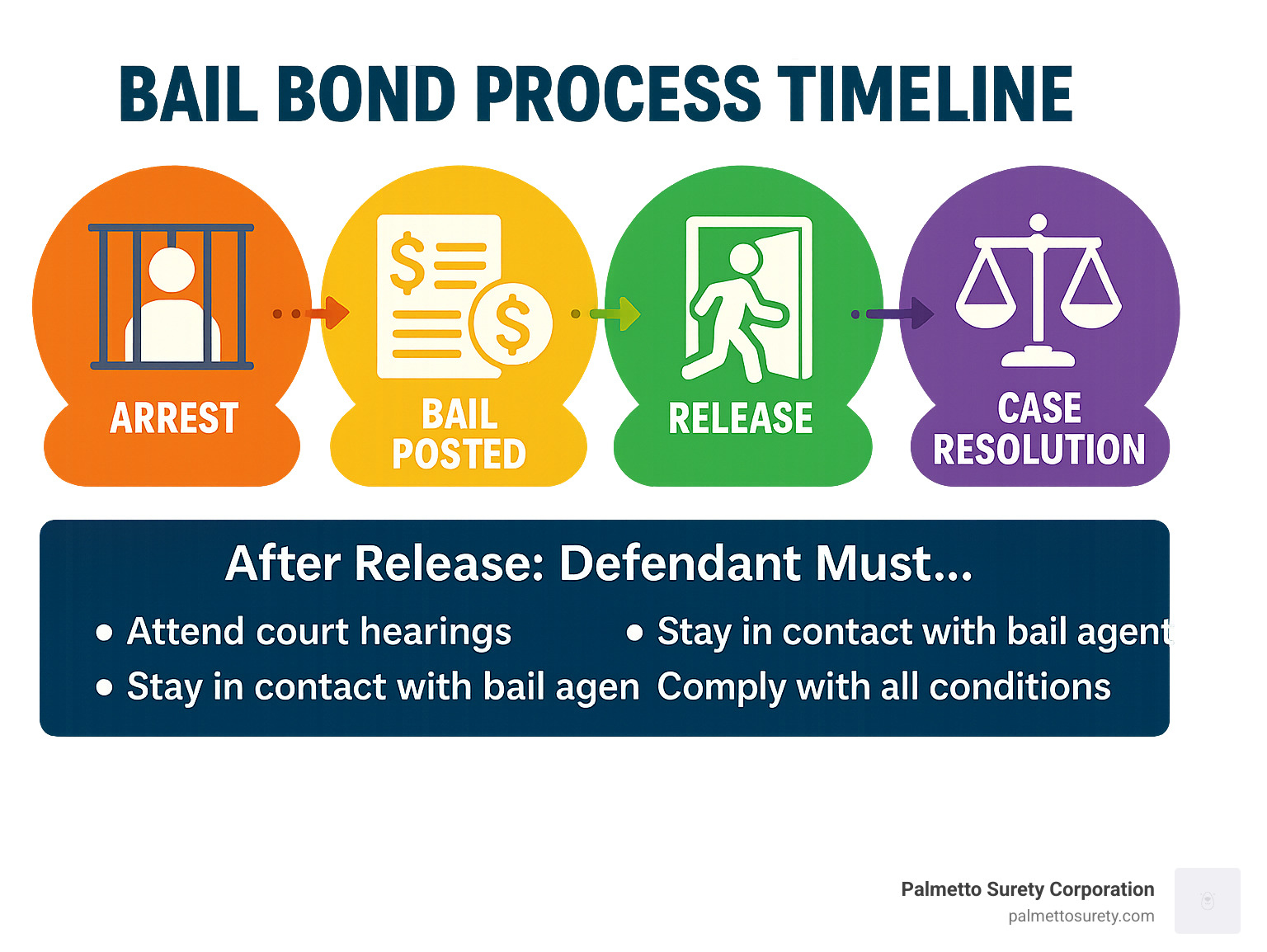
Walking out of jail isn’t the end of the bail bond process—it’s just the beginning. The defendant must attend all court dates (sometimes multiple appearances over months), stay in contact with us, and comply with any conditions set by the court.
We take our responsibility seriously to remind clients of upcoming court dates. Missing court isn’t just bad for the defendant—it puts the person who signed for the bond at financial risk too.
“We’re not just getting people out of jail,” our Charleston office manager says. “We’re partnering with families to make sure their loved one meets their obligations so everyone can move forward.”
Failure to Appear Consequences
What happens if someone doesn’t show up to court after we’ve posted their $50,000 bail bond? It triggers a serious chain of events:
First, the court issues a bench warrant for immediate arrest. Our company then has a limited timeframe (typically 90-180 days depending on the jurisdiction) to locate and surrender the defendant before we’re required to pay the full $50,000 to the court.
If we can’t find the defendant, that $50,000 comes due—and we’ll need to recover it from the indemnitor or by claiming the collateral that was pledged.
“Our recovery agents work diligently to locate defendants who miss court,” explains our risk management director. “This is one of many services covered by the premium you pay—we absorb this risk and cost so families don’t have to come up with the full bail amount.”
Collateral Return Timeline
The good news is that for clients who make all their court appearances, any collateral provided is returned once the case concludes—regardless of the outcome of the case itself.
At Palmetto Surety, we pride ourselves on processing collateral returns promptly, typically within 30 days after case resolution. Whether it’s the deed to property, jewelry, or vehicle titles, we return everything once all obligations are fulfilled.
“Getting your collateral back is something we take seriously,” our bond processor shares. “We know these are important assets to our clients, and returning them promptly is just part of the service we promise.”
Full Cash Bail vs. Bail Bondsman
When faced with a $50,000 bail, you generally have two options: pay the full amount in cash to the court or use a bail bondsman. Let’s compare:
| Aspect | Full Cash Bail ($50,000) | Bail Bond ($5,000 premium) |
|---|---|---|
| Upfront cost | $50,000 | $5,000 (or less with payment plan) |
| Refundable? | Yes, minus court fees | No, premium is non-refundable |
| Processing time | Can be slower | Often faster due to bail agent’s expertise |
| Risk if defendant flees | Lose entire $50,000 | Lose collateral + potentially owe $50,000 |
| Opportunity cost | $50,000 tied up for months/years | Only premium amount is spent |
| Expertise provided | None | Professional guidance through process |
“Many people don’t realize that posting the full cash bail means tying up a large sum of money for the duration of the case, which could be months or even years,” points out our financial advisor. “While you eventually get most of it back, that’s a significant opportunity cost.”
In Georgia, for example, where Palmetto Surety operates in cities like Atlanta, Augusta, and Savannah, court cases can take 6-18 months to resolve, meaning $50,000 would be unavailable to the family for that entire period.
Frequently Asked Questions about $50,000 Bail Bonds
Is the $5,000 fee ever refundable?
No, the premium is never refundable. This is one of the most common misunderstandings we encounter at Palmetto Surety. The premium (typically $5,000 for a $50,000 bail bond) isn’t a deposit—it’s the fee for our service of posting the bond and taking on the financial risk. Even if your case gets dismissed the very next day or all charges are dropped, the premium is considered fully earned once the defendant walks out of jail.
One of our clients in Columbus, GA, shared her experience: “I honestly thought I’d get at least some money back when my son’s case was dismissed two weeks after his arrest. The agent patiently explained that the premium covered their risk and service of posting the bond, not the outcome of the case. Wish I’d understood that from the beginning.”
How fast can someone get out on a $50,000 bond?
In most cases, you can expect release within 1-4 hours after we post the bond, though this timeline varies significantly depending on where the arrest occurred. Several factors affect how quickly someone can get out:
The jail’s current staffing levels and how busy they are that day make a huge difference. Weekend and overnight releases typically take longer since facilities operate with reduced staff. Some jails are simply more efficient than others—a reality we’ve witnessed across all the southeastern states we serve.
Other factors like additional holds, pending warrants, or incomplete booking procedures can also delay release. Our team at Palmetto Surety works diligently to move the process along as quickly as possible, but ultimately, the jail controls the final release timeline.
Can I negotiate the percentage below my state’s minimum?
Generally, no—and you should be suspicious of anyone who claims otherwise. In states with regulated bail bond rates, offering rates below the minimum is typically illegal and could put your loved one’s freedom at risk. For example, in California, bail bond companies cannot legally charge less than the regulated rate.
“When someone offers you a rate that seems too good to be true, it usually is,” our compliance officer often warns clients. “Significantly lower rates could indicate illegal rebating or other unethical practices that might jeopardize the validity of the bond—and that’s the last thing you need during an already stressful time.”
That said, legitimate discounts are available and completely above-board. Military members, union members, and those with attorney referrals can often reduce the cost of a $50,000 bail bond from the standard $5,000 down to around $3,500-$4,000 in many jurisdictions. These discounts are legal and can provide meaningful savings during a difficult time.
Conclusion
When you’re dealing with a $50,000 bail situation, knowing exactly what you’ll pay can make a stressful time a little easier to handle. While how much does a 50 000 bail bond cost typically comes down to $5,000 (that standard 10% premium), your actual cost might vary based on where you live, discounts you qualify for, and your specific circumstances.
Here at Palmetto Surety Corporation, we’ve spent over two decades helping families across the Southeast steer the bail process. If there’s one thing we’ve learned, it’s that being upfront about costs and what to expect helps people make better decisions during difficult times.
“The relief on someone’s face when they understand exactly what they’re paying and why – that’s why transparency matters in this business,” shares one of our veteran agents in Atlanta.
When facing a $50,000 bail situation, remember:
The standard $5,000 premium isn’t coming back to you – it’s the fee for our service of posting the full bail amount with the court. Think of it like paying a plumber to fix your pipes – you’re paying for the service, not making a deposit.
Military members, union workers, and folks referred by attorneys often qualify for significant discounts – sometimes bringing that $5,000 down to as low as $3,500.
Collateral is usually required alongside your premium for a bond this size, but unlike the premium, you’ll get your collateral back once the case closes (assuming all court appearances were made).
Can’t pay the full premium upfront? That’s okay. We offer payment plans designed to work with your budget while still getting your loved one released quickly.
Our goal is always quick approval – in most cases, we can have paperwork processed within hours, not days.
Across Georgia, Florida, Louisiana, Mississippi, South Carolina, Tennessee, and Texas, our network of agents works to make the bail process as smooth as possible. Whether you’re in Atlanta, Savannah, Charleston, or any city in between, we have local agents who understand your specific court system and can guide you through each step.
When the case concludes, we’ll handle returning your collateral promptly – typically within 30 days of the case resolution.
For more information about our bail bond services or to speak with a licensed agent about your specific situation, visit Palmetto Surety. We’re here to help when you need us most – because we understand that behind every bail bond is a family waiting for someone to come home.


