


Indemnity Bond for Car Title: 5 Powerful Steps Solving 2025 Troubles
Car Title Troubles? Understanding Indemnity Bonds
An indemnity bond for car title is a financial guarantee that helps you obtain legal ownership when your original title is missing, damaged, or incomplete. Think of it as a safety net that protects both you and the state when documentation isn’t perfect.
“If you’ve ever been in a situation where you’ve lost a car title or bought a vehicle with ownership uncertainties, then a surety bond is your knight in shining armor.”
What is an indemnity bond for car title?
| What it is | What it does | How long it lasts | Typical cost |
|---|---|---|---|
| A surety bond guaranteeing vehicle ownership | Allows you to register, insure, and sell a vehicle without the original title | 3 years in most states | $100 flat rate for bonds up to $6,000 |
When you can’t provide a valid certificate of title, your state DMV may allow you to obtain a “bonded title” by purchasing an indemnity bond. This bond:
- Protects previous owners and lienholders against improper title issuance
- Provides a legal pathway to establish ownership
- Creates a three-party agreement between you, the state, and the surety company
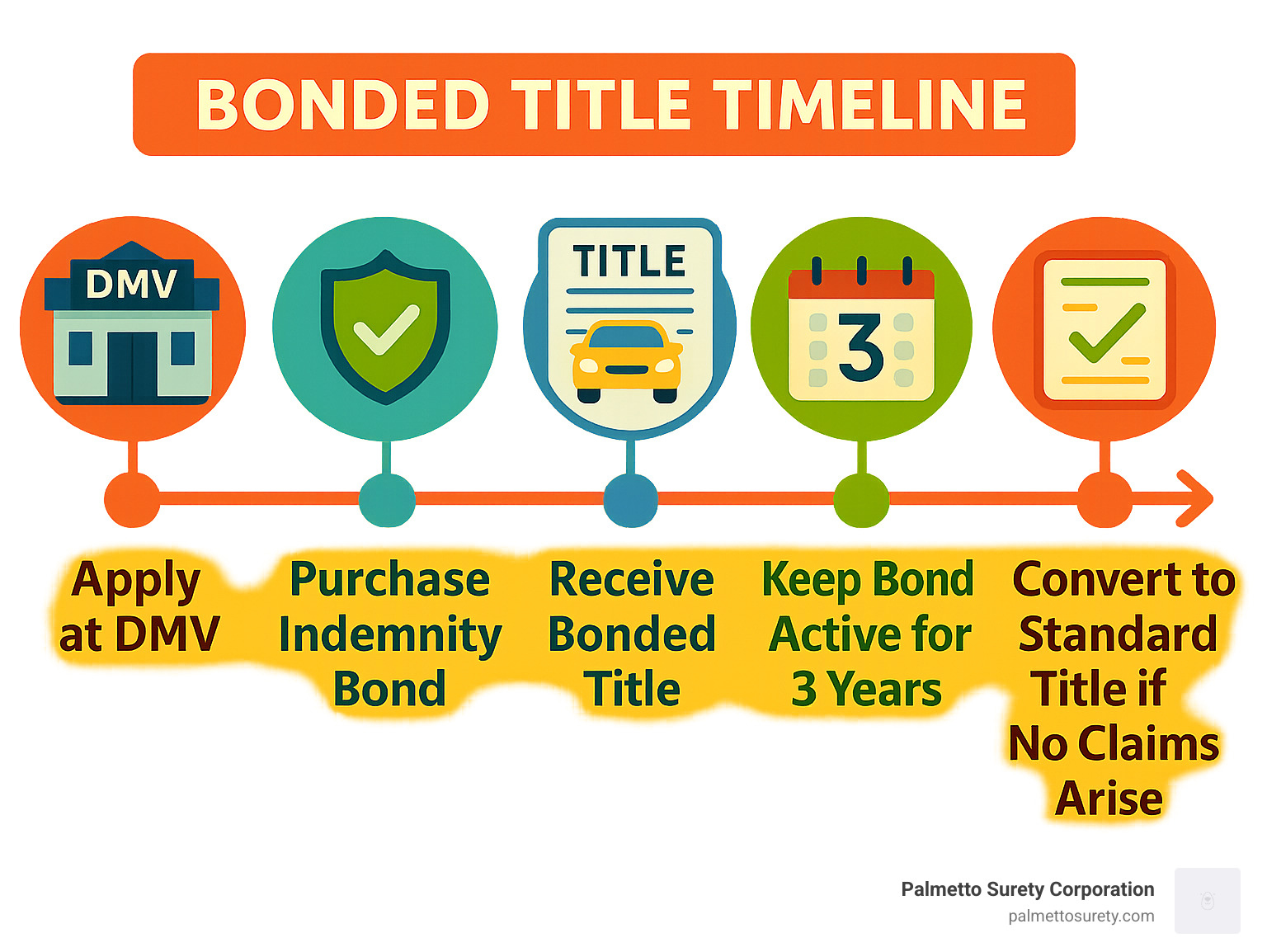
- Converts to a standard title after the bond period (typically 3 years) if no claims arise
I’m Haiko de Poel Jr, a fractional Chief Marketing Officer who has helped numerous vehicle owners steer the complexities of indemnity bonds for car titles through my work with Palmetto Surety Corporation, one of the fastest-growing surety bond companies in the United States. My experience has shown that understanding the indemnity bond for car title process is crucial for anyone facing title documentation challenges.
Learn more about indemnity bond for car title:
– car title bond near me
– how to get a title for a car without title
Why You Might Need an Indemnity Bond
Life happens, and sometimes your car’s paperwork gets caught in the crossfire. There are many situations where an indemnity bond for car title becomes your best (and sometimes only) option for resolving title issues. Let’s look at the most common scenarios that might bring you to this solution.

Lost or Stolen Title
We’ve all been there – that moment of panic when you realize an important document has vanished. Maybe you moved houses and that folder with your car title disappeared in the shuffle. Perhaps it was accidentally tossed during spring cleaning, or worse, stolen along with other personal documents. Without this crucial piece of paper, selling or registering your vehicle becomes nearly impossible.
Defective Title Assignment
Sometimes you have the title, but there’s something wrong with it. The previous owner might have signed in the wrong place, forgotten to complete certain fields, or perhaps coffee was spilled on a critical section. These errors aren’t just annoying – they can completely halt your ability to register the vehicle in your name.
As one Palmetto Surety client told us: “I thought I had everything in order until the DMV clerk pointed out the previous owner had signed the title but never dated it. Since they had moved out of state, an indemnity bond for car title saved me weeks of tracking them down.”
Inherited Vehicles
Losing a loved one is difficult enough without paperwork complications. When family members leave you a vehicle, proper documentation might be missing, especially if the car wasn’t specifically mentioned in a will. Probate issues can further complicate matters, leaving you with a vehicle you legally own but can’t properly register.
Vintage or Classic Cars

That beautiful 1968 Camaro might have changed hands a dozen times over the decades. With each transfer, there’s a chance something went wrong with the paperwork. Vintage vehicles often come with complicated ownership histories and incomplete documentation trails, making bonded titles particularly common in the classic car community.
Auction or Private Party Purchases
“I’ll mail you the title once I find it” are words that should immediately raise red flags when buying a vehicle. Whether you purchased at auction or from a private seller, incomplete documentation is a common problem. That promising deal can quickly turn into a headache when the title never materializes.
Lender Out of Business
You diligently made every payment on your auto loan, but before sending you the clear title, your lender went out of business. Now who’s supposed to release the lien? This increasingly common scenario leaves many responsible car owners in title limbo through no fault of their own.
Salvage Rebuilds
If you’ve purchased and restored a salvage vehicle, you know the paperwork can be as complicated as the mechanical repairs. Rebuilt vehicles often have complex title histories that require bonding to establish clear ownership.
Bill-of-Sale-Only Transactions
Particularly with older or lower-value vehicles, you might only have received a bill of sale. While this proves you paid for the vehicle, most states require more for proper registration. Without the formal title transfer, you’ll need an alternative solution.
One Georgia client shared: “I bought an old farm truck with just a handwritten bill of sale. The seller swore that’s all I needed in our county. The DMV disagreed. The indemnity bond for car title process was my only path forward to legally register and use the vehicle.”
When you find yourself in any of these situations, Palmetto Surety Corporation can help steer the bonded title process quickly and affordably, getting you back on the road with proper documentation and peace of mind.
How an Indemnity Bond for Car Title Works
Understanding the mechanics of an indemnity bond for car title is easier when you think of it as a three-way promise – what experts call the “surety triad”:
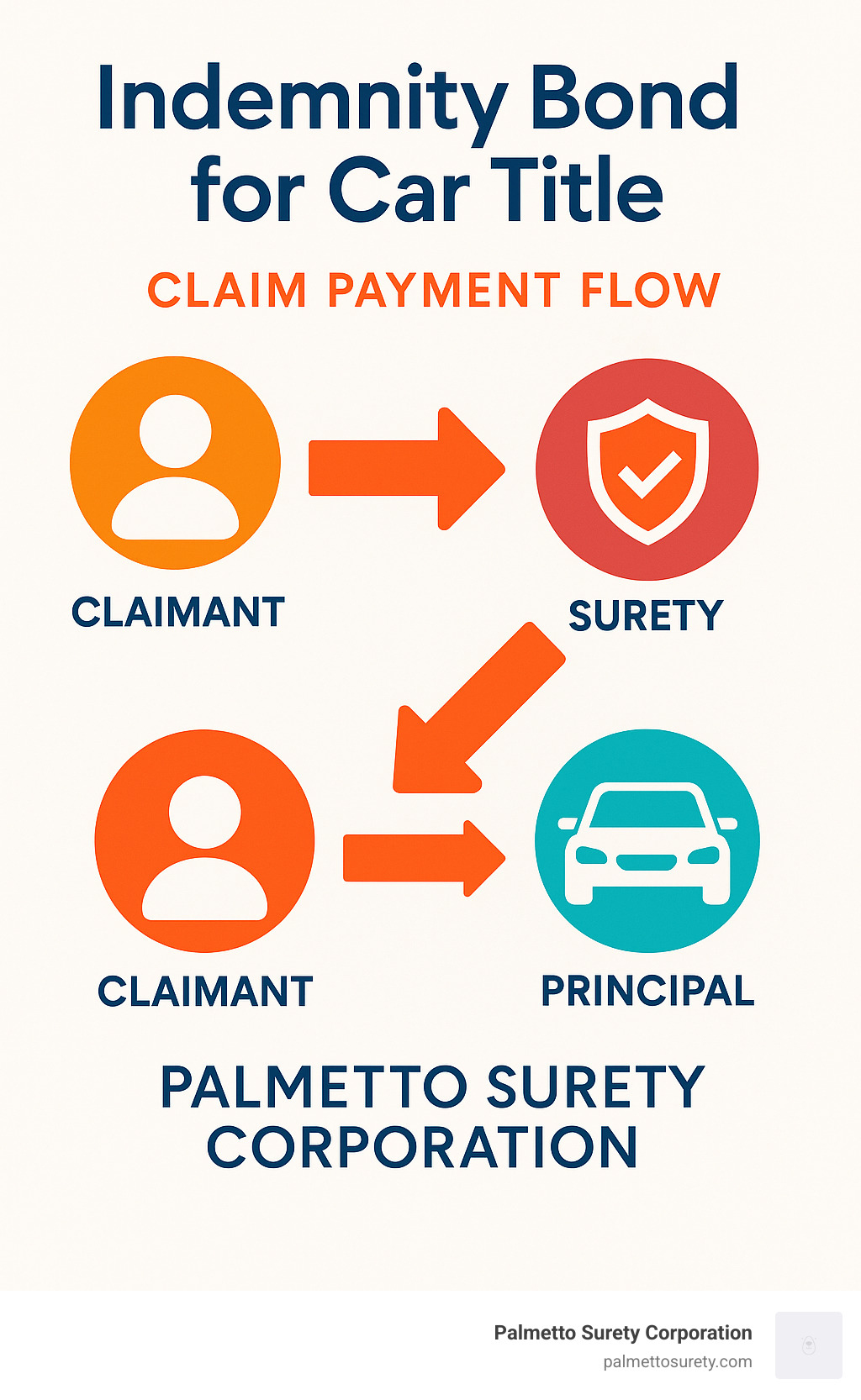
- Principal (You): The vehicle owner seeking the bonded title
- Obligee (State DMV): The government agency requiring the bond
- Surety (Bond Company): The company that issues the bond and guarantees payment

When you purchase an indemnity bond for car title, you’re not buying protection for yourself. Instead, you’re paying a surety company to make a promise to your state DMV. That promise? If someone with a legitimate claim to your vehicle comes forward, they’ll be compensated fairly.
Think of it as a financial safety net that allows the DMV to issue you a title now, while protecting anyone who might have rights to the vehicle.
The Claim Process
Let’s say someone shows up during your bond period claiming they’re the rightful owner of your car. Here’s what happens:
First, they file a claim with the surety company. The surety then investigates to determine if the claim is legitimate. If it turns out to be valid, the surety pays the claimant up to the bond amount.
But here’s the important part – you’re still responsible in the end. As one of our bond specialists at Palmetto Surety Corporation explains: “The bond doesn’t protect you as the current vehicle owner – it protects previous owners, lienholders, and the state. If a claim is paid, you’ll need to reimburse the surety company.”
This might sound scary, but remember – valid claims are actually quite rare when the proper steps are taken upfront.
Comparing Bonded Titles vs. Regular Titles
| Feature | Regular Title | Bonded Title |
|---|---|---|
| Appearance | Standard certificate | Marked as “BONDED” |
| Ownership rights | Full and clear | Provisional for 3 years |
| Registration | Standard process | Same as regular title |
| Insurance | No restrictions | Generally no restrictions |
| Selling | No special disclosures | Must disclose bonded status |
| Future conversion | N/A | Converts to regular title after bond period |
| Cost | Standard title fee ($5-$150) | Title fee plus bond premium |
The good news is that a bonded title functions almost identically to a regular title for most everyday purposes. You can register, insure, and drive the vehicle just like normal. The main difference is the “BONDED” designation and the need to disclose this status if you sell the vehicle during the bond period.
Premium Costs and Credit Scores
“How much will this cost me?” is usually the first question people ask. The answer depends on three main factors:
The bond amount is typically 1.5-2 times your vehicle’s value. Your credit score plays a role too – better credit means lower rates. And state requirements can set minimum bond amounts regardless of vehicle value.
For most everyday vehicles valued under $6,000, many surety companies (including Palmetto) offer a simple flat rate of around $100. For higher-value vehicles, premiums usually range from 1-2% of the bond amount if you have good credit (700+ score).
Let’s make this concrete: If your cherished pickup truck is valued at $10,000 and your state requires a bond at 1.5 times the value ($15,000), your premium might be $150-$300 depending on your credit history.
How long does an indemnity bond for car title last?
An indemnity bond for car title typically remains active for three years from when it’s issued. During this period:
The bond can’t be canceled – it’s a commitment you’re making for the full term. Your title will show a “BONDED” brand or notation that alerts others to its status. And this three-year window is when any legitimate ownership claims must be filed.
The best part? After those three years pass without any claims, the bond automatically expires. At that point, you can apply to have the “BONDED” designation removed from your title, resulting in a clean, standard certificate of title. It’s like a probationary period that, once completed successfully, rewards you with full, unquestioned ownership.
Many of our clients at Palmetto Surety mark their calendars for that three-year anniversary – it’s a day worth celebrating when it arrives without incident!
State-by-State Eligibility and Requirements
The world of indemnity bond for car title requirements can feel like navigating 50 different countries instead of one nation. Each state has its own unique rules, and understanding them is crucial before you start your application. Here’s a friendly tour through the states where Palmetto Surety Corporation helps vehicle owners daily:
Florida
The Sunshine State takes a fairly structured approach to bonded titles. Florida requires a bond amount equal to twice the vehicle’s appraised value – one of the higher multiples nationwide. They’re also quite specific about which vehicles qualify: only those between 10 and 25 years old can receive a bonded title here. You’re limited to automobiles, light trucks under 4 tons, and motorcycles. One important note: if your vehicle was previously registered in another state, Florida won’t allow a bonded title process.
Georgia
Georgia keeps things relatively straightforward with a minimum bond amount of $5,000 regardless of your vehicle’s value. They’re sticklers for paperwork, though – you must use their state-approved bond form, and all processing goes through the Georgia Department of Revenue, Motor Vehicle Division. I’ve found Georgia DMV staff to be quite helpful in guiding applicants through their process.
North Carolina
The Tar Heel State requires bonds at 1.5 times your vehicle’s appraised value, with a minimum of $100. They’re particularly form-heavy – you’ll need to complete the MVR-1, MVR-92A, MVR-92D, and MVR-92H forms. North Carolina also requires a physical inspection by their NCDMV License & Theft Bureau before approval. They exclude abandoned vehicles, mechanics/storage liens, and vehicles involved in active litigation from the bonded title process. For complete details, check the Official NCDMV guide.

South Carolina
Our home state keeps the process fairly streamlined. All bonded title applications go through the Department of Motor Vehicles, and you’ll need to provide a bill of sale and complete a VIN verification. South Carolina’s process tends to be more straightforward than some neighboring states.
Tennessee
The Volunteer State bases their bond requirement on your vehicle’s value, similar to most states. One thing to note about Tennessee – their processing time typically runs 4-5 weeks after filing, so plan accordingly if you need your vehicle registered by a specific date.
Texas
Everything’s bigger in Texas, including the paperwork! You’ll need to complete form VTR-130-SB1 specifically for your bonded title application. Texas bases bond amounts on vehicle appraisals, and they have a separate specialized process for vehicles with existing liens, which can be particularly helpful if you’re dealing with a lender that’s gone out of business.
Vehicle Eligibility Limitations
Not every vehicle can qualify for a bonded title, regardless of which state you call home. Common exclusions I see regularly include:
Vehicles reported as stolen, abandoned vehicles, and those with branded titles (salvage, junk, or non-repairable) generally can’t receive bonded titles. Vehicles involved in ongoing lawsuits, those exceeding certain weight limits (typically 8,000-10,000 pounds), and newer model vehicles in some states are also excluded.
As one Florida DMV representative told me recently, “Bonded titles are meant to solve documentation problems, not ownership disputes. We’re helping people with paperwork issues, not deciding who legally owns a vehicle.”
I’ve helped hundreds of vehicle owners through this process at Palmetto Surety Corporation, and while the state requirements may seem overwhelming at first, having a knowledgeable guide makes all the difference. The right surety partner can help you steer these state-specific requirements with confidence.
For accurate vehicle valuations that many DMVs accept, you can use the U.S. DOT valuation tool.
Step-by-Step Process to Obtain Your Indemnity Bond for Car Title
Getting an indemnity bond for car title might seem complicated, but I’ve guided hundreds of vehicle owners through this process. While requirements vary slightly by state, here’s your roadmap to success:
1. Contact Your State DMV
Your journey begins with a call or visit to your local DMV. When I helped my cousin in Georgia last year, this initial conversation saved him hours of headaches later. Make sure to:
Ask if they offer bonded titles, confirm your vehicle qualifies, get all required forms, and understand any state-specific requirements that might apply to your situation.
2. Complete the DMV Application
Now it’s paperwork time! Most states require several specific documents:
A title application form, an affidavit explaining why you don’t have the original title, vehicle information documents, and a statement of ownership. Be thorough and honest in your explanations—this isn’t the place to gloss over details.
3. Have Your Vehicle Inspected
Think of this as your vehicle’s “identity verification.” The VIN inspection confirms your car isn’t stolen, matches any existing documentation, and documents its current condition.
Depending on your state, this inspection might be performed by a DMV official, law enforcement officer, licensed dealer, or specialized unit like North Carolina’s License & Theft Bureau. One client told me this was the most nerve-wracking part—but it’s usually straightforward if you’ve been honest about the vehicle’s history.
4. Determine the Vehicle’s Value
Your bond amount depends on what your vehicle is worth. Most states use:
Kelley Blue Book values, NADA guides, state valuation schedules, or professional appraisals for specialty vehicles.
Most states require the bond to be 1.5-2 times the vehicle’s appraised value. This isn’t to make things expensive—it’s to ensure adequate protection for potential previous owners.
5. Purchase the Indemnity Bond
With your vehicle value in hand, you’re ready to get your indemnity bond for car title from a licensed surety company like Palmetto Surety Corporation. We make this part easy:
Complete a simple bond application, provide your vehicle details (VIN, make, model, year), pay the premium (typically just $100 for bonds up to $6,000), and receive your bond certificate—often within hours rather than days.
6. Submit Everything to the DMV
Head back to the DMV with your complete package:
Your filled-out application forms, the original bond certificate (not a copy!), vehicle inspection documentation, any required fees, and your personal identification. Double-check everything before you go—missing items mean starting over.
7. Receive Your Bonded Title
After processing (typically 4-5 weeks), you’ll receive a title marked as “BONDED.” This special title allows you to register the vehicle, get insurance, legally drive it, and even sell it (though you must disclose its bonded status).

Documents and Information Checklist
Before diving in, gather these essentials:
Personal Documentation:
– Valid photo ID (driver’s license or passport)
– Proof you live where you say you do (utility bill, lease)
– Social Security Number (for the bond application)
Vehicle Documentation:
– Any existing paperwork (bill of sale, previous title)
– Vehicle details (VIN, make, model, year)
– Current odometer reading
– Lien release if applicable
– Proof you bought it (receipt, canceled check)
Forms: Title application, ownership affidavit, bond application, VIN verification form, and odometer disclosure statement (specific forms vary by state).
Determining Your Bond Amount and Cost
Calculating your bond amount follows a simple formula:
- Find your vehicle’s value using Kelley Blue Book or your state’s approved method
- Multiply by your state’s required factor (usually 1.5-2×)
- That’s your total bond amount
The premium—what you actually pay—is just a fraction of this total. For most people, it’s a $100 flat rate for bonds up to $6,000. For higher-value vehicles, expect to pay 1-2% of the bond amount if you have good credit.
For example, if you have a $10,000 car in a state requiring 1.5× coverage, you’d need a $15,000 bond. With decent credit, this might cost $150-$300 as a one-time payment.
What Happens After Filing?
Once everything’s submitted:
The DMV reviews your application for completeness. If approved, they issue your bonded title (usually within 4-5 weeks). You can then register your vehicle normally, and most insurance companies accept bonded titles without any special requirements.
Your bond remains active for three years—this is the “waiting period” when previous owners could make claims. After this time passes without claims, you can apply to convert to a standard title.

At Palmetto Surety Corporation, we’ve simplified this process for countless vehicle owners. One customer in South Carolina told me, “I thought I’d never be able to register my grandfather’s old truck since the title was long gone. Your team made what seemed impossible completely manageable.”
Risks, Responsibilities, and Next Steps
Getting an indemnity bond for car title opens a path to vehicle ownership when documentation isn’t perfect, but it’s important to understand what you’re signing up for. Let’s walk through what this means for you.
Understanding Your Liability
When you get a bonded title, you’re making a promise that you’re the rightful owner. If it turns out you’re not, there are consequences:
The bond doesn’t protect you – it protects everyone else. If someone proves they actually own the vehicle during the bond period, the surety company will pay their claim, and then you’ll need to pay the surety company back every penny.
I recently spoke with Michael from Tennessee who learned this lesson the hard way: “I bought a beautiful 1967 Camaro with just a bill of sale. Two years after getting my bonded title, the previous owner’s grandson showed up with the original title his grandfather had misplaced. I lost the car AND had to repay the surety company $8,500. Always dig deep on ownership before buying!”
Potential Claim Scenarios
Most claims come from situations you might not expect:
A previous owner who thought they lost the title but finds it years later. The ex-spouse who was actually co-owner but wasn’t involved in the sale. That bank that held a lien but went through a merger and lost track of paperwork. Even victims of vehicle theft who finally track down their stolen vehicle years later.
Each of these people could make a legitimate claim against your bond, and if they prove their case, you could find yourself without both the vehicle and the money you paid for it.
Selling a Vehicle with a Bonded Title
Yes, you can sell a vehicle with a bonded title, but transparency is essential. You must tell potential buyers about the bonded status, and many will either walk away or offer less than market value.
The bond stays with the vehicle until the end of the three-year period – it doesn’t restart with the new owner. While this is good news for the buyer, it means they inherit whatever time remains on your bond period.
Transferring Ownership
When you sell a vehicle with a bonded title, the transfer process works just like a regular title transfer. The new owner doesn’t need to purchase a new bond, but they do inherit the same provisional ownership status until the bond expires.
Be sure to provide the buyer with documentation about when the bond was issued so they know when they can apply for a clear title.
Removing the Bonded Brand
The big day finally arrives – three years have passed without claims! Now you can remove that “BONDED” brand from your title:
Head back to your DMV with proof that the bond period has expired. Complete their application for a clear title, pay any required fees, and wait for your standard title to arrive. This final step transforms your provisional ownership into permanent, worry-free vehicle ownership.
Selecting a Licensed Surety
Not all surety companies are created equal. When choosing who to work with for your indemnity bond for car title, look for:
A company licensed in your state with solid financial ratings (A.M. Best rating of A or better). Experience matters – companies that specialize in title bonds understand the nuances of state requirements. Consider how quickly they can issue your bond and whether they offer support if claims arise.
Palmetto Surety Corporation checks all these boxes with over two decades of experience, A-rated financial stability, and same-day approvals for many applicants. We’ve helped thousands of vehicle owners steer title challenges with minimal stress and maximum efficiency.

Frequently Asked Questions about Indemnity Bonds for Car Titles
Can a bonded title be transferred or sold?
Yes, you can absolutely sell or transfer a vehicle with a bonded title. I’ve worked with many clients who’ve done this successfully, though there are some important things to know:
You must be upfront with any potential buyer about the bonded status. The title will still show that “BONDED” designation, and the bond remains active for the original three-year period—it doesn’t restart with the new owner.
When someone buys your bonded-title vehicle, they step into your shoes in terms of risk. They’ll have provisional ownership until that bond period expires, just like you did.
One of our clients in Texas shared: “I was worried about selling my truck with a bonded title, but after explaining the situation clearly to the buyer and slightly reducing my asking price, the sale went through without a hitch. Being transparent made all the difference.”
The transfer process follows the same steps as a regular title transfer at your DMV, but make sure your buyer fully understands what they’re getting into.
What vehicles are ineligible for a bonded title?
Not every vehicle can qualify for an indemnity bond for car title. While requirements differ across states, several common exclusions exist:
Vehicles reported as stolen in any database are automatically disqualified—for obvious reasons! Similarly, abandoned vehicles acquired through abandonment processes typically can’t receive bonded titles.
Vehicles with existing branded titles (salvage, junk, or non-repairable) are generally ineligible, as are any vehicles currently involved in legal disputes.
Many states won’t bond vehicles last registered in another state, and some have specific age restrictions. Florida, for instance, only offers bonded titles for vehicles between 10 and 25 years old, under 4 tons, and never previously registered elsewhere.
Heavy vehicles exceeding weight limits (typically 8,000-10,000 pounds) and vehicles with active, unsatisfied liens generally don’t qualify either.
If you’re unsure about your vehicle’s eligibility, give us a call at Palmetto Surety—we can quickly help determine if your vehicle meets your state’s requirements.
Who pays if a valid owner files a claim?
This is perhaps the most important question to understand before pursuing an indemnity bond for car title. If someone proves they’re the legitimate owner during the bond period:
The surety company (that’s us at Palmetto Surety Corporation) pays the claimant first—that’s our obligation. However, you (as the bond purchaser) must then reimburse us for every dollar we paid out. The bond isn’t insurance that protects you; it protects previous owners and the state.
Depending on state laws, the claimant might also recover the actual vehicle.
“Think of the bond as your promise that you’ll make things right if someone with a better claim to the vehicle comes forward,” explains one of our surety agents. “It’s why we set the bond amount higher than the vehicle’s value—to cover not just the vehicle’s worth but potential legal costs too.”
This is why it’s so important to be thorough in your ownership research before pursuing a bonded title. The more confidence you have that no legitimate prior owners will appear, the less risk you take on.
Conclusion
When you’re facing car title troubles, an indemnity bond for car title can be the lifeline you need. While nobody plans to lose their title or purchase a vehicle with documentation problems, these situations happen to good people every day. The bonded title process creates a clear path forward when you find yourself in this challenging position.
At Palmetto Surety Corporation, we’ve walked thousands of vehicle owners through this journey. From our offices in Charleston to locations across Georgia, Florida, Louisiana, Mississippi, South Carolina, Tennessee, and Texas, our team understands the frustration and confusion that comes with title problems. We’ve built our reputation on turning these stressful situations into success stories with fast approvals and personalized guidance.
The bonded title process might seem complicated at first, but remember these essentials:
Your bonded title provides legitimate, provisional ownership while protecting the rights of any previous owners who might come forward. Think of it as a three-year testing period for your ownership claim. Each state has its own specific requirements and procedures—what works in Georgia won’t necessarily work in Texas. After your bond period expires without claims (typically three years), you can finally remove that “BONDED” brand and enjoy a standard, clean title.
Throughout the bond period, you remain responsible for any valid claims that might arise. This is why working with an experienced surety company makes all the difference. We’ve seen almost every scenario imaginable and can help you steer the process with confidence.
Whether you’ve lost your car title in a move, purchased a vehicle with only a bill of sale, or inherited a family member’s car without proper documentation, an indemnity bond for car title offers the peace of mind that comes with legal vehicle ownership. You can register your car, get proper insurance, and even sell the vehicle if needed (with appropriate disclosures).
The road to vehicle ownership shouldn’t end because of paperwork problems. With over 20 years of experience in the surety bond business, Palmetto Surety Corporation has the expertise to help you overcome title obstacles and get back on the road with confidence. Most applications receive same-day approval, so you won’t be left waiting and wondering.
For more information about how we can help with your title bond needs, visit our website or contact our friendly surety specialists at any of our Southeast locations. We’re here to turn your title troubles into title triumphs.


