


Tax Surety Bond: 7 Powerful Facts for Success in 2025
Understanding Tax Surety Bonds: A Financial Safeguard
A tax surety bond is a financial guarantee that ensures businesses or individuals will fulfill their tax obligations to government agencies. If you’re looking to understand what a tax surety bond is and when you might need one, here’s what you need to know:
| Tax Surety Bond Basics |
|---|
| Definition: A three-party agreement that guarantees tax payments to government agencies |
| Parties Involved: Principal (business/individual), Obligee (government), Surety (bond provider) |
| Common Types: Sales tax bonds, tax preparer bonds, public official bonds |
| Cost: Typically 1-10% of the bond amount, based on credit and risk factors |
| Purpose: Protects public funds and ensures tax compliance |
Tax surety bonds serve as a crucial financial safeguard that protects government agencies from potential losses due to unpaid taxes. Unlike insurance, these bonds don’t protect the business that purchases them—instead, they guarantee that if the business fails to meet its tax obligations, the government will still receive the money it’s owed.
These bonds are commonly required for:
- Retailers collecting sales tax
- Tax preparation professionals
- Public officials handling tax funds
- Businesses selling regulated products (alcohol, tobacco, fuel)
The bond amount varies significantly based on your business type, location, and tax liability. For example, California tax preparers need a $5,000 bond, while sales tax bonds can range from $2,000 to $50,000 depending on your state and sales volume.
If you fail to fulfill your tax obligations, the government agency can file a claim against your bond. The surety company will pay the claim up to the bond amount, but you’ll be legally required to reimburse them for any payments made.
My name is Haiko de Poel Jr, and as the strategic marketing leader at Palmetto Surety Corporation, I’ve helped countless businesses steer the complexities of tax surety bonds to ensure their compliance with state and federal regulations while protecting their operational continuity.
Easy tax surety bond word list:
– bond tax
– municipal bond sales
– high interest bonds 2025

What Is a Tax Surety Bond?

A tax surety bond is like a financial promise with teeth. It’s a legally binding agreement that guarantees government agencies they’ll get their tax money, even if the business or individual responsible hits hard times or tries to skip town.
Think of it as a safety net for tax dollars. If you’re required to collect or pay certain taxes, this bond tells the government, “Don’t worry, this person will handle their tax obligations properly—and if they don’t, we’ll cover it.”
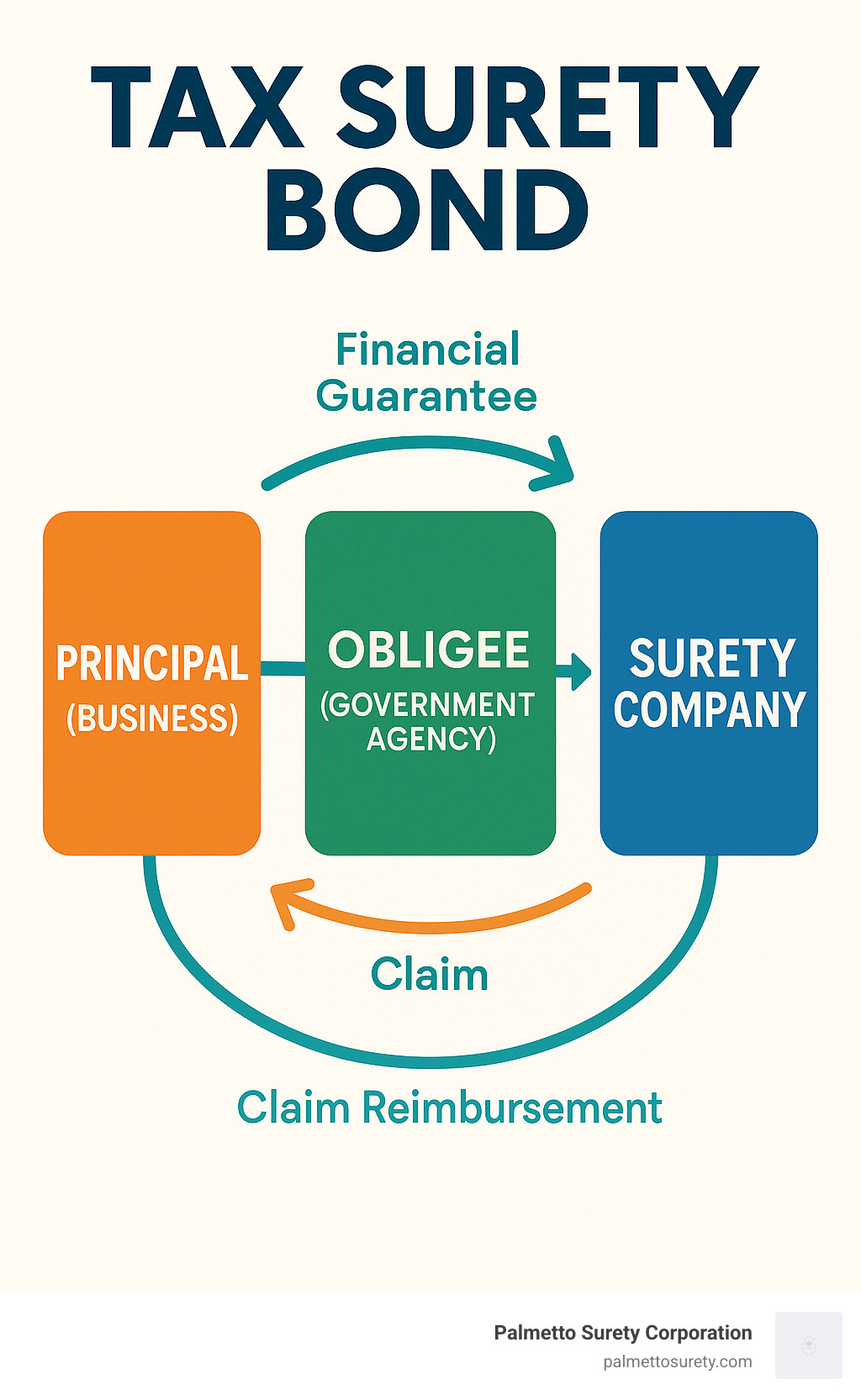
Unlike typical contracts between two parties, a tax surety bond brings three players to the table:
- Principal – That’s you—the business owner or individual who needs the bond
- Obligee – The government agency requiring the guarantee (like your state’s Department of Revenue)
- Surety – The company backing the bond (like us at Palmetto Surety Corporation)
“Most folks confuse bonds with insurance, but they’re quite different,” explains our bonding specialist. “With a tax surety bond, we’re not protecting you—we’re protecting the government from you potentially not paying your taxes. And if we have to pay on your behalf, you’ll need to pay us back.”
Why Governments Require a Tax Surety Bond
Imagine if every business collecting sales tax could simply pocket that money without consequences. Public schools, roads, and emergency services would quickly run out of funding. That’s why governments take tax collection seriously.
Tax surety bonds serve as a powerful tool for several reasons:
Revenue protection is the primary concern—governments need to ensure tax dollars make it to public coffers, not private pockets. These bonds guarantee they’ll get their money regardless of what happens to your business.
The bonds also act as fraud deterrence. When business owners know their personal assets are ultimately on the line, they’re much less likely to “borrow” from collected tax funds.
Ethical compliance gets a boost too. The bond reinforces the idea that collected taxes aren’t your money—you’re just the temporary custodian of funds that belong to the public.
As for public funds security, research from the Tax Foundation shows states rely heavily on sales tax revenue, with combined rates reaching nearly 10% in some areas. That’s a lot of money that needs protecting!
Key Parties in a Tax Surety Bond
Let’s break down the three-way relationship that makes a tax surety bond work:
The Principal (you) sits at the center of the arrangement. As a business owner collecting sales tax or a professional preparing tax returns, you’re required to follow tax laws to the letter. The bond doesn’t protect you—instead, it puts you on the hook to reimburse the surety company if they ever have to pay a claim.
The Obligee is the government agency holding your feet to the fire. They require the bond as a condition of your license or permit, and they have the right to file a claim if you fail to remit taxes properly.
The Surety (that’s where we come in at Palmetto Surety Corporation) is essentially vouching for you. We’re telling the government, “We trust this person enough to put our money behind them.” But make no mistake—if you default, we’ll pay the claim and then turn around to collect from you.
Our underwriting manager puts it this way: “We’re not giving you insurance; we’re lending you our financial credibility. It’s more like co-signing a loan than providing coverage. If you don’t pay, we will—but then you’ll owe us.”
This three-party structure creates a powerful incentive for tax compliance while giving government agencies the financial assurance they need to issue licenses and permits with confidence.
How Tax Surety Bonds Work & Who Needs Them
When you’re running a business that handles taxes, the government wants some assurance you’ll play by the rules. That’s where tax surety bonds come into action—they’re like a financial promise that you’ll meet your tax obligations.
The process is pretty straightforward. First, a government agency requires you to get a bond before they’ll let you collect taxes or operate certain businesses. You then purchase this bond from a surety company like Palmetto Surety Corporation. This bond serves as your promise that you’ll properly collect, report, and pay all required taxes on time.
If something goes wrong and you miss tax payments or file incorrectly, the government can make a claim against your bond. The surety company steps in to cover the government’s losses—up to the full bond amount. But here’s the important part: you’re still on the hook. The surety will expect you to pay them back for every penny they paid on your claim.
“Think of it like having a financially-strong friend co-sign a loan,” explains our bond specialist. “They’re backing you up, but they absolutely expect you to handle your responsibilities.”
Many different folks need these bonds to operate legally. Retailers collecting sales tax from customers need them to ensure those funds make it to the government. Tax preparers in certain states need bonds to protect their clients from potential mistakes or misconduct. Public officials handling tax money need bonds to guarantee they’ll manage those funds properly. Distributors of heavily-taxed goods like alcohol, tobacco, or fuel often need specialized bonds. Even some corporations claiming particular tax credits may need to be bonded.
Types of Tax Surety Bonds (Sales, Preparer, Collector & More)
The world of tax surety bonds includes several different types, each designed for specific situations:
Sales Tax Bonds protect states from lost revenue if retailers fail to remit collected sales taxes. These are especially common for new businesses or those selling highly-taxed items. When a local boutique owner contacted us recently, she was surprised to learn she needed a bond before opening her doors: “I had no idea this was required, but Palmetto made the process painless.”
Tax Preparer Bonds are mandatory in states like California, where they safeguard consumers against errors or misconduct by tax professionals. If your tax preparer makes a costly mistake, this bond provides financial recourse.
Public Official Bonds ensure government employees handling tax funds do so honestly and legally. Tax collectors, treasurers, and similar officials typically need these bonds.
Fuel Tax Bonds are required for businesses distributing or selling gasoline, diesel, and other fuels to guarantee payment of fuel excise taxes.
Alcohol and Tobacco Tax Bonds help ensure proper payment of the substantial excise taxes on these regulated products.
Marijuana Tax Bonds have emerged in states with legal cannabis to address the unique taxation requirements of this rapidly growing industry.
Foreign Tax Credit Bonds come into play when businesses file Form 1117 with the IRS, claiming credits for foreign taxes they’ve accrued but haven’t paid yet.
Situations Requiring a Tax Surety Bond
You might find yourself needing a tax surety bond in several common scenarios:
Starting a new business often triggers bond requirements, especially if you’ll be collecting sales tax. Many states won’t issue your business license until you’ve secured the appropriate bond.
Tax troubles can lead to bond requirements too. If you’ve fallen behind on tax payments, some jurisdictions will require a bond as a condition for continuing operations—it’s their way of saying “we need extra assurance now.”
Working in high-risk industries like alcohol, tobacco, or fuel distribution almost always means higher bonding requirements. The substantial tax revenue at stake means the government wants extra protection.
Court proceedings sometimes result in bond requirements. If you’ve been involved in tax disputes, a judge might order you to obtain a bond as part of the resolution.
Claiming certain tax credits—particularly the foreign tax credit using IRS Form 1117—can trigger bond requirements before the IRS will process your claim.
Professional registration often includes bonding requirements. For example, tax preparers in California must secure a bond as part of their registration with the California Tax Education Council (CTEC), as outlined in the IRS PTIN guidance.
One Georgia business owner we worked with put it perfectly: “Running a multi-state fuel distribution company meant navigating different bond requirements in each state. Having Palmetto Surety handle all our bonds gave us one less headache and let us focus on what we do best.”
Tax Surety Bond Costs, Amounts & Applications

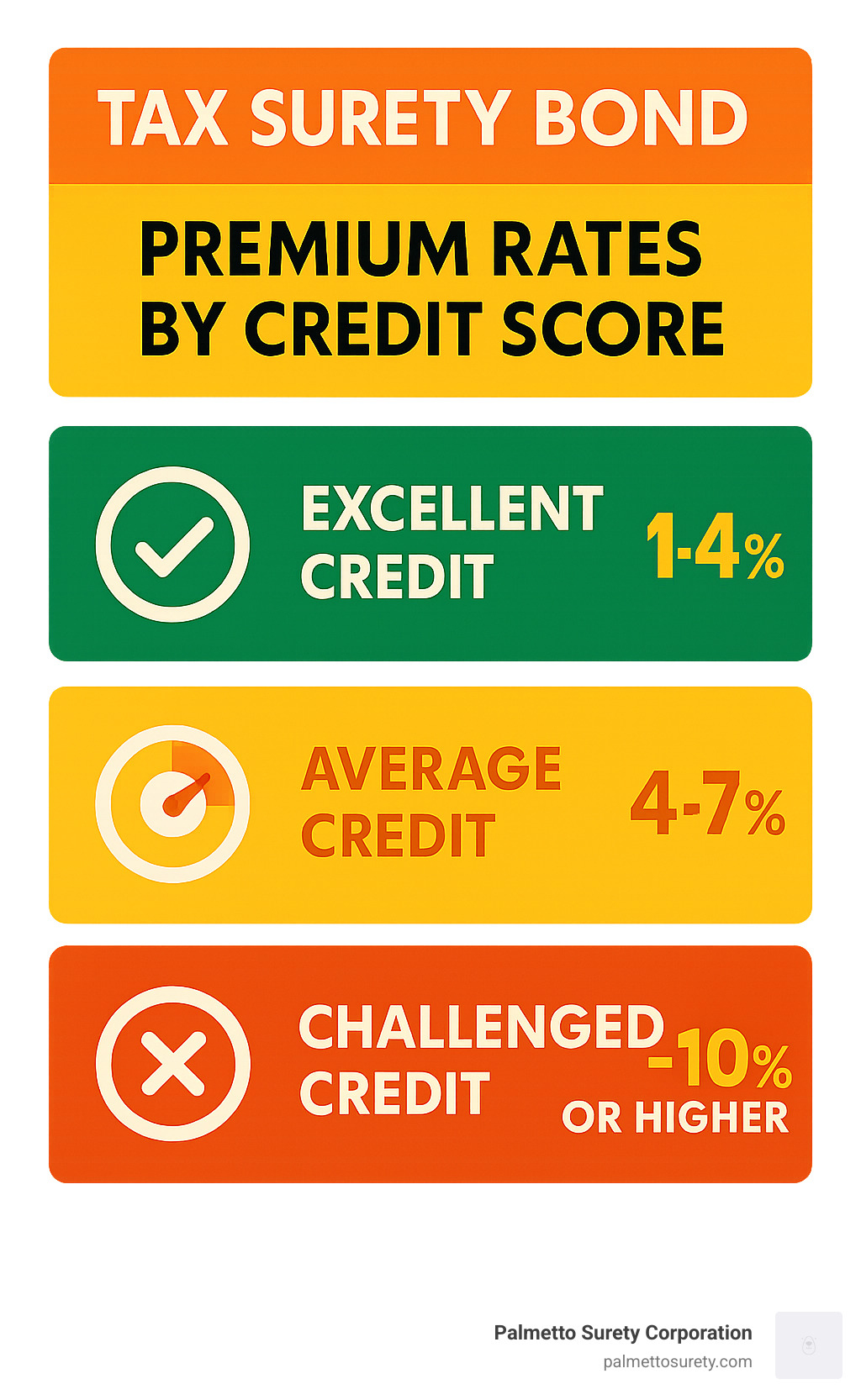
When it comes to tax surety bonds, the good news is you won’t need to come up with the full bond amount upfront. Instead, you’ll pay a premium—typically between 1% and 10% of the total bond value. Think of it as the cost of having someone vouch for you financially.
For instance, if your business needs a $10,000 tax collector bond and you qualify for a 3% rate, you’ll pay just $300 annually. That’s a lot more manageable than putting up the full $10,000 in cash!
What determines your exact premium? The surety company will look at several factors during underwriting:
Your credit score is a big one—both personal and business credit histories matter here. They’ll also examine your business’s financial health, how long you’ve been in the industry, and your track record of tax compliance. The specific type of bond and your state’s requirements also factor into the equation.
At Palmetto Surety Corporation, we understand that time is money. That’s why we’ve streamlined our approval process to provide decisions within hours rather than making you wait days or weeks. This quick turnaround can be a lifesaver when you need that bond to keep your business running.
Premium Factors & Typical Rates for a Tax Surety Bond
Your premium rate for a tax surety bond depends on several key factors, with credit history usually being the most influential. It’s a bit like applying for a loan—better credit means lower rates.
“Your credit score is essentially telling us how likely you are to fulfill your obligations,” explains one of our underwriters. “The stronger your credit, the less risk we take on, which translates to lower premiums for you.”
The size of your bond also impacts your rate. While larger bonds might come with slightly lower percentage rates, the total premium will be higher because of the increased risk to the surety company.
Your industry matters too. Some sectors have higher claim frequencies, which can bump up rates. And established businesses with proven tax compliance histories typically qualify for better rates than new ventures.
Here’s what you can generally expect to pay:
Looking for a bargain? Some bonds offer multi-year discounts. For example, California tax preparer bonds cost about $25 for one year, but you might pay just $50 for a three-year term—essentially getting the third year free!
Determining the Required Bond Amount
The required amount for your tax surety bond varies widely depending on what type you need, where you’re located, and your specific tax liability.
For sales tax bonds, the amount typically reflects your expected tax liability over a certain period. A state might require a bond covering three to six months of expected tax payments. These commonly range from $2,000 to $50,000, though larger businesses may need higher amounts.
“When I opened my retail store in Tennessee, I was surprised to learn my sales tax bond amount was based on my projected monthly sales,” shares one of our clients. “As my business grew, I had to increase my bond accordingly.”
Tax preparer bonds usually have fixed amounts set by state law. In California, for instance, all tax preparers need a $5,000 bond—no more, no less.
Public official bonds for tax collectors and similar positions are set by statute or local ordinance, typically ranging from $10,000 to $100,000 or more, depending on the jurisdiction and how much tax money the official handles.
For businesses dealing with fuel taxes, bond amounts often correlate with expected monthly fuel sales or tax liability. These can range from $10,000 for small operations to several million dollars for major distributors.
Be aware that some jurisdictions may increase your required bond amount if you’ve had compliance issues in the past. Always verify the exact requirement with the relevant authority to avoid licensing delays.
Obtaining, Renewing & Increasing a Tax Surety Bond
Getting a tax surety bond is surprisingly simple, especially with a seasoned provider like Palmetto Surety Corporation guiding you through the process.
First, you’ll complete an application with basic information about your business and the specific bond you need. Our underwriting team will then review your application to determine your eligibility and premium rate. Once approved, you’ll pay the premium, and we’ll issue your bond certificate—often electronically for immediate use. The final step is submitting the bond to the requiring agency as part of your licensing or registration process.
Most tax surety bonds run for one year and need annual renewal. The good news? Renewing is typically easier than the initial application, usually requiring just an updated form and your premium payment.
Some bonds are “continuous” until canceled, meaning they stay in effect until explicitly terminated. You’ll still need to pay your premium each year, but you won’t have to deal with reissuing the bond annually.
If your tax liability increases—perhaps because your business is growing—you may need to increase your bond amount. This usually requires adding a rider to your existing bond or, in some cases, getting a new bond at the higher amount.
“The electronic delivery option was a lifesaver,” a South Carolina retailer told us recently. “I applied in the morning and had my bond certificate by email that afternoon, allowing me to complete my business license application the same day.”
At Palmetto Surety Corporation, we pride ourselves on making the bonding process as painless as possible. After all, your tax surety bond should be a simple step toward compliance, not a roadblock to running your business.
Claims, Non-Compliance & Bad-Credit Options
When tax obligations go unmet, the consequences can ripple through your business in ways many entrepreneurs don’t anticipate. A tax surety bond claim isn’t just paperwork—it’s the beginning of a potentially challenging process that requires your immediate attention.
“Most business owners don’t realize that when a bond claim happens, it’s essentially like having a loan called due immediately,” explains our claims department manager. “The government gets paid right away, but the principal is still on the hook for every penny.”
The claims process follows a predictable path: the government agency identifies missing or improperly handled taxes, files a formal claim with the surety company, and the investigation begins. Our team thoroughly reviews the documentation, reaches out to you for your side of the story, and examines the relevant tax records. If the claim proves valid, we’re obligated to pay the government—but that’s when your responsibility kicks in.
Under the indemnity agreement you signed when obtaining your tax surety bond, you must reimburse the surety for the full claim amount plus any legal costs and related expenses. Think of it as the surety extending you emergency credit in a moment of crisis.
The Tax Surety Bond Claim Process
The moment a government agency files a claim against your bond, the clock starts ticking. You’ll receive a notification from us explaining the nature of the claim and requesting your response.
“Transparency is crucial during a claim investigation,” our senior claims analyst advises. “The more cooperative and forthcoming you are, the more efficiently we can resolve the situation—sometimes even helping identify errors in the claim itself.”
If our investigation confirms the claim’s validity, we’ll fulfill our obligation to the government by paying up to the full bond amount. However, this payment doesn’t let you off the hook. The indemnity agreement you signed makes you responsible for reimbursing:
- The complete claim amount paid to the government
- Any legal expenses incurred during the investigation
- Additional costs associated with processing the claim
Failure to reimburse the surety can lead to legal action, credit damage, and significant difficulty obtaining bonds in the future—potentially jeopardizing your ability to maintain required licenses and operate your business.
Consequences of Not Having a Required Tax Surety Bond
Operating without a required tax surety bond is a bit like driving without insurance—it might seem fine until something goes wrong. Then the consequences can be devastating.
Regulatory agencies take bond requirements seriously, and the penalties for non-compliance can include:
“I thought I could save money by delaying my bond renewal,” a South Carolina retailer told us. “That three-week delay ended up costing me nearly $15,000 in lost revenue when the state suspended my sales tax permit. The $300 premium suddenly seemed like the bargain of the century.”
Beyond the immediate business disruption, operating without a required bond can damage your relationships with suppliers who may become wary of doing business with a non-compliant partner. The reputation damage often lasts far longer than the direct financial penalties.
Getting a Tax Surety Bond with Bad Credit
Credit challenges don’t have to be a roadblock to obtaining your required tax surety bond. At Palmetto Surety Corporation, we’ve developed specialized programs specifically for business owners working to rebuild their financial standing.

“Everyone deserves a second chance,” our underwriting director often says. “Past financial difficulties don’t define your future business success.”
If your credit is less than stellar, we can typically offer several pathways to bonding:
Higher premium rates are the most common solution—you may pay more (typically in the 7-10% range of the bond amount), but you’ll still get the bond you need to operate legally. Specialized bad credit programs can help make these rates more manageable.
For larger bonds, collateral can significantly improve your approval odds. Cash, marketable securities, or irrevocable letters of credit can provide the security the surety needs to issue your bond despite credit concerns.
Some clients benefit from having a financially strong co-signer who can share the indemnity obligation, while others leverage strong business financial statements to demonstrate that their operation is healthier than their personal credit might suggest.
A restaurant owner from Tennessee shared: “After my divorce wrecked my credit, I thought I’d have to close my business when Tennessee required a new sales tax bond. Palmetto Surety found me a solution within 24 hours—it wasn’t the cheapest option, but it kept my doors open while I rebuilt my finances.”
We’ve built our reputation on finding ways to say “yes” when other sureties say “no.” Your past financial challenges shouldn’t prevent your business from moving forward.
Tax Surety Bond vs. Insurance & State Variations
When business owners first encounter tax surety bonds, they often assume they’re purchasing an insurance policy. This is a common misunderstanding, but the two financial instruments are fundamentally different. Let’s clear up the confusion.
Tax surety bonds and insurance policies serve entirely different purposes. While both involve payments to a company that provides financial protection, the similarities largely end there. This table highlights the key differences:
| Characteristic | Tax Surety Bond | Insurance Policy |
|---|---|---|
| Protects | Government/public | Policyholder |
| Parties | Three-party agreement | Two-party contract |
| Claims | Principal must reimburse surety | No reimbursement required |
| Purpose | Guarantees compliance | Transfers risk of loss |
| Premium | Based primarily on credit | Based primarily on risk factors |
| Term | Usually annual | Variable terms |
| Coverage | Specific obligation amount | Policy limits with deductibles |
As you can see, a tax surety bond functions more like a credit product than a traditional insurance policy. This fundamental difference explains why bond underwriting focuses so heavily on your credit history.
How a Tax Surety Bond Differs from Insurance
“I tell clients to think of a bond as more like a co-signer on a loan than an insurance policy,” explains our bonding specialist at Palmetto Surety. “We’re not taking on your tax obligations—we’re vouching for you to the government.”
The differences between tax surety bonds and insurance are substantial:
When it comes to protection direction, a bond protects the government (obligee), not you. Insurance, on the other hand, exists specifically to protect you as the policyholder.
The claim reimbursement process is entirely different too. If your insurance company pays a claim, that’s the end of the story—you don’t have to pay them back. But if a claim is paid on your tax surety bond, you’re legally obligated to reimburse the surety company for every penny.
Risk transfer is another key distinction. Insurance transfers risk from you to the insurance company. With a bond, you retain all the risk—the surety is simply guaranteeing your performance to the government.
The underwriting focus also differs significantly. Insurance companies look primarily at risk statistics and loss history when setting rates. Bond companies focus heavily on your personal and business credit, treating the bond more like a loan than an insurance policy.
State-Specific Tax Surety Bond Requirements
If you operate in multiple states, you’ll quickly find that tax surety bond requirements vary dramatically across state lines. This can create compliance challenges for businesses with a regional or national footprint.
California has some of the most well-known requirements, mandating a $5,000 bond for tax preparers who aren’t already CPAs, attorneys, or enrolled agents. This bond must be filed with the California Tax Education Council (CTEC) as part of the registration process.
“The California tax preparer bond is one of our most frequently requested bonds,” notes our West Coast representative. “At just $25-50 for the typical term, it’s also one of the most affordable.”
Nevada has similar tax preparer bond requirements, though with different registration procedures than California.
If you’re in Mississippi and work as a deputy tax assessor, you’ll need a $10,000 bond. Deputy tax collectors in the state face even higher requirements—a $50,000 bond.
Tennessee and Arkansas have the highest combined state and local sales tax rates in the country at 9.47%. This higher tax burden often translates to more substantial sales tax bond requirements for retailers operating in these states.
Here in Georgia, our home state, we see specific requirements for alcohol and tobacco retailers. Bond amounts are typically calculated based on your estimated tax liability, which means they can vary significantly from one business to another.
Many states offer exemptions for certain professionals. CPAs and attorneys, for instance, are typically exempt from tax preparer bond requirements. This makes sense given the rigorous professional licensing and oversight these professions already face.
“The patchwork of state requirements reminds me of a quilt my grandmother made,” shares our regional manager with a smile. “Every piece is different, but somehow they all need to fit together for businesses operating across state lines. We help our clients steer these differences to ensure they’re compliant everywhere they operate.”
At Palmetto Surety Corporation, we specialize in helping businesses understand and meet the specific tax surety bond requirements in their states of operation. Our extensive experience throughout the Southeast gives us unique insight into the regional variations that can impact your bonding needs.
Frequently Asked Questions About Tax Surety Bonds
What happens if my business can’t pay its tax surety bond claim?
When your business faces a bond claim it can’t pay, things can get stressful quickly. The surety company will step in to pay the government, but that’s just the beginning of your concerns.
“We always try to work with principals facing financial difficulties,” shares our claims manager. “Setting up a payment plan is often possible, but ignoring the obligation will only make the situation worse.”
If you can’t reimburse the surety company, several consequences typically follow. The surety may take legal action to recover what they paid plus any legal costs. This unpaid claim will almost certainly damage both your business and personal credit scores. Perhaps most concerning for your future operations, you’ll find it extremely difficult to obtain any bonds going forward.
Your business licenses may be suspended or revoked entirely, effectively shutting down your operations. And if you signed a personal indemnity agreement (which is standard practice with tax surety bonds), your personal assets could be at risk to satisfy the debt.
The good news? Most surety companies, including Palmetto Surety Corporation, prefer to work out payment arrangements rather than pursuing immediate legal action. Communication is key—reaching out proactively shows good faith and opens the door to potential solutions.
Are there alternatives to posting a tax surety bond?
While tax surety bonds are the standard requirement in most jurisdictions, some alternatives might be available depending on your location and situation.
Some government agencies will accept a cash deposit equal to the full bond amount. This eliminates premium payments but ties up significant capital that could otherwise be used in your business. It’s like putting down a massive security deposit—you get it back eventually (minus any claims), but that money isn’t working for you in the meantime.
Letters of credit from financial institutions are sometimes accepted as alternatives. However, these often require collateral and can come with their own set of fees and complications. They’re essentially a bank’s promise to pay the government if you don’t fulfill your obligations.
Larger corporations sometimes qualify for self-insurance programs, though these are rarely available to small and medium businesses. Some agencies might accept certificates of deposit assigned to them as security.
At Palmetto Surety Corporation, we can help determine if alternatives are available in your situation, but be aware that many jurisdictions specifically require surety bonds and don’t accept substitutes. The flexibility varies significantly from state to state and by bond type.
How long does a tax surety bond last before renewal?
Most tax surety bonds have a one-year term, after which they need to be renewed to maintain compliance. The renewal process is typically straightforward—you’ll receive a renewal notice from your surety provider, submit any updated information if requested, pay your renewal premium, and receive confirmation that your coverage continues.
“We send renewal notices well in advance of expiration dates,” our client services manager explains. “We recommend setting calendar reminders as well, since operating without a required bond—even briefly—can create significant problems.”
Some bonds are written as “continuous until canceled,” meaning they remain in effect until explicitly terminated. You’ll still need to pay the premium annually, but the paperwork is simplified since the bond itself doesn’t need to be reissued each year.
For those looking to save time and potentially money, multi-year bonds are available in some cases. For example, California tax preparer bonds can be purchased for up to five years at discounted rates. This approach not only reduces paperwork but often comes with a lower overall cost compared to annual renewals.
Letting your tax surety bond lapse can have immediate consequences for your business license and ability to operate legally. At Palmetto Surety Corporation, we pride ourselves on making the renewal process as seamless as possible, helping you maintain continuous compliance without interruption to your business.
Conclusion
Tax surety bonds are more than just paperwork—they’re the financial backbone of our tax system, providing peace of mind to government agencies while allowing your business to operate without freezing large amounts of capital. Whether you’re just starting out or running an established operation, understanding these bonds is crucial for staying compliant and protecting your business.
Here at Palmetto Surety Corporation, we’ve spent over 20 years helping folks just like you steer the sometimes confusing world of surety bonds. Our deep roots in the southeastern United States—including Georgia, Florida, Louisiana, Mississippi, South Carolina, Tennessee, and Texas—have given us unique insights into the regional requirements that affect your business.
What makes us different? Speed, for one thing. When you need a tax surety bond, you typically need it yesterday. That’s why we’ve built our processes to provide approvals within hours rather than making you wait days or weeks. We understand that your business can’t afford to sit idle while paperwork processes.
“Getting my bond through Palmetto was refreshingly simple,” one of our retail clients recently told us. “I was expecting a headache and instead got a solution that let me focus on running my business instead of worrying about compliance issues.”
Whether you’re:
– A small retailer needing your first sales tax bond
– A tax preparation professional requiring certification
– A distributor managing complex tax obligations across multiple state lines
Our team of friendly experts is ready to guide you through every step of the process. We’ll help you understand exactly what you need, secure the right bond at competitive rates, and ensure you have the documentation required to keep your business running smoothly.
The bonding process doesn’t have to be complicated. With the right partner, it can be just another simple step in building your successful business. At Palmetto Surety Corporation, we take pride in being that partner—providing not just bonds, but peace of mind.
Ready to secure your tax surety bond or just have questions about what you might need? Contact Palmetto Surety Corporation today, and let’s get started on keeping your business protected and compliant. Your success is our business, and we’re here to help you every step of the way.
More info about surety services


