


how to get a title for a car without title: 5 Proven Easy Ways 2025
Lost Your Car Title? Understanding Your Options
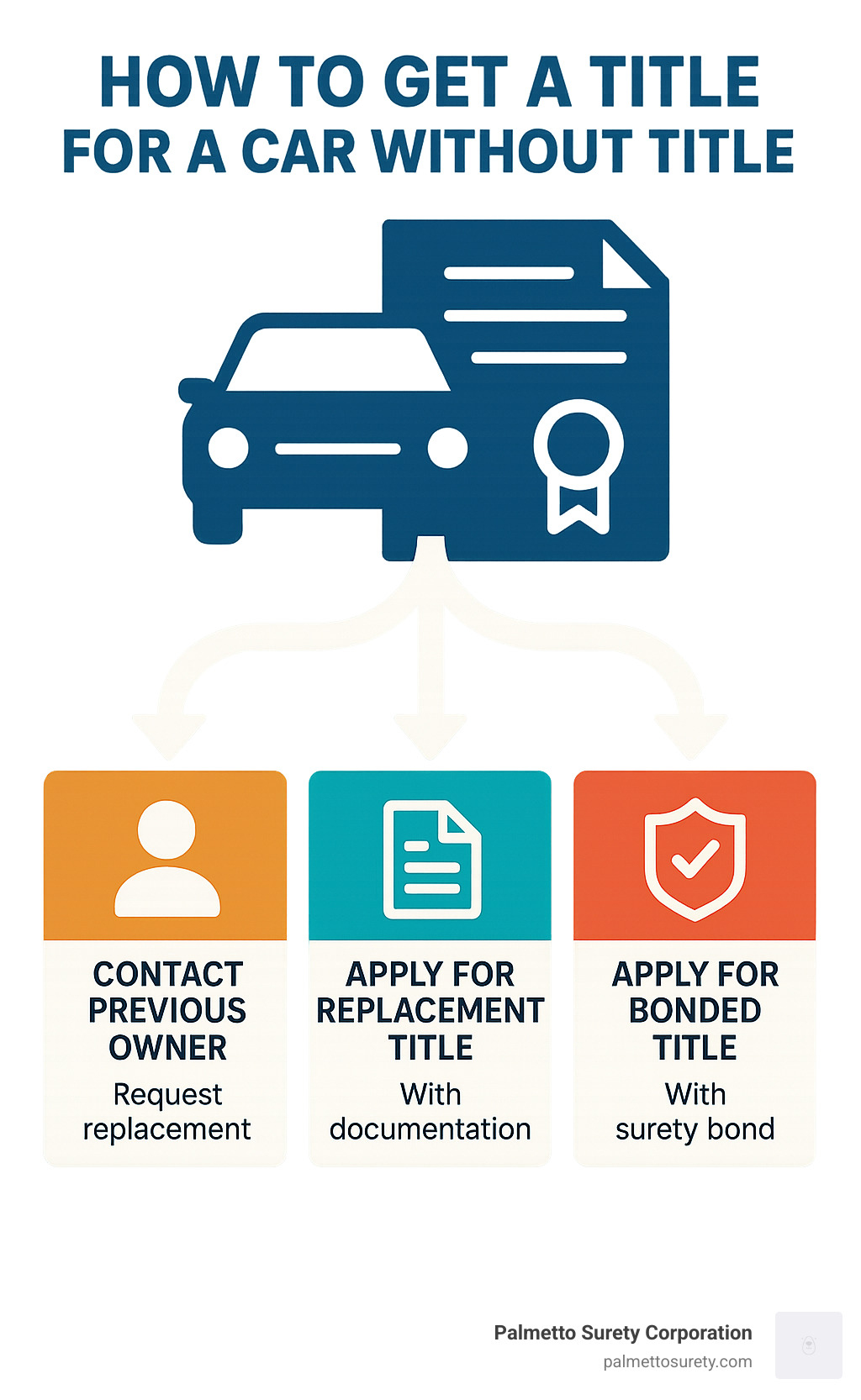
If you need to know how to get a title for a car without title, here’s a quick overview of your options:
- Contact the previous owner – Have them apply for a replacement title
- Apply for a replacement title – If you’re the registered owner ($8-$30)
- Get a bonded title – When other options aren’t available ($100-$200)
- Use Vermont’s registration method – For vehicles 15+ years old
- Pursue a court-ordered title – As a last resort option
A car title is the essential document that proves you legally own your vehicle. Without it, you can’t register, insure, or legally sell your car in most states. Losing this critical piece of paper or purchasing a vehicle without one creates immediate headaches, but the good news is that there are established processes to solve this problem.
I’m Haiko de Poel Jr, and through my work at Palmetto Surety Corporation, I’ve helped countless vehicle owners steer the complexities of how to get a title for a car without title, particularly through the bonded title process that requires surety bonds as financial guarantees.
Car Title 101: Why That Piece of Paper Matters
That rectangular piece of paper might not look impressive, but your car title is actually one of the most important documents you’ll ever own. Before we dive into solving your missing title problem, let’s understand why this document matters so much.
What Exactly Is a Car Title?
A car title is the official certificate that establishes who legally owns a vehicle. While sometimes called a “pink slip” (a throwback to when California printed them on pink paper), today’s titles come in various colors depending on your state.
Your title contains critical information that identifies both you and your vehicle:
- Your full legal name and address as the rightful owner
- The complete vehicle identification number (VIN)
- Details about your car’s make, model, and year
- The odometer reading when you bought it
- Any liens (loans) against your vehicle
- Special “brands” that reveal your car’s history (like salvage, rebuilt, or flood damage)
Your state’s DMV or motor vehicle agency creates, issues, and maintains all these records in their database. Think of your title as your car’s birth certificate and deed combined into one essential document.

Why a Title Matters When You Buy, Sell or Register
“I never realized how important my title was until I lost it,” shares Marcus from Atlanta. “Suddenly I couldn’t sell my car, and when I went to renew my registration, the DMV turned me away. My car was basically stuck in ownership limbo.”
Your car title matters for several crucial reasons:
It proves you’re the legal owner. Without a title, you can’t definitively prove the vehicle belongs to you. This becomes especially problematic if there’s ever any dispute about ownership.
You need it for registration. Most states won’t issue license plates or registration documents without seeing a valid title in your name. No title often means no legal driving.
Insurance companies want proof of ownership. Many insurers require title information before they’ll issue comprehensive coverage on your vehicle.
Selling becomes impossible (legally, anyway). Without a title, you can’t transfer ownership to someone else, which severely limits your ability to sell your car.
It reveals important vehicle history. Those title “brands” mentioned earlier alert potential buyers to past damage or serious issues, helping prevent fraud.
When you understand what your title represents, it’s clear why finding a solution for how to get a title for a car without title is so important. The good news is that while the document itself might be missing, the record of your ownership still exists in your state’s database—and there are established paths to replacing that crucial piece of paper.
No-Title Purchase: Risks, Laws & Smart Pre-Checks
Is It Legal to Own or Buy Without a Title?
The short answer: it depends on your state and the vehicle’s age. While purchasing a vehicle without a title isn’t automatically illegal, it creates significant legal complications.
Most states require a title for vehicles manufactured after a certain year (often 1986 or newer). For example, in Georgia, all vehicles 1986 and newer require a title certificate, while older vehicles can be registered with just a bill of sale and inspection.
There are legitimate exceptions where a title might not be required:
– Antique vehicles (typically 25+ years old in many states)
– Custom-built or kit cars
– Vehicles from states or countries that don’t issue titles
– Brand-new vehicles with a Manufacturer’s Certificate of Origin
However, even in these cases, you’ll eventually need some form of ownership documentation to register and drive the vehicle legally.
The Hidden Dangers: Liens, Theft & Title Jumping
Buying a car without a title exposes you to several serious risks:
1. Undisclosed liens: The vehicle might have an outstanding loan. If the seller hasn’t paid off their loan, the lender has a legal claim to the vehicle and could repossess it from you, even if you’ve paid the seller.
2. Stolen vehicles: Without running a VIN check, you might unknowingly purchase a stolen vehicle. According to the National Insurance Crime Bureau (NICB), nearly 1 million vehicles were reported stolen in 2022.
3. Title jumping: This illegal practice occurs when sellers avoid transferring a title into their name before selling to you, usually to evade taxes or hide problems. This breaks the chain of ownership and creates headaches when you try to register the vehicle.
4. Branded title issues: The vehicle might have a salvage, rebuilt, or flood history that the seller is trying to hide by “losing” the title.
As one customer from Savannah shared: “I bought what I thought was a great deal on a classic Mustang without a title. Turns out there was a lien I didn’t know about, and six months later, the bank came looking for their collateral. I lost both the car and my money.”
Due Diligence Checklist Before You Pay
If you’re considering buying a vehicle without a title, follow these critical steps:
-
Verify the VIN in multiple locations on the vehicle (dashboard, door jamb, engine block) to ensure they match and haven’t been tampered with.
-
Run a free VIN check through the National Insurance Crime Bureau’s VINCheck tool to verify the vehicle isn’t reported stolen.
-
Purchase a comprehensive vehicle history report from services like Carfax or AutoCheck to check for liens, accidents, and title problems.
-
Ask why the title is missing and be wary of vague explanations or sellers who seem evasive.
-
Get a detailed bill of sale that includes:
- Complete vehicle description with VIN
- Seller’s full name, address, and driver’s license number
- Sale price and date
- Odometer reading
-
Seller’s signature (notarized if possible)
-
Use traceable payment methods like checks or electronic transfers rather than cash.
-
Have a mechanic inspect the vehicle to ensure there are no hidden mechanical issues.
-
Trust your instincts – if something feels off about the transaction, walk away.
How to Get a Title for a Car Without Title: 5 Proven Paths
Now for the solutions. There are five main approaches to obtaining a title when the original is missing:
Path 1: Have the Seller Order a Replacement Title
If you’re purchasing a vehicle and the seller claims to have lost the title, the simplest solution is to have them obtain a replacement before completing the sale.
How it works:
1. The seller contacts their state DMV
2. They complete a replacement title application (varies by state)
3. They provide proof of identity and pay a fee (typically $8-$30)
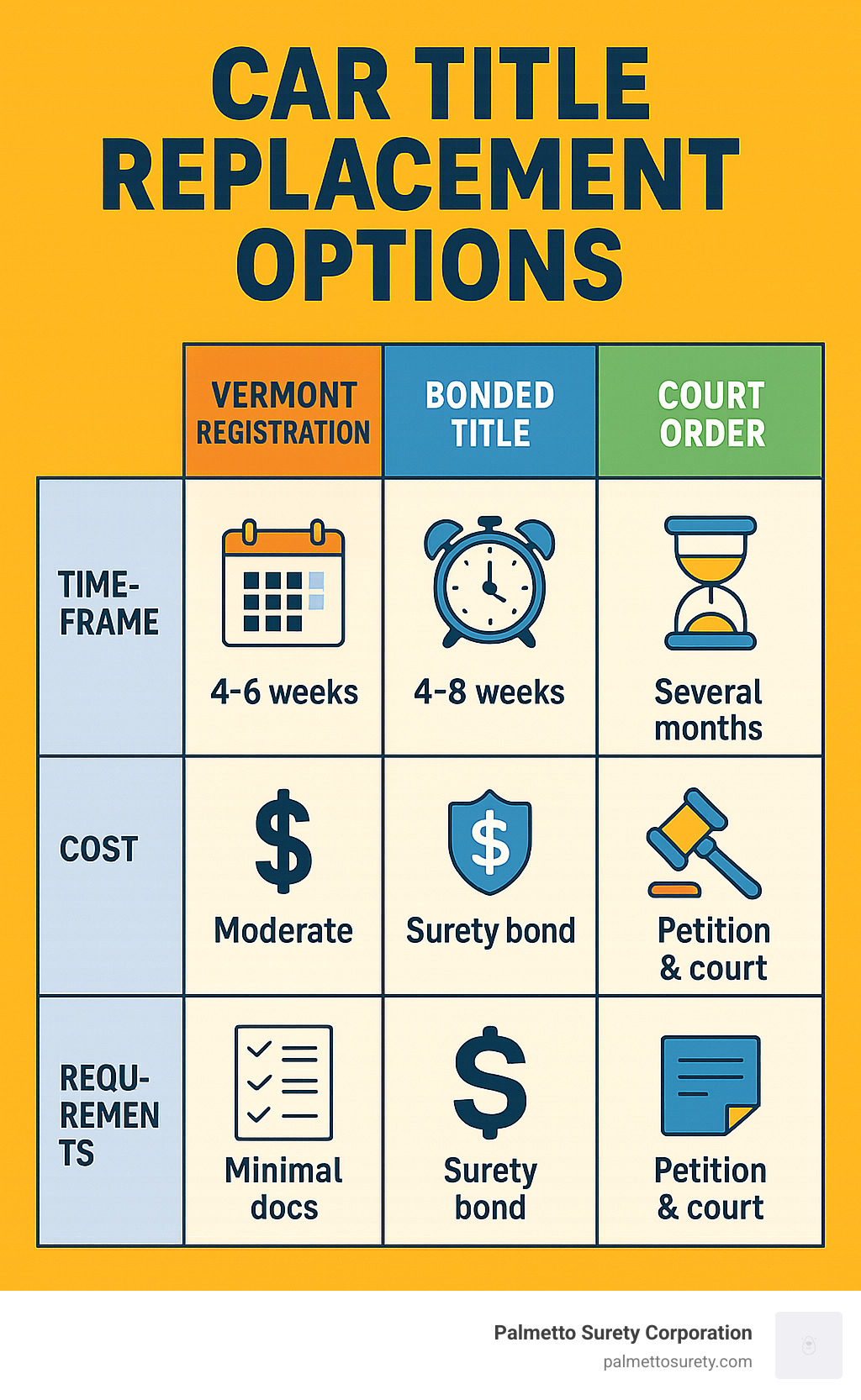
4. They receive a new title (processing time: 4-8 weeks in most states)
5. Once received, they sign it over to you
Advantages:
– Cleanest chain of ownership
– Lowest risk for you as the buyer
– Relatively inexpensive ($8 in Georgia, $27 in California)
Potential issues:
– Seller may be unwilling to wait
– Seller might not be the actual owner
– Title might have liens or other problems
Path 2: Apply for a Duplicate Title Yourself (With Proper Proof)
If you already own the vehicle and have lost the title, you can apply for a duplicate yourself.
How it works:
1. Visit your state DMV website or office
2. Complete a duplicate title application
3. Provide proof of identity and ownership (registration, insurance card, bill of sale)
4. Pay the required fee
5. Receive your replacement title
Timeframe: Some states like Michigan offer instant replacement titles at certain DMV offices, while others take 4-8 weeks for processing.
Cost: Varies by state: $8 in Georgia, $20 in New York, $27 in California, as low as $2 by mail in Texas.
Path 3: Secure a Bonded Title – how to get a title for a car without title
A bonded title is your primary solution when:
– You’ve purchased a vehicle without receiving a title
– The previous owner is unreachable
– You cannot prove ownership through conventional means
What is a bonded title?
A bonded title is a regular vehicle title with a notation indicating that a surety bond has been attached to it. The bond serves as financial protection for previous owners and the state in case someone later makes a valid claim of ownership.
How it works:
1. Contact your state DMV to confirm eligibility and requirements
2. Complete the required forms (in Georgia: MV-1, MV-46, MV-46A)
3. Purchase a surety bond for 1.5-2 times the vehicle’s value
4. Submit your application, bond, and fee to the DMV
5. Receive your bonded title
Cost breakdown:
– State fee: $18 in Georgia, varies by state
– Surety bond premium: Usually $100-$200 for most vehicles
– Total cost: Typically under $250 for vehicles valued under $10,000
Bonded title period:
The “bonded” status remains on your title for 3-5 years (varies by state). During this period, if someone proves they have a superior claim to the vehicle, the bond covers their financial loss. After the bond period expires without claims, you can apply for a standard title.
At Palmetto Surety Corporation, we’ve helped thousands of vehicle owners in Georgia, Florida, Louisiana, Mississippi, South Carolina, Tennessee, and Texas obtain the surety bonds needed for bonded titles, often approving applications within hours.
Path 4: Use the Vermont “Bill of Sale Only” Registration
This unique approach takes advantage of Vermont’s non-titling policy for older vehicles.
How it works:
1. Vermont doesn’t issue titles for vehicles 15+ years old
2. They will register vehicles to out-of-state residents
3. You submit form VD-119 with a bill of sale and fee ($76 for cars, $48 for motorcycles)
4. Vermont issues a registration certificate
5. You use this registration to obtain a title in your home state
Advantages:
– Works for out-of-state residents
– Requires minimal documentation
– No surety bond needed
Limitations:
– Only works for vehicles 15+ years old
– Some states may resist accepting the Vermont registration
– Total cost is higher than some replacement title fees
Path 5: Last Resort – Court-Ordered Title for how to get a title for a car without title
When all other methods fail, you can petition your local court for a title order.
How it works:
1. File a petition with your county or circuit court
2. Provide all available evidence of ownership
3. Attend a hearing before a judge
4. If approved, receive a court order
5. Take the court order to your DMV for title issuance
Best for:
– Inherited vehicles with missing paperwork
– Abandoned vehicles you’ve legally acquired
– Situations where the chain of ownership is severely broken
Drawbacks:
– Time-consuming and potentially expensive
– May require legal assistance
– No guarantee of approval
State & Special Scenarios: Georgia Rules, Antique Cars & More
Georgia Step-By-Step (1986 & Newer)
For Georgia residents dealing with vehicles from 1986 or newer, here’s your precise roadmap:
For replacement titles (when you’re the last titled owner):
1. Complete Form MV-1 (Title/Tag Application)
2. Provide your Georgia driver’s license or ID
3. Pay the $8 replacement title fee
4. Submit at your County Tag Office
For bonded titles (when you can’t get a replacement):
1. Complete Forms MV-1, MV-46, and MV-46A
2. Provide proof of identity and any ownership documentation
3. Pay the $18 title fee
4. Purchase a surety bond (we at Palmetto Surety Corporation can help with this)
5. Submit all documents at your County Tag Office
Additional requirements:
– Emissions inspection (if in metro Atlanta counties)
– Proof of insurance filed electronically
– Payment of all applicable taxes and fees
Processing time in Georgia is typically 4-8 weeks for standard applications, though expedited service may be available in some cases.
Georgia Pre-1986 Vehicles
Georgia offers a simplified process for older vehicles:
For vehicles manufactured before 1986:
1. No title certificate is required
2. Provide a bill of sale
3. Obtain Form T-22B (Certification of Inspection) completed by a law enforcement officer
4. Submit these documents with Form MV-1 to register the vehicle
This exemption makes Georgia an attractive state for classic car enthusiasts dealing with title issues on vintage vehicles.
Other Notable States & Non-Titling Jurisdictions
Different states have unique approaches to vehicle titling:
Michigan: Offers instant replacement titles at certain Secretary of State offices.
Vermont: Doesn’t issue titles for vehicles 15+ years old, only registrations.
Montana: Has become popular for establishing LLCs to register vehicles with lower fees and taxes.
Alabama: Requires a surety bond equal to 1.5 times the vehicle’s value for bonded titles.
Florida: Has a relatively low $6 replacement title fee but stricter verification procedures.
Always check your specific state’s requirements, as they vary significantly and change periodically.
Finish Line: Registration, Insurance, FAQs & Final Thoughts

Registering and Insuring After You Get the Title
The feeling of finally holding your new car title is incredible – but your journey isn’t quite complete. Now comes the practical part of making your vehicle fully road-legal.
Getting your vehicle properly registered is your next step. In most states, you’ll need to bring your fresh title to the DMV along with proof of insurance and be prepared to pay registration fees. These fees vary widely – Georgia residents pay a $20 license plate fee plus ad valorem taxes based on your vehicle’s value, while other states have their own unique fee structures.
Don’t forget about emissions testing! If you live in metro Atlanta or other areas with air quality concerns, you’ll need that emissions certificate before registration can proceed. It’s a small but crucial step that many folks overlook until they’re already waiting in the DMV line.
Insurance companies will breathe easier once you have a proper title, though some might charge slightly higher premiums if you have a bonded title. This usually drops once the bond period expires and you convert to a standard title. Simply provide your insurance agent with your new documentation, and they’ll update your policy accordingly.
Scam Prevention & Safe Selling Later
After all the work of securing your title, protecting it becomes priority number one. As Sarah from Columbus told me, “After going through the hassle of getting a bonded title, I keep my new title in a fireproof safe. I’m never going through that process again!”
Smart move, Sarah. Never store your title in your vehicle – that’s just asking for trouble. Take photos of all your documents as backup, and keep all receipts and correspondence related to your title process in case questions arise later.
If you decide to sell your vehicle down the road, always disclose any title brands honestly. Whether it’s a “bonded” status or a rebuilt designation, hiding these facts isn’t just unethical – it could land you in legal hot water. And please, avoid title jumping by properly transferring ownership with each sale. The small savings in taxes isn’t worth the potential headaches and legal issues.
Frequently Asked Questions About Lost Car Titles
How much will it cost overall?
The wallet impact of replacing a lost title varies significantly depending on which path you take:
Getting a simple replacement title when you’re the last registered owner is the budget option – just $8 in Georgia and typically under $30 in most states. The bonded title route costs a bit more, with the $18 state fee in Georgia plus your surety bond premium (usually $100-$200 for most vehicles).
The Vermont method runs $76 for cars and $48 for motorcycles, while a court-ordered title can set you back $100-$300 in court filing fees alone, not counting potential attorney costs if your case is complicated.
Don’t forget to budget for those “extras” too – vehicle history reports ($25-$40), emissions testing where required, and your regular registration fees and taxes. All told, most folks spend between $150-$300 for the entire process of replacing a lost title and getting back on the road legally.
Can I drive while waiting for a bonded title?
I get this question constantly, and I understand the frustration – you’ve got a car but can’t legally drive it yet. Unfortunately, in most states, driving without proper registration (which requires a title) puts you at risk for tickets, fines, and even having your vehicle impounded.
Some states do offer temporary solutions. Look into temporary registration permits specifically designed for vehicles in the titling process. Some states also offer trip permits for limited driving purposes or temporary operating authority while your paperwork is pending.
Your best bet is to call your state DMV and specifically ask about legal options for driving while awaiting your title. That five-minute phone call could save you hundreds in potential tickets.
What if I can’t reach the prior owner at all?
This situation is frustratingly common. Maybe the seller moved away, changed their phone number, or simply doesn’t want to be found. Don’t panic – you still have options.
First, document your attempts to contact them. Sending certified mail with return receipt requested creates a paper trail showing you tried to resolve things properly. Gather any proof of purchase you have – receipts, bank statements, text messages, or emails discussing the sale.
With this documentation in hand, a bonded title becomes your most straightforward option in most states. For older vehicles, consider the Vermont method we discussed earlier. If all else fails, you can pursue a court-ordered title, though this should be your last resort due to the time and expense involved.
As Mike from Marietta shared, “The seller moved out of state after I bought the car, and his phone was disconnected. The certified letters I sent came back undeliverable. Thankfully, the bonded title process worked even without his cooperation.”
Final Thoughts & Next Steps
The journey to answer how to get a title for a car without title can feel like navigating a maze, but thousands of vehicle owners successfully solve this problem every day. The key is taking action quickly – title issues rarely resolve themselves, and delays only make the process more complicated.
Remember these five golden rules as you move forward:
Document everything related to your vehicle purchase and ownership. Check your state’s specific requirements before starting any paperwork. Be completely honest in all your applications about how you acquired the vehicle. Keep copies of everything – forms, letters, receipts. And follow up regularly on pending applications – a polite check-in call can sometimes unstick paperwork that’s fallen through the cracks.
If you need a surety bond for a bonded title in Georgia, Florida, Louisiana, Mississippi, South Carolina, Tennessee, or Texas, we at Palmetto Surety Corporation can help. With over 20 years in the surety bond industry, we approve most applications within hours, helping you get back on the road faster.
Life’s too short to let paperwork problems keep you from enjoying your vehicle. With these methods, you can overcome title challenges and drive with the peace of mind that comes from proper documentation.
For more information about surety bond services for vehicle titles, visit Palmetto Surety Corporation or contact one of our offices throughout the Southeast.


