


bail bonds agent jobs: 7 Powerful Reasons to Apply Now 2025
Breaking Into the Bail Bonds Industry: Career Opportunities and Requirements
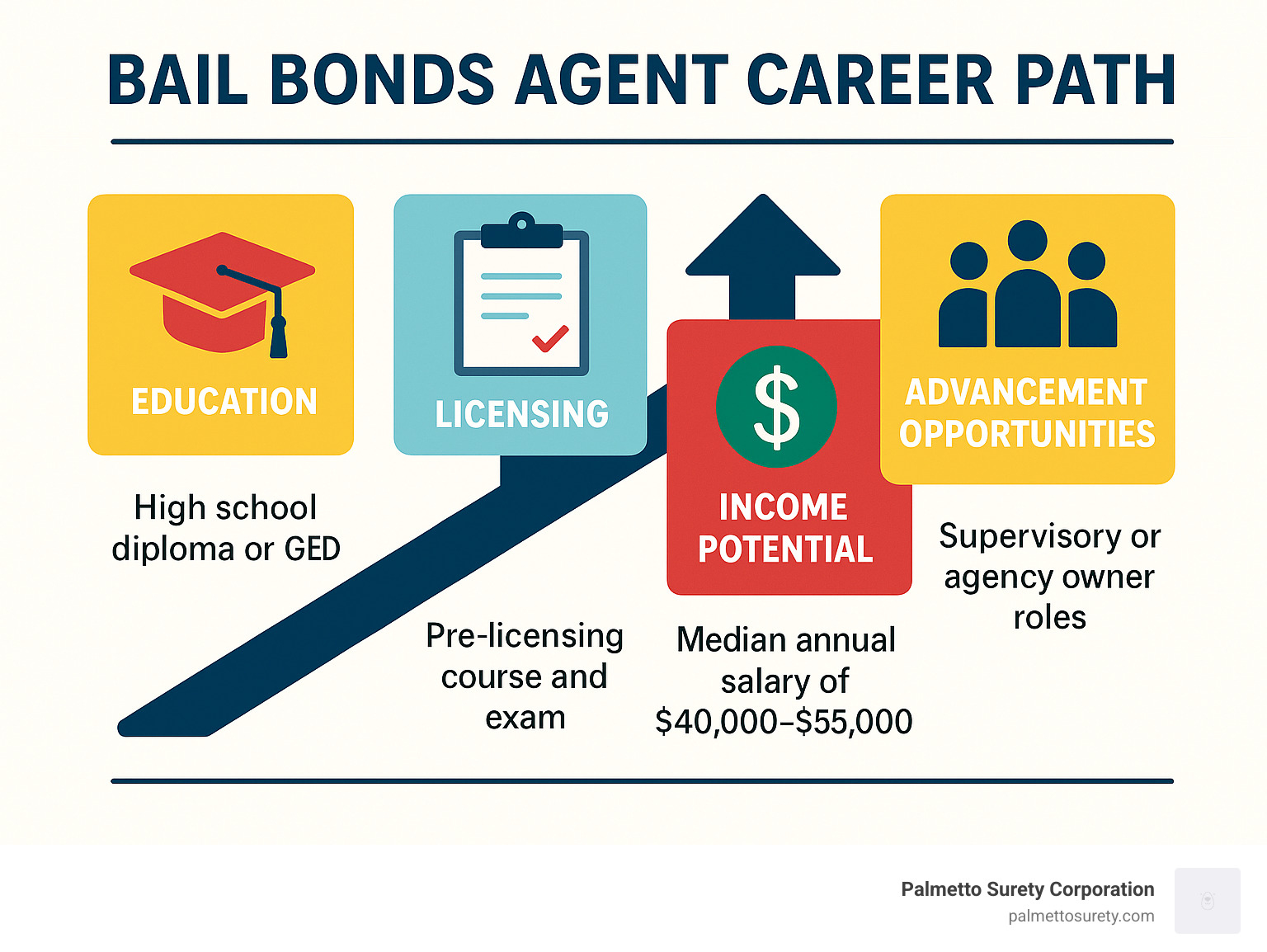
Bail bonds agent jobs typically require a high school diploma, clean criminal record, and state licensure with median annual salaries ranging from $40,000 to $55,000. Most positions involve:
- Education: High school diploma/GED minimum
- Licensing: State-specific pre-licensing course and exam
- Income: 10-15% commission on bond amounts
- Work Schedule: Often includes 24/7 shifts with on-call rotation
- Skills Needed: Sales ability, paperwork management, skip tracing
The bail bonds industry offers a unique career path for those interested in the intersection of criminal justice, finance, and client services. Bail agents serve as the crucial link between defendants and the court system, providing surety bonds that allow individuals to remain free until their court dates. With approximately 15,000 bail agents operating across the United States and a 97% court appearance rate for clients, the profession maintains a steady demand despite evolving pretrial release practices.
I’m Haiko de Poel Jr, and as the leader of a fast-growing US Surety Bond company, I’ve worked extensively with professionals in bail bonds agent jobs across the southeastern United States, helping them steer the complex regulatory landscape and client management challenges of this unique profession.
Bail bonds agent jobs definitions:
– Experienced bail bondsman
– are bail bonds agents cops
Day in the Life, Salary & Job Outlook
Ever wonder what it’s really like to work in bail bonds agent jobs? It’s far more dynamic than most people imagine. Your day might start with a strong cup of coffee and checking your messages from defendants who need reassurance about their upcoming court dates.
“Most folks think we just post bail and then kick back waiting for our money,” laughs Marcus, one of our veteran bail agents at Palmetto Surety in Atlanta. “The reality? We’re constantly juggling client check-ins, paperwork mountains, and making sure everyone shows up when they’re supposed to.”
A typical day in the life of a bail agent flows through several key activities. Mornings often involve administrative tasks – reviewing new cases and processing paperwork that keeps the justice system moving. By midday, you might find yourself at the courthouse attending bail hearings or coordinating with defense attorneys. Afternoons typically involve meeting with new clients and their families, carefully explaining bond terms and responsibilities. When evening rolls around, you could be at the county jail posting bonds for newly arrested defendants, offering them a pathway to freedom while awaiting trial.

One of the more interesting aspects of the job is skip tracing – using investigative techniques to locate clients who’ve missed court dates or check-ins. This detective-like work requires persistence, creativity, and solid research skills.
Bail bonds agent jobs rarely follow a 9-to-5 schedule. Since arrests happen around the clock, most agencies operate on a 24/7 rotation. This means taking your turn being on-call during nights, weekends, and yes, even holidays. It’s demanding but never boring!

Salary Expectations
When it comes to earning potential, bail bonds agent jobs offer a unique compensation structure that rewards hustle and relationship-building. Unlike traditional salaried positions, most bail agents earn their living primarily through commissions.
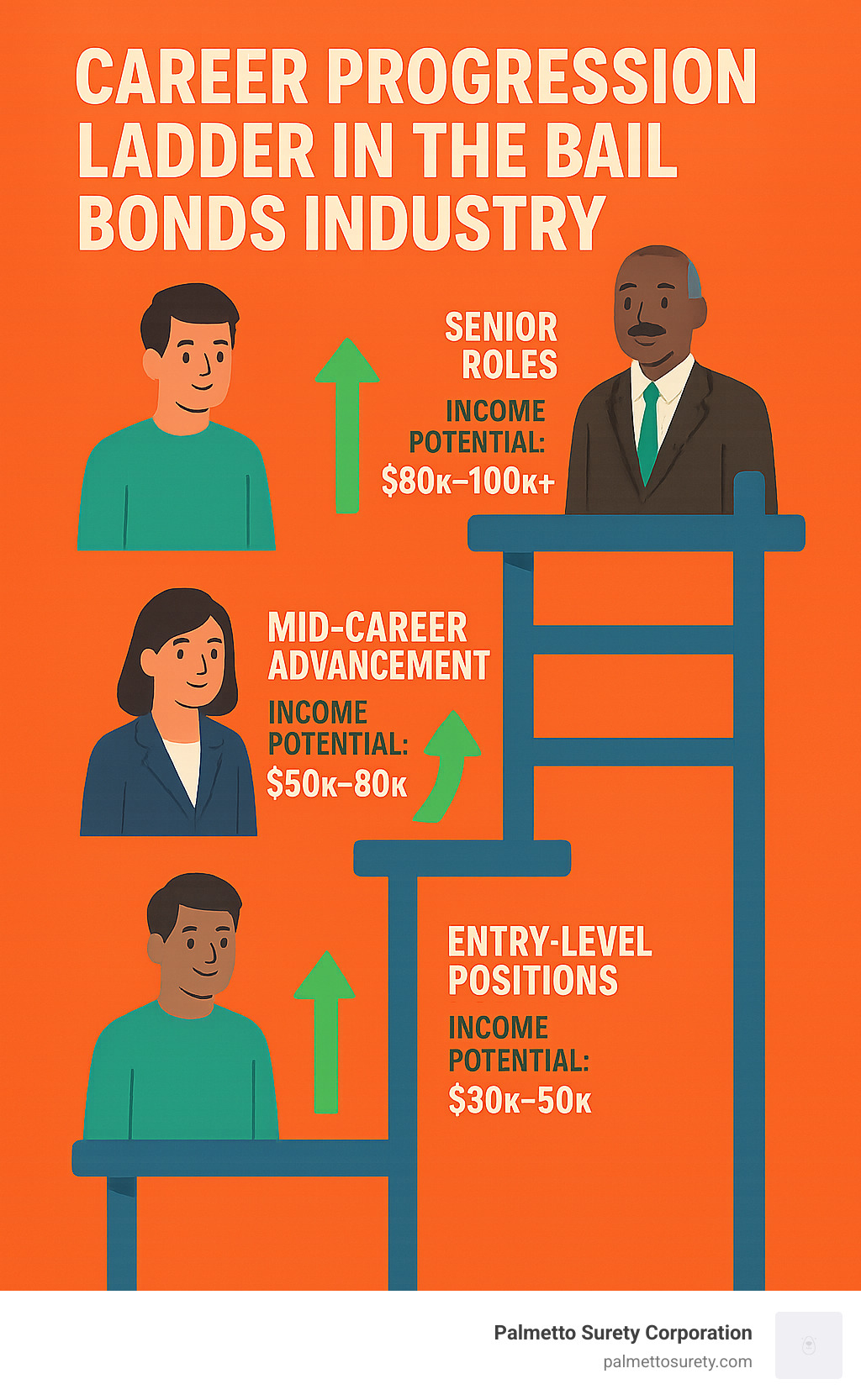
The numbers tell an interesting story. Industry data shows the median annual income hovers around $40,634, with the overall range typically spanning from $25,000 for newcomers to $55,000+ for established professionals. Location matters too – agents in busy urban areas generally see more opportunities than those in quieter rural settings.
The commission structure is straightforward but powerful. Agents typically earn 10-15% of the total bond amount, often split 50/50 with their agency. For perspective, writing a $10,000 bond with a standard 10% premium creates a $1,000 fee. With that typical 50/50 split, you’d pocket $500 for a single transaction that might take just a couple of hours.
“Your financial success in this business directly reflects your work ethic and relationship-building skills,” explains our regional manager in Savannah. “Our top performers consistently earn in the upper range because they’re reliable, responsive, and have cultivated strong networks with attorneys and law enforcement.”
The industry boasts an impressive 97% court appearance rate for defendants released on commercial bail – a testament to the effectiveness of the personal connection bail agents establish with their clients.
Job Outlook
Looking ahead, the landscape for bail bonds agent jobs remains relatively stable, though not without challenges. According to the Bureau of Labor Statistics, related fields such as private investigators are projected to grow by 6% between 2021 and 2031, keeping pace with the national average for all occupations.
Several factors contribute to the continued demand for bail professionals. Court system backlogs create ongoing need for pretrial release options. The high appearance rate (97%) for defendants released through commercial bail demonstrates the system’s effectiveness. And geographic expansion, particularly in states with growing populations, opens new opportunities.
At Palmetto Surety Corporation, we’ve witnessed consistent growth across our operations in Georgia, Florida, Louisiana, Mississippi, South Carolina, Tennessee, and Texas – all states where the traditional bail system maintains strong roots.
For those looking to enter the field, the southeastern United States offers particularly fertile ground. These states have maintained traditional bail systems while some other regions have implemented various reforms. This regional stability provides a solid foundation for building a lasting career in the bail industry.
License & Qualifications Checklist
Ready to jump into bail bonds agent jobs? Before you start sending out applications, you’ll need to get licensed. The process varies by state, but I’ll walk you through what you need to know to get started on the right foot.
Basic Requirements
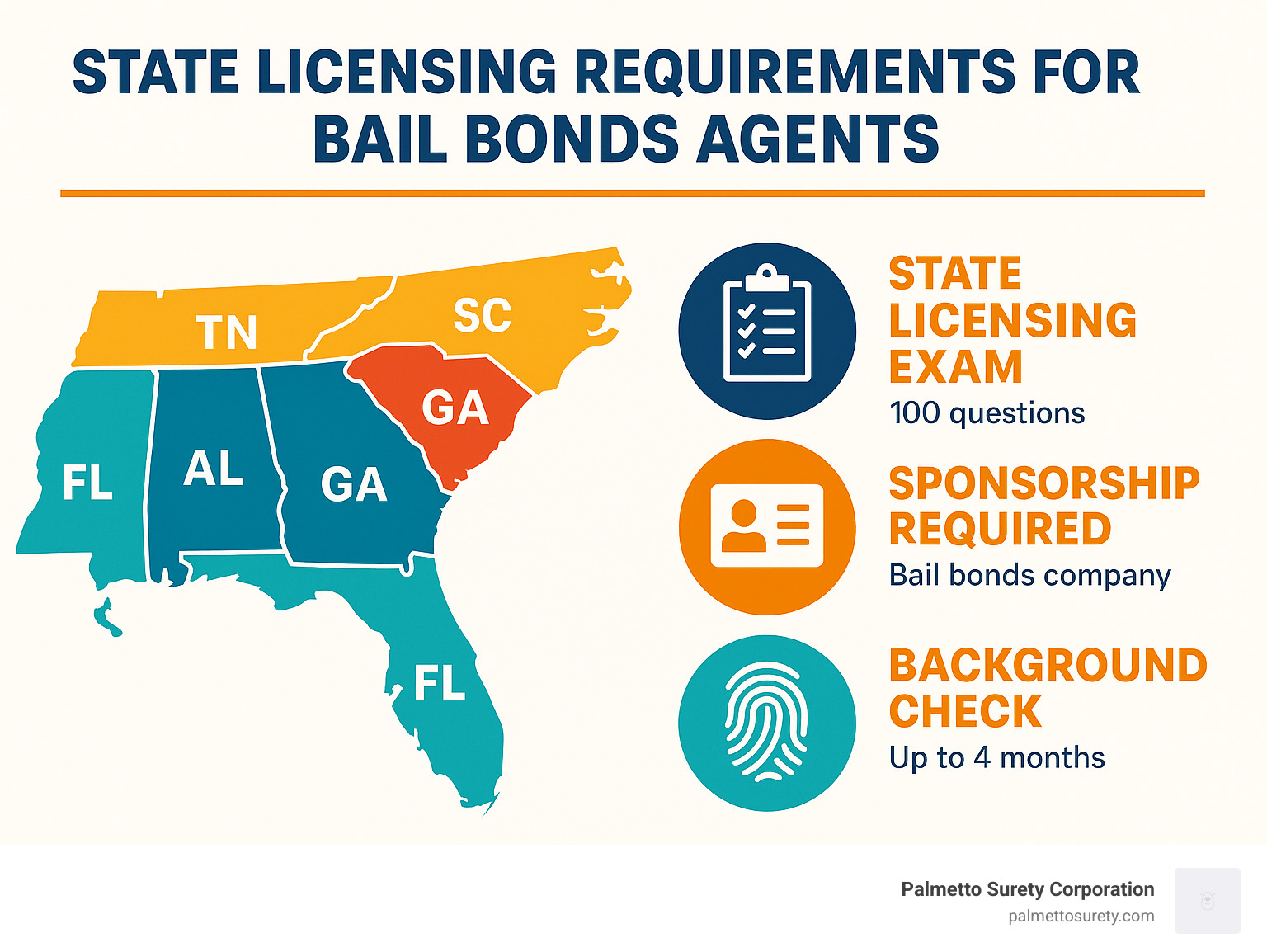
The foundation of your bail bonds career starts with meeting some straightforward qualifications. Most states require you to be at least 18 years old (though some like Mississippi set the bar at 21). You’ll need a high school diploma or GED, and—no surprise here—a clean criminal record. Felonies or crimes involving dishonesty will typically disqualify you.
“When I was looking to change careers, I was worried about the requirements,” says James, who joined our Tallahassee office last year. “But honestly, if you’ve got a clean record and a willingness to learn, the basic qualifications aren’t as intimidating as they seem.”
You’ll also need to be a U.S. citizen or legal resident and have reliable transportation with a valid driver’s license. After all, bail agents are constantly on the move between courts, jails, and client meetings.
Pre-Licensing Education
Think of pre-licensing courses as Bail Bonds 101. These courses cover everything from legal terminology to the nuts and bolts of writing bonds. The length varies dramatically by state—Florida requires a whopping 120 hours while Georgia only asks for 8.
Even in states where these courses aren’t mandatory, we at Palmetto Surety strongly recommend them. As one of our Georgia agents put it, “That 8-hour course saved me from making rookie mistakes that could have cost thousands of dollars.”
State Licensing Exam
Once you’ve completed your education requirements, you’ll face the state licensing exam. Don’t take this lightly—the test typically includes about 100 questions covering bail laws, ethics, procedures, and financial responsibilities. You’ll generally need to score at least 70% to pass.
“I studied for two weeks straight,” remembers Tanya from our Columbus office. “The exam was tough, but knowing I was prepared gave me confidence walking in.”
Sponsorship Requirement
Here’s where bail bonds agent jobs differ from many other careers: in most states, you need a licensed bail bonds company to sponsor you before you can get your license. It’s a bit of a chicken-and-egg situation that trips up many newcomers.
At Palmetto Surety Corporation, we look for candidates who show potential before offering sponsorship. Demonstrating professionalism, reliability, and strong work ethic can help you stand out when seeking a sponsor.
Surety & Fidelity License
Since bail bonds are essentially a form of insurance, many states require agents to obtain a Property and Casualty Insurance license or a Surety and Fidelity license. This additional credential ensures you understand the financial obligations involved in the profession.
Background Check Process
Be prepared for a thorough background investigation that can take up to four months. This isn’t just a quick criminal record check—it typically includes an FBI review, credit check, employment verification, and character references.
“The background check was more extensive than when I bought my house,” jokes Marcus, one of our veteran agents. “But it makes sense when you think about the responsibility we have.”
State-Specific Requirements Comparison
| State | Minimum Age | Education Requirement | Pre-Licensing Hours | Exam Fee | Background Check | Sponsorship |
|---|---|---|---|---|---|---|
| Georgia | 18 | High School/GED | 8 hours | $100 | Yes | Required |
| Florida | 18 | High School/GED | 120 hours | $150 | Yes | Required |
| South Carolina | 18 | High School/GED | 20 hours | $80 | Yes | Required |
| Tennessee | 18 | High School/GED | 24 hours | $125 | Yes | Required |
| Texas | 18 | High School/GED | 8 hours | $110 | Yes | Required |
| Louisiana | 18 | High School/GED | 8 hours | $75 | Yes | Required |
| Mississippi | 21 | High School/GED | 40 hours | $100 | Yes | Required |
At Palmetto Surety Corporation, we’ve helped countless agents steer these requirements across our southeastern service area. If you’re feeling overwhelmed, don’t worry—that’s normal! The NAFRA FAQ is also an excellent resource for newcomers with questions about the licensing process.
The licensing process is your first step into a profession that makes a real difference in people’s lives during challenging times. While the requirements might seem extensive, they ensure that only qualified, trustworthy individuals enter this important field.
Where to Find Bail Bonds Agent Jobs in 2024
Ready to put your license to work? Let’s explore the best places to find bail bonds agent jobs in today’s market – from traditional brick-and-mortar agencies to digital platforms.
Local Bail Bonds Agent Jobs
The bail bonds industry still thrives on local connections, with physical offices strategically positioned near courthouses and jails across the country.
Main-street offices remain the backbone of the industry, particularly in smaller southeastern communities. These agencies often become fixtures in their local justice systems, building decades-long relationships with court personnel and attorneys.
“Our offices are strategically located near courthouses in major southeastern cities,” explains our operations director at Palmetto Surety. “This proximity is crucial for quick response times and building relationships with court personnel.”
Don’t underestimate the power of a personal visit when job hunting. Many agency owners appreciate candidates who take the initiative to stop by with a resume in hand. This face-to-face approach demonstrates the kind of proactive attitude that succeeds in this industry.
One of our agents in Warner Robins, Georgia shares: “Working in a smaller community means I know many of my clients and their families personally. It creates a different kind of accountability that can be very rewarding.”
If you’re exploring local opportunities, check county jail approved bondsman lists – most detention centers maintain these records, which can lead you straight to active agencies in your area.
Online Boards Posting Bail Bonds Agent Jobs
The digital landscape has transformed how bail bonds agent jobs are advertised and filled. Several online platforms have become go-to resources for both employers and job seekers.
LinkedIn filters can help you zero in on relevant opportunities. Set up job alerts specifically for “bail bonds agent,” “bail bondsman,” or “surety agent” positions, and use location filters to focus on areas where you’re licensed. Following companies like Palmetto Surety Corporation ensures you’ll see their job announcements as soon as they’re posted.
Indeed keyword searches should include variations of job titles to capture all potential openings. The bail industry sometimes uses different terminology across regions – from “bail agent” to “surety agent” to “bail enforcement agent.” Cast a wide net with your search terms while filtering for both full-time positions and independent contractor opportunities.
Glassdoor salary insight provides valuable compensation information that can help set realistic expectations. The platform also features company reviews, giving you a peek into agency cultures before you apply. This information can be particularly helpful when comparing opportunities across different regions or company sizes.
When using these platforms, look for agencies that provide training programs for new agents – these can be excellent entry points for those new to the industry.
Association Networks with Bail Bonds Agent Jobs
Industry associations offer some of the most valuable networking opportunities in the bail bonds world, often leading to job placements that never hit public job boards.
PBUS conferences (Professional Bail Agents of the United States) bring together agency owners and managers from across the country. Their annual events feature educational sessions, legislative updates, and plenty of networking opportunities.
“I found my position through a connection I made at a PBUS conference,” recalls one of our senior agents in Atlanta. “The face-to-face networking was invaluable for getting my foot in the door.”
State bail associations in Georgia, Florida, South Carolina, and other southeastern states host regular meetings and maintain member directories that can be goldmines for job seekers. These organizations often have job boards or informal networks where agencies post openings before advertising them publicly.
Business-card swaps at industry events remain a surprisingly effective way to find opportunities in this relationship-driven field. Come prepared with professional cards and a concise explanation of why you’re interested in the industry. Our recruitment specialist notes: “These informal exchanges at regional meet-ups are how many agencies find their next hire.”
At Palmetto Surety Corporation, we regularly participate in these industry events across our service areas in the Southeast, making them excellent opportunities to connect with our team and learn about upcoming openings.
Whether you’re exploring traditional agencies or leveraging digital platforms, the key to finding bail bonds agent jobs is to demonstrate reliability, professionalism, and a genuine interest in the unique intersection of criminal justice and client service that defines this profession.
Top Skills & Personal Qualities
Success in bail bonds agent jobs requires a unique combination of skills and personal qualities. Based on our experience at Palmetto Surety Corporation working with hundreds of agents across the Southeast, these are the traits that distinguish top performers:

Essential Hard Skills
When I talk with our most successful bail agents, they all mention how crucial strong legal knowledge is in this field. You don’t need a law degree, but understanding bail laws, court procedures, and legal terminology makes all the difference. The good news? You’ll learn the basics during licensing courses, though the best agents never stop learning as laws change.
Financial acumen is another must-have skill. At its core, writing bail bonds is a financial transaction with real risk. You’ll need to get comfortable assessing financial risk, understanding how to value different types of collateral, clearly explaining payment terms to clients, and managing your commission structure. As one of our agents in Atlanta puts it, “If you can’t explain the financial commitment to a panicked family member at 2 AM, this job might not be for you.”
Skip tracing abilities quickly become essential in this line of work. When clients miss court dates, finding them becomes your responsibility. Our top performers excel at database research, know how to use social media for investigations, can steer public records efficiently, and have developed strong interview techniques to gather information from friends and family.
Documentation expertise might sound boring, but it’s absolutely vital. “The paperwork in this business is relentless,” shares a veteran agent from our Savannah office. “Your ability to maintain meticulous records can make or break your career.” Missing signatures or incorrectly filed forms can lead to serious problems down the road.
Today’s bail agents also need solid technology proficiency. Gone are the days of paper-only records. Modern agents use specialized software for client management, court date tracking, electronic filing, and accessing skip tracing databases. Being comfortable with these tools gives you a significant advantage.
Critical Soft Skills
Negotiation skills might be the most underrated ability for success in bail bonds agent jobs. You’ll constantly negotiate with clients about payment terms, with co-signers about responsibilities, with courts about bond modifications, and sometimes with fugitives about voluntary surrender. The ability to find win-win solutions under pressure is invaluable.
Many people don’t realize that bail bonding is fundamentally a sales position. “You’re selling a service to people in crisis,” explains our training director, “which requires a unique approach to sales.” This isn’t aggressive selling – it’s about clearly communicating how you can help during what’s often the worst day of someone’s life.
Empathy and emotional intelligence separate the good agents from the great ones. Your clients and their families are typically experiencing intense stress and uncertainty. Being able to show genuine compassion while maintaining professional boundaries is crucial. One of our most successful agents in Mississippi tells me, “People remember how you made them feel during their darkest moments. That’s what builds a referral business.”
Time management skills become essential when juggling irregular hours, court deadlines, and client check-ins. The bail business doesn’t follow a 9-to-5 schedule, and the most successful agents develop systems to track multiple cases simultaneously without letting anything fall through the cracks.
Perhaps most importantly, this career requires genuine resilience. The bail industry involves significant stress, rejection, and occasional financial losses when clients abscond. Mental toughness is necessary to weather these challenges and maintain a positive outlook.
Character Traits for Success
Looking across our offices in Atlanta, Augusta, Savannah, and other southeastern locations, certain character traits consistently appear in our top performers.
Integrity stands above all else. The bail industry operates on trust. Courts, clients, and co-signers must believe in your word. Your reputation becomes your most valuable asset, and protecting it should guide every decision you make.
Decisiveness becomes crucial when evaluating potential clients. “You’ll often need to make quick decisions about whether to write a bond based on limited information,” notes a senior agent in our Columbus office. “Hesitation can cost you business, but poor decisions can cost you money.” The best agents develop strong instincts about risk assessment.
Adaptability helps you thrive in this ever-changing industry. Laws change, court procedures evolve, and each client presents unique challenges. Flexibility and a willingness to learn keep you ahead of the curve.
An entrepreneurial mindset is essential even if you’re working as an employee. Successful bail agents typically approach their role as if running their own business within the agency – taking ownership of their client relationships, marketing efforts, and professional development.
Strong community connections often translate to better client relationships and referral networks. Agents who genuinely care about their communities tend to build stronger businesses. As one of our veteran agents in Louisiana puts it, “In this business, your reputation in the community is everything.”
At Palmetto Surety Corporation, we’ve found that while we can teach the technical aspects of bail bonds agent jobs, these character traits and soft skills are often what determine long-term success. The most fulfilled agents combine professional skill with genuine care for helping people steer difficult situations.
Frequently Asked Questions about Bail Bonds Agent Jobs
What is the difference between a bail bonds agent and a bounty hunter?
One of the questions I hear most often when talking about bail bonds agent jobs comes straight from Hollywood’s influence: “So, you’re like Dog the Bounty Hunter, right?”
I always chuckle and explain that bail agents and bounty hunters are actually quite different professions, despite what TV might suggest.
A bail bonds agent is essentially a licensed insurance professional who provides the financial guarantee that gets someone out of jail before their trial. We’re the folks who meet with families, evaluate risks, process paperwork, and post bonds at the courthouse or jail.
A bounty hunter (more formally called a fugitive recovery agent) comes into the picture only when something goes wrong—specifically when a defendant skips court. They’re the specialists who track down and apprehend these individuals.
“Many people are surprised to learn these are separate careers,” says our compliance director at Palmetto Surety. “While some bail agents in certain states might handle recoveries themselves, most partner with specialized recovery agents when needed.”
The differences are significant:
| Bail Bonds Agent | Bounty Hunter |
|---|---|
| Provides financial surety | Apprehends fugitives |
| Licensed by state insurance departments | Regulated differently in each state |
| Focuses on underwriting and client management | Focuses on investigation and apprehension |
| Typically works from an office | Works in the field tracking fugitives |
| Required in most states | Illegal in some states |
Across our southeastern states like Georgia and South Carolina, most of our bail agents focus on their core business of writing bonds and managing clients, leaving the recovery work to specialists when necessary.
How do bail bonds agents get paid?
When I talk to people interested in bail bonds agent jobs, the conversation inevitably turns to money. The compensation structure is quite different from your typical 9-to-5 job.
Most bail agents work primarily on commission, earning a percentage of the premium charged to clients. Here’s the basic breakdown:
When a defendant’s bail is set at, say, $10,000, we typically charge a non-refundable premium of 10-15% (depending on state regulations). That’s $1,000-$1,500 that the client pays for our service of posting the full bond amount with the court.
This premium is then usually split between the agent and the agency. A common arrangement is 50/50, meaning on that $1,000 premium, you’d pocket $500.
“The income can be feast or famine,” admits Marcus, one of our veteran agents in Atlanta. “One week you might write several large bonds back-to-back, and then go days without a call. You have to budget for the ups and downs.”
Beyond the standard commission, some agencies offer additional income opportunities:
– Base salaries for new agents while they build their book of business
– Performance bonuses for meeting monthly targets
– Incentives for client retention and court appearance rates
– Additional fees for payment plan management or check-ins
At Palmetto Surety, we work with our agents to find compensation structures that provide stability while rewarding hustle and performance. This flexible approach has helped us retain top talent across our southeastern locations.
Are bail bonds agent jobs dangerous?
The safety question comes up in almost every interview with potential agents, and it’s a valid concern. After all, we’re working with people who’ve been arrested and their sometimes stressed-out families.
The reality? It’s far less dramatic than what you see on TV.
“I’ve been doing this for over a decade, and I can count on one hand the truly threatening situations I’ve encountered,” shares a veteran agent from our Savannah office. “And those were all defused with proper communication.”
That said, bail bonds agent jobs do involve some inherent risks:
When meeting new clients—sometimes in jail settings or their homes—you’re interacting with strangers during what might be one of the worst moments of their lives. Emotions can run high.
Some bail offices handle cash transactions, making them potential targets for theft. And in states where bail agents perform their own fugitive recovery (though at Palmetto Surety, we typically work with specialized recovery agents), that aspect certainly carries higher risk.
The good news? These risks are manageable with proper training and procedures. Our agents follow proven safety protocols:
First, thorough client screening helps identify potential problems before they arise. Second, we often meet new clients in secure locations or have a colleague present when needed. Third, we provide de-escalation training to all our agents.
“The best safety measure is respect,” explains our training coordinator. “When you treat clients with dignity and clear communication, even in difficult circumstances, you prevent most problems before they start.”
The day-to-day reality of bail work involves far more paperwork, phone calls, and routine check-ins than confrontations. With proper training and common sense, most agents find the job no more dangerous than many other customer service roles.
Conclusion
The journey to a successful career in bail bonds agent jobs is a unique blend of formal requirements, personal qualities, and professional relationships. At Palmetto Surety Corporation, we’ve witnessed people from all walks of life build rewarding careers in this field—former police officers, insurance professionals, paralegals, and even those completely new to the industry.
Working in the bail bonds industry means providing an essential service to communities across the Southeast. You’re maintaining that delicate balance between keeping communities safe and respecting individual rights. For those with the right mix of skills, personality, and work ethic, this career offers something special: flexibility, financial opportunity, and the satisfaction of helping people steer some of their most challenging moments.
If you’re thinking about becoming a bail bonds agent, here’s my personal advice after years in the industry:
First, take time to thoroughly research your state’s specific requirements. Each state has its own licensing process, and understanding this early saves headaches later.
Next, connect with established professionals who can mentor you. There’s nothing like learning from someone who’s already walked the path you’re considering.
Be prepared for the financial ups and downs of commission-based work. Some months will be fantastic, others slower—having savings and a financial plan is crucial.
Focus on developing those key skills we discussed earlier. Your ability to communicate clearly, show empathy while maintaining boundaries, and manage risk will set you apart.
Consider starting your career in the southeastern states where Palmetto Surety Corporation operates. Georgia, Florida, Louisiana, Mississippi, South Carolina, Tennessee, and Texas all maintain strong traditional bail systems that provide solid opportunities for new agents.
At Palmetto Surety Corporation, we’re proud of our 20+ years supporting professional bail agents across the Southeast. When you work with us, you’ll appreciate our quick approval processes and experienced support team who understand what it takes to succeed in this challenging but rewarding profession.
Whether you’re just starting out or looking to transition into bail bonds, there are plenty of opportunities for those willing to invest in the necessary education, licensing, and relationship-building. Bail bonds agent jobs today require a special combination of legal knowledge, financial savvy, and people skills—a mix that can lead to a fulfilling long-term career serving your community.
The bail industry isn’t just a job—it’s a profession where you can make a real difference while building a sustainable career. Many of our most successful agents tell me they never expected to find such satisfaction in this work, but now couldn’t imagine doing anything else.
For more information about joining the Palmetto Surety Corporation team or to learn more about our surety solutions, visit our website or reach out to any of our offices in Atlanta, Augusta, Columbus, Savannah, or our other southeastern locations. We’re always looking for dedicated professionals to join our growing family of bail agents.


