


List of tax saving bonds: 10 Powerful Picks for 2025 Success
Why Tax-Saving Bonds Are Your Secret Weapon Against Rising Tax Bills
Finding the right list of tax saving bonds can cut hundreds or even thousands from your annual tax bill while providing steady, government-backed returns. Here are the top tax-saving bond options available in 2025:
Federal Tax-Saving Bonds:
– Series EE Bonds – 2.60% fixed rate, education tax exclusion available
– Series I Bonds – 3.11% current rate (inflation-protected)
Capital Gains Tax-Saving Bonds (Section 54EC):
– REC Bonds – Rural Electrification Corporation bonds
– PFC Bonds – Power Finance Corporation bonds
– NHAI Bonds – National Highways Authority bonds
Municipal Bond Options:
– Vanguard Tax-Exempt Bond ETF (VTEB) – 3.61% yield, 0.03% expense ratio
– iShares National Muni Bond ETF (MUB) – 3.67% yield, 5,700+ bonds
Tax-saving bonds work in two main ways. Some bonds let you deduct the money you invest from your taxable income. Others give you completely tax-free interest payments. The key is matching the right bond type to your tax situation and timeline.
Why this matters: If you’re in the 20% or 30% tax bracket, a 6% tax-free bond gives you the same after-tax return as an 8% or 9% taxable investment. That’s real money staying in your pocket instead of going to the IRS.
I’m Haiko de Poel Jr, and through my work in financial marketing and business consulting, I’ve helped clients steer complex investment decisions including creating comprehensive guides for the list of tax saving bonds that maximize after-tax returns. My experience at companies handling millions in financial transactions has shown me how the right bond strategy can significantly reduce tax liability while building wealth.

Quick list of tax saving bonds terms:
– bond tax
– municipal bond sales
– high interest bonds 2025
Tax-Saving vs. Tax-Free Bonds: Know the Difference
When building your list of tax saving bonds, you’ll encounter two distinct types that work in completely different ways. Think of them as two different tools in your tax-reduction toolbox – each designed for specific situations.

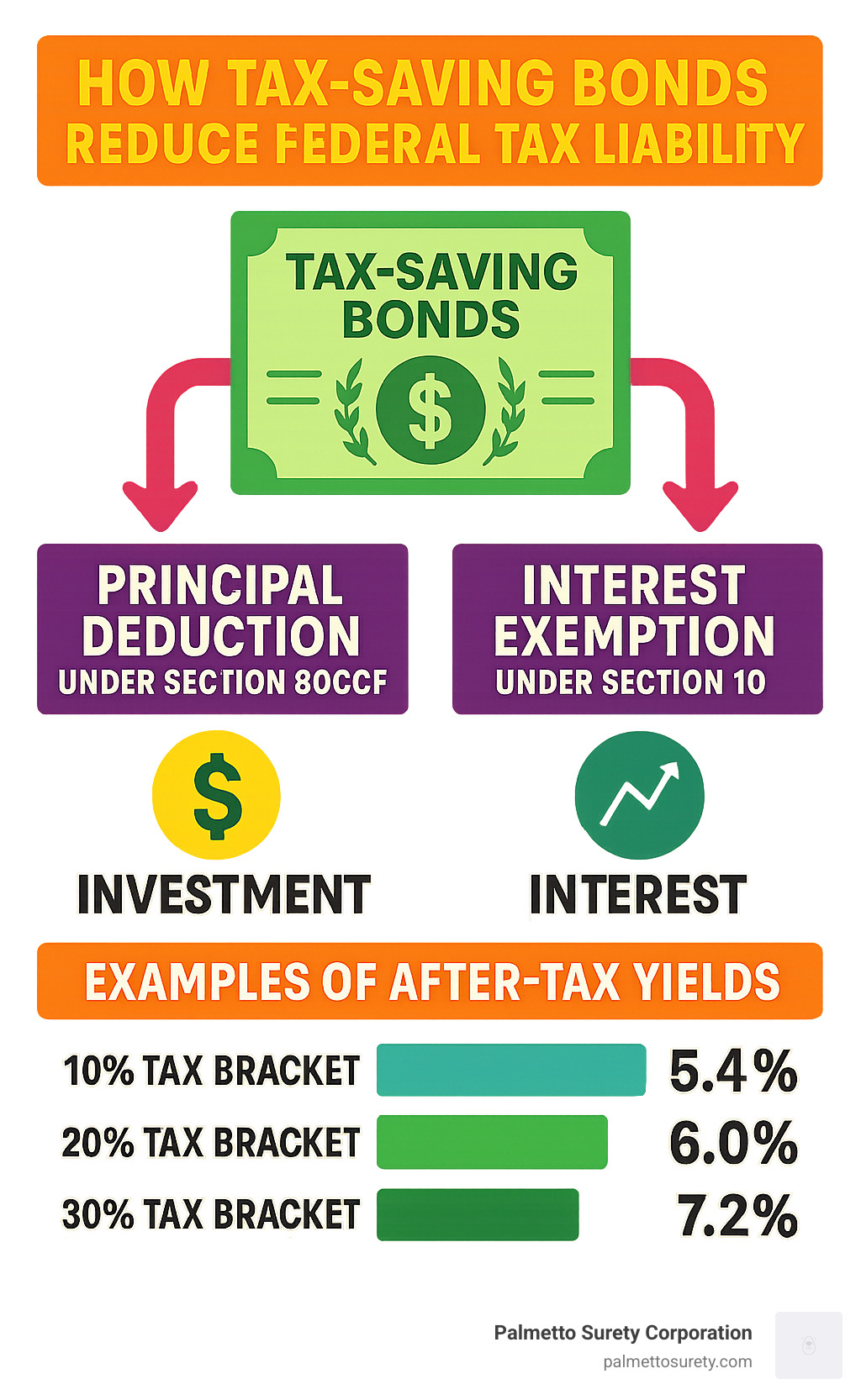
Tax-saving bonds give you an upfront tax break on the money you invest. Under Section 80CCF, you can deduct up to ₹20,000 from your taxable income each year. It’s like getting an immediate discount on your tax bill. But here’s the catch – when these bonds pay interest, you’ll owe taxes on every penny according to your regular tax bracket.
Tax-free bonds work the opposite way. You can’t deduct the initial investment, but the interest payments are completely exempt under Section 10. Every dollar of interest goes straight into your pocket without sharing a dime with the IRS.
For American investors, the landscape looks a bit different. Municipal bonds offer federal tax exemptions on interest, and if you buy bonds from your home state, you often skip state taxes too. Series EE and I bonds come with special education exclusions that can make the interest tax-free when used for qualified education expenses.
The lock-in periods tell an important story about each bond type. Tax-saving bonds typically tie up your money for 5-7 years, while tax-free bonds often require 10-20 year commitments. Municipal bonds offer more flexibility through secondary market trading, but you’ll face interest rate risk if you sell before maturity.
| Feature | Tax-Saving Bonds | Tax-Free Bonds |
|---|---|---|
| Principal Deduction | Yes (Section 80CCF) | No |
| Interest Taxation | Taxable | Tax-Free (Section 10) |
| Typical Interest Rate | 5-7% | 5.5-8.75% |
| Lock-in Period | 5-7 years | 10-20 years |
| Investment Limit | ₹20,000 per year | No limit |
| Early Exit | Limited options | Secondary market trading |
Why Understanding This Matters for Your list of tax saving bonds
Your tax bracket is the secret decoder ring for choosing between these bond types. The higher your bracket, the more valuable tax-free interest becomes. If you’re paying 30% in taxes, a 6% tax-free bond delivers the same after-tax punch as an 8.57% taxable investment.
Here’s the simple math: divide the tax-free yield by (1 minus your tax rate). So that 6% tax-free yield ÷ (1 – 0.30) = 8.57% taxable equivalent. This after-tax yield comparison should drive every bond decision you make.
Maturity matching prevents expensive mistakes. If you might need your money in five years for a home down payment, those 20-year tax-free bonds with early exit penalties could backfire. But if you’re building a retirement nest egg and won’t touch the money for decades, longer-term tax-free bonds often deliver superior returns.
Liquidity considerations matter more than most investors realize. Tax-saving bonds with strict lock-in periods offer little flexibility if life throws you a curveball. Municipal bond ETFs and individually traded municipal bonds give you the option to sell anytime, though you’ll face current market prices rather than guaranteed principal return.
Comprehensive List of Tax Saving Bonds for 2025
When you’re looking for the best list of tax saving bonds this year, you’ll find options that span everything from rock-solid U.S. Treasury securities to specialized capital gains bonds from India. The key is knowing which bonds match your tax situation and investment timeline.
Let me walk you through the standout choices for 2025, starting with the most accessible options for American investors.
Federal Picks in the 2025 list of tax saving bonds
Series EE Bonds remain one of the smartest moves for conservative investors who want guaranteed growth. The current 2.60% fixed rate might seem modest, but here’s the kicker – these bonds are guaranteed to double in value over 20 years, regardless of the stated interest rate. That works out to at least 3.5% annually, tax-deferred.
You can buy Series EE bonds starting at just $25 electronically, and the annual limit is $10,000 per Social Security number. The real tax magic happens when you use the proceeds for qualified education expenses – the interest becomes completely tax-free at the federal level. Even if you don’t use them for education, you’ll avoid state and local taxes on the interest.
Series I Bonds offer something even better for 2025 – inflation protection. The current composite rate of 3.11% combines a 1.20% fixed rate with an inflation component that adjusts every six months. This means your purchasing power stays intact even if prices rise.

Both bond types share the same $10,000 annual purchase limit and can only be bought through TreasuryDirect as of 2025. You can redeem them after 12 months, though you’ll forfeit three months of interest if you cash out before the five-year mark.
The education tax exclusion deserves special attention. If your modified adjusted gross income falls within IRS limits and you use bond proceeds for tuition and fees at eligible institutions, every penny of interest escapes federal taxation. For the latest rates and purchase options, check the U.S. Treasury website.
India-Backed Options in the list of tax saving bonds
Capital Gains Tax-Saving Bonds under Section 54EC solve a specific but important problem – what to do with capital gains from selling property or other assets. These bonds let you reinvest those gains tax-free, as long as you act within six months of the sale.
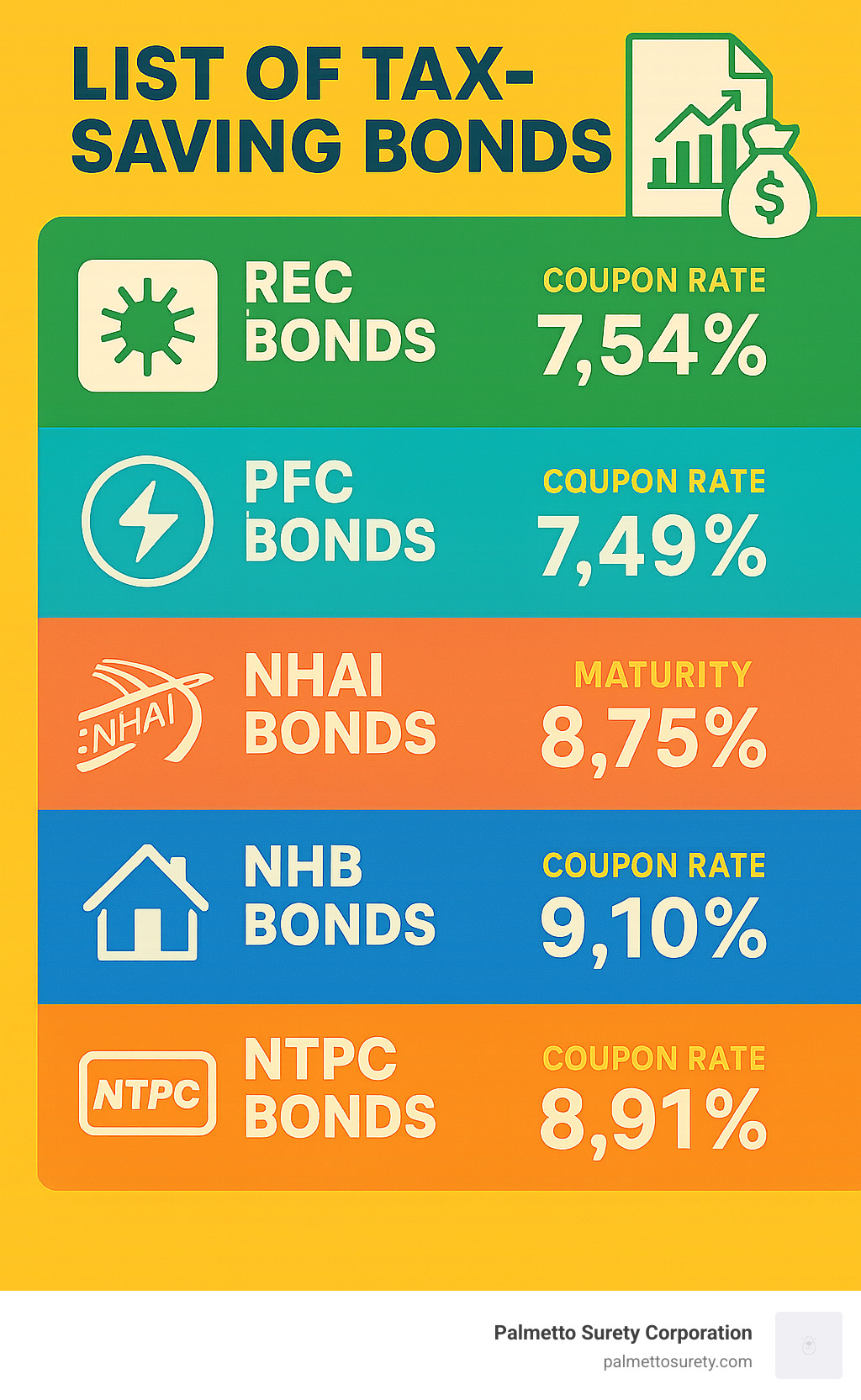
REC (Rural Electrification Corporation) Bonds typically offer 5.5% to 6.5% annual interest with a five-year lock-in period. These AAA-rated bonds carry the backing of the Government of India and can shelter up to ₹50 lakh in capital gains. The interest payments come annually, providing steady income while your principal stays protected.
PFC (Power Finance Corporation) Bonds work similarly, funding power sector projects across India. They carry the same AAA credit rating and government backing, making them virtually risk-free from a credit standpoint.
NHAI (National Highways Authority) Bonds have been particularly attractive, with some older issues paying 8.75% coupons. Current yields to maturity hover around 5.48% for bonds maturing in February 2029, reflecting their strong secondary market performance.
Moving beyond capital gains bonds, tax-free bonds under Section 10 offer a different advantage – completely tax-free interest income. NHB (National Housing Bank) Bonds from older issues still pay 9.10% coupons, though current yields to maturity are around 5.01% for bonds maturing in November 2033.
NTPC Limited Bonds provide exposure to India’s power generation sector with 8.91% coupon rates and 5.60% yields to maturity for December 2033 maturities.
For those wanting floating-rate exposure, GOI Floating-Rate Savings Bonds currently pay 7.15% with rates reset every six months. You can start with just ₹1,000 and there’s no upper investment limit. The catch? Interest is taxable, unlike the Section 10 bonds.
Municipal Bond ETFs round out our comprehensive list of tax saving bonds for American investors who want diversification without the hassle of buying individual bonds. Vanguard Tax-Exempt Bond ETF (VTEB) delivers 3.61% tax-free yield with an ultra-low 0.03% expense ratio across more than 9,800 holdings.
iShares National Muni Bond ETF (MUB) offers slightly higher 3.67% yields with excellent liquidity and over 5,700 bond holdings. For investors concerned about Alternative Minimum Tax, Invesco National AMT-Free Municipal Bond ETF (PZA) provides 4.03% yields from AMT-free bonds, though the 0.28% expense ratio is higher.
The beauty of this diverse list of tax saving bonds is that you can mix and match based on your specific tax situation, risk tolerance, and liquidity needs. Whether you’re sheltering capital gains, building tax-free income, or just want government-backed safety, there’s a bond that fits.
How to Buy & Hold These Bonds Without a Headache
Buying bonds from your list of tax saving bonds doesn’t need to stress you out. Whether you’re going after U.S. Treasury securities or Indian government bonds, the process is pretty straightforward once you know the steps.
Getting Started with U.S. Treasury Securities
If you want Series EE or I bonds, TreasuryDirect is your only option. The government shut down paper bond sales, so everything happens online now. Setting up your TreasuryDirect account takes about 15 minutes. You’ll need your Social Security Number, a U.S. bank account, and a driver’s license or state ID to verify who you are.
Once you’re in, buying bonds feels like online shopping. Click “BuyDirect,” pick your bond type, enter how much you want to invest (minimum $25), and choose your bank account for payment. Your bonds show up in your account within a day or two, and interest starts building right away.
The nice thing about TreasuryDirect is how hands-off it becomes. Your bonds sit there earning interest, you get annual statements to download for tax time, and you can set up automatic purchases if you want to buy bonds regularly.
Municipal Bond ETFs Work Like Regular Stocks
Municipal bond ETFs trade on stock exchanges, so you can buy them through any brokerage account. This gives you way more flexibility than individual bonds. You can buy and sell during market hours, and most brokers don’t charge commissions on ETF trades anymore.
The key is picking ETFs with low expense ratios and checking if they offer tax benefits in your state. Some municipal bond funds focus on bonds from specific states, which can give you extra tax savings if you live there.

Indian Government Bonds Need More Paperwork
Indian bonds require a Demat account and proper KYC documentation. Your PAN card is mandatory – no exceptions. You’ll also need your Aadhaar card and bank account details ready.
For new bond issues, you can apply online through authorized platforms or fill out physical forms at banks. The timing matters here. Submit your application before 3 PM and your bonds start earning interest the same day. Apply after 3 PM and you lose a day of interest.
Step-by-Step Application Flow
New Bond Issues Make You Wait
When Indian government entities issue new bonds, the process takes about a week. You submit your application with the required funds, then wait for the allotment advice. If you don’t get the bonds you wanted, your money gets refunded automatically.
The value date determines when your bonds start earning interest. This isn’t the day you apply – it’s when the government actually receives your properly submitted application. That’s why beating the 3 PM cutoff saves you money.
Secondary Market Trading Happens Faster
Already-issued bonds trade on the secondary market through your Demat account. You can research current prices, place buy orders, and get your bonds the next working day. The downside? You might pay more or less than face value depending on market conditions.
Interest Payments Come Like Clockwork
Most bonds in your list of tax saving bonds pay interest semi-annually – typically in January and July. The money goes straight to your registered bank account. Tax-free bonds don’t have TDS deducted, which keeps things simple at tax time.
Redemption, Collateral & Transfer Rules
Getting Your Money Back Has Rules
U.S. Series EE and I bonds let you cash out after 12 months, but you’ll lose three months of interest if you redeem before five years. After five years, no penalty applies. The bonds automatically mature at 30 years whether you want them to or not.
Indian tax-saving bonds are stricter. Most don’t allow early redemption at all. You’re locked in for the full term. Tax-free bonds offer more flexibility since you can sell them in the secondary market, but you might get more or less than you paid depending on interest rate changes.
Using Bonds as Collateral Gets Tricky
Don’t count on using your bonds to secure loans. U.S. Series EE and I bonds generally can’t be pledged as collateral. Indian tax-saving bonds are non-transferable, so banks won’t accept them either.
Tax-free bonds and municipal bond ETFs have better luck with lenders, but policies vary by institution. If you need liquidity, consider this limitation before putting too much money into bonds with long lock-in periods.
Transfer Rules Keep Things in the Family
You can transfer bonds to immediate family members or through inheritance, but selling to random people isn’t allowed except through official secondary markets. Court orders for divorce settlements also work, but you’ll need proper legal documentation.
For detailed U.S. tax reporting guidance, check IRS Publication 550 which covers investment income and expenses.
Risks, Yields & Suitability Checklist
Let’s be honest – no investment is perfect, and that includes tax-saving bonds. But understanding the risks helps you make smart choices and sleep better at night.
Interest rate risk is your biggest concern with longer-term bonds. When rates go up, bond prices go down. It’s like buying a car and watching the newer model get better features for the same price. Your 15-20 year tax-free bonds feel this pinch the most, while Series EE and I bonds with early redemption options give you more wiggle room. Municipal bond ETFs swing with daily rate changes, so expect some bumps.
Inflation can be a silent wealth killer for fixed-rate bonds. Your 6% bond might look great today, but if inflation hits 4%, you’re only gaining 2% in real purchasing power. That’s where Series I bonds shine – they adjust with inflation automatically. For other bonds in your list of tax saving bonds, consider mixing inflation-protected and fixed-rate options.
Credit risk varies widely across bond types. U.S. Treasury securities are rock-solid – backed by the full faith and credit of the government. Indian government bonds carry minimal risk thanks to sovereign backing. Municipal bonds are generally safe, but checking credit ratings never hurts.
Here’s something that catches high earners off guard: Alternative Minimum Tax (AMT) exposure. Regular municipal bonds might trigger AMT for wealthy taxpayers, wiping out some tax benefits. The fix? Look for AMT-free municipal bond ETFs like PZA that sidestep this issue entirely.

Who should consider tax-saving bonds? Senior citizens love the stable, predictable income and capital preservation focus. The tax efficiency works beautifully in retirement, though you’ll want to factor in inflation’s impact on those fixed payments.
High-net-worth individuals can save serious money in high tax brackets. Most tax-free bonds have no investment limits, and they offer nice estate planning benefits. Just spread your bets across multiple bond types for better diversification.
Young professionals face a trickier decision. Those long lock-in periods might not fit changing life circumstances. But the education tax benefits on Series EE and I bonds are worth considering, especially if you’re building a tax-efficient foundation. Just don’t put your entire portfolio here – you need growth investments too.
Here’s the math that matters: Tax-equivalent yield shows what a taxable investment would need to pay to match your tax-free bond. Take a 6% tax-free bond and divide by (1 minus your tax rate). In the 22% bracket, that 6% bond equals a 7.69% taxable investment. At 32%, it’s like earning 8.82%. At 37%? You’d need a 9.52% taxable return to match.
Portfolio allocation depends on your style. Conservative investors might put 20-40% in tax-saving bonds, balancing with diversified equity and other fixed income. Moderate investors typically stick to 10-25%, leaving more room for growth. Aggressive investors keep it to 5-15%, focusing mainly on equity and alternatives.
Are Tax-Saving Bonds Better Than FDs or T-Bills?
The short answer: it depends on your tax bracket, timeline, and need for quick access to cash.
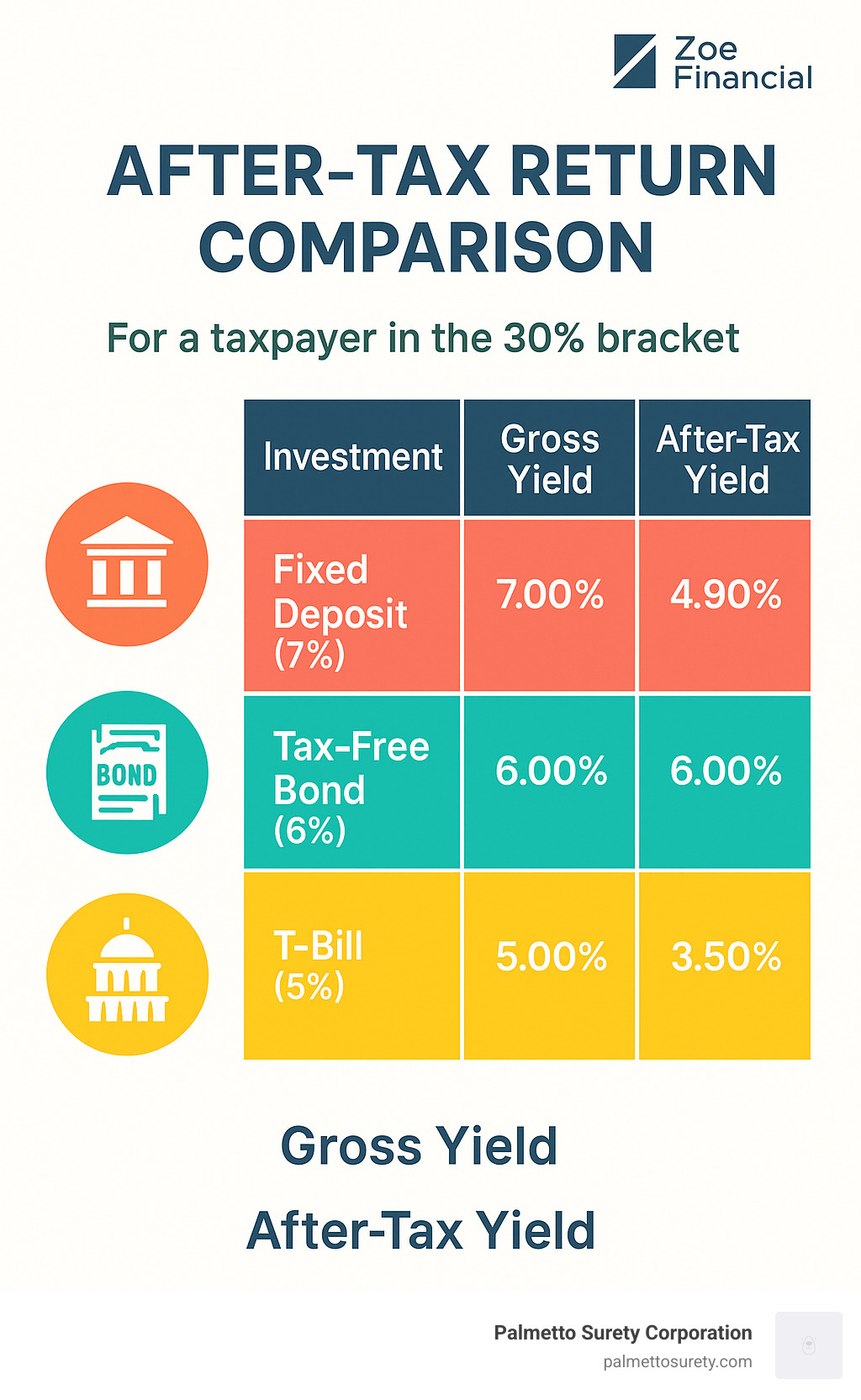
Let’s crunch some after-tax numbers. Say you’re in the 30% tax bracket comparing a 7% fixed deposit, 6% tax-free bond, 5% T-bill, and 3.11% Series I bond. After taxes, that FD only nets you 4.90%. The T-bill drops to 3.50%. But your tax-free bond? You keep the full 6%. The Series I bond gives you 3.11% plus inflation protection – potentially better than it looks.
Liquidity tells a different story. Fixed deposits hit you with penalties for early withdrawal, but you can access your money. T-bills are super liquid – sell anytime at market price. Your list of tax saving bonds typically locks you in for years with limited escape routes. Municipal bond ETFs trade daily, but prices bounce around.
Safety-wise, here’s the pecking order: U.S. Treasury securities top the list with government backing. Indian government bonds run a close second with sovereign guarantees. Municipal bonds are generally safe, though checking credit ratings is smart. Bank fixed deposits get FDIC insurance up to limits. Corporate bonds offer higher potential returns but carry more risk.
Most savvy investors don’t pick just one. They blend liquid investments with longer-term tax-saving bonds, balancing immediate needs with long-term tax efficiency. The key is matching your bond choices to your life situation and financial goals.
Frequently Asked Questions about Tax-Saving Bonds
When you’re building your list of tax saving bonds, these common questions often come up. Let’s tackle the most important ones with straightforward answers that help you make smart decisions.
What is the minimum & maximum I can invest?
The investment limits vary quite a bit depending on which bonds you choose. For U.S. Treasury Securities, you can start small with just $25 for electronic Series EE and I bonds. The government caps your annual purchases at $10,000 per calendar year for each bond type per Social Security Number. Here’s a neat trick: you can buy an additional $5,000 worth of paper I bonds using your tax refund.
Indian Government Bonds work differently. Most issues start at ₹1,000 or ₹2,000 minimum, which makes them accessible to most investors. If you’re looking at tax-saving bonds under Section 80CCF, you can only claim deductions up to ₹20,000 per financial year. But here’s where it gets interesting – tax-free bonds have no upper limit, though practical limits might apply when new issues come to market.
For capital gains bonds under Section 54EC, you can invest up to ₹50 lakh to get exemption from capital gains tax. That’s a substantial amount that can really help if you’ve sold property or other major assets.
Municipal Bond ETFs are the most flexible option. You can start with just one share, typically costing $50-100, and there’s no maximum limit beyond what your brokerage account allows.
How is interest from tax-saving bonds taxed at federal, state & local levels?
Tax treatment can make or break your returns, so understanding this is crucial for your list of tax saving bonds strategy.
At the federal level, U.S. Treasury Securities give you some nice flexibility. You can defer reporting interest until redemption or report it annually – your choice. The real bonus comes with the education exclusion, where interest might be completely tax-free if you use it for qualified education expenses. Municipal bonds are generally exempt from federal income tax, though some might trigger the Alternative Minimum Tax if you’re in that situation.
State-level treatment is where things get really interesting. U.S. Treasury Securities are exempt from state and local income taxes in all states. If you live in a high-tax state like California or New York, this exemption can add serious value to your returns. Municipal bonds follow the “home state rule” – bonds from your state are typically exempt from state tax, while out-of-state municipal bonds might get taxed.
For Indian tax-free bonds, the treatment is beautifully simple. Interest is completely exempt under Section 10 with no TDS (Tax Deducted at Source). You still need to declare it in your tax return for transparency, but you won’t pay a rupee in tax on that interest.
Tax-saving bonds under Section 80CCF work the opposite way. You get to deduct the principal investment from your taxable income, but the interest gets taxed according to your income slab. It’s a trade-off between upfront tax savings and ongoing tax liability.
Can these bonds be used as collateral for a personal loan?
This is where many investors get surprised. Most tax-saving bonds aren’t great collateral options, and here’s why.
Series EE and I bonds are held electronically in TreasuryDirect, making them difficult to pledge to lenders. The government designed these bonds for individual savers, not as collateral instruments. Similarly, tax-saving bonds under Section 80CCF are usually non-transferable and non-negotiable during their lock-in periods.
Municipal Bond ETFs offer more flexibility since they can be pledged like other securities in your brokerage account. Some brokers even offer securities-based lines of credit against your bond portfolio, which can be more convenient than traditional collateral arrangements.
Older tax-free bonds might work as collateral after their lock-in period ends, but this depends on the specific bond terms and your lender’s policies. Factors like liquidity, credit rating, and market price stability all influence whether a lender will accept your bonds.
If you need to borrow against your bond investments, consider these alternatives: margin loans for tradeable bonds and ETFs, securities-based credit lines from your broker, or simply unsecured personal loans if bond pledging isn’t available.
That pledging bonds creates additional risk. If you default on the loan, you might face forced bond liquidation, potentially triggering unwanted tax consequences. Interest rate changes can also affect both your bond values and loan terms simultaneously.
Before using any bonds as collateral, it’s smart to consult with both your lender and tax advisor. They can help you understand all the implications and find the best approach for your specific situation.
Conclusion
Creating your perfect list of tax saving bonds isn’t about finding one magical investment. It’s about building a strategy that fits your tax situation, timeline, and sleep-at-night comfort level.
Think of tax-saving bonds as the steady, reliable friend in your investment group. Series EE and I bonds offer that government-backed security with education benefits that could help fund your kids’ college years. Municipal bond ETFs give you the flexibility to buy and sell while keeping Uncle Sam’s hands off your interest payments. Indian government bonds provide either upfront tax deductions or completely tax-free income streams. And capital gains bonds can be a lifesaver when you’ve just sold property and need to shelter those gains.
The magic happens when you combine these different bond types thoughtfully. You might start with some liquid municipal bond ETFs for flexibility, add Series I bonds for inflation protection, include longer-term tax-free bonds for maximum tax efficiency, and keep some capital gains bonds ready if opportunity knocks.
But here’s the thing – tax-saving bonds work best as part of your bigger financial picture. They’re the foundation, not the whole house. Combine them with your 401(k), IRA contributions, and other tax-smart moves for real wealth-building power.
At Palmetto Surety Corporation, we’ve spent over 20 years helping businesses in the Southeast steer complex financial requirements through our surety bond services. We understand that whether you’re securing a construction project or building personal wealth, having the right financial foundation matters. Sound personal financial strategies, including smart tax-efficient investing, often translate into stronger business decisions too.
The best approach? Start where you are, with what you have. You don’t need to build the perfect list of tax saving bonds portfolio overnight. Begin with one bond type that makes sense for your situation, then gradually add others as you learn and your circumstances change.
Time in the market beats timing the market, especially with government-backed bonds. The tax advantages compound over years, not months. Every dollar you save on taxes is a dollar that can work harder for your future.
For more information about our surety bond services and how we help businesses manage their bonding needs efficiently, visit Palmetto Surety Corporation.
Remember: the best time to start building your tax-saving bond strategy was yesterday. The second-best time is right now.


