


Municipal Bond Sales: Top Insights for 2025 Success
Understanding Municipal Bond Market Fundamentals
Municipal bond sales refer to the process by which state and local governments raise capital by issuing debt securities to fund public projects like schools, highways, and water systems. If you’re looking to understand municipal bond sales quickly, here’s what you need to know:
| Municipal Bond Sales – Key Points |
|---|
| • Debt securities issued by state and local governments |
| • Used to finance public infrastructure projects |
| • Typically sold in $5,000 increments |
| • Often exempt from federal taxes and sometimes state/local taxes |
| • Sold through primary market (new issues) or secondary market (existing bonds) |
| • Total municipal bond market valued at approximately $4.1 trillion as of Q4 2025 |
Municipal bonds represent a critical financing tool for communities across America. When a city needs to build a new school or a county must upgrade its water treatment facility, they often turn to municipal bond sales to secure the necessary funding. These bonds essentially function as loans from investors to government entities, with the promise of regular interest payments and eventual return of principal.
Unlike corporate bonds, municipal bonds often come with tax advantages. Interest earned is typically exempt from federal income tax and may also be exempt from state and local taxes if you live in the issuing state. This tax-exempt status allows municipalities to offer lower interest rates while still attracting investors, particularly those in higher tax brackets.
“Municipal bonds are acting like bonds again” – offering attractive tax-exempt income and potential total returns from income alone, a dynamic absent for almost 10 years.
The municipal bond market operates through two channels: the primary market (where new bonds are issued) and the secondary market (where existing bonds are bought and sold). In the primary market, bonds are sold through either competitive sales (auction-style bidding) or negotiated sales (working with selected underwriters). The secondary market operates over-the-counter through broker-dealers rather than on centralized exchanges.
I’m Haiko de Poel Jr, a financial consultant with extensive experience guiding clients through municipal bond sales and other financial instruments at Palmetto Surety Corporation, where I’ve helped countless businesses and individuals steer the complexities of bond markets and secure appropriate financial guarantees.
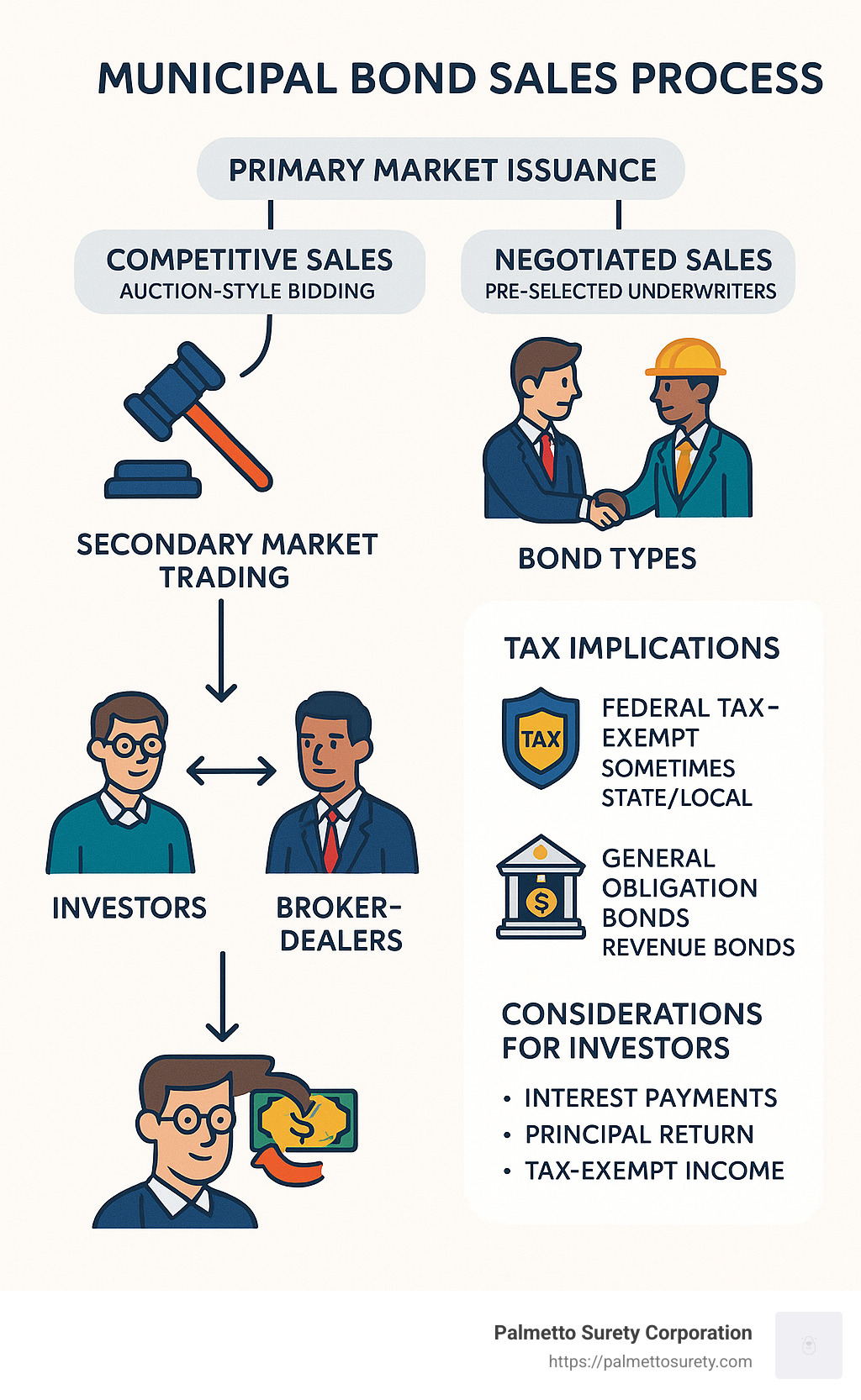
Municipal bond sales basics:

What Are Municipal Bonds and How Do They Function?
Ever wonder how your town built that beautiful new library or fixed those pothole-riddled streets? The answer likely involves municipal bonds – the financial backbone of community development across America.
Municipal bonds are debt securities issued by states, cities, counties, and other local government entities to fund important public projects. When you buy a municipal bond, you’re essentially lending money to your community. In return, they promise to pay you interest (usually twice a year) and return your original investment when the bond matures.
Most municipal bonds come with a $5,000 face value (also called par value), though in the secondary market, you might find them priced differently based on current interest rates and market conditions. The interest rate the issuer promises to pay is called the coupon rate, and these bonds typically mature anywhere from one to 30 years after issuance.
What makes municipal bonds special is their tax treatment. The interest you earn is typically exempt from federal income tax and sometimes from state and local taxes if you live where the bond was issued. This tax advantage is a win-win: communities can borrow at lower rates, and investors (especially those in higher tax brackets) can enjoy attractive after-tax returns.
Every municipal bond comes with a bond indenture – a legal document outlining all terms and conditions, including interest rate, maturity date, and special provisions like call features that allow the issuer to redeem the bond early.
According to the Municipal Securities Rulemaking Board Education Center, the municipal bond market had approximately $4.1 trillion in outstanding bonds as of late 2025. That’s a whole lot of schools, bridges, and water systems being built!
Types of Municipal Bonds in Today’s Market
The municipal bond world offers more variety than you might expect. Let’s explore the different flavors:
General Obligation (GO) Bonds are the workhorses of municipal finance. Backed by the “full faith and credit” of the issuer, these bonds are secured by the government’s ability to levy taxes. Think of them as having the strongest safety net – the issuer can raise taxes if needed to make payments, making them among the safest municipal investments.
Revenue Bonds take a different approach. Rather than being backed by taxing power, they’re repaid from revenue generated by the specific project they fund. That toll bridge? The tolls pay back the bondholders. This direct connection between project and repayment means these bonds carry somewhat higher risk – if the project doesn’t generate enough revenue, payments might be affected.
Private Activity Bonds sit in an interesting middle ground. Though issued by government entities, they primarily benefit private organizations or activities. Think airports, student loans, or affordable housing developments that serve both public and private interests.
Conduit Bonds are issued by government entities on behalf of private organizations like non-profit hospitals or universities. The government acts as a “conduit,” allowing these organizations to access tax-exempt financing, but the private entity bears the responsibility for repayment.
Zero-Coupon Bonds offer a different approach to interest. Rather than making regular interest payments, they’re sold at a discount to their face value. When the bond matures, you receive the full face value – the difference between your purchase price and that final amount represents your interest.
Variable Rate Bonds feature interest rates that fluctuate with market conditions rather than staying fixed. Variable Rate Demand Obligations (VRDOs) typically require larger minimum investments (around $100,000) compared to the standard $5,000 for fixed-rate bonds.
Housing Bonds specifically finance affordable housing projects, including both single-family mortgage revenue bonds and multi-family housing bonds.
Municipal Notes are short-term obligations that typically mature within a year. Cities and counties use these to bridge temporary cash flow gaps, like when tax revenues haven’t arrived but bills need paying.
Understanding these different bond types is crucial for anyone interested in municipal bond sales and building a diversified portfolio. For a comprehensive reference, the MSRB’s Glossary of Municipal Securities Terms provides detailed definitions of these and many other bond-related terms.
The Tax Advantages of Municipal Bond Investments
The tax benefits of municipal bonds might be their most compelling feature, especially if you’re in a higher tax bracket. Let’s break down these advantages:
Federal Tax Exemption is the headline benefit. Interest income from most municipal bonds is exempt from federal income taxes. This allows municipalities to offer lower interest rates while still providing competitive after-tax returns to investors like you.
State and Local Tax Exemption can add another layer of savings. If you purchase bonds issued in your state of residence, the interest may also be exempt from state and local income taxes. This “triple tax exemption” can be particularly valuable if you live in a high-tax state like California or New York.
To truly understand what these tax advantages mean for your bottom line, you’ll want to calculate the taxable-equivalent yield. This shows what a taxable investment would need to yield to match your tax-exempt municipal bond:
Taxable-Equivalent Yield = Tax-Exempt Yield ÷ (1 – Marginal Tax Rate)
For example, if a municipal bond offers a 3% tax-exempt yield and you’re in the 35% federal tax bracket:
3% ÷ (1 – 0.35) = 3% ÷ 0.65 = 4.62%
This means a taxable bond would need to yield 4.62% to provide the same after-tax return as your 3% tax-exempt municipal bond. That’s a significant difference!
However, there are some important tax considerations to keep in mind:
The Alternative Minimum Tax (AMT) may apply to interest from certain private activity bonds, potentially reducing their tax advantage depending on your tax situation.
The De Minimis Tax Rule can affect bonds purchased at a discount. If that discount exceeds 0.25% multiplied by the number of full years to maturity, the discount might be treated as ordinary income rather than capital gains when the bond matures or is sold.
For instance, with a 20-year municipal bond with a revised issue price of 99 and nine years remaining, the de minimis threshold would be 96.75 (99 – (0.25 × 9)).
It’s worth noting that while interest income may be tax-exempt, capital gains from selling bonds at a profit are still subject to capital gains taxes. Additionally, tax laws can change over time.
Given these complexities, we at Palmetto Surety Corporation always recommend consulting with a tax professional about your specific situation. For more information, the Tax and Liquidity Considerations for Buying Discount Bonds guide from the MSRB provides excellent additional details.
Understanding Municipal Bond Sales in the Primary Market
The primary market is where the journey of municipal bonds begins – it’s the birthplace of new bonds before they make their way into investors’ portfolios. This is the arena where state and local governments first raise capital for their community projects. Whether you’re an issuer looking to fund a new school or an investor seeking tax advantages, understanding how this market works is essential for navigating municipal bond sales.
When a city or county determines they need funds for a specific purpose – perhaps upgrading aging water systems or building a new community center – the process starts with careful planning. After securing the necessary approvals (which often includes voter approval for major projects), the government entity assembles a team of financial experts to help structure their bond offering.

The primary market process unfolds like a well-choreographed dance. First comes the planning and authorization phase, where funding needs are assessed and legal permissions secured. Next, the issuer selects their financing team, bringing together financial advisors, bond counsel, and underwriters who will guide them through the process.
During bond structuring, the team crafts the bond’s features – from maturity dates to interest rates – essentially designing the financial product to meet both the issuer’s needs and investor expectations. Meanwhile, they prepare disclosure documents including the official statement (OS) and preliminary official statement (POS), which serve as the bond’s resume, detailing its features and the issuer’s financial health.
Many issuers seek a credit rating from agencies like Moody’s or S&P to help investors assess risk. Think of this as the bond’s credit score – better ratings typically mean lower interest costs for the issuer.
When it comes to the actual marketing and sale, municipalities have three main options:
Competitive sales work like an auction – underwriters submit sealed bids, and the bonds go to whoever offers the lowest interest cost. This approach often yields the best rates for simple, straightforward bond issues from well-known entities.
Negotiated sales involve working directly with a pre-selected underwriter to determine pricing and terms. This route offers more flexibility and is particularly valuable for complex offerings or when market conditions are volatile.
Private placements bypass the public entirely, with bonds sold directly to a limited group of institutional investors. This approach can be faster and less costly for certain types of issues.
The pricing of new municipal bonds isn’t arbitrary – it’s influenced by current market rates, the issuer’s creditworthiness, the bond’s maturity structure, and recent comparable offerings. Yield curves, particularly the Municipal Market Data (MMD) curve, serve as crucial reference points for determining appropriate interest rates.
For investors interested in newly issued bonds, the Electronic Municipal Market Access (EMMA) website is an invaluable resource. Operated by the Municipal Securities Rulemaking Board, EMMA provides transparent access to official statements and other critical information about upcoming and recent municipal bond sales.
At Palmetto Surety Corporation, we’ve guided numerous clients through this primary market process, helping them understand the nuances that can significantly impact their long-term financial outcomes.
The Role of Underwriters in Municipal Bond Sales
Underwriters are the vital bridge connecting municipal issuers with investors – they’re the market-makers who transform a city’s funding needs into investment opportunities. These financial institutions, typically investment banks or specialized broker-dealers, bring essential expertise and market connections to municipal bond sales.
In competitive sales, underwriters function somewhat like bidders at an auction. They carefully analyze the proposed bond issue, assess market conditions, and submit sealed bids specifying exactly what interest rates they’re willing to offer. The issuer then awards the entire bond package to whoever proposes the lowest overall borrowing cost, typically measured by the true interest cost (TIC).
For negotiated sales, which are more common for complex or larger issues, the relationship starts much earlier. The issuer selects an underwriter upfront, and together they develop a customized approach. The underwriter’s role becomes far more consultative and comprehensive.
The underwriter begins with thorough due diligence, investigating the issuer’s financial health and the project being funded. This isn’t just bureaucratic box-checking – it’s essential for ensuring accurate disclosure to potential investors and identifying any issues that might affect pricing.
Next comes bond structuring, where the underwriter helps determine the most advantageous maturities, interest rates, and features based on current market conditions and the issuer’s specific needs. Their market knowledge proves invaluable in designing an offering that will appeal to investors while minimizing the issuer’s borrowing costs.
The underwriter also performs critical risk assessment and pricing analyses. They evaluate various factors – from credit quality to market liquidity – to determine price points that will attract investors without unnecessarily increasing the issuer’s interest costs.
For larger issues, the lead underwriter often forms a syndicate with other firms. This collaboration spreads the risk and expands distribution capabilities, ensuring the bonds reach a wider investor audience.
When it’s time to market the bonds, underwriters leverage their investor relationships and market expertise. Many offerings include a dedicated “retail order period” where individual investors get first access before institutional buyers enter the picture. This approach can sometimes lead to better overall pricing and broader distribution.
The underwriter purchases the entire bond issue from the issuer and then resells those bonds to investors. This is a genuine risk position – they’re committing their own capital with no guarantee they’ll successfully resell all the bonds at profitable prices.
Underwriters earn their compensation primarily through the “spread” or “underwriter’s discount” – the difference between what they pay the issuer and what they charge investors. For negotiated sales, this spread is agreed upon in advance, while in competitive sales, it’s built into the bid.
These activities aren’t conducted in a regulatory vacuum. Underwriters must adhere to rules established by the Municipal Securities Rulemaking Board and the Securities and Exchange Commission, ensuring fair dealing and appropriate disclosure throughout the process.
At Palmetto Surety Corporation, we’ve helped countless clients throughout the Southeast understand and steer the underwriting process. Our experience across Georgia, Florida, Louisiana, Mississippi, South Carolina, Tennessee, and Texas gives us valuable perspective on how regional market conditions can affect municipal bond sales.
How Municipal Bond Auctions and Competitive Sales Work
Competitive sales – often called auctions in the municipal world – represent democracy in action within the bond market. This approach harnesses the power of open competition to secure the lowest possible interest rates for taxpayers. For both issuers and investors, understanding this process provides valuable insight into how municipal bond sales establish fair market prices.
The competitive sale begins with the issuer making a public announcement through a formal notice of sale. This document serves as the rulebook for the auction, specifying when bids are due, how much debt is being offered, maturity schedules, and other critical terms. The announcement is distributed widely through financial publications and electronic platforms to ensure maximum participation.
Behind the scenes, the issuer and their financial advisors carefully prepare bid specifications that underwriters must follow. These detailed guidelines create a level playing field for all bidders and ensure the issuer receives comparable offers.
On auction day, the bidding process unfolds with precision. Underwriters submit their sealed bids electronically or in physical form, each specifying the interest rate they’ll charge for each maturity and the price they’ll pay for the bonds. From these figures emerges the true interest cost (TIC) – the comprehensive measure of what the borrowing will actually cost the issuer over the life of the bonds.
Most competitive sales require all-or-none bids, meaning underwriters must bid on the entire package rather than cherry-picking only the most attractive maturities. This approach ensures the issuer can sell their complete offering, not just the easy-to-place portions.
When all bids are in, the issuer applies their pre-established award criteria – typically awarding the bonds to whoever offers the lowest true interest cost. This moment of truth reveals whether the issuer has achieved their financial goals.
One of the hallmarks of competitive sales is the public opening and announcement of bids. This transparency serves as a powerful check against favoritism or manipulation, showing taxpayers that their government sought the best possible deal.
After the award, the process moves toward closing, where bonds are delivered to the winning underwriter in exchange for payment. The funds then become available for the issuer’s intended project.
Modern technology has transformed this once paper-heavy process. Electronic auction platforms now allow for efficient submission and evaluation of bids, with automated calculations reducing the potential for human error.
Competitive sales particularly shine for:
- General obligation bonds with strong credit ratings
- Straightforward revenue bonds with established revenue streams
- Issuers with good market recognition and investor acceptance
- Standard bond structures without complex features
The transparency requirements of competitive sales help ensure issuers receive fair market prices. However, this approach offers less flexibility than negotiated sales in terms of timing and structure. Issuers must have their disclosure documents and credit ratings fully prepared before the auction, with limited ability to adjust terms based on market feedback.
For investors, bonds sold through competitive sales become available through the winning underwriter shortly after the auction. The competitive process helps ensure the bonds are priced at current market rates, potentially offering fair value to both the issuer and investors.
At Palmetto Surety Corporation, we help clients throughout the Southeast understand whether competitive sales align with their specific needs and market conditions. Our experience with municipal bond sales across various jurisdictions gives us practical insight into when this approach is likely to yield the best results.
Navigating the Secondary Market for Municipal Bond Sales
The secondary market is where previously issued municipal bonds change hands among investors. Unlike the primary market where new bonds make their debut, the secondary market offers a vital function: providing liquidity for existing bondholders and creating opportunities for new investors to purchase bonds that have already been issued. If you’re involved in municipal bond sales in any capacity, understanding this market is essential.
Municipal bonds don’t trade on centralized exchanges like stocks do. Instead, they trade in an over-the-counter (OTC) market through a network of broker-dealers. This decentralized approach means there’s no single marketplace where all municipal bonds are bought and sold, which can make price transparency and liquidity more challenging.

When you decide it’s time to sell a municipal bond before it matures, the process typically unfolds like this:
First, you’ll contact your broker-dealer to let them know you’re interested in selling. Rather than executing an immediate sale (as you might with stocks), your broker-dealer will place your bond for bid on electronic trading platforms used by dealers across the country. This process aims to find you the best available price.
Once bids come in, you’ll review them and decide whether to accept the best offer or wait for potentially better prices. If you decide to accept a bid, your broker-dealer executes the transaction, typically charging a mark-down – that’s the difference between what the dealer pays you and the bond’s prevailing market value. Finally, the transaction settles with the bonds transferred to the buyer and funds to you, typically within one or two business days.
The municipal bond secondary market has some unique characteristics that set it apart from other securities markets. For one thing, there are over one million different municipal bonds outstanding, compared to just several thousand stocks. This vast number makes it difficult to maintain active markets for all issues. Many municipal issues also have relatively small sizes, which can limit their liquidity.
Another factor is that many municipal bond investors are “buy-and-hold” types who plan to keep their bonds until maturity, which naturally reduces secondary market activity. And if you’re selling less than $100,000 in par value (what’s known as an “odd lot”), you may receive less favorable pricing than larger institutional-sized trades.
Fortunately, the MSRB’s Electronic Municipal Market Access (EMMA) website offers valuable tools for navigating the secondary market, including their Price Findy tool that lets you search for recent trade prices. This transparency helps you evaluate whether you’re receiving fair prices when buying or selling bonds.
At Palmetto Surety Corporation, we work with clients throughout the southeastern United States to help them understand the nuances of secondary market municipal bond sales. Our experience in Georgia, Florida, South Carolina, and beyond gives us insight into regional market dynamics that can affect bond liquidity and pricing.
Factors Affecting Municipal Bond Pricing and Yields
Municipal bond prices and yields don’t exist in a vacuum – they’re shaped by numerous interconnected factors. Whether you’re issuing bonds, investing in them, or advising others, understanding these dynamics is crucial for successful municipal bond sales.
The interest rate environment is perhaps the most powerful force affecting municipal bond prices. When interest rates climb, the prices of existing bonds typically fall as newer issues hit the market with higher coupon rates. When rates decline, existing bonds with higher coupons become more valuable. As the Municipal Market Data (MMD) yield curve shifts, the entire municipal bond market adjusts accordingly.
“The conclusion of the hiking cycle likely means the end for these attractive short-term yields.”
This quote highlights an important relationship between Federal Reserve policy and municipal bond yields. When the Fed concludes a rate-hiking cycle and begins cutting rates, the yield curve typically steepens. This creates opportunities for investors to extend duration to capture higher yields, but it also means those short-term yields that looked so attractive during the hiking cycle begin to decline.
Credit ratings play a major role too. Bonds with higher credit ratings generally command higher prices (and thus offer lower yields) than those with lower ratings, reflecting their lower default risk. When an issuer receives a credit rating upgrade or downgrade, the prices of its outstanding bonds often adjust in response.
Call provisions matter significantly. Many municipal bonds include provisions allowing the issuer to redeem them before maturity. Bonds with these features typically offer higher yields to compensate investors for the risk that the bonds might be called if interest rates decline, forcing investors to reinvest at lower rates.
Maturity length affects pricing as well. Longer-term bonds generally offer higher yields than shorter-term bonds to compensate investors for the greater interest rate and inflation risks associated with longer time horizons. This relationship between maturity and yield appears in the yield curve.
The tax status of municipal bonds significantly impacts their pricing. Changes in tax laws or an individual investor’s tax situation can affect the relative value of tax-exempt versus taxable bonds.
Supply and demand also exert a strong influence. As we head into 2025, many analysts predict robust municipal bond supply, potentially putting pressure on prices. However, a significant amount of outstanding municipal bonds are set to mature as well, which may offset some of the new supply.
Broader economic conditions like inflation expectations, economic growth forecasts, and the fiscal health of state and local governments all impact municipal bond pricing. The issuer’s reputation and financial health matter as well – bonds from issuers with strong financial management and healthy economies often command premium prices compared to those from issuers facing fiscal challenges.
For secondary market investors, it’s worth noting that municipal bonds often trade less frequently than stocks, which can lead to pricing inefficiencies. While this creates challenges in finding accurate pricing information for some bonds, it also means diligent investors may find undervalued bonds amid these inefficiencies.
At Palmetto Surety Corporation, we help clients understand these pricing dynamics and steer the complexities of municipal bond sales in both primary and secondary markets. Our experience across the southeastern United States gives us valuable insight into regional factors that can affect municipal bond valuations.
Strategies for Selling Municipal Bonds Before Maturity
While many investors buy municipal bonds planning to hold them until maturity, life happens. Financial needs change, interest rates shift, and investment strategies evolve. When circumstances require selling bonds before they mature, having a solid approach to the secondary market becomes an important aspect of municipal bond sales knowledge.
Timing can make all the difference when selling bonds. If interest rates have fallen since you purchased your bond, it may be worth more than what you paid, potentially giving you a capital gain. On the flip side, if rates have risen, you might face a loss if you sell. Credit quality changes matter too – if the issuer’s credit rating has improved since your purchase, the bond may command a higher price, while credit deterioration would have the opposite effect. Bonds approaching their first call date may experience price compression, as their upside becomes limited by the likelihood of the issuer exercising the call option if rates are falling.
Transaction costs are an important consideration when selling municipal bonds. Unlike stock trades where commissions are clearly stated, bond dealers typically include their compensation as a mark-down – the difference between what they pay you and what they believe is the bond’s current market value. This mark-down is built into the price quoted to you. The bid-ask spread – the difference between what dealers will pay for a bond and what they’re asking when selling it – represents another form of transaction cost. These spreads tend to be wider for less liquid bonds.
The tax implications of selling municipal bonds before maturity can be significant. If you sell a bond for more than you paid, the gain is generally subject to capital gains tax, even though the interest income from the bond may have been tax-exempt. On the positive side, losses from bond sales can offset capital gains from other investments, potentially reducing your tax liability. The de minimis rule adds another layer of complexity – if you purchased a bond at a discount to its face value, the discount may be treated as ordinary income rather than capital gain when you sell, depending on how the discount relates to the de minimis threshold.
To maximize value when selling municipal bonds, consider these practical approaches:
Don’t settle for the first offer you receive. Unlike the stock market, municipal bond prices can vary among dealers. Getting bids from multiple dealers can help ensure you receive a competitive price. Before selling, use the MSRB’s EMMA website to research recent trades of your bond or similar bonds to gauge fair market value.
If possible, try selling bonds in lots of $100,000 par value or more, which can result in better pricing than selling smaller “odd lot” positions. Before committing to selling, evaluate whether other strategies might better meet your needs, such as borrowing against your bonds rather than selling them outright.
Working with a knowledgeable financial professional can make a world of difference. They can help you evaluate the trade-offs involved in selling bonds before maturity and may have access to a broader network of dealers.
At Palmetto Surety Corporation, we help clients across Georgia, Florida, South Carolina, and other southeastern states evaluate their options when considering selling municipal bonds before maturity. Our regional experience provides valuable perspective on market dynamics that can affect secondary market municipal bond sales. We understand that selling bonds is often part of a larger financial strategy, and we’re committed to helping our clients make informed decisions that align with their overall goals.
Key Risks and Considerations in Municipal Bond Sales
When it comes to investing, nothing is completely risk-free – even municipal bonds, which many consider relatively safe investments. Before diving into municipal bond sales, it’s worth understanding the potential pitfalls that could affect your investment.
Think of municipal bonds like any relationship – they come with commitments and potential complications. While historically stable (with only 71 defaults among U.S. municipal bond issuers between 1970 and 2011), they’re not immune to problems.
Credit risk sits at the top of the concern list. This is simply the possibility that the government entity that issued your bond might not make good on its promises to pay interest or return your principal. While rare, these defaults do happen. That’s why rating agencies like Moody’s, Standard & Poor’s, and Fitch exist – they’re like the credit score bureaus for bond issuers, helping you gauge how reliable a particular bond might be.
Interest rate risk is another big one, and it trips up many investors. When interest rates climb, the market value of existing bonds typically falls. It’s like buying last year’s smartphone right before the new model comes out – suddenly your purchase seems less valuable. This matters most if you need to sell before maturity, as you might get back less than you paid. Generally speaking, the longer your bond’s term, the more sensitive it is to these rate changes.
Call risk might be the most frustrating for income-focused investors. Many municipal bonds come with a “call option” that lets the issuer redeem them early, typically when interest rates fall. Imagine finally finding a great apartment with a reasonable rent, only to have the landlord terminate your lease early because they can now charge someone else more. When your bond gets called, you’ll get your money back, but then you’re stuck reinvesting in a lower-rate environment.
The municipal bond market also faces liquidity challenges. Unlike stocks that trade rapidly all day long, municipal bonds can sometimes be difficult to sell quickly without accepting a significant price cut. This is especially true for bonds with lower ratings, from smaller issuers, or with unusual features. It’s like trying to sell a house in a remote location – you might have to lower your price considerably to attract a buyer in a hurry.
Inflation risk quietly erodes your returns over time. Your bond might pay a fixed 3% annually, but if inflation runs at 4%, your money is actually losing purchasing power. This is particularly concerning for longer-term bonds where inflation has more time to chip away at your returns.
Legislative risk is often overlooked but potentially significant. Tax laws can change, potentially affecting the tax-exempt status that makes municipal bonds attractive in the first place. A major reduction in federal income tax rates, for example, would reduce the relative advantage that tax-exempt municipal bonds hold over taxable alternatives.
Tax complications can also arise in specific situations. Some municipal bonds are subject to the Alternative Minimum Tax (AMT), and bonds purchased at a discount face the complex “de minimis rule” that could affect their tax treatment. Even more concerning, a bond that was originally tax-exempt could lose that status if it fails to comply with applicable tax requirements.
Market volatility affects all investments, including municipal bonds. During periods of economic uncertainty or rapid interest rate changes, bond prices may fluctuate significantly. This volatility can create both risks and opportunities for investors.
Reinvestment risk becomes particularly relevant in declining interest rate environments. When your bond pays interest or gets called early, you might have to reinvest those proceeds at lower rates than you originally expected, reducing your overall return.
In extremely rare cases, there’s even repudiation risk – where an issuer might challenge the validity of its debt obligation. Think of this as the governmental equivalent of claiming “I never signed that contract!” Thankfully, this almost never happens.
At Palmetto Surety Corporation, we’ve spent over two decades helping clients across Georgia, Florida, South Carolina, and other southeastern states steer these risks when engaging in municipal bond sales. Our regional expertise gives us valuable insight into local factors that might affect municipal bond risk profiles in ways that national analyses might miss.
Evaluating Credit Quality and Ratings
Understanding credit quality is like knowing how to read a weather forecast before planning an outdoor event – it helps you prepare for what might come. For municipal bonds, credit quality directly impacts both risk and potential returns, making it essential knowledge for anyone considering municipal bond sales.
The three major rating agencies – Moody’s, Standard & Poor’s, and Fitch – serve as the meteorologists of the bond world. They provide independent assessments of an issuer’s ability and willingness to meet financial obligations, using letter grades that range from pristine AAA (or Aaa for Moody’s) down to C or D for bonds in default or teetering on the edge.
As of 2011, Moody’s had rated approximately 9,700 municipal bond issuers, showing just how vast this market is. The good news? In recent years, credit upgrades have been outpacing downgrades by about 2.5 to 1, suggesting an overall improvement in municipal credit health.
When evaluating a bond’s credit quality, several factors come into play. For revenue bonds, the debt service coverage ratio is crucial – essentially asking whether the project generates enough money to cover its debt payments with room to spare. A higher ratio means more financial breathing room, which translates to lower risk.
For general obligation bonds, the health and diversity of the local economy take center stage. Analysts look at population trends (is the area growing or shrinking?), employment rates, income levels, and the diversity of the tax base. A town reliant on a single factory for most of its tax revenue presents a much higher risk than a city with diverse industries and income sources.
Management quality matters enormously but can be harder to quantify. Competent leadership with transparent financial reporting and conservative budgeting practices typically leads to better credit outcomes. Think of it as the difference between lending money to a friend who carefully tracks expenses versus one who can never quite remember where their money goes.
Debt burden represents another critical factor. Just as an individual with too many credit cards might struggle to make payments, a municipality with excessive debt relative to its resources may face challenges meeting obligations. High debt levels often signal potential future stress.
The specific legal provisions and security pledges associated with a bond also influence its credit profile. Some bonds come with stronger guarantees and protections than others, much like how some apartment leases offer more tenant protections than others.
While credit ratings provide a valuable starting point, savvy investors dig deeper. Official statements and continuing disclosures, available through the EMMA website, offer detailed information about the issuer’s financial condition and any material events that might affect creditworthiness. Annual financial reports and budgets reveal the issuer’s fiscal health and management practices, while local economic data helps assess the underlying strength of the economy.
Some municipal bonds come with credit improvements that improve their safety profile. Bond insurance guarantees timely payment if the issuer defaults, effectively substituting the insurer’s credit rating for the issuer’s. Letters of credit provide similar guarantees from financial institutions, while some states offer guarantees for certain types of municipal bonds issued within their borders.
At Palmetto Surety Corporation, we help clients across Georgia, Florida, South Carolina, and other southeastern states evaluate credit quality when considering municipal bond sales. Our regional expertise allows us to provide insights into local economic conditions and issuer creditworthiness that might not be fully captured in standardized ratings. We’ve seen how local politics, development trends, and regional economic factors can impact municipal finances in ways that national rating agencies sometimes miss.
The Impact of Interest Rates on Municipal Bond Values
Interest rates and bond values dance together in a perfectly choreographed but inverse relationship – when one goes up, the other goes down. This fundamental principle affects every aspect of municipal bond sales, whether you’re buying new issues or trading existing bonds.
Think of it this way: if you own a bond paying 3% interest and new bonds start offering 4%, your bond becomes less attractive by comparison. Why would someone pay full price for your 3% bond when they could get 4% elsewhere? To make your bond competitive, its price must fall until its effective yield rises to match current rates. Conversely, if new bonds offer only 2%, your 3% bond suddenly looks quite appealing, and its market value rises.
This relationship is quantified through a measure called duration, which indicates how sensitive a bond’s price is to interest rate changes. A bond with a duration of 5 would be expected to lose about 5% of its value if interest rates rise by 1 percentage point, or gain about 5% if rates fall by the same amount. Several factors affect a bond’s duration:
Bonds with longer maturities generally have higher durations, making them more sensitive to rate changes – like a seesaw where longer bonds sit farther from the fulcrum and therefore move more dramatically.
Lower coupon bonds typically have higher durations than higher coupon bonds of the same maturity, partly because more of their return comes at maturity rather than through regular interest payments.
Callable bonds often have lower effective durations because they might be redeemed early if interest rates fall significantly.
The yield curve – that graph showing the relationship between bond yields and maturities – offers crucial insights into the interest rate environment. In early 2024, the municipal bond market was experiencing a shift from a partially inverted yield curve toward a more normal, steeper curve as the Federal Reserve signaled an end to its rate-hiking cycle. This shift created opportunities for investors to extend duration to capture higher yields on longer-term bonds.
Federal Reserve policy decisions send ripples through the entire bond market. When the Fed raises its target federal funds rate, yields on short-term municipal bonds typically rise in response, putting downward pressure on prices. When the Fed cuts rates, the opposite occurs. As of early 2024, market expectations suggested about three to four Fed rate cuts into early 2025, creating a favorable environment for longer-duration municipal bonds.
As one market commentary noted, “In this environment, investors may enjoy attractive total returns from income alone, a dynamic absent for almost 10 years.” This highlights how changing interest rate environments create different opportunities for bond investors.
Inflation expectations profoundly influence interest rates and bond values. Inflation erodes the purchasing power of fixed bond payments – if inflation runs at 3% annually, a bond paying 3% interest is merely preserving purchasing power, not increasing it. When inflation expectations rise, investors typically demand higher yields to compensate, putting downward pressure on bond prices.
Rising interest rates also increase the opportunity cost of holding existing lower-yielding bonds. If you’re holding a 2% bond when rates rise to 4%, you’re effectively missing out on the additional 2% you could be earning. This opportunity cost often leads to selling pressure in the secondary market.
Changing interest rates also affect reinvestment risk – the challenge of reinvesting proceeds from coupon payments or called bonds at rates different from what you originally anticipated. In a falling rate environment, this can significantly impact a bond’s overall return, as those regular interest payments end up being reinvested at progressively lower rates.
At Palmetto Surety Corporation, we’ve helped clients across Georgia, Florida, South Carolina, and other southeastern states understand these interest rate dynamics and their implications for municipal bond sales for over two decades. Our regional expertise provides valuable perspective on how local municipal bond markets respond to changing interest rate environments, helping our clients make informed decisions in both rising and falling rate scenarios.
Tools and Resources for Municipal Bond Investors
Let’s face it – the municipal bond market can be a bit intimidating. With over a million different bonds out there, how do you find reliable information to make smart decisions about municipal bond sales? Thankfully, there are excellent tools that can help you steer these waters with confidence.
The Electronic Municipal Market Access (EMMA) website should be your first stop. Operated by the Municipal Securities Rulemaking Board, EMMA is a treasure trove of free information on virtually every municipal bond. It’s like having a municipal bond library at your fingertips! Here you’ll find official statements for new issues, ongoing disclosures from issuers, real-time trade data, credit ratings, and even educational resources if you’re just getting started.
One of EMMA’s most valuable features is the Trade Price Findy tool. This handy feature lets you search for recent trades of specific bonds or similar bonds, giving you a clear picture of fair market values when you’re considering buying or selling. No more wondering if you’re getting a good deal!
When you’re crunching numbers, bond calculators become your best friends. Various financial websites offer calculators that help you determine yield to maturity, compare tax-exempt bonds with taxable alternatives, assess interest rate risk, and even build bond ladders across different maturities. These tools take the guesswork out of complex calculations and help you make apples-to-apples comparisons.
To keep your finger on the pulse of the broader municipal market, several indices track overall performance. The S&P Municipal Bond Index, Bloomberg Municipal Bond Index, and ICE BofA Municipal Securities Index serve as valuable benchmarks. Many of these indices also offer sub-indices focusing on specific segments like high-yield municipal bonds or particular maturity ranges.
Understanding market trends becomes clearer with municipal yield curves. The Municipal Market Data (MMD) curve published by Refinitiv shows the relationship between yields and maturities for high-grade municipal bonds. These curves help you understand how the market is moving and serve as benchmarks for pricing. Think of them as the market’s temperature gauge.
Timing can be everything in the bond market. Economic calendars that track data releases, Federal Reserve meetings, and Treasury auctions help you anticipate factors that might impact municipal bond values. These calendars allow you to prepare for market movements rather than simply reacting to them.
Beyond EMMA, several other sources provide valuable municipal bond information. Bloomberg Municipal Repository, DPC Data, Interactive Data Pricing and Reference Data, Standard & Poor’s, and FINRA’s Market Data Center all offer additional perspectives and data points that can round out your research.
Nothing quite replaces the value of human expertise. Professional financial advisors with municipal bond experience can provide personalized guidance based on your specific situation and goals. At Palmetto Surety Corporation, our team has been helping clients across Georgia, Florida, Louisiana, Mississippi, South Carolina, Tennessee, and Texas steer municipal bond sales for years. We understand the regional nuances that national data sometimes misses.
To stay current on market developments, industry publications like The Bond Buyer provide news, analysis, and data on the municipal bond market. The SEC’s Office of Investor Education and Advocacy also offers educational resources about municipal bonds, including investor bulletins and alerts that highlight important considerations and potential risks.
Don’t overlook state-specific resources. Many states maintain websites with information about their bond programs and offerings. These can be particularly valuable if you’re focusing on bonds from your home state for tax advantages.
Using these tools effectively can transform your approach to municipal bond investing. Whether you’re researching new purchases or evaluating existing holdings, having reliable information at your fingertips helps you make decisions with confidence. At Palmetto Surety Corporation, we’re committed to helping our clients leverage these resources to build municipal bond portfolios that align with their financial goals while navigating the complexities of municipal bond sales.
How to Access and Interpret Municipal Bond Information
With so many resources available, knowing exactly what information matters and how to interpret it can make all the difference in your municipal bond investment decisions. Let’s break down the key documents and data you’ll encounter when researching municipal bond sales.
Official statements are the bedrock of municipal bond information. Think of them as the bond’s biography – they tell you everything you need to know about a new issue. These comprehensive documents outline the purpose of the issue, how the money will be used, what security is pledged for repayment, and the issuer’s financial condition. They also detail the specific terms of the bonds, including interest rates, maturity dates, and call provisions.
For new issues, you’ll first see preliminary official statements (POS) before the bonds are priced, followed by final official statements after they’re sold. Don’t skip reading these documents! They’re available on the EMMA website and provide crucial insights that can help you avoid unpleasant surprises down the road.
The story doesn’t end after a bond is issued. Continuing disclosures keep you updated on the issuer’s financial health and any significant developments. These include annual financial reports, audited statements, and notices of material events like rating changes or draws on debt service reserves. The frequency and detail of these disclosures vary by issuer and bond type, but they’re essential reading for monitoring your investments.
Trading data gives you visibility into how bonds are actually changing hands in the market. EMMA provides real-time information on municipal bond trades, including prices, yields, trade amounts, and whether trades occurred between dealers or with customers. This data is incredibly valuable when you’re trying to determine if a price offered by your broker is fair.
When reviewing trade data, pay attention to how recently the bond has traded, the size of those trades compared to your potential transaction, and any price trends over time. Also, compare yields with similar bonds to ensure you’re getting competitive pricing. Smaller trades (under $100,000 par value) often execute at less favorable prices than larger institutional trades.
Credit rating reports offer independent assessments of an issuer’s ability to meet its financial obligations. When reading these reports, look beyond the letter rating to understand the agency’s reasoning. Note the current outlook (stable, positive, or negative), key factors supporting the rating, and potential triggers for future changes. Comparing the issuer with similar entities can provide helpful context for interpreting these ratings.
When evaluating whether a municipal bond offers good value, yield comparisons are essential. Compare the bond’s yield to similar municipal bonds, Treasury securities of comparable maturity (adjusted for tax considerations), and historical yield spreads. For bonds with call features, pay special attention to the “yield to worst” calculation, which shows the lowest potential yield based on all possible call scenarios.
Municipal bond prices are quoted as a percentage of par value, which can be a bit confusing at first. A price of 102 means 102% of par value, or $1,020 for a bond with a $1,000 par value. Bonds trading above par (premium bonds) typically have coupon rates higher than current market yields, while those trading below par (discount bonds) have coupon rates lower than current yields. Premiums and discounts have tax implications, particularly the de minimis rule for discount bonds, which can affect how gains are taxed.
At Palmetto Surety Corporation, we’ve helped countless clients across the southeastern United States make sense of this information. Our experience in Georgia, Florida, South Carolina, and other regional markets gives us valuable insights into local municipal bond issuers and market conditions that national data might not capture. We believe that informed investors make better decisions, and we’re committed to helping our clients understand the full picture when considering municipal bond sales.
Best Practices for Municipal Bond Investment Decisions
Making smart municipal bond investment decisions isn’t just about finding the highest yield. It’s about creating a thoughtful strategy that aligns with your financial goals while managing risks effectively. Whether you’re new to municipal bond sales or have been investing for years, these best practices can help you build a stronger portfolio.
Diversification is your first line of defense against risk. Don’t put all your eggs in one basket! Spread your investments across different issuers, sectors, geographies, and maturities. Mix general obligation bonds with revenue bonds. If your tax situation allows, consider bonds from multiple states. Include various sectors like education, transportation, healthcare, and utilities. Creating a ladder of different maturities helps manage interest rate risk while providing liquidity at regular intervals.
While credit ratings provide a useful starting point, thorough credit research goes much deeper. Take time to read official statements and continuing disclosures. Look at the issuer’s financial statements with a critical eye. Consider economic conditions in the issuer’s region – is the local economy growing or struggling? Keep tabs on news about the issuer and relevant sectors. For revenue bonds, understand exactly what revenue sources back the bonds and how stable those sources are.
Smart tax planning can significantly improve your municipal bond returns. Consider both your current and expected future tax brackets. If you live in a high-tax state, in-state municipal bonds might offer additional tax advantages. Always calculate taxable-equivalent yields to make fair comparisons between municipal bonds and taxable alternatives. Tax rules can be complex, especially regarding the Alternative Minimum Tax and the de minimis rule, so consulting with a tax professional is often worth the investment.
Bond laddering is a strategy that offers remarkable flexibility. By purchasing bonds with staggered maturity dates, you create regular opportunities to reinvest at current market rates. This approach reduces interest rate risk compared to concentrating in a single maturity. It also provides ongoing liquidity as bonds mature and gives you the flexibility to adjust your strategy as your financial needs change.
Professional guidance can be invaluable in navigating the municipal bond market. Financial advisors can help align your municipal bond investments with your overall financial goals. Tax professionals can identify strategies to optimize the tax advantages. Bond specialists can help you find attractive opportunities that might not be obvious. At Palmetto Surety Corporation, our team has over 20 years of experience helping clients make confident financial decisions, including those related to municipal bond sales across the southeastern United States.
Municipal bonds are typically best viewed through a long-term lens. Consider your investment time horizon and liquidity needs before buying. Be prepared to hold bonds through market fluctuations rather than reacting to every market movement. Trying to time the interest rate market is notoriously difficult and often counterproductive. Instead, focus on the steady income generation that municipal bonds provide rather than short-term price movements.
Make a habit of regularly reviewing your municipal bond holdings. Ensure they continue to align with your financial goals as your life circumstances change. Evaluate any shifts in the credit conditions of issuers in your portfolio. Assess how interest rate changes might impact your holdings. Look for opportunities to rebalance or optimize your portfolio based on current market conditions.
Be honest with yourself about your potential need to sell bonds before maturity. If liquidity is a priority, focus on larger, more actively traded issues from well-known issuers. Understand that selling less liquid bonds might require accepting a lower price, especially in smaller transaction sizes. Maintain adequate cash reserves so you’re not forced to sell bonds at inopportune times.
Stay informed about broader market conditions that could affect municipal bonds. Keep an eye on Federal Reserve policy and interest rate expectations. Watch for tax policy changes that might impact municipal bond tax advantages. Monitor economic conditions that could affect issuer creditworthiness. Pay attention to supply and demand trends in the municipal bond market.
By following these best practices, you can build a municipal bond portfolio that provides steady, tax-advantaged income while managing risks appropriately. At Palmetto Surety Corporation, we’re committed to helping our clients across Georgia, Florida, Louisiana, Mississippi, South Carolina, Tennessee, and Texas make informed decisions about municipal bond sales and investments that support their long-term financial goals.
Frequently Asked Questions about Municipal Bond Sales
What is the difference between primary and secondary municipal bond sales?
When you’re first getting into municipal bond sales, understanding the difference between primary and secondary markets is like knowing the difference between buying a new car from the dealership versus a used one from another owner.
In primary municipal bond sales, you’re buying newly issued bonds directly from the government entity (through underwriters). Your money goes straight to funding that new school, highway, or water treatment plant. It’s fresh capital for the issuer, and you’re the first owner of that particular bond.
The secondary market, on the other hand, is where previously issued bonds change hands between investors. When you buy in the secondary market, your money goes to another investor, not to the government that originally issued the bond. Think of it as the “pre-owned” market for municipal bonds.
The differences go beyond just who gets your money. Primary sales involve extensive documentation (those official statements can run hundreds of pages!), while secondary sales rely on existing paperwork and continuing disclosures. Primary market bonds come in standard, large blocks, while secondary market trades can be any size – sometimes even those smaller “odd lots” that might get you a less favorable price.
Pricing works differently too. In the primary market, bonds are priced through competitive bidding or negotiation with underwriters. In the secondary market, prices respond to current interest rates, changes in the issuer’s credit quality, and good old supply and demand.
How do municipal bond sales differ from selling stocks?
Selling municipal bond sales is a whole different ballgame from selling stocks, and understanding these differences can save you from some unpleasant surprises.
The most obvious difference is in how these securities trade. Stocks zip around on centralized exchanges with prices updating by the second. Municipal bonds, however, trade “over-the-counter” through a network of dealers, with no central marketplace. This difference fundamentally changes how you sell.
With stocks, you place an order and – boom! – it’s typically executed almost immediately at the current market price. With municipal bonds, your broker needs to shop your bond around to find the best bid. They’ll place your bond on electronic platforms where dealers can see it and submit what they’re willing to pay. Then you review these offers and decide whether to accept the best one. This whole process can take time, sometimes hours or even days for less common bonds.
The pricing transparency difference can be jarring if you’re used to stocks. With stocks, you can see real-time prices from anywhere. With municipal bonds, pricing information is more limited, and while the EMMA website shows historical trades, your particular bond might not have traded for weeks or months.
Even how you pay for the transaction differs. Stock trades typically have clear commissions. Bond sales include dealer compensation as “mark-downs” – the difference between what the dealer pays you and what they think the bond is actually worth – built right into the price you receive.
And here’s a reality check: municipal bonds are generally much less liquid than stocks. While popular stocks might trade millions of shares daily with penny-wide spreads, many municipal bonds might go days or weeks without a single trade, and the difference between buying and selling prices can be substantial.
What tax implications should I consider when selling municipal bonds?
While the tax-exempt interest is what draws many people to municipal bond sales in the first place, the tax picture gets more complicated when you sell before maturity.
Here’s the big surprise for many first-time bond sellers: even though your interest payments may have been tax-free, if you sell your bond for more than you paid, that capital gain is generally taxable. On the flip side, if you sell at a loss, you can use that loss to offset capital gains from other investments – a potential silver lining if you need to sell in an unfavorable market.
The tax rate you’ll pay on gains depends on how long you’ve owned the bond. Hold it for more than a year, and you’ll qualify for those lower long-term capital gains rates (currently 0%, 15%, or 20%, depending on your income). Sell before hitting the one-year mark, and you’re looking at short-term capital gains rates, which match your ordinary income tax rate.
The “de minimis rule” is where things get truly complex. If you bought a bond at a discount exceeding a certain threshold (0.25% times the number of full years to maturity), the gain from that discount might be taxed as ordinary income rather than capital gain. This rule catches many investors by surprise.
Premium bonds have their own tax wrinkles. If you paid more than face value and elected to amortize that premium (essentially spreading the extra cost over the bond’s remaining life), your cost basis has been decreasing over time, which affects your gain or loss calculation when you sell.
And don’t forget state and local taxes. While the interest might have been exempt from state and local taxes (especially if you bought bonds from your home state), capital gains from selling these bonds generally aren’t exempt from state and local income taxes.
At Palmetto Surety Corporation, we’ve seen these tax surprises catch many clients off guard. That’s why we always suggest talking with a tax professional before selling municipal bonds. The tax code is complex, and your specific situation might have nuances that affect the optimal selling strategy. Our team works with clients across Georgia, Florida, Louisiana, Mississippi, South Carolina, Tennessee, and Texas to help them understand these considerations as part of their overall financial picture.
Conclusion
Municipal bond sales represent a crucial intersection of public finance and individual investment strategy. Throughout this guide, we’ve explored the multifaceted world of municipal bonds—from their issuance in the primary market to their trading in the secondary market, and from their tax advantages to the risks they entail.
As we’ve seen, municipal bonds serve a vital purpose in financing essential public infrastructure while offering investors a potentially tax-advantaged income stream. The municipal bond market, with about $4.1 trillion in outstanding bonds as of Q4 2025, continues to play a significant role in both community development and investment portfolios.
When I reflect on what we’ve covered, several important points stand out. Understanding the difference between general obligation bonds (backed by a government’s taxing power) and revenue bonds (backed by specific revenue streams) is fundamental to assessing your risk and potential returns. This distinction often determines how secure your investment might be in various economic conditions.
The tax-exempt status of most municipal bonds creates a unique advantage, especially if you’re in a higher tax bracket. I’ve seen many clients surprised by how competitive these bonds can be when they properly calculate the taxable-equivalent yield compared to other investments. That tax advantage is often the secret sauce that makes municipal bonds so attractive.
We’ve also explored how the primary market operates through competitive or negotiated sales, with underwriters playing that crucial intermediary role between issuers and investors. It’s a well-orchestrated dance that brings new bonds to life and funds important community projects.
The secondary market for municipal bonds is quite different from what many investors are used to with stocks. The over-the-counter trading, less transparency, and different execution processes require a different approach. I often tell clients it’s like shopping at a specialty boutique rather than a department store—you need to know what you’re looking for and be prepared to negotiate.
Multiple factors affect municipal bond pricing and yields—interest rates, credit quality, call provisions, and market supply and demand all play their parts in this complex equation. Understanding these relationships helps you make more informed decisions about when to buy, hold, or sell.
We’ve also discussed the various risks associated with municipal bonds—credit risk, interest rate risk, call risk, and liquidity risk must all be carefully evaluated and managed. No investment is without risk, but knowledge is your best defense.
Fortunately, a wealth of resources is available to help you research and analyze municipal bonds. The MSRB’s EMMA website serves as a central repository for official statements, continuing disclosures, and trade data—it’s like having a research assistant at your fingertips.
At Palmetto Surety Corporation, we’ve been helping clients across the southeastern United States steer financial decisions for over 20 years. Our expertise in surety bonds and financial instruments positions us to provide valuable guidance on municipal bond sales and investments. With locations throughout Georgia, Florida, Louisiana, Mississippi, South Carolina, Tennessee, and Texas, we offer regional insights that can help investors understand local municipal bond markets.
Whether you’re considering investing in municipal bonds, evaluating your current holdings, or planning a strategy for selling bonds before maturity, a thoughtful approach that considers your specific financial situation, goals, and risk tolerance is essential. Professional guidance can help you steer the complexities of the municipal bond market and make decisions aligned with your overall financial plan.
For more information about how Palmetto Surety Corporation can assist with your financial needs, including surety bonds for various industries, please visit our website or contact one of our offices. Our ability to approve most applications within hours demonstrates our commitment to providing quick and efficient service to our clients.
In the changing landscape of municipal finance, staying informed and working with knowledgeable professionals remains the best strategy for achieving your financial objectives while managing risk appropriately. The municipal bond market may seem complex at first glance, but with the right guidance, it can be a valuable part of your investment strategy.


