


what are the four types of bonds in construction: Top 4 Powerful 2025 Guide
Building Trust: The Four Pillars of Construction Security
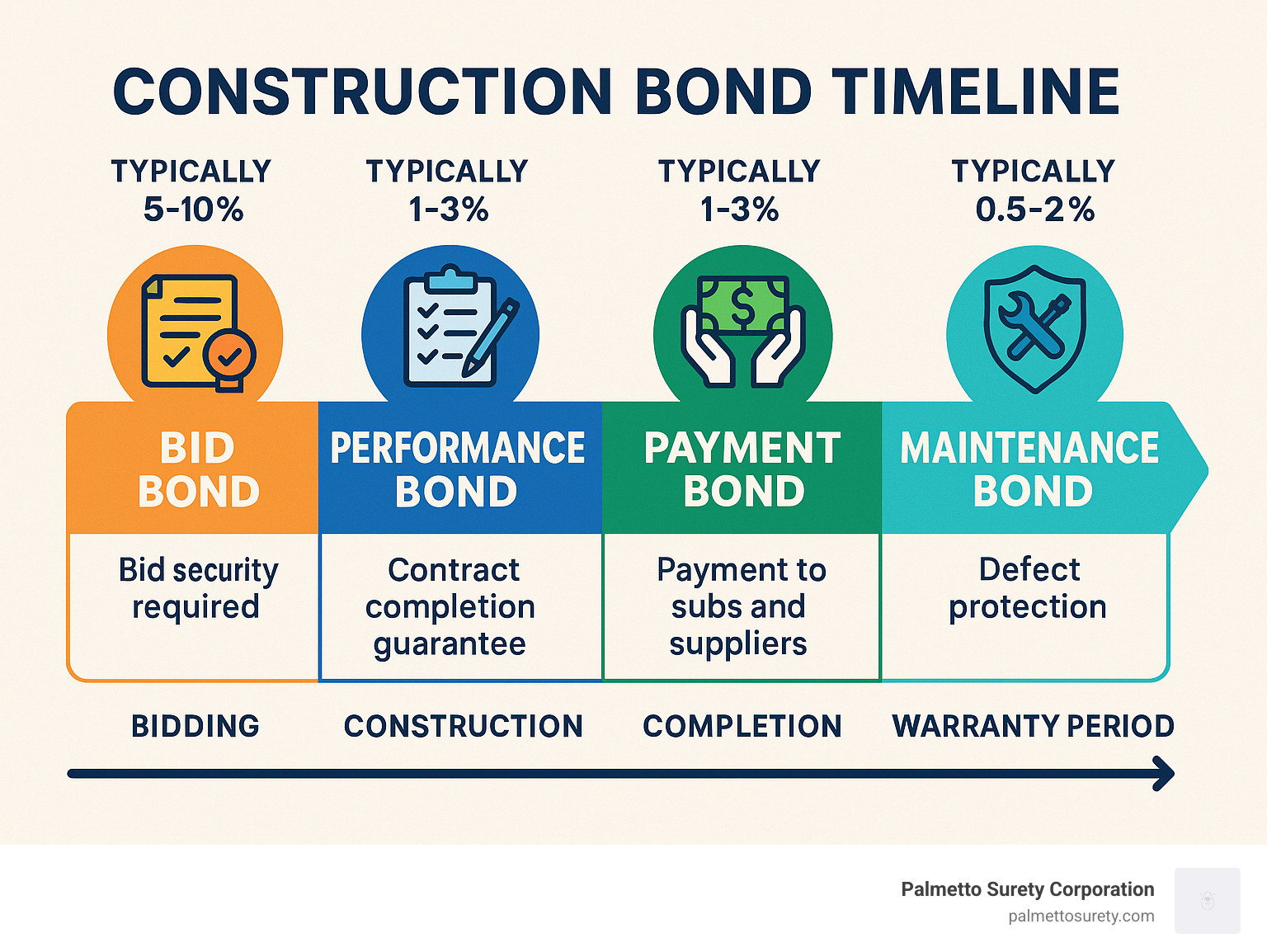
What are the four types of bonds in construction? The four main types of construction bonds are:
- Bid Bonds – Guarantee contractors will honor their bid and enter into the contract if awarded
- Performance Bonds – Ensure the contractor completes the project according to contract specifications
- Payment Bonds – Guarantee payment to subcontractors and suppliers for labor and materials
- Maintenance Bonds – Protect against defective workmanship or materials for a specified period after completion
In the construction world, risk management isn’t optional—it’s as essential as the foundation beneath your feet. What are the four types of bonds in construction isn’t just industry jargon; it’s crucial knowledge for anyone involved in building projects, especially those funded with public dollars.
Think of construction bonds as financial safety nets that protect project owners when contractors can’t fulfill their obligations. They ensure subcontractors receive payment for their work and materials, and ultimately help guide projects to successful completion. Unlike insurance policies that cover accidents or damage, bonds are three-party promises involving the contractor (principal), project owner (obligee), and bond provider (surety).
Each bond type addresses specific risks at different project stages, creating a continuous chain of protection from the initial bid through the warranty period after completion. This systematic approach to risk management helps construction projects move forward with confidence, even in an industry known for its complexities and challenges.
I’m Haiko de Poel Jr, and at Palmetto Surety Corporation, I’ve helped countless contractors steer the sometimes confusing world of what are the four types of bonds in construction. My experience has shown that understanding these bond types isn’t just important for contractors seeking work—it’s equally valuable for owners protecting their investments in construction projects.
Looking for more information about what are the four types of bonds in construction? We’ve got you covered with these helpful resources:
– performance and payment bonds
– how much does a construction performance bond cost
– bonds and insurance in construction
What are the Four Types of Bonds in Construction? (Quick Recap)
Let’s take a moment to understand the key differences between the four types of construction bonds that keep projects running smoothly across America:

| Bond Type | Project Phase | Protects | Typical Premium | Required For |
|---|---|---|---|---|
| Bid Bond | Bidding | Owner from non-serious bidders | 5-10% of bid amount | Federal projects over $100,000 |
| Performance Bond | Construction | Owner from incomplete/substandard work | 1-3% of contract value | Federal projects over $150,000 |
| Payment Bond | Throughout construction | Subcontractors and suppliers | 1-3% of contract value | Federal projects over $150,000 |
| Maintenance Bond | Post-completion | Owner from defects after completion | 1-3% of contract value | Varies by project |
I’ve seen how these bonds create a safety net throughout the construction process. As one surety expert once told me, “No industry involves a greater variety of surety bonds than construction.” Each bond serves as a crucial risk management tool at a specific project phase.
If you’re working on federal projects, you should know that the Miller Act requires performance and payment bonds on all federal construction projects over $150,000. Most states have their own “Little Miller Acts” with similar requirements for state-funded projects, though the dollar thresholds can vary widely depending on where you’re building.
What are the Four Types of Bonds in Construction – Owner Perspective
For project owners (the obligees), construction bonds aren’t just paperwork—they’re peace of mind.
“When I invest millions in a new facility, bonds give me confidence that my project will actually get built,” a hospital administrator once told me. This sentiment echoes across public and private projects nationwide.
From the owner’s perspective, what are the four types of bonds in construction really comes down to protection. Bonds effectively transfer financial risk from the owner to the surety company. They also serve as a quality filter, since contractors must pass rigorous financial screening to obtain bonds in the first place.
Bonds also discourage fraudulent bids and contractor misconduct—nobody wants to risk their bonding capacity with shady behavior. Perhaps most importantly, they ensure projects get completed even if the original contractor fails. I’ve seen situations where a surety had to step in and hire a replacement contractor to finish a critical infrastructure project, saving the owner from disaster.
What are the Four Types of Bonds in Construction – Contractor Perspective
For contractors, bonds represent both opportunity and obligation.
Your bonding capacity essentially functions as your business’s credit limit for public works projects. As one successful contractor put it, “With the right bond terms, you can bid on larger contracts and win more jobs that would otherwise be out of reach.”
From a contractor’s viewpoint, what are the four types of bonds in construction translates to credibility in the marketplace. When you’re bonded, you’re demonstrating financial stability and performance capability that’s been verified by surety underwriters. This gives you a competitive edge, especially for public projects and larger private jobs where bonds are required.
However, obtaining bonds isn’t always simple. You’ll need to maintain strong financial statements (usually CPA-prepared), show relevant experience with successful past projects, and provide personal and corporate indemnity. The premiums you’ll pay depend on your contract value and the surety’s assessment of your risk profile.
For smaller contractors struggling with bonding capacity, there’s good news. The U.S. Small Business Administration offers bond guarantee programs specifically designed to help small and disadvantaged businesses compete for contracts. Additionally, some cities like New York offer up to $500,000 in collateral assistance for surety bond applications—a real game-changer for growing companies.
Want to learn more about navigating the bonding process as a contractor? Check out this comprehensive Contractor’s Guide for additional insights.
Bid Bond

Picture this: a room full of nervous contractors, sealed envelopes in hand, waiting for the moment when bids are opened and read aloud. That’s where our journey through what are the four types of bonds in construction begins—with the bid bond.
A bid bond is your first dance with the surety world. It’s that initial handshake that tells project owners, “Yes, I’m serious about this job.” When you submit a bid with this bond attached, you’re making three promises:
First, your bid isn’t just a wild guess—it’s thoughtful and sincere. Second, if you win, you’ll actually sign the contract at your bid price (no cold feet allowed!). And third, you’ll provide the required performance and payment bonds if selected.
“A bid bond ensures that contractors submit serious bids and allows project developers to recover the difference if the selected contractor declines the job,” as one Orlando construction attorney puts it. It’s like a security deposit on your word.
For federal projects, the rules are clear—if the contract value hits $100,000 or more, a bid bond isn’t optional. Imagine bidding on that $500,000 bridge project without one—you simply wouldn’t be considered.
Most bid bonds require 5-10% of your bid amount. This protects the owner if you win but then decide to ghost them, refuse to sign on the dotted line, or can’t provide the follow-up bonds needed.
Here’s a real-world scenario I’ve seen play out: Contractor A rushes through their estimate, accidentally leaves out an entire division of work, and submits the lowest bid. When they realize their $200,000 mistake after winning, they try to back out. The owner can then claim against the bid bond to cover the difference between their bid and the next lowest bidder.
As a construction law firm clearly states, “A construction bond, also known as a contract or surety bond, guarantees that your contract is completed and lets you recover losses if the other party defaults.”
For smaller contractors in New York City, there’s good news—the city offers up to $500,000 in collateral assistance for surety bond applications. As the city explains, “A surety bond makes sure that a contract is completed” even when things go sideways.
How a Bid Bond Protects Owners
For project owners (especially those managing public funds), bid bonds are like a security blanket. They provide comfort in several important ways:
They act as a serious bidder filter, keeping tire-kickers and dreamers from clogging up the bidding process. When you need to put skin in the game, only legitimate contractors apply.
They prevent bid shopping—that questionable practice where contractors win a bid, then try to back out and renegotiate. With a bid bond in place, this tactic becomes expensive quickly.
If your winning bidder gets cold feet, the bond covers the cost difference to the next bidder, saving owners from budget nightmares.
Perhaps most importantly, bid bonds serve as a preliminary qualification check. If a surety company is willing to issue a bond, they’ve already done some homework on the contractor’s capabilities.
“Bid bonds are required by federal law for all contractors bidding on projects valued at $100,000 or more,” a surety professional once told me. This requirement isn’t arbitrary—it maintains the integrity of how we spend public money.
I remember a school board that was racing against time to build a new elementary school before the next academic year. By requiring bid bonds, they ensured only serious, qualified contractors would submit proposals for their time-sensitive project.
How to Obtain a Bid Bond
Getting your first bid bond might seem intimidating, but the process is straightforward:
Start by finding a surety partner you can build a relationship with. Like a good financial advisor, the right surety agent can guide you through construction’s financial maze.
For smaller bonds (under $750,000), preparation is minimal—typically a simple application based on personal credit. Larger bonds require more homework: financial statements, work history, and references that show you can handle the job.
Don’t forget the Agreement to Bond (sometimes called Consent of Surety). This critical document promises that if you win the bid, performance and payment bonds will follow. Without it, your bid bond may not satisfy requirements.
The cost? Bid bond premiums typically run about 5-10% of the bid amount. However, many sureties will issue bid bonds for free if they’ll be providing your performance and payment bonds later.
“Start early to partner with your surety agent and bond underwriter,” advises a construction bonding specialist I’ve worked with. “An experienced construction bond broker can secure competitive terms and ensure understanding of bond obligations.”
At Palmetto Surety Corporation, we’ve helped countless contractors steer the bid bond process, often approving applications within hours rather than days—because we understand that in construction, timing is everything.
Performance Bond

When the excitement of winning a bid settles, the real work begins – and so does the need for a performance bond. This crucial safeguard steps in during the construction phase, giving project owners peace of mind that their vision will become reality as planned.
A performance bond is essentially a contractor’s promise backed by financial muscle. As a construction attorney I work with often says, “A performance bond secures that a contractor will complete the project according to the contract, allowing a claim to fund a second contractor if needed.” It’s not just paperwork – it’s protection with teeth.
Under the federal Miller Act, performance bonds are mandatory for all federal construction projects exceeding $150,000. Most states have their own “Little Miller Acts” with similar requirements for state and local projects. This isn’t just bureaucratic red tape – it’s a system that’s evolved to protect public investments.
For contractors with solid financials and a strong track record, performance bond premiums typically run between 1-3% of the contract value. While this might feel like an extra expense, it’s actually a one-time investment that covers the entire project lifespan.
I remember working with a small municipal client who experienced the value of these bonds firsthand. They were halfway through constructing a community center when their contractor suddenly faced financial collapse and abandoned the project. Rather than leaving taxpayers holding the bag, the performance bond kicked in. The surety company quickly brought in a replacement contractor who completed the work to specification – crisis averted!
As one industry expert colorfully puts it, “This isn’t an investment bond, but insurance for the client, protecting them against you failing to finish the job.” When a contractor can’t fulfill their obligations, the surety has several options: complete the project with another contractor, pay the owner up to the bond amount, or provide financial support to help the original contractor cross the finish line.
The effectiveness of performance bonds isn’t just anecdotal. Scientific research on performance bonds consistently shows they significantly reduce project abandonment risk while encouraging quality construction practices.
Claim Process if Performance Fails
When things go sideways on a construction project, the performance bond claim process follows a structured path to resolution. It begins with the default notice – a formal document where the owner alerts both the contractor and surety company that performance has fallen short of contractual requirements.
Next comes the investigation phase. The surety doesn’t simply write a check – they thoroughly examine the situation to verify the legitimacy of the default and evaluate the best path forward. This protects all parties from hasty decisions and unnecessary expenses.
Based on their findings, the surety makes a decision and takes action. A bonding expert I consulted describes it this way: “After a default, a surety engages a new contractor to finish work under a performance bond claim. The surety then seeks reimbursement from the original contractor under the indemnity agreement.”
I witnessed this process on a commercial project where the specifications called for 6-inch thick concrete flooring, but core samples revealed only 4 inches had been poured. The performance bond covered the considerable cost of demolition and replacement to meet the required specifications – saving the owner from absorbing a massive unexpected expense.
Boosting Your Performance Bond Capacity
For growing contractors, increasing performance bond capacity opens doors to larger, more lucrative projects. The path to higher bonding limits starts with financial strength. Maintaining robust financial statements (preferably CPA-prepared at the review or audit level) gives sureties confidence in your fiscal stability.
Your track record matters tremendously. Demonstrating successful project management on similar projects shows sureties you can handle the work you’re bidding on. As one surety underwriter told me, “We’re not just bonding the project – we’re bonding the contractor’s ability to manage it successfully.”
Keeping a detailed Work in Progress (WIP) Schedule helps sureties understand your current obligations and capacity for new work. This transparency builds trust and shows you’re organized and responsible.
Strong banking relationships with adequate credit lines provide additional security for sureties. They want to see you have access to operating capital when needed.
For smaller contractors or those facing bonding challenges, the SBA Guarantee Programs can be a game-changer. As one contractor told me, “The SBA program was our bridge to bigger projects – we couldn’t have grown without it.”
A surprising insight from an underwriting expert: “Internal accounting quality can be as important as CPA statements for bonding capacity. Accounting should be viewed as a business tool for profitability and bonding capacity, not just an expense.”
Different bond thresholds trigger different documentation requirements. Bonds under $750K typically need just a 1-2 page application based on personal credit. As you move up to $750K-$2M, owner and company financial statements become necessary. For bonds over $2M, detailed third-party verified financials are the standard.
For contractors looking to expand their bonding capacity, the SBA Surety Bond Homepage offers valuable resources and program information that could make all the difference in your growth journey.
Payment Bond

When you ask contractors what keeps them up at night, many will tell you it’s making sure everyone gets paid. That’s where payment bonds come in – they’re the unsung heroes of construction projects, especially public ones.
A payment bond (sometimes called a labor and material payment bond) works like a financial safety net for subcontractors, suppliers, and workers. It guarantees they’ll receive what they’re owed, even if the general contractor runs into money troubles.
“A payment bond guarantees payment to subcontractors and suppliers if the contractor becomes insolvent,” as one construction law expert puts it. “It’s particularly crucial on public projects where mechanics liens cannot be filed against government property.”
Just like performance bonds, what are the four types of bonds in construction includes payment bonds as a federal requirement for projects exceeding $150,000 under the Miller Act. Each state has its own version (called “Little Miller Acts”) with varying thresholds.
The cost typically runs 1-3% of the contract value – and here’s an important detail: payment bonds almost always come packaged with performance bonds rather than standing alone. They’re like peanut butter and jelly – they just belong together.
I recently spoke with a contractor who experienced this firsthand: “We were working on a state highway project when our main client hit cash flow problems. Three of our suppliers hadn’t been paid in 60 days. Thankfully, they filed claims against the payment bond, got their money, and our materials kept flowing. Without that bond, the whole project might have ground to a halt.”
Making a Payment Bond Claim
If you’re a subcontractor or supplier who hasn’t been paid, the payment bond claim process follows a fairly straightforward path:
Start with a preliminary notice when you begin work – this puts the owner, general contractor, and surety on notice that you’re involved in the project. If payment issues arise, send a notice of intent to warn that you’re preparing to file a claim. Then submit your formal claim to the surety with documentation of what you’re owed.
If things still aren’t resolved, send an intent to proceed with legal action. As a last resort, enforce the claim by filing suit within the statutory deadline.
“I had a subcontractor client who was owed $87,000 for electrical work,” shared a construction attorney I know. “The general contractor kept promising payment ‘next week’ for three months. Once we filed the payment bond claim with proper documentation, the surety investigated and cut a check within 21 days.”
Timing is everything with payment bond claims. On federal projects, you typically must file within 90 days of your last work or material delivery, and any lawsuits must follow within one year. Miss these deadlines, and you might lose your rights entirely.
Want to see exactly how this works? Watch Levelset’s video on bond claims for a practical walkthrough.
Payment Bond vs. Mechanics Lien
When considering what are the four types of bonds in construction, it’s helpful to understand how payment bonds differ from mechanics liens:
Payment bonds are the go-to protection on public projects where government property can’t be liened. The claim is made against the bond itself, not the property. While this doesn’t cloud the property title, it does come with strict notice and claim deadlines.
Mechanics liens, meanwhile, shine on private projects. They create an actual lien on the property title, essentially holding the property hostage until payment is made. Each state has its own mechanics lien laws with varying deadlines.
A contractor I work with explained it perfectly: “On Monday, I’m installing cabinets at a private medical office, so I’d file a mechanics lien if I don’t get paid. On Wednesday, I’m doing the exact same work at a VA hospital, but there I’d need to make a payment bond claim. Same work, different protections.”
Payment bonds serve as a substitute for mechanics lien rights on public projects. They provide similar protection, just through a different legal pathway. For subcontractors and suppliers, understanding this difference can mean the difference between getting paid and writing off a loss.
Many contractors working on public projects for the first time don’t realize they need to send preliminary notices to preserve their bond claim rights. Unlike some mechanics lien processes, these notices aren’t always automatic – you need to be proactive to protect yourself.
Maintenance Bond

Just when you think the bonding process is complete, there’s one final layer of protection that kicks in after the ribbon-cutting ceremony: the maintenance bond. This final member of what are the four types of bonds in construction protects owners during that critical post-completion period when newly installed systems and materials are put to the test.
Think of a maintenance bond as a warranty with financial muscle behind it. While contractors always promise to stand behind their work, this bond puts actual dollars behind that promise for a specified period—typically one to two years after project completion.
“I’ve seen maintenance bonds save countless owners from heartache,” says a Charleston-based construction manager. “That beautiful new civic plaza looks perfect on opening day, but what happens when those pavers start shifting six months later? The maintenance bond ensures someone will be back to fix it.”
These bonds typically cost 1-3% of the contract value and are particularly common on public infrastructure projects. Why? Because taxpayers shouldn’t foot the bill when a newly paved road starts crumbling before its time.
Let me share a real-world example that happened just outside of Charleston. Six months after completing a downtown sidewalk project, several concrete sections began cracking prematurely due to improper concrete mixing. The city filed a claim on the maintenance bond, and the surety company ensured the defective sections were removed and replaced without costing taxpayers an extra dime.
What Maintenance Bonds Cover (and Don’t)
Not everything that goes wrong after completion is covered by a maintenance bond, and understanding these limitations is crucial for both contractors and owners.
Maintenance bonds typically cover defective workmanship that doesn’t meet contract specifications, material failures due to quality issues, and installation errors that lead to failure. If you’re doing design-build work, they may also cover design flaws that cause problems down the road.
However, they don’t cover normal wear and tear—no matter how disappointing it might be when that shiny new floor starts showing scuff marks. They also won’t help with damage from extreme weather events, owner misuse, or routine maintenance items the owner should handle.
“I always tell my clients to think of the maintenance bond as protection against things that shouldn’t happen, not things that naturally will happen,” explains a surety professional from Palmetto Surety. “It’s not an extension of the construction contract—it’s a safety net for genuine defects.”
The bond period is finite—once it expires, so does the protection. That’s why documentation and timely reporting of issues are critical for owners who find potential defects.
Aligning Maintenance Bonds with Warranty Obligations
Smart contractors treat maintenance bonds as business tools, not just paperwork requirements. Aligning your bond with your warranty obligations creates clarity for everyone involved.
When a project reaches substantial completion, obtain formal acceptance certificates from the owner. This documentation establishes the official start date for your warranty period and maintenance bond coverage. Before this happens, address all punch list items thoroughly—unresolved issues can come back to haunt you during the warranty period.
Be crystal clear about warranty terms in your contracts. Does your bond period match your contractual warranty obligations? If your contract promises a two-year warranty but your bond only covers one year, you’re creating a risky gap in protection.
“Documentation is your best friend when it comes to maintenance bonds,” advises a veteran contractor. “Keep detailed records of all warranty work performed, including dates, descriptions, and photos. When your bond period approaches its end, you’ll want evidence that you’ve fulfilled all obligations.”
Some owners request extended maintenance bonds for certain building components—like 20-year roof warranties or 10-year structural guarantees. These extended warranties should be carefully negotiated and priced accordingly, as they represent long-term commitments.
At Palmetto Surety Corporation, we’ve helped countless Southeast contractors steer these warranty period complexities. We understand that a well-structured maintenance bond protects not just the owner, but also your reputation as a quality contractor who stands behind their work.
How These Four Bonds Work Together from Bid to Warranty
Think of construction bonds as a relay team, each passing the baton of protection as your project moves from conception to completion. Rather than working in isolation, these four bond types create a seamless safety net that protects everyone involved throughout the entire project lifecycle.
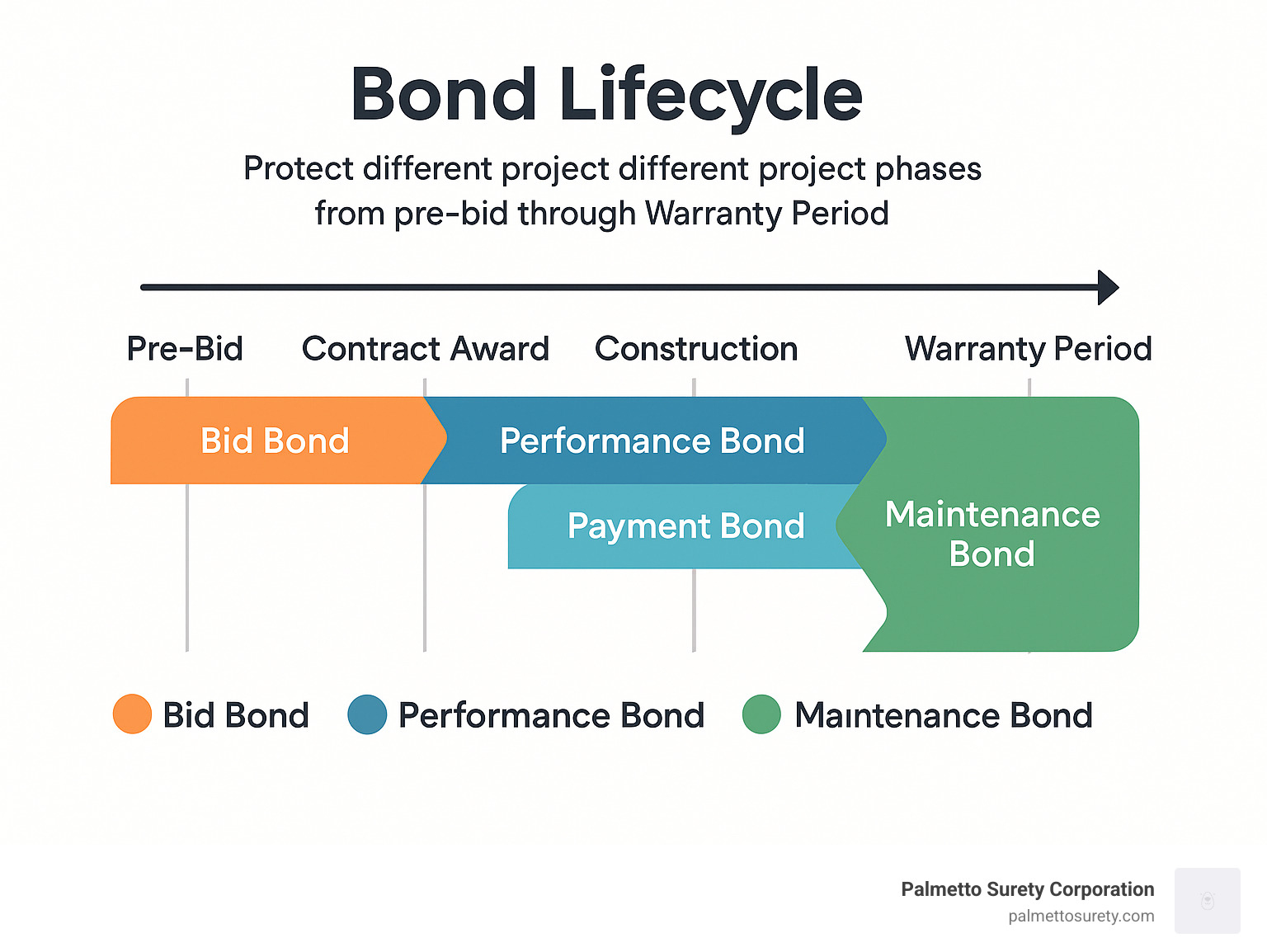
The journey begins with the bid bond, which serves as the gatekeeper to the project. This bond doesn’t just protect owners from contractors who might withdraw their bids—it actually helps create a level playing field where only serious, qualified contractors participate in the bidding process.
“I’ve seen how bid bonds transform the procurement process,” explains Sarah Johnson, a municipal project manager. “Before we required them, we’d waste weeks evaluating bids from contractors who couldn’t actually perform the work. Now, the surety company does that preliminary screening for us.”
When the contract is awarded, a change occurs. The bid bond steps aside as the performance and payment bonds take center stage. These twins are almost always issued together, creating a powerful duo that addresses the two biggest risks during construction: project abandonment and unpaid subcontractors or suppliers.
“My first bonded project felt different from day one,” shares Michael Torres, a general contractor in Charleston. “Everyone—from my subcontractors to the project owner—seemed more confident knowing these bonds were in place. It created an atmosphere of trust that made the whole project run smoother.”
As construction progresses toward completion, the performance bond continues to guarantee that your project will be completed according to specifications. Meanwhile, the payment bond ensures that everyone from the plumber to the lumber supplier gets paid for their contributions. This prevents the nightmare scenario of liens being filed against the property or work grinding to a halt because subcontractors haven’t been paid.
Finally, as the ribbon is cut and the project is officially completed, the maintenance bond steps forward to protect the owner during the warranty period. This final guardian ensures that any defects in workmanship or materials that appear after completion will be properly addressed.
“Each bond type is perfectly aligned to specific risks at different project phases,” explains a veteran surety expert. “It’s a beautifully designed system that has evolved over decades to provide maximum protection with minimal gaps.”
For contractors, your relationship with your surety provider becomes one of your most valuable business partnerships. What are the four types of bonds in construction isn’t just academic knowledge—it’s the foundation of your ability to take on larger, more profitable projects. Many contractors find that their bonding capacity effectively creates a “soft revenue cap” on how much public work they can handle simultaneously.
“Your surety isn’t just a vendor—they’re a partner in your success,” notes Haiko de Poel Jr. of Palmetto Surety Corporation. “As you successfully complete bonded projects, your capacity typically increases, allowing you to bid on larger contracts and grow your business strategically.”
This is why established contractors view their surety relationship as one of their most valuable business assets. A strong track record with your surety provider opens doors to bigger opportunities and can even help you weather occasional financial storms that might otherwise threaten your business.
The four construction bonds work together like a well-orchestrated symphony, each playing its crucial part at precisely the right moment. Understanding how they complement each other helps both owners and contractors steer projects with confidence, knowing that protection extends from the very first bid through the final warranty period.
Frequently Asked Questions about Construction Bonds
What happens if a contractor defaults under any of these bonds?
When a contractor can’t fulfill their obligations, the surety steps in – but how this plays out depends on which bond is in effect.
With a bid bond default, things are pretty straightforward. If you win a bid but then get cold feet or can’t follow through, the surety pays the project owner the difference between your bid and the next lowest bidder. For example, if you bid $500,000 but can’t proceed, and the next bidder offered $525,000, the surety covers that $25,000 difference (up to the bond amount).
Performance bond defaults are more complex. The surety first investigates to confirm the default is legitimate. Then they have options: they might provide financial support to help you finish the job, bring in another contractor to complete the work, or simply pay the owner the bond amount.
“I’ve seen cases where a surety actually helped a struggling contractor through a cash flow crisis rather than declaring default,” explains a construction finance expert. “They’d rather help you succeed than pay a claim.”
For payment bond defaults, subcontractors and suppliers who haven’t been paid can file claims directly with the surety. Valid claims get paid up to the bond amount, ensuring these parties receive what they’re owed even if the general contractor is having financial troubles.
When maintenance bond defaults occur during the warranty period, the surety steps in to cover repair costs if you can’t or won’t fix defective work.
Remember – unlike insurance, these bonds ultimately protect the project owner, not you. And here’s the critical part: you must reimburse the surety for any claims they pay. That indemnity agreement you signed? It means the surety expects to get back every dollar they pay out.
How are construction bonds different from insurance?
People often mix up bonds and insurance, but they’re fundamentally different animals.
Construction bonds involve three parties: you (the principal), the project owner (the obligee), and the surety company. They’re essentially a guarantee that you’ll fulfill your contractual obligations. The surety expects zero losses – they’re backing your promise to perform, not insuring against something going wrong.
Insurance policies, on the other hand, involve just two parties: you and the insurer. They protect you against specific losses or damages, and the insurer fully expects and prices for a certain level of claims.
“Think of it this way,” explains a surety professional from Palmetto Surety, “insurance is like betting something will go wrong, while bonding is promising nothing will go wrong.”
Another key difference: with insurance, once a covered claim is paid, that’s the end of it. With bonds, you must reimburse the surety for any claims they pay. The surety is essentially extending you credit.
The qualification process is also much more rigorous for bonds. Where insurance underwriting focuses on broad risk categories, sureties look deeply at your specific business finances, experience, and character before deciding to back you.
Perhaps most importantly, bonds protect the project owner while insurance protects you, the contractor. It’s a completely different direction of protection.
Are these bonds mandatory on all projects or just public jobs?
Bond requirements vary significantly depending on who’s funding the project.
For federal projects, the rules are crystal clear. The Miller Act requires performance and payment bonds on all contracts exceeding $150,000, and bid bonds on contracts over $100,000. There’s no wiggle room here – if you want federal work, you need bonds.
State and local projects follow similar rules under “Little Miller Acts,” but the thresholds can vary dramatically. In Texas, you need bonds for state projects over $25,000, while in Pennsylvania, the threshold is just $5,000. If you work across state lines, you need to know each state’s requirements.
Private projects are a different story. Bond requirements are completely at the owner’s discretion. They’re much more common on large commercial developments than on residential work, though some high-end custom home builders are now being asked to provide bonds.
“Even when not legally required, bonds often become practically necessary,” notes a construction attorney. “Many lenders won’t finance large projects without seeing that bonds are in place.”
The trend is moving toward more bond requirements, not fewer, especially as project owners become more risk-conscious. For contractors, having bonding capacity isn’t just about meeting requirements – it’s becoming a competitive advantage that opens doors to more opportunities.
Conclusion
Understanding what are the four types of bonds in construction isn’t just academic knowledge – it’s essential business intelligence for anyone in the industry. These bonds work together to create a safety net that protects all parties throughout the project lifecycle.
At Palmetto Surety Corporation, we’ve spent over two decades helping contractors steer the bonding process. Based in Charleston, SC, we specialize in quick approvals – often within hours, not days – and we understand the unique challenges contractors face in the Southeast.
Whether you’re bidding on your first public project or looking to increase your bonding capacity to take on larger jobs, our team can help you secure the bonds you need at competitive rates. We work with contractors of all sizes across various industries, from small specialty contractors to large general contractors handling multi-million dollar projects.
Ready to learn more about how the right bonds can help your construction business grow? Contact Palmetto Surety Corporation today for a consultation about your specific bonding needs.
More info about construction surety solutions
Conclusion
Understanding what are the four types of bonds in construction isn’t just academic—it’s essential knowledge that can make or break your construction business or project. These four bonds—bid, performance, payment, and maintenance—create a safety net that protects everyone involved from the bidding phase through the warranty period.
Here at Palmetto Surety Corporation, we’ve spent over two decades helping contractors across the Southeast steer the sometimes confusing world of construction bonds. Our team deeply understands the regional challenges contractors face in Georgia, Florida, Louisiana, Mississippi, South Carolina, Tennessee, and Texas. We’ve built our reputation on providing bonding solutions that are both reliable and remarkably fast.
What makes us different? While many surety companies keep you waiting for days, we approve most applications within hours. When you’re racing against a bid deadline or trying to lock in a contract, that speed can make all the difference.
I’ve seen how construction bonds can transform from seemingly frustrating requirements into powerful business tools. When properly understood and managed, your bond capacity becomes a credential that demonstrates your company’s financial health and performance track record to potential clients. It’s like having a financial vote of confidence backing every project you take on.
For contractors just starting out with their first public project, the bonding process might seem intimidating. For established companies looking to expand and take on larger contracts, increasing bond capacity becomes a critical growth strategy. Wherever you are in your journey, our experienced team at Palmetto Surety is ready to guide you through each step with the personal attention that national bonding companies simply can’t match.
Construction bonds aren’t just paperwork—they’re the foundation of trust in our industry. They give project owners confidence that their investments are protected, subcontractors assurance they’ll be paid, and provide you with opportunities to bid on projects that might otherwise be out of reach.
Ready to turn construction bonds from a challenge into your competitive advantage? For more information about how Palmetto Surety Corporation can help with your specific bonding needs, visit our construction surety solutions page.


