


Bounty Hunter Career: Top 10 Powerful Success Tips 2025
Why a Bounty Hunter Career Attracts Risk-Takers and Entrepreneurs
A bounty hunter career offers one of the most unique paths in the criminal justice system, combining investigative work, entrepreneurship, and direct community impact. These specialized professionals, also known as bail enforcement agents or fugitive recovery agents, work as independent contractors to locate and apprehend individuals who have skipped bail.
Quick Facts About Bounty Hunter Careers:
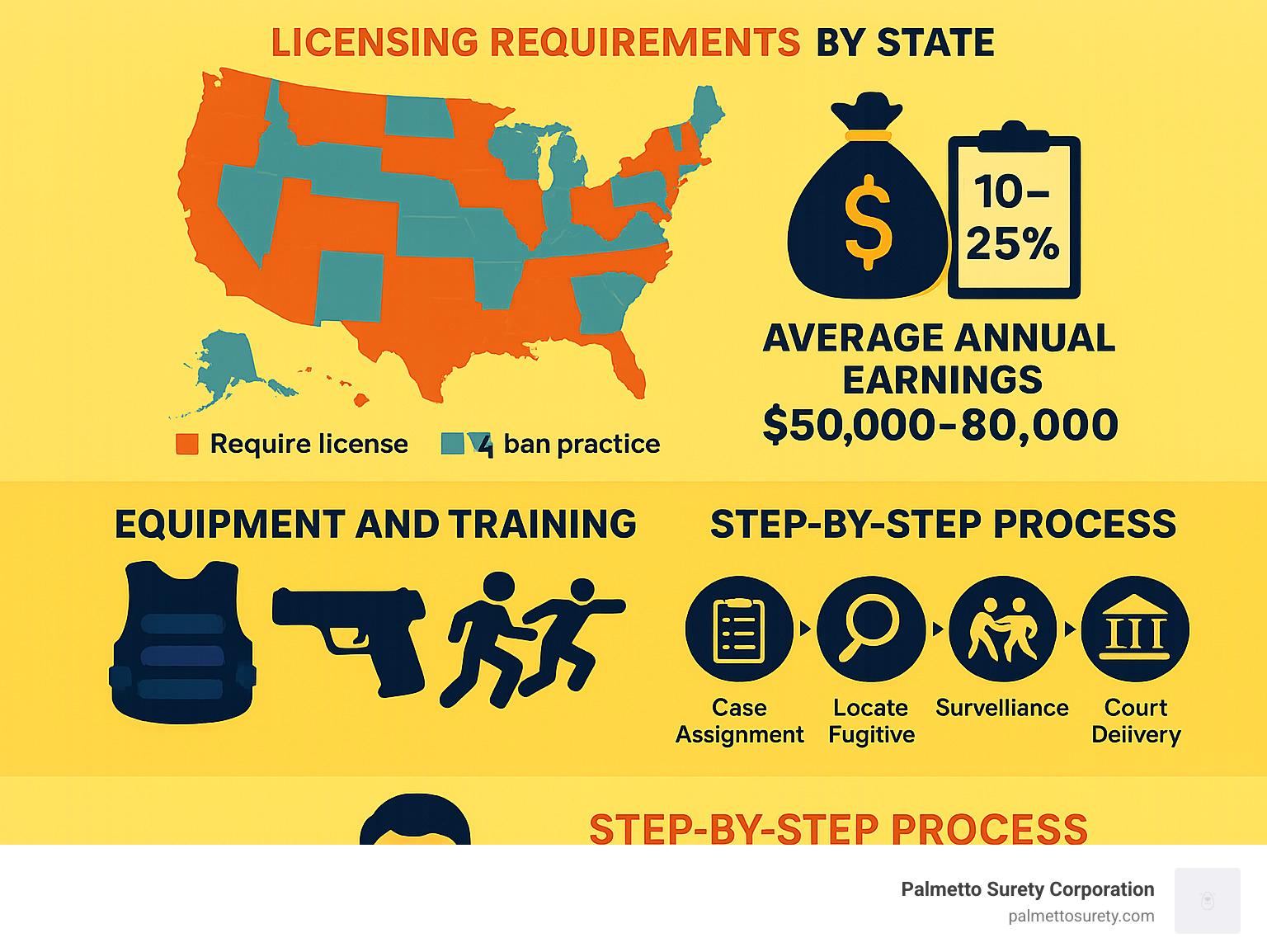
– Earnings: 10-25% commission per fugitive (typically $50,000-$80,000 annually)
– Success Rate: Professional bounty hunters achieve a 97% capture rate
– Requirements: Varies by state – 28 states require licensing, 4 states ban the practice
– Job Growth: 6% projected growth through 2033 (related private investigation field)
– Entry Time: Can start in as little as 1 month in some states
The profession traces back to the 1873 Supreme Court case Taylor v. Taintor, which granted bounty hunters unique legal powers that even exceed those of police officers in certain situations. Unlike law enforcement, bounty hunters can cross state lines, enter private property without warrants, and apprehend fugitives without reading Miranda rights.
With approximately 15,000-20,000 bounty hunters operating across the United States, they recover about 31,500 bail jumpers annually – roughly 90% of all people who skip bail.
As Haiko de Poel Jr., I’ve worked extensively with bail bond companies and surety corporations, helping them steer the complex regulatory landscape that governs the bounty hunter career field. My experience at Palmetto Surety Corporation has given me deep insight into how licensing, bonding, and compliance requirements shape this unique profession.
Similar topics to bounty hunter career:
– are bounty hunters legal
– how much do bounty hunters earn
– bail enforcement agent badge
Bounty Hunting 101: Role, History & Process
Bounty hunting combines old-west tradition with modern criminal justice. The profession got its legal foundation from the 1873 Supreme Court case Taylor v. Taintor, which granted bounty hunters extraordinary powers – more than regular police officers have in many situations.

Here’s how the system works: A defendant needs bail money but can’t afford the full amount. The bail bondsman posts the bond for a fee (usually 10-15% of the total). When the defendant skips court, the bondsman faces losing the entire bail amount unless they can bring the fugitive back.
The bounty hunter career revolves around this high-stakes recovery game. Professional fugitive recovery agents earn 10-25% of the total bail amount for each successful capture. With bail amounts often reaching tens of thousands of dollars, a single case can pay quite well.
Bounty hunters achieve an impressive 90% capture rate compared to much lower recovery rates from traditional law enforcement. Their effectiveness comes from specialized focus, financial motivation, and unique legal authorities that allow them to cross state lines, enter certain private properties, and pursue fugitives with single-minded determination.

How Bounty Hunting Fits Into the Criminal Justice & Bail Bond System
The bail bond system is like a three-legged stool, and bounty hunters are the safety net that keeps it stable. The court wants assurance defendants will show up for trial. The defendant wants to stay out of jail while awaiting court. The bail bondsman bridges this gap by posting the required money, but they’re taking serious financial risk.
At Palmetto Surety Corporation, we’ve watched this system operate across the southeastern United States for over 20 years. We back bail bondsmen with surety bonds, creating a network of financial responsibility that serves both courts and public safety.
Bounty hunters serve as risk mitigation specialists for bail bondsmen. Without effective fugitive recovery, the entire bail bond industry would collapse under forfeited bonds. The financial incentives align perfectly with public safety goals.
Typical Day in the Field
Most days don’t involve dramatic car chases. They start with coffee, paperwork, and detective work. A typical morning begins with reviewing case files and researching fugitive backgrounds through skip tracing – finding people who’ve vanished.
Professional bounty hunters spend hours on surveillance, often parked outside mundane locations. The interview process requires serious people skills when talking to family members and associates. When it comes time for apprehension, experienced professionals prefer conversation over confrontation.
After capture comes transport to jail or courthouse, followed by paperwork and court hand-off. Successful bounty hunters are part private investigator, part negotiator, and part small business owner.
Step-by-Step Roadmap to Launch Your Bounty Hunter Career
Breaking into a bounty hunter career requires systematic planning. The journey typically takes one month to a year, depending on your state’s requirements and how quickly you complete necessary steps.
Your first step is research. Every state handles bounty hunting differently – some welcome you with minimal requirements, others require extensive licensing, and four states ban the practice entirely. You’ll focus on three main areas: meeting eligibility requirements, getting proper training, and building relationships with bail bondsmen.

Minimum Eligibility Checklist for a Bounty Hunter Career
Age requirements are usually 18-21, depending on state and firearm regulations. Criminal background matters significantly – any felony convictions typically disqualify you completely. Even some misdemeanors involving violence or dishonesty can end your career before it starts.
Citizenship and residency requirements are standard. You’ll need to be a U.S. citizen or legal resident. A valid driver’s license with clean record is non-negotiable since you’ll be driving extensively for surveillance and transport.
Physical fitness isn’t always formally tested, but you should handle basic physical demands of restraining and transporting unwilling individuals. Some states require mental health clearances to ensure you can handle stress and make good decisions under pressure.
Education & Training Pathways
A high school diploma or GED is the bare minimum. Criminal justice education isn’t required everywhere but provides huge advantages. Southern New Hampshire University criminal-justice programs offer excellent online options.
Specialized bounty hunter training covers legal authorities and limitations, arrest and control techniques, defensive tactics, firearms safety, skip tracing methods, and report writing. Training investment typically pays for itself quickly through higher success rates and fewer legal problems.
Building Your Network & Finding First Cases
Success depends more on relationships than physical abilities. Building relationships with bail bondsmen requires patience and professionalism. Many successful bounty hunters offer first few cases at reduced rates to prove reliability.
Professional associations like NAFRA and PBUS provide networking opportunities and credibility. Finding a mentor can accelerate your career tremendously through knowledge sharing and partnership opportunities.
At Palmetto Surety Corporation, our agent services help connect qualified professionals in the bail bond industry, including bounty hunters who meet our standards.
Setting Up Your Fugitive Recovery Business
Most bounty hunters work as independent contractors, meaning you’re running a small business. Forming an LLC separates personal assets from business liabilities. Insurance coverage including professional liability and general liability is essential.
Surety bonds are required in several states as financial guarantees. At Palmetto Surety Corporation, we help bounty hunters obtain necessary bonds to operate legally. Marketing and branding matter – invest in professional business cards, basic website, and clean social media presence.
Legal Landscape & State-by-State Licensing Requirements
Understanding bounty hunting laws is crucial since they change dramatically across state lines. 22 states require licensing or registration, while four states (Oregon, Kentucky, Wisconsin, Illinois) have completely banned the profession.
Remaining states allow bounty hunting with minimal regulation, but you still must follow federal laws and property rights. States with licensing requirements take this seriously – Connecticut demands 28 hours of training, Nevada requires 80 hours.
| State | License Required | Training Hours | Background Check | Firearms Permit | Notification Rules |
|---|---|---|---|---|---|
| California | Yes | 40 hours | Yes | Separate permit | Local police notification |
| Florida | Yes | 40 hours | Yes | Concealed carry | Court notification |
| Texas | Yes | 20 hours | Yes | LTC required | Local sheriff notification |
| North Carolina | Yes | 20 hours | Yes | Separate permit | Sheriff notification |
| Connecticut | Yes | 20 hours + 8 firearms | Yes | Pistol permit | State police notification |
How to Obtain Your State License or Registration
The application process starts with detailed paperwork asking about personal history, employment, and references. Background investigations are thorough, including fingerprinting and criminal history checks that can take weeks or months.
Training requirements cover legal authorities, arrest procedures, use of force, and professional ethics. Examinations test knowledge of relevant laws and procedures. Fees and renewals range from under $100 to several hundred dollars, with periodic renewal requirements.
Crossing State Lines & Federal Considerations
Bounty hunters can chase fugitives across state lines thanks to the original bail contract and Taylor v. Taintor. However, you must follow laws of every state you enter. Interstate operations require careful planning and research of notification requirements.
Federal considerations include compliance with firearms laws, civil rights statutes, and other regulations. Professional bounty hunters build relationships with law enforcement in jurisdictions where they frequently work.
Ethical & Legal Boundaries for a Bounty Hunter Career
Constitutional protections still apply. You can’t use excessive force or violate fundamental rights without facing serious consequences. Use of force must be proportional to resistance encountered. Property rights require understanding when you can enter premises legally.
Professional conduct standards apply to all licensed bounty hunters. The best protection is thorough training, professional liability insurance, detailed documentation, and conservative interpretation of legal authorities.
Must-Have Skills, Gear & Safety Protocols
Success in a bounty hunter career depends on detective work, people skills, and business savvy more than physical toughness. Investigation skills form the backbone – you’ll spend most time “skip tracing” to find people who don’t want to be found.
Communication and negotiation abilities often matter more than physical strength. Most apprehensions happen through conversation, not confrontation. Physical fitness and self-defense training remain important for long surveillance hours and potentially dangerous encounters.
Technology skills are essential for modern fugitive recovery using databases, social media research, and digital surveillance tools. Business management capabilities matter since most bounty hunters work independently.

Tech & Tools That Give You an Edge
Skip tracing databases compile public records, credit reports, and employment history into searchable formats. Professional systems cost several hundred monthly but pay for themselves by reducing location time.
Open Source Intelligence (OSINT) techniques turn social media into powerful investigative tools. GPS tracking devices and night vision equipment enable safer surveillance operations. Communication systems keep team members connected during operations.
Mobile technology puts powerful tools in your pocket through specialized apps for case management, mapping, and report writing. Technology improves human judgment rather than replacing it.
Personal Safety & Risk Mitigation
Team operations provide the best protection. Working with partners means backup if things go wrong, witnesses for legal protection, and additional perspectives when planning approaches.
Situational awareness and de-escalation training can literally save your life. Protective equipment including body armor and less-lethal weapons provides extra safety margins. Professional insurance protects your financial future through liability and errors coverage.
Legal compliance reduces exposure to lawsuits and criminal charges. When unsure about authority, be conservative and seek advice rather than risk crossing legal boundaries.
Earnings, Risks & Long-Term Outlook
The financial reality of a bounty hunter career is both promising and challenging. Most bounty hunters work on commission of 10-25% of total bail amounts. Successfully apprehending someone who skipped on a $50,000 bond could earn $5,000 to $12,500.
The Bureau of Labor Statistics reports a median annual salary of $52,540 for related professions. However, successful bounty hunters in high-activity areas often earn $80,000 to $120,000 annually. The profession shows projected growth of 6% through 2032.

Calculating Your Potential Income in a Bounty Hunter Career
Commission rates typically start at 10-15% when new, increasing to 20-25% as you prove reliability. Case volume makes huge differences – new bounty hunters might handle 20-30 cases annually while experienced professionals manage 50-100 cases.
Regional factors and efficiency directly impact earnings. You’re running a business with significant expenses consuming 25-40% of gross income. Most new bounty hunters earn $30,000-$50,000 in their first year, while experienced professionals earn $60,000-$100,000 or more.
Career Progression & Related Paths
Private investigation represents natural progression using similar skip tracing and surveillance skills. Process serving offers lower-risk income supplementation. The jump to bail bondsman appeals to experienced bounty hunters who understand both sides of the business.
Security consulting leverages expertise in risk assessment. Some eventually move into traditional law enforcement. Successful career progression requires continuously building skills and maintaining professional relationships.
Common Risks & How Pros Reduce Liability
Physical danger tops risk concerns. Professional bounty hunters reduce this through team operations, proper surveillance, and preferring negotiation over confrontation. Legal liability from mistakes can destroy careers – protection includes comprehensive insurance and strict legal compliance.
Mistaken identity, property damage, reputation damage, and business risks all require systematic management. Professionals who thrive approach risk management systematically through proper training, insurance coverage, conservative procedures, and careful case selection.
Frequently Asked Questions about Bounty Hunting
Is bounty hunting legal everywhere?
No – four states have completely banned bounty hunting: Oregon, Kentucky, Wisconsin, and Illinois. Several other states like Maine and Nebraska have essentially eliminated it by removing commercial bail bonds.
Twenty-two states require licensing or regulation, while others allow the practice with minimal oversight. Bounty hunting is almost exclusively American – it’s illegal in virtually every other country worldwide.
How long does it take to start a bounty hunter career?
In states with minimal regulation, someone could theoretically start within days. In licensing states, expect 1-6 months depending on training requirements and background check processing.
For real success, most professionals recommend 6-12 months for proper preparation including training, relationship building, equipment acquisition, and business setup. Those who rush often struggle or fail.
What weapons can bounty hunters carry?
Bounty hunters have no special weapon privileges – they follow the same federal, state, and local gun laws as other civilians. For firearms, they need the same permits required for concealed carry.
Less-lethal weapons like Tasers and pepper spray are generally more accessible but still subject to local regulations. Restraint devices like handcuffs are typically unrestricted.
Many successful bounty hunters rarely use weapons because they’ve developed excellent peaceful apprehension techniques. Their real tools are communication skills and ability to build trust.
Conclusion
A bounty hunter career represents one of America’s most distinctive law enforcement paths, blending tradition with modern investigative techniques. While television glamorizes dramatic chases, successful bounty hunters are part detective, part negotiator, and part business owner.
Financial rewards can be substantial with commissions of 10-25% and experienced professionals earning $60,000-$100,000 annually. The 90% success rate comes from methodical investigation work, not Hollywood heroics.
The legal landscape continues shifting as 22 states now require licensing while four have banned bounty hunting entirely. This trend toward regulation means professional training and ethical conduct are becoming legal requirements.
For serious candidates, preparation is everything. Research your state’s requirements thoroughly, invest in proper training beyond minimums, build genuine relationships with bail bondsmen, and treat this as a legitimate business with proper insurance and legal structure.
At Palmetto Surety Corporation, we’ve supported bail bond professionals across the Southeast for over two decades. Through our commercial surety bonds, we’ve seen how the industry rewards professionalism and punishes shortcuts.
The bounty hunter career is evolving with technology, stricter legal requirements, and higher public expectations. Those who thrive will accept these changes rather than resist them.
This career demands patience of an investigator, people skills of a counselor, business sense of an entrepreneur, and physical capability for dangerous situations. For individuals with proper preparation and commitment to professional excellence, bounty hunting offers the rare opportunity to build a meaningful career that serves justice while maintaining self-employment independence.
The path forward is clear: get properly trained, build professional relationships, operate with integrity, and never stop learning. The bail bond industry needs skilled professionals who understand that successful fugitive recovery serves justice, protects public safety, and keeps the entire system functioning effectively.


