


are bounty hunters legal? 7 Powerful Facts for 2025 Success
The Reality Behind Bounty Hunters’ Legal Status
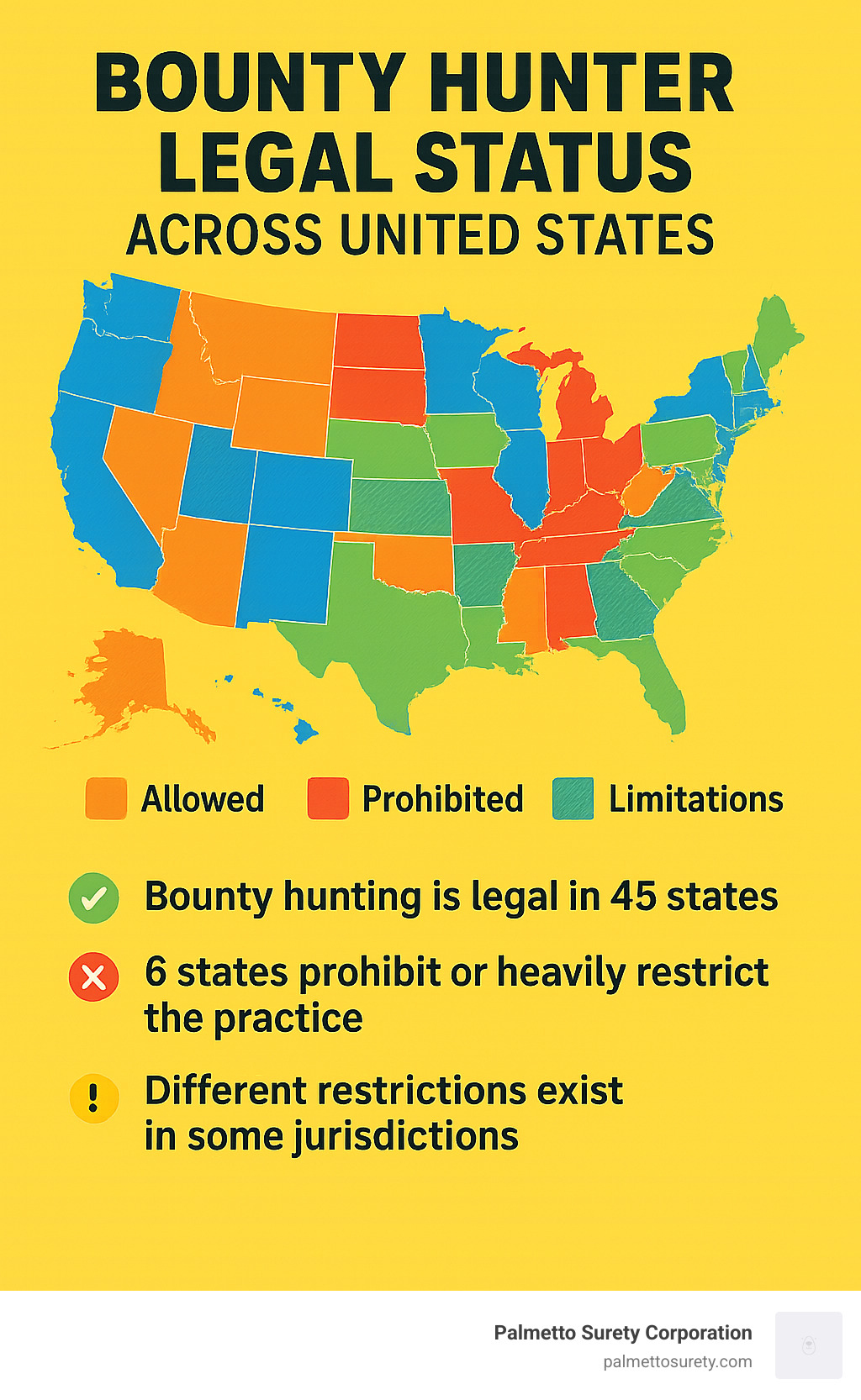
Are bounty hunters legal? Yes, bounty hunters are legal in most of the United States (45 states), though they are banned or heavily restricted in 6 states including Illinois, Kentucky, Oregon, Wisconsin, North Carolina, and Texas. Their legal authority stems from the 1873 Supreme Court case Taylor v. Taintor.
| Quick Facts: Bounty Hunter Legality |
|---|
| ✅ Legal in 45 U.S. states |
| ❌ Banned/heavily restricted in 6 states |
| 📋 22 states require specific licensing |
| 💰 Typically earn 10-20% of bail amount |
| 🏆 Recover approximately 90% of bail jumpers |
When someone skips bail, bounty hunters enter the picture. These professionals, also known as bail enforcement agents or fugitive recovery agents, operate in a unique legal space between private citizens and law enforcement.
Their job is straightforward: locate and apprehend people who have failed to appear in court after being released on bail. What makes their role controversial is the significant power they wield despite not being government officials.
Unlike police officers, bounty hunters derive their authority from civil contracts rather than constitutional power. This distinction gives them certain freedoms that even police don’t have – like crossing state lines without extradition procedures or entering a fugitive’s home without a warrant in many states.
Most bounty hunters work on commission, typically earning 10-20% of the total bail amount. For a $10,000 bail bond, that means a $1,000-$2,000 payday per capture. Experienced agents handle between 80-150 cases annually, with potential earnings ranging from $50,000 to $80,000.
The profession exists primarily in the United States and the Philippines – virtually every other country has outlawed the practice.
I’m Haiko de Poel Jr, and as the head of Mass Impact working with Palmetto Surety Corporation, I’ve gained extensive knowledge about whether bounty hunters are legal through my work with one of America’s fastest-growing surety bond companies that regularly interacts with bail enforcement professionals.

Bounty Hunters 101: Role and Relationship to Bail Bonds
If you’ve ever wondered what happens when someone skips bail, you’re about to find out. Bounty hunters are the unsung heroes of America’s bail system – the folks who step in when defendants decide court dates are optional.
When defendants can’t afford their full bail amount (which is often), they typically turn to bail bondsmen. For a non-refundable fee – usually 10% of the total bail – these bondsmen post the full amount to the court. It’s a financial promise that the defendant will show up when they’re supposed to.
“When you purchase a bond from a bail bondsman, the bondsman becomes liable for the full amount if a defendant skips out,” as one veteran bail enforcement agent with over 20 years of experience told me. “The bondsman stands to lose a lot of money if they can’t get that person back to court.”
This is where bounty hunters earn their keep. They’re essentially the insurance policy that keeps the bail bond industry afloat. The numbers speak for themselves – bounty hunters recover about 31,500 bail jumpers annually, capturing roughly 90% of people who jump bail. With a track record like that, it’s no wonder bail bond companies rely so heavily on their services.
Key Differences Between Bounty Hunters and Bail Bond Agents
Though they work hand-in-hand, bounty hunters and bail bond agents are definitely not the same thing:
| Bail Bond Agents | Bounty Hunters |
|---|---|
| Post bail for defendants | Locate and apprehend fugitives |
| Typically licensed in all states | Licensing varies by state |
| Cannot use force or carry weapons in most states | Can use reasonable force and may carry weapons (state-dependent) |
| Bear financial liability if defendant skips | Work on commission with no direct financial liability |
| Prohibited from entering homes without consent | Can enter fugitive’s residence without a warrant in many states |
As one bail enforcement professional colorfully put it: “Bail bondsmen handle the paperwork and financial side. We handle the tracking and recovery when things go south.”
How Bounty Hunters Get Paid
Here’s where it gets interesting – bounty hunters only get paid when they succeed. They work on contingency, earning typically 10-20% of the total bail amount when they bring someone in.
Let’s break that down with some real numbers:
– A $5,000 bail means a $500-$1,000 payday
– A $25,000 bail jumps that to $2,500-$5,000
– And a $100,000 bail? That’s a whopping $10,000-$20,000 for a single recovery
Most experienced bounty hunters handle between 80 and 150 cases yearly, with annual earnings typically falling between $50,000 and $80,000. But those numbers can swing wildly depending on several factors: the size of the bonds they recover, their success rate, how many cases they take on, their reputation in the industry, and where they operate.
It’s worth noting that this isn’t all profit. Bounty hunters cover their own expenses – everything from gas and travel costs to surveillance equipment and even weapons training in states where it’s permitted. They’re essentially small business owners who only get paid when they deliver results.
The financial arrangement creates a powerful incentive system that helps keep the American bail system functioning – and explains why bounty hunters are legal in most states despite the controversial powers they’re granted.
Are Bounty Hunters Legal in the United States?
The short answer is yes—bounty hunters are legal in most of the United States, but the rules vary dramatically depending on where you are.
Think of America’s bounty hunting laws as a patchwork quilt—each state has sewn its own unique piece into the legal fabric. Some states accept bounty hunters with open arms, while others have slammed the door shut on the entire profession.

Historical Roots: Are Bounty Hunters Legal Since 1873?
The bounty hunting profession isn’t just something that popped up on reality TV—it has deep historical roots in American law. The cornerstone of bounty hunters’ legal authority is a nearly 150-year-old Supreme Court case: Taylor v. Taintor (1873).
In this landmark decision, the Court essentially said that when you sign a bail bond agreement, you’re handing a special kind of power to your bail bondsman. The ruling stated that bail sureties have custody over defendants, allowing them (or their agents—bounty hunters) to “seize and deliver” fugitives who skip court.
As the Court colorfully put it: “When bail is given, the principal is regarded as delivered to the custody of his sureties. Their dominion is a continuance of the original imprisonment.”
In plain English? When you sign that bail paperwork, you’re agreeing that if you run, someone can come find you—and they don’t need a warrant to do it.
Interestingly, legal scholars often point out that this powerful statement was technically “obiter dictum”—a fancy way of saying it wasn’t essential to the court’s main decision. Yet this side comment has shaped the bounty hunting profession for generations.
State-by-State Reality: Are Bounty Hunters Legal Everywhere?
Despite that powerful Supreme Court precedent, states have taken dramatically different approaches to bounty hunting. Let’s break it down:

If you’re in Illinois, Kentucky, Oregon, Wisconsin, North Carolina, or Texas, bounty hunters either don’t exist or operate under severe restrictions. Texas, for instance, requires bounty hunters to also be peace officers, licensed PIs, or commissioned security officers—effectively limiting who can enter the profession.
Some states have taken a different approach by banning commercial bail bonds entirely—Maine and Nebraska fall into this category. No bail bonds means no bounty hunters.
On the other end of the spectrum, states like California, Connecticut, Nevada, and Arizona allow bounty hunting but with substantial oversight. California requires a bail agent license, while Nevada demands 80 hours of formal training.
Many other states take a more relaxed approach with minimal regulations—often just requiring bounty hunters to be adults without felony convictions. In these states, the barriers to entry can be surprisingly low for a profession with such significant powers.
Arguments For and Against Their Legality
The debate around whether bounty hunters should be legal isn’t just academic—it touches on fundamental questions about liberty, justice, and public safety.
Those who support bounty hunters point to impressive statistics: they recover about 90% of bail jumpers, a success rate that far outpaces law enforcement. They also save taxpayer dollars, as bounty hunters work on commission rather than drawing from public funds. By helping make bail bonds viable, they indirectly reduce jail overcrowding by allowing more defendants to await trial outside of custody.
As one veteran bondsman told me, “Without us, the courts would grind to a halt. We’re the oil in the justice system’s engine.”
Critics raise equally compelling concerns. Many bounty hunters operate with minimal training yet wield significant powers—including the ability to enter homes without warrants in many states. The profit motive can lead to dangerous corner-cutting or overly aggressive tactics. Civil liberties advocates worry about the potential for abuse when private citizens have arrest powers that sometimes exceed those of police.
A notable study published in the New York Times highlighted these concerns, quoting a legal scholar who argued: “Abolition of bounty hunters is a just, viable, and durable policy. Four states have eliminated bounty hunters and sustained their criminal justice systems.”
The debate continues, but for now, bounty hunters remain legal across most of America—operating in that fascinating gray area between public law enforcement and private enterprise.
Powers & Limitations: What the Law Allows
Bounty hunters walk a unique legal tightrope in America. They wield powers that sometimes exceed those of police officers, yet they operate without the same oversight. Let’s pull back the curtain on what these bail recovery agents can—and cannot—legally do.
Entry Without a Warrant—How Far Can They Go?
One of the most eyebrow-raising aspects of bounty hunting is their ability to enter property without those pesky warrants police officers need. But there are important boundaries:
When entering a fugitive’s own home, bounty hunters in most states can legally walk right in without a warrant if they reasonably believe their target is inside. This unusual power comes from the bail contract the defendant signed—essentially agreeing to these terms when they accepted the bond.
“The contract basically extends the original custody,” explains a veteran bounty hunter with 15 years of experience. “We’re just continuing what the court started.”
Third-party homes are a different story entirely. Most states draw a firm line here—bounty hunters cannot legally enter someone else’s residence without permission, even if they’re certain their fugitive is hiding inside.
Texas makes this crystal clear in its statutes: “A private investigator executing a capias or arrest warrant may not enter a residence without the consent of the occupants.”
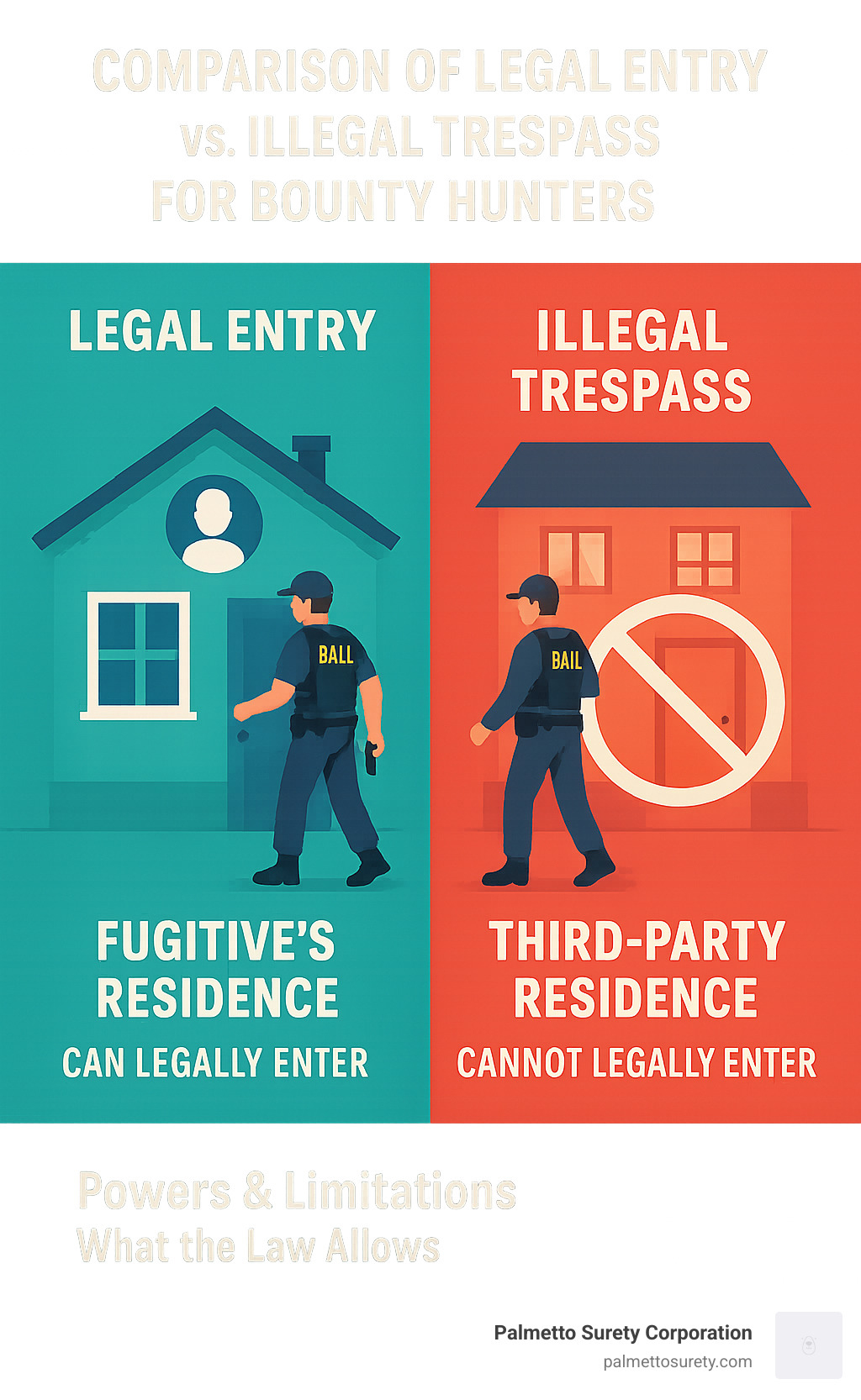
Many states have created a patchwork of rules governing exactly how entry must happen:
Some require a courtesy call to local police before making an arrest. Others insist bounty hunters clearly identify themselves—no sneaking around pretending to be pizza delivery folks. Several states prohibit middle-of-the-night entries, and most draw the line at breaking down doors or windows.
Use of Force and Firearms
When it comes to physical force, the rules get even murkier—and more dangerous.
Most states permit “reasonable force” to apprehend someone who’s jumped bail. The problem? What’s “reasonable” often remains frustratingly undefined until someone ends up in court arguing about it.
Deadly force is typically off-limits. Texas, for example, explicitly prohibits it. As one bail enforcement trainer puts it, “Your job is to bring them back alive to face justice, not deliver justice yourself.”
Firearms regulations vary dramatically from state to state:
Pennsylvania requires bounty hunters to complete certified firearms training through the Pennsylvania State Police—a process involving application, fingerprinting, physical and psychological exams, and about $102.60 in fees.
Meanwhile, other states have no special requirements beyond standard gun laws that apply to any citizen.
Perhaps the most crucial difference between bounty hunters and police: bounty hunters have no qualified immunity. This legal protection shields police officers from personal liability in many situations, but bounty hunters enjoy no such cover. If they cross the line into excessive force or rights violations, they can be personally sued for damages.
“We have more power in some ways,” notes one experienced bail recovery agent, “but way more personal risk if we mess up. One mistake could cost everything.”
For defendants and their families seeking guidance on bail bonds in the Southeast, Palmetto Surety Corporation has been navigating these complex legal waters for over 20 years, helping ensure that both bail agents and defendants understand their rights and responsibilities.
Becoming a Bounty Hunter: Requirements, Training, Licensing
So you’re interested in becoming a bounty hunter? It’s certainly not your average 9-to-5 job! Before you start tracking down fugitives, though, you should know that the path to this career varies dramatically depending on where you plan to work.
Basic Requirements in Most States
Most states have some baseline requirements to enter this profession. You’ll typically need to be at least 18 or 21 years old, depending on the state. Having a clean criminal record is essential—most states won’t allow anyone with felony convictions to become a bounty hunter. A high school diploma or GED is usually the minimum education required, and you’ll generally need to be a U.S. citizen and resident of the state where you plan to work.
Think of these as your entry-level qualifications—the bare minimum to get your foot in the door.
Training and Education
The training landscape for bounty hunters is as varied as the profession itself. Some states have surprisingly few requirements, while others demand significant training before you can make your first capture.
In states with minimal oversight, you might not need any formal training at all (though we’d strongly advise getting some anyway). Other states take a middle ground—Connecticut, for example, requires 20 hours of criminal justice training plus 8 hours of firearms training. Then there are states like Nevada, which demands a whopping 80 hours of training or Peace Officer Standards and Training certification.

While not always mandatory, degrees in criminal justice or law enforcement can give you a serious edge in this competitive field. At Palmetto Surety Corporation, we’ve noticed that even in states with no formal training requirements, the most successful bounty hunters invest in some form of education or mentorship. Learning how to safely track and apprehend fugitives isn’t something you want to figure out through trial and error!
Licensing Paths and Important Exams
The licensing journey for bounty hunters typically follows one of several paths:
Some states offer specific bail enforcement agent licenses designed just for bounty hunters. Others require you to be a licensed bail bondsman before you can perform recoveries. States like Texas take a different approach, requiring bounty hunters to hold private investigator licenses. Some jurisdictions demand security officer commission status, while a surprising number of states have no specific license requirement at all.
Regardless of the specific license, the process usually involves application fees ranging from $100-$500, comprehensive background checks, fingerprinting, proof of completed training, passing a state exam, and securing liability insurance or surety bonds. In Florida, for instance, bounty hunters must become licensed as “limited surety agents” and complete specific coursework before taking an exam.
Crossing State Lines or International Borders
One of the most unique aspects of bounty hunting in America is the ability to cross state lines when pursuing fugitives. The Uniform Criminal Extradition Act (adopted everywhere except Missouri and South Carolina) governs this process.
This interstate authority comes with significant responsibilities, though. When entering another state, you must:
– Comply with that state’s bounty hunting laws (which might be stricter than your home state)
– Notify local law enforcement before making an arrest
– Properly transport the fugitive back to the original jurisdiction
As for international bounty hunting? In a word: don’t. American bounty hunters have zero legal authority outside the United States. Attempting to apprehend someone in another country can land you in serious legal trouble—like kidnapping charges.
Just ask Duane “Dog” Chapman, who learned this lesson the hard way in 2003. After capturing fugitive Andrew Luster in Mexico, Chapman himself was arrested by Mexican authorities and charged with kidnapping. His case serves as a stark reminder that bounty hunting authority stops at the U.S. border.
If you’re considering this career path and have questions about the surety bonds often required for licensing, our team at Palmetto Surety Corporation is always happy to provide guidance based on our 20+ years in the industry.
Risks, Rights, and Controversies
Let’s be honest – bounty hunting isn’t all dramatic captures and high-stakes chases like you see on TV. It’s a profession filled with real dangers, legal complexities, and ongoing public debate.
Risks for Bounty Hunters
Being a bounty hunter isn’t for the faint of heart. These professionals routinely face dangerous situations that would make most of us think twice:
“I’ve had doors slammed in my face, been threatened with weapons, and even had a dog sicced on me once,” shares a veteran bounty hunter with 15 years of experience. “The job comes with risks you have to accept.”
Beyond physical dangers, bounty hunters face significant legal exposures. Unlike police officers, they don’t enjoy qualified immunity – meaning they can be personally sued if something goes wrong during an apprehension. This is why liability insurance is so crucial in this field. At Palmetto Surety Corporation, we’ve observed that professional bounty hunters typically carry at least $1 million in liability coverage, sometimes even more in states where it’s mandated.
The risk of mistaken identity cases is particularly troubling. Imagine the legal nightmare that unfolds when the wrong person is detained – something that happens more often than the industry would like to admit.
Rights of Defendants and Third Parties
If someone shows up at your door claiming to be a bounty hunter, you’re not without rights. Here’s what you should know:
First, you have the right to verification. Ask to see credentials and documentation proving they’re authorized to make an arrest. Legitimate bounty hunters will have paperwork showing which bail bond company they represent and information about the person they’re seeking.
Second, if you’re not the fugitive, you have the right to refuse entry to your home in most states. While bounty hunters can enter a fugitive’s residence without a warrant in many jurisdictions, they generally cannot legally enter a third party’s home without permission.
You also have the right to contact law enforcement if you believe a bounty hunter is acting illegally or inappropriately. And if your rights are violated, you maintain the right to sue for damages – something that has happened numerous times throughout the industry’s history.
“Always ask for identification,” advises a former bail enforcement agent. “Legitimate bounty hunters won’t be offended by this request – they’ll expect it.”
Notable Controversies and Cases
The bounty hunting profession has seen its share of headline-making controversies that raise important questions about whether bounty hunters are legal in their current form.
The Sidney Jaffe case stands as perhaps the most notorious. In 1981, bounty hunters Timm Johnsen and Daniel Kear tracked Jaffe to Canada, where they forcibly captured him and returned him to Florida to face bail-jumping charges. This international incident resulted in kidnapping charges against the bounty hunters and created significant diplomatic tension between the U.S. and Canada. The case highlighted the dangerous gray area of bounty hunters operating across international borders.
Similarly, reality TV star Duane “Dog” Chapman learned this lesson the hard way when he captured fugitive Andrew Luster in Mexico in 2003. Mexican authorities promptly arrested Chapman and charged him with kidnapping – a stark reminder that bounty hunting authority doesn’t extend beyond U.S. borders.
Closer to home, cases of mistaken identity have led to tragic outcomes. In 2017, bounty hunters mistakenly entered a car dealership in Texas looking for a fugitive, resulting in a shootout that left two bounty hunters and the suspect dead. Incidents like these fuel ongoing calls for reform.
These controversies have sparked important conversations about the future of the profession. Many states have responded by implementing stricter training requirements, more rigorous licensing standards, and clearer guidelines about what bounty hunters can and cannot do.
As bail reform movements gain momentum across the country, the debate around whether bounty hunters are legal – or should be – continues to evolve. What’s clear is that the profession sits at an uncomfortable intersection of private enterprise and public justice, a tension that isn’t likely to be resolved anytime soon.
Frequently Asked Questions about “Are Bounty Hunters Legal”
Are bounty hunters legal across state lines?
Yes, bounty hunters can legally cross state lines to pursue fugitives, thanks to the Supreme Court’s Taylor v. Taintor ruling. It’s one of the unique powers that makes bounty hunting so distinctive in our legal system.
That said, it’s not a free pass to do whatever they want. When a bounty hunter crosses from Georgia into Florida, for example, they immediately become subject to Florida’s laws and regulations—which might be quite different from their home state.
“The biggest mistake I see newer agents make is assuming the rules from their home state apply everywhere,” explains a veteran bounty hunter with over 15 years of experience. “Each state is its own world with its own rules.”
The Uniform Criminal Extradition Act, which most states have adopted, provides the framework for transporting fugitives between states. Bounty hunters need to follow these procedures carefully or risk serious legal consequences.
Are bounty hunters legal internationally?
The short answer? Absolutely not. American bounty hunters have zero legal authority outside U.S. borders. This is a lesson that even famous bounty hunters have learned the hard way.
Take Duane “Dog” Chapman’s case. When he captured fugitive Andrew Luster in Mexico in 2003, Mexican authorities weren’t impressed with his bounty hunter credentials—they arrested him on kidnapping charges instead.
International fugitive recovery is the domain of proper governmental channels and law enforcement agencies. If someone jumps bail and flees to Canada, Mexico, or beyond, bounty hunters need to step back and let official extradition processes take over.
At Palmetto Surety Corporation, we always advise our bail agent partners to work with law enforcement when a fugitive has crossed international borders. The risks of doing otherwise are simply too great.
What rights do I have if a bounty hunter comes to my door?
If you hear that knock and someone announces they’re a bounty hunter, it’s important to know your rights—they’re more substantial than you might think.
First, you can (and should) ask to see their identification and documentation. Legitimate bounty hunters will have paperwork showing they’re authorized to arrest a specific person. Take your time reviewing it.
If you’re not the person they’re looking for, in most states you can refuse entry to your home. Unlike the fugitive’s residence, bounty hunters typically can’t legally enter a third party’s home without consent.
Feel something isn’t right? You can contact local law enforcement. In fact, in some states, bounty hunters are required to notify police before making an arrest.
“We always recommend that people call the local police if they have any concerns,” says a representative from Palmetto Surety. “Legitimate bounty hunters have nothing to hide from law enforcement.”
If you are the person named in the bail agreement, however, the situation changes. In most states, the bounty hunter does have legal authority to enter your residence and use reasonable force to take you into custody. This authority comes directly from the bail contract you signed when you were released.
Bounty hunters aren’t above the law—they’re bound by it. If one uses excessive force or violates your rights, you may have grounds for a civil lawsuit. Know your rights, stay calm, and when in doubt, involve the police.
Conclusion
So, are bounty hunters legal? As we’ve seen, the answer isn’t simple. Bounty hunting remains legal across most of America, though with a patchwork of regulations that vary dramatically from state to state. And the landscape is changing—more states are implementing stricter oversight, training requirements, and accountability measures.
Bounty hunters occupy a truly unique position in our justice system. They’re private citizens wielding extraordinary powers, but these powers come from civil contracts rather than constitutional authority. This unusual arrangement brings both benefits and challenges. On one hand, bounty hunters successfully recover about 90% of bail jumpers, keeping the bail system functioning. On the other hand, their methods occasionally generate controversy and raise legitimate concerns about oversight.
If you’re considering using a bail bond service, understanding who might come looking for you if you miss court is important. At Palmetto Surety Corporation, we’ve spent over 20 years providing surety bonds and working with bail bondsmen throughout the Southeast. Our experience has taught us that reputable bail agents partner with professional bounty hunters who understand and respect their legal boundaries.
The future of bounty hunting in America stands at a crossroads. Bail reform movements continue gaining momentum, with several states already abolishing commercial bail entirely. Others have implemented increasingly strict regulations while maintaining the system. What seems certain is that the profession will continue evolving as states work to balance the effectiveness of commercial bail against concerns about proper oversight and civil liberties.
Whether you’re in need of a bail bond, curious about pursuing bounty hunting as a career, or just fascinated by this uniquely American institution, we hope this guide has helped clarify the legal reality behind the “wanted alive” profession that exists largely in the shadows of our justice system.
For more information about surety bonds and navigating the bail process, please reach out to us at Palmetto Surety Corporation. We take pride in approving most applications within hours and providing quick, efficient service to clients throughout the Southeast. Our experienced team is ready to answer your questions and guide you through the process with the care and attention you deserve.


