


Before anyone knocks on your door and claims the right to enter, it’s crucial to understand where a bail bond agent’s authority begins and ends. The answer is rooted in a mix of constitutional law, contract law, and centuries-old court decisions.
The Fourth Amendment of the U.S. Constitution is your foundational protection against “unreasonable searches and seizures.” This means your home is your castle—no one, not even law enforcement, can barge in without a proper warrant or specific legal justification. However, bail bond agents operate in a unique legal gray area because of the bail contract you or your co-signer agree to when posting bail.
Taylor v. Taintor (1872) is the landmark Supreme Court case that established the broad rights of bail bond agents (and their hired bounty hunters) to track, detain, and even enter a defendant’s residence in pursuit of someone who has skipped bail. The reasoning? By signing a bail agreement, the defendant (and sometimes the co-signer) contractually waives certain privacy rights, allowing the bondsman to recover the individual if they fail to appear in court.
But—and this is a big but—these rights are not unlimited. State laws, public policy, and the exact wording of your bail contract all play a role. In most cases, the contractual waiver only applies to the defendant’s own residence and within “reasonable” circumstances.
Surety law is the backbone here. When a bail bond is posted, the surety (the bail agent) becomes financially responsible for ensuring the defendant appears in court. This financial risk is why contracts can include clauses about tracking, home entry, or even the use of electronic monitoring.
Scientific research on court appearance rates shows that most people return to court simply with reminders and supportive services—not because they fear a bondsman’s knock. (The Bail Project’s data shows over 90% of clients return to court.)
Can a Bail Bond Agent Enter Your Home? Core Rules & Exceptions
The Hollywood image of a bail bondsman or “bounty hunter” breaking down doors is more myth than reality. In practice, there are strict rules on when and how a bail bond agent can enter a home.
Here’s a quick breakdown:

| Situation | Bail Bond Agent Entry Allowed? | Requires Warrant or Consent? | Notes |
|---|---|---|---|
| Defendant’s own home (with contract clause) | Sometimes | Contract may grant limited entry | Usually requires “reason to believe” defendant is inside |
| Third-party home (friend, landlord, family) | Rarely | Requires explicit homeowner consent | Entry without consent is trespassing, unless a judge issues a search/arrest warrant |
| With valid court-issued warrant | Yes | Warrant required | Often rare; judges issue warrants only with probable cause |
| “Hot pursuit” of fleeing defendant | Sometimes | No, if actively chasing | Only applies if agent directly witnesses the defendant fleeing into a dwelling |
| Excessive force or property damage | No | Never allowed | “Reasonable force” only; excessive force = legal liability |
| During restricted hours (varies by state) | State-dependent | See state laws | E.g., Florida bans entry between 10 PM and 6 AM |
When Can a Bail Bond Agent Enter Your Home Without a Warrant?
- Hot Pursuit: If a bail bond agent is actively chasing a defendant who is fleeing, and the agent directly observes the defendant enter a residence, some states allow immediate entry. This “hot pursuit” exception is narrow and risky for the agent—if the person isn’t actually inside, they risk criminal trespass charges.
- Contract Clause: Many bail agreements specify that the defendant consents to home visits or even searches by the bail agent. This only applies to the defendant’s own residence, not a friend’s or family member’s home.
- Defendant’s Own Home: If the contract includes such a clause, and the agent has reason to believe the defendant is inside, limited entry may be legal (but not with excessive force).
When Can a Bail Bond Agent Enter Your Home Only With Consent?
- Third-party Homes: If you are not the defendant, you have every right to refuse entry to a bail bond agent. They must have your explicit permission—preferably in writing—to enter. Verbal consent is sometimes accepted, but written permission is always safer for both sides.
- Landlord or Roommate Rights: Landlords and roommates can refuse entry to agents unless the defendant is on the lease and the contract specifically allows it. Agents cannot use a bail agreement with one tenant to search another tenant’s separate space.

State-by-State Variations You Must Know
America loves a patchwork of laws, and bail bond agent authority is no different. Here are some big state-by-state differences:
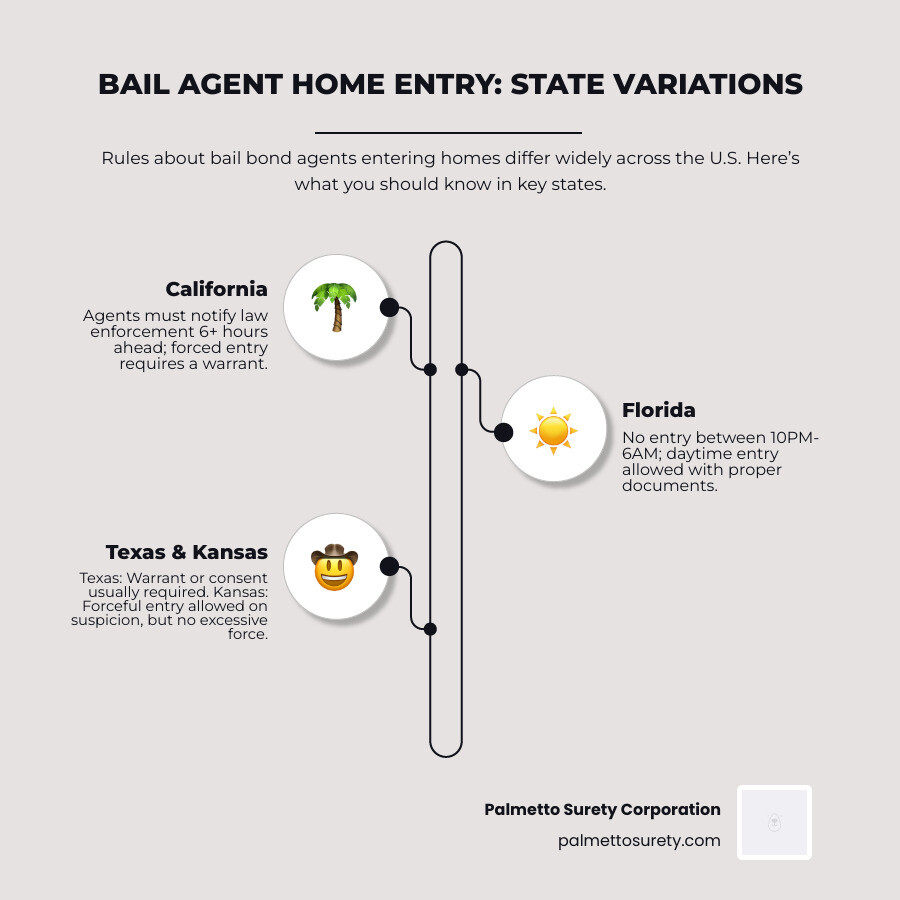
- California: Bail fugitive recovery agents must notify local law enforcement at least 6 hours before attempting an apprehension. Forced entry generally requires a warrant, and agents must carry a $1,000 surety bond. Learn more from the California Department of Insurance
- Florida: State law prohibits agents from entering residences between 10 PM and 6 AM. However, Florida Statute 648.30 allows agents to enter any home to recover a defendant who has skipped court—no court order needed—but only during legal hours and with proper documentation.
- Texas: Bail bond agents generally need a warrant to enter a residence unless the homeowner gives explicit consent.
- Kansas: Kansas law is more lenient, allowing forceful entry on “reasonable suspicion” the fugitive is inside, but excessive force is still prohibited.
- New York: New York bans private bounty hunters entirely; only law enforcement can recover fugitives.
- Tennessee: Bounty hunters must have both a search warrant and an arrest warrant, and a law enforcement officer must be present for any entry without owner permission.
Licensing requirements are also strict. Agents must be licensed (minimum age, background checks, training hours, and liability insurance vary by state), and must always carry proper ID and case documentation.
Protecting Your Castle: Practical Steps for Homeowners & Co-Signers
When faced with a bail bond agent at your door, knowledge and calm are your best defenses. Here’s how to protect your rights:
- Verify Credentials: Always ask for official identification, proof of licensing, and any relevant court or bail documentation. A legitimate agent will have these ready.
- Demand a Warrant: Unless you’re the defendant and the contract clearly grants entry, you are under no obligation to let an agent in without a court-issued warrant.
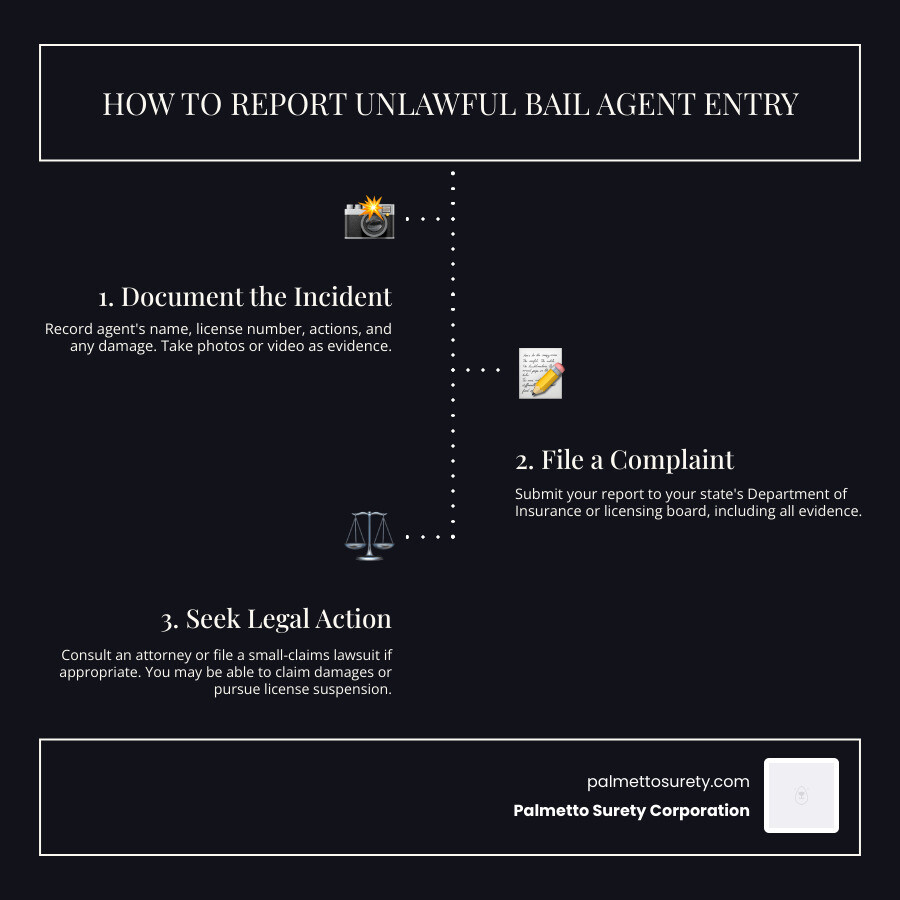
- Document Everything: Take note of names, badge numbers, time, and what is said. If you feel threatened or your property is damaged, take photos or video (from a safe distance).
- Call Law Enforcement: If an agent tries to force their way in unlawfully, call the police immediately. You have a right to protection from trespass, even from bail agents.
- Know Reasonable Force Limits: Agents may only use force proportional to the resistance they encounter—no kicking in doors unless they have a warrant or are in hot pursuit.
- Keep Records: Save all bail contracts, receipts, and communications. Co-signers should pay extra attention, as their financial liability can reach up to 140% of the bond amount if the defendant skips court.
For more on protecting your interests in other types of surety bonds, see our commercial surety bonds overview.

Remedies & Recourse if Your Rights Are Violated
So what if a bail bond agent crosses the line and enters your home without legal authority? You have options:
- Civil Lawsuit: You can sue for trespass and property damage. In most states, small claims court can award damages up to $5,000.
- Trespass Claims: If the agent entered without proper authority or used excessive force, this is a classic case of trespassing.
- Report to Insurance Department: File a complaint with your state’s Department of Insurance, which regulates bail bond agents and can suspend or revoke licenses for misconduct.
- Attorney Consultation: A lawyer can help you assess your rights, file a civil claim, or seek an injunction against further harassment.
- Bondsman License Suspension: Repeated or egregious violations may result in the agent losing their license to operate.
Frequently Asked Questions about Bail Bond Agent Home Entry
Can a bail bondsman legally break down my door?
Generally, no. Bail bond agents can only use “reasonable force” to apprehend a defendant, and only under specific circumstances—such as hot pursuit or with a valid court-issued warrant. Excessive force, like breaking down doors without clear legal authority, opens the agent up to legal liability.
Do they need to notify local law enforcement first?
It depends on the state. In California, bail agents must notify law enforcement at least 6 hours before an apprehension. In other states, like Florida or Texas, there may be no such requirement, but agents still must carry proper documentation.
Can a bail bond agent enter a friend’s house to arrest me?
Only with homeowner consent or a court-issued warrant. Bail bond agents have no authority to enter third-party residences without permission. If they do, it’s trespassing, and you or your friend can call the police or take legal action.
Conclusion
Your home is your sanctuary, and the law generally agrees. While bail bond agents have unique authority under certain circumstances—thanks to centuries-old surety law and the bail contract you sign—these powers are not unlimited.
Key takeaways:
- Always know your state’s specific rules about bail bond agent entry.
- Read every line of any bail agreement, especially clauses about home entry or tracking.
- Never be afraid to ask for ID, demand a warrant, or call law enforcement if you feel your rights are being violated.
- The majority of people show up to court without the need for aggressive tactics—supportive services and information go a long way.
At Palmetto Surety Corporation, we’re committed to helping families and businesses steer the complex world of bail and surety bonds with clarity, speed, and respect for your rights. With 20+ years of experience and locations across the Southeast, we’re here to answer your questions and guide you through every step of the process.
For more about how we support our agents, see our agent services.
Need help or have more questions about bail, surety, or protecting your home? Contact us today.


