


How Do Bail Bond Agents Make Money: 5 Powerful Truths 2025
Why Understanding Bail Bond Agent Earnings Matters
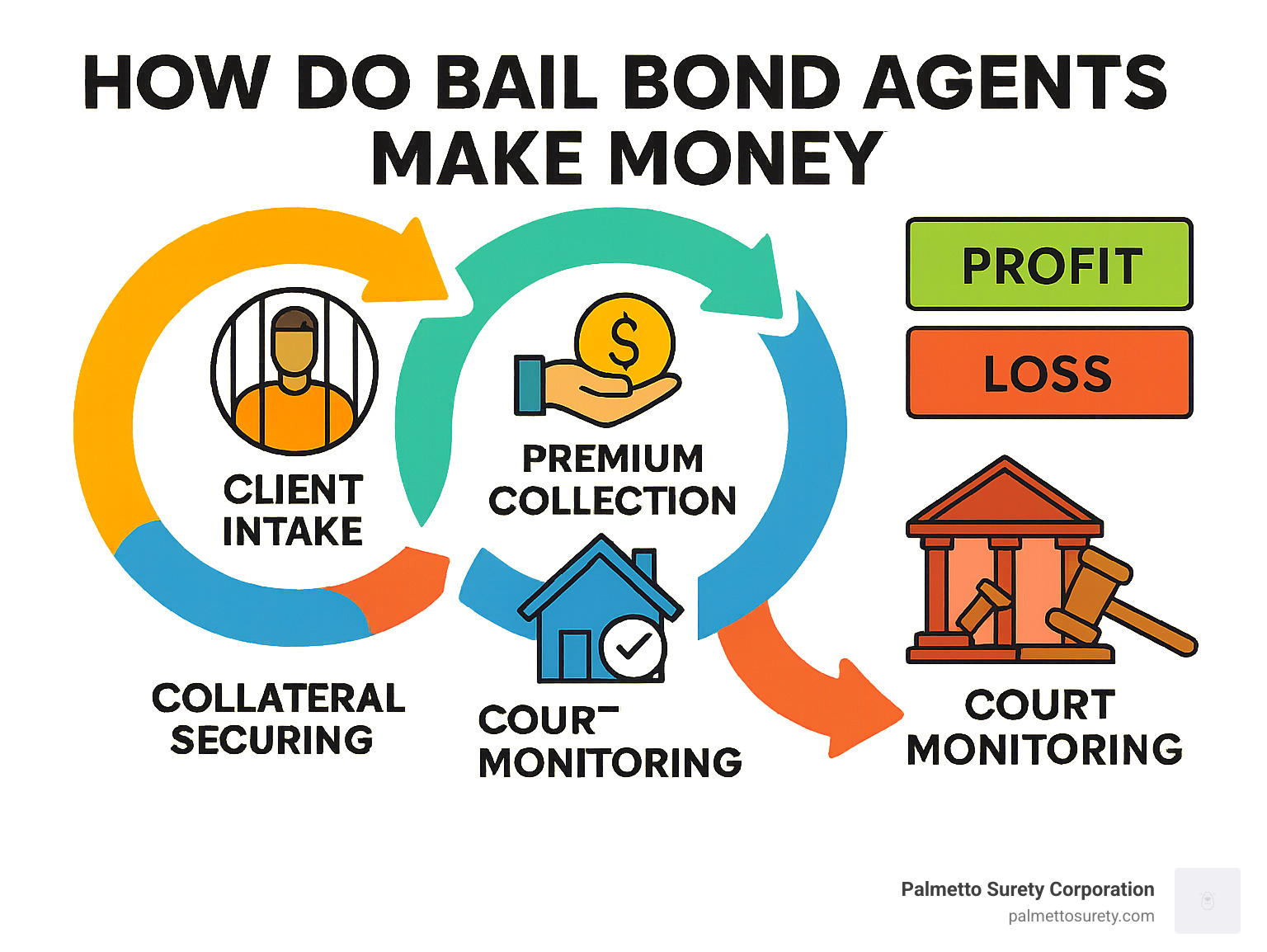
How do bail bond agents make money is a question that reveals the inner workings of America’s $15 billion bail bond industry. These financial intermediaries earn income through several key methods:
Primary Revenue Streams:
– Non-refundable premiums – typically 10-15% of the total bail amount
– Collateral seizure – when defendants fail to appear in court
– Payment plan interest – financing fees on installment arrangements
– Ancillary services – GPS monitoring, notary work, and court reminders
The bail bond business operates on high volume and calculated risk. With approximately 15,000 bail bond agents serving over 2 million defendants annually, agents must balance profit potential against substantial financial liability.
When a defendant can’t afford the full bail amount set by the court, bail bond agents step in to guarantee the defendant’s court appearance. In exchange for this service and financial risk, agents collect their fees upfront – money they keep regardless of the case outcome.
The financial stakes are significant. If a defendant skips bail on a $50,000 bond, the agent faces losing the full amount unless they can recover the fugitive or seize enough collateral to cover their loss.
I’m Haiko de Poel Jr, and through my work with Palmetto Surety Corporation and other companies in the pretrial services industry, I’ve gained deep insights into how do bail bond agents make money and manage their financial risks. This guide will break down every revenue stream and risk factor that determines an agent’s profitability.
How do bail bond agents make money glossary:
– what is a bail bonds agent
– bail bond agent job description
– can a bail bonds agent arrest you

Understanding the Bail Bond Business Model
The bail bond industry thrives on a simple reality: most people can’t afford to pay thousands of dollars in cash when they or a loved one gets arrested. This financial gap creates the perfect opportunity for bail bond agents to step in and make money by providing an essential service.
When the court sets bail at $10,000, very few families have that kind of cash available. But they might be able to scrape together $1,000 for a bail bond agent’s fee. That’s where how do bail bond agents make money becomes clear: they collect that smaller upfront payment and take on the larger financial risk.
A bail bond is essentially a surety bond – a specialized type of insurance contract that involves three parties working together. The insurance company (called the surety) backs the bond financially, while the bail agent handles the day-to-day client relationships and risk management.
This surety triangle creates a safety net that allows the bail system to function smoothly. Without it, jails would be even more overcrowded, and many defendants would lose their jobs while waiting months for their court dates.
What Is a Bail Bond?
A bail bond works like a financial promise to the court. Instead of requiring defendants to hand over tens of thousands in cash, the court accepts a surety bond from a licensed bail agent. This bond guarantees that either the defendant shows up for court, or someone pays the full bail amount.
The surety triangle breaks down like this:
- Principal (Defendant): The person who needs out of jail and promises to appear in court
- Obligee (Court): The judge and court system that needs assurance the defendant won’t disappear
- Surety (Insurance Company): The financial powerhouse that backs the bond if things go wrong
The bail bond agent sits right in the middle of this triangle, earning money by evaluating risks, collecting fees, and making sure everyone follows through on their commitments. It’s a business built on trust, quick decision-making, and understanding human nature.
When a defendant skips court, the agent doesn’t just lose their fee – they’re on the hook for the entire bail amount unless they can track down the missing person or recover enough collateral to cover their losses.
The Role of the Bail Bond Agent
Bail bond agents juggle multiple responsibilities that directly impact how bail bond agents make money. They’re part financial analyst, part customer service representative, and part detective all rolled into one.
Underwriting and risk assessment forms the foundation of their business. Every potential client gets evaluated for their likelihood of showing up to court. Agents look at criminal history, job stability, family connections in the community, and how serious the charges are.
This evaluation determines not just whether the agent takes the case, but also what collateral requirements they’ll demand and how closely they’ll monitor the defendant.
Client monitoring keeps the money flowing and the risks manageable. Smart agents don’t just collect their fee and disappear. They stay in regular contact through phone calls, text reminders about court dates, and sometimes GPS monitoring devices.
Loss prevention strategies separate successful agents from those who go out of business quickly. Experienced agents require cosigners who have skin in the game, secure valuable collateral like car titles or property deeds, and maintain relationships with bounty hunters who can track down defendants who try to run.
How Do Bail Bond Agents Make Money? (Core Revenue Streams)

How do bail bond agents make money comes down to three main income sources that keep this $2.4 billion industry running. Think of it like a financial services business – agents collect fees upfront while taking on significant risk for each bond they write.
The business model is surprisingly straightforward. Agents earn money immediately through premiums and fees, but they’re also gambling that their clients will show up to court. When defendants skip town, agents can lose thousands or even tens of thousands of dollars on a single bond.
Most successful agents handle dozens of bonds each month, creating multiple revenue streams that add up to substantial annual earnings. Let’s break down exactly where that money comes from.
Bail Premiums: how do bail bond agents make money on every bond?
The bread and butter of how do bail bond agents make money is the premium – that non-refundable fee every client pays upfront. This fee typically runs between 10% and 15% of the total bail amount, depending on what your state allows and how risky the case looks.
Here’s what agents actually earn on typical bail amounts:
| Bail Amount | 10% Premium | 15% Premium |
|---|---|---|
| $5,000 | $500 | $750 |
| $10,000 | $1,000 | $1,500 |
| $25,000 | $2,500 | $3,750 |
| $50,000 | $5,000 | $7,500 |
| $100,000 | $10,000 | $15,000 |
State regulations keep these fees from getting out of hand. California caps premiums at 10%, while states like Colorado allow up to 15%. Some states have eliminated cash bail entirely, which obviously affects how agents can earn money in those markets.
The beauty of premiums from an agent’s perspective is that they’re completely non-refundable. Whether the defendant gets their charges dropped, wins at trial, or gets convicted, the agent keeps that money. It’s payment for taking on the financial risk and providing the service.
Collateral & Asset Seizure: another way how do bail bond agents make money
Here’s where things get interesting – and potentially profitable. Another major way how do bail bond agents make money involves the collateral they require to secure bonds. For larger bail amounts, agents typically demand collateral worth the full bail amount or more.
Agents accept real estate titles like homes and investment properties, vehicle titles for cars, trucks, boats, and motorcycles, jewelry and precious metals, investment accounts, and even business equipment as collateral. Basically, anything with clear value that can be legally seized if needed.
When defendants show up to all their court dates, the collateral gets returned – no questions asked. But when someone skips bail, that’s when agents can make additional money beyond their original premium.
Let’s say an agent posts a $50,000 bond and the defendant disappears. The agent can now legally take possession of the defendant’s car, put liens on their house, or liquidate whatever collateral was pledged. Any money recovered beyond the bail amount goes back to the collateral owner, but the agent protects their investment and sometimes comes out ahead.
Added Income: Payment Plans, GPS Monitoring & Notary Services
Smart agents have figured out that there’s money to be made beyond just writing bonds. Modern bail bond businesses offer several additional services that create ongoing revenue streams.
Payment plans with interest have become huge money makers. Instead of requiring the full 10% premium upfront, agents might accept 1% down and finance the rest over six months at 15% annual interest. This brings in clients who couldn’t otherwise afford the service while generating extra income through interest charges and late fees.
GPS monitoring services provide monthly recurring revenue. Agents rent ankle monitors to clients for $300-500 per month, which helps ensure court compliance while adding to the bottom line. It’s a win-win – clients get to stay out of jail, and agents get ongoing income plus reduced flight risk.
Many agents also become notaries public to offer document services, charge fees for court transportation, and provide court date reminder services. These might seem like small add-ons, but they can add up to thousands of extra dollars per year for busy agents.
Managing Risk and Recovering Losses
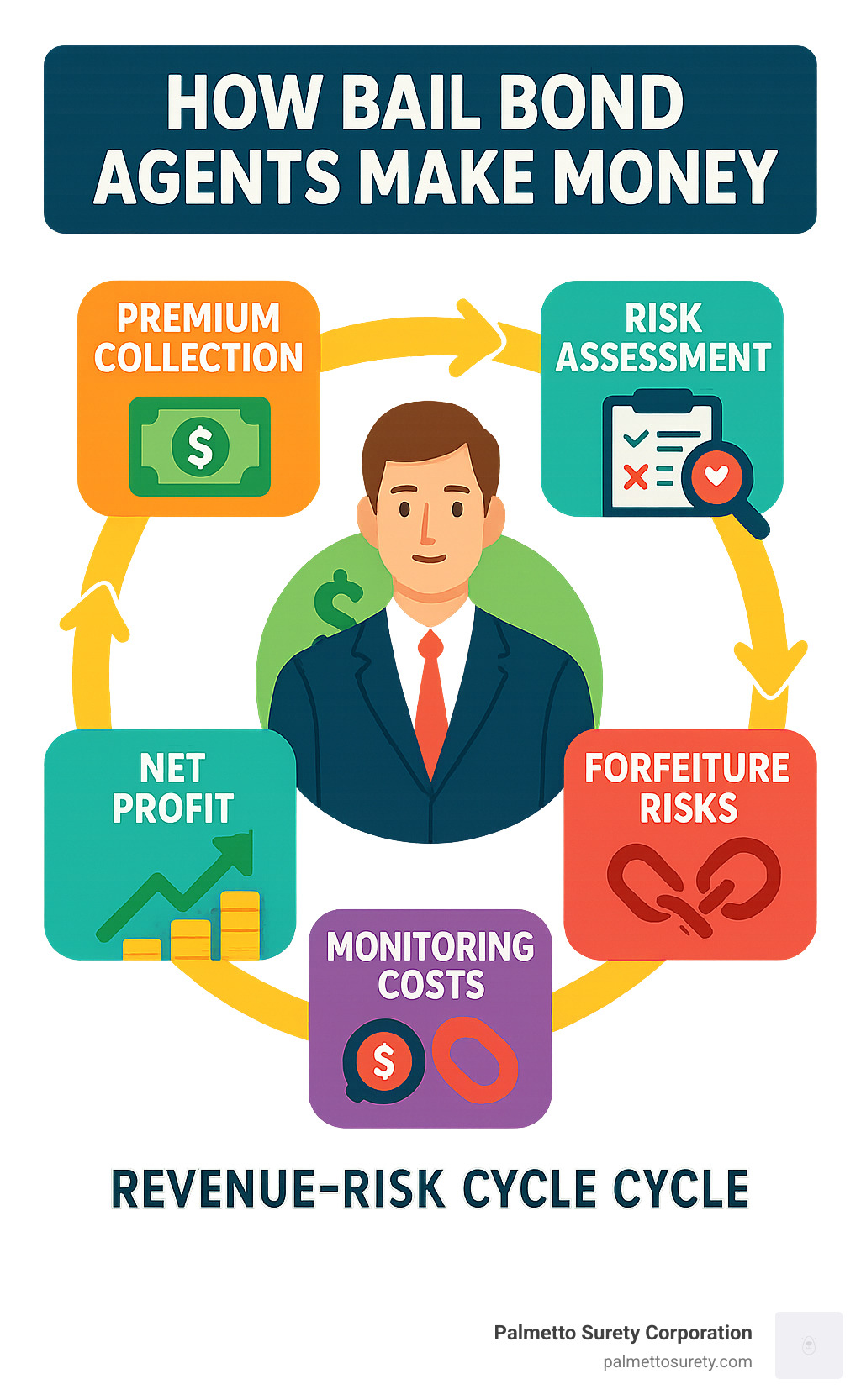
The bail bond business walks a financial tightrope every single day. When an agent posts a $100,000 bond and collects a $10,000 premium, they’re essentially gambling $100,000 that the defendant will show up to court. That’s why understanding risk management isn’t just smart business – it’s survival.
Successful agents know that how do bail bond agents make money depends heavily on keeping their losses minimal. They implement comprehensive flight risk scoring systems that evaluate everything from employment history to family ties. A defendant with a steady job, local family, and no history of missing court dates represents a much safer investment.
The stakes become crystal clear when you consider that it’s a risk to help bail you out. Every bond represents potential profit or devastating loss, making careful risk assessment the foundation of profitable operations.
Agents also rely on surety insurer backing to help manage their exposure. These insurance companies provide financial backing but require agents to meet strict underwriting standards.

What Happens When a Defendant Skips Bail?
When a defendant fails to appear in court, the agent’s world turns upside down fast. The court immediately declares a bond forfeiture, meaning the agent now owes the full bail amount to the court system. This isn’t a maybe – it’s a legal obligation that can destroy an agent’s business if not handled properly.
Most states provide a 90-day recovery window (sometimes up to 180 days) where agents can locate and return the defendant to avoid paying the full forfeiture. This grace period becomes the most stressful time in an agent’s career.
The financial pressure intensifies quickly. On a $50,000 bond, the agent collected maybe $5,000 in premium but now faces paying $50,000 to the court. That’s why agents immediately activate their recovery networks, hiring bounty hunters and skip tracers to locate fugitives.
If recovery efforts fail, the court issues a final judgment against the agent. At this point, the agent must pay the full amount and then pursue civil suits against the defendant and any cosigners to recover their losses.
Tools Agents Use to Protect Their Bottom Line
Smart agents don’t just hope defendants show up – they actively work to ensure court appearances through multiple protective strategies. Background checks form the foundation of their risk assessment, diving deep into criminal history, employment stability, and previous court compliance.
Agents pay special attention to community ties when evaluating low flight risk candidates. Someone with local family, steady employment, and property ownership is far less likely to flee than a transient defendant with no local connections.
GPS monitoring has revolutionized defendant tracking, allowing agents to monitor client locations 24/7. Many agents require high-risk defendants to wear ankle monitors and check in regularly, creating accountability while generating additional monitoring revenue.
Collateral buffers provide crucial financial protection. Rather than accepting collateral equal to the bond amount, experienced agents often require 120-150% coverage. This extra cushion helps absorb recovery costs and provides better loss protection.
The relationship with professional bounty hunters can make or break an agent’s recovery success. These licensed professionals successfully apprehend about 90% of fugitives, making their 10-20% fee a worthwhile investment when facing bond forfeitures.
Finally, requiring cosigners creates additional layers of accountability and recovery options. When family members or friends co-sign bonds, they become legally responsible for the defendant’s appearance and any financial losses.
Regulations, Fees & State Variations
The bail bond industry operates under a complex web of state regulations that directly impact how do bail bond agents make money. Each state sets its own rules for licensing, fee caps, and operational requirements – creating a patchwork of earning opportunities across the country.
Some states allow agents to charge up to 15% premiums, while others cap fees at 10%. A few states have eliminated cash bail entirely, effectively shutting down traditional bail bond operations in those markets.
Most states require agents to complete 20-40 hours of pre-licensing education, pass written examinations, and undergo thorough background checks. The licensing process ensures agents understand the legal complexities and financial responsibilities they’re taking on.
Federal and immigration bonds represent a specialized segment with higher earning potential but increased complexity. These cases often involve longer timeframes and stricter requirements, but they can command premium rates of 15-20% compared to standard state bonds.
Licensing & Compliance Essentials for Prospective Agents
Getting licensed as a bail bond agent requires jumping through several regulatory hoops, but the process protects both agents and the public they serve.
Pre-licensing education typically involves 20-40 hours of approved coursework covering bail law, ethics, and business practices. California requires 20 hours initially plus 12 hours of continuing education annually. These classes cover the legal foundations that determine how do bail bond agents make money while staying within the law.
The examination and background check process weeds out unsuitable candidates. You’ll need to pass written exams covering state bail laws and undergo extensive background investigations, including fingerprinting and credit checks. Felony convictions typically disqualify applicants.
Surety company appointment is where the rubber meets the road. You must secure backing from licensed insurance companies authorized to write bail bonds in your state. These companies provide the financial muscle behind your bonds, but they’re selective about who they’ll work with.
Ongoing compliance never ends once you’re licensed. You’ll need to maintain errors and omissions insurance, complete continuing education requirements, and submit to periodic regulatory audits.
Federal & Immigration Bonds: Higher Risk, Higher Reward
Federal and immigration bonds offer some of the best opportunities for understanding how do bail bond agents make money at higher profit margins. These specialized cases involve ICE detainees and federal criminal defendants, creating unique challenges that justify premium pricing.
Higher premiums are the most obvious benefit. Federal and immigration bonds typically command 15-20% premiums due to increased flight risk and case complexity. A $50,000 immigration bond might generate $7,500-10,000 in premium income compared to $5,000 for a standard state bond.
Extended case duration cuts both ways. Immigration cases often take months or years to resolve, requiring longer monitoring periods. However, this also means the agent’s investment in client relationships pays dividends over extended periods.
Stricter collateral requirements become essential with federal cases. These bonds typically require substantial collateral due to higher flight risk and limited recovery options if defendants flee to other countries.
Specialized expertise sets successful federal bond agents apart from their competitors. You’ll need to understand complex federal procedures, maintain relationships with specialized attorneys, and work with recovery services experienced in international fugitive cases.
For comprehensive information about licensing and compliance requirements, visit our More info about surety bond services page.
Frequently Asked Questions about Bail Bond Agent Income
You’ve probably got some burning questions about what bail bond agents actually earn and how the money side of things works. Let’s explore the most common questions people ask about how do bail bond agents make money.
How much can an agent earn each year?
The honest answer? It depends on how hard you work and how smart you work. Annual earnings for bail bond agents can range from modest part-time income to six-figure salaries, and it all comes down to volume, strategy, and market conditions.
A high-volume agent who processes about 20 bonds monthly with an average value of $25,000 each can pull in around $50,000 per month in gross revenue at a 10% premium rate. That’s $600,000 annually before expenses.
On the flip side, some agents prefer the boutique approach. They handle fewer cases but focus on high-value bonds. An agent processing just 5 bonds monthly averaging $100,000 each at 12% premium can earn about $60,000 monthly or $720,000 annually in gross revenue.
Part-time agents typically see more modest returns. Processing 5 smaller bonds monthly (around $10,000 each) generates about $5,000 monthly, or $60,000 annually in gross revenue.
But here’s the reality check – those are gross numbers. Running a bail bond business involves significant expenses including surety company fees (typically 10-15% of your premiums), office costs, marketing, recovery expenses, insurance, and administrative costs.
Most efficient operations see net profit margins between 30-50%. So that successful agent grossing $600,000 might net $200,000-300,000 after expenses.
Is the premium ever refundable?
This is probably the most misunderstood aspect of how do bail bond agents make money. The short answer is no – bail bond premiums are never refundable, and that’s actually the law in every state.
Think of it this way: you’re paying for a service and for someone to take on significant financial risk on your behalf. Once that bond is posted and your loved one walks out of jail, the agent has already provided the service you paid for.
The non-refundable structure holds true even in situations that might seem unfair to families. Whether charges get dropped the next day, the defendant is found innocent at trial, the case gets dismissed, or someone pleads guilty immediately – the premium stays with the agent.
This policy isn’t agents being greedy – it’s how the business model works and how agents can afford to take on the massive financial risks involved.
What if collateral isn’t enough to cover a forfeiture?
This scenario keeps bail bond agents up at night, but experienced agents have several tools in their toolkit when collateral falls short of covering a forfeited bond.
Civil litigation is often the first step. Agents can sue defendants and cosigners for the remaining balance, potentially securing wage garnishments or placing liens on assets that weren’t initially used as collateral.
Many agents work with surety companies like Palmetto Surety Corporation that provide insurance backing. When collateral isn’t sufficient, agents may file insurance claims for unrecovered amounts, though deductibles and coverage limits apply.
Sometimes the human approach works best. Payment arrangements can be negotiated with defendants or their families to recover losses over time rather than immediately pursuing aggressive legal action.
Professional skip tracers and asset investigation specialists can locate hidden assets or income sources that weren’t initially apparent.
As a last resort, unrecoverable losses may qualify as business deductions, though agents should always consult with tax professionals for specific guidance on their situation.
Conclusion

The question of how do bail bond agents make money isn’t just about dollars and cents – it’s about understanding a business that touches thousands of families during their most stressful moments. These agents earn their living by taking on significant financial risks while helping people steer the complex world of pretrial release.
The math is straightforward but the stakes are high. Agents collect non-refundable premiums of 10-15% upfront, manage collateral worth tens of thousands of dollars, and face potential losses that could wipe out months of profits if a single defendant disappears. It’s a business where a $50,000 bond might generate $5,000 in premium income, but could cost the agent the full $50,000 if things go wrong.
What makes successful agents thrive isn’t just their ability to assess risk or collect fees. It’s their understanding that every bond represents a family trying to stay together while facing legal challenges. The best agents build their businesses around comprehensive client evaluation, fair collateral requirements, and genuine care for their clients’ success in the court system.
The industry outlook remains strong despite ongoing criminal justice reforms. While some states have eliminated cash bail for certain offenses, the fundamental need for pretrial release services continues. Agents who adapt to changing regulations while maintaining ethical business practices find plenty of opportunity in this $2.4 billion industry.
At Palmetto Surety Corporation, we’ve watched agents build successful careers over our 20+ years in the southeastern market. The ones who last understand that balancing profit with community service isn’t just good business – it’s essential for long-term success. Whether you’re posting bonds in South Carolina or Texas, the principles remain the same: careful risk assessment, fair pricing, and genuine commitment to helping defendants meet their court obligations.
The bail bond business will always involve risk, but it also offers the chance to make a real difference in people’s lives while building a profitable enterprise. For those considering this career path or simply wanting to understand how the system works, behind every bond is a story of someone trying to get back to their family, their job, and their life while facing legal challenges.
If you’re ready to explore opportunities in the bail bond industry or need surety backing for your existing business, visit our More info about agent services page. We’re here to help you succeed in this challenging but rewarding field.


