


Bail Enforcement Agent Badge: 10 Powerful Must-Have Picks 2025
Why Professional Credentials Matter in Fugitive Recovery
A bail enforcement agent badge serves as the primary identification tool for licensed professionals in the fugitive recovery industry. These badges represent legal authority, professional credibility, and compliance with state regulations – but only when properly obtained and displayed according to strict legal requirements.
Key Facts About Bail Enforcement Agent Badges:
- Legal Authority: Only licensed agents may carry and display these badges
- State Regulations: Each state has specific design, size, and display requirements
- Standard Dimensions: Most badges measure 2.13″ x 3.00″ to 2.83″ x 3.50″
- Price Range: Basic badges start at $18.99, while custom state-specific designs can cost up to $192
- Required Documentation: Must be paired with official ID cards and proper licensing
- Display Restrictions: Can only be shown during authorized operations while wearing approved clothing
The bail enforcement industry has grown significantly, with agents playing a crucial role in the criminal justice system. Unlike law enforcement badges, bail enforcement agent badges represent private contractual authority rather than government police powers.
Professional appearance and proper identification help establish credibility when interacting with defendants, law enforcement, and the public. Quality badges demonstrate commitment to the profession and adherence to industry standards.
I’m Haiko de Poel Jr, and through my work at Palmetto Surety Corporation, I’ve helped hundreds of bail professionals steer licensing requirements and obtain the proper bonds needed for their bail enforcement agent badge credentials.
Quick bail enforcement agent badge definitions:
– are bounty hunters legal
– how much do bounty hunters earn
– what do bounty hunters do
What a Bail Enforcement Agent Badge Represents
When you see a bail enforcement agent badge, you’re looking at more than just shiny metal or polymer. It’s a powerful symbol that carries real meaning in fugitive recovery and criminal justice.

Your badge serves as your professional calling card, instantly telling everyone – from defendants to law enforcement officers – that you’re a licensed professional with legitimate authority. This establishes trust and credibility in situations that can get tense quickly.
The bail enforcement agent badge acts as your identity marker in the field. When things get complicated during an apprehension, that badge helps everyone understand who you are and why you’re there. It’s the difference between being seen as a legitimate professional and being mistaken for someone with no business being involved.
Your badge also acts as a deterrent. When a defendant sees that official badge paired with your ID card, it often encourages voluntary cooperation. From a public safety standpoint, your bail enforcement agent badge helps police officers quickly identify you as an authorized agent during operations.
Most importantly, your badge represents your commitment to doing things the right way. It shows you’ve completed required training, passed background checks, and posted necessary bonds.
Bail Enforcement Agent Badge vs Police Shield
Understanding the difference between your bail enforcement agent badge and a police shield could keep you out of serious legal trouble.
Police badges represent government authority backed by the full power of the state or city that employs them. They can enforce any law, make arrests for any crime, and act in the broader public interest.
Your bail enforcement agent badge represents private contractual authority. Your power comes from the agreement between your bail bond company and the defendant who skipped out on their bond. This authority is much more limited and specific than what police officers have.
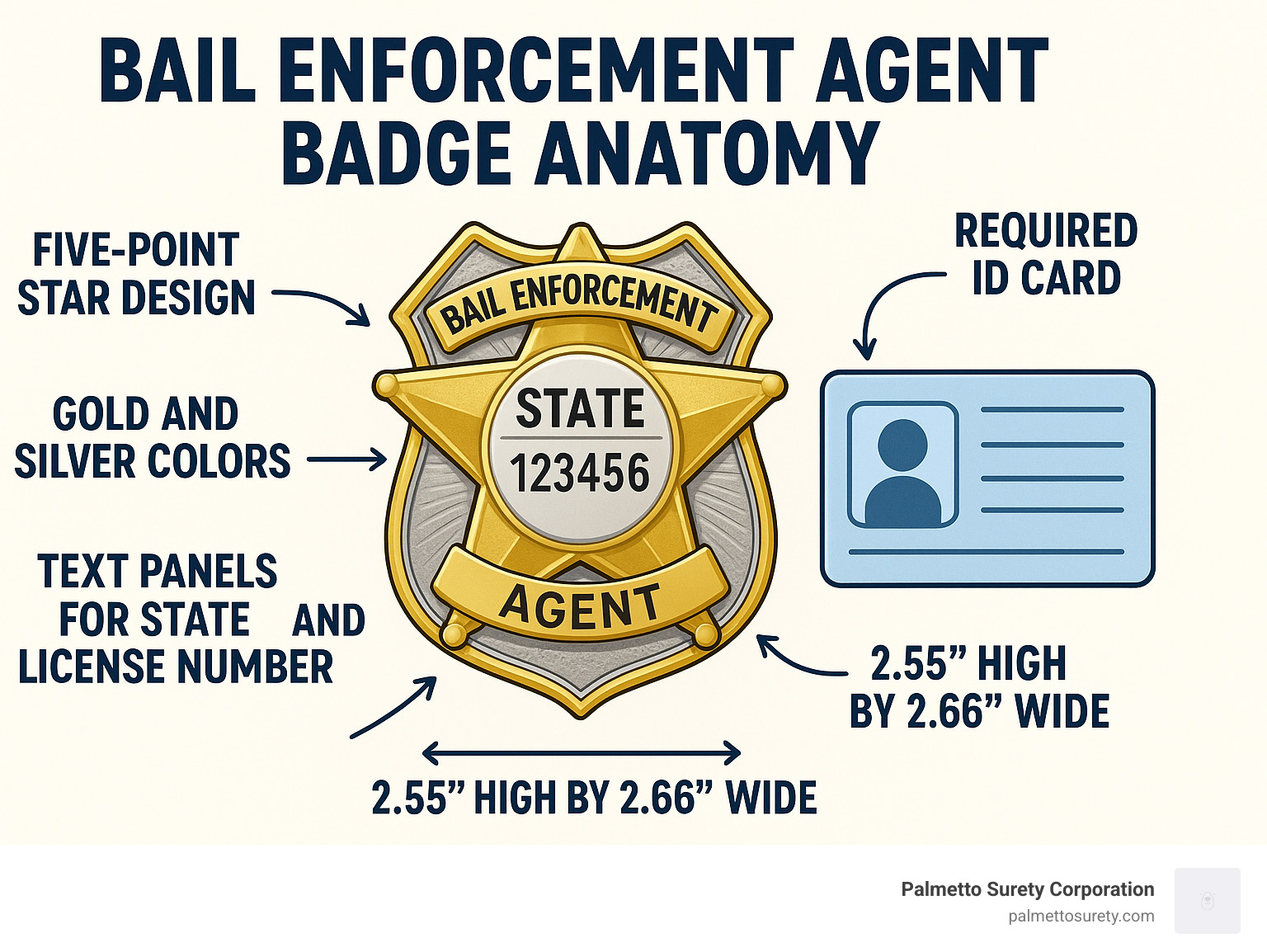
The visual differences matter too. Police badges typically use blue, black, or silver color schemes and feature municipal seals or state symbols. Your bail enforcement badge likely incorporates gold and silver elements with specific text panels showing your role and license number.
These design differences aren’t just aesthetic – they’re legal requirements. Your bail enforcement agent badge must be clearly distinguishable from police badges. You can never represent yourself as a police officer, even accidentally. The penalties for impersonating law enforcement are severe and can end your career permanently.
The scope of authority is the biggest difference. While police can pursue anyone who breaks any law, you can only apprehend defendants who have violated their bail agreements.
Legal Framework & State-Specific Rules
The legal landscape for bail enforcement agent badges varies significantly by state. Understanding these regulations isn’t just about staying compliant; it’s about protecting your career and avoiding legal headaches.
Utah’s Code §53-11-121 requires precise specifications. Your bail enforcement agent badge must measure exactly 2.55 inches high by 2.66 inches wide in the shape of a five-point star on a circle. The design must feature a gold star on a silver circle with black block lettering, and specific text panels must show “Utah” along with your license number.
New York operates under Article 7 of the General Business Law, requiring a $50,000 surety bond and maintaining strict eligibility requirements including a minimum age of 21 and comprehensive background checks. The New York Department of Financial Services regulates licensing and badge compliance strictly.
California follows Insurance Code sections 1800-1823. Individual agents need a $1,000 surety bond and must complete at least 20 hours of pre-licensing education. Companies operating in California must post a $5,000 bond, and the California Department of Insurance regulates both licensing and badge requirements.
Most states share common requirements: at least 21 years old, meet residency requirements, pass background checks, and demonstrate good moral character. Training programs and written examinations are standard before you can legally carry your bail enforcement agent badge.
Display restrictions are universal. You can only show your badge while wearing approved identifying clothing and carrying your official identification card. Unauthorized display or misuse can result in license suspension, criminal charges, and civil liability.
For Utah agents, the official Badges and Approved Clothing guidelines provide detailed specifications for compliance.
When & Where You May Flash Your Bail Enforcement Agent Badge
Knowing when to display your bail enforcement agent badge is critical – timing and circumstances matter tremendously.
Planned apprehensions represent standard scenarios for badge display. You need to wear approved identifying clothing with clear lettering on both your chest and back, display your badge properly, and carry your official identification card.
Emergency situations create gray areas requiring careful judgment. If you unexpectedly encounter a defendant you’re authorized to apprehend, you may display your bail enforcement agent badge even without complete uniform requirements. However, you must have your ID card and be able to clearly explain the emergency circumstances.
Law enforcement encounters demand immediate identification. Utah law specifically requires agents to identify themselves and present their identification card to police officers at the first opportunity during any interaction.
Your badge and official identification card work as a team – never display one without the other. This dual requirement helps law enforcement officers quickly verify your authority and reduces the risk of conflicts.
Casual display of your bail enforcement agent badge is strictly prohibited. Never flash your badge to impress friends, get better service, or for any purpose unrelated to official duties. Inappropriate display can result in charges of impersonating a law enforcement officer.
Design Features & Product Round-Up
When shopping for a bail enforcement agent badge, you’ll find these are serious professional tools built to withstand fugitive recovery work demands while meeting strict legal requirements.
Most quality badges start with zinc alloy or brass bases, then get treated with gold and silver plating to meet color requirements. The five-point star design remains standard – it’s what most states require and looks professional.
Oval shield designs give off that classic law enforcement vibe while staying clearly distinct from police badges. These typically feature reverse enamel finishing, which means the colored parts are recessed and protected from wear.
FlexBadge polymer options are becoming increasingly popular. These lightweight alternatives use durable polymer construction instead of metal, making them much more comfortable for long operations. They’re flexible enough to bend without breaking.
Size-wise, most badges fall between 2.13″ x 3.00″ and 2.83″ x 3.50″. Utah gets specific with their 2.55″ x 2.66″ requirement, but most other states give you wiggle room. Quality engraving that won’t fade or wear off is worth paying extra for.
Price tiers reflect quality. Basic badges start around $18.99 for simple designs, while custom state-specific badges with precise specifications can run up to $192.

Must-Have Bail Enforcement Agent Badge Styles for 2024
Certain bail enforcement agent badge styles are dominating the field right now.
The Utah-spec five-point star is the gold standard – even if you’re not working in Utah. This design features exact 2.55″ x 2.66″ dimensions with a gold star on silver circle, complete with black center seal reading “Liberty & Justice For All.”
Classic eagle-top oval designs never go out of style. These badges measure about 3″ high by 2″ wide and give you that traditional law enforcement aesthetic while staying clearly distinct from police badges.
U.S. flag motif badges incorporate red, white, and blue enamel elements alongside traditional gold and silver plating. They’re popular with agents who want to emphasize their role in the American justice system.
State-seal custom options are perfect for states with specific design requirements. These badges incorporate your state’s seal and required text or color schemes.
Flexible & Lightweight Options
Wearing a heavy metal badge for 12 hours straight gets old fast. That’s why flexible and lightweight bail enforcement agent badge options are becoming popular.
Velcro-back FlexBadges are game-changers for comfort. These polymer badges weigh a fraction of traditional metal ones and use Velcro attachment systems for quick removal or repositioning.
Embroidered patches offer the lowest profile option while meeting identification requirements. You can have them permanently sewn onto approved clothing or use them with Velcro systems for flexibility.
Duty-belt clips solve badge placement problems without damaging clothing. These systems let you display your badge prominently while keeping it secure and easily accessible.
Budget-Friendly Starter Picks
Starting out in bail enforcement doesn’t mean breaking the bank on your first bail enforcement agent badge.
Zinc alloy basics provide excellent durability at reasonable prices. These badges typically feature gold plating over base metal and can last for years with proper care.
Standard 3″ x 2″ badges represent the sweet spot for both compliance and cost. This size fits most state requirements and is commonly manufactured, keeping prices down.
The under-$30 range includes plenty of quality options with basic five-point star designs, standard text panels, and reliable pin-back attachments.
Quick ship availability is crucial when you’re just getting started. Many suppliers keep common designs in stock to support new agents who need badges fast after licensing approval.

Carrying & Display Best Practices
Knowing how to properly carry and display your bail enforcement agent badge isn’t just about looking professional – it’s about staying safe, legal, and effective in the field.
The foundation starts with a secure holder system. You need something that keeps your badge firmly in place during foot chases or physical confrontations, but still allows quick access when you need to identify yourself. Quality holders use retention mechanisms like spring-loaded clips or snap-closure designs.
Avoiding accidental display protects you from legal headaches and public confusion. Your badge should stay hidden during off-duty activities. Many agents make the mistake of leaving their badge visible, which can lead to awkward situations or even impersonation charges.
The lettered clothing pairing requirement creates a complete identification system that protects both you and the public. Your badge works with approved clothing that displays your role clearly on both chest and back.
For attachment methods, you have two main choices: wallet clips or safety pins. Wallet clips offer discretion and quick access. Safety pins provide solid attachment during active operations but can damage clothing over time.
ID card readiness cannot be overstated. Your badge and official identification card are a team – one without the other leaves you vulnerable to challenges about your authority. Keep that ID card accessible instantly, even under stress.

Care & Maintenance Checklist
Your bail enforcement agent badge represents a significant investment in your career, and proper maintenance keeps it looking professional while extending its useful life.
Polish routine should become second nature, but don’t overdo it. Gold and silver plating respond differently to cleaning products, so check with your badge manufacturer for specific recommendations. A gentle metal polish applied with a soft cloth once a month usually works.
Enamel protection requires special attention since colored elements can’t be easily repaired if damaged. Skip harsh cleaners and stick to mild soap solutions for routine cleaning.
Lost-badge protocol is something you hope you’ll never need, but preparation matters. If your badge goes missing, immediately contact your state licensing authority and badge supplier. Some states require incident reports for lost badges.
Serial tracking protects you legally and practically. Many states require badge serial numbers as part of licensing documentation, and having this information readily available speeds up replacement processes.
Licensing, Bonds & How to Obtain Your Badge
Getting your hands on a legitimate bail enforcement agent badge isn’t as simple as placing an order online. There’s a whole process designed to protect both you and the public, starting with proper licensing and bonding.
Surety bond requirements vary significantly. California keeps it at $1,000, while New York jumps to $50,000. These bonds aren’t just paperwork – they’re your promise to operate ethically and professionally.
At Palmetto Surety Corporation, we’ve been helping bail professionals steer these bonding requirements for over 20 years. We’ve seen agents get their bonds approved within hours, not weeks. The key is understanding exactly what your state requires before starting the application process.
Training hours vary dramatically depending on where you plan to work. California requires a minimum of 20 hours of pre-licensing education covering everything from legal authority to defendant rights. This isn’t busy work – it’s the foundation that keeps you safe and legally compliant.
The background check process is thorough. Investigators will examine your criminal history, financial stability, and character references to ensure you meet “good moral character” standards. This typically includes FBI fingerprint checks and reviews of local law enforcement records.
Application packets require careful attention to detail. You’ll need proof of your surety bond, training completion certificates, background check results, and various fees. Most states also want proof of residency, citizenship or legal resident status, and age verification.
Here’s something many new agents don’t realize: legitimate badge suppliers will verify your licensing status before making your badge. They’ll ask for copies of your license or documentation proving you’re authorized to carry a bail enforcement agent badge. If a supplier doesn’t ask for this proof, that’s a red flag.
For detailed information about our bail surety services and how we can help streamline your bonding process, check out our bail surety services page. We’ve helped hundreds of professionals get properly bonded and licensed across the Southeast.
You can also browse professional badge options at reputable suppliers like this Sample Gallery to get an idea of what’s available once you’re properly licensed.
The entire process typically takes several weeks from start to finish, but proper preparation can speed things up considerably. Start with your surety bond application early – it’s often the longest part of the process, and you can’t move forward without it.
Frequently Asked Questions about Bail Enforcement Badges
Do I need a license before ordering a badge?
Yes, you absolutely must have a valid license before ordering a bail enforcement agent badge. This isn’t just a good idea – it’s the law. Possessing or displaying a badge without proper licensing can land you in serious legal trouble, including criminal charges for impersonating a law enforcement officer.
The badge represents your legal authority, and that authority only comes with proper licensing. Reputable badge manufacturers will ask for proof of your license before producing your badge. If a supplier doesn’t ask for this documentation, that’s a red flag.
The licensing process varies by state, but you’ll typically need to be at least 21 years old, pass comprehensive background checks, complete required training hours, and pass a written examination. Most states also require you to post a surety bond and provide character references.
Can I carry the badge concealed?
You can carry your bail enforcement agent badge concealed when you’re not actively working, but there are important rules about when and how you can display it. Most states have strict guidelines about badge display.
When carrying the badge concealed, you’re protecting yourself from potential violations. Casual or unauthorized display can get you into legal trouble, so keeping it hidden during non-operational activities is often the safest approach.
However, once you’re conducting official business, everything changes. You must be ready to display your badge immediately, along with your official identification card. This is especially important when interacting with law enforcement officers.
Your badge should only become visible when you’re wearing approved identifying clothing with proper lettering on both the chest and back.
What happens if someone misuses a bail enforcement agent badge?
Misusing a bail enforcement agent badge can have severe and career-ending consequences.
The criminal penalties alone should make anyone think twice. Impersonating a peace officer is typically a felony charge that can result in significant fines and prison time. Even seemingly minor violations like unauthorized display can escalate into serious criminal charges.
Beyond criminal penalties, you’re also looking at civil liability. If your badge misuse contributes to false imprisonment, assault, or other harm, you could face expensive lawsuits.
State licensing boards can suspend or revoke your license, impose hefty fines, and require additional training. A serious badge violation will often prevent you from getting licensed in any other state – effectively ending your career in fugitive recovery.
The most common violations include impersonating law enforcement officers, displaying badges inappropriately, letting unlicensed people use your badge, or using your badge for personal matters unrelated to legitimate bail enforcement work.
At Palmetto Surety Corporation, we’ve worked with agents for over 20 years, and we always stress the importance of proper badge usage.
Conclusion
Your bail enforcement agent badge is much more than a piece of metal or plastic – it’s the cornerstone of your professional identity in the fugitive recovery world. After helping hundreds of bail professionals get properly licensed and bonded over the past two decades, I’ve seen how the right credentials can make or break a career in this industry.
Getting your badge legally starts with understanding your state’s specific requirements. Whether you’re dealing with Utah’s ultra-precise 2.55″ x 2.66″ star design, New York’s hefty $50,000 bond requirement, or California’s 20-hour training mandate, cutting corners isn’t an option. The legal consequences of badge misuse can end your career before it really begins.
Quality matters when choosing your gear. A well-made bail enforcement agent badge paired with proper identification sends a clear message to everyone you encounter – defendants, law enforcement, and the public. It shows you’re serious about your profession and committed to doing things the right way.
Here at Palmetto Surety Corporation, we’ve made it our mission to help bail professionals across the Southeast get the bonds they need quickly and efficiently. Most of our applications get approved within hours, which means you can get your licensing process moving fast. We serve Georgia, Florida, Louisiana, Mississippi, South Carolina, Tennessee, and Texas.
The bail enforcement industry keeps evolving, but some things never change. Professionalism, compliance, and public safety will always be the foundation of successful fugitive recovery work. When you invest in proper credentials and quality equipment, you’re not just following the rules – you’re building a reputation that will serve you throughout your career.
Ready to get your surety bond sorted out? Check out our bail surety services page for all the details about our bonding process. Our team knows the ins and outs of bail enforcement agent badge requirements, and we’re here to help you get properly licensed and ready to work.


