


Surety Bond on Car Title: 7 Essential Steps for 2025 Success
Navigating Title Troubles: The Surety Bond Solution
A surety bond on car title is a financial guarantee that allows you to register and legally drive your vehicle when you don’t have the original title. If you’re trying to understand what this means for your vehicle situation, here’s a quick overview:
| What is it? | When you need it | What it costs | How long it lasts |
|---|---|---|---|
| A guarantee to the DMV that covers potential claims from previous owners | When original title is lost, stolen, damaged, or missing | Typically $100 for vehicles under $6,000 in value | 3 years, after which you receive a regular title |
When you’re stuck without a car title, it can feel like you’re driving into a dead end. Maybe you purchased a vehicle and the seller never provided the title, inherited a car with missing paperwork, or simply lost the original document. A surety bond on car title creates a legal pathway forward.
Think of a title bond as your “ownership insurance policy” – it protects the state, any previous owners, and potential future buyers by providing financial backing if someone later comes forward with a legitimate claim to the vehicle.
In California, these bonds are required when:
– Your vehicle is valued at $5,000 or more (or vessel at $2,000+)
– You cannot obtain a release from a previous owner or lienholder
– The title is nontransferable for some reason
The good news? Claims against these bonds are extremely rare, and after the 3-year bond period expires, you’ll receive a standard title with no further bonding requirements.
Must-know surety bond on car title terms:
– how to get a title for a car without title
– indemnity bond for car title
– purchase a lost title bond
What Is a Surety Bond for a Car Title?
When you’re stuck without a car title, a surety bond on car title becomes your path forward. Also called a Certificate of Title Bond, Motor Vehicle Ownership Surety Bond, or Lost Title Bond, this legal agreement creates a safety net when your original title is nowhere to be found. In California, Vehicle Code Sections 4157 and 4307 spell out exactly how these bonds work.

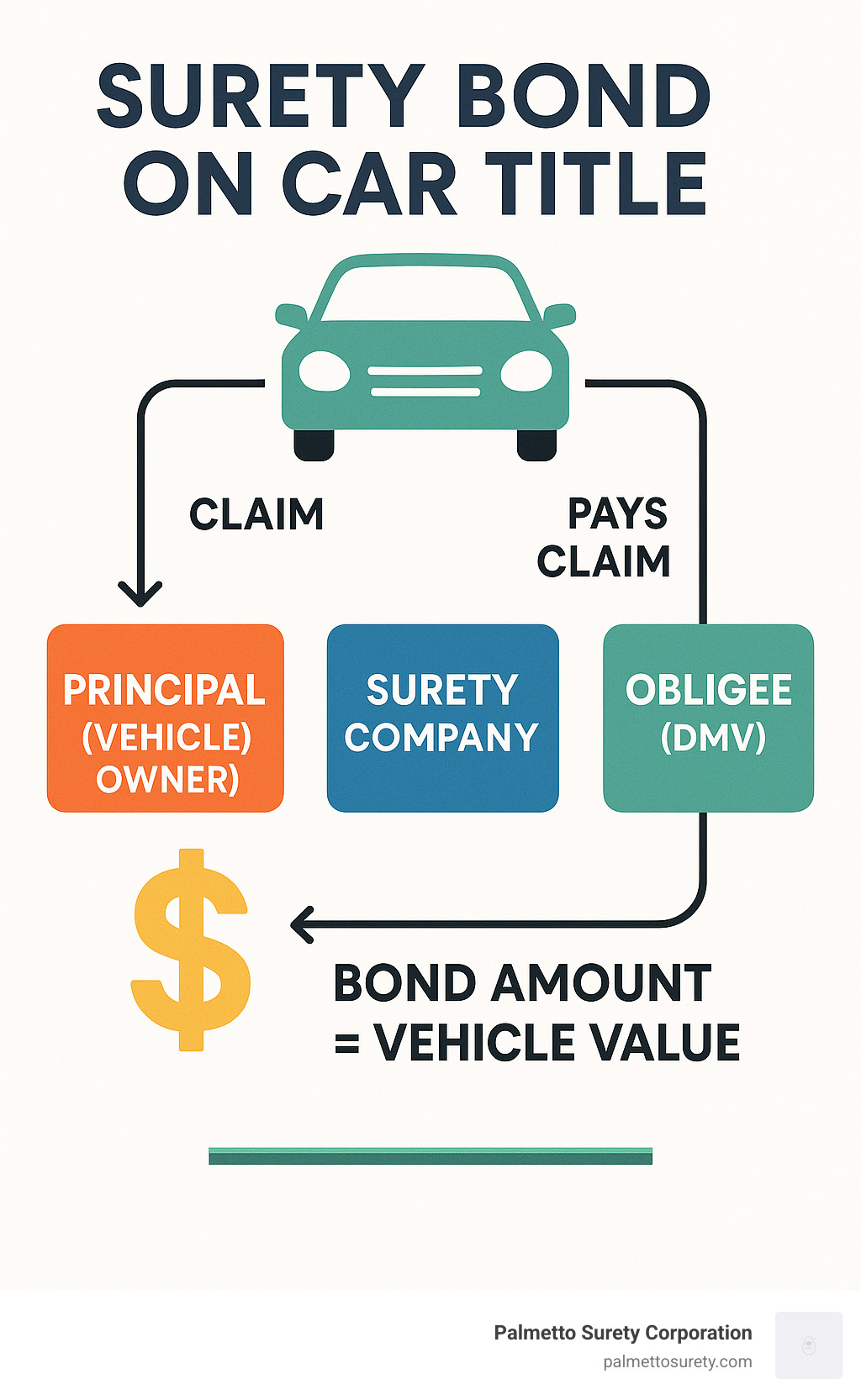
Think of a title bond as a three-way promise between:
- You (the Principal) – As the vehicle owner, you purchase the bond and take on the financial responsibility
- The DMV (the Obligee) – They require this protection before issuing a new title
- The bond company (the Surety) – They issue the bond and back it financially if problems arise
It’s like asking a trusted friend to vouch for you when buying a used bike without a receipt. Your friend (the surety) tells the bike shop (the DMV) “I believe this is rightfully theirs, and if someone proves otherwise, I’ll make it right financially.”
The surety bond on car title protects previous owners, lienholders, and the state itself if someone later proves they have a legitimate claim to your vehicle.
Surety Bond Basics & How It Works
Unlike insurance that protects you, a surety bond on car title protects others. Here’s the process:
You pay a premium (usually just a fraction of the bond amount) to a surety company. They provide a bond certificate that you file with the DMV, who then issues your bonded title. This title lets you register, drive, and eventually sell your vehicle legally.
If someone comes forward during the bond period with proof they have rights to the vehicle, the surety investigates. For valid claims, they’ll pay the claimant up to the full bond amount – but you must reimburse the surety for any payments they make.
The good news? Claims against title bonds hardly ever happen. Most people complete their three-year bond period without any issues.
Bonded Title vs. Regular Title – Key Differences
Understanding what sets a bonded title apart from a regular one helps you know what to expect:
| Feature | Bonded Title | Regular Title |
|---|---|---|
| Appearance | Marked as “bonded” | No special markings |
| Legal rights | Full ownership rights | Same ownership rights |
| Selling the vehicle | Possible, but may face buyer hesitation | No special considerations |
| Duration | Temporary (3 years in California) | Permanent until transfer |
| Cost | Bond premium + regular title fees | Standard title fees only |
| After bond period | Converts to regular title automatically | N/A |
The most important thing to understand is that your bonded title gives you virtually all the same rights as a regular title. After your three-year bond period ends in California, assuming no claims were made, your title automatically converts to a regular one.
When & Why You Might Need a Bonded Title
Life happens. Keys get lost, paperwork disappears, and sometimes you end up with a vehicle but no title to prove it’s yours. That’s when a surety bond on car title becomes your best friend on the road to legal vehicle ownership.
Think of a bonded title as your “plan B” when the original title is nowhere to be found. Maybe you’ve searched every drawer in your house, or perhaps the previous owner never gave you proper documentation in the first place.

You might need a surety bond on car title if you’re facing any of these common scenarios:
Your title is lost or stolen – Perhaps during a move or home renovation, that important document vanished.
Your title is damaged beyond recognition – Coffee spills, water damage, or just the wear of time can make a title illegible.
You made an out-of-state purchase without proper documentation – Interstate vehicle sales can sometimes result in paperwork complications.
You bought a vehicle at an auction or estate sale where title transfer wasn’t handled properly.
You inherited a vehicle but the paperwork wasn’t transferred correctly.
The title has a non-transferable designation that’s preventing normal transfer.
A lienholder is unresponsive or out of business – If a bank or finance company listed on the title no longer exists or won’t respond.
You’re dealing with a vintage or custom-built vehicle with complicated documentation history.
In most cases, you’ll need to show you’ve made a genuine effort to resolve the issue through conventional channels before a bonded title becomes an option.
“surety bond on car title” Triggers in California
California has specific requirements that trigger the need for a surety bond on car title. If you’re in the Golden State, you’ll need one when:
Your vehicle is valued at $5,000 or more (or $2,000+ if you’re dealing with a boat or vessel).
Your title has been flagged as “non-transferable” by the DMV for some reason.
You can’t get a proper release from the previous owner or lienholder, despite your best efforts to contact them.
To start the bonding process in California, you’ll need to complete Form REG 227 (Application for Replacement or Transfer of Title) and Form REG 256 (Statement of Facts) where you’ll explain your specific situation.
The bond amount must equal your vehicle’s fair market value according to California Vehicle Code sections 4157 and 4307. You can determine this value using Kelley Blue Book or by getting an appraisal from a licensed dealer.
Protections the Bond Provides
A surety bond on car title isn’t just about helping you – it creates a safety net for everyone involved in the vehicle’s history and future.
For previous owners, the bond offers peace of mind if they need to make a legitimate claim.
The DMV benefits too, as the bond shields the state agency from liability for issuing a title without complete documentation.
Any future buyers of your vehicle will appreciate the bond’s protection during its three-year term.
The bond also protects state revenue by ensuring proper taxes and fees are paid on the vehicle.
Finally, the financial requirement serves as a fraud deterrent, discouraging those with dishonest intentions while still being accessible to honest vehicle owners with genuine documentation problems.
How to Obtain a Surety Bond on Car Title in California: 7-Step Roadmap
Getting a surety bond on car title in California might sound complicated, but it’s manageable when broken down into clear steps:
Step 1: Complete the Application
Start by filling out the Application for Replacement or Transfer of Title (REG 227) with the California DMV.
Step 2: Document Your Situation
Next, complete a Statement of Facts (REG 31). Be honest and thorough—explain how you came to own the vehicle and why you don’t have the original title.
Step 3: Calculate Your Required Bond Amount
California requires your bond amount to match your vehicle’s fair market value. You have two options to determine this value:
- Get a written appraisal from a licensed dealer or insurance representative
- Use Kelley Blue Book or another recognized valuation guide
If you go with Kelley Blue Book, California allows you to average the lowest and highest values. For instance, if your car’s low value is $8,000 and the high value is $10,000, you’d need a $9,000 bond.
Step 4: Have Your Vehicle Inspected
A DMV representative needs to physically check your vehicle to verify the VIN matches your application. This inspection isn’t meant to be stressful—it’s simply ensuring everything matches up and helps prevent fraud.
Step 5: Buy the Bond Fast – Online or In-Person

With your required bond amount in hand, you’re ready to purchase your surety bond on car title. For most people, this is the easiest part of the process. If your vehicle is valued at $6,000 or less, you’ll typically enjoy:
A straightforward $100 flat rate premium, no credit check needed, same-day issuance (if ordered before 4 PM CST), and digital delivery with a physical copy in the mail.
For higher-value vehicles (over $25,000), the process might include a credit check and more detailed information about your vehicle. The good news? Even with these additional steps, most bonds are issued quickly.
Step 6: Submit Your Bond to the DMV
With your bond in hand, gather all your paperwork and head to your local California DMV office. Bring your completed application forms, vehicle inspection documentation, proof of insurance, and payment for any DMV fees.
Step 7: Register Your Vehicle
With your bonded title now in your possession, you can register your vehicle, get your license plates, and legally hit the California roads.
For more detailed information on California’s specific requirements, the CA DMV Section on Bonds offers comprehensive guidance.
Costs, Duration, Claims & Post-Bond Life
Let’s talk money – because I know that’s probably one of your biggest questions about getting a surety bond on car title. The good news? It’s probably more affordable than you think.
Cost Structure
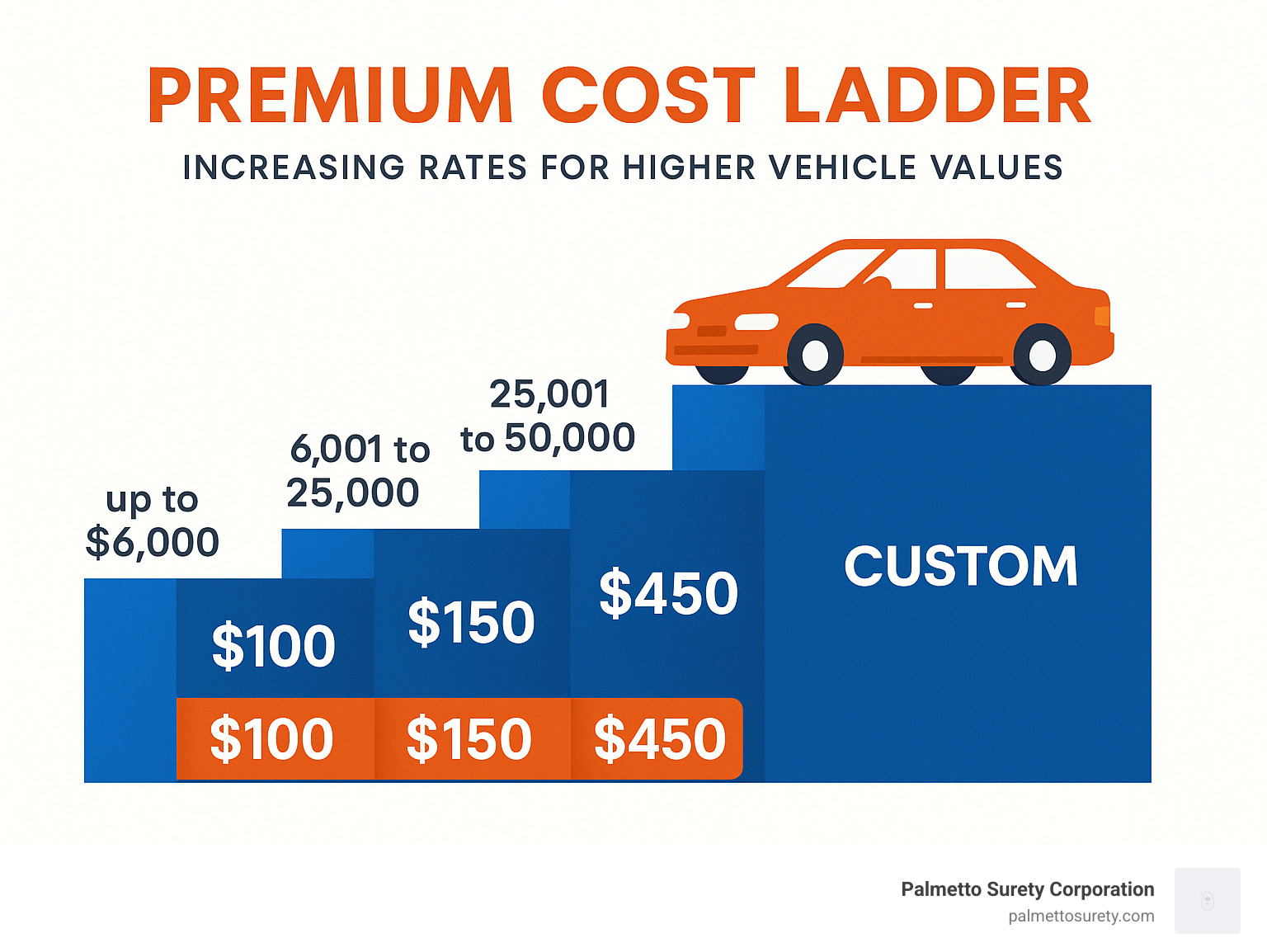
In California, the pricing for these bonds follows a simple tier system based on how much your vehicle is worth:
- Got a car worth $6,000 or less? You’ll pay a flat $100 for the full 3-year term. That’s about $33 per year.
- Driving something valued between $6,001 and $25,000? The formula is simple: $10 for every $1,000 of value, starting at $100.
- For vehicles in the $25,001 to $50,000 range, it jumps to $15 per $1,000, starting at $375.
- Luxury vehicle over $50,000? You’ll need custom underwriting, typically starting around $500.
To put this in real terms, your family sedan valued at $15,000 would cost you $150 for the entire bond period. For most folks, the premium works out to roughly 1% of your vehicle’s value.
Bond Duration and Claims
Your surety bond on car title stays active for exactly 3 years in California. During this time, if someone comes forward with proof they actually own your car (rare, but it happens), they can file a claim against your bond.
When a claim comes in, the surety company investigates to determine if it’s legitimate. If it turns out to be valid, they’ll pay the claimant up to the bond amount, but you’ll need to pay them back. This isn’t insurance for you; it’s protection for others.
After those 3 years pass without any claims, you graduate to a regular, non-bonded title. It’s like your car’s title gets a clean slate – no more “bonded” designation, just a normal title like everyone else has.
Bond Cancellation
Selling your car before the 3 years are up? You’ll need to submit a written cancellation notice at least 30 days before you want the bond to end. Just don’t expect to get your money back – these bonds are sold for the full term.
Post-Bond Life
Once your bond expires, your vehicle’s title automatically transforms into a standard title. This quiet change means:
- You’re free from the bond requirement
- Your title no longer carries any special markings or designations
- You can sell your vehicle without explaining a bonded title to confused buyers
- Your registration and insurance processes become completely standard
This transition happens without you needing to file additional paperwork or make special trips to the DMV.
Risks, Responsibilities & Alternatives
Getting a surety bond on car title opens a path to legal vehicle ownership when you’re missing the original title, but it’s worth understanding what you’re signing up for.
Owner Risks and Responsibilities
When you become the principal on a title bond, you’re taking on several important responsibilities.
First is the financial liability. If someone comes forward with proof they actually own your vehicle, the surety company will pay their claim—but then you’ll need to pay the surety back.
Honesty matters tremendously in this process. Providing incorrect information on your application isn’t just frowned upon—it could result in your bond being canceled and potentially open you up to legal issues.
Before you purchase a bond, it’s smart to run a thorough VIN check on the vehicle. This simple step can save enormous headaches by revealing any hidden liens, salvage history, or theft reports.
If you sell your vehicle during the bond period, remember to be upfront about its bonded title status with potential buyers.

Credit Considerations
Here’s some good news if your credit isn’t perfect: for most title bonds under $6,000, you won’t face a credit check. This makes bonded titles accessible to nearly everyone.
For higher-value vehicles requiring larger bonds, your credit score might influence your premium rates and approval likelihood.
That said, title bonds are typically more accessible than many other surety bonds. They’re primarily based on your vehicle’s value rather than your complete financial picture.
Alternatives to Bonded Titles
Before you commit to getting a surety bond on car title, it’s worth exploring whether one of these alternatives might work better:
If you’re already the registered owner and simply lost your title, a duplicate title application is usually simpler and less expensive.
When there’s a lienholder listed on your title, try contacting them directly first. If you’ve paid off the loan, they should provide a lien release.
Some states offer a court-ordered title process as an alternative to bonding.
For vehicles that appear abandoned, many states have specific abandoned vehicle procedures that might provide an easier path to ownership.
In limited situations, a properly executed bill of sale combined with other documentation might be sufficient for transferring a title, though this varies by state.
Each alternative has its own requirements and limitations, so research which option best fits your circumstances.
Frequently Asked Questions about Surety Bond on Car Title
What happens if someone makes a claim against my bond?
If someone believes they have a legitimate ownership interest in your vehicle, they’ll contact the surety company with documentation supporting their claim. You’ll receive notification, giving you the chance to respond.
The surety company then investigates whether the claim is valid. If they determine the claim is legitimate (very uncommon), they’ll pay the claimant up to the bond amount you purchased.
If a payment is made, you’re responsible for paying back the surety company, plus any legal costs involved.
The best way to handle a claim is to respond promptly and provide any evidence supporting your ownership. Most claims are resolved without payment once all the facts are presented.
Can I sell a vehicle with a bonded title in California?
Yes, you absolutely can sell your vehicle with a bonded title in California! The bonded title gives you legal ownership rights, including the right to sell.
You’ll need to be upfront with potential buyers about the bonded status. Some buyers might have questions or concerns about what this means for them.
When explaining to buyers, emphasize that the bond remains in effect for the remainder of the 3-year term, protecting them as well. After that period expires, they can apply for a standard title without any special requirements.
Some buyers might use the bonded status as a negotiating point for a lower price. Having a clear explanation ready about why you needed a bonded title can help reassure potential buyers.
Can I get a surety bond on car title with bad credit?
For most vehicles valued at $6,000 or less, your credit score won’t even enter the picture. Most bond providers offer these bonds at a flat rate of $100 regardless of your credit history.
For higher-value vehicles that require larger bonds, your credit may be considered, but it’s rarely a deal-breaker. Unlike many other financial products, title bonds focus primarily on the vehicle’s value rather than extensive personal financial underwriting.
Even if your credit is less than stellar, options are typically available. The premium might be slightly higher, but approval is still very possible.
Conclusion
Ready to solve your title troubles? Getting a surety bond on car title is simpler than most people think. This solution brings peace of mind when title problems seem impossible.
Think of a title bond as your bridge back to legal driving. When that original title is nowhere to be found, this bond creates a legitimate path forward that protects everyone involved while giving you full ownership rights.
Here’s what to remember as you move forward:
Your California title bond equals your vehicle’s fair market value—not twice the value like some states require. For most folks with vehicles under $6,000, you’ll pay just $100 for the entire three-year bond period. Even for higher-value vehicles, the rates remain reasonable, typically around 1% of the vehicle’s value.
The three-year bonding period passes quickly, and when it expires, you’ll receive a standard title automatically. The vast majority of bonded titles never see a single claim, making this one of the safest ways to resolve complicated title situations.
Ready to get started? Begin by gathering these essentials:
– Your vehicle’s VIN and basic details (make, model, year)
– Any proof of purchase you have (bill of sale, receipt, canceled check)
– Documentation showing your attempts to track down the original title
At Palmetto Surety Corporation, we’ve spent over two decades helping vehicle owners steer bonding requirements with minimal hassle. Our team specializes in quick approvals—often within hours—and we’re known for making what seems complicated surprisingly straightforward.
With offices throughout the Southeast including Georgia, Florida, Louisiana, Mississippi, South Carolina, Tennessee, and Texas, we understand the specific requirements in your state and can guide you through each step with confidence.
For more information about our title bond services or to get started today, visit Palmetto Surety Corporation.
Don’t let a missing title keep you in park. With a surety bond on car title, your journey continues with confidence and full legal protection.


