


Surety Bond for Car Title Cost: 7 Powerful Savings in 2025
Understanding Car Title Bond Costs: What You’ll Actually Pay
The surety bond for car title cost typically ranges from $100-$250 for most vehicles. Most states require a bond amount equal to 1.5 times your vehicle’s value, but you only pay a small percentage of this as a premium.
| Vehicle Value | Required Bond Amount | Typical Premium Cost |
|---|---|---|
| Under $6,000 | 1.5× value | Flat $100 |
| $6,000-$25,000 | 1.5× value | 1-2% of bond amount |
| Over $25,000 | 1.5× value | 1-3% of bond amount |
When you’re missing your car’s title or purchase a vehicle without proper documentation, you can’t legally register, insure, or sell it. This is where a car title surety bond (also called a lost title bond) comes in. It provides a legal pathway to vehicle ownership when the original title is unavailable or defective.
Think of it as an ownership guarantee backed by a financial promise. The bond protects previous owners, lienholders, and state DMVs against fraudulent ownership claims.
But what will it actually cost you?
Many vehicle owners panic when they hear they need a bond for “1.5 times their vehicle’s value” – thinking they’ll need to pay thousands of dollars. The good news is you only pay a small premium, typically 1-3% of the total bond amount.
For most standard vehicles, you’ll likely pay around $100-$250, regardless of your vehicle’s value. Only luxury or high-value vehicles typically exceed this range.
I’m Haiko de Poel Jr, and through my work with Palmetto Surety Corporation, I’ve helped countless vehicle owners steer the surety bond for car title cost process, ensuring they receive the most competitive rates while meeting all DMV requirements.

Easy surety bond for car title cost word list:
– how to get a title for a car without title
– indemnity bond for car title
– purchase a lost title bond
What Is a Car Title Surety Bond & Why the DMV Cares
Imagine this: You’ve just bought your dream car, but there’s one tiny problem – the title is nowhere to be found. Or perhaps you inherited Grandpa’s vintage Mustang, but the paperwork disappeared years ago. What now? Enter the car title surety bond – your pathway to legitimate vehicle ownership when life throws documentation curveballs your way.
A car title surety bond (sometimes called a lost title bond, certificate of title bond, or defective title bond) is essentially a financial promise that protects everyone involved in vehicle ownership when a valid title isn’t available. Think of it as an insurance policy that bridges the gap between your missing paperwork and legal ownership.
Your state DMV isn’t being difficult by requiring these bonds – they’re actually looking out for everyone. Without proper documentation, there’s no way to verify you’re the rightful owner or that the vehicle isn’t carrying hidden liens. The surety bond for car title cost is a small investment that creates a safety net for all parties while giving you a path to legal ownership.
If someone with a legitimate claim to your vehicle appears within the bond period (typically three years), they can seek compensation through your bond. After this waiting period passes without claims, you’ll receive a standard, non-bonded title – problem solved!

When You Must Buy One
You’ll likely need a car title surety bond if you find yourself in any of these common situations:
When your title is missing and a simple replacement won’t work (usually because it wasn’t in your name yet), or if your title is damaged beyond recognition from water, fire, or years of poor storage.
If you purchased a vehicle with only a bill of sale but no title, or if your lender went out of business before releasing your title after loan payoff.
Other scenarios include inheriting a vehicle without proper documentation, having your title stolen before registration, dealing with an incorrectly completed title, or facing out-of-state title issues that don’t meet your new state’s requirements.
How the Bond Works & Who It Protects
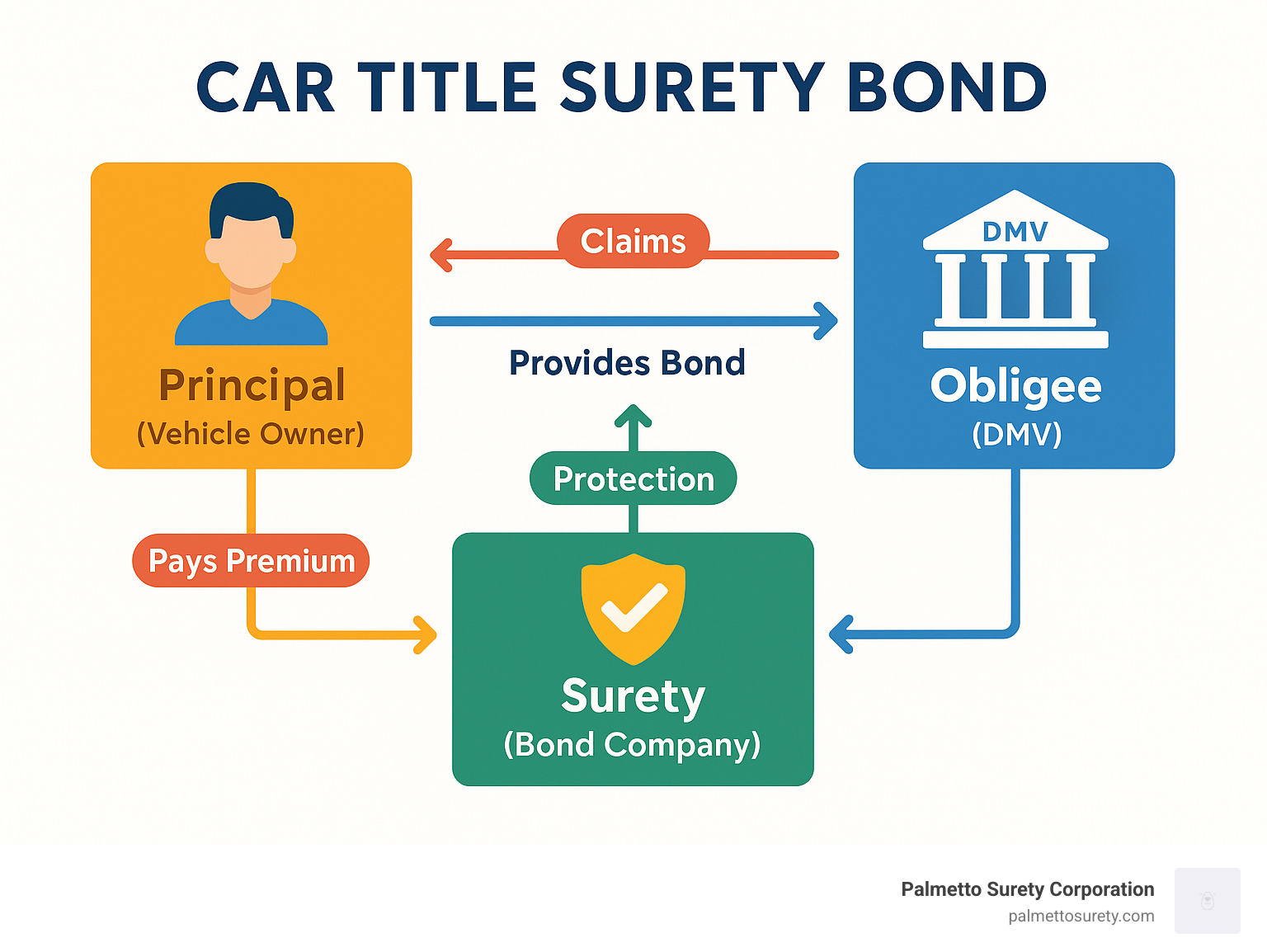
A car title surety bond creates a three-way relationship between:
You (the Principal) – As the vehicle owner seeking the bonded title, you’re responsible for purchasing the bond and ultimately for any valid claims.
The DMV (the Obligee) – Your state agency requires the bond as protection before issuing a bonded title.
The Bond Company (the Surety) – A company like Palmetto Surety Corporation issues the bond, guaranteeing payment for valid claims during the bond period.
Here’s the process in action: You purchase a bond from a surety company. This creates a financial safety net that remains in place (typically for three years) while you use your vehicle with a bonded title. If someone with a legitimate claim to the vehicle comes forward during this time – perhaps a previous owner or lienholder – they can file a claim against your bond.
The surety company will pay valid claims up to the bond amount, but (and this is crucial to understand) you remain ultimately responsible. The surety will seek reimbursement from you for any claims they pay.
This arrangement protects previous owners who may have lost their title, lienholders with financial interest in the vehicle, your state DMV from issuing titles incorrectly, and future buyers who need assurance of clear ownership.
The surety bond for car title cost essentially buys you this protection mechanism that allows you to register and use your vehicle while protecting others’ potential interests. When you consider the alternative – being unable to legally drive, insure, or sell your vehicle – the bond premium becomes a worthwhile investment in resolving your title dilemma.
Surety Bond for Car Title Cost: How Rates & Bond Amounts Are Calculated
Let’s break down how surety bond for car title costs actually work, because this is where most folks get confused (and sometimes unnecessarily worried).
Your cost has two parts: the bond amount (what the DMV requires as coverage) and your premium (what you actually pay out of pocket). The good news? You only pay the premium, which is typically just a small fraction of the total bond amount.
Most states require your bond to cover 1.5 times your vehicle’s fair market value. So how do you figure out what your car is worth? You’ve got several options:

You can use Kelley Blue Book (KBB), NADA Guides, get an appraisal from a licensed dealer, or complete state-specific forms like California’s REG 256. According to the California DMV’s guidelines on fair market value of the car, they often determine value by averaging the highest and lowest prices from a recognized guide.
Here’s where it gets better – for most everyday vehicles, you’ll pay much less than you might expect:
- Got a car worth under $6,000? You’ll likely pay just a flat $100 premium, regardless of the exact bond amount.
- Driving something worth between $6,000-$25,000? Expect to pay about 1-2% of the bond amount.
- Own a luxury vehicle over $25,000? Your premium might be 1-3% of the bond amount, with your credit score becoming more important.
For example, if you have a $10,000 car, your required bond amount would be $15,000 (that’s the 1.5× multiplier), but you’d only pay about $150-$300 as your actual premium. Not thousands – just a few hundred dollars at most!
Minimum and Maximum Surety Bond for Car Title Cost Examples
To make this concrete, let’s look at some real-world examples of what you might pay:
For your basic economy car valued at $4,000, the bond amount would be $6,000, but you’d pay just the minimum $100 premium. That’s it!
If you’re driving a nice mid-range sedan worth $12,000, your bond would be $18,000, with a premium between $180-$360.
Luxury SUV owners with vehicles worth $40,000 would need a $60,000 bond, with premiums ranging from $600-$1,800 depending on credit and other factors.
And for the classic car enthusiasts with a collector’s item worth $80,000, the bond jumps to $120,000, with premiums between $1,200-$3,600.
Vehicles over $25,000 typically require more thorough underwriting, and those over $50,000 usually need custom quotes based on a deeper financial review.
Factors That Influence Your Quote
Several things can affect what you’ll actually pay for your surety bond for car title cost:
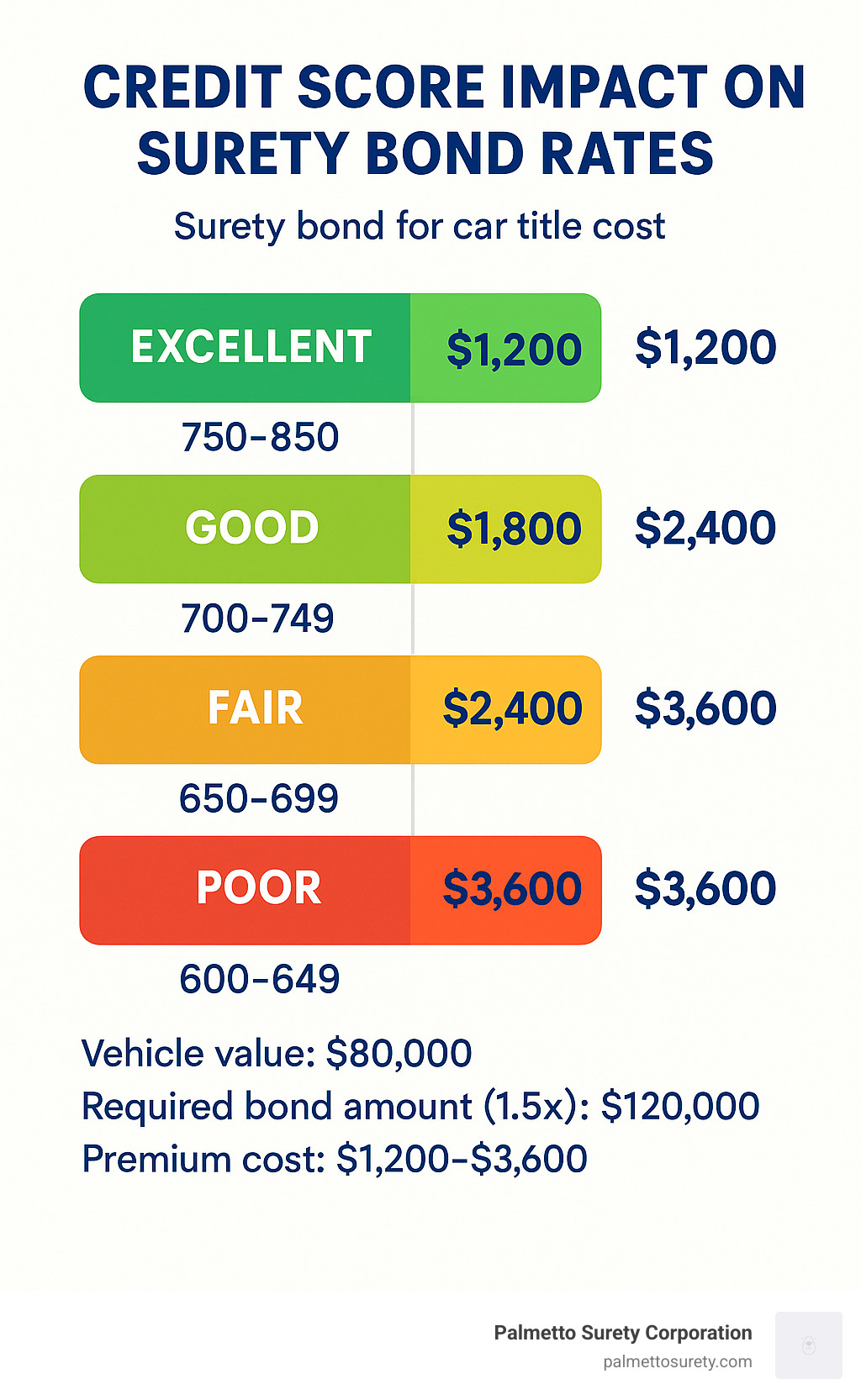
Your state’s requirements matter – some use a 1× multiplier, others 1.5× or even 2×, which directly impacts your bond amount. Your vehicle’s value is obviously crucial (higher value = higher bond amount), and for more expensive vehicles, your credit score becomes increasingly important.
Other factors include your vehicle’s age (older vehicles sometimes have more complicated histories), any previous claim history you might have, current surety market conditions, and the bond term length in your state (typically three years, but this varies).
The most common misunderstanding I see is people thinking they need to pay the full bond amount. I’ve had panicked calls from folks who thought they needed to come up with $15,000 for their bond! I’m always happy to explain they’ll only pay a small percentage of that amount.
Can You Obtain a Surety Bond for Car Title Cost with Bad Credit?
Absolutely yes! This is another area where people worry unnecessarily. Even with challenging credit, you can still get the bond you need.
For vehicles valued under $6,000 (which covers a large percentage of bonded titles), most surety companies offer that same flat $100 rate regardless of your credit score. It’s a level playing field.
For higher-value vehicles, your options might vary:
– Some states don’t even check credit for title bonds
– Bonds between $9,000-$25,000 may have rates affected by credit, but approval remains likely
– For bonds over $25,000, credit becomes more important, but solutions still exist
If your credit is less than stellar, don’t worry. At Palmetto Surety Corporation, we work with multiple markets to find solutions for all credit situations. We can help you shop different sureties (they all have different risk appetites), explore collateral options if needed, and connect with specialized markets that focus on higher-risk bonds.
We firmly believe everyone deserves a path to legal vehicle ownership, regardless of credit history. After all, you can’t improve your situation if you can’t legally drive to work!
Step-by-Step: How to Get a Car Title Bond in Your State
Getting a car title bond doesn’t have to be complicated. While each state has its own quirks, the basic process follows a similar path no matter where you live. Let me walk you through exactly what you’ll need to do to turn that vehicle with no title into your legally-owned ride.
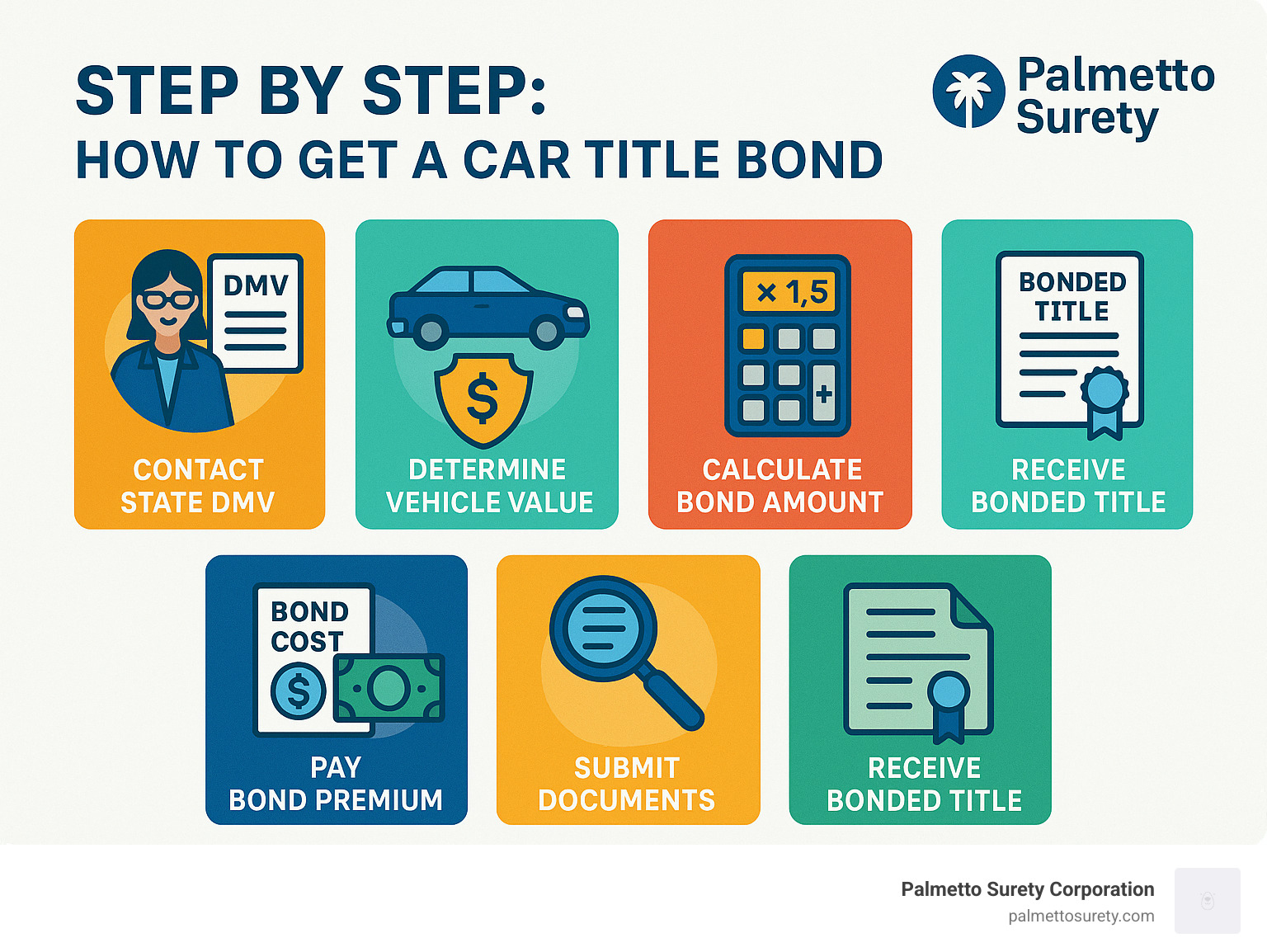
First, visit your local DMV to confirm a bonded title is the right solution for your situation. This initial conversation saves you time and prevents unnecessary steps. The DMV representative will explain your state’s specific requirements and may provide the necessary forms right then and there.
Next, you’ll need to determine your vehicle’s value. You can use Kelley Blue Book (KBB), NADA Guides, or get an appraisal from a licensed dealer. Print out this valuation – you’ll need it for both the bond company and the DMV.
With your vehicle’s value in hand, calculate the required bond amount. Most states require a bond worth 1.5 times your vehicle’s value. So if your car is worth $10,000, you’ll need a $15,000 bond. Don’t worry – you won’t pay this full amount!
Now it’s time to apply for your bond. Contact a reputable surety company like Palmetto Surety Corporation and complete their application. You’ll provide details about your vehicle (year, make, model, VIN) along with your personal information. The good news? Most applications are approved quickly – often within 24-48 hours.
Once approved, you’ll pay the premium – remember, this is just a small percentage of the total bond amount. For most vehicles, you’ll pay between $100-$250, regardless of the bond size.
With bond certificate in hand, head back to the DMV with all your required documentation. This is where preparation pays off! Bring everything on the checklist below to avoid making multiple trips.
Many states require a physical VIN inspection to verify the vehicle matches the paperwork. This can often be done at the DMV or by a law enforcement officer.
Finally, after processing (which typically takes 2-3 weeks), you’ll receive your bonded title. It will look similar to a regular title but will indicate its bonded status. The entire process from start to finish usually takes about 4-5 weeks, though the bond itself can often be issued within 1-2 business days.
Required Documents Checklist
When you head to the DMV to apply for your bonded title, being prepared will save you significant time and frustration. Every state has slightly different requirements, but most will ask for:
Title application form – Your state’s specific form (like REG 227 in California) that initiates the title request. Fill this out completely before your visit.
Proof of ownership – This could be a bill of sale, canceled check, or other evidence showing you purchased the vehicle legitimately.
Statement of Facts – A written explanation of why you don’t have the original title. Be honest and thorough here.
VIN inspection certificate – Documentation that the vehicle identification number has been physically verified.
Odometer disclosure – Required for vehicles less than 10 years old to prevent odometer fraud.
Vehicle appraisal – Documentation of your vehicle’s current market value from a recognized source.
Your surety bond certificate – The document provided by your surety company showing bond coverage.
Personal ID – Your driver’s license or state ID card.
Insurance proof – Current auto insurance card showing coverage that meets state minimums.
Payment for fees – Cash, check, or card to cover DMV processing fees.
Having everything organized and ready will help ensure your application moves smoothly through the system. The surety bond for car title cost is just one part of the process, but it’s a crucial step in establishing your legal ownership.
Registering Your Vehicle After the Bond
Once your bond is in place, you’re ready for the final stretch – getting your vehicle properly registered. The process is straightforward but requires attention to detail.
Start by submitting your bond certificate and completed title application to the DMV. The clerk will review your documents and let you know if anything else is needed.
You’ll then pay your state’s registration fees, which vary based on your location, vehicle type, and weight. These fees fund road maintenance and other transportation infrastructure.
Many DMVs issue temporary registration while they process your bonded title application. This allows you to legally drive your vehicle during the waiting period, which is especially important if you need the vehicle for work or family transportation.
You’ll receive standard license plates just like any other vehicle owner. There’s no special designation on the plates indicating your title is bonded.
The DMV will verify your insurance coverage meets state minimum requirements. This protects both you and other drivers on the road.
Finally, you’ll receive your bonded title in the mail, typically within a few weeks. This title will have a notation indicating its bonded status, but otherwise functions like a standard title.
The bond period generally lasts three years. During this time, you can drive, insure, and even sell the vehicle (though you must disclose its bonded status to buyers). After the bond period expires without claims, you can apply to have the bond notation removed, resulting in a clear, standard title.
At Palmetto Surety Corporation, we’ve helped thousands of vehicle owners through this process. While it might seem daunting at first, most people find it’s much simpler than they feared – and the peace of mind that comes with legal vehicle ownership is well worth the effort.
State Variations, Alternatives & Common Mistakes
The world of title bonds isn’t one-size-fits-all. The surety bond for car title cost and requirements can vary dramatically depending on where you live. Let’s take a look at how different states handle this process:
| State | Bond Multiplier | Bond Term | Minimum Bond | Special Requirements |
|---|---|---|---|---|
| California | 1.0× value | 3 years | $5,000 | Vessels: $2,000 minimum |
| Florida | 2.0× value | 3 years | None | Must verify not stolen |
| Georgia | 1.5× value | 4 years | None | Title tax must be paid |
| New York | 1.5× value | 3 years | None | DMV appraisal required |
| Texas | 1.5× value | 3 years | $4,000 | VTR-130-SOF form required |
| Michigan | 1.0× value | 3 years | None | Can use lowest KBB value |
| Illinois | 1.5× value | 3 years | None | Must attempt title recovery |
| Ohio | 1.5× value | 3 years | None | Out-of-state bonds accepted |
As you can see, some states like Florida require a bond amount equal to twice your vehicle’s value, while Michigan only requires the actual value. Georgia stands out with a longer 4-year bond term compared to the standard 3 years in most states.
Not everyone’s situation fits neatly into the bonded title process. If you’re facing unusual circumstances, you might consider these alternatives:
A court-ordered title might be your solution if there are complex ownership disputes. While typically more expensive and time-consuming than a bonded title, it provides the strongest legal foundation for ownership.
Some savvy vehicle owners use what’s known as the Vermont registration method for older vehicles. Vermont has unique laws that allow registering certain vehicles without a title, which can then be transferred to your home state.
If you’ve performed significant work on an abandoned vehicle, a mechanic’s lien might be an option in certain states. This process allows repair shops to claim ownership of vehicles when owners fail to pay for services.
California and some other states offer a diligent effort process where you can establish ownership by documenting your attempts to contact previous owners. This can sometimes eliminate the need for a bond altogether.

Common Errors That Cost You Money
I’ve seen plenty of vehicle owners make costly mistakes during the bonded title process. Here are the pitfalls you should avoid:
Using incorrect vehicle valuations can lead to purchasing a bond for the wrong amount. Always use current, reputable sources like KBB or NADA guides, and keep documentation of your valuation.
Waiting too long after getting a quote is another common error. Bond rates, like any insurance product, can change. When you receive a good quote, act promptly to lock in that rate.
Missing signatures might seem minor, but they’ll cause your application to bounce right back from the DMV. Double-check that all required signature fields are completed before submission.
The vehicle identification number (VIN) is the unique fingerprint of your vehicle. One wrong digit can create a bureaucratic nightmare, so verify this critical information carefully on all documents.
Many people panic about the bond amount, thinking they need to pay the full $15,000 (or whatever your bond amount is). You only pay the premium—typically just 1-3% of the total bond amount.
Existing liens can’t simply be ignored. If you know of any outstanding loans or liens against the vehicle, these must be addressed before proceeding with a bonded title.
Some vehicle owners attempt a DIY approach when a simple replacement title would suffice. If you’re the last titled owner and merely lost your title, you might qualify for a straightforward replacement process without needing a bond.
By avoiding these common mistakes, you’ll save yourself time, money, and the headache of having your application rejected. At Palmetto Surety Corporation, we guide clients through this process every day, helping them steer these potential pitfalls with ease.
What Happens After You Have a Bonded Title?
Once you receive your bonded title, you should understand several important aspects:
3-Year Liability Window: In most states, the bond remains active for three years. During this period, if someone with a legitimate claim to the vehicle comes forward, they can file a claim against your bond.
Claims Scenario: If a valid claim is made, the surety company will investigate. If deemed valid, they’ll pay the claimant up to the bond amount. You’ll then be responsible for reimbursing the surety company for the claim amount.
Converting to Standard Title: After the bond period expires without claims, you can apply to have the bond notation removed, resulting in a standard title. This process typically requires a simple application to the DMV.
Finding the Original Title: If you find the original title after obtaining a bonded title, don’t simply discard the bonded title. Contact your DMV for guidance on how to proceed, as specific procedures vary by state.
Selling with a Bonded Title: You can sell a vehicle with a bonded title, but you must disclose this status to potential buyers. Some buyers may be hesitant or offer less due to the bonded status.
Risks & Downsides: The primary risk is that a legitimate claimant appears during the bond period. Additionally, some insurance companies may charge higher premiums for vehicles with bonded titles.
The surety bond for car title cost provides peace of mind during this three-year period, ensuring you can legally drive, insure, and eventually sell your vehicle despite the original title issues.
Frequently Asked Questions about Surety Bond for Car Title Cost
How long does a title bond last and can it be renewed?
Most title bonds stay active for three years, though some states march to their own beat (Georgia, for instance, requires four years). The good news? These bonds naturally expire after their term—no renewal headaches necessary.
Once your bond period passes without anyone raising their hand to claim your vehicle, you can apply to remove that “bonded” notation from your title. It’s like graduating to a normal title! This process is usually straightforward—just a simple form submitted to your local DMV, and you’re on your way to standard title ownership.
What if someone files a claim against my bond?
This is the scenario that keeps vehicle owners up at night, but understanding the process helps ease those worries. If someone believes they have rights to your vehicle, they can file a claim against your bond. The surety company then puts on their detective hat to investigate whether the claim holds water.
Valid claims typically come from:
– A previous owner who can prove legitimate ownership rights
– A bank or finance company with an unpaid loan on the vehicle
– Someone with evidence the vehicle was stolen
If the surety company determines the claim is valid, they’ll pay the claimant up to the bond amount. Here’s the important part though—this isn’t free money. You’ll ultimately be responsible for paying back the surety company for any claims they cover.
This is precisely why the surety bond for car title cost is so valuable—it provides immediate protection for legitimate claimants while giving you breathing room to address the situation properly.
Are there vehicles that cannot use a bonded title?
Yes, not every vehicle qualifies for the bonded title path. Several situations can slam that door shut:
Vehicles with existing liens can’t receive a bonded title until those financial obligations are satisfied. This makes sense—the lender has a financial stake in the vehicle that needs to be respected.
If your dream car turns out to be hot (stolen, that is), you won’t be getting a bonded title. The system is designed to prevent laundering stolen vehicles through the bonded title process.
Vehicles tangled in legal proceedings—whether divorce disputes, inheritance battles, or repossession cases—typically need to clear those problems before becoming eligible for a bonded title.
Some states give the side-eye to salvage or total loss vehicles, requiring special procedures beyond standard bonded titles. Similarly, extremely valuable vehicles might exceed state-imposed limits for bonded title eligibility.
Truly abandoned vehicles usually require a different legal pathway altogether, and some states restrict bonded titles to vehicles previously titled within their borders.
Before investing time and money in the bonded title process, a quick call to your state DMV can save you headaches by confirming your specific vehicle qualifies. At Palmetto Surety, we’re always happy to help steer these requirements and explain the surety bond for car title cost for your particular situation.
Conclusion

Breathing a sigh of relief after navigating the maze of vehicle ownership paperwork is a feeling every car owner deserves. The good news? Getting a surety bond for car title cost is far more affordable than most people initially fear. As we’ve explored throughout this guide, most vehicle owners will pay just $100-$250 for their bond premium, regardless of their vehicle’s total value.
You’re not paying the full bond amount (typically 1.5 times your vehicle’s value) – just a small premium of 1-3%. For most standard vehicles valued under $6,000, you’ll likely pay a flat $100 rate that won’t break the bank. This small investment provides three years of protection while establishing your legal ownership rights.
What I find most reassuring for my clients is that even those with credit challenges have options. The bonded title process creates a path to legal vehicle ownership for nearly everyone, regardless of financial background. Though the process involves several steps with your local DMV, most people can complete everything within 4-5 weeks and drive away with peace of mind.
At Palmetto Surety Corporation, we’ve guided thousands of vehicle owners through this process over our 20+ years in the business. Our team takes pride in approving most applications within hours rather than days, getting you back on the road legally and confidently. We understand that vehicle ownership issues don’t just represent paperwork problems – they impact your daily life, work commute, and family transportation needs.
Whether you’re dealing with a lost title after purchasing a used car, inheriting a vehicle without proper documentation, or facing any other title complication, a car title surety bond offers a straightforward, legal path forward. The process might seem daunting at first glance, but with the right guidance, it becomes remarkably manageable.
For more information about our bonded title services or to get started with your application today, visit Palmetto Surety Corporation. With offices throughout Georgia, Florida, Louisiana, Mississippi, South Carolina, Tennessee, and Texas, we’re ready to help you secure your vehicle’s legal status and drive with confidence.


