


Can a Bail Bondsman Make an Arrest? 7 Powerful Facts 2025
Understanding Bail Bondsman Arrest Powers
Can a bail bondsman make an arrest? Yes, but only under specific circumstances. Here’s what you need to know:
| Question | Answer |
|---|---|
| Can they arrest anyone? | No, only defendants who have skipped bail |
| Do they need a warrant? | In most states, yes |
| Can they use force? | Only reasonable force |
| Can they enter homes? | The defendant’s home: usually yes Third-party homes: generally no without consent |
| Is their authority the same as police? | No, their power comes from the bail contract, not law enforcement authority |
When you’re released from jail on a bail bond, you’re not just walking free—you’re entering into a legal contract. The bail bondsman posts your bail for a fee (typically 10% of the total bail amount), and in return, you promise to show up for court. If you don’t appear, that’s when things get complicated.
The bail bondsman’s ability to arrest stems from a 150-year-old Supreme Court case, Taylor v. Taintor (1872), which established that when a defendant is released on bail, they are technically in the “custody” of the bondsman, not completely free.
This is not the same as police arrest powers. Bail bondsmen are private citizens with a financial stake in making sure you appear in court. If you skip bail, they stand to lose the full bail amount they guaranteed to the court.
I’m Haiko de Poel Jr, and through my work with Palmetto Surety Corporation, I’ve gained extensive insight into the bail bond industry and the legal framework governing when can a bail bondsman make an arrest of defendants who violate their bail agreements.
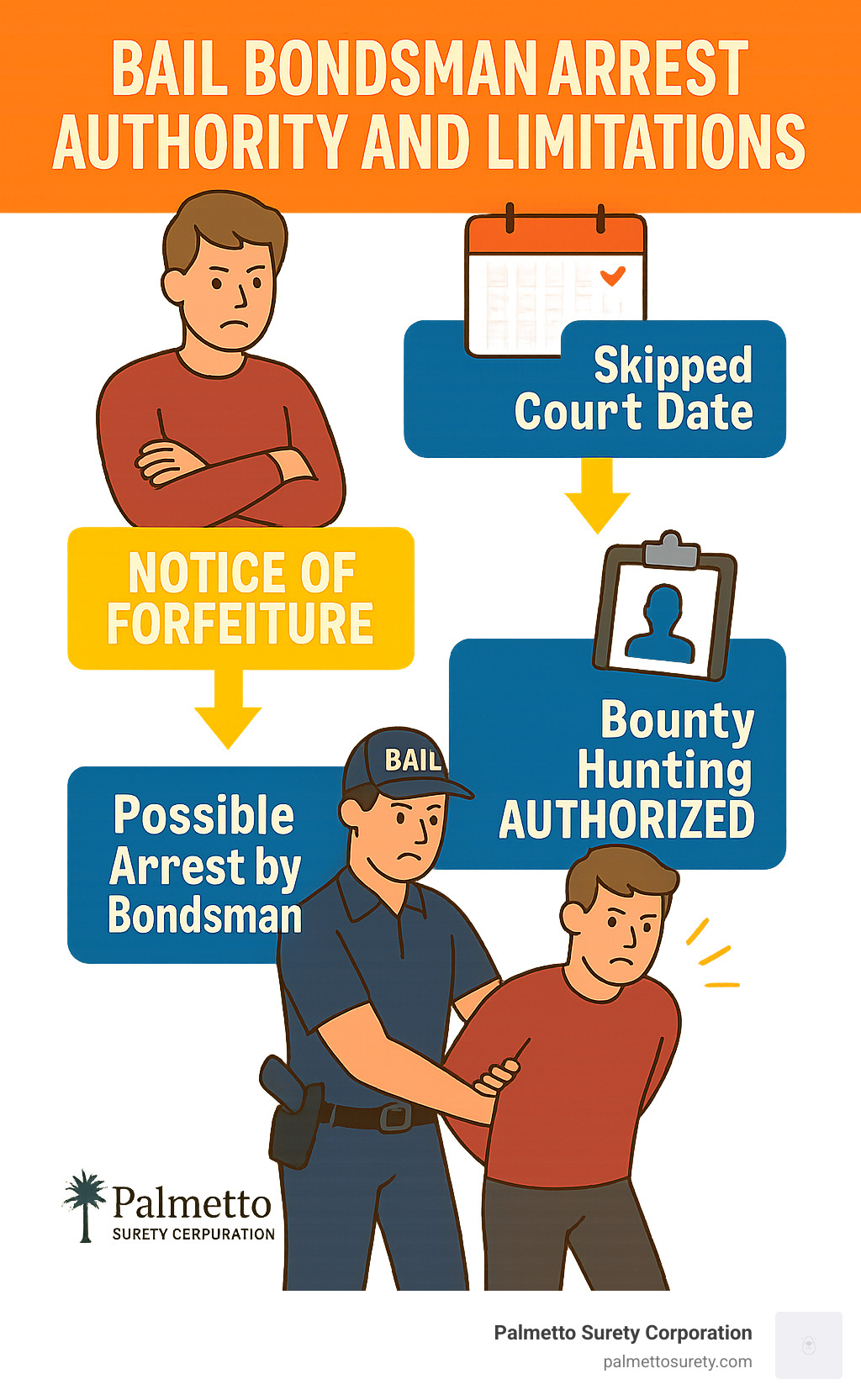
Can a bail bondsman make an arrest terms made easy:
– do bail bondsman make good money
– how do you make money as a bail bondsman
What Does a Bail Bondsman Actually Do?
When someone gets arrested and a judge sets bail at $10,000, most folks don’t have that kind of cash sitting around. That’s where bail bondsmen step in – we’re the financial lifeline between jail and freedom for many Americans.

At its core, a bail bondsman provides a financial guarantee to the court. We promise that if we help get you out of jail, you’ll show up for your court date. If you don’t, we’re on the hook for the full amount.
Here at Palmetto Surety Corporation, our network of bail agents typically charges a 10% fee of the total bail amount. So for that $10,000 bail, you’d pay us $1,000 – which is non-refundable, even if your case gets dismissed. This fee compensates us for taking on significant financial risk and handling all the paperwork and monitoring.
Think of bail like a promise backed by money. The whole purpose of bail isn’t to punish someone before trial – it’s to ensure they come back to face their day in court while allowing them to maintain their job, family connections, and help prepare their defense.
What many people don’t realize is that bail bondsmen are actually quite effective at what they do. Department of Justice statistics show defendants released through surety bonds have significantly better court appearance rates compared to other pretrial release methods.
The Bail Contract & Financial Stakes
When you work with one of our bail agents, you’re entering into a serious legal agreement. The surety bond we issue is backed by our promise to pay the full bail amount if you disappear.
The relationship works like this: you pay us the premium (that 10% fee), and sometimes provide collateral like property deeds, car titles, or jewelry for higher-risk cases. In exchange, we post the bond that gets you released.
The financial stakes are substantial for everyone involved. If you skip court, we’ll lose the entire bail amount unless we can find you and bring you back. That’s why we’re very careful about who we post bond for and why we sometimes require a co-signer who promises to help ensure you’ll appear.
This also explains why bail bondsmen have the authority to track down and apprehend clients who don’t show up – forfeiture of the full bond amount creates a powerful financial incentive to make sure every client makes their court date.
When the system works correctly, everyone wins: defendants maintain their freedom and employment while awaiting trial, courts get high appearance rates, jails reduce overcrowding, and we earn our fee for facilitating the process and managing the risk.
Can a Bail Bondsman Make an Arrest? Legal Authority Explained
Ever wonder where a bail bondsman gets the authority to track down and arrest someone who skips bail? It all comes from a fascinating 1872 Supreme Court case called Taylor v. Taintor – the legal foundation that’s shaped this industry for over 150 years.
When the Supreme Court ruled on this case, they established something called “constructive custody.” In plain English, this means that when you’re released on bail, you’re not completely free – you’re actually in the custody of your bail bondsman.
The Court explained it quite colorfully:
“When bail is given, the principal is regarded as delivered to the custody of his sureties. Their dominion is a continuance of the original imprisonment. Whenever they choose to do so, they may seize him and deliver him up to his discharge; and if it cannot be done at once, they may imprison him until it can be done. They may exercise their rights in person or by agent. They may pursue him into another state; may arrest him on the Sabbath; and if necessary, may break and enter his house for that purpose.”
This creates what we call a “contractual custody” relationship. The defendant (the “principal”) remains under the supervision of the bail bondsman (the “agent”) until their court case concludes.
Bail bondsmen are not police officers. They’re private citizens with specific, limited powers granted through this unique contract relationship and backed by court precedent.
When can a bail bondsman make an arrest?
A bail bondsman’s arrest authority isn’t unlimited – far from it. They can only make arrests under very specific circumstances:
Can a bail bondsman make an arrest when a defendant has failed to appear in court? Yes. This is the most common scenario. When someone misses their court date, it triggers a bond forfeiture and usually results in a bench warrant.
Can a bail bondsman make an arrest to surrender the bond early? Yes. Sometimes a bondsman may decide to “surrender the bond” before a court date if they believe the defendant has become a flight risk or is violating bond conditions.
Can a bail bondsman make an arrest of someone who’s entered fugitive status? Yes. Once a defendant misses court and a bench warrant is issued, they’re legally considered a fugitive.
What a bail bondsman cannot do is arrest someone for committing a new crime (unless it involves skipping bail), being suspected of a crime, or for any reason unrelated to the bail agreement.
At Palmetto Surety Corporation, our network of agents takes these limitations seriously, operating within legal boundaries to protect both their financial interests and defendants’ rights.
How can a bail bondsman make an arrest without a police badge?
Making a legal arrest as a bail bondsman follows a specific process that differs from police procedures:
First, proper identification is essential. The bail agent must clearly identify themselves and show documentation, including their bail agent license and a certified copy of the bail bond (often called a “bail piece”).
Next comes documentation. In most states, the agent must have a copy of the bench warrant or bond forfeiture paperwork when making an arrest.
Unlike police officers, bail agents can only use reasonable force necessary to detain the defendant. Excessive force can lead to serious civil and criminal consequences.
Many jurisdictions require bail agents to notify local law enforcement before attempting to apprehend a defendant – a good practice that helps prevent dangerous misunderstandings.
One common misconception worth clearing up: bail bondsmen don’t need to read Miranda rights. Why? Because they’re not gathering evidence for prosecution – they’re simply returning the defendant to the court’s custody as required by their contract.
The scientific research on bail enforcement, as documented in case law, shows this system has evolved to balance the rights of defendants with the practical needs of the court system.
How, Where & Whom Bail Bondsmen May Arrest
When it comes to arrest powers, bail bondsmen operate in a very specific lane. Unlike police officers who have broad authority, a bail agent can only arrest:
- The exact defendant named in their bail bond agreement
- For the single purpose of returning them to court custody
- Within the boundaries set by state laws
Many bondsmen don’t actually make arrests themselves. Instead, they hire professional fugitive recovery agents (yes, the folks commonly called “bounty hunters”) to track down and apprehend defendants who’ve skipped town. These agents aren’t police—they’re working under the bail bondsman’s authority.
Let’s break down how bail bondsman powers stack up against police powers:
| Authority | Bail Bondsman | Police Officer |
|---|---|---|
| Arrest for new crimes | No | Yes |
| Need warrant for arrest | Usually yes | Not always |
| Enter defendant’s home | Usually yes | Need warrant or exigent circumstances |
| Enter third-party home | No (without consent or warrant) | Need warrant or exigent circumstances |
| Use of force | Reasonable force only | Reasonable force based on situation |
| Jurisdiction | Limited by state laws | Within their jurisdiction |
| Miranda rights requirement | No | Yes, for custodial interrogation |
Entry Into Homes & Property Limits

Here’s where things get tricky—and where bail bondsmen often get into trouble. The rules about entering private property depend entirely on whose property it is.
When it’s the defendant’s home:
Based on that 1872 Supreme Court case (Taylor v. Taintor), bail bondsmen generally can enter a defendant’s residence to arrest them, even without a separate warrant. Think of it as an extension of the original bail agreement. However, many states have added their own restrictions to this power.
When it’s someone else’s home:
This is a whole different ball game. Can a bail bondsman make an arrest in your house if you’re harboring a friend who skipped bail? Generally not without:
– Getting your permission first
– Having a separate search warrant
– Being able to see the defendant from outside
Many states have “Castle Doctrine” laws that protect homeowners from forced entry. These apply to bail agents just like any other private citizen. Breaking these rules can lead to trespassing charges, lawsuits, or even more serious criminal charges.
At Palmetto Surety Corporation, we always advise our network of bail agents to play it safe: verify locations, get proper documentation, coordinate with local police when needed, and never force entry into a third-party home without proper authority.
Crossing State Lines or Country Borders

Things get even more complicated when defendants cross state lines. The Uniform Criminal Extradition Act provides some guidelines for interstate fugitive recovery, but the rules vary dramatically from state to state.
While that old Supreme Court case suggests bail agents can pursue defendants across state lines, the reality is more nuanced. Many states require out-of-state bondsmen to register with local authorities or team up with agents licensed in that state.
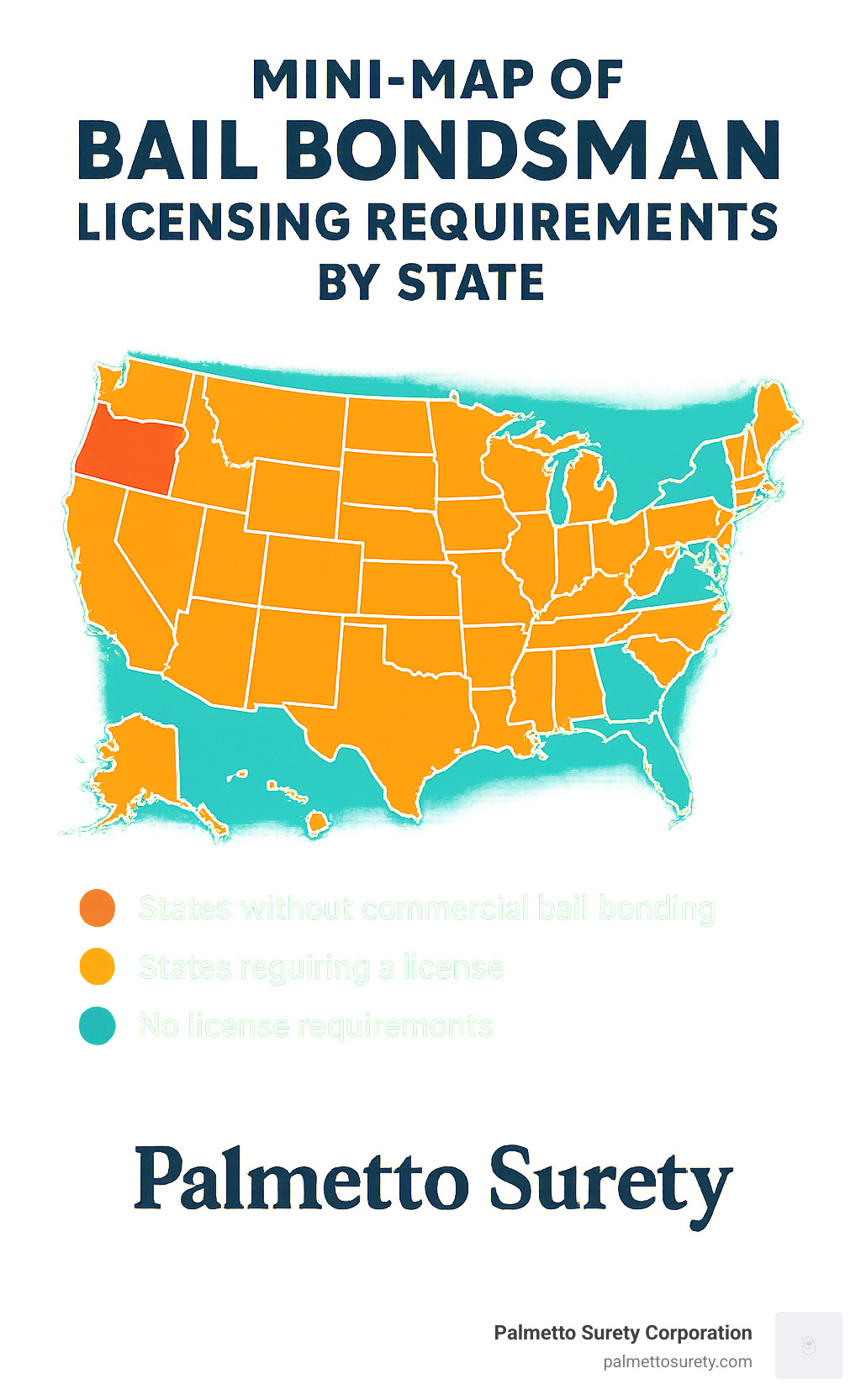
Here’s something many people don’t realize: four states—Illinois, Kentucky, Oregon, and Wisconsin—have completely banned commercial bail bonding. This makes it illegal for bail agents to make arrests there, period.
And if you’re thinking of fleeing the country? Bounty hunting is illegal in virtually every developed nation except the Philippines. Some countries have even extradited bounty hunters who tried to make arrests on their soil.
Let me give you a real-world example: If someone skips bail in South Carolina (where Palmetto Surety operates) and runs to Tennessee, a bail agent would need to understand both states’ laws and potentially coordinate with Tennessee authorities before attempting an arrest.
This legal maze is precisely why many bail bondsmen hire specialized skip tracers and recovery agents who understand the complex legal landscape of interstate pursuit. It’s not as simple as the movies make it seem!
Limits, Rights & Remedies for Defendants and Third Parties
When it comes to arrest powers, bail bondsmen walk a fine line between contractual authority and legal boundaries. While they can pursue defendants who’ve skipped bail, their powers aren’t unlimited—and both defendants and innocent bystanders have important protections under the law.
The “reasonable force standard” is perhaps the most critical limitation. Simply put, bail agents can only use the minimum force necessary to take someone into custody. Going beyond that? That’s when legal troubles begin for the bondsman, not the defendant.
“We train our agents to prioritize peaceful apprehension,” says Haiko de Poel Jr. of Palmetto Surety Corporation. “The goal is always to bring the defendant back to court—not to create new legal problems for anyone involved.”
Most states also require clear identification—bail agents must announce who they are and why they’re there before attempting an arrest. This isn’t just professional courtesy; it’s the law. Breaking down doors unannounced or damaging property unnecessarily can lead to civil liability for the bondsman.
Unfortunately, the industry isn’t without its problems. The FBI investigation known as “Operation Wrinkled Robe” in Louisiana uncovered serious misconduct by some bail enforcement agents. Cases like these highlight why proper training and oversight matter—and why the California Department of Insurance, among other state regulators, has developed strict guidelines for bail recovery.
Your Rights If a Bondsman Oversteps
If you believe a bail bondsman has crossed the line, you’re not powerless. Here’s what you should know:
First, always ask for identification. A legitimate bail agent should readily show their license and documentation, including the warrant or bond paperwork. If they refuse, that’s a major red flag.
Second, document everything. In this age of smartphones, recording the interaction (where legal) provides powerful evidence if things go wrong. Many cases of bondsman overreach have been resolved because someone had the foresight to hit “record.”
Third, don’t hesitate to call 911 if you feel threatened or believe the bail agent is acting illegally. Local police can help determine whether the bondsman is operating within their authority.
It’s also worth noting the “Miranda myth”—bail agents don’t need to read you your rights because they’re not law enforcement officers gathering evidence for prosecution. They’re simply returning you to court custody.
If your rights have been violated, consult an attorney about potential civil claims, and file a formal complaint with your state’s regulatory agency (typically the Department of Insurance). These agencies take misconduct seriously and have the power to impose meaningful penalties.
Consequences for Bondsmen Who Violate the Rules
When bail bondsmen step outside their legal authority, the consequences can be severe and career-ending:
Their license can be suspended or revoked by state regulatory agencies. Without a license, they can’t work in the industry at all—period.
Courts may refuse to accept or exonerate bonds posted by agents with a history of violations, effectively cutting off their ability to do business.
Depending on the severity of the violation, bail agents may face criminal charges ranging from trespassing to assault or even kidnapping. The badge doesn’t provide immunity from prosecution.
Victims can also pursue civil damages for everything from false imprisonment to emotional distress. These lawsuits can result in substantial financial penalties.
Perhaps most damaging in the long run is the blow to a bondsman’s business reputation. In this industry, credibility with courts, clients, and surety companies is essential. Once lost, it’s nearly impossible to rebuild.
At Palmetto Surety Corporation, we understand these stakes completely. That’s why we carefully vet our network of bail agents, ensuring they’re not just licensed professionals but individuals who understand and respect the legal boundaries of their authority. After more than 20 years in the industry, we’ve learned that doing things the right way isn’t just ethically sound—it’s good business.
Can a bail bondsman make an arrest? Yes—but only within carefully defined legal parameters that protect everyone’s rights.
Practical Tips: What To Do If a Bail Bondsman Shows Up

It’s a scenario that can catch anyone off guard—a knock at the door, and suddenly you’re face-to-face with a bail bondsman looking to take someone into custody. Whether you’re the defendant or someone living with them, these moments can be tense and confusing. Let me walk you through how to handle this situation with grace and protect your rights.
If you’re the defendant who missed a court date, staying calm is your best first move. I’ve seen many situations escalate unnecessarily when people panic. Take a deep breath—running or resisting will only compound your problems and might add new charges to your record.
Always ask to see identification. A professional bail agent won’t be offended by this request. They should readily show you their bail agent license and the paperwork authorizing them to take you into custody. This might include a bench warrant or bond forfeiture documentation. Take a moment to review these documents carefully.
“Can I see the warrant, please?” is a perfectly reasonable question to ask. Verifying the warrant ensures that everything is being done by the book. Check that your name appears correctly and that the documentation is current.
If everything seems in order, consider voluntary surrender. I’ve advised many clients that cooperating often works in your favor when you eventually appear before a judge. It demonstrates responsibility and respect for the legal process—qualities that courts value.
Before you go anywhere, though, you have the right to request a call to your attorney. While bail agents aren’t legally required to allow this, reputable professionals like those who work with Palmetto Surety Corporation typically permit a brief call. A quick conversation with your lawyer can help clarify your options and next steps.
Now, if you’re not the defendant but rather someone who shares a home with them, your position is different. You don’t have to let bail agents into your home without a search warrant or your explicit permission. The protection of your private property remains intact, even when someone you live with has skipped bail.
When bail agents come to your door looking for someone else, asking for documentation is essential. Request to see their identification, professional license, and any warrants they claim to have. This isn’t being difficult—it’s exercising your legal rights.
If something feels off or you’re uncertain about the situation, don’t hesitate to contact law enforcement. Local police can verify the bail agent’s authority and ensure everything proceeds legally. In most states, your home is protected by Castle Doctrine laws against unauthorized entry.
For everyone involved in these situations, documenting everything can provide valuable protection. If possible and legal in your state, consider recording the interaction on your phone. This creates an objective record of what transpired.
Above all, avoid physical confrontation. Even if you believe the bail agent is overstepping, physical resistance is never the answer. Instead, document the behavior and report any misconduct to your state’s regulatory agency (often the Department of Insurance) after the fact.
Myth-Busting: TV vs. Reality
Television has given us some wildly entertaining but thoroughly misleading ideas about how bail recovery works. Shows like “Dog the Bounty Hunter” might make for good TV, but they don’t reflect the reality of how can a bail bondsman make an arrest in real life.
Those dramatic high-speed chases and confrontations you see on screen? In reality, most fugitive recovery involves methodical research, patient surveillance, and carefully coordinated, low-key apprehensions. Good bail recovery agents do their homework before ever approaching a door.
Perhaps the most dangerous myth is that bounty hunters can kick down any door to apprehend a fugitive. The truth is far more nuanced—entry into third-party homes without consent or a warrant is generally illegal and could expose the bail agent to serious legal consequences.
Many people believe bail bondsmen have the same authority as police officers. They don’t. Their authority is strictly limited to apprehending defendants who have skipped bail on bonds they’ve underwritten. They can’t arrest for new crimes or investigate unrelated matters.
Another common misconception is that bounty hunting is legal everywhere. In fact, it’s completely illegal in four U.S. states (Illinois, Kentucky, Oregon, and Wisconsin) and most other countries. Attempting to apprehend someone in these jurisdictions could result in criminal charges against the bail agent.
Finally, contrary to popular belief, bail bondsmen do need proper documentation to arrest someone. In most states, they must have proof of the defendant’s failure to appear and often a bench warrant. They can’t simply decide on their own to take someone into custody without proper authorization.
Understanding these realities helps everyone steer bail recovery situations with greater knowledge and confidence. At Palmetto Surety Corporation, we believe that an informed public makes the bail process work better for everyone involved.
State-By-State Snapshots & Places Without Commercial Bail
The landscape of bail bond regulations looks dramatically different depending on which state you’re in. This patchwork of laws can be confusing for defendants and their families, especially when crossing state lines.
Four states have completely abolished commercial bail bonding:
- Illinois was ahead of the curve, eliminating the practice way back in 1963.
- Kentucky replaced commercial bail with a comprehensive pretrial services program.
- Oregon banned the industry in 1973, finding it inconsistent with their justice goals.
- Wisconsin uses a direct deposit system where defendants work with the court, not bondsmen.
In these states, the question “can a bail bondsman make an arrest?” has a simple answer: they can’t, because commercial bail bondsmen don’t legally exist there.
For the rest of the country, the rules vary significantly from state to state. Some states have acceptd strict regulations while others maintain a more hands-off approach.
California takes regulation seriously. Bail agents must complete 20 hours of pre-licensing training, pass a comprehensive exam, submit to background checks, and post a $1,000 surety bond. When making arrests, California agents must clearly identify themselves, explain why they’re making the arrest, and in certain situations, advise defendants of their rights. These requirements help protect both defendants and the public.
New York focuses on defendant rights, requiring bail agents to provide a clear statement of rights to defendants and imposing a 24-hour cooling-off period after arrest before contacting defendants. This gives people time to understand their situation and consider their options.
Mississippi takes a different approach. Under Mississippi Code § 99-5-27, bail agents have explicit authority to arrest principals anywhere or authorize others to do so for surrender purposes. This gives Mississippi bondsmen broader powers than in many other states.
Tennessee has created specific rules for interstate pursuit situations, requiring out-of-state bail agents to partner with Tennessee-licensed agents before making arrests. This ensures local oversight while still allowing for interstate fugitive recovery.
At Palmetto Surety Corporation, we’ve spent over two decades building a network of professional bail agents throughout the Southeast who understand the nuances of each state’s regulations. When our agents operate, they do so with complete knowledge of local statutes and requirements, ensuring both legal compliance and respect for defendants’ rights.
This state-by-state variation is why it’s so important to work with experienced, local bail agents who understand the specific rules of their jurisdiction. The legal authority to answer “can a bail bondsman make an arrest?” depends entirely on where you are and the specific circumstances involved.
Frequently Asked Questions about Bail Bondsmen Arrest Powers
Can a bail bondsman arrest someone in another state?
Yes, but it’s not as straightforward as TV shows might suggest. While the landmark Taylor v. Taintor Supreme Court case did establish that bail agents can cross state lines to pursue defendants, the reality is much more complex today.
Think of it like this: just because your driver’s license works in all 50 states doesn’t mean the rules of the road are identical everywhere. The same applies to bail enforcement.
Many states require out-of-state bondsmen to register with local authorities before making an arrest. Others insist you partner with a locally licensed bail agent. And remember those four states—Illinois, Kentucky, Oregon, and Wisconsin—where commercial bail is completely banned? Attempting to make an arrest there could land you in serious legal trouble.
Before heading across state lines to apprehend someone, smart bail agents always:
- Research the destination state’s specific laws on bail enforcement
- Contact local law enforcement where the defendant is believed to be
- Gather all necessary documentation, including the warrant and bail agreement
- Consider partnering with a licensed bail agent in that state
At Palmetto Surety Corporation, we advise our network of bail agents to prioritize legal compliance over speed when dealing with interstate fugitive recovery.
Can a bondsman enter a third-party home?
Generally speaking, no. This is one of the most important limitations to understand about bail enforcement authority.
While can a bail bondsman make an arrest at the defendant’s own residence is usually permitted (based on the bail contract and legal precedent), this authority stops at the threshold of someone else’s home. Think of it as a boundary line that shouldn’t be crossed without proper authorization.
Entering a third party’s home without permission is typically considered trespassing—and could result in serious consequences including criminal charges, civil lawsuits, and loss of your bail license. The law generally respects the sanctity of private homes, even when pursuing someone who has skipped bail.
If you believe a defendant is hiding at someone else’s residence, the proper approach is to either obtain the homeowner’s consent, work with local law enforcement to secure a proper search warrant, or simply wait for the defendant to leave the property. Patience often proves wiser than forced entry.
Do bondsmen need to read Miranda rights?
No—and this is a common misconception fueled by television and movies.
Miranda warnings (“You have the right to remain silent…”) are specifically required when law enforcement officers conduct custodial interrogations to gather evidence for criminal prosecution. Since bail bondsmen aren’t law enforcement officers and aren’t collecting evidence, they don’t need to read these rights.
Can a bail bondsman make an arrest without reading Miranda rights? Absolutely. The bondsman’s goal isn’t to investigate crimes or build a case—it’s simply to return the defendant to court custody as required by the bail agreement.
That said, professional bail agents should still follow proper protocols during an apprehension:
– Clearly identify themselves as bail agents
– Explain why they’re making the arrest
– Show proper documentation including their license and the warrant
– Use only reasonable force necessary for the apprehension
At Palmetto Surety Corporation, we’ve spent over 20 years supporting professional bail agents who understand both their authority and its limitations. We believe that knowing these boundaries isn’t just about legal compliance—it’s about maintaining the integrity of the bail system and protecting everyone’s rights.
Conclusion
When it comes to the question “Can a bail bondsman make an arrest?” we’ve seen that the answer isn’t a simple yes or no. Bail bondsmen do have legal authority to apprehend defendants who skip court, but this power comes with significant boundaries and responsibilities.
Throughout my years working with Palmetto Surety Corporation, I’ve watched countless bail agents steer these complex waters. The most successful ones understand that their authority stems from that contractual relationship with defendants and the landmark Taylor v. Taintor case—not from a badge or police powers.
The best bail agents I know approach their work with professionalism and respect. They understand that having the right to apprehend someone doesn’t mean storming in like an action movie hero. They follow proper procedures, respect property rights, use only reasonable force, and coordinate with local authorities when appropriate.
This balance protects everyone involved. For defendants, it means knowing your rights if a bail agent comes knocking. For families and third parties, it means understanding when you can (and should) say “no” to entry without a warrant. And for bail agents themselves, it means conducting business within legal boundaries that protect their license and livelihood.
At Palmetto Surety Corporation, we’ve dedicated over two decades to supporting licensed bail agents across the Southeast. We’ve built our reputation on understanding both the letter and spirit of the law in each state where we operate. Our network of professionals knows that effective bail enforcement isn’t about intimidation—it’s about accountability to the courts and respect for legal procedures.
Whether you’re considering using a bail bondsman’s services, you’re currently out on bail, or you’re simply curious about how this corner of the justice system works, I hope this guide has helped clarify when can a bail bondsman make an arrest and what protections exist for all parties involved.
The bail system, when operated properly, helps keep our courts functioning efficiently while allowing defendants to maintain their freedom and normal lives while awaiting trial. Understanding the rules that govern this system helps ensure it works as intended—fairly and with respect for everyone’s rights.
For more information about court surety services and how Palmetto Surety Corporation supports the bail bond industry throughout Georgia, Florida, Louisiana, Mississippi, South Carolina, Tennessee, and Texas, please visit our website or reach out to one of our offices. We’re always happy to answer questions and provide guidance on navigating the bail process.


