


Bond for Notary: 10 Essential Powerful Facts in 2025
Why Every Notary Needs to Understand Bonding Requirements
A bond for notary is a state-required financial guarantee that protects the public from errors, fraud, or misconduct by notaries public. Here’s what you need to know:
Quick Facts About Notary Bonds:
• Purpose: Protects the public, not the notary
• Required in: 29 states plus Washington D.C.
• Cost: Typically $35-$100 for the full term
• Amount: Ranges from $500 (Wisconsin) to $50,000 (Alabama)
• Term: Usually 4 years, but Louisiana notaries hold lifetime commissions
• Filing: Must be submitted to state or county within 30-60 days
Think of a notary bond like a safety net for your clients. When you notarize documents, you’re performing a crucial public service that affects legal transactions, real estate deals, and important personal documents. If something goes wrong due to your error or misconduct, the bond ensures the affected party can recover their losses.
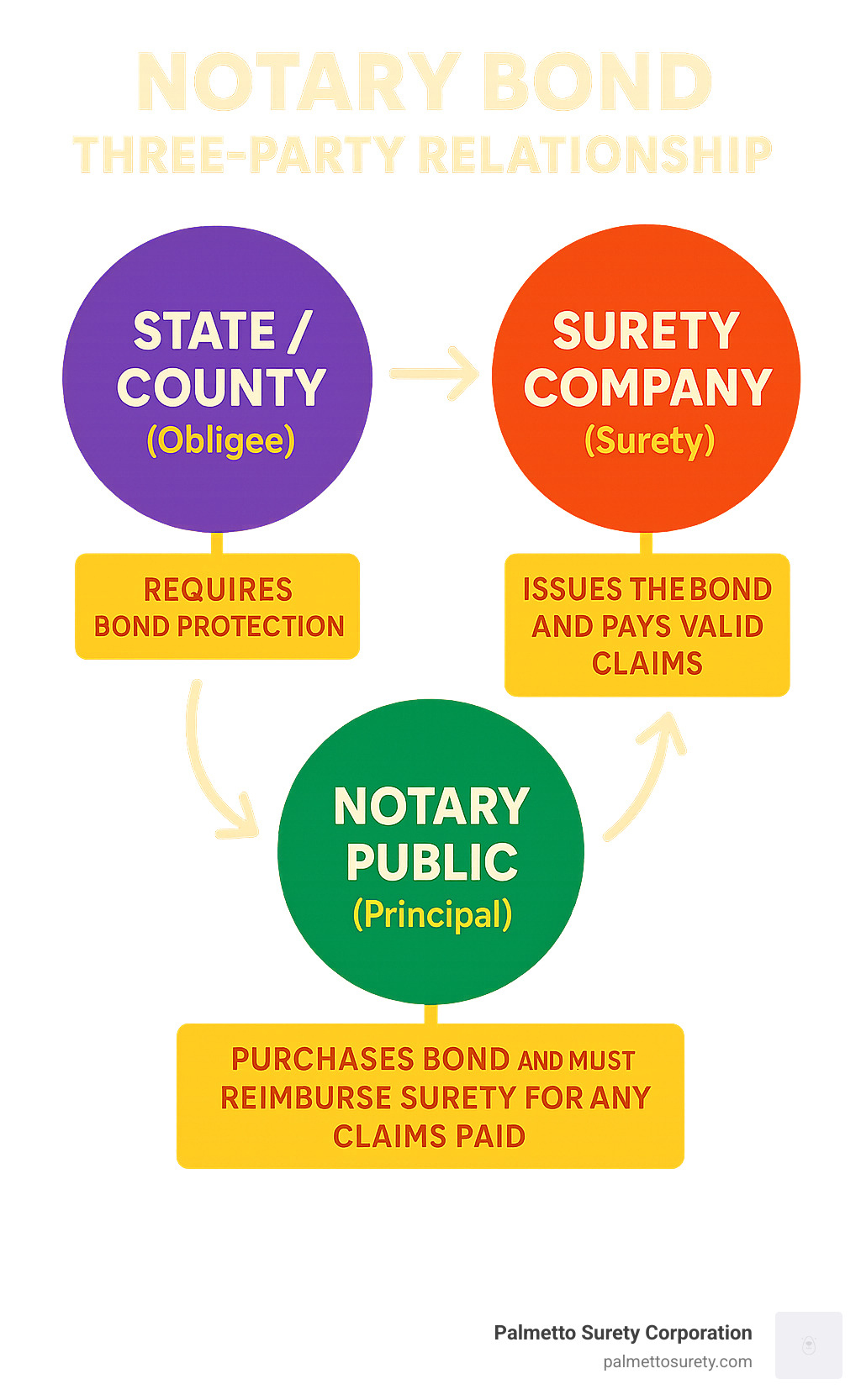
The bond works through a three-party agreement: the state (which requires it), the surety company (which issues it), and you (the notary who purchases it). Unlike insurance that protects you, this bond protects the people you serve. If a claim is paid out, you’re legally required to reimburse the surety company.
I’m Haiko de Poel Jr., and through my work at Palmetto Surety Corporation, I’ve helped countless notaries understand how a bond for notary protects both their practice and the public they serve. My experience in the surety industry has shown me that proper bonding is essential for maintaining public trust in notarial services.
What Is a Bond for Notary and How Does It Work?
Think of a bond for notary as a promise with teeth. It’s not insurance that protects you—it’s a financial guarantee that protects everyone else from your mistakes. This three-party contract ensures that when you mess up (and let’s be honest, we’re all human), there’s money available to fix the problem.
The beauty of the surety system lies in what we call the surety triangle. Each corner has a specific role that keeps the whole system working smoothly.

The obligee—your state or county government—requires the bond because they want to protect their citizens. They’re essentially saying, “If you want to be a notary in our jurisdiction, you need to prove there’s financial backing behind your work.”
You, the principal, are the notary who purchases the bond. You’re making a promise to follow all state laws and perform your duties correctly. The bond doesn’t give you a free pass to be sloppy—it’s your guarantee that you’ll do things right.
The surety company (like us at Palmetto Surety Corporation) issues the bond and investigates any claims. We’re betting on your ability to do good work, and we’ll pay valid claims up to the bond amount.
Here’s where it gets interesting: if we pay out a claim, you owe us every single penny back, plus investigation costs. This isn’t insurance where you file a claim and walk away. It’s more like having a very wealthy friend cosign a loan—if you default, they’ll cover it, but they’re coming after you for repayment.
| Notary Bond | Errors & Omissions Insurance |
|---|---|
| Protects the public | Protects the notary |
| Required by law in 29 states | Optional (but recommended) |
| Must be repaid if claim is paid | No repayment required |
| Fixed premium | Premium varies by coverage |
| State-mandated amounts | Choose your coverage limit |
Key Parties in a Bond for Notary
Your licensing authority sets the rules and receives your filed bond. Whether it’s your state’s Secretary of State office or your local county clerk, they’re the ones who decided you need a bond in the first place. They’re not trying to make your life difficult—they’re protecting their residents from notarial errors that could cost thousands of dollars.
The surety company underwrites your bond based on your ability to perform notarial duties properly. Unlike other types of surety bonds, most notary bonds don’t require credit checks because the risk is relatively low. We’re confident that most notaries will do their jobs correctly and never have a claim filed against them.
As the commissioned notary, you’re the one with all the responsibility. You need to understand your state’s laws, maintain proper records, and follow every single notarial procedure. The bond exists because mistakes happen, but it’s not a license to be careless.
The Claims Process Explained
When someone files a claim against your bond for notary, the process follows specific investigation steps designed to protect everyone involved. First, the surety company reviews the claim for basic validity and completeness. Not every complaint becomes a valid claim.
Next comes the real detective work. We might request documentation, interview the parties involved, or even hire professional investigators. This isn’t CSI, but we take it seriously because false claims hurt everyone.
If the investigation proves the claim is valid, we’ll pay up to the payout limits set by your bond amount. Invalid claims get denied, and we’ll fight frivolous ones in court if necessary.
Here’s the part that surprises many notaries: after we pay a valid claim, you get a bill for the full amount plus costs. This reimbursement obligation is what makes surety bonds different from insurance. We’re advancing the money to help the injured party, but you’re ultimately responsible for your mistakes.
The bond amount represents the maximum we’ll pay per claim, but your liability can extend beyond that limit depending on your state’s statutes. That’s why many notaries also carry Errors & Omissions insurance—it provides additional protection for their personal assets.
Why States Require a Bond for Notary
Think about the last time you had a document notarized. Maybe it was for a home purchase, a power of attorney, or an important business contract. In that moment, you trusted a notary to verify your identity and witness your signature properly. But what happens when that trust is broken?
That’s exactly why states require a bond for notary services. When you notarize a document, you’re doing much more than just stamping a piece of paper. You’re certifying that the signer appeared before you, proved their identity, and signed willingly. If something goes wrong in this process, people can lose their homes, businesses, or life savings.
Currently, 29 states plus the District of Columbia require notary bonds, and the rules vary quite a bit. Wisconsin keeps things simple with a modest $500 bond, while Alabama takes a more serious approach with a $50,000 requirement. Some states like Louisiana grant lifetime commissions, while most others stick with standard 4-year terms.
The bond requirement isn’t just bureaucratic red tape—it serves some pretty important purposes. Consumer protection ensures there’s money available if a notary causes financial harm to someone. Fraud deterrence creates real financial consequences for unethical behavior. The bonds also help maintain professional standards by encouraging notaries to take their duties seriously, which ultimately builds public confidence in the entire notarial system.
Here’s something that surprises many new notaries: getting a bond for notary services typically doesn’t require a credit check. These bonds are considered low-risk because notaries are state-commissioned officials with specific training and legal obligations. The surety companies understand that most notaries are honest professionals who take their responsibilities seriously.

Common Reasons Claims Are Filed
Understanding why claims happen is your first line of defense against them. Most problems fall into a few common categories that are completely preventable with proper care.
Identity verification failures top the list of claim reasons. This happens when notaries don’t properly check IDs or accept expired identification. It’s especially problematic in real estate transactions where imposters might try to steal someone’s property by forging documents.
Forged signatures create another major headache. Sometimes notaries allow one person to sign for another, or they notarize documents where signatures were mysteriously added after the notarization. Both scenarios violate the fundamental principles of what notaries are supposed to do.
Incomplete certificates might seem like small mistakes, but they can have big consequences. Failing to complete all required fields, not dating documents properly, or using the wrong certificate language can invalidate important legal documents.
Negligent acts cover a wide range of careless mistakes. This includes notarizing for someone who doesn’t speak English without proper translation, or failing to ensure signers actually understand what they’re signing.
The most serious issues involve fraud schemes. Sometimes notaries participate in or unknowingly enable fraudulent transactions. This includes deed theft schemes, mortgage fraud, or fake document scams that can devastate innocent victims.
How Notaries Can Avoid Bond Claims
The good news is that most bond claims are completely preventable. A few smart habits can protect both you and the people you serve.
Detailed record-keeping is your best friend. Keep a comprehensive journal of every notarization, including signer information, document types, and any unusual circumstances. Many states require this anyway, and it becomes your best defense if someone files a false claim against your bond for notary.
Rigorous identity verification means always checking current, government-issued photo ID. Don’t get tempted to rely on expired documents, photocopies, or your personal knowledge of someone instead of proper identification. That friendly neighbor might be trying to pull a fast one.
Knowing when to refuse a notarization is just as important as knowing when to proceed. If something seems suspicious, trust your instincts. You have both the right and responsibility to refuse notarizations that seem improper, fraudulent, or outside your authority. It’s better to disappoint someone than to enable fraud.
Continuing education keeps you sharp and current. State laws change, especially with remote online notarization becoming more common. Attend notary education seminars, join professional organizations, and stay connected with other notaries in your area. The investment in learning pays off in avoiding costly mistakes.
State-by-State Bond Amounts, Terms, and Costs
When it comes to bond for notary requirements, there’s no one-size-fits-all approach across America. Each state sets its own rules, creating a patchwork of requirements that can seem confusing at first glance.
The bond amounts vary dramatically—from Wisconsin’s modest $500 requirement all the way up to Alabama’s substantial $50,000 bond. Most states fall somewhere in the middle, typically requiring between $5,000 and $15,000 in coverage. These amounts reflect each state’s assessment of potential risk and their commitment to public protection.
Terms usually align with your commission period, which means four years is the standard in most states. Louisiana stands out as unique with its lifetime commissions, making it the exception rather than the rule. This longer commitment reflects the state’s different approach to notarial service.
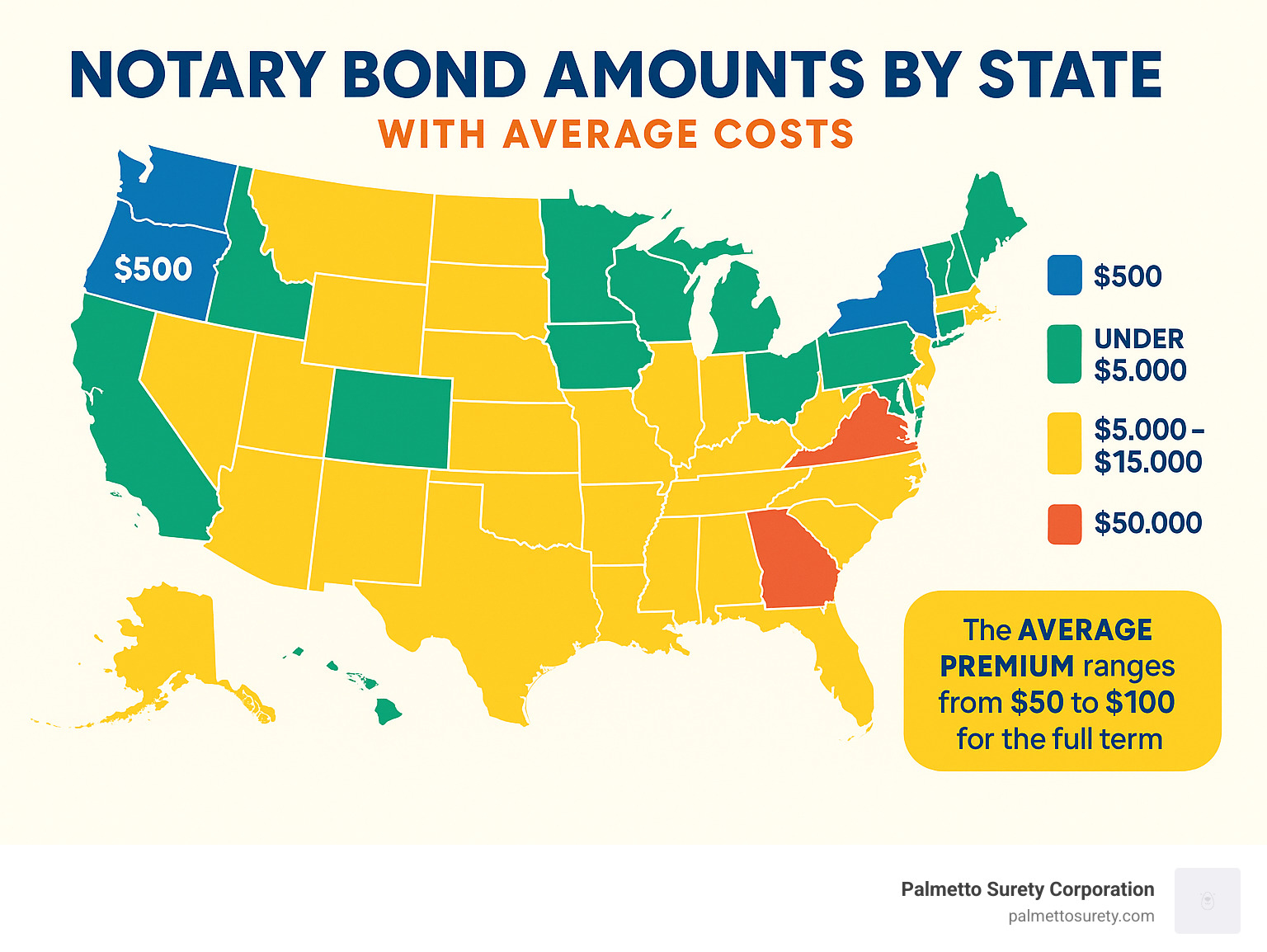
Here’s the good news: despite the varying bond amounts, the actual cost to you remains remarkably affordable. Average premiums range from $50 to $100 for the entire term—not per year. This makes notary bonds one of the most accessible surety products available.
The application process is refreshingly quick. Most applications receive approval within hours, and many bonds can be downloaded instantly once approved. This speed helps ensure you can meet your state’s filing deadlines without stress.
Sample Cost Breakdown
Real-world examples help illustrate how affordable these bonds actually are. In Alabama, despite requiring the highest bond amount at $50,000, you’ll pay approximately $45-70 for the full four years. That breaks down to less than $20 per year for maximum protection.
California notaries need a $15,000 bond and pay around $38-50 for four years. In Louisiana, the $10,000 bond costs approximately $50 for five years, reflecting their longer commission terms. Even Wisconsin’s smaller $500 bond still costs about $35-50 for four years because there are minimum processing costs involved.
Florida represents a middle ground with its $7,500 bond requirement and $40-60 premium for four years. These examples show that regardless of your state’s bond amount, the cost remains manageable for any notary’s budget.
The key point to remember is that these are total costs for the entire term—not annual payments. This makes budgeting simple and eliminates surprise renewal bills every year.
Filing and Renewal Rules
Getting your bond is only half the battle—you must also file it properly and on time. Most states give you 30 to 60 days after receiving your commission to submit your bond to the appropriate authority. Some states require filing with the Secretary of State, while others designate county clerks as the receiving office.
Bond riders become your friend when life changes happen. If you get married and change your name, move to a different county, or find an error on your original bond, a rider can fix these issues without requiring a completely new bond. These amendments ensure your coverage remains valid and accurately reflects your current information.
Renewal time approaches faster than you might expect. When your four-year commission expires, you’ll need a fresh bond for your new term. The silver lining? If you’ve maintained a clean record without claims, renewal typically costs the same as your original bond and processes just as quickly.
Some states allow you to update your address or other minor information through simple notifications, while others require formal amendments. Knowing your state’s specific requirements helps avoid any gaps in coverage that could jeopardize your commission status.
How to Obtain and File Your Bond for Notary
Getting your bond for notary doesn’t have to be complicated or time-consuming. In fact, most notaries are pleasantly surprised by how straightforward the process really is. You can typically complete everything online in just a few minutes and have your bond certificate in hand the same day.
The beauty of modern notary bonding is that it’s designed for busy professionals who need quick solutions. Gone are the days of lengthy paperwork and weeks of waiting. Today’s process involves choosing a reputable surety provider, filling out a simple online application, paying your premium, and downloading your bond certificate.
One thing that’s evolved significantly is remote online notary (RON) services. If you’re planning to offer remote notarizations, you’ll want to confirm whether your state requires additional bonding beyond your standard notary bond. Some states have specific requirements for RON activities, while others consider them covered under your regular bond for notary. Click to start your RON journey if you’re interested in expanding your services.
The key is making sure you understand your state’s specific requirements before you start. Each state has its own filing deadlines, bond amounts, and submission processes. Getting these details right from the beginning saves you time and potential headaches later.
Step-by-Step Application Guide for a Bond for Notary
First, verify your state’s exact requirements. Check the bond amount, term length, and filing deadline with your state’s notary commissioning authority. This prevents any surprises and ensures you’re getting exactly what you need.
Next, choose your surety provider carefully. Look for a company that specializes in notary bonds and offers instant issuance. You want someone who understands the notary industry and can answer your questions knowledgeably.
When completing your application, accuracy is everything. Enter your legal name exactly as it appears on your commission documents. Double-check your address, commission number, and term dates. Small mistakes here can cause big delays later.
Payment is typically straightforward with most providers accepting credit cards through secure online systems. This is usually a one-time payment that covers your entire commission term—not an annual fee.
Once you receive your bond certificate, review it immediately. Make sure all information is correct before you file it. If you spot any errors, contact your surety provider right away for corrections.
Finally, file your bond promptly with the required state or county office. Don’t wait until the last minute—some offices have specific processing times, and missing your deadline could delay your commission.
Bond Riders: When and How to Use Them for a Bond for Notary
Think of bond riders as helpful amendments that keep your bond for notary current without starting over from scratch. They’re particularly useful when life changes affect your notarial information.
Name changes are the most common reason for needing a rider. Whether you’re getting married, divorced, or legally changing your name for other reasons, your bond needs to match your commission records exactly. A rider handles this smoothly and cost-effectively.
Moving to a different county within your state might also require a bond rider, depending on your state’s rules. Some jurisdictions want your bond to reflect your current location, while others don’t mind as long as you’re still within the state.
Commission renewals sometimes need riders to extend bond terms or adjust effective dates. This is especially helpful if your new commission period doesn’t align perfectly with your original bond dates.
Riders typically cost between $25 and $50, making them much more economical than purchasing an entirely new bond. Most surety companies can process riders quickly, often within the same day you request them. It’s a simple way to keep your bond current and compliant without unnecessary expense or hassle.
Frequently Asked Questions about Bond for Notary
Who does a notary bond protect—the notary or the public?
This is the biggest misconception about notary bonds, and it trips up new notaries all the time. A bond for notary protects the public—not you, the notary. I can’t tell you how many times I’ve had to explain this distinction to surprised notaries who thought they were buying protection for themselves.
Think of it this way: when you make a mistake that costs someone money, the bond ensures they can recover their losses. But here’s the catch—you still have to pay the surety company back for every penny they shell out, plus any investigation costs. It’s not a get-out-of-jail-free card.
If you want actual protection for yourself, you’ll need Errors & Omissions insurance. Unlike the bond, E&O insurance covers your liability without requiring you to reimburse the insurance company later. Many smart notaries carry both—the bond because the state requires it, and E&O insurance because it actually protects their financial well-being.
Is a credit check required to obtain a notary bond?
Here’s some good news: most bond for notary applications don’t require credit checks. The surety industry considers notary bonds low-risk because the amounts are relatively small, notaries are state-commissioned officials, and the duties are clearly defined by law.
Some companies might run credit checks for larger bond amounts or if you’ve had previous claims, but this is the exception rather than the rule. Even if you have poor credit, you can usually still get a notary bond—though your premium might be slightly higher.
The straightforward application process is one reason why notary bonds are so accessible. Most applications get approved within hours, and you can often download your bond certificate immediately after payment.
Can Errors & Omissions insurance replace a bond in my state?
In most states, the answer is a firm no. E&O insurance cannot replace a required bond because they serve completely different purposes and protect different parties. The state requires the bond to protect citizens, and they’re not interested in substitutes.
However, Louisiana is the notable exception. Louisiana notaries can choose between a $10,000 surety bond or an equivalent E&O insurance policy. This flexibility reflects Louisiana’s unique legal system and their different approach to notarial services.
A few other states might accept E&O insurance for specific situations, but this is extremely rare. Always verify your state’s exact requirements before making any assumptions. Using E&O insurance when your state specifically requires a bond could actually invalidate your commission—and nobody wants that headache.

Conclusion
Understanding your bond for notary requirements is essential for operating legally and protecting the public you serve. While the bond doesn’t protect you personally, it demonstrates your commitment to professional standards and ensures that injured parties have recourse if something goes wrong.
The bonding process is straightforward and affordable, with most notaries paying less than $100 for their entire commission term. The key is choosing a reputable surety provider who understands notary requirements and can provide quick, efficient service.
At Palmetto Surety Corporation, we’ve been helping notaries across the Southeast understand and obtain their required bonds for over 20 years. Our ability to approve most applications within hours means you can get your bond quickly and focus on serving your clients. Whether you’re in Georgia, Florida, South Carolina, or any of our other service areas, we’re here to help you maintain continuous compliance with your state’s bonding requirements.
A notary bond is just one part of comprehensive protection. Consider pairing your required bond with Errors & Omissions insurance for complete coverage—protecting both the public through your bond and yourself through insurance. This dual protection approach gives you confidence to perform your notarial duties while maintaining the highest professional standards.
For more information about our surety solutions and how we can help with your bonding needs, visit our website.


