


Cost of Surety Bond Freight Broker: 7 Powerful 2025 Savings Tips
Understanding the Cost of Freight Broker Surety Bonds
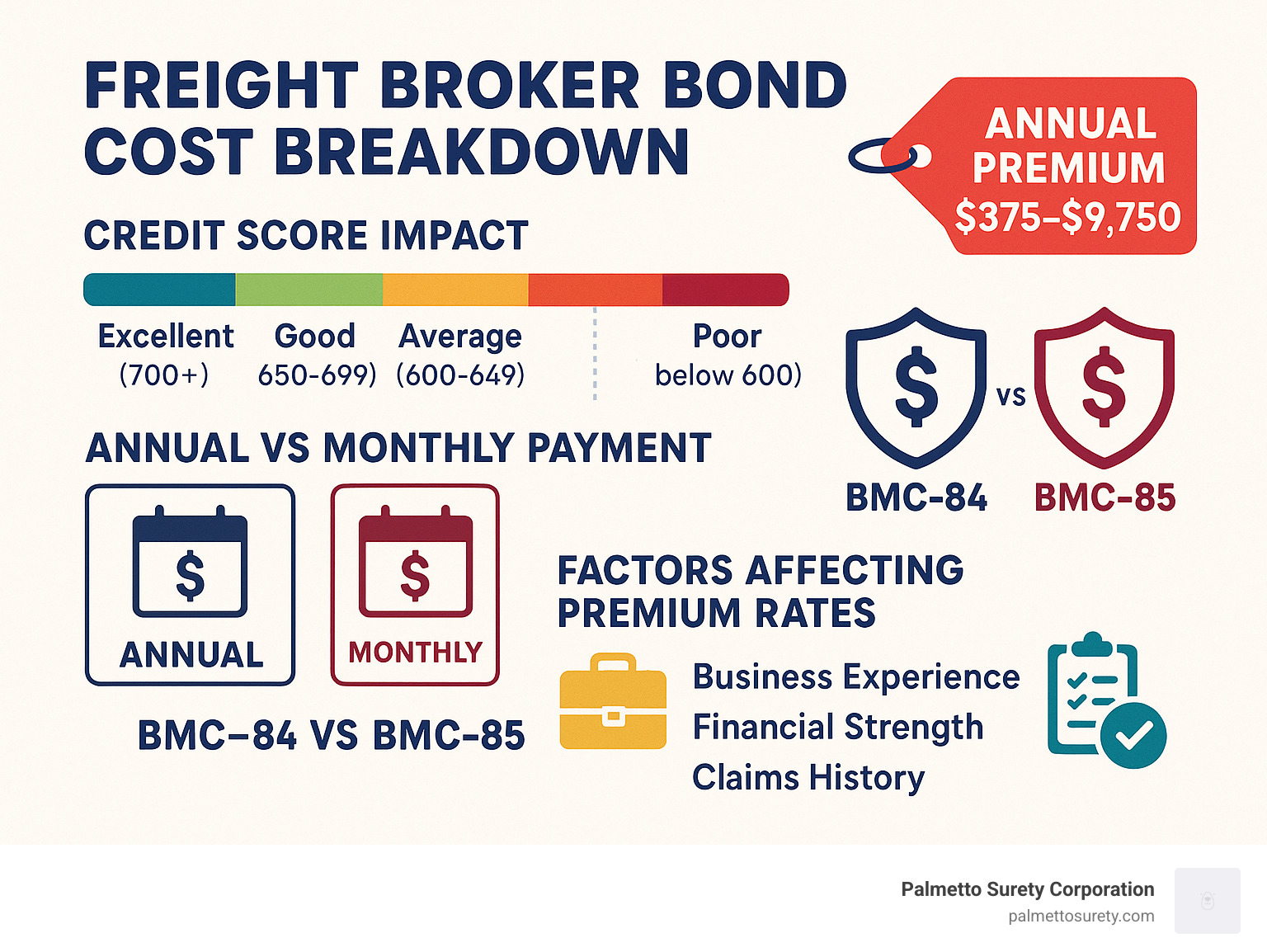
The cost of surety bond freight broker varies widely based on your credit score and business profile. Here’s a quick overview:
| Credit Score | Annual Premium (% of $75,000) | Typical Cost |
|---|---|---|
| Excellent (700+) | 0.5%-1.25% | $375-$938 |
| Good (650-699) | 1.25%-3% | $938-$2,250 |
| Average (600-649) | 3%-5% | $2,250-$3,750 |
| Poor (below 600) | 5%-13% | $3,750-$9,750 |
Starting a freight brokerage business comes with several regulatory requirements, and one of the most significant is securing a freight broker surety bond. The cost of surety bond freight broker is a critical consideration for anyone entering this industry, as it represents a substantial ongoing expense that directly impacts your bottom line. Since 2013, when the Moving Ahead for Progress in the 21st Century Act (MAP-21) increased the required bond amount from $10,000 to $75,000, understanding these costs has become even more important for freight brokers looking to maintain their operating authority with the Federal Motor Carrier Safety Administration (FMCSA).
My name is Haiko de Poel Jr, and as the Chief Marketing Officer at Palmetto Surety Corporation, I’ve helped countless freight brokers steer the complexities of the cost of surety bond freight broker requirements, ensuring they secure the most competitive rates while maintaining full FMCSA compliance.
Freight Broker Surety Bond Basics: What & Why
Before we talk about dollars and cents, let’s make sure you understand exactly what you’re paying for. After all, the cost of surety bond freight broker requirements only makes sense when you know what these bonds actually do for your business.

A freight broker surety bond (officially called a BMC-84) is essentially a three-way promise between you as the broker, the FMCSA as the regulator, and a surety company that backs the bond. This requirement isn’t just bureaucratic red tape – it’s mandated by federal law under Title 49 U.S.C. § 13904 to protect everyone in the transportation chain.
Think of it as the government’s way of saying: “We need to make sure carriers get paid, even if a broker runs into trouble.”

What is a freight broker surety bond (BMC-84)?
Simply put, a BMC-84 bond is your promise to play by the rules. Unlike insurance that protects you, this bond protects the people you do business with – primarily motor carriers and shippers.
When you purchase a bond, you’re not buying protection for yourself. Instead, you’re providing a financial guarantee that you’ll fulfill your obligations. The bond form filed with the FMCSA confirms three key things:
You (as the principal) agree to follow all regulations and pay carriers properly.
The surety company promises to cover valid claims up to $75,000 if you fail to meet obligations.
The FMCSA (as the obligee) has the authority to enforce these requirements to protect the public.
Here’s the part that surprises many new brokers: if someone makes a valid claim against your bond and the surety pays out, you’re legally required to pay that money back to the surety company. This isn’t insurance – it’s more like having a co-signer who’ll cover your debts but expect reimbursement.
Why does FMCSA require it?
The FMCSA didn’t create this requirement to make life difficult for brokers. According to research from the FMCSA, these bonds serve several critical purposes in maintaining a healthy transportation industry.
First, they provide financial security for carriers and shippers. If a broker suddenly closes shop or refuses to pay, carriers have a way to recover what they’re owed (up to the bond amount).
Second, bonds act as powerful fraud deterrence. When you know you’ll be personally responsible for reimbursing any claims, you’re much more motivated to run your business ethically and pay carriers on time.
Third, bonds help maintain claim payout reliability. The surety company’s involvement means carriers have a better chance of getting paid for legitimate claims, even if the broker lacks immediate funds.
Operating without a valid bond isn’t just risky – it’s illegal. The consequences include substantial civil penalties, immediate license revocation, and potential lawsuits from carriers or shippers who suffer financial losses. The FMCSA actively monitors compliance, making this $75,000 bond a non-negotiable aspect of running a legitimate freight brokerage.
Understanding these basics helps explain why the cost of surety bond freight broker requirements varies so widely – the surety company is taking on real financial risk by backing your business operations.
The cost of surety bond freight broker: What You’ll Actually Pay
Let’s talk dollars and cents – what will a freight broker bond really cost you? This is where things get personal, because the cost of surety bond freight broker varies dramatically depending on your specific situation.

Here’s the good news: while the bond amount is fixed at $75,000, you don’t need to write a check for that full amount. Instead, you pay a premium – think of it as the “rental fee” for borrowing the surety company’s financial guarantee. This premium typically runs between 0.5% and 13% of the total bond amount, putting most freight brokers somewhere between $375 and $9,750 annually.
I’m happy to share that the industry has evolved to be more broker-friendly. Many surety providers (including us at Palmetto) now offer monthly payment plans starting around $70-$93 per month for well-qualified applicants. This can be a game-changer for managing cash flow, especially for newer brokers.
Unlike the BMC-85 trust fund option (which we’ll discuss later), a surety bond doesn’t tie up your capital or require collateral for most applicants. Your bond remains valid for one year and must be renewed annually to keep your operating authority active with the FMCSA.
How insurers calculate the cost of surety bond freight broker
When underwriters determine your cost of surety bond freight broker, they’re essentially answering one question: “How likely is this broker to generate claims?”
Your credit score often carries the most weight in this calculation. A strong personal credit history demonstrates financial responsibility and typically results in lower premiums. But that’s just the beginning of what underwriters examine.
Your business experience matters too. Established brokers with several years in the industry generally qualify for better rates than newcomers. The logic is simple – you’ve proven you know how to steer the industry’s challenges.
Financial statements tell another important part of your story. Strong business financials with positive cash flow, substantial assets, and minimal liabilities can dramatically reduce your premium costs. Some sureties will even offer their best rates to financially solid companies regardless of the owner’s personal credit.
Your claims history is equally critical. Previous claims against your bond (or other surety bonds) will likely increase your premium, as they suggest a higher risk of future claims.
Even broader industry conditions can affect your rates. During periods of high claim frequency across the freight brokerage sector, base rates might increase for everyone.
Sample price scenarios for the cost of surety bond freight broker
To help you better understand what you might pay, let’s look at some typical scenarios:
If you have excellent credit (700+ score), you’re in the sweet spot. Your annual premium might be just 0.5%-1.25% of the bond amount, or $375-$938. With a clean credit history, established business, and strong financials, you could pay as little as $38-$78 monthly.
With average credit (600-649 score), expect to pay in the middle range. Your annual premium will likely fall between 3%-5%, translating to $2,250-$3,750. Some credit issues, moderate experience, and adequate financials put you at roughly $188-$313 monthly.
If you’re dealing with poor credit (below 600 score), the premiums climb significantly. You might face rates between 5%-13%, meaning $3,750-$9,750 annually. Significant credit challenges, limited industry experience, and weaker financials could mean monthly payments of $313-$813.
It’s worth noting that startups typically pay higher rates than established brokers, even with identical credit profiles. Without an operating history, sureties have less data to evaluate your risk level, resulting in higher premiums until you build a track record.
These are general guidelines. Your specific rate might vary based on the unique combination of factors in your application. That’s why working with an experienced surety provider who understands the freight industry can make all the difference in securing competitive rates.
Key Factors That Influence Your Premium
Ever wonder why your broker friend got a much better bond rate than you did? Understanding what drives your premium can help you take steps to secure the lowest possible cost of surety bond freight broker. Let’s explore the factors that make the biggest difference to your bottom line:

Personal Credit Score
Your personal credit score is the heavyweight champion when it comes to determining your bond premium. Think of it as your financial report card – surety companies use it to predict how likely you are to trigger claims.
If you’re sporting an excellent score of 700+, you’re in the sweet spot for the lowest rates, often below 1.25% of the bond amount. That’s the difference between paying $938 versus potentially thousands more annually.
Those with good credit (650-699) still get competitive rates between 1.25% and 3%, while fair credit (600-649) bumps you into the moderate range of 3% to 5%.
The picture gets considerably more expensive with poor credit (550-599), where rates typically jump to 5-9%. And if your score has taken a serious beating (below 550), you might face premium rates exceeding 10-13%, or even collateral requirements.
Business Experience and Financial Strength
Surety companies love experience. Having more than two years of successful operation in the freight industry significantly reduces your perceived risk level. It’s like dating – they’re more comfortable committing to someone with a proven track record!
Your business financials tell an equally important story. Underwriters look for signs of stability such as a positive net worth, healthy liquid assets, and strong cash flow. They’re also checking out your debt-to-income ratio and whether your operations are profitable.
A broker with solid financials and five years of claims-free experience will almost always secure better rates than a newcomer with identical credit scores.
Industry Reputation and Claims History
Had claims against your bond in the past? That red flag will likely cost you at renewal time. Surety companies view previous claims as predictive of future behavior.
What’s interesting is that even if you’ve never had a claim, you might still feel the impact of others’ mistakes. Surety companies monitor overall claims rates in the freight brokerage industry when setting their base pricing structures. When industry-wide claims increase, everyone feels the pinch.
Strategies to lower the cost
Good news! There are practical ways to reduce your cost of surety bond freight broker:
First, improve your credit score by paying down debts and resolving collections or judgments. Even a 30-point improvement can sometimes drop you into a better rate tier.
Next, strengthen your financials by maintaining healthy business bank balances and reducing unnecessary expenses. Underwriters love to see growing net worth and stable operations.
Don’t be shy about providing additional documentation like detailed financial statements and business plans. These extras can help underwriters see beyond just the numbers.
Consider your payment options carefully. While monthly installments help with cash flow, annual payments typically save you money overall.
Here at Palmetto Surety Corporation, we maintain relationships with multiple sureties and can help match you with the best provider for your specific situation. Sometimes, bundling coverage with other necessary insurance products can open up additional savings.
Patience pays off. If you’re currently stuck with a high premium, implementing these strategies consistently can lead to substantial savings at your next renewal. Your bond is a significant business expense, but with the right approach, you can minimize its impact on your profitability.
BMC-84 Bond vs. BMC-85 Trust Fund
When satisfying the FMCSA’s $75,000 financial security requirement, freight brokers face an important choice: the BMC-84 surety bond or the BMC-85 trust fund agreement. This decision can significantly impact your cash flow and business operations, so let’s break down the differences.
| Feature | BMC-84 Surety Bond | BMC-85 Trust Fund |
|---|---|---|
| Upfront Capital Required | Only annual premium (1-13% of $75,000) | Full $75,000 deposit |
| Working Capital Impact | Minimal – preserves cash flow | Significant – ties up $75,000 |
| Annual Cost | $375-$9,750 based on credit | $1,000-$1,500 bank fee (1-2%) |
| Claims Process | Surety investigates validity before payment | Funds may be released immediately upon claim |
| Risk Transfer | Surety provides financial backing | No risk transfer – your money at stake |
| Best For | Most brokers, especially startups | Established brokers with excess capital |
Pros & cons for different broker profiles
Think of your business stage and financial situation when making this choice. The cost of surety bond freight broker is just one factor in a more complex decision.
For Startup Brokers:
The BMC-84 bond is typically the clear winner for new operations. When you’re just getting started, preserving capital is crucial. With a bond, you’ll only pay a fraction of the $75,000 as your annual premium, keeping the rest of your money working in your business.
A trust fund, by contrast, requires you to park the entire $75,000 in an account where it sits idle. That’s capital that could otherwise fund operations, marketing, or hiring your first employee.
For Established Brokers:
Even successful operations often prefer the BMC-84 option. The bond provides built-in claims investigation support, potentially protecting you from fraudulent claims. The surety company has a financial incentive to thoroughly verify any claim before paying it out.
That said, very large brokerages with substantial cash reserves might consider the BMC-85. If you have excellent banking relationships and the $75,000 represents a small percentage of your available capital, the trust fund might make sense.
For Brokers with Credit Challenges:
If your credit score isn’t ideal, you’ll face higher premiums for a BMC-84 bond. However, the total cost of surety bond freight broker will still typically be less than tying up the full $75,000 in a trust fund.
The BMC-85 does have one advantage here: your credit score doesn’t affect your eligibility since the arrangement is fully collateralized with your own funds.
In our experience at Palmetto Surety Corporation, the vast majority of freight brokers choose the BMC-84 bond option. It simply makes better financial sense for most operations, allowing you to maintain liquidity and invest more capital in growing your business.
Every situation is unique, though. We’re always happy to discuss which option might work best for your specific circumstances, taking into account your credit profile, business stage, and financial goals.
How to Apply, Secure a Lower Rate, and Stay Compliant
Navigating the freight broker bond application process doesn’t have to give you a headache. With the right approach, you can secure your bond quickly while potentially saving thousands on your premium.

Step-by-step application checklist
Let’s break down the process into manageable steps. First, gather all your essential information. You’ll need your FMCSA MC number (or be ready to apply for one), your business structure details, and contact information. Have your Social Security number handy for the credit check, and if possible, bring business financial statements to strengthen your application. Documentation of your industry experience can also work in your favor.
When you’re ready to get a quote, submit your information to a reputable surety provider like us at Palmetto Surety Corporation. We’ll conduct a soft credit pull (don’t worry—this won’t affect your credit score) and provide you with a customized quote based on your specific situation. Take time to review the quote and payment options to find what works best for your cash flow.
Once you’re happy with the terms, completing the application is straightforward. Simply sign the required documents, pay your premium, and we’ll handle filing the bond electronically with the FMCSA. The electronic filing typically appears in the FMCSA system within 24-48 hours, and you can verify your status on the FMCSA Licensing & Insurance database.
To stay compliant, mark your renewal date on your calendar (exactly one year from issue), and be sure to let your surety know if your business information changes. If you ever receive claim notifications, respond promptly—addressing potential issues early can save you significant headaches down the road.
Can you get bonded with imperfect credit?
Here’s some good news: yes, you absolutely can secure a freight broker bond even with credit challenges. At Palmetto Surety Corporation, we work with specialized markets offering high-risk programs that have approval rates approaching 99%. While your cost of surety bond freight broker will be higher with imperfect credit, it’s almost always more economical than tying up $75,000 in a trust fund.
If your credit history isn’t spotless, transparency is your best friend. Be upfront about your situation when applying. Strengthen your application by providing solid documentation about your industry experience and detailed business plans with financial projections. Sometimes, bringing in a co-signer with stronger credit can help, or offering a small amount of collateral might reduce your premium.
Many of our clients start with higher premiums due to credit issues but successfully refinance their bond at a lower rate after demonstrating a year of successful operations. Your first year in business is a perfect opportunity to build a positive payment history and improve your credit profile, setting you up for better rates at renewal time.
The bond application process is designed to be accessible—not a roadblock to your business goals. With the right partner guiding you through the process, securing your freight broker bond can be a smooth experience, even if your financial history has a few bumps along the way.
Frequently Asked Questions About Freight Broker Bond Costs
What is the minimum bond amount and does it ever change?
The freight broker bond world saw a major shift back in 2013 when the MAP-21 legislation kicked in. The minimum bond amount jumped from a modest $10,000 to a much heftier $75,000 – and that’s where it stands today.
While this amount has remained stable for over a decade now, it’s worth noting that government requirements can change. If the FMCSA decides to adjust this figure in the future, they’ll provide advance notice and a transition timeline. But for your current business planning, that $75,000 figure is your target.
What happens if a claim is filed against my bond?
Nobody wants to deal with a bond claim, but understanding the process helps remove some of the mystery and anxiety. If a carrier or shipper believes you haven’t fulfilled your obligations, here’s what typically unfolds:
First, they’ll submit documentation to your surety company explaining their grievance. Your surety will then notify you about the claim and ask for your side of the story – this is your chance to provide evidence and context. The surety conducts a thorough investigation to determine if the claim has merit.
If the claim is found valid, the surety may pay out up to the $75,000 bond limit. Here’s the important part: you are legally obligated to reimburse every penny the surety pays on your behalf. It’s not insurance – it’s a guarantee of your performance.
Claims can significantly drive up the cost of surety bond freight broker renewals or even make obtaining a new bond difficult. That’s why successful brokers prioritize prompt carrier payments, thorough documentation, clear communication, and professional dispute resolution.
Are cargo or liability insurance premiums separate from my bond cost?
Absolutely – your bond premium and insurance premiums are completely separate expenses. Think of them as different tools in your financial protection toolkit:
Your bond protects carriers and shippers from financial harm if you fail to fulfill contractual obligations. It’s mandatory for all freight brokers, no exceptions.
Insurance policies, on the other hand, have varying requirements:
For freight brokers, there’s no federal mandate to carry cargo or liability insurance, though many smart brokers obtain coverage anyway to protect their business interests.
Freight forwarders who physically handle cargo must maintain cargo insurance.
Motor carriers face strict liability insurance requirements ranging from $750,000 to $5,000,000 depending on what they’re hauling.
If you wear multiple hats in the transportation industry (like operating as both a broker and carrier), you’ll need to satisfy all the requirements for each role you play. Insurance premiums typically run around $1,500 annually for each policy – a separate budget line item from your cost of surety bond freight broker.
At Palmetto Surety Corporation, we’re happy to clarify exactly which financial protections you need for your specific business model, helping you avoid both costly over-insurance and dangerous coverage gaps.
Conclusion
Navigating cost of surety bond freight broker requirements doesn’t have to feel like driving through a fog without headlights. With the right information and approach, you can secure competitive rates that keep your freight brokerage moving forward smoothly on the road to success.

I hope this guide has helped explain what affects your bond premiums and how to position yourself for the best possible rates. Let’s recap the most important takeaways:
Your credit score is the driving force behind your premium costs, with rates typically ranging from 0.5% to 13% of the $75,000 bond amount. This means your annual investment could be anywhere from $375 to $9,750—quite a difference! The better your credit, the less you’ll pay, so treating your credit score as a business asset really pays off.
For most freight brokers—especially those just starting out—a BMC-84 surety bond makes more financial sense than tying up $75,000 in a BMC-85 trust fund. Think of it this way: would you rather have most of that capital working for your business or sitting untouched in a trust account?
Your bond isn’t a one-and-done expense. You’ll need to renew it annually to keep your FMCSA operating authority active. Mark this important date on your calendar, as letting it lapse can bring your operations to a screeching halt.
Treat your carriers right! Claims against your bond can dramatically increase your future premiums. Paying carriers promptly and resolving disputes professionally isn’t just good ethics—it’s good business that protects your bottom line.
At Palmetto Surety Corporation, we’ve spent over 20 years helping freight brokers throughout the Southeast find their way through the bonding process. Our team understands the unique challenges you face in Georgia, Florida, Louisiana, Mississippi, South Carolina, Tennessee, and Texas. We’re committed to finding you competitive rates with minimal hassle, whether you’re securing your first bond or looking to reduce your renewal costs.
The cost of surety bond freight broker may be an unavoidable expense, but it’s also an investment in your business’s credibility. It tells carriers and shippers that you’re serious about your obligations and committed to playing by the rules. With the right partner guiding you, you can manage this cost effectively while building a reputation for reliability in an industry where trust means everything.
For more detailed information about freight broker bonds and how we can help you secure the best possible rates, visit our website at Palmetto Surety Corporation.


