


Texas Bond Claims: 4 Essential Steps for Success in 2024
Texas bond claims play a crucial role in ensuring that contractors, subcontractors, and suppliers get paid for their work on public and private projects. To help you quickly understand this topic, here’s a brief overview:
- What are Texas bond claims?
-
Claims that ensure payment or performance on construction projects.
-
Why are they important?
- They protect against financial loss for contractors and suppliers.
-
Ensure project completion and quality work.
-
How to file a Texas bond claim?
- Follow legislative requirements and deadlines.
- Serve necessary notices and provide required information.
Successfully navigating Texas bond claims is essential due to the state’s complex and stringent notice, lien, and bond requirements. From understanding the bond types to meeting critical deadlines, having a clear, concise guide is invaluable for anyone involved in construction projects. This article will walk you through the process step by step.
I’m Haiko de Poel Jr, an expert in marketing and digital change. I have an background in guiding businesses, including those in construction, through complicated processes such as filing bond claims in Texas. My goal is to simplify complex topics, making them accessible and actionable for you.
Texas bond claims word guide:
– Texas bond regulations
– license bonds texas

Understanding Bond Claims in Texas
Texas bond claims play a crucial role in ensuring that contractors, subcontractors, and suppliers get paid for their work on public and private projects. To help you quickly understand this topic, here’s a brief overview:
Types of Bonds
Surety Bonds
A surety bond is a three-party agreement that involves the principal (the contractor), the obligee (the project owner), and the surety (the bond provider). These bonds ensure the contractor fulfills their obligations.
Payment Bonds
A payment bond guarantees that subcontractors, suppliers, and laborers will be paid for their work and materials. This is crucial for maintaining smooth operations on a project and avoiding financial disputes.
Performance Bonds
Performance bonds ensure that the contractor completes the project according to the terms and conditions of the contract. If the contractor fails to perform, the bond compensates the project owner for any financial losses.
Key Legislation
Texas Government Code 2253
This code outlines the requirements for payment and performance bonds on public projects in Texas. It ensures that contractors provide bonds to protect the interests of subcontractors and suppliers.
Texas Little Miller Act
The Texas Little Miller Act mandates that payment bonds are required for public works projects exceeding certain thresholds ($25,000 for most projects and $50,000 for transportation-related projects). This act ensures that subcontractors and suppliers have a legal avenue to claim unpaid dues.
Public Projects vs. Private Projects
Public Projects
On public projects, payment bonds are required to protect subcontractors and suppliers. The bond must be posted before work begins, ensuring that all parties involved are covered from the outset.
Private Projects
While not mandated by law, payment and performance bonds are often used on large private projects to provide similar protections. These bonds are governed by the contract terms rather than state legislation.
Key Points to Remember
- Bond Types: Understand the differences between surety, payment, and performance bonds.
- Legislation: Familiarize yourself with Texas Government Code 2253 and the Texas Little Miller Act.
- Project Type: Know the specific requirements for public and private projects.
By understanding these basics, you can steer Texas bond claims more effectively, ensuring compliance and protecting your financial interests. Next, we’ll dive into the step-by-step process of filing a bond claim in Texas.
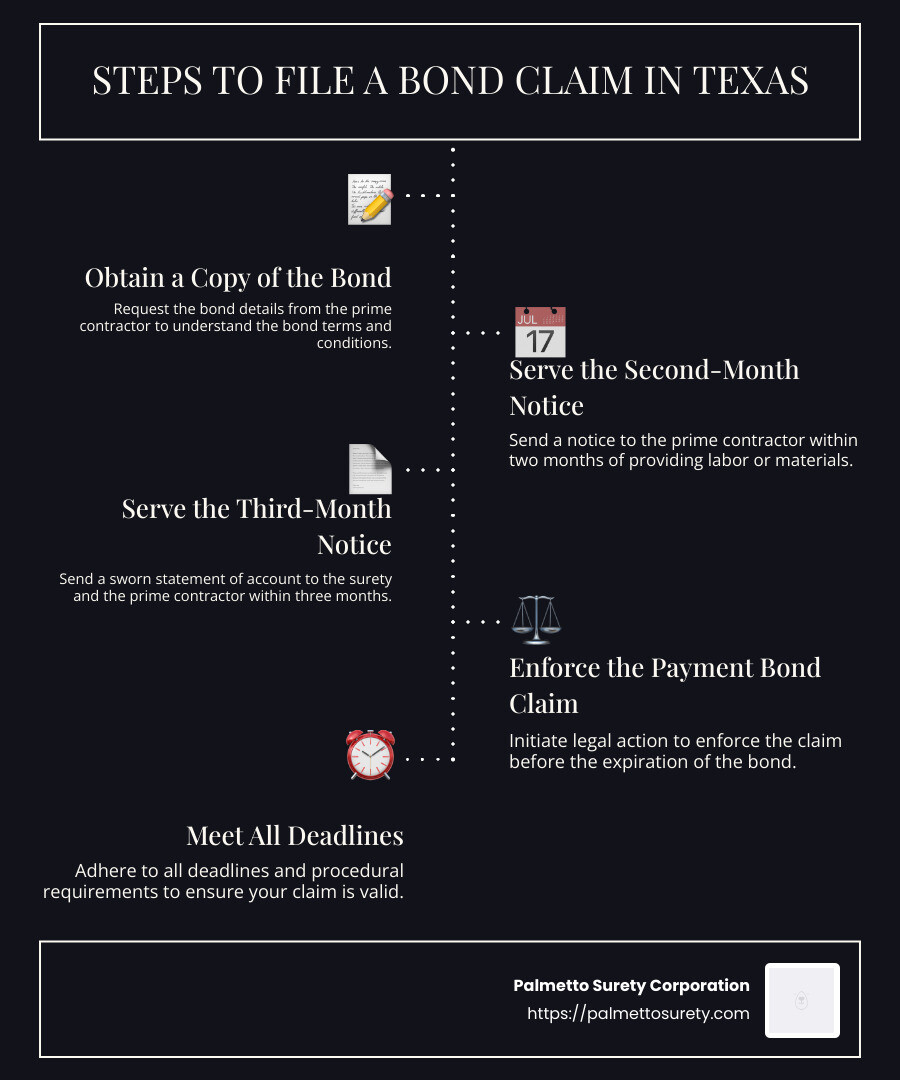
Steps to File a Bond Claim in Texas
Filing a Texas bond claim can seem overwhelming, but breaking it down into steps makes it manageable. Here’s a simplified guide to help you through the process:
Step 1: Obtain a Copy of the Bond
Before you can file a claim, you need to get a copy of the bond. This document will contain essential details like the bond amount, surety company, and terms. To request a bond copy:
- Contact the prime contractor: They should provide you with the bond details.
- Request from the project owner: If the prime contractor is unresponsive, the project owner can also furnish this information.
Step 2: Serve the Second-Month Notice
For second-tier subcontractors and suppliers (those hired by a subcontractor), the next step is to serve a Second-Month Notice to the prime contractor. This notice must be sent by the 15th day of the second month following each month you provided labor or materials and were not paid.
Key Points:
– Address it to the prime contractor.
– Include details: The name of the party you worked for, dates of work, description of labor/materials, and the amount due.
Step 3: Serve the Third-Month Notice
The Third-Month Notice is crucial because it is the actual bond claim. Both first-tier and second-tier claimants need to serve this notice by the 15th day of the third month after each month of unpaid work.
For First-Tier Subcontractors/Suppliers:
– Send to both the surety and the prime contractor.
– Include a Sworn Statement of Account: This sworn statement must affirm that the claimed amount is correct and include any applicable credits.
For Second-Tier Subcontractors/Suppliers:
– Send to the surety and the prime contractor.
– Combine notices if needed: You can combine the Second-Month Notice and Third-Month Notice if you missed the earlier deadline.
Step 4: Enforce the Payment Bond Claim
If you still haven’t been paid after serving the notices, you may need to take legal action to enforce the payment bond claim. Here’s what you need to do:
- Wait at least 61 days: This waiting period starts from the date you mailed the Third-Month Notice.
- File a lawsuit: You must file the lawsuit within one year from the date you served the Third-Month Notice or the project completion date, whichever is earlier.
Important: Missing these deadlines can render your claim unenforceable, so be diligent about tracking dates and sending notices on time.
By following these steps, you can steer the process of filing a Texas bond claim effectively. Next, we’ll cover the detailed requirements for notices to ensure your claim is valid.
Detailed Requirements for Notices
Understanding the specific requirements for notices is critical to perfecting your Texas bond claim. Here, we’ll break down the details for both the Second-Month and Third-Month Notices.
Second-Month Notice Requirements
For second-tier subcontractors and suppliers, the Second-Month Notice is a preliminary step to inform the prime contractor of unpaid labor or materials.
Content:
– Name of the party for whom the work was performed or to whom the materials were delivered.
– Approximate dates of performance or delivery.
– Description of the labor or materials provided.
– Amount due.
Timing:
– Must be sent on or before the 15th day of the second month following the month in which the labor or material was provided.
Mailing Requirements:
– Send the notice to the prime contractor’s residence or last known business address.
– Use certified or registered mail to ensure there’s a verifiable record of delivery.
Third-Month Notice Requirements
The Third-Month Notice is crucial for formalizing your bond claim. Both first-tier and second-tier claimants must follow specific guidelines.
For First-Tier Subcontractors/Suppliers:
– Content:
– A Sworn Statement of Account affirming that the claimed amount is correct and includes any applicable credits.
- Timing:
-
Must be sent by the 15th day of the third month following the month in which the labor or material was provided.
-
Mailing Requirements:
- Send to both the surety and the prime contractor.
- Ensure the notice is sent by certified or registered mail.
For Second-Tier Subcontractors/Suppliers:
– Content:
– Include the same details as the Second-Month Notice.
– Attach a Sworn Statement of Account.
- Timing:
-
Must be sent by the 15th day of the third month following the month in which the labor or material was provided.
-
Mailing Requirements:
- Send to both the surety and the prime contractor.
- Use certified or registered mail.
Important: Always double-check that your notice includes all required information and is sent to the correct addresses to avoid any issues with your claim.
By adhering to these detailed requirements for notices, you can ensure that your Texas bond claim is valid and enforceable.
Next, we’ll address some frequently asked questions about Texas bond claims to further clarify the process.
Frequently Asked Questions about Texas Bond Claims
How to File a Claim Against a Bond in Texas?
Filing a Texas bond claim can seem complicated, but following the correct steps ensures you get paid for your work. Here’s a simplified process:
-
Obtain a Copy of the Bond: First, request a copy of the bond from the prime contractor or the project owner. This document contains essential details like the bond number and the surety company.
-
Serve the Second-Month Notice: For second-tier subcontractors and suppliers, send a notice to the prime contractor by the 15th day of the second month after your work or materials were provided. Use certified or registered mail.
-
Serve the Third-Month Notice: Both first-tier and second-tier claimants must send a Third-Month Notice to the surety and prime contractor by the 15th day of the third month after the work or materials were provided. Include a Sworn Statement of Account.
-
Enforce the Payment Bond Claim: If payment is still not received after 60 days, you may need to file a lawsuit against the bond. This must be done within one year from the filing date of the bond claim notice.
Always ensure your notices are complete and sent on time to make your claim enforceable.
What is a Texas Bond $10,000 for 4 Years?
A Texas bond of $10,000 for 4 years typically refers to a notary bond. Here’s what you need to know:
- Purpose: This bond protects the public from any errors or misconduct by a notary public.
- Duration: It lasts for four years, which is the standard term for a notary public commission in Texas.
- Amount: The bond amount is $10,000, meaning it covers up to $10,000 in damages.
Obtaining this bond is mandatory for notaries in Texas and ensures they perform their duties ethically and accurately.
Can You Get Your Bond Money Back in Texas?
Refunding bond money in Texas depends on the type of bond and the circumstances:
- Surety Bonds: Generally, you cannot get a refund for the premium paid on a surety bond. The premium is the cost of obtaining the bond and is non-refundable.
- Court Decisions: If a court case involving a bond is resolved in your favor, you may be entitled to a refund of the bond amount minus any fees.
For specific cases, such as bail bonds, the refund process and conditions can vary. Always check with the bond issuer or a legal advisor for precise information.
By understanding these common questions and their answers, you’ll be better equipped to steer the complexities of Texas bond claims. Next, let’s summarize the key points and highlight why it’s crucial to comply with all requirements.
Conclusion
Filing bond claims in Texas can be complicated, but following the correct steps ensures that you get paid for your work. Compliance with Texas’ stringent notice, lien, and bond requirements is crucial. Missing deadlines or failing to provide necessary information can render your claim unenforceable.
Summary
To recap, here are the essential steps in the process:
- Obtain a Copy of the Bond: This document has all the details you need.
- Serve the Second-Month Notice: Notify the prime contractor by the 15th day of the second month.
- Serve the Third-Month Notice: Send this to the surety and prime contractor by the 15th day of the third month, including a Sworn Statement of Account.
- Enforce the Payment Bond Claim: If payment is not received, you may need to file a lawsuit within one year.
Importance of Compliance
Compliance is not just a legal requirement; it’s your best strategy to secure payment. Texas has some of the most complex bond claim rules in the country. Missing a single deadline or failing to provide required information can invalidate your claim. Always double-check your notices for completeness and ensure they are sent on time.
Palmetto Surety Corporation
At Palmetto Surety Corporation, we understand the intricacies of Texas bond claims. With over 20 years of experience in the industry, we specialize in providing quick and efficient surety bond services. Our team is here to guide you through every step of the process, ensuring you meet all legal requirements and deadlines.
If you need assistance with filing a bond claim in Texas, contact us for a no-obligation consultation. We are committed to helping you get paid for your work and protecting your financial interests.
For more information or to discuss your specific needs, visit our website.
By following these guidelines and leveraging the expertise of Palmetto Surety Corporation, you can steer the complexities of Texas bond claims with confidence.


