


Surety Bond Application Form: Don’t Miss 1 Step!
Understanding the Surety Bond Application Form
A surety bond application form is the first step to obtaining a surety bond. It’s a detailed request for information about you and your business, which the surety company uses to evaluate your application.
Here’s what a surety bond application form is and why it matters:
- What it is: A document you fill out to apply for a surety bond.
- Its purpose: To provide the surety company with information to assess your background, finances, and ability to meet the bond’s terms.
- Why it’s important: It helps the surety assess your risk and decide if they can guarantee your obligations.
I’m Haiko de Poel Jr. With years of experience in the surety industry, including relaunching one of the fastest-growing US Surety Bond companies, I have unique insights into what makes a successful surety bond application form. Let’s explore how to make yours stand out.
Relevant articles related to surety bond application form:
The Application Process: A Step-by-Step Guide
This section outlines the universal steps to successfully apply for a surety bond, from initial information gathering to final submission.
Completing Your Surety Bond Application Form
The surety bond application form is your first step in securing a surety bond. It gathers comprehensive information for the surety company’s due diligence, a process called underwriting. During underwriting, the surety evaluates your financial stability, character, and capacity to meet the bond’s obligations.


A typical surety bond application form will ask for several key pieces of information:
- Applicant Information: Includes personal details (name, address, SSN, DOB) and business information (legal name, address, business type, federal tax ID) to identify the applicant.
- Obligee Information: The name and contact details of the obligee (the entity requiring the bond), who is the beneficiary of the bond’s guarantee.
- Bond Details: Specifies the bond type (e.g., performance, license), the required bond amount (the “penal sum”), and the effective/expiration dates. The penal sum is the surety’s maximum liability.
- Contract Details: For contract bonds, this includes project description, contract value, start/end dates, retentions, and non-performance penalties.
- Business Financials: Requires recent balance sheets, income statements, and cash flow statements to assess your company’s financial health, including working capital and profitability.
- Personal Financials: Personal financial statements from owners are often required, especially for smaller businesses, to assess personal net worth and liquidity, as owners typically indemnify the bond.
The information you provide on the surety bond application form is the foundation of the surety’s decision, so accuracy and completeness are vital. The cost of a surety bond is typically a percentage of the bond amount, influenced by your risk profile as determined by this application. For more details on how this works, you can find more info about the cost of surety bonds.
Essential Supporting Documents
In addition to the surety bond application form, you will need supporting documents. These corroborate your information and provide a deeper understanding of your financial and operational capacity. Preparing these documents in advance significantly speeds up the application process.
Here’s a list of common supporting documents you might need:
- Personal Financial Statements: Vital for business owners, these detail your assets and liabilities to determine personal net worth. You can Download a Personal Financial Statement Form from our resources.
- Business Financial Statements: For established businesses, includes balance sheets, income statements, and cash flow statements from the past few years to evaluate profitability and stability.
- Credit Authorization: Allows the surety to run credit checks on you and your business. Credit history is a key underwriting factor reflecting your financial responsibility and can lead to better rates.
- Copy of Contract: For contract bonds, a copy of the contract is essential for the surety to understand the scope of work and terms you are guaranteeing.
- Court Order: For judicial bonds (e.g., probate), a copy of the court order mandating the bond is required to specify its purpose and amount.
- Work on Hand Schedule: For contractors, this schedule of uncompleted work helps the surety assess your capacity for new projects.
- Business Plan and Resume: For new businesses or large bonds, a business plan and resumes of the principals are beneficial to show operational strategy and experience.
- Bank Reference Letter: Confirms your banking relationship and financial standing.
- Supplier and Job References: Provide insight into your reliability and performance.
Having these documents organized and ready before you start your surety bond application form will save time and demonstrate your professionalism to the surety.
Navigating Different Types of Surety Bond Applications
The complexity of a surety bond application form and the level of scrutiny from the surety company depend entirely on the type of bond you need. The requirements for a simple license bond differ greatly from those for a large construction bond.
Contract Bond Applications (Performance & Payment Bonds)
Contract bonds, common in construction, have the most detailed surety bond application forms. This is because they guarantee major projects are completed and all parties are paid.

Bid bonds guarantee that if your bid is successful, you will enter into the contract and secure the necessary follow-up bonds. The application focuses on your financial capacity for the project.
Performance bonds guarantee you will complete the project as specified in the contract. The application requires deep dives into project details, contract value, timelines, and penalties for non-performance, as the surety needs confidence in your ability to deliver.
Payment bonds work with performance bonds to ensure that subcontractors and suppliers are paid for their labor and materials.
The extensive underwriting for contract bonds, especially for projects over $250,000, is rigorous. Sureties examine your company’s financial history, cash flow, project experience, and management team. You’ll need to provide comprehensive financial documents and schedules of current work.
The good news is that Palmetto Surety offers a Fast Track Program for contract bonds under $350,000. Qualified applicants with good credit may be approved with a simple two-page application and minimal financial documentation, saving significant time.
The surety evaluates the “Three C’s”: Capacity (experience, equipment, people), Character (reliability, trustworthiness), and Capital (financial strength). Your surety bond application form must clearly demonstrate all three. For a deeper dive into the various bond types and their specific requirements, check out more info about types of surety bonds.
Commercial Bond Applications (License, Permit, & Court)
Commercial bonds generally have simpler, credit-based application processes and faster approvals. They ensure compliance with laws and regulations and are less complex than contract bonds.
License and permit bonds are required by government agencies for many business types, like car dealers or freight brokers. The surety bond application form is straightforward, usually requiring only basic business information and a credit check, allowing for same-day approval with good credit.
Court bonds are required by courts to ensure individuals fulfill their duties. Examples include probate bonds for executors and guardianship bonds. The application focuses on case details, the bond amount, and your personal finances to ensure court orders are followed.
Fiduciary bonds guarantee the honest performance of fiduciaries like trustees and executors, focusing on positions of financial trust.
Commercial bonds often have statutory requirements, making the process predictable and allowing for much faster approvals than contract bonds. Our expertise at Palmetto Surety allows us to approve most commercial bond applications within hours. We’ve streamlined the process to get you the license bond you need quickly. For more detailed information about court-related bonds specifically, visit our page with more info about court bonds.
In short, the key difference between contract and commercial surety bond application forms is complexity and timeline. Contract bond applications involve deep financial and project analysis, while commercial bond applications focus on credit and regulatory compliance.
Government and State-Specific Surety Bond Application Forms
Many government bodies and states have unique surety bond application forms and regulations. Understanding these specific requirements is crucial for compliance and smooth business operations.

The SBA Form 994 for Small Businesses
Securing a surety bond for federal contracts can be daunting for small businesses that may not meet traditional underwriting requirements. The U.S. Small Business Administration (SBA) helps with its Surety Bond Guarantee Program.
The SBA guarantees a portion of the bond (up to 90%), reducing the surety company’s risk. This makes it easier for small and emerging contractors to obtain bonds they might otherwise be denied. The program primarily supports contract bonds for projects up to $6.5 million, and sometimes up to $10 million.
The core of this assistance is the SBA Form 994, the “Application for Surety Bond Guarantee Assistance.” When you apply for this program, you’ll complete SBA Form 994, providing detailed information about your company, the contract, and your financial situation. With the SBA guarantee, even businesses with limited financial history might secure the bonds they need to grow. You can Download the official SBA Form 994 directly from the SBA’s website.
State-Specific Examples: California and Pennsylvania
Many states also have unique surety bond application form requirements for specific industries, often to protect consumers or ensure regulatory compliance.
In California, commercial fundraisers must file a $25,000 California Commercial Fundraiser Surety Bond with the Department of Justice. This bond protects the public from harm caused by a fundraiser’s negligence or wrongdoing. The state-specific surety bond application form requires details about the fundraiser, the surety, and the bond term.
Pennsylvania Health Club Surety Bonds protect consumers by providing refunds for purchased health club contracts. Crucially, this bond is not considered a club asset in bankruptcy, ensuring members are protected even if the club fails. The surety bond application form for a health club bond requires club and surety details and confirms understanding of the Health Club Act.
These examples show that a surety bond application form can range from a general financial assessment to a highly specific, legally mandated document. Understanding these nuances is vital for compliance. For those operating in the Southeast, for example, you can find more info about Georgia surety bonds and other state-specific requirements.
Best Practices for a Successful Application
Following best practices can streamline your application process, prevent delays, and increase your chances of approval.
How to Prepare Your Application Effectively
Preparing your surety bond application form effectively is like preparing for an important interview. A proactive approach helps secure quick approval and avoid delays.
Gather your documents early. Collect all necessary financial statements, tax returns, and business records before you begin the application. This saves time and shows professionalism.
Be thorough. Read every question carefully. Incomplete applications are the top cause of delays. Answer every field, using “N/A” if a question doesn’t apply.
Accuracy is critical. Double-check all numbers, dates, and personal information. Minor mistakes can raise red flags, and the surety needs to trust your information completely.
Work with an experienced agent. A seasoned surety professional understands the nuances of different bond types and knows what underwriters look for. They can help you present your application in the most favorable light and guide you through complex situations. For larger projects, their expertise in large bond underwriting becomes invaluable.
At Palmetto Surety Corporation, we approve most applications within hours because we work with applicants who present complete, accurate information from the start.
The Consequences of Inaccurate Information
Providing inaccurate information on your surety bond application form is a serious mistake with severe consequences. It will be finded and the outcome is never positive.
- Application denial is the most immediate consequence. Sureties conduct thorough checks and will find discrepancies, leading to a swift rejection.
- Bond cancellation is likely if the inaccuracy is finded after issuance. A canceled bond can halt a project or lead to license suspension, causing breach of contract.
- Legal repercussions are severe. Providing false information can lead to fraud charges. The indemnity agreement you sign allows the surety to take legal action to recover losses.
- Fraud allegations are possible in cases of intentional deception, carrying penalties like fines and jail time.
- Future bonding difficulty is a long-term consequence. The surety industry is small, and a reputation for dishonesty will make it extremely difficult to get bonded in the future.
Surety companies want to approve your application. Transparency about any challenges, addressed with the help of an experienced agent, is always better than hiding information that will eventually be finded.
Frequently Asked Questions about the Surety Bond Application Form
It’s normal to have questions about the surety bond application form. Here are answers to some of the most common ones.
How long does the surety bond application process take?
The timeline varies by bond type. Many commercial bonds (license, permit) are credit-based and can be approved within hours. Larger, more complex contract bonds require in-depth underwriting of your business financials and project experience, which can take several days to a week. Providing complete information upfront is the fastest way to get approved. At Palmetto Surety Corporation, we pride ourselves on efficiency, approving most applications within hours.
What is the difference between a surety bond application and the bond itself?
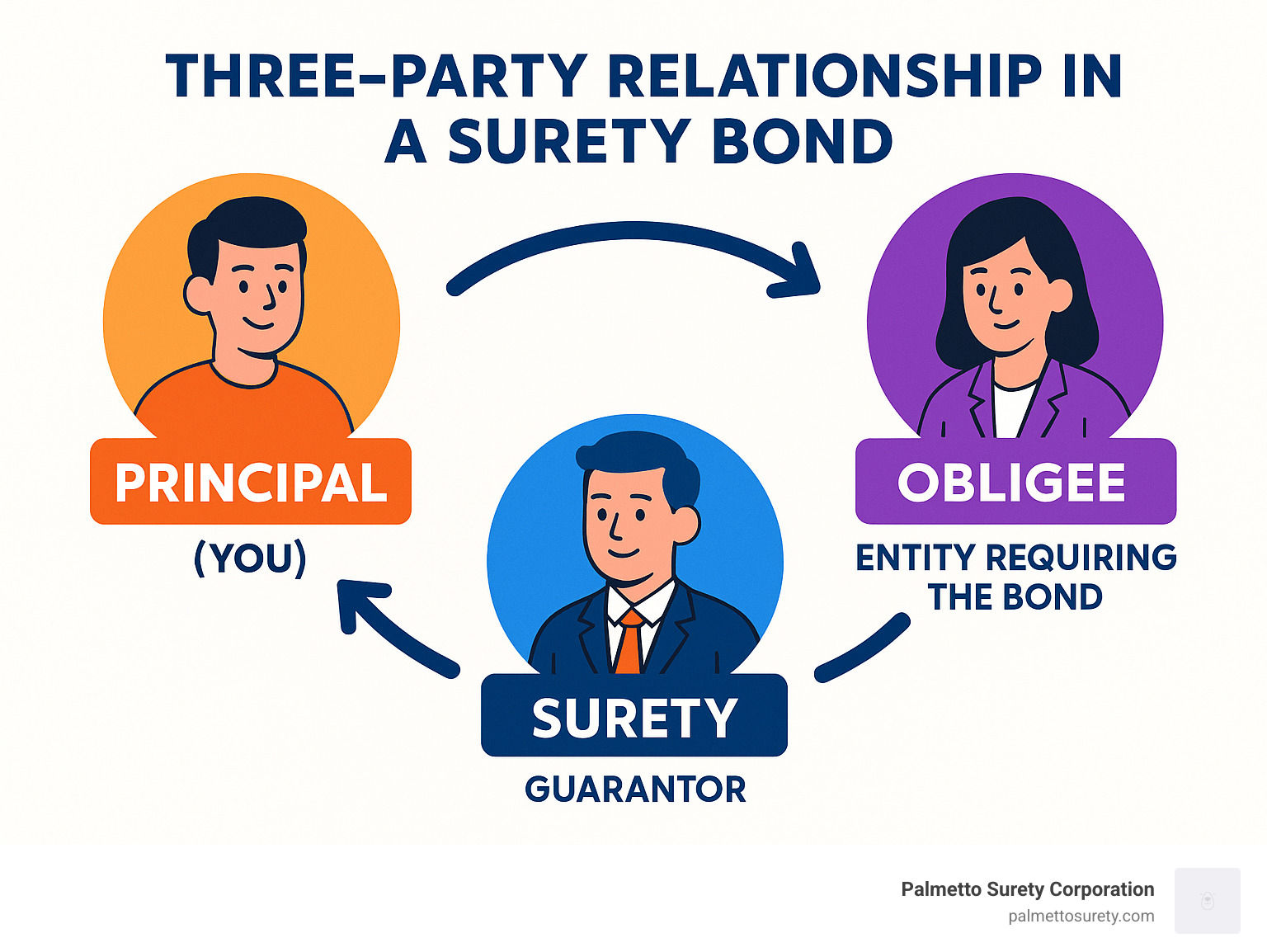
The surety bond application form is the request you submit to the surety company. It provides the information needed for them to assess risk and underwrite your request. The bond itself is the legal, three-party contract issued after approval. This contract is the guarantee from the Surety (us) to the Obligee (the entity requiring the bond) that you (the Principal) will fulfill your obligations. The application is the request; the bond is the guarantee.
Can I get a surety bond with bad credit?
Yes, it’s often possible to get a surety bond with bad credit. While good credit helps and lowers costs, it’s not always a deal-breaker, especially for some commercial bonds. Many sureties, including those in our network, have programs for applicants with less-than-perfect credit. However, be aware that a lower credit score may lead to a higher premium (the bond’s cost) to offset the increased risk. You might also be asked to provide collateral (cash or other assets) to secure the bond. Being transparent about your financial situation and working with an experienced agent is the best approach to explore all available options.
Conclusion: Your Next Steps to Securing a Surety Bond
You now understand surety bond application forms. The process, while detailed, is manageable with preparation, honesty, and thoroughness. Your application is your opportunity to present your case to the surety company.
The journey from filling out your first surety bond application form to holding an approved bond doesn’t have to be stressful. Whether you need a simple license bond or a complex contract bond, the key ingredients are accurate information, complete documentation, and working with the right partner.
At Palmetto Surety Corporation, our 20+ years of experience have perfected our approach. We approve most applications within hours by focusing on key underwriting factors and streamlining the process. We understand the urgency of your bonding needs, from last-minute bids to licensing deadlines.
Your next steps are straightforward. Gather your financial documents early, be transparent on your application, and lean on experienced professionals for guidance. Every successful business owner who needs bonding started exactly where you are now: with their first surety bond application form.
You are now equipped with the knowledge to steer the surety bond world confidently. You understand the different bond types, what documents to prepare, and the importance of accuracy.
Ready to get started? Find the right surety bond for your needs today! Your contractual and licensing obligations are waiting, and with the right approach to your surety bond application form, you’ll meet them without unnecessary delays.


