


Certificate of Title Florida: Complete 4 Easy Steps
Introduction
When you own a vehicle, mobile home, or vessel in the Sunshine State, the certificate of title Florida is your official proof of ownership. It’s a critical legal document.
Here’s what you need to know quickly:
- What it is: Proof of ownership for your vehicle, mobile home, or vessel.
- What it proves: That you legally own the asset.
- Why it matters: Essential for selling, registering, or transferring ownership.
- Format: Can be electronic or a paper document.
This guide simplifies the process of getting a Florida vehicle title. Whether you’re buying, moving to the state, or replacing a lost title, we’ll cover how to get one, handle liens, and manage special situations.
I’m Haiko de Poel Jr. With years of experience in the surety bond industry, I’ve steered complex ownership documents like the certificate of title Florida. My goal is to simplify this process for you.
Understanding the Basics of a Florida Certificate of Title
Your certificate of title Florida is the official birth certificate for your vehicle, mobile home, or boat. Issued by the Florida Department of Highway Safety and Motor Vehicles (FLHSMV), it’s the indisputable proof that you are the legal owner. The title includes key details like the Vehicle Identification Number (VIN) to uniquely identify your property.
For a deeper dive into how titles work, especially when liens are involved, the FLHSMV offers some excellent resources directly on their website: Liens and Titles information from FLHSMV.

What is a Certificate of Title and Why is it Important?
A certificate of title Florida is the ultimate proof of ownership for your motor vehicle, mobile home, or vessel. It legally confirms your right to possess, use, and sell the property.
This document is critical for two reasons. First, it’s required for all legal transactions; you cannot legally sell your vehicle, mobile home, or boat without transferring its title. Second, it helps prevent fraud by clearly documenting ownership, which stops theft and unauthorized sales.
Florida titles can be electronic or paper. Electronic titles are securely stored in the FLHSMV database. A paper title is often needed for private sales or moving a vehicle out of state. Both formats provide the same legal proof of ownership.
Vehicles That Require a Title in Florida
In Florida, most vehicles and vessels require a certificate of title Florida.
This includes all motor vehicles (cars, trucks, motorcycles over 50cc), mobile homes, most vessels (boats), and trailers over 2,000 lbs.
Exceptions to the Titling Requirement
However, a certificate of title Florida isn’t required for some smaller items.
For example, mopeds and motorized bicycles are usually just registered and don’t need a title. Trailers under 2,000 pounds are also exempt from the titling requirement.
Understanding these distinctions saves headaches. If a title is missing or improperly assigned, you may need a surety bond to verify ownership. Companies like Palmetto Surety Corporation can assist with the necessary Florida certificate of title bond when the paperwork isn’t perfect.
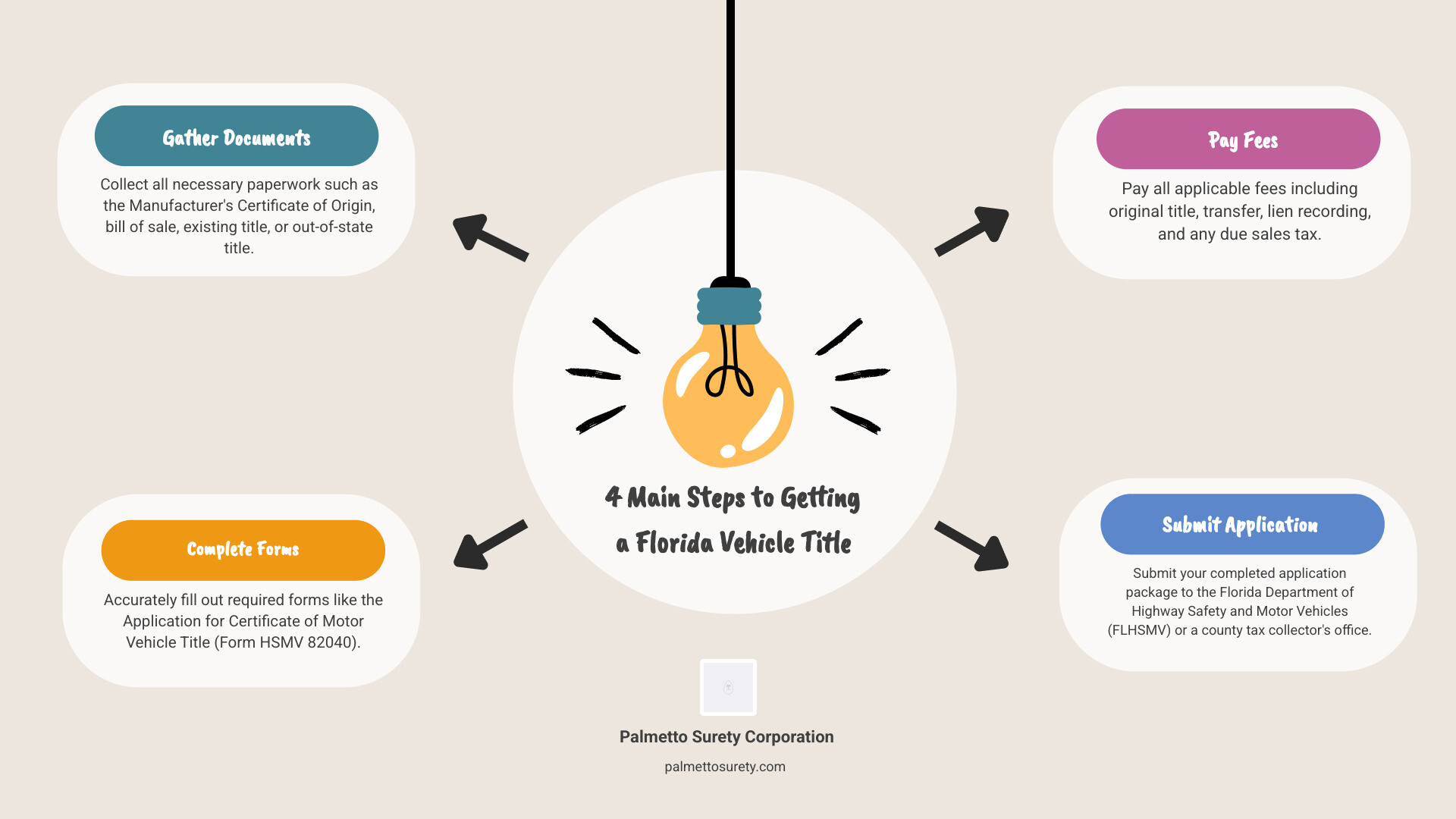
How to Apply for a Certificate of Title in Florida

Applying for a certificate of title Florida is a straightforward process if you have the right documents and follow the steps.
The core of the application is Form 82040, the Application for Certificate of Motor Vehicle Title. You can download it here: Application for Certificate of Motor Vehicle Title (Form 82040).
When to Apply for a Title
Timing is important when applying for a certificate of title Florida, as the state has clear deadlines to keep ownership records current.
You must apply for a title when buying a new or used vehicle, mobile home, or vessel. You also need a Florida title if you are moving to the state with a vehicle. A new title application is required any time ownership changes, including through sale, gift, or inheritance.
You have 30 days from the purchase date to apply for your title and registration. Missing this deadline results in a $20 late transfer penalty, so be sure to file on time.
Documentation for a Brand New Vehicle Title
When buying a new vehicle from a dealership, they will handle most of the paperwork, but it’s good to understand the process.
The key document is the Manufacturer’s Certificate of Origin (MCO), which proves it’s a new vehicle. You’ll also need the completed Form HSMV 82040, a bill of sale, an odometer disclosure, and proof of identity (driver’s license, ID card, or passport). Be ready to pay the necessary fees and sales tax to complete your certificate of title Florida application.
How to Complete a Florida Title Transfer (In-State)
Transferring a title from a private seller in Florida is a common and manageable process.
The seller must provide the original Florida title certificate (no copies). Both the seller and buyer must sign the designated sections on the title, ensuring signatures match the names on the front.
You’ll complete Form HSMV 82040 to apply for the title in your name. While a bill of sale might not always be strictly required if the price is written on the title, it’s smart to have one to document the purchase price and date for sales tax calculation.
You will also need proof of Florida insurance to register the vehicle. Many people complete the transfer together at a local tax collector’s office to ensure it’s done correctly.
How to Transfer an Out-of-State Title to Florida
Transferring an out-of-state title to get a certificate of title Florida involves a few extra but simple steps.
Start with your original title certificate from your previous state. You’ll need a VIN and Odometer Verification (Form HSMV 82042). This physical inspection can be performed by a licensed dealer, Florida notary public, police officer, or a DMV/Tax Collector employee.
Proof of Florida insurance and proof of identity (your current driver’s license or passport) are essential.
Regarding taxes, bring proof of sales tax paid in your previous state. Florida may offer a credit, but you must pay the difference if your old state’s tax rate was lower. After completing Form HSMV 82040, you’ll be an official Florida vehicle owner.
Managing Your Title: Liens, Duplicates, and Special Cases

Managing your certificate of title Florida involves more than just the initial application. Understanding how to handle loans, lost titles, and unique ownership situations will save you time and prevent future issues.
Handling a Title with a Lienholder
If you financed your vehicle, the lienholder (e.g., a bank or credit union) has a legal claim to it until the loan is paid off.
Florida primarily uses a modern Electronic Lien and Title (ELT) system. The lien information is stored digitally in the FLHSMV database instead of on a paper certificate of title Florida, which is more secure.
Once you make your final payment, the lienholder electronically notifies the FLHSMV to remove the lien. This automatic process is called lien satisfaction.
To sell a car with an outstanding loan, you need lienholder authorization. Contact your lender for permission and proper documentation. Plan for at least 30 days, as this process can take time.
Joint Ownership: The Difference Between ‘And’ and ‘Or’
For joint ownership, the word connecting the names on your certificate of title Florida is critical: “AND” versus “OR.”
If the title says ‘AND,’ both owners must sign for any transaction, such as selling or transferring the title.
If the title says ‘OR,’ either owner can act independently to sell or transfer the title, offering more flexibility.
If there’s no “AND” or “OR” on your title, Florida law assumes it’s “AND.” For more details about joint ownership rules, check out the FLHSMV’s comprehensive guide.
How to Get a Duplicate or Replacement Certificate of Title in Florida
If your title is lost, stolen, or damaged, getting a replacement certificate of title Florida is a straightforward process.
You’ll need to complete the Application for Duplicate or Lost in Transit Reassignment for a Title Certificate (Form HSMV 82101). Bring your proof of identity and the required fees to your local Florida county tax collector’s office.
If you find your original title after getting a duplicate, the original is invalid. Destroy it or return it to the FLHSMV to avoid confusion.
What to Do When You Have No Title (Bonded Titles)
If you have a vehicle but no proper certificate of title Florida because it was lost or improperly transferred, Florida offers a solution: a “bonded title.”
This process involves getting a surety bond worth double your vehicle’s value. The bond acts as insurance for the state, protecting previous owners and future buyers from ownership disputes.
You’ll need to complete an affidavit (Form 82026) explaining how you acquired the vehicle and why the title is missing. Florida typically only issues bonded titles for cars, trucks under 8,000 pounds, or motorcycles between 10 and 25 years old with no liens.
This process can feel overwhelming, but companies like Palmetto Surety Corporation specialize in helping people obtain the necessary Florida certificate of title bond. With over 20 years of experience in surety bonds, they can guide you through the requirements efficiently.
Special Circumstances
Special situations require specific handling for your certificate of title Florida. After an owner’s death, the process varies. A surviving spouse can often use Form HSMV 82152 to get a free title replacement to remove the deceased partner’s name or transfer ownership.
Court orders from divorces or probate can serve as proof of ownership for title transfers. If a vehicle is repossessed, the lienholder follows specific procedures to get a new title. You can grant someone Power of Attorney using Form HSMV 82053 to handle your title business.
These special circumstances often involve complex paperwork. For situations requiring court bonds or other specialized surety products, experts like those at Palmetto Surety Corporation can help. You can learn more about court surety bonds for these unique situations.
Florida Title Fees and Expedited Services
Obtaining or transferring a certificate of title Florida involves fees that cover administrative costs. It’s important to know these costs and your options for expedited service.
Standard Titling and Transfer Fees
Fees can vary slightly by county, but here’s a general overview of common fees associated with obtaining or transferring a certificate of title Florida:
| Service Type | Example Fee (Orange County, FL) | Description |
|---|---|---|
| Electronic Title | $75.75 | Standard title issuance, kept electronically |
| Mail Title | $78.25 | Standard title issuance, paper title mailed to you |
| In-Person Title | $75.75 | Standard title issuance, processed at a service center |
| Florida Title Transfer | $85.75 | Transferring an existing Florida title to a new owner |
| Out-of-State Title Transfer | $95.75 | Transferring an out-of-state title to a Florida title |
| Print Electronic Title Online | $4.50 | Requesting a paper title from an electronic record via MyDMV Portal |
| Request Paper Title via Mail | $2.50 | Requesting a paper title from an electronic record via mail |
| Duplicate/Replacement Title | $85.75 | For lost, stolen, or damaged paper titles (if issued by local office) |
| Duplicate/Replacement Title | $78.25 | For lost, stolen, or damaged paper titles (if issued by state) |
| Late Transfer Penalty | $20.00 | Assessed if title application is not filed within 30 days |
Note: These fees are examples from a specific county (Orange County, FL) and may vary. Always check with your local tax collector’s office for the most current and accurate fee schedule.
What is a ‘Fast Title’ Service?
If you need your certificate of title Florida immediately, the state offers a “fast title” service for same-day printing.
- Expedited Service: This service allows you to receive your paper title much faster than standard mail processing.
- Same-Day Printing: Your title is issued and printed on the spot during your in-person visit.
- In-Person Request: To use this service, you must visit a Florida county tax collector’s office or service center in person.
- Additional $10 Fee: This expedited service comes with an additional $10 fee on top of the standard title fees. It’s a small price to pay for immediate peace of mind, especially if you’re in a rush to sell your vehicle or need the title for another time-sensitive transaction.
Frequently Asked Questions about Florida Vehicle Titles
We understand you might have more questions, so we’ve compiled some of the most common ones to help you steer your way through getting your certificate of title Florida.
How do I convert my electronic title to a paper title?
Converting your electronic certificate of title Florida to a paper one is simple. A physical copy may be needed for a private sale or moving out of state. You have several options:
- Online via the MyDMV Portal: This is often the quickest method. For a $4.50 fee, you can request a paper title, which will be mailed to your address on record, typically arriving in 3-4 weeks.
- By Mail: You can send a written request, a copy of your valid photo ID, and a $2.50 fee to your local Florida county tax collector’s office.
- In Person: For same-day service, visit a local Florida county tax collector’s office. There is a higher fee (around $10.00 in some counties) for the ‘fast title’ service, but you receive it immediately.
While electronic titles are secure, a paper copy can make private sales smoother, as many buyers prefer a physical document.
How long do I have to transfer a title after buying a car in a private sale?
After purchasing a vehicle in a private sale, you must apply for a certificate of title Florida and register it in your name within 30 days.
Failing to apply within this 30-day window results in a $20 late transfer penalty fee, so transfer the title promptly to avoid extra charges!
What happens if I move to Florida with a car that has a lien on it?
If you move to Florida with a vehicle that has an active lien, you must still title it in Florida. The process is similar to other out-of-state transfers but requires an extra step with your lienholder:
- Contact Your Lienholder: Contact your lienholder for permission and the necessary authorization. They must provide information directly to the Florida tax collector’s office so the lien can be recorded on your new Florida title.
- Follow Standard Out-of-State Transfer Procedures: Besides coordinating with your lienholder, you’ll still need all the usual documents. This includes your original out-of-state title, proof of Florida insurance, a VIN verification, proof of your identity, and any applicable sales tax payments.
Start this process early, as coordinating with an out-of-state lienholder can take time.
Your Guide to Florida Vehicle Titles
You now have the information to confidently handle your certificate of title Florida, from straightforward purchases to more complex situations.
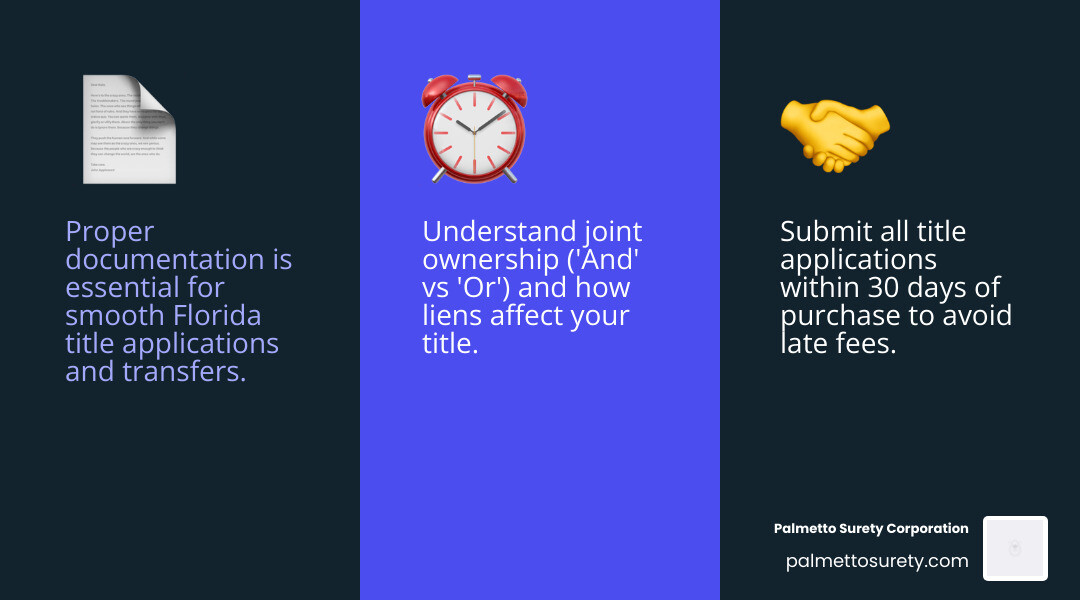
Remember these key points. Proper documentation is essential. Keep your papers organized, as the FLHSMV has strict requirements, and being prepared can save you extra trips to the tax collector’s office.
Timing is critical. The 30-day deadline is a firm requirement with a financial penalty. Whether buying privately or transferring an out-of-state title, meet the deadline to avoid the $20 late fee.
Understanding ownership structures prevents future headaches. The difference between “AND” and “OR” on a title determines who must sign for transactions. If unsure, ask the staff at the tax collector’s office for guidance.
Liens add complexity but are manageable. If you’re financing, work closely with your lender. The electronic lien system simplifies the process, but call your lienholder if you need clarification.
For those unique situations that don’t fit the standard mold – like probate cases, court orders, or other complex legal circumstances – specialized help is available. At Palmetto Surety Corporation, we understand that sometimes life throws curveballs that require specific types of financial guarantees. Our team has over 20 years of experience helping people steer these challenging situations. Find out more about court surety bonds.
Getting your certificate of title Florida doesn’t have to be stressful. Take it one step at a time, gather your documents, meet deadlines, and ask questions. With the right preparation, you can get your title sorted out efficiently.


