


Bail Bond Agent: 5 Powerful Steps to Instantly Avoid Mistakes
Why Finding the Right Bail Bond Agent Can Save Hours of Your Life
A bail bond agent is a licensed professional who posts bail on behalf of defendants who cannot afford to pay the full bail amount upfront. Here’s what you need to know:
Key Facts About Bail Bond Agents:
- Charge a non-refundable fee of typically 10% of the bail amount
- Must be licensed by the state insurance department
- Available 24/7 to process bail applications
- Act as surety to guarantee the defendant’s court appearance
- Can help secure release within hours of arrest
When someone gets arrested, time moves fast. Every hour spent in jail waiting for release is an hour away from family, work, and preparing a defense. The bail bond industry handles nearly $14 billion in bond turnover annually with approximately 15,000 bail bondsmen working across the United States.
But here’s the problem: not all bail bond agents are created equal. Some charge hidden fees, others lack proper licensing, and many simply don’t answer their phones when you need them most. With 25% of released felony defendants failing to appear in court according to 1996 federal data, choosing the wrong agent can lead to serious consequences.
The good news? Those released through surety bonds (bail bond agents) appear in court more frequently than other defendants, making professional bail bond services a reliable option for pre-trial release.
I’m Haiko de Poel Jr., and I’ve spent years working in the surety bond industry at companies like Palmetto Surety Corporation, where I’ve seen how the right bail bond agent can make the difference between a quick release and days of confusion. My experience in rebranding and launching one of the fastest-growing US surety bond companies has given me unique insight into what separates professional agents from the rest.
Bail bond agent helpful reading:

Know the Bail Basics Before You Call
Before you start calling bail bond agents, understanding the fundamentals will help you ask the right questions and avoid costly mistakes. The bail system operates on a simple principle: the court sets a bail amount, and you have several options to secure release.
Cash bail means paying the full amount directly to the court. If the defendant appears for all court dates, this money is typically refunded minus court fees. However, most people don’t have thousands of dollars readily available – which is where bail bond agents come in.
A surety bond through a bail bond agent requires only a 10% premium of the total bail amount. For example, if bail is set at $10,000, you’ll pay the agent $1,000 (non-refundable) plus provide acceptable collateral. The agent then posts the full $10,000 with the court.
Collateral serves as security for the bond. Acceptable forms typically include:
- Real estate (most common)
- Vehicles with clear titles
- Jewelry and valuable items
- Bank accounts or certificates of deposit
- Business assets
The court appearance guarantee is crucial. When you work with a bail bond agent, they’re betting that the defendant will show up for all scheduled court dates. If the defendant fails to appear, the agent loses the full bail amount unless they can locate and return the defendant to court.
According to scientific research on bail outcomes, defendants released through surety bonds actually have better court appearance rates than those released through other methods. This data supports the effectiveness of professional bail bond services.
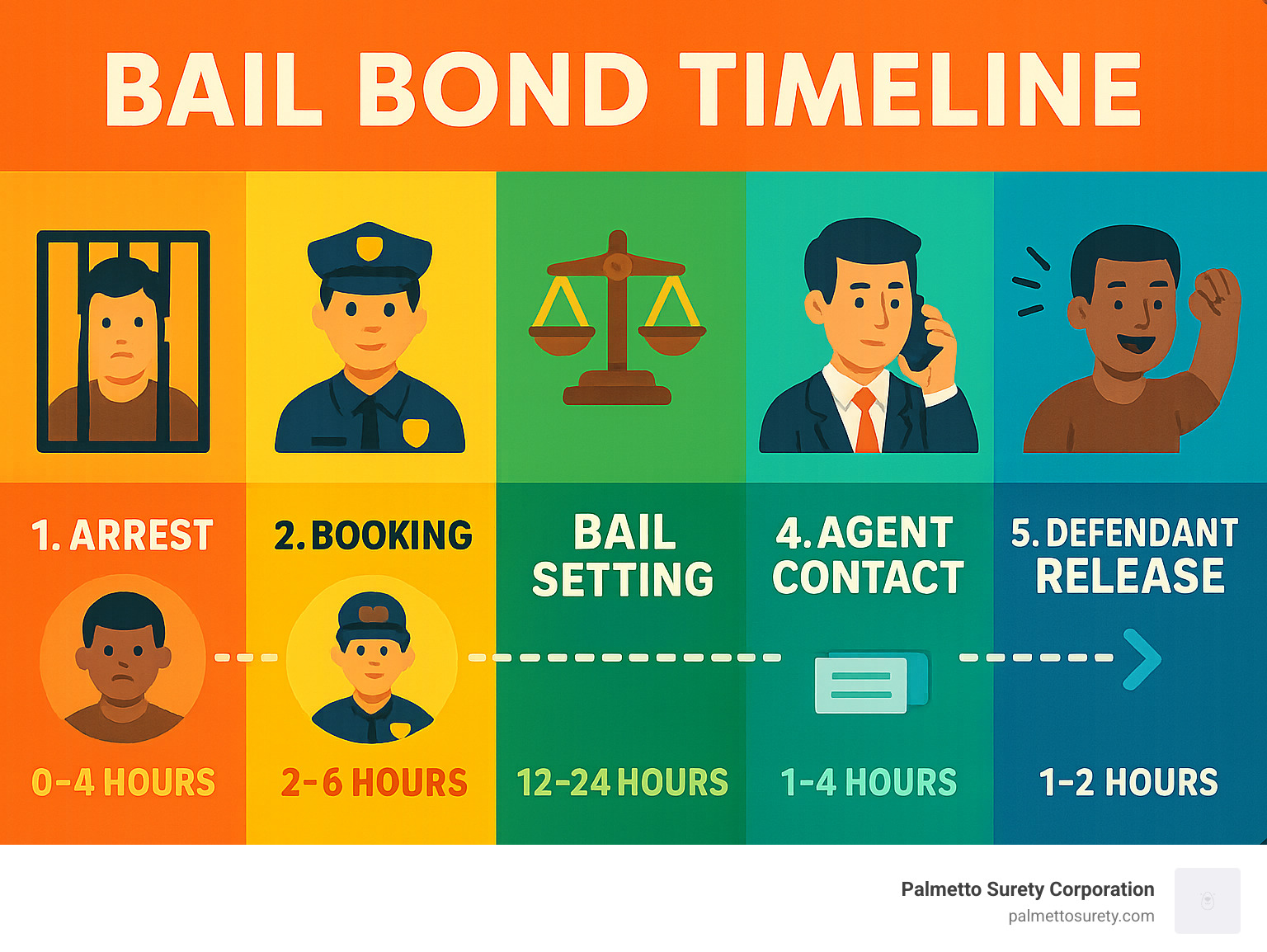
The Bail Bond Process in 90 Seconds
Here’s how the process works from start to finish:
- Booking – After arrest, the defendant is processed and bail is set according to the jurisdiction’s bail schedule
- Bail Schedule – Courts use predetermined amounts based on the charge type and defendant’s criminal history
- Indemnitor – A co-signer (usually family or friend) contacts the bail bond agent and agrees to be responsible for the defendant
- Release Paperwork – The agent posts bond with the court, and the defendant is released, typically within 2-6 hours
The entire process can happen remarkably quickly with the right agent. We’ve seen cases where defendants were released within hours of the initial phone call, allowing them to return home and begin preparing their defense.
How to Spot a Reliable Bail Bond Agent Fast

When you’re under pressure, it’s tempting to call the first bail bond agent you find online. But taking five minutes to verify these key indicators can save you from headaches, hidden fees, and legal complications down the road.
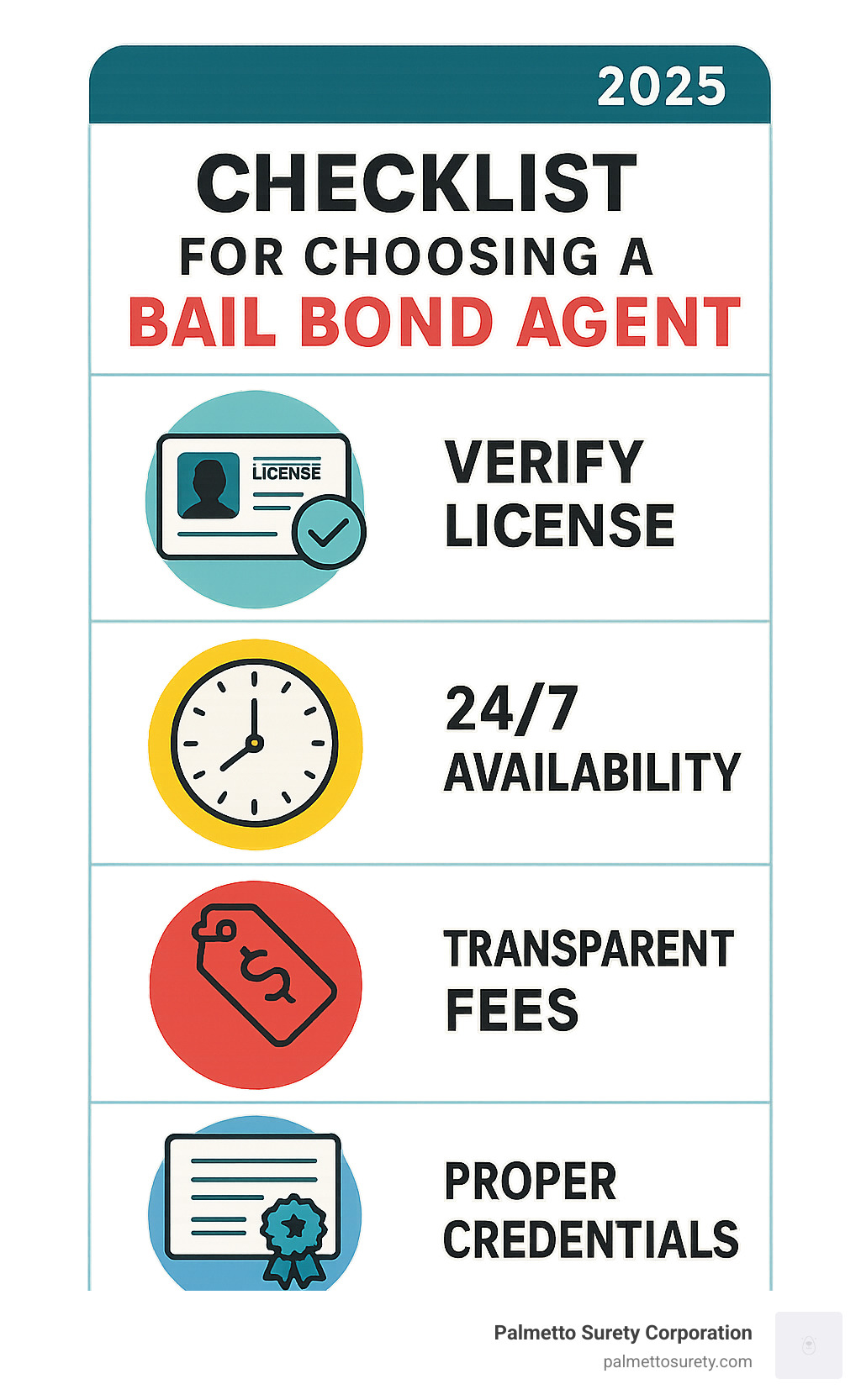
Licensing is non-negotiable. Every legitimate bail bond agent must be licensed by their state’s insurance department. In our experience at Palmetto Surety Corporation, we’ve seen too many cases where unlicensed operators took advantage of desperate families. Always ask for their license number and verify it with the state department of insurance.
24/7 availability isn’t just a marketing slogan – it’s essential. Arrests don’t happen on a convenient schedule. A professional bail bond agent should answer their phone at 2 AM just as readily as at 2 PM. If you get voicemail during business hours, that’s a red flag.
Transparent fees separate professionals from predators. Legitimate agents will clearly explain their 10% premium, any additional fees, and collateral requirements upfront. Be wary of agents who won’t discuss costs over the phone or who mention “special deals” that sound too good to be true.
Online reviews provide valuable insights, but read them carefully. Look for patterns in complaints – are multiple people mentioning hidden fees, poor communication, or difficulty getting collateral returned? A few negative reviews are normal, but consistent problems indicate deeper issues.
Compliance with state regulations shows professionalism. Ask about their continuing education, bonding requirements, and how they handle collateral returns. Professional agents will be proud to discuss their credentials and compliance measures.
License & Regulation Checklist for Any Bail Bond Agent
Before working with any bail bond agent, verify they meet these minimum requirements:
State Examination – All bail bond agents must pass a state-administered exam covering insurance law, bail procedures, and ethical requirements. In California, for example, agents must complete 20 hours of approved prelicensing classroom study plus a 40-hour power of arrest course.
Surety Insurer Appointment – Agents must be appointed by a licensed insurance company that backs their bonds. This appointment ensures the agent has the financial backing to cover bond obligations.
Background Check – Most states require criminal background checks and fingerprinting. Agents with certain felony convictions may be prohibited from licensure or require special approval.
Continuing Education – Professional agents maintain their knowledge through ongoing education. California requires 12 hours of continuing education before each license renewal.
Bonding Requirements – Agents themselves must often post surety bonds (typically $1,000 to $50,000) to guarantee their ethical conduct and compliance with regulations.
Questions to Ask a Bail Bond Agent on the First Call
The first phone call reveals a lot about a bail bond agent’s professionalism and reliability. Here are the essential questions to ask:
“What is your exact premium rate?” – The standard rate is 10% for state charges and 15% for federal charges, with some states setting minimum fees around $100. Be suspicious of rates significantly above or below these norms.
“How and when will collateral be returned?” – Professional agents should explain their collateral return process clearly. In Florida, for example, collateral must be returned within 21 days after bond discharge notice is received.
“Do you provide court date reminders?” – While not required, many professional agents offer this service to help ensure their clients don’t miss court dates accidentally.
“What payment plans are available?” – Legitimate agents often offer payment plans for the premium, though they’ll typically require some money upfront and acceptable collateral before posting the bond.
Quick Comparison of Release Alternatives
| Release Method | Cost | Speed | Risk to Family | Refundability |
|---|---|---|---|---|
| Bail Bond Agent | 10% premium | 2-6 hours | Low (collateral at risk) | Premium non-refundable |
| Cash Bail | Full amount | 1-2 hours | High (full amount at risk) | Refundable minus fees |
| Own Recognizance | $0 | 1-2 hours | None | N/A |
| Pretrial Services | $0-50 | 4-24 hours | None | Varies |
Bail bond agents offer the best balance of speed, cost, and risk management for most families. While the 10% premium is non-refundable, it’s often the only realistic option when bail amounts reach tens of thousands of dollars.
Cash bail provides the fastest release but requires significant liquid assets. For a $50,000 bail, you’d need to have $50,000 available immediately, which most families don’t.
Own recognizance release is ideal when available, but it’s typically reserved for minor offenses and defendants with strong community ties and no flight risk.
Pretrial services programs are expanding in many jurisdictions but may involve monitoring requirements, check-ins, and other conditions that some defendants prefer to avoid.
State Rules & Red Flags to Watch

State regulations vary dramatically, and knowing your local rules helps you identify legitimate bail bond agents quickly. Here are some key state-specific requirements:
California requires agents to complete a minimum of 20 hours of approved prelicensing classroom study and a 40-hour power of arrest course. The state also prohibits agents from soliciting business on jail grounds and requires all advertisements to include the agent’s full street address.
Florida has strict collateral handling rules. Cash accepted as collateral over $50,000 must be made payable to the insurer and received as a cashier’s check, money order, or wire transfer. Agents must provide 10 days’ advance notice before converting collateral on forfeited bonds, as referenced in the Florida Statutes.
New York issues bail enforcement agent licenses for 2-year terms and requires agents to be at least 21 years old, U.S. citizens or legal residents, and New York residents for at least one year.
Banned States – Four states have completely banned commercial bail bonding: Illinois, Kentucky, Oregon, and Wisconsin. If someone offers bail bond services in these states, they’re operating illegally.
Solicitation Limits – Many states prohibit bail bond agents from soliciting business directly at jails or within certain timeframes after arrest. Professional agents respect these boundaries.
Bail Bond Agent Penalties for Non-Compliance
The consequences for bail bond agents who violate regulations are severe, which is why working with compliant agents protects you too:
License Suspension – Agents can lose their license for violations ranging from improper advertising to mishandling collateral. An agent without a valid license cannot legally write bonds.
Five-Times Collateral Fine – In Florida, improper handling of collateral can result in penalties up to five times the collateral amount. This creates strong incentives for proper compliance.
Third-Degree Felony – Serious violations, such as failure to return collateral properly, can result in felony charges against the agent. These penalties ensure agents take their responsibilities seriously.
When a Bail Bond Agent Becomes a Bounty Hunter (and When They Can’t)
There’s often confusion about the relationship between bail bond agents and bounty hunters (bail enforcement agents). Here’s what you need to know:
Bail Enforcement authority varies by state. In some states, bail bond agents have the legal authority to apprehend defendants who fail to appear in court. In others, they must work with licensed bounty hunters or law enforcement.
Fugitive Recovery is a specialized skill. Not all bail bond agents are trained or equipped to track down defendants who skip bail. Many work with professional fugitive recovery agents when needed.
Authority Limits are strict. Even where bail bond agents have enforcement powers, they cannot use excessive force, break into homes without proper authority, or operate outside their jurisdiction without proper coordination.
Bounty Hunter Bans – Some states prohibit the use of bounty hunters entirely. In North Carolina, for example, bondsmen themselves must apprehend fugitives rather than hiring bounty hunters.
Frequently Asked Questions About Finding a Bail Bond Agent
What fees will a bail bond agent charge?
The standard fee structure is straightforward: 10% of the bail amount for state charges and 15% for federal charges. Some states set minimum fees – Florida, for example, requires a minimum of $100 even for small bail amounts.
However, beware of hidden fees. Some disreputable agents add charges for:
- “Processing fees”
- “Administrative costs”
- “Travel expenses”
- “Storage fees” for collateral
A professional bail bond agent will explain all costs upfront. The 10% premium is non-refundable, even if charges are later dropped or the defendant is found not guilty.
What collateral is usually accepted?
Most bail bond agents accept these forms of collateral:
Real Estate – The most common form, including homes, land, and commercial property. The agent will typically require equity equal to the full bail amount.
Vehicles – Cars, trucks, motorcycles, boats, and RVs with clear titles. The agent may require the vehicle to be worth more than the bail amount.
Valuable Items – Jewelry, electronics, firearms, and collectibles. These items are often held by the agent until the case concludes.
Financial Assets – Bank accounts, certificates of deposit, stocks, and bonds. Some agents accept these as collateral while others prefer physical assets.
The key is that collateral must have verifiable value and be easily liquidated if necessary. Professional agents will explain their collateral requirements clearly and provide receipts for any items they hold.
What happens if the defendant misses court?
When a defendant fails to appear in court, several things happen quickly:
Immediate Consequences – The court issues a bench warrant for the defendant’s arrest and declares the bond forfeited. The bail bond agent now has a limited time (usually 30-180 days depending on the state) to locate and return the defendant.
Agent’s Response – Professional agents will immediately contact the indemnitor (co-signer) and begin efforts to locate the defendant. They may hire fugitive recovery agents or work with law enforcement.
Financial Impact – If the defendant isn’t returned within the specified timeframe, the agent loses the full bail amount. This is why agents are selective about which bonds they write and why they require adequate collateral.
Collateral at Risk – If the agent can’t recover the defendant and must pay the forfeited bond, they may need to liquidate the collateral to cover their loss.
Conclusion
Finding the right bail bond agent doesn’t have to be a time-consuming ordeal that adds stress to an already difficult situation. By understanding the basics, knowing what questions to ask, and recognizing the signs of a professional agent, you can secure reliable representation quickly.
Remember these key points to save time and avoid problems:
- Verify licensing with your state’s insurance department before signing anything
- Read all contracts carefully, especially sections about collateral and fees
- Ask about payment plans if you need flexibility with the premium
- Confirm 24/7 availability before you need emergency services
- Understand your state’s specific regulations to spot non-compliant agents
The bail bond industry exists to help people steer a challenging time, and the right agent can make the difference between a quick resolution and weeks of complications. Professional agents like those in our network at Palmetto Surety Corporation understand that fast approvals – often within hours – can be crucial for families dealing with arrest situations.
Whether you’re in Atlanta, Charleston, or any of our other service areas across the southeastern United States, the principles for finding a reliable bail bond agent remain the same. Take the time to verify credentials, understand the terms, and choose an agent who prioritizes transparency and professionalism.
For more information about bail bonds and how they work, visit our bail surety bonds page. With over 20 years of experience in the surety bond industry, we’ve built our reputation on quick approvals and reliable service when you need it most.
Remember: in the bail bond business, time is money, but rushing into the wrong relationship can cost you much more than time. Invest a few minutes in finding the right agent, and you’ll save hours of frustration later.


