


what is a notary public bond 7 powerful facts 2025 guide
Notary Bond Basics: What You Need to Know
What is a notary public bond? It’s a financial guarantee that protects the public from mistakes or misconduct by a notary. Think of it as a safety net for people who use notary services.
Here’s a quick breakdown of what a notary public bond is:
| Key Point | Simple Explanation |
|---|---|
| Definition | A surety bond that guarantees a notary will follow the law and perform duties correctly |
| Purpose | Protects the public (not the notary) from financial harm caused by notary errors |
| Structure | A three-party agreement between the notary, state authority, and surety company |
| Cost | Typically $38-$50 for a $10,000 bond (most common amount) |
| Requirement | Mandatory in most states before becoming a commissioned notary |
A notary public bond is not insurance for the notary. If someone suffers a loss because of your mistake as a notary, they can file a claim against your bond. The surety company pays the claim up to the bond amount, but then you must reimburse them.
Most states require notary bonds ranging from $500 to $25,000, with $10,000 being the most common requirement. Your bond typically lasts for the duration of your commission period (usually 4 years).
I’m Haiko de Poel Jr, and as a marketing expert who has worked extensively with Palmetto Surety Corporation, I’ve helped thousands of notaries understand what is a notary public bond and why it’s a critical part of their professional responsibility.
What Is a Notary Public Bond?
When you’re stepping into the role of a notary public, you’ll likely hear about something called a notary public bond. Think of it as your professional safety net – but not for you, for everyone else!
A notary public bond is a special type of surety bond that most states require before you can receive your notary commission. It’s a financial guarantee that protects the public from potential mistakes or misconduct that might happen during your notarial duties.

This bond isn’t designed to protect you. Instead, it safeguards the people who rely on your services. When you purchase a bond, you’re essentially making a promise to the state that you’ll follow all notary laws and perform your duties with integrity and accuracy.
As one notary put it: “I thought my bond protected me until I had to reach into my own pocket after a mistake. That’s when I truly understood what a notary public bond is all about.”
Quick definition – what is a notary public bond in one sentence
A notary public bond is a financial safety net required by most states that ensures funds will be available to compensate the public if your actions as a notary cause someone financial harm.
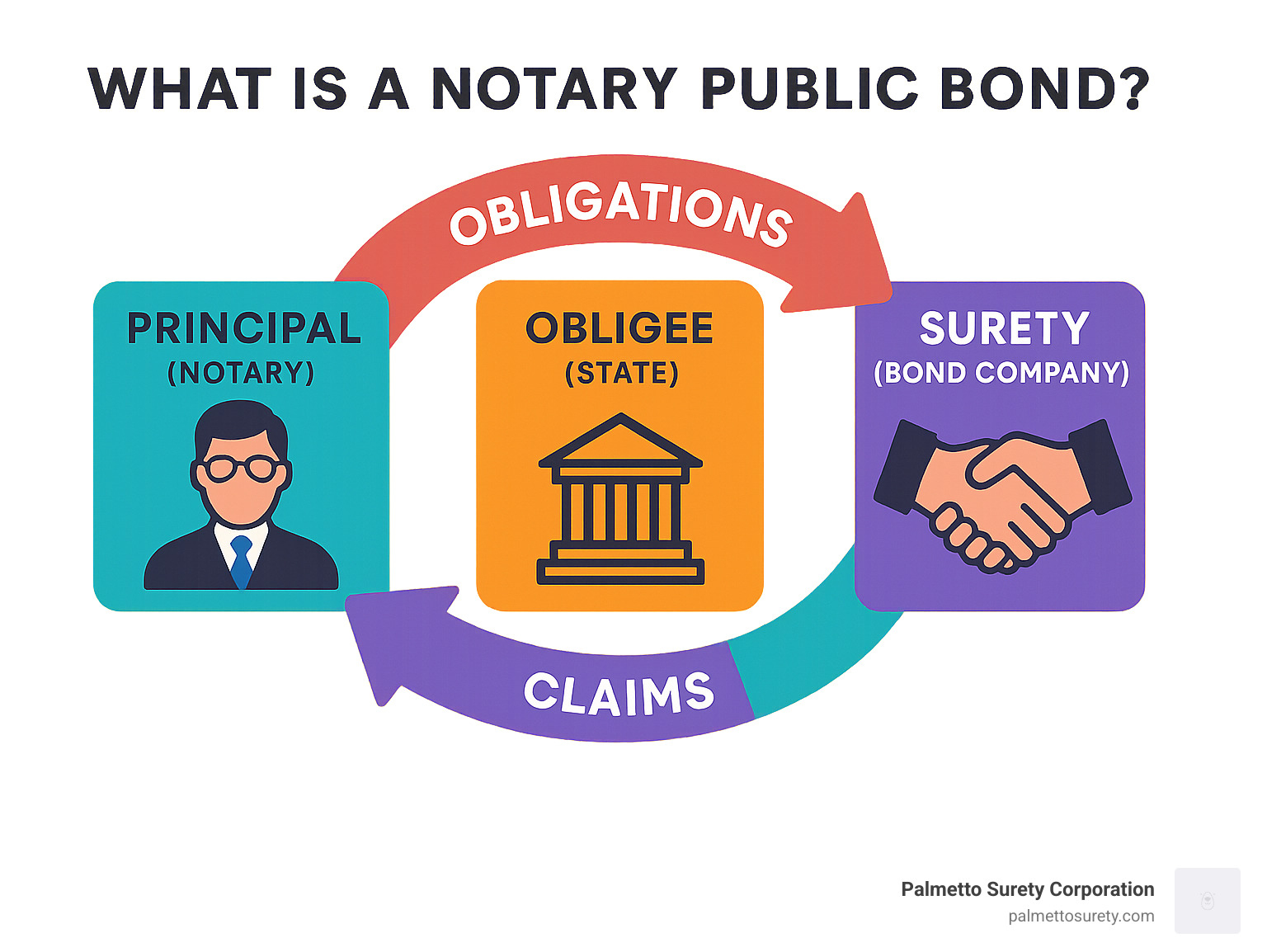
Parties in a notary public bond: Principal, Obligee, Surety
Every notary bond creates a relationship between three distinct parties:
-
Principal (You, the Notary): As the principal, you purchase the bond and make a binding promise to fulfill your notarial duties according to state laws.
-
Obligee (The State): Your state government requires the bond and represents the public interest. They’re the party to whom you’re making your promise of proper conduct.
-
Surety (The Bond Company): A company like Palmetto Surety Corporation that issues your bond and stands behind your promise, guaranteeing payment up to the bond amount if you fail to perform your duties correctly.
The “penal sum” is the maximum dollar amount the surety company will pay if someone files a valid claim against your bond. For example, with a $10,000 bond, if someone suffers a $5,000 loss because you notarized a document without proper identification, the surety would pay up to $5,000 to the injured party.
Here’s the part many new notaries miss: if the surety company pays a claim, you must reimburse them for every penny. This obligation is spelled out in the indemnity agreement you sign when purchasing your bond.
One experienced notary shared: “After 15 years as a notary, I finally understand that my bond is like a credit card for the public – if they use it because of my mistake, I’m still responsible for the bill.”
How Does a Notary Bond Work?
Let me walk you through a real-world example that shows exactly how a notary bond works in practice:
Sarah is a notary who makes a critical mistake. When Tyler (who’s actually Simon’s roommate) comes to her claiming to be Simon, Sarah fails to properly verify his identity. She notarizes a document that transfers ownership of Simon’s car to a buyer named Nate.
When Simon finds his car has been sold without his knowledge, he’s understandably upset – and out several thousand dollars. Here’s where the notary bond comes into play: Simon files a claim against Sarah’s notary bond. After investigation, the state determines Sarah failed in her fundamental duty to verify the signer’s identity.
The surety company that issued Sarah’s bond compensates Simon for his loss (up to the bond limit). But here’s the crucial part many notaries misunderstand – the surety company then turns to Sarah for complete reimbursement, plus any legal costs they incurred during the process.
Unlike car insurance that absorbs the cost of an accident, a notary bond works more like a credit line. The surety expects to be paid back every dollar they pay out on your behalf.
Step-by-step lifecycle from purchase to renewal
The life of your notary bond follows a predictable path from start to finish:
You begin by applying for a bond through a trusted provider like Palmetto Surety Corporation. Most applications with Palmetto are approved within hours – significantly faster than the industry average. You’ll pay a premium that’s just a small percentage of the total bond amount (typically $38-$50 for a standard $10,000 bond).
Once approved, you’ll receive your official bond certificate, which you’ll then file with your state’s notary division or secretary of state along with your notary application. After your commission is approved, you can begin performing notarial acts according to your state’s laws.
Throughout your commission term – typically 4 years – you’ll perform your duties while the bond stands as a silent guarantee behind your work. Before your commission expires, you’ll need to renew both your bond and commission to continue practicing.

What happens if a claim is filed?
If someone believes they’ve suffered financial harm due to your improper notarization, they can file a claim against your bond. The process that follows can be stressful but follows a clear pattern:
First, the surety company thoroughly investigates the claim to determine if it’s valid. If they find the claim has merit, they’ll pay the claimant up to the bond amount to cover their loss.
Then comes the part that surprises many notaries – you must reimburse the surety company for the full amount they paid plus any legal fees they incurred. As one claims specialist put it, “Most notaries don’t realize they’re personally liable for claims paid under their bond. It’s not uncommon for a notary to be shocked when we contact them for reimbursement.”
Beyond the financial impact, you might face additional consequences including loss of your notary commission, difficulty obtaining future bonds, and even potential legal action depending on the severity of the error.
This reality underscores why understanding what is a notary public bond – and its limitations – is so important before you begin your notary career. It’s also why many professional notaries supplement their mandatory bond with Errors & Omissions insurance, which we’ll explore in the next section.
Notary Bond vs. Errors & Omissions (E&O) Insurance
Many new notaries get confused about the difference between a notary bond and Errors & Omissions insurance. This confusion is completely understandable – they sound similar but serve very different purposes in your notary practice.
“Think of a notary bond as a promise to the public that you’ll do your job correctly, with financial backing,” explains an industry expert. “E&O insurance, on the other hand, is protection for you when honest mistakes happen despite your best efforts.”
Let me break down the key differences in a way that’s easy to understand:
| Feature | Notary Bond | E&O Insurance |
|---|---|---|
| Purpose | Protects the public | Protects the notary |
| Required? | Yes, in most states | No, but highly recommended |
| Who files claims | Members of the public | The notary (for defense costs) |
| Reimbursement | Notary must repay the surety | No repayment required |
| Coverage | Limited to bond amount | Can be $25,000 to $100,000+ |
| Cost | $38-$50 for 4 years (typical) | $60-$200 per year (typical) |
The fundamental difference is who benefits from each. Your notary public bond protects the public from your mistakes, while E&O insurance protects you from financial devastation if those mistakes happen.
Why you still need E&O even with a bond
Let me share a real-life example that shows why having both is so important:
A notary in Missouri with a $10,000 bond made an honest mistake on a mortgage document. The error wasn’t found until months later, causing the homeowner to incur $15,000 in legal fees and costs to correct the issue.
The homeowner filed a claim against the notary’s bond and received $10,000 (the bond limit). But now the notary faced a double financial hit:
1. They had to reimburse the surety company the full $10,000
2. They potentially faced a lawsuit for the remaining $5,000 in damages
Had this notary carried E&O insurance, they would have been protected from this financial nightmare. The E&O policy would have covered:
– The $10,000 reimbursement to the surety company
– The additional $5,000 in damages
– Legal defense costs if the matter went to court
As one relieved notary told me: “My E&O insurance costs me just a few pennies a day, but it saved me thousands when a client claimed I made an error on their documents. Without it, I would have had to pay everything out of pocket.”
E&O insurance becomes even more crucial if you handle high-value transactions like real estate closings, wills, or business contracts. In these situations, a small mistake could lead to significant financial losses – potentially far exceeding your bond amount.
According to research on becoming a notary, most professional notaries consider E&O insurance an essential part of their business toolkit, not just an optional extra. The peace of mind alone is worth the modest annual premium – knowing that one mistake won’t wipe out your savings or put your personal assets at risk.
Remember: your notary public bond is mandatory in most states, but it protects others. Your E&O insurance is optional, but it protects you. Together, they provide the comprehensive protection you need to perform your duties with confidence.
Costs, State Requirements & How to Get Your Bond
Wondering what a notary bond will cost you? Good news – it’s probably more affordable than you think!
The price tag for your notary public bond depends on three main factors: your state’s required bond amount, how long your commission lasts, and sometimes your credit history.
Here at Palmetto Surety Corporation, most notaries can secure a standard $10,000 bond for around $38-$50 for a four-year term. That breaks down to less than a dollar per month for financial protection that benefits the public. We’re talking about roughly 0.5% of the total bond value – quite the bargain!
Bond requirements vary widely across America, with each state setting its own rules. Alabama notaries need a hefty $25,000 bond, while California requires $15,000, Missouri asks for $10,000, and Wisconsin notaries can get by with just a $500 bond.

If you have good credit, expect to pay between 1% and 3% of the bond amount as your premium. Those with credit challenges might pay a bit more – typically 5% to 10% of the bond amount. But don’t worry, there are options for everyone, which we’ll discuss later.
State-by-state highlights & commission terms
While I wish we could cover all 50 states (that would be quite the read!), here’s a helpful snapshot of bond requirements and commission terms across various states:
Alabama requires a substantial $25,000 bond with a 4-year term, while California notaries need a $15,000 bond, also for 4 years. Interestingly, Florida doesn’t require a bond at all, though we recommend a $7,500 bond for protection. Georgia, Missouri, Texas, and Washington all require a $10,000 bond with standard 4-year terms.
Indiana stands out with both a higher bond amount ($25,000) and a longer commission period (8 years). On the lower end, Wisconsin requires just a $500 bond for a 4-year term.
Most states follow a 4-year renewal cycle, meaning you’ll need to renew both your bond and commission every four years to keep notarizing. Mark those renewal dates on your calendar – continuing your notary service without a proper bond could land you in hot water!
7-step fast-track to secure a notary bond
Getting bonded doesn’t have to be complicated. At Palmetto Surety, we’ve simplified the process to get you bonded quickly and painlessly:
First, check your state requirements. Every state has different rules, so verify the exact bond amount and any special requirements for your location.
Next, choose a reputable surety company with experience in notary bonds. Look for one that makes the process straightforward (like us!).
Apply for your bond by completing a simple application with your personal information and notary commission details. Most applications can be completed online in minutes.
Pay your premium – a small percentage of the total bond amount. Most bonds can be purchased instantly with a credit card or electronic payment.
Receive your bond certificate. At Palmetto Surety, we pride ourselves on speed – most bonds are issued within hours, not days.
File with your state by submitting your bond along with your notary application to your state’s commissioning authority.
Begin your notary duties once you’re officially commissioned. Congratulations – you’re ready to serve your community!
As one of our recent customers told us, “I was dreading the paperwork nightmare, but it was actually painless! Applied in the morning, had my bond certificate that afternoon, and was notarizing by the end of the week.”
The process is designed to be simple because becoming a notary should be about helping your community, not wrestling with red tape. With your notary public bond in place, you’re taking an important step toward your new role as a trusted public official.
Preventing Claims & Extra Protection
Let’s face it – nobody wants to deal with a claim against their notary bond. The good news is that preventing most claims comes down to following some straightforward practices in your day-to-day work as a notary.
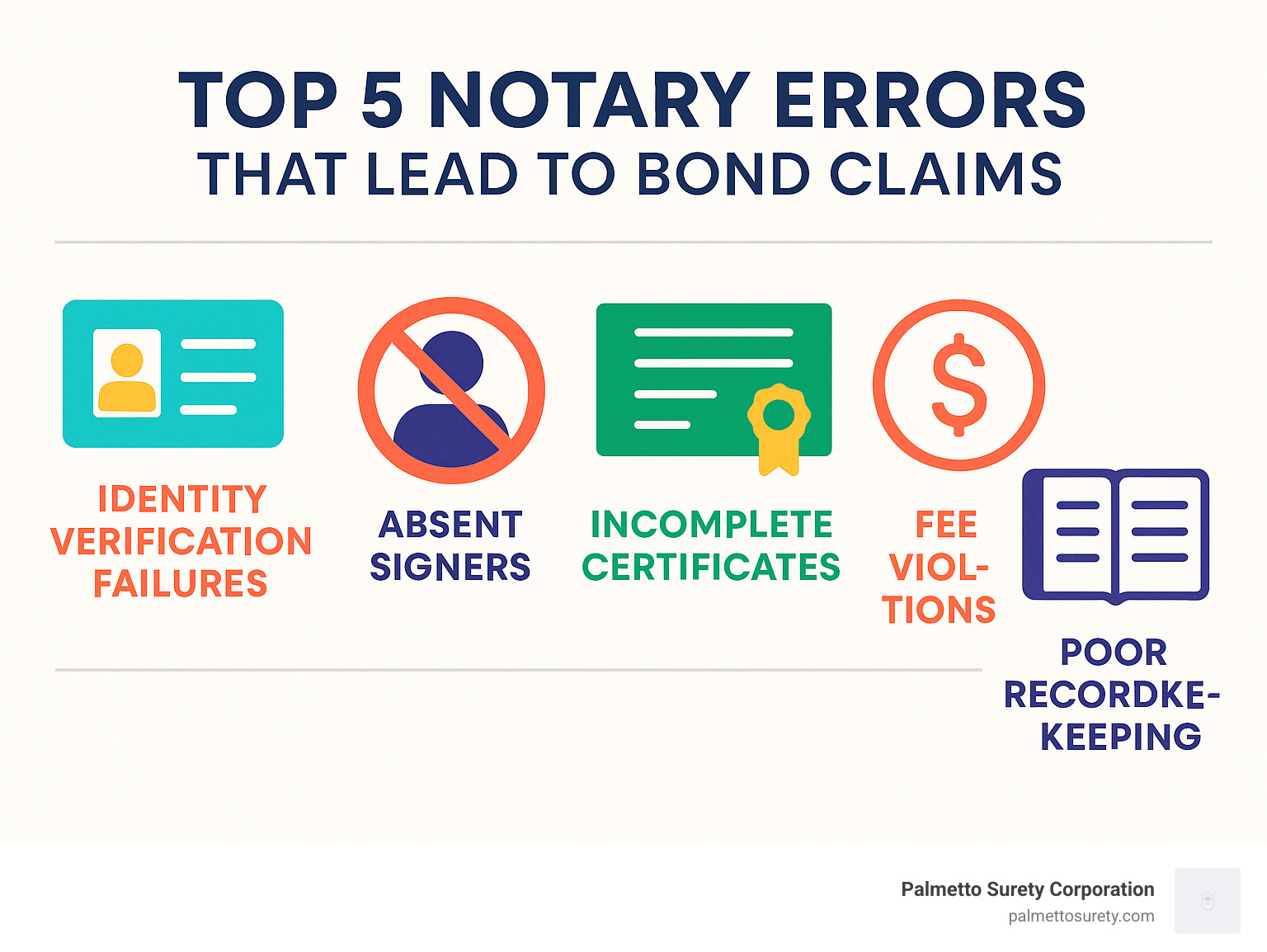
After helping thousands of notaries over the years, I’ve noticed that most bond claims stem from a handful of common mistakes. The biggest culprit? Failure to properly verify identity. Always check a government-issued photo ID for every signer – no exceptions, not even for people you know.
Another frequent issue is notarizing without the signer present. I’ve heard countless stories of notaries who thought they were “helping out” by notarizing documents when the signer wasn’t physically there. This is never okay and is a direct violation of your duties.
Many claims also result from incomplete notarial certificates where important information is missing or incorrect. Take your time and double-check that everything is filled out properly. Similarly, overcharging fees beyond what your state allows can lead to complaints and claims.
Lastly, don’t underestimate the importance of good recordkeeping. Your notary journal isn’t just busywork – it’s your best defense if questions ever arise about a notarization you performed.
One of our long-time customers shared something that’s stuck with me: “I’ve been a notary for 15 years without a single claim. My secret? I never make exceptions to the rules—not for friends, family, or anyone. The rules protect everyone, including me.”
I couldn’t agree more. Consistency is your best protection.
Can you get bonded with bad credit?
“Will my credit score prevent me from becoming a notary?” This is one of the most common questions we hear at Palmetto Surety Corporation. The short answer is no – you can absolutely get a notary bond with less-than-perfect credit.
However, there is a tradeoff. While a notary with good credit might pay around $50 for a standard $10,000 bond, someone with credit challenges might pay between $500 to $1,000 for the same coverage. This is because the surety company views applicants with lower credit scores as higher risk.
The premium typically jumps from the standard 1-3% of the bond amount to somewhere in the 5-10% range for those with credit issues. But don’t let this discourage you – many successful notaries started their careers while rebuilding their credit.
We believe that past financial difficulties shouldn’t stand in the way of your professional goals. One of our customers recently told us, “I was worried my credit would prevent me from becoming a notary, but Palmetto Surety got me approved with a slightly higher premium, and I was able to start my notary business. The additional cost was worth it.”
Many specialist underwriters (including us at Palmetto Surety) work with applicants across the entire credit spectrum. We’ve found that people working to improve their financial situation often make some of the most dedicated and detail-oriented notaries.

Frequently Asked Questions about Notary Bonds
Who does a notary bond protect?
A notary bond isn’t there to protect you—it’s designed to protect the public. When someone visits you for notarial services, they’re placing their trust in you to handle important documents correctly. The bond ensures that if you make a mistake that causes financial harm, they have a path to compensation.
“Think of the notary bond as a safety net for the public,” explains one of our experienced agents at Palmetto Surety. “If you accidentally notarize a fraudulent document that causes someone to lose money, they can recover those funds through your bond.”
This is precisely why having E&O insurance alongside your bond makes so much sense. Your bond protects the public, while your E&O insurance protects you—creating a complete circle of protection for everyone involved.
How long is a notary bond valid?
Your notary bond stays valid for exactly as long as your notary commission—typically 4 years in most states. Some states march to their own beat, like Indiana with its longer 8-year terms.
Here’s what’s important to remember: your bond must remain active during your entire commission period. Even if you decide to stop working as a notary halfway through, your bond obligation continues until either your commission expires or you formally surrender your commission through proper state channels.
When renewal time approaches, you’ll need to handle both your commission and bond renewal. At Palmetto Surety Corporation, we help our notaries time this perfectly so there’s never a gap in coverage that could put you in a legally vulnerable position.
What if I skip the bond where it’s required?
Trying to work as a notary without a required bond is like driving without a license—it’s illegal and opens you up to serious consequences:
First, you simply won’t get your commission. States that require bonds won’t issue your notary commission without proof that you’ve secured the appropriate bond.
Any notarizations you perform without a valid bond (and therefore without a valid commission) may be considered invalid, potentially causing serious legal problems for the people who trusted you with their documents.
You’ll also face complete personal liability for any damages caused by your notarial acts—with no financial protection whatsoever. In some states, you could even face misdemeanor charges for acting as a notary without proper credentials.
As one state notary division director bluntly put it: “What is a notary public bond? It’s not optional paperwork—it’s mandatory consumer protection. We take this requirement seriously because the public deserves that financial safeguard.”
The small investment in a notary bond (typically $38-$50 for a four-year term) is insignificant compared to the legal and financial risks of operating without one. It’s simply not worth cutting this corner when becoming a notary public.
Conclusion
Let’s face it—getting your notary public bond might feel like just another box to check off on your path to becoming a notary. But this small investment plays a mighty role in our legal system.
Think of it as your promise to the public that you’ll do things right. If you make a serious mistake, that bond ensures people won’t be left high and dry financially. It’s one of those rare requirements that truly serves the greater good.
As we wrap up, let’s remember what matters most about your notary bond:
Your bond isn’t your personal safety net—it protects the folks who trust you with their important documents. If someone suffers a loss because of a mistake you make, your bond pays them first, but you’ll need to pay the surety company back afterward. This is why adding E&O insurance to your professional toolkit is so important—it protects you when honest mistakes happen.
The simplest way to avoid claims? Follow the rules every single time. No exceptions for friends, no shortcuts on busy days. Your attention to detail is your best protection.
At Palmetto Surety Corporation, we’ve spent over two decades helping notaries like you get bonded quickly and painlessly. Most of our applicants receive approval within hours—not days or weeks like you might experience elsewhere. We understand that when you’re ready to start your notary journey, waiting is the last thing you want to do.
Whether you’re in the warm sunshine of Florida, the rolling hills of Tennessee, or anywhere across the Southeast, our team is ready to guide you through the bonding process with a friendly voice and straightforward advice.
Ready to secure your notary public bond and take the next step toward your commission? Visit Palmetto Surety Corporation today. We’ll help you steer the process with confidence, so you can focus on building your notary business and serving your community with integrity.


