


Lost Title Bond: 7 Powerful Steps for Stress-Free 2025 Success
Getting Back on the Road: The Lost Title Bond Solution
A lost title bond is a financial guarantee required by state DMVs when you need to register a vehicle but cannot provide sufficient proof of ownership.
What is a Lost Title Bond?
* A surety bond that guarantees you’re the rightful owner of a vehicle
* Required when original title is lost, missing, or never received
* Typically costs $100 for bonds up to $6,000, with higher amounts costing 1.5-3% of the bond value
* Must remain active for 3-5 years (varies by state)
* Protects previous owners and the DMV from fraudulent title claims
When your car’s title goes missing, it creates more than just a paperwork problem—it prevents you from legally driving, insuring, or selling your vehicle. Whether you purchased a car but never received the title, lost the title before transferring it to your name, or bought a vehicle with only a bill of sale, a lost title bond provides the legal pathway to get your vehicle properly registered again.
The bond works as a financial guarantee to your state’s Department of Motor Vehicles (DMV) that you are the rightful owner. If someone later comes forward with proof they’re the legitimate owner, the bond covers their financial loss.
I’m Haiko de Poel Jr, and through my work with Palmetto Surety Corporation, I’ve helped countless vehicle owners steer the complexities of lost title bonds to regain full legal ownership of their vehicles. My experience has shown that understanding the lost title bond process is the first crucial step to getting your vehicle legally back on the road.
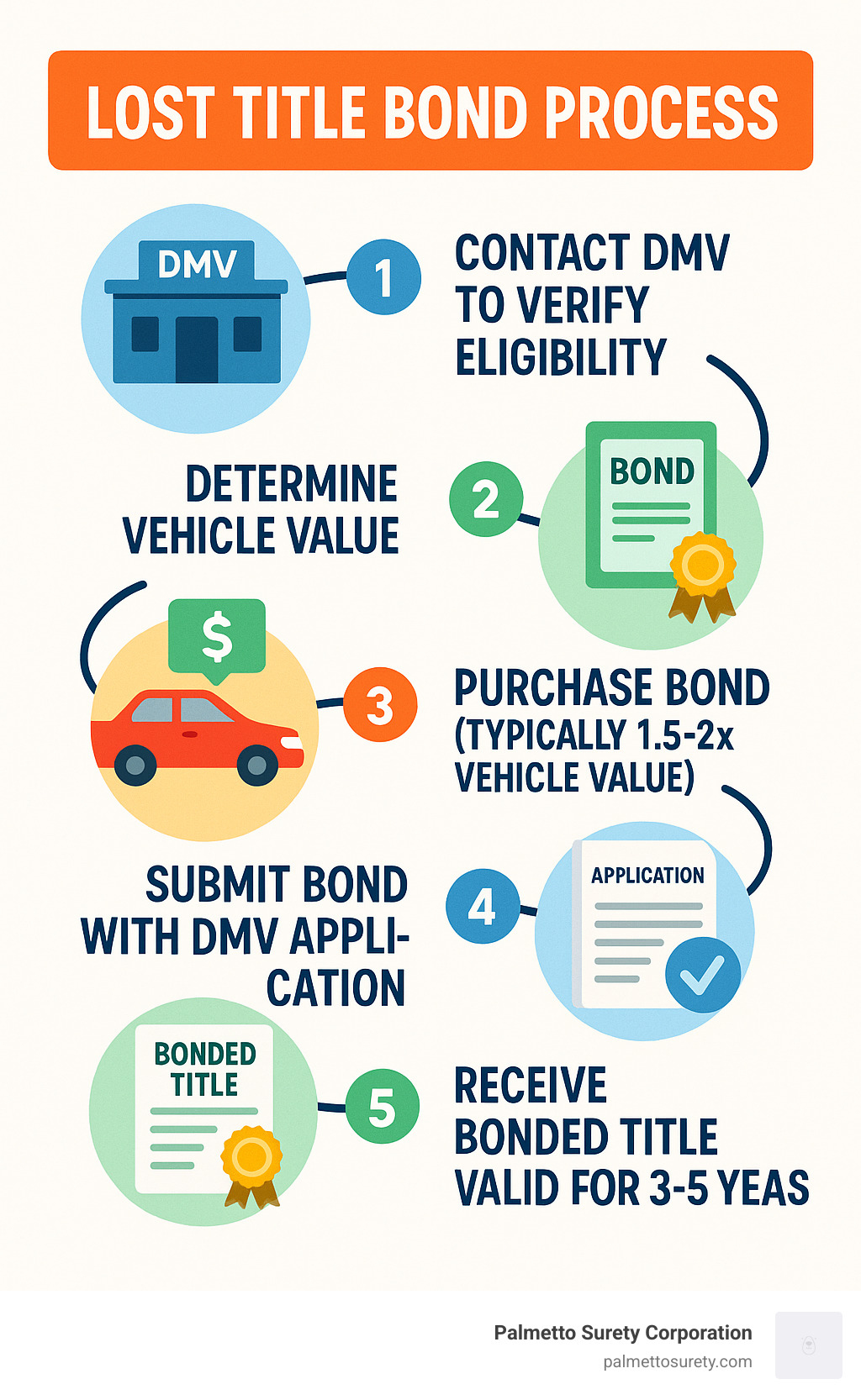
Lost title bond further reading:
– car title bond near me
– how to get a title for a car without title
– indemnity bond for car title
Lost Title Bond Basics: What, Why & How
Ever found yourself in vehicle ownership limbo? A lost title bond might be your ticket back to the road. Also known as a certificate of title bond or defective title bond, this financial guarantee steps in when you’re missing those crucial ownership papers.

The end result? A “bonded title” – a special title document stamped with the word “bonded” that tells the world, “Yes, there’s a story here, but it’s been legally sorted out.”
But why do DMVs insist on these bonds? It’s all about protection. When your local DMV issues a bonded title, they’re essentially taking your word that you rightfully own that shiny set of wheels. The lost title bond provides financial backing to your claim, protecting both the DMV and any potential previous owners if your ownership claim turns out to be incorrect.
Don’t confuse this with a duplicate title request, though. Duplicate titles only work if you were already the registered owner on the original title. If you never received the title in the first place, bought the vehicle without proper transfer paperwork, or finded the title was incorrectly assigned, a bonded title is your path forward.
Typically, the bond amount runs about 1.5 to 2 times your vehicle’s value, as determined by trusted valuation guides like Kelly Blue Book. This ensures there’s enough financial coverage if someone contests your ownership down the road.
How does a lost title bond work?
Think of a lost title bond as a three-way promise between:
- The Principal (that’s you, the vehicle owner)
- The Obligee (your state’s DMV)
- The Surety (the bonding company, like us at Palmetto Surety)
Here’s the scenario: You get your bonded title and happily drive your vehicle. But what if, during the bond period (usually 3-5 years), someone comes forward with legitimate proof that they actually own your car? They can file a claim against your lost title bond. If their claim checks out, our surety company pays them up to the full bond amount.
But here’s the crucial part – you’ll then need to reimburse us for that payment. This accountability is precisely why these bonds effectively deter fraudulent title applications. If you try to title a vehicle that isn’t rightfully yours, you’ll be on the hook when the true owner comes knocking.
Key parties in a lost title bond
Let’s break down who does what in this relationship:
The Principal (You) purchase the bond, submit it to the DMV along with your other paperwork, and remain financially responsible for any valid claims. You’ll need to maintain the bond for the required period, which typically ranges from 3-5 years depending on your state.
The Obligee (State DMV) sets all the requirements, determines the bond amount, accepts your application, and issues that coveted bonded title once everything checks out. They may also handle claims against the bond.
The Surety Company (That’s us at Palmetto Surety Corporation) reviews your application, issues the bond when approved, investigates any claims, and pays valid claims – though we’ll then work with you for reimbursement.
At Palmetto Surety, we’ve spent over 20 years helping folks just like you steer these waters. We’ve provided countless bonds to get vehicles legally back on roads throughout the southeastern United States, turning ownership headaches into happy driving stories.
Whether you’re dealing with a private sale gone wrong or inherited a vehicle with missing paperwork, we understand the frustration and confusion these situations can bring. Our team specializes in making this process as smooth as possible, often approving applications within hours rather than days.
Do You Need One? Eligibility, Exceptions & State Rules
You might need a lost title bond if you find yourself in one of these common scenarios:
-
You purchased a vehicle but never received the title. Perhaps the seller promised to mail it later but never did, or maybe they simply didn’t have it.
-
You only received a bill of sale. While a bill of sale proves a transaction occurred, it doesn’t transfer legal ownership of the vehicle in most states.
-
You received an improperly assigned title. If the title wasn’t correctly signed or completed by the previous owner, the DMV won’t accept it for transfer.
-
You lost the title before transferring it into your name. If you had the title but lost it before registering the vehicle, you can’t simply request a duplicate since it wasn’t in your name.
-
The title was destroyed or damaged beyond legibility. Water damage, tears, or other destruction can render a title unusable.
However, not all vehicles are eligible for the bonded title process. Most states have specific restrictions, which typically include:
- Vehicles reported as stolen
- Vehicles with active liens or loans
- Salvage or junk-branded vehicles
- Vehicles with VIN discrepancies or alterations
Additionally, some vehicle types may have different requirements or processes. For example, boats, RVs, and manufactured homes often have specialized titling procedures that differ from standard vehicle titling.
Each state has its own specific rules regarding lost title bonds. For example, Florida Statute 319.23(7) requires a surety bond equal to twice the vehicle’s value for bonded titles, while Texas has its own set of regulations under the Texas Administrative Code.
Before pursuing a lost title bond, we always recommend contacting your local DMV or visiting their website to understand the specific requirements in your state. The Florida Department of Highway Safety & Motor Vehicles provides detailed information for Florida residents, and other states have similar resources available.
When is a lost title bond mandatory?
A lost title bond becomes mandatory in several specific situations:
Private-sale vehicles without proper documentation: When you purchase a vehicle from a private party and don’t receive a properly signed title, most states require a bonded title process before they’ll register the vehicle in your name.
Abandoned vehicle purchases: If you legally purchase an abandoned vehicle through an auction or other means, but there’s no title available, a bond is typically required.
Antique or classic cars without records: Older vehicles, especially those manufactured before computerized record-keeping, often lack proper documentation. A lost title bond can help establish legal ownership.
Vehicles with broken chains of ownership: If a vehicle has passed through multiple owners without proper title transfers, a bonded title may be the only way to establish clear ownership.
In our experience at Palmetto Surety Corporation, we’ve seen that most states will require a bonded title any time you can’t prove a clear chain of ownership from the last titled owner to yourself. This is especially common in Georgia, Florida, Louisiana, Mississippi, South Carolina, Tennessee, and Texas—all states where we regularly help vehicle owners secure their lost title bonds.
Situations NOT solved by a lost title bond
It’s equally important to understand when a lost title bond won’t help you:
Stolen vehicles: If a vehicle is reported as stolen in any database, you cannot obtain a bonded title. The vehicle must be returned to its rightful owner.
Vehicles with active liens: If there’s a lien on the vehicle (meaning someone has a financial claim to it, like a bank that financed it), you’ll need to satisfy that lien before pursuing a bonded title.
Salvage or junk-branded vehicles: These require specialized processes beyond standard bonded titles.
Vehicles with VIN issues: If the Vehicle Identification Number (VIN) has been altered, removed, or doesn’t match records, this typically requires law enforcement involvement before any title can be issued.
Out-of-state residents: Most states require you to be a resident of that state to apply for a bonded title there. For example, a Georgia resident cannot apply for a Florida bonded title.
If you’re unsure whether your situation qualifies for a lost title bond, we at Palmetto Surety Corporation can help assess your specific circumstances and guide you through the appropriate process.
How to Secure Your Lost Title Bond: Step-by-Step Guide

So you’ve determined you need a lost title bond – now what? I’ve guided hundreds of vehicle owners through this process, and while it might seem daunting at first, breaking it down into manageable steps makes it much more approachable. Let me walk you through the journey from paperwork puzzlement to proudly holding your bonded title.
Step 1: Contact Your Local DMV
Your first stop should be your state’s DMV office or website. Every state has its own unique requirements, and you’ll want to confirm three key things:
Whether your specific situation qualifies for a bonded title (remember, not all vehicles are eligible), what specific paperwork you’ll need to gather, and exactly how much bond coverage your state requires.
I’ve seen many folks skip this crucial first step only to find themselves frustrated later. For example, in Florida, only vehicles 10-25 years old qualify for the bonded title process – something you’d definitely want to know before investing time and money!
Step 2: Vehicle Inspection and Valuation
Most states require an official inspection of your vehicle before they’ll issue a bonded title. This typically involves:
A law enforcement officer or DMV representative verifying your Vehicle Identification Number (VIN) to ensure it matches records and hasn’t been tampered with. They’ll also verify your odometer reading, which helps establish the vehicle’s value.
Speaking of value – this is where resources like Kelly Blue Book come in handy. Your state will use a recognized valuation guide to determine your vehicle’s worth, which then determines your bond amount. If your vintage Mustang is valued at $12,000 and your state requires a bond at 1.5 times the value, you’ll need an $18,000 lost title bond.
Step 3: Gather Required Documentation
Now it’s time for a paperwork scavenger hunt! The specific documents vary by state, but you’ll typically need:
Your government-issued photo ID (driver’s license or state ID), any proof of purchase you have (even an old bill of sale or canceled check can help), your completed VIN verification form, the state’s title application forms, and an affidavit explaining why you don’t have the original title.
Be thorough here – missing documentation is the number one reason for bonded title application delays. At Palmetto Surety, we’ve seen applications delayed for weeks simply because someone forgot to include their completed affidavit!
Step 4: Apply for Your Lost Title Bond
This is where we at Palmetto Surety Corporation can make your life easier. After 20+ years in the surety bond business across the Southeast, we’ve streamlined this process to be as painless as possible.
You’ll complete our bond application with details about yourself and the vehicle. For bonds over certain amounts (typically $6,000), we’ll run a soft credit check that won’t impact your credit score. Most bonds up to $6,000 cost a flat $100 premium, while larger bonds typically cost between 1.5-3% of the total bond amount.
The best part? We can usually approve your application within hours, not days or weeks. We understand you need to get back on the road, and our team works quickly to make that happen.
Step 5: Receive and File Your Bond
Once approved, we’ll send you your official bond document, complete with all necessary signatures and seals. This isn’t just any piece of paper – it’s your ticket to vehicle ownership!
You’ll take this bond, along with all your other documentation, to your local DMV or tax collector’s office. Don’t forget to bring your checkbook, as you’ll need to pay the standard title and registration fees as well.
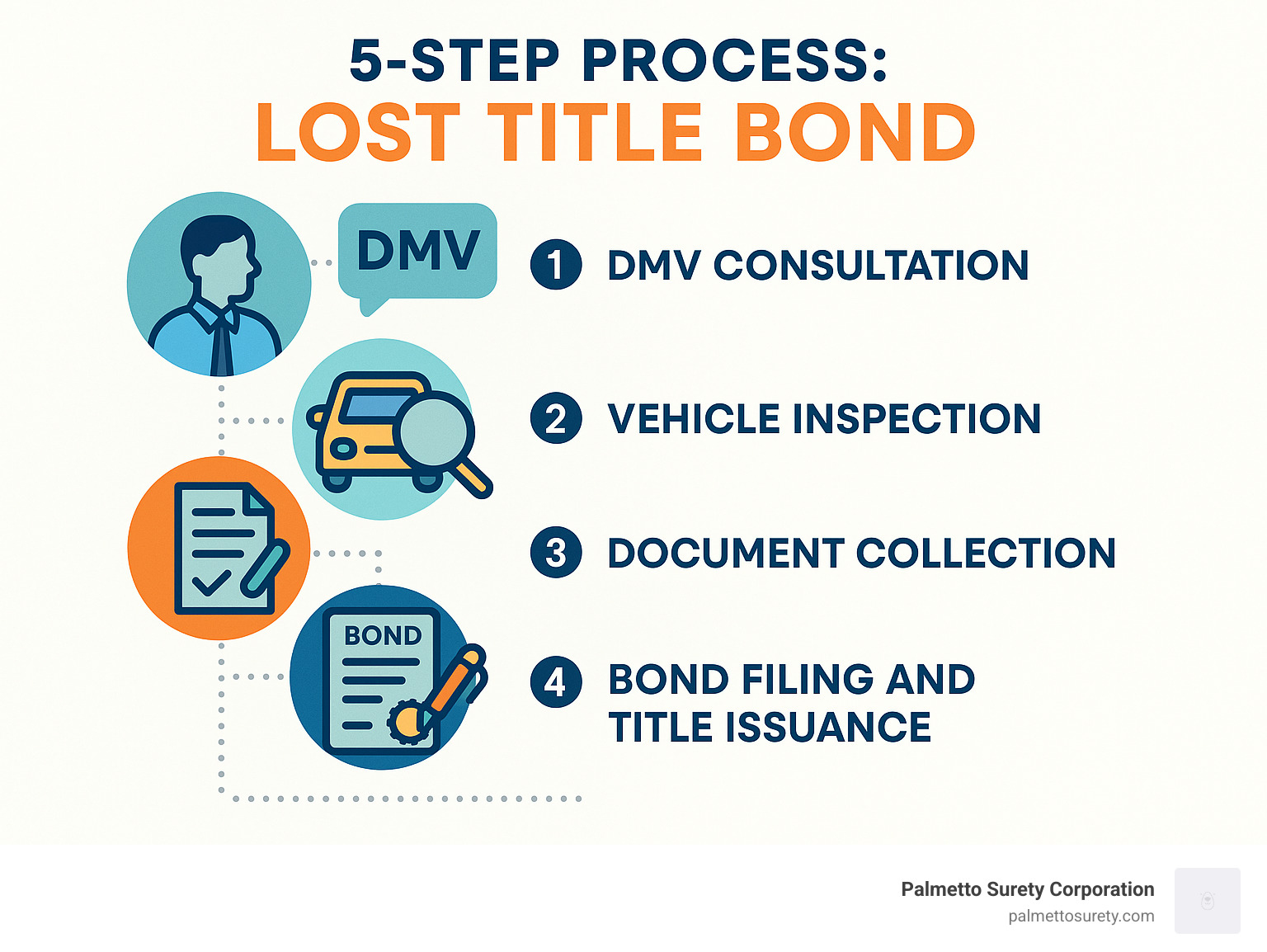
Filing your lost title bond with the DMV
When you arrive at the DMV with your lost title bond in hand, attention to detail becomes your best friend. Be sure to sign the original bond document where indicated – most states won’t accept photocopies or digital signatures.
Your complete submission package should include the original signed bond, your title application, VIN verification, ownership affidavit, and any other state-specific forms. You’ll also need to pay all required fees, which typically include a title application fee, registration fee (if you’re registering at the same time), and possibly administrative processing fees.
The exact office where you’ll submit these documents varies by state. Florida residents work through their county tax collector’s office, while Georgians visit their County Tag Office. Our team can guide you to the right location based on your address.
What happens after DMV accepts your bond?
Once the DMV processes your application and lost title bond, they’ll issue your bonded title – a regular title with a special “bonded” notation. This title gives you full legal ownership rights, allowing you to register, insure, and drive your vehicle without restriction.
Your bond remains active for a set period, typically 3-5 years depending on your state’s regulations. During this time, if someone comes forward with legitimate proof they’re the rightful owner, they can make a claim against your bond.
The good news? In my two decades in this business, I’ve rarely seen legitimate claims filed against lost title bonds. Most people who go through this process are indeed the rightful owners – they just lack the proper documentation to prove it.
After your bond period expires without any claims, the “bonded” brand is removed from your title. In most states, you’ll need to apply for a new clean title at that time, but the process is straightforward since you’re already the recognized owner.
At Palmetto Surety Corporation, we’ve helped countless vehicle owners in Georgia, Florida, Louisiana, Mississippi, South Carolina, Tennessee, and Texas steer this process successfully. What seems complex at first becomes manageable with the right guidance – and that’s exactly what we provide.
Money Matters: Bond Amount, Cost, Duration & Claims
Let’s talk dollars and cents – because understanding the financial side of a lost title bond is just as important as knowing the paperwork process.
Bond Amount vs. Premium Cost
First things first: there’s a big difference between the bond amount and what actually comes out of your pocket:
-
Bond Amount: This is the financial guarantee backing your claim to the vehicle. Think of it as the “insurance policy” that protects the DMV and potential previous owners. Most states require this to be 1.5 to 2 times your vehicle’s appraised value.
-
Premium Cost: This is what you actually pay upfront. Good news – it’s just a fraction of the total bond amount!
For example, if you have a $10,000 truck and your state requires double coverage, your bond amount would be $20,000. But you might only pay $300-$600 for the bond itself. Much more manageable, right?
Typical Premium Costs
At Palmetto Surety, we’ve structured our pricing to be as straightforward as possible:
For most everyday vehicles with bonds up to $6,000, you’ll pay a simple flat rate of $100. That covers a lot of older or economy vehicles.
For more valuable vehicles requiring larger bonds, premiums typically run 1.5% to 3% of the total bond amount. Your specific rate depends on a few factors we’ll cover shortly.
Here’s a quick look at what you might expect to pay:
| Vehicle Value | Bond Amount (2× Value) | Typical Premium Cost |
|---|---|---|
| $3,000 | $6,000 | $100 (flat rate) |
| $10,000 | $20,000 | $300-$600 (1.5-3%) |
| $25,000 | $50,000 | $750-$1,500 (1.5-3%) |
What Affects Your Premium Rate?
Several factors can influence what you’ll pay for your lost title bond:
Credit Score plays a role, with better credit often qualifying for lower rates. But don’t worry if your credit isn’t perfect – we’ve helped countless clients across the credit spectrum.
Bond Amount matters too – larger bonds may have slightly higher percentage rates simply because they represent more financial risk to the surety company.
Vehicle Type can sometimes affect pricing, especially for specialty or collectible vehicles that might require special valuation methods.
Your State’s Rules also impact pricing since each state has its own specific requirements for bond amounts and terms.
Bond Duration and Renewal
Unlike some bonds that need regular renewal, a lost title bond stays in effect for a set period and then expires:
Most bonds remain active for 3-5 years, depending on your state. Florida requires a 3-year term, Texas also requires 3 years, and other states may vary slightly.
Once this period ends without any claims, you can typically apply to have the “bonded” brand removed from your title. It’s like a probationary period for your vehicle’s ownership – get through it claim-free, and you’re home free!
What happens if a claim is filed against my lost title bond?
This is the scenario nobody wants, but it’s important to understand:
If someone comes forward claiming to be the rightful owner of your vehicle during the bond period, the surety company (that’s us) will investigate the claim thoroughly. We don’t just take someone’s word for it – we need proof.
If the claim proves valid, we’ll pay the claimant up to the bond amount. However – and this is crucial – you would then be legally responsible for reimbursing us for that payment. This is why it’s so important to be certain about your rightful ownership before pursuing a bonded title.
The good news? In our 20+ years of experience at Palmetto Surety Corporation, we’ve seen very few legitimate claims filed against properly obtained lost title bonds. Most people seeking these bonds truly are the rightful owners who just lack the proper documentation.
Can I get a lost title bond with bad credit?
Absolutely yes. We believe everyone deserves a chance to properly title their vehicle, regardless of credit history.
For bonds under $25,000 (which covers most everyday vehicles), we can often issue bonds with minimal credit verification. For larger amounts, your credit might affect the premium rate, but it rarely results in outright denial.
Over our two decades in the surety business across the southeastern United States, we’ve developed specialized programs specifically designed to help clients with credit challenges. We’ve seen how getting that bonded title can be a crucial step in someone’s financial recovery journey, and we’re proud to be part of that process.
At Palmetto Surety Corporation, we’re in the business of finding ways to say “yes” when others might say “no.” After all, everyone deserves the chance to legally drive and own their vehicle.
Conclusion, Tips & FAQs
After guiding hundreds of vehicle owners through this process, I’ve seen how getting a lost title bond can transform a frustrating situation into a solved problem. What seems like a complex maze of paperwork becomes manageable when you know the right steps to take.
Let me share some wisdom that’ll make your journey smoother:
Start by doing your homework. A quick call to your state DMV before you do anything else can save you hours of headaches later. Every state has its own quirks when it comes to bonded titles.
Gather every scrap of evidence showing your connection to the vehicle. That old maintenance receipt you almost tossed? The text messages with the seller? Keep them all. These breadcrumbs help establish your legitimate claim to ownership.
Honesty is non-negotiable when completing your application. Be straightforward about how you acquired the vehicle and why you don’t have a title. The bond exists to protect against fraud, not to enable it.
Keep meticulous records throughout the process. I recommend creating a dedicated folder—physical or digital—where you store copies of every document, receipt, and piece of correspondence related to your bonded title journey.
Filing promptly once you receive your lost title bond minimizes the time you spend in ownership limbo. The sooner you submit everything to the DMV, the sooner you’ll have that bonded title in hand.
Always remember your financial responsibility. The bond isn’t insurance—it’s a guarantee that you’ll make things right if someone proves they’re the rightful owner. This rarely happens with legitimate purchases, but it’s important to understand the obligation.
With Palmetto Surety’s 20+ years in the business across Georgia, Florida, Louisiana, Mississippi, South Carolina, Tennessee, and Texas, we’ve refined our process to get most applications approved within hours. Our goal is simple: get you back on the road legally, with minimal hassle.
For more information about our surety services, visit our website or reach out to one of our regional offices.

Frequently asked questions about lost title bonds
How long does a lost title bond last?
Most lost title bonds stay active for 3-5 years, with Florida and Texas requiring a 3-year term. Think of this period as a waiting time, allowing any legitimate previous owners to come forward if there’s an issue. If the bond period expires without claims, you can typically apply to remove the “bonded” designation from your title—giving you a clean, regular title.
How is the required bond amount determined?
Your state DMV typically sets the bond amount at 1.5-2 times your vehicle’s appraised value. This isn’t arbitrary—the higher amount ensures there’s enough coverage for potential claims, including the vehicle’s value plus any related costs. Florida, for instance, requires a bond amount equal to twice the vehicle’s value based on recognized guides like Kelley Blue Book. Check with your local DMV for their specific multiplier.
Are bonded titles transferable if I sell the vehicle?
Absolutely! If you sell your vehicle while it still has a bonded title, the buyer receives that same bonded title, and the bond continues for its original term. Just be upfront with potential buyers about the bonded status—full disclosure builds trust. While some buyers might hesitate, a bonded title is perfectly legal and far better than no title at all. After the bond period ends without claims, the new owner can apply to remove the “bonded” designation.
Can I get insurance for a vehicle with a bonded title?
Yes, you can insure a vehicle with a bonded title without issue in most cases. Insurance companies recognize that a bonded title is a legitimate title issued by your state DMV. In our experience at Palmetto Surety, the vast majority of our clients secure standard insurance coverage without any complications. That said, policies vary between insurance companies, so it’s worth shopping around if you encounter any hesitation.
What if I find the original title after obtaining a bonded title?
Found that original title in the back of your filing cabinet after all that work? Contact your DMV for guidance, but generally, once a bonded title has been issued, it supersedes the original title—making the original void. Your bonded title remains in effect for the specified term regardless. However, having that original title could prove valuable if anyone ever makes a claim against your bond, as it helps establish your legitimate ownership.
How quickly can I get a lost title bond?
At Palmetto Surety, we’ve streamlined our process to approve most lost title bond applications within hours—many bonds can even be issued the same day you apply. Once you have your bond in hand, you can immediately file it with your state DMV. The entire journey from bond application to receiving your bonded title typically takes 4-6 weeks, with most of that time being the DMV’s processing period, not ours.
Understanding these common questions and following the guidelines I’ve shared will help you steer the lost title bond process with confidence. We’re here to help every step of the way, with offices throughout the southeastern United States and over two decades of experience making this process as painless as possible.


