


South Carolina Mechanical Contractor Bond: 7 Key Benefits 2025
Understanding Bond Requirements for SC Mechanical Contractors
A South Carolina Mechanical Contractor Bond is a financial guarantee required by the state for contractors who perform commercial mechanical work (including HVAC, plumbing, and electrical) on projects over $10,000. This bond serves as your promise to clients and the state that you’ll fulfill your obligations according to industry standards and regulations.
| Bond Requirement | Details |
|---|---|
| Required For | Commercial mechanical projects over $10,000 |
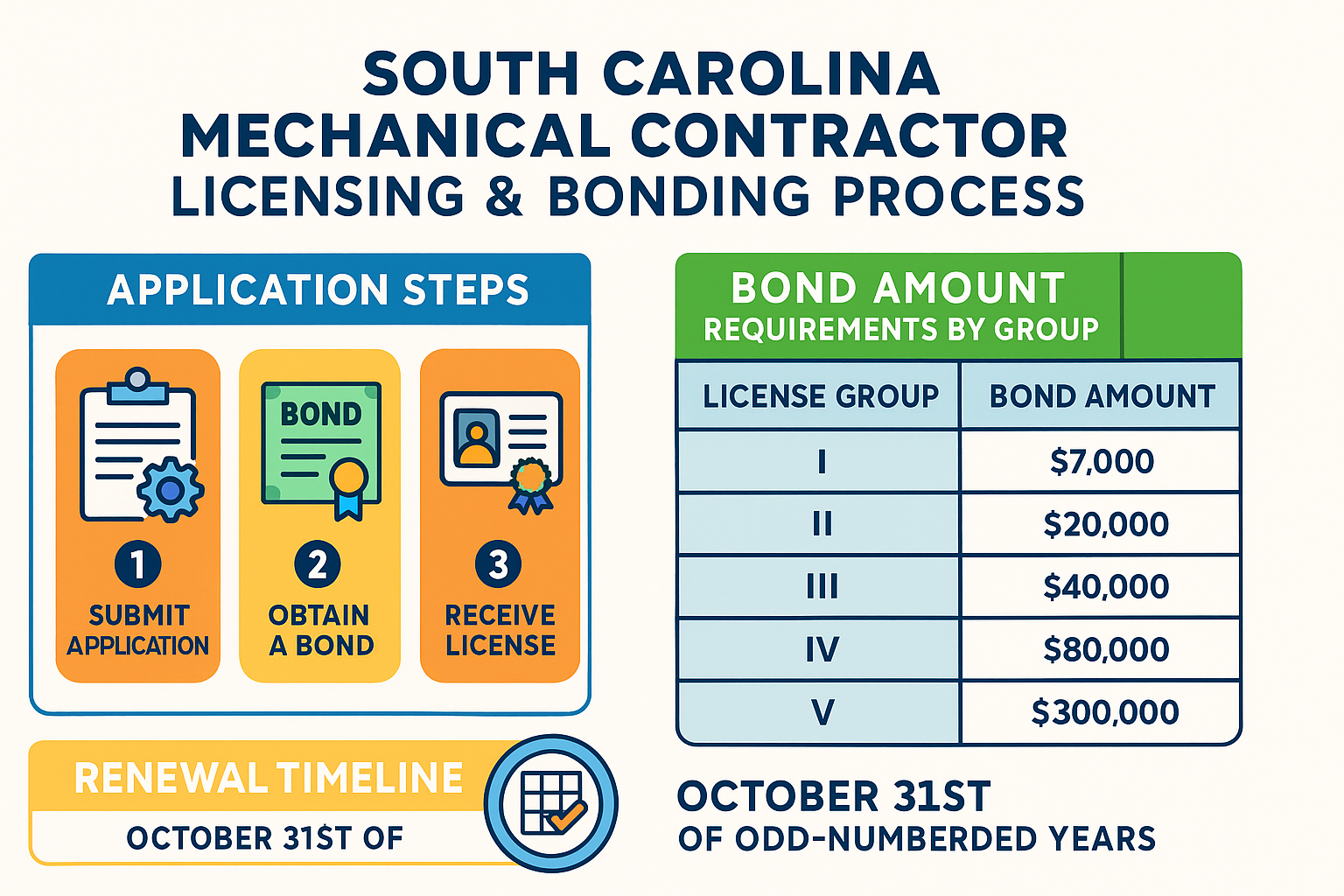
| Bond Amounts | $7,000 to $300,000 (based on license group) |
| Cost | Typically 1-9% of bond amount annually |
| Purpose | Alternative to financial statements proving net worth |
| Expiration | October 31st of odd-numbered years |
| Filed With | SC Contractors Licensing Board |
If you’re entering the mechanical contracting field in South Carolina, understanding these bonding requirements is essential to your business success. The state implemented these rules to protect consumers while giving contractors a more accessible path to licensing.
Since May 2018, the South Carolina Contractor’s Licensing Board has offered a welcome alternative to the detailed financial documentation previously required. Rather than submitting comprehensive financial statements to prove your net worth, you can now provide a South Carolina Mechanical Contractor Bond instead. This change has made the licensing process much more straightforward for many professionals.
Unlike insurance that protects you, this bond protects the public. If you fail to complete a project according to contract terms or violate state regulations, the bond provides financial compensation to those harmed by your actions. Think of it as a safety net for your clients, backed by a third party (the surety company) that vouches for your professional integrity.
I’m Haiko de Poel Jr, and through my role as a fractional Chief Marketing Officer in the surety bond industry, I’ve guided many contractors through the South Carolina Mechanical Contractor Bond process. My experience with Palmetto Surety Corporation—one of the fastest-growing surety providers in the US—has given me insight into how these bonds help legitimate contractors establish credibility while weeding out less reputable operators.
What Is a South Carolina Mechanical Contractor Bond?
A South Carolina Mechanical Contractor Bond is your financial safety net with the state – but not for you. It’s actually for everyone else. This legal guarantee required by the South Carolina Department of Labor, Licensing and Regulation ensures you’ll follow the rules and fulfill your promises on mechanical contracting jobs.
Think of it as a three-way handshake between:

- You (the Principal) – promising to play by the rules
- South Carolina (the Obligee) – setting and enforcing those rules
- The surety company (like Palmetto Surety) – backing your promise with financial muscle
Established under Section 40-11-262 of the South Carolina Code, this bond must stay active throughout your license period. It’s designed specifically to protect consumers, suppliers, and workers if something goes wrong on your projects.
Since 2018, the SC Contractor’s Licensing Board has offered contractors a welcome alternative: “The Board can now accept a surety bond in lieu of a financial statement for both renewals and initial applications.”
This change has been a game-changer for many contractors. As Jim, an HVAC specialist in Columbia told us, “I used to dread the paperwork nightmare of preparing financial statements. The bond option saved me time, money, and a massive headache.”
South Carolina Mechanical Contractor Bond vs Other Contractor Bonds
While all contractor bonds in South Carolina aim to protect the public, they differ in important ways.
| Bond Type | Required For | Bond Amount | Renewal Cycle |
|---|---|---|---|
| Mechanical Contractor | Commercial mechanical projects >$10K | $7,000-$300,000 (by group) | Oct 31, odd years |
| General Contractor | Commercial construction >$10K | $10,000-$400,000 (by group) | Oct 31, even years |
| Residential Builder | Residential construction >$5K | $15,000 (fixed) | Annual |
| Residential Specialty | Specialty trades >$5K | $5,000-$10,000 | Annual |
The South Carolina Mechanical Contractor Bond specifically covers HVAC, plumbing, and electrical work in commercial settings. While general contractor bonds cast a wider net over construction activities, mechanical bonds focus exclusively on these specialized systems.
Pay attention to those renewal cycles too – mechanical bonds expire October 31st of odd-numbered years, while general contractor bonds expire on even-numbered years. Missing these dates can create serious headaches for your business.
South Carolina Mechanical Contractor Bond: Key Takeaways
Let’s boil down what makes these bonds essential:
They transfer risk from the public to you (and your surety), creating accountability where it matters. If you’ve been struggling with the paperwork burden of financial statements, these bonds offer a simpler path to licensing compliance.
Your bond amount directly correlates to your license group and the size of projects you can legally undertake. If claims arise because you’ve violated licensing laws or contract terms, the bond provides financial recourse for affected parties.
Remember – this bond isn’t a one-time thing. It must remain continuously active until you either surrender your license or meet the state’s net worth requirements through financial statements.
As one contractor from Charleston put it: “Using a South Carolina Mechanical Contractor Bond instead of preparing formal financial statements saved me over $2,000 in accounting fees last year alone. Plus, the whole renewal process took about an hour instead of weeks.”
Who Must Obtain One & When
If you’re a mechanical contractor in South Carolina, you might be wondering if you need a bond. The short answer? If you’re working on commercial mechanical projects over $10,000, you’ll need a South Carolina Mechanical Contractor Bond – or an acceptable alternative.
This requirement applies to all contractors who serve as the Qualifying Party (QP) for their business. As the QP, you’re the person who demonstrates the technical knowledge and experience needed for the license. Before even thinking about the bond, you’ll need to:
- Pass the South Carolina Business Management & Law exam
- Pass the specific PSI technical exams for your specialty (HVAC, plumbing, or electrical)
- Prove you have at least two years of relevant commercial experience
- Submit your QP application (Document 168)
Once you’re qualified, your bond requirement depends on which license group you fall into:
Group 1 contractors handling projects up to $17,500
Group 2 contractors taking on work up to $50,000
Group 3 contractors working on projects up to $100,000
Group 4 contractors managing jobs up to $200,000
Group 5 contractors working on unlimited project sizes
“When I upgraded from Group 3 to Group 4 to take on larger commercial projects in Columbia, I needed to increase my bond amount,” shares Mike, an HVAC specialist. “Palmetto Surety processed my new bond the same day, which meant I didn’t have to delay bidding on a major office complex renovation.”
You’ll need to obtain or update your bond when:
– Applying for a new mechanical contractor license
– Renewing your existing license (which happens October 31st of odd-numbered years)
– Upgrading your license group to take on larger projects
– Transitioning from financial statements to the bond option
Exceptions & Alternatives
Not everyone needs to purchase a bond. South Carolina offers several alternatives that might work better for your situation.
If you can prove you have sufficient net worth through financial statements, you can skip the bond entirely. As of May 2023, thanks to South Carolina Bill H4115, you can also qualify using your working capital (that’s your current assets minus current liabilities).
Some contractors prefer setting up a bank line of credit equal to the required bond amount. While this works, it typically ties up your borrowing capacity and often costs more in the long run than a simple bond would.
You might be completely exempt from bonding requirements if:
- You work exclusively on projects under $10,000
- You only perform residential work under $5,000
- You can provide audited financial statements showing sufficient net worth
- You’re a sole proprietor with owner-prepared financial statements that meet the requirements
“I initially thought I needed a bond for my small residential repair business,” explains Sarah, a plumbing contractor from Greenville. “But after talking with Palmetto Surety, I learned that since my projects never exceed $5,000, I could save that expense. That advice alone paid for the consultation!”
The bond isn’t just red tape—it’s a practical alternative to tying up your working capital or paying for expensive audited financial statements. For many contractors, it’s the most cost-effective way to meet licensing requirements while keeping your business financially flexible.
Bond Amounts & How They’re Calculated
The South Carolina Mechanical Contractor Bond isn’t a one-size-fits-all requirement. Your bond amount depends directly on your license group, which relates to the size of projects you plan to tackle. Here’s what you need to know:
| License Group | Bond Amount | Maximum Project Size | Net Worth Requirement |
|---|---|---|---|
| Group 1 | $7,000 | $17,500 | $3,500 |
| Group 2 | $15,000 | $50,000 | $10,000 |
| Group 3 | $30,000 | $100,000 | $20,000 |
| Group 4 | $60,000 | $200,000 | $40,000 |
| Group 5 | $300,000 | Unlimited | $200,000 |
The state didn’t just pull these numbers out of thin air. They carefully designed these bond amounts to protect consumers while being fair to contractors based on their project scope and financial capacity.
When choosing your license group, think about where your business stands today and where you want it to go. Consider your typical project size, your current financial situation, and your growth plans for the next few years.
I recently spoke with Mark, a plumbing contractor from Columbia, who shared his experience: “I started with a Group 2 license because most of my commercial projects were under $50,000. As my business grew, I upgraded to Group 3, which required a larger bond but allowed me to bid on more lucrative projects.”
Many contractors start in a lower group and move up as they build their reputation and financial strength. The bond amount increases with each step up, but so does your earning potential.
Why Two Times Net-Worth Became One
Good news for contractors! In May 2023, South Carolina Bill H4115 made a contractor-friendly change to bond requirements. Previously, you needed a bond equal to twice your net worth requirement. Now, the bond amount simply equals the net worth requirement.
The South Carolina Contractors Licensing Board FAQ puts it plainly: “Surety bond limits were reduced to equal net worth rather than twice net worth.”
This change brings several benefits to hardworking contractors across the state:
Lower bond amounts mean you can qualify for the same license group with less financial strain. Reduced premiums put more money back in your pocket each year. Easier qualification for higher license groups helps you grow your business faster. And more accessible licensing for newer contractors helps fresh talent enter the field.
Let’s look at a real example: Before this change, a Group 3 contractor needed a $60,000 bond (twice the $30,000 net worth requirement). Now, they only need a $30,000 bond. For many contractors, this could mean saving hundreds of dollars annually on bond premiums.
This update reflects South Carolina’s commitment to supporting contractors while still maintaining appropriate consumer protections. The state recognized that the previous requirement created unnecessary financial problems without providing proportional benefits to the public.
The bottom line? It’s now more affordable than ever to get the bond you need to operate legally in South Carolina.
Price Tag: Premiums, Credit & Saving Tips
Let’s talk dollars and cents. How much will that South Carolina Mechanical Contractor Bond actually cost you?
The truth is, bond premiums vary widely – typically between 1% and 9% of the total bond amount. To put that in real terms:
If you’re a Group 3 contractor needing a $30,000 bond, you might pay anywhere from $300 to $2,700 per year.
Moving up to Group 4 with a $60,000 bond? Your annual cost could range from $600 to $5,400.
That’s quite a spread! So what determines where you fall on that spectrum?
Your credit score is the biggest factor. Contractors with excellent credit (720+) often qualify for those attractive 1% rates, while those with some credit challenges might land closer to the higher end. It’s similar to how your credit affects interest rates on loans.
But credit isn’t everything. Sureties also consider your experience in the industry (established contractors typically get better rates), your overall financial strength, and whether you’ve had any previous bond claims (which can significantly drive up your premium).
Here’s a quick breakdown of what you might expect based on credit:
| Credit Score | Rate | Cost for $30,000 Bond | Cost for $60,000 Bond |
|---|---|---|---|
| 720+ | 1% | $300/year ($30/month) | $600/year ($60/month) |
| 650-719 | 2-3% | $600-900/year | $1,200-1,800/year |
| 600-649 | 3-5% | $900-1,500/year | $1,800-3,000/year |
| 550-599 | 5-7% | $1,500-2,100/year | $3,000-4,200/year |
| 500-549 | 7-9% | $2,100-2,700/year | $4,200-5,400/year |
The good news? There are ways to save money on your bond premium.
First, improve your credit if possible before applying. Even a 20-point boost could drop you into a better rate tier. Second, be realistic about which license group you need – don’t pay for a bigger bond than necessary. Many contractors also don’t realize that some providers offer multi-year discounts if you’re willing to commit to a longer term.
Don’t be afraid to shop around for competitive rates, but working with an established, reputable provider like Palmetto Surety Corporation often provides value beyond just the lowest price.
And if cash flow is tight, ask about monthly payment options. Breaking that annual premium into smaller chunks can make it much more manageable for a growing business.
“My credit took a hit during the 2008 recession,” shares Mike, a Charleston HVAC contractor. “I thought I wouldn’t qualify for a reasonable bond rate, but Palmetto Surety found me a program that worked with my situation. I was licensed and working within a week.”
Speaking of credit challenges – don’t let past financial difficulties stop you. Many providers, including Palmetto Surety Corporation, offer specialized programs for contractors with less-than-perfect credit histories.
Surety Bond vs CPA Financials – Which Costs Less?
Here’s a decision many contractors face: Should you get a surety bond or prepare financial statements that meet the state’s requirements?
When we look at the numbers, the difference can be dramatic.
Going the CPA-prepared financial statement route means paying:
– $2,500-$5,000 for a compiled statement
– $5,000-$10,000 for a reviewed statement
– $10,000-$20,000+ for a fully audited statement
Plus, you’ll have those costs every year, along with ongoing accounting fees. You’ll also need to disclose detailed financial information to the state.
On the other hand, a surety bond typically costs just 1-9% of the bond amount annually. There’s no need to share your detailed financials with the state, the renewal process is much simpler, and – perhaps most importantly – you keep your working capital free for actually running your business.
“I was spending over $3,000 annually on compiled financial statements for my Group 2 license,” says James, an electrical contractor from Greenville. “Switching to a bond through Palmetto Surety cost me less than $300 per year and saved me hours of paperwork.”
For most contractors, especially those in Groups 1-4, a surety bond is the clear winner from a cost perspective. The bond option is particularly valuable if you’re just starting out, if you’re in a growth phase and need your capital for expansion, if you prefer to keep your detailed financials private, or if your business experiences seasonal cash flow variations.
The bottom line? Unless you already need audited financials for other business purposes, the bond route will almost always be more affordable and straightforward.
How to Obtain & File Your Bond Step-by-Step
Ready to get your South Carolina Mechanical Contractor Bond? The process is simpler than you might think! I’ve helped hundreds of contractors through this process, and with the right guidance, you can have your bond in hand quickly and painlessly.
Step 1: Request a Quote
Start by getting a quote from a reputable surety provider like Palmetto Surety Corporation. You’ll need to:
- Complete a quick online application with basic business information
- Specify which license group you need (remember those Groups 1-5 we discussed?)
- Agree to a “soft” credit check (don’t worry, this won’t hurt your credit score!)
Most contractors are surprised by how fast this step goes. You can often get a quote in minutes rather than days.
Step 2: Review and Accept Your Quote
Once your application is processed, you’ll receive your premium quote. This is where your credit score and business history come into play. If you’re happy with the rate:
- Choose whether you want to pay annually or monthly (monthly payments can help with cash flow)
- Complete the payment process online or by phone
- Review the final bond details to ensure everything is correct
“I was shocked when my quote came back in less than an hour,” says Mike, an HVAC contractor from Spartanburg. “I expected days of back-and-forth, but Palmetto Surety made it incredibly easy.”
Step 3: Receive Your Bond
After payment, your bond certificate will be issued, typically within 24 hours. If you’re in a rush, many providers (including Palmetto Surety) offer same-day processing for orders placed before 4 PM EST.
You’ll usually receive your bond via email first, with hard copies following by mail if needed. This quick turnaround means you won’t have to delay your license application or renewal.
Step 4: File Your Bond with the State
Now it’s time to submit your bond to the South Carolina Contractors Licensing Board. You have two options:
Option A: Electronic Filing (Faster)
Log into the SC LLR eService portal and use the Document Submission link to upload your bond certificate. You’ll receive a confirmation that your bond was received.
Option B: Mail Filing (Traditional)
Send your original bond to:
Contractors Licensing Board
Synergy Business Park, Kingstree Building
110 Centerview Drive
Columbia, SC 29210
Electronic filing can save you several days of processing time, so it’s worth considering if you’re in a hurry.
Step 5: Complete Your License Application
Your bond is just one piece of the licensing puzzle. You’ll also need to submit:
- Your Contractor’s License Application (Doc 165) – application form (Doc 165)
- Qualified Party documentation (Doc 168)
- Business registration from the Secretary of State
- $350 license fee
- Proof that you’ve passed the required PSI technical exams
The state typically needs 7-10 business days to process your application, and then another 2-4 weeks to mail your physical license. Plan accordingly if you have projects lined up!
Filing Checklist for the Contractors Licensing Board
To avoid delays (and we all hate delays!), make sure your submission includes everything the board needs:
Your bond submission should include the original bond certificate with the power of attorney attached. Make sure it’s properly executed with all required signatures and notarizations.
The bond must name the State of South Carolina as the obligee and clearly state that it will remain in continuous effect until canceled according to state regulations.
“The most common mistake I see is contractors forgetting to double-check their license group requirements,” shares Jennifer, a licensing specialist. “Make sure your bond amount matches your license group, or you’ll be starting the process all over again.”
If you run into questions along the way, don’t hesitate to reach out to your bond provider. The team at Palmetto Surety Corporation has guided thousands of contractors through this process and can help ensure your submission meets all state requirements.
With your bond properly filed, you’re one big step closer to getting your South Carolina mechanical contractor license!
Staying Compliant: Renewal, Claims & Penalties
Maintaining compliance with your South Carolina Mechanical Contractor Bond requirements is essential for keeping your license active and avoiding penalties. Here’s what you need to know:
Renewal Process
All mechanical contractor bonds in South Carolina expire on October 31st of odd-numbered years, aligning with the mechanical contractor license renewal cycle. To maintain continuous coverage:
- Receive a renewal notice from your surety provider 30-45 days before expiration
- Pay your renewal premium before the deadline
- Receive a continuation certificate
- Submit the continuation certificate to the Contractors Licensing Board
If you’ve previously filed an original bond on the current form, you can submit continuation certificates electronically through the SC LLR e-service portal.
Bond Claims
Claims against your bond can arise if you:
– Fail to complete contracted work
– Perform substandard work that violates building codes
– Don’t pay subcontractors or suppliers
– Abandon projects without justification
– Engage in fraudulent practices
When a claim is filed:
1. The claimant submits documentation to the surety company
2. The surety investigates the claim’s validity
3. If valid, the surety pays the claim up to the bond amount
4. You’re legally obligated to reimburse the surety company for any paid claims
Penalties for Non-Compliance
Failing to maintain a valid bond can result in serious consequences:
- License suspension or revocation
- Stop work orders on active projects
- Fines starting at $250 for first offenses
- Loss of lien rights
- Inability to legally collect payment for work performed
- Potential civil lawsuits from clients
As one contractor learned the hard way: “I let my bond lapse during a busy period, and the state suspended my license. I had to stop work on three active projects until I secured a new bond, costing me thousands in delays and penalties.”
Common Reasons Claims Are Filed
Understanding common claim triggers can help you avoid issues with your bond:
-
Defective Workmanship: Failing to meet building codes or industry standards often leads to claims. Ensure your work meets or exceeds all applicable codes and standards.
-
Unpaid Suppliers or Subcontractors: When contractors don’t pay their bills, suppliers and subcontractors may file claims against the bond. Maintain clear payment records and resolve disputes promptly.
-
Project Abandonment: Leaving projects incomplete without justification is a major claim trigger. If circumstances require you to pause work, communicate clearly with clients and document all agreements.
-
Misrepresentation: Making false statements about qualifications, materials, or work performed can lead to claims. Be truthful in all business communications and marketing.
-
Contract Violations: Failing to adhere to contract terms regarding timelines, materials, or specifications often results in claims. Document all change orders and keep clients informed of any necessary modifications.
What Happens After a Claim?
If a claim is filed against your bond:
-
Investigation: The surety company will investigate the claim’s validity, reviewing contracts, invoices, and other documentation.
-
Your Response: You’ll have an opportunity to provide your side of the story and any evidence supporting your position.
-
Resolution: If the claim is valid, the surety may:
- Negotiate a settlement
- Pay the claim directly
-
Work with you to remedy the situation
-
Reimbursement: Under the indemnity agreement you signed when obtaining the bond, you’re obligated to reimburse the surety for any paid claims.
-
Future Impact: Paid claims may affect:
- Your ability to renew your bond
- Your premium rates
- Potentially your license status
In some cases, the Contractors Licensing Board may require an increased bond amount after violations, which can be reduced once issues are resolved and compliance is demonstrated.
Frequently Asked Questions about South Carolina Mechanical Contractor Bonds
How long is the bond valid and when do I renew?
Your South Carolina Mechanical Contractor Bond stays valid until October 31st of odd-numbered years, perfectly matching the state’s mechanical contractor license renewal schedule.
I recommend marking your calendar to renew about 30-45 days before expiration. At Palmetto Surety Corporation, we’ll send you friendly reminders well ahead of time so you won’t have to worry about coverage gaps.
Even if you get your bond in the middle of a licensing cycle, you’ll still renew on that same October schedule. Many contractors appreciate that we offer prorated terms to align with this timetable, so you’re not paying for more coverage than you need.
“I was concerned about timing my bond renewal with my license,” shares Michael, an HVAC contractor from Spartanburg. “But the renewal notice came with plenty of time to spare, and the whole process took less than 15 minutes online.”
Can I qualify if my credit score is low?
Absolutely yes! While your credit score does affect your premium rate, it rarely disqualifies you entirely. At Palmetto Surety Corporation, we’ve built our reputation on helping contractors across the entire credit spectrum.
If your credit has some bumps and bruises, you might:
– Pay a somewhat higher premium rate
– Need to provide a bit more financial information
– Qualify for our specialized programs designed for credit-challenged contractors
The best part? As your credit improves over time, you can request rate reviews that might lower your premium at renewal time. We love nothing more than rewarding our customers’ financial progress with better rates.
I remember working with a plumbing contractor who had weathered a difficult divorce that damaged his credit. “I thought my 540 credit score would keep me from getting licensed,” he told me later. “But Palmetto Surety got me bonded within 48 hours. Yes, I paid more than someone with perfect credit, but I got to keep working and providing for my family.”
May I substitute a bank line of credit instead of the bond?
Yes, South Carolina does allow contractors to use a bank line of credit instead of a surety bond. But before you go that route, consider these practical drawbacks:
Most banks require you to put up the full bond amount as collateral. That means a $30,000 bond would tie up $30,000 of your working capital—money that could otherwise be paying for equipment, materials, or growing your business.
Meanwhile, the typical surety bond costs just 1-9% of the bond amount annually. That same $30,000 bond might cost you only $300-$900 per year with good credit, leaving your capital free to work for you.
As one of our contractors put it: “I initially thought using my line of credit would be simpler. Then I realized I’d be locking up $60,000 I needed for a new work truck and equipment. My Palmetto Surety bond cost me $600 for the year and I kept my cash flowing.”
Beyond the capital concerns, bank lines of credit often come with ongoing maintenance fees, annual renewal paperwork, and restrictions on how you use other banking services. For most contractors, a surety bond simply makes better business sense.
Need more information about your options? Our team at Palmetto Surety is always happy to walk you through the pros and cons of each approach for your specific situation.
Conclusion
Securing a South Carolina Mechanical Contractor Bond doesn’t have to feel like climbing a mountain. I’ve walked you through everything you need to know, from the basics to the nitty-gritty details that will help you stay compliant while protecting both your business and your clients.
Let’s recap what really matters:
Your bond works as a practical alternative to those tedious financial statements that prove your net worth. Depending on your license group, you’ll need a bond between $7,000 and $300,000 – with the recent change to a one-to-one ratio making this more affordable than ever before.
Most contractors pay between 1-9% of the bond amount annually. That means a $30,000 bond might cost you anywhere from $300 to $2,700 per year, depending largely on your credit score and business experience.
Important date: October 31st of odd-numbered years. That’s when all mechanical contractor bonds in South Carolina expire. Mark your calendar now!
“I nearly missed my renewal deadline last year,” a Charleston HVAC contractor told me recently. “The reminder from Palmetto Surety saved me from having my license suspended and potentially losing thousands in project revenue.”
If things go wrong and someone files a claim against your bond, you’ll need to address it promptly. Claims typically arise from issues like defective workmanship, unpaid suppliers, or abandoned projects. The best protection? Quality work and clear communication with everyone involved in your projects.
Maintaining continuous bond coverage isn’t just recommended – it’s essential. Let your bond lapse, and you could face license suspension, stop work orders, and fines starting at $250. That’s a headache none of us need!
At Palmetto Surety Corporation, we’ve spent over 20 years helping contractors just like you steer the bonding process. Our team understands the unique challenges South Carolina mechanical contractors face, and we’re committed to making the bonding process as painless as possible.
Whether you’re applying for your first license, moving up to a higher group to take on bigger projects, or simply renewing your existing bond, we’re here to help. With competitive rates and same-day service, we can get you bonded and back to what you do best – running your business.
Don’t let bonding requirements become a roadblock to your success. Contact Palmetto Surety Corporation today for a free, no-obligation quote on your South Carolina Mechanical Contractor Bond.
For more information about mechanical contractor bonds and other surety solutions, visit Palmetto Surety Corporation.


