


cash bond in court: 7 Powerful Facts You Must Know 2025
Understanding Cash Bonds in Court
When your loved one calls from jail, understanding your options becomes critical. A cash bond in court represents the most straightforward—though often challenging—path to freedom before trial.
Simply put, a cash bond in court means paying the entire bail amount directly to the court system. Unlike other bond options, there’s no middleman—just you, your money, and the court clerk. This full payment serves as a financial promise that the defendant will show up for all scheduled court appearances.
Most people don’t realize that when a judge sets bail at $5,000, you actually need all $5,000 in hand to secure a cash bond release. Not $500, not a payment plan—the full amount, paid upfront. While this might seem steep, the good news is that this money typically returns to you after the case concludes (minus any court fees or fines).
| What It Is | How It Works | When It’s Refunded |
|---|---|---|
| Full bail amount paid in cash to the court | Defendant pays 100% of bail amount to secure release | Returned after all court appearances (minus fees) |
| Financial guarantee of court appearance | Requires cash, cashier’s check, or money order | Forfeited if defendant fails to appear |
| Set by judge based on crime severity and flight risk | Can be posted at court clerk’s office or jail | May be applied to fines and court costs |
The beauty of a cash bond in court is its simplicity. You pay, they release. No contracts to sign with bail bondsmen, no property to put up as collateral. However, this simplicity comes with a significant hurdle—having immediate access to potentially thousands of dollars.
Cash bonds serve three essential purposes in our justice system. First, they create a powerful financial incentive for defendants to return for court dates (nobody wants to forfeit thousands of dollars). Second, they help protect community safety by setting a financial barrier to release for those who might pose risks. Finally, they allow defendants to prepare their defense from home rather than a jail cell.
As one client told me recently, “No one wants to sit in jail if they don’t have to, especially when they haven’t been convicted of anything.” This reality makes understanding all your bond options crucial.
I’m Haiko de Poel Jr., and through my work with Palmetto Surety Corporation, I’ve guided countless families through the maze of court bonds. The cash bond in court option isn’t right for everyone—but knowing exactly how it works helps you make the best decision during an already stressful time.

Cash Bond in Court: Definition, Purpose & Amounts
A cash bond in court represents more than just money—it’s a promise between you and the justice system. At its core, this legal financial guarantee serves as security for a defendant’s release from custody while their case moves through the courts. It’s important to know this right is protected under the Eighth Amendment of the U.S. Constitution, which specifically prohibits “excessive bail” for those accused of crimes.
Think of a cash bond in court as a refundable deposit—similar to when you rent an apartment. The court holds your money until your case concludes, creating a powerful financial incentive to return for all scheduled court dates. This system allows defendants to prepare their defense from home rather than a jail cell.
Unfortunately, the reality of cash bonds creates significant challenges for many Americans. According to research from the Prison Policy Initiative, about 536,000 people remain in jails simply because they cannot afford their bail or bondsman fees. That’s more than half a million people waiting for trial behind bars, not because they’ve been found guilty, but because they lack financial resources.
What does a “cash bond in court” really mean?
When a judge orders a cash bond in court, you’ll need to pay the entire bail amount upfront—no installment plans or partial payments accepted. If bail is set at $5,000, you must present the full $5,000 in cash or equivalent (like a cashier’s check) to secure release.
This direct transaction between you and the court distinguishes cash bonds from other options. There’s no middleman or bail bondsman involved—just you and the court system. Your money sits in a court account throughout your case, serving as a financial guarantee of your return for future hearings.
The good news? If you make all your court appearances and follow all requirements, that money typically comes back to you when your case ends (minus any court fees or fines that might be assessed). This refundable nature represents one of the main advantages of choosing a cash bond in court over other options.
How courts set a cash bond in court
Setting a cash bond in court isn’t a one-size-fits-all process. Judges weigh numerous factors when determining how much money stands between a defendant and temporary freedom.
Severity of the alleged crime plays a primary role. A minor shoplifting charge might see bail of just a few hundred dollars, while serious felonies can jump into tens of thousands. Your criminal history matters too—previous convictions or missed court dates often result in higher amounts.
Judges also consider whether you’re a flight risk. Strong community ties, stable employment, and family connections in the area all suggest you’re likely to return for court, potentially lowering your bail amount. Conversely, public safety concerns can drive bail amounts higher if the court believes you might pose a danger to others.
While many jurisdictions use standardized bail schedules as starting points (think of these as suggested retail prices), judges maintain significant discretion to adjust amounts based on individual circumstances. These decisions happen quickly, often during brief bail hearings lasting just minutes, yet they can profoundly impact defendants’ lives for months or even years.
As noted by the Prison Policy Initiative, these financial barriers create a troubling reality where hundreds of thousands of legally innocent people remain detained simply because they lack the funds to secure release. This situation raises important questions about fairness and equality in our judicial system that continue to drive bail reform efforts nationwide.

The Cash Bond Process: Posting to Refund
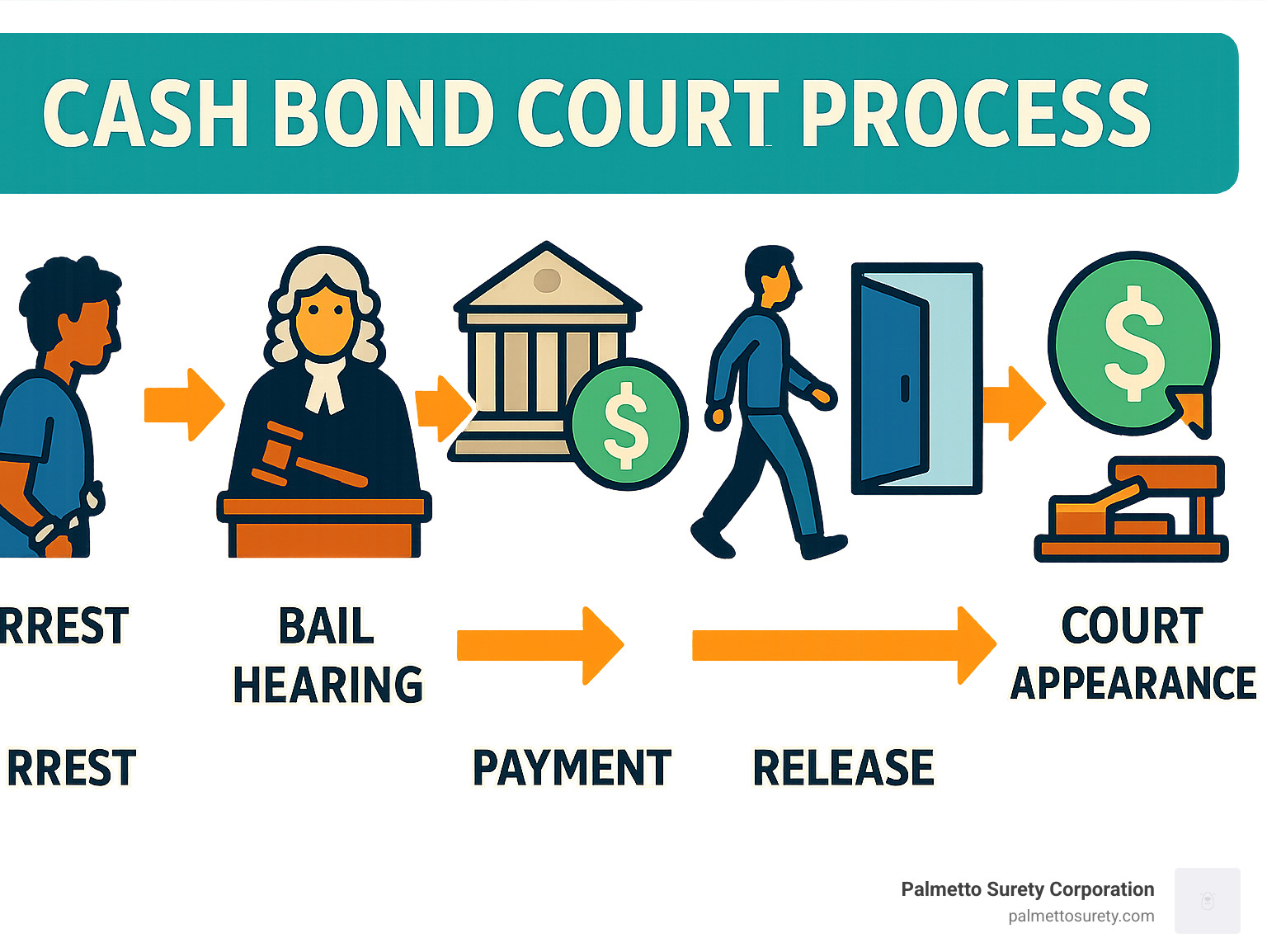
The journey of a cash bond in court follows a predictable path from the moment of arrest through the eventual refund. I’ve seen families steer this process countless times, and while it can feel overwhelming, understanding each step helps reduce the stress during an already difficult time.
Step 1 – Posting your cash bond in court
After the judge sets bail, you’ll need to actually post the cash bond in court. This usually happens at either the court clerk’s office or the jail where your loved one is being held.
Most courts accept cash (bring the exact amount—many facilities don’t make change), cashier’s checks, or money orders made payable to the court. Some jurisdictions now offer credit or debit card payments through approved portals, though these typically come with processing fees that won’t be refunded.
For instance, in Harris County, Texas, you can post cash bonds at 700 N. San Jacinto Street in Houston. They accept cash, cashier’s check, money order, or electronic payment through AllPaid.com. I always remind clients that personal checks are almost universally rejected.
When you arrive to post a cash bond in court, be prepared with:
– Your valid government-issued photo ID
– The full bond amount in an acceptable form
– Basic information about the defendant (full name and booking number if you have it)
“I’ll never forget the time a mother came to post bond without her receipt,” a colleague once told me. “The court had no record of payment by the hearing date, and her son nearly faced re-arrest.” The moral of the story? Always get and keep your receipt. This small piece of paper is your only proof of payment until the bond is processed in the court’s system.
Step 2 – Keeping your cash bond in court safe
After posting bond, protecting your investment requires diligence. The defendant must attend every single court appearance—no exceptions—and comply with all conditions of release.
These conditions vary widely but might include travel restrictions (often needing permission to leave the state), regular check-ins with pretrial services, drug testing, substance abuse treatment, no-contact orders with alleged victims, or surrendering certain items like firearms.
In Illinois, for example, defendants released on bond cannot leave the state without a judge’s permission and must notify the clerk of any address changes within 24 hours. These rules aren’t suggestions—they’re requirements that protect your cash bond in court.
I always recommend setting up multiple calendar reminders for court dates. Many jurisdictions now offer online docket lookup services or automated reminder systems. Missing even a single court date can result in forfeiture of the entire bond amount, so staying organized is crucial.
Step 3 – Getting the money back
The final phase—and the one most people look forward to—is getting your money back after the case concludes. This process varies significantly by jurisdiction but generally follows a predictable pattern.
First, the case must be fully resolved, whether through dismissal, acquittal, conviction, or plea agreement. Then, the judge must formally “exonerate” or release the bond. In some courts, this happens automatically; in others, you must specifically request it.
Many jurisdictions require a formal refund request, often with the original receipt and identification. One court clerk I spoke with noted, “People often assume the money will just show up in their account, but most courts require you to initiate the refund process.”
Patience is key—refunds typically take 2-6 weeks to process, depending on the court’s procedures and workload. Also, be prepared for deductions. Courts may subtract administrative processing fees, court costs, fines, or restitution ordered to victims.
Some jurisdictions use cash bonds as “purge bonds,” meaning they can be applied directly to any fines or costs the defendant owes. This practice can significantly reduce the amount refunded.
A helpful tip I share with clients: “Ask the judge to exonerate the bond at each hearing to trigger refund processing. Otherwise, it may be forgotten in the shuffle of paperwork.”

Cash Bond vs Surety, Property & PR Bonds
When you’re facing bail, understanding your options can make a huge difference to your wallet and peace of mind. A cash bond in court is just one way to secure release – let’s compare it with the alternatives so you can make the best choice for your situation.
Think of bail bonds like different paths to the same destination – freedom while awaiting trial. Each path comes with its own costs, benefits, and potential pitfalls.
| Bond Type | Payment Required | Refundable? | Pros | Cons |
|---|---|---|---|---|
| Cash Bond | 100% of bail amount | Yes (minus fees) | Full refund possible; no third party | Requires full amount upfront |
| Surety Bond | 10-15% fee to bondsman | No (fee is non-refundable) | Lower upfront cost | Fee never returned; collateral risk |
| Property Bond | Real estate with 1.5× equity | Property returned if compliant | No cash needed | Complex, slow process; property at risk |
| Personal Recognizance | $0 (signature only) | N/A (no payment) | No cost | Limited availability; strict conditions |
Cash Bond vs. Surety Bond
The main difference between these options comes down to money and middlemen:
With a cash bond in court, it’s just you and the court system. You pay the full amount directly to the court – say $10,000 on a $10,000 bail. The good news? If you make all your court appearances, you’ll get most or all of that money back when your case concludes.
A surety bond brings a third party – the bail bondsman – into the picture. Instead of paying the court $10,000, you pay the bondsman a non-refundable fee (typically $1,000-$1,500 on that same $10,000 bail). The bondsman then guarantees the full amount to the court.
“Think of the bondsman fee like an insurance premium,” explains one bail professional. “You’re paying for the service of not having to come up with the full amount.”
The catch? That fee is gone forever, even if you attend every court date perfectly. And most bondsmen require collateral – your car title, jewelry, or property deed – which they can claim if you skip court.
Cash Bond vs. Property Bond
If you’re house-rich but cash-poor, a property bond might sound appealing:
A cash bond in court is straightforward but requires immediate cash. You pay, you get a receipt, you’re released.
A property bond uses your real estate equity instead of cash. The court places a lien on your property worth at least 150% of the bail amount. For a $20,000 bond in Colorado, for example, you’d need property with at least $30,000 in unencumbered equity.
Property bonds take time – sometimes days or even weeks – while the court verifies ownership, orders appraisals, and files liens. And if you miss court? Your property could be foreclosed upon.
Cash Bond vs. Personal Recognizance Bond
On the opposite end of the spectrum sits the personal recognizance (PR) bond:
A cash bond in court costs money but gives you more certainty of release.
A PR bond costs nothing – just your signature promising to return to court. It’s the judicial equivalent of “we trust you’ll come back.”
PR bonds are typically reserved for minor offenses, first-time offenders, or people with strong community ties. If you have a stable job, a local family, and no criminal history, you might qualify. But for serious charges or those with prior failures to appear, courts rarely offer this option.
Switching from a cash bond in court to a surety bond
Life happens – sometimes you post a cash bond and then realize you need that money for other expenses. In many jurisdictions, you can convert a cash bond to a surety bond:
- First, check with the court clerk to confirm conversion is allowed in your jurisdiction
- Find a licensed bail bondsman willing to post a surety bond for your case
- Complete paperwork to withdraw your cash bond
- Pay the non-refundable premium to the bondsman
- Once the surety bond is posted, the court releases your cash
Not every court permits this switch, and timing restrictions may apply. By converting, you’re trading the potential for a full refund for immediate access to most of your cash.

Costs, Benefits, Risks & Jurisdictional Variations
Let’s talk money. When it comes to a cash bond in court, your wallet will definitely feel the impact—but how much depends on where you are and what you’re charged with.
Financial Considerations
Posting a cash bond in court means coming up with the entire bail amount upfront. Unlike working with a bondsman who only requires 10-15% (though keeps that as their fee), you’ll need the full sum in hand. For many families, this creates an immediate financial squeeze.
Courts don’t provide this service for free either. Most jurisdictions tack on administrative fees ranging from $20-100 that they’ll happily deduct from your refund. And don’t forget about the opportunity cost—that money sitting with the court can’t help pay your attorney or keep the lights on while you’re fighting your case.
The actual bond amounts vary dramatically based on the charge. A simple misdemeanor might only require $500, while serious felonies can demand $20,000 or much more. This wide range means some defendants walk free while others sit behind bars simply because of financial circumstances.
Jurisdictional Variations
Cross a state line, and you’ll find yourself in an entirely different bail system. It’s like bail bonds have 50 different rulebooks:
In states like Illinois, Kentucky, Oregon, and Wisconsin, commercial bail bondsmen are actually outlawed. Instead, defendants typically pay 10% of the bail amount directly to the court. In Illinois, for example, you’ll pay $1,000 on a $10,000 bond, but the court keeps $100 as a processing fee even if you make every court date.
Colorado takes a unique approach with property bonds, requiring unencumbered equity worth 1.5 times the bond amount. So for a $20,000 bond, you’d need property with $30,000 in equity that’s free and clear.
Some states have moved away from cash bail entirely. New Jersey and Alaska now primarily use risk assessment tools instead of financial requirements for most offenses. California attempted similar reform with Proposition 25, though voters ultimately rejected it.
It’s worth noting that globally, the commercial bail bond system exists only in the United States and the Philippines. Most other countries rely on different mechanisms that don’t place such a heavy emphasis on financial conditions.

Advantages of a cash bond in court
Despite the hefty upfront cost, a cash bond in court offers several compelling advantages that might make it worth the initial financial strain.
The biggest perk? Full refundability. Unlike the premium you pay to a bondsman (which you’ll never see again), cash bonds generally come back to you when the case ends—minus those pesky administrative fees, of course.
There’s also something to be said for cutting out the middleman. With a cash bond, you avoid the bail bondsman entirely, which means no contracts to sign, no collateral requirements, and no awkward relationships with a third party who has a financial interest in your case.
Many people don’t realize that cash bonds often lead to faster release. Once the payment is processed, the jail typically releases the defendant more quickly than when waiting for a bondsman to complete their paperwork.
I recently spoke with a family who posted a $5,000 cash bond in court for their son’s first-offense DUI. By making all his court appearances and following every condition, they got back $4,900—only losing a $100 administrative fee. That’s $4,400 more than they would have kept if they’d gone with a bondsman charging 10%.
Disadvantages of a cash bond in court
Let’s be honest—the cash bond in court system isn’t perfect, and for many, it presents serious challenges.
The most obvious drawback is the high upfront cost. Coming up with thousands of dollars immediately is simply impossible for many families. This creates a troubling reality where freedom before trial becomes a privilege of the financially stable.
This leads to serious inequality concerns. The Prison Policy Initiative reports that approximately 536,000 people sit in jails not because they’ve been convicted, but because they cannot afford bail. This burden falls disproportionately on minority and low-income communities, as noted in Forbes’ examination of how cash bail affects equity.
There’s also the matter of asset freezing—having a significant chunk of money tied up for months or even years while a case proceeds through the courts. This can create cascading financial problems for families already under stress.
And don’t forget the risk of full forfeiture. Miss just one court date, even by accident, and you could lose the entire bond amount. That’s a steep penalty for what might be an honest mistake.
Frequently Asked Questions about cash bond in court
Q: Who can pay a cash bond?
A: Virtually anyone can post a cash bond in court. Whether you’re the defendant, a family member, friend, or even an unrelated good Samaritan, the court will gladly take your money. You’ll just need valid identification and need to complete some paperwork. Some jurisdictions do have special rules about who can post bonds for certain offenses, particularly in domestic violence cases.
Q: Is a cash bond always refundable?
A: In theory, yes—but in practice, it’s complicated. Your refund will almost certainly be reduced by administrative fees. Courts may also apply the bond to any fines, costs, or restitution ordered in your case. Some jurisdictions treat cash bonds as “purge bonds” that automatically convert to payment for penalties. And of course, failure to appear will result in forfeiture. Check your local court’s rules to understand exactly what to expect.
Q: What happens if the defendant misses court?
A: Missing court creates a domino effect of problems. First, the judge will issue a bench warrant for the defendant’s arrest. The cash bond in court becomes subject to forfeiture, and the court schedules a forfeiture hearing (typically within 120 days). At this hearing, the judge determines whether to take the entire bond amount.
There is hope, though. If the absence was for a legitimate reason (like being hospitalized), the court may show mercy. In some jurisdictions, if the defendant shows up before the forfeiture hearing with a valid excuse, the court might reinstate the bond and cancel the warrant.

Conclusion
Navigating cash bonds in court doesn’t have to feel overwhelming, though it certainly comes with its share of complexities. Throughout this guide, we’ve walked through everything from posting your bond to getting your money back, and I hope you’re feeling more confident about the process now.
When it comes down to it, cash bonds in court represent both opportunity and challenge. On one hand, they offer the promise of getting most of your money back—something a bail bondsman’s fee can never provide. On the other hand, they demand resources upfront that many families simply don’t have available at a moment’s notice.
Here’s what I want you to remember about cash bonds in court:
The full amount must be paid upfront—no exceptions or payment plans. This is perhaps the biggest hurdle for most families facing the bail system.
Your diligence matters tremendously. Keep every receipt, write down every court date, and make absolutely certain the defendant appears when required. Even one missed appearance can mean losing everything you’ve paid.
Every jurisdiction has its own rules and quirks. What works in Georgia might not apply in Florida or Texas. Always check local procedures rather than relying on general advice.
The refund process requires patience and follow-through. Don’t expect the courts to automatically return your money—you’ll likely need to request it and provide documentation.
Court compliance isn’t just about showing up—it’s about meeting all conditions of release, from check-ins to travel restrictions.
At Palmetto Surety Corporation, we’ve spent over two decades helping families through these exact situations. Our network of licensed bail agents across the Southeast understands the emotional and financial stress you’re experiencing. Whether you’re in Atlanta, Augusta, Columbus, Savannah, or anywhere across Georgia, Florida, Louisiana, Mississippi, South Carolina, Tennessee, or Texas, we’re here to help you make informed decisions that work for your unique circumstances.
For many people, a cash bond in court represents the ideal scenario—pay now, get most back later. But we understand that’s not realistic for everyone. That’s why we’re committed to explaining all your options, including surety bonds that might require less money upfront.
Posting bail is just the beginning. The real work comes in ensuring compliance with all court requirements—not just for financial reasons, but for the best possible case outcome.
For more information about alternatives to cash bonds and our surety bond solutions, visit our website. Our experienced agents are ready to guide you through this challenging time with compassion and expertise.


