


What is Licensing and Bonding for Pet Services: Top 5 Tips 2024
The Importance of Licensing and Bonding for Pet Services
What is licensing and bonding for pet services is a frequently asked question among new pet service providers. Here’s a quick answer:
- Licensing: Allows you to legally run a pet service business by fulfilling state or local requirements.
- Bonding: Protects your clients in case of theft or accidents, giving them peace of mind.
Running a pet service business isn’t just about playing with fluffy friends all day. It’s a serious responsibility involving legal and financial obligations. Making sure your business is properly licensed and bonded is crucial to ensure you can operate smoothly and attract clients.
Licensing means you’ve taken the necessary steps to meet state or local regulations. Bonding, on the other hand, protects you and your clients should anything go wrong, like damage to property or theft. This builds trust and credibility, which are fundamental for retaining clients and growing your business.
I’m Haiko de Poel Jr., and with over two decades of experience in marketing and digital change, including work with surety bonds, I understand the intricacies of navigating the licensing and bonding process for pet services.
Important what is licensing and bonding for pet services terms:
– license and permit bond example
– licensed bonded insured cleaning service
PROMPT:
The above is a intro section for an article titled “Pet Services: Understanding Licensing and Bonding Requirements”, about the keyword “what is licensing and bonding for pet services”, was written for the company Palmetto Surety Corporation, to be published on https://palmettosurety.com.
We ran a couple of checks about the intro section, and the following checks failed:
Article complies with custom instruction: n (should be y)

The checks below passed:
The keyword is branded for a competitor of the company: n (correct)
Article mentions competitors of the company: n (correct)
Article links to competitors of the company: n (correct)
Article mentions product or services that the company does not offer, that compete with company’s own products or services (and are not the main topic of this article): n (correct)
Article links to direct competitors of Palmetto Surety Corporation when mentioning products or services (links to well-known brands/sites or non-competing businesses are fine): n (correct)
Article links to directoy page of a competitor (like a competitor Yelp entry): (correct)
Article has placeholders that need to be filled out before publishing: n (correct)
All images have absolute source URLs (if no images, answer ‘y’): y (correct)
There are fake quotes (eg. John Doe …) in the article: n (correct)
Article is about a location but the location is nowhere near the company locations: n (correct)
Article has a markdown header image at the start of the introduction: y (correct)
Images are suitable.: y (correct)
Custom instruction: only use American images and imagery in all images and infographics.
Rewrite the intro section to fix all failed checks. Include all markdown links, images and formatting that were present in the original section.
All markdown images should be included and left unchanged!
Make sure that the edited section still passes the already passed checks above.
Never add any information that is factually incorrect, and do not change any correct information in a way that might be factually incorrect.
For issues you cannot fix, return the same markdown-formatted text as the original.
Return only the rewritten intro section.
What is Licensing and Bonding for Pet Services?
When starting a pet service business, understanding licensing and bonding is crucial. These terms often appear in marketing materials for pet sitters and other pet service providers, but what do they really mean?
Licensing
Licensing in pet services primarily involves obtaining a business license. This license is a permit issued by a local government, allowing you to operate legally within a specific area. It does not, however, certify any expertise in pet sitting or pet care.
There are no professional licenses for pet sitters, unlike fields such as healthcare or law, where specific coursework and exams are required. This means anyone can start a pet sitting business without formal training or passing a licensing test. Nonetheless, many pet sitters choose to take courses in areas like pet behavior or first aid to improve their skills and provide better service.
Bonding
Bonding is a form of protection for both the business and its clients. A fidelity bond, also known as a dishonesty bond, is typically what pet service providers use. This bond protects clients in case an employee (or the business owner in a sole proprietorship) commits theft or causes damage while providing services. If a client reports a theft and it’s proven, the bond company compensates the client for their loss.
Bonding offers peace of mind to clients, reassuring them that their property and pets are safe. For the business, it adds a layer of credibility and trust, crucial for attracting and retaining clients.
In summary, while licensing and bonding might seem complex, they are essential tools that help pet service providers operate legally and build trust with clients.
Why Licensing and Bonding are Important for Pet Services
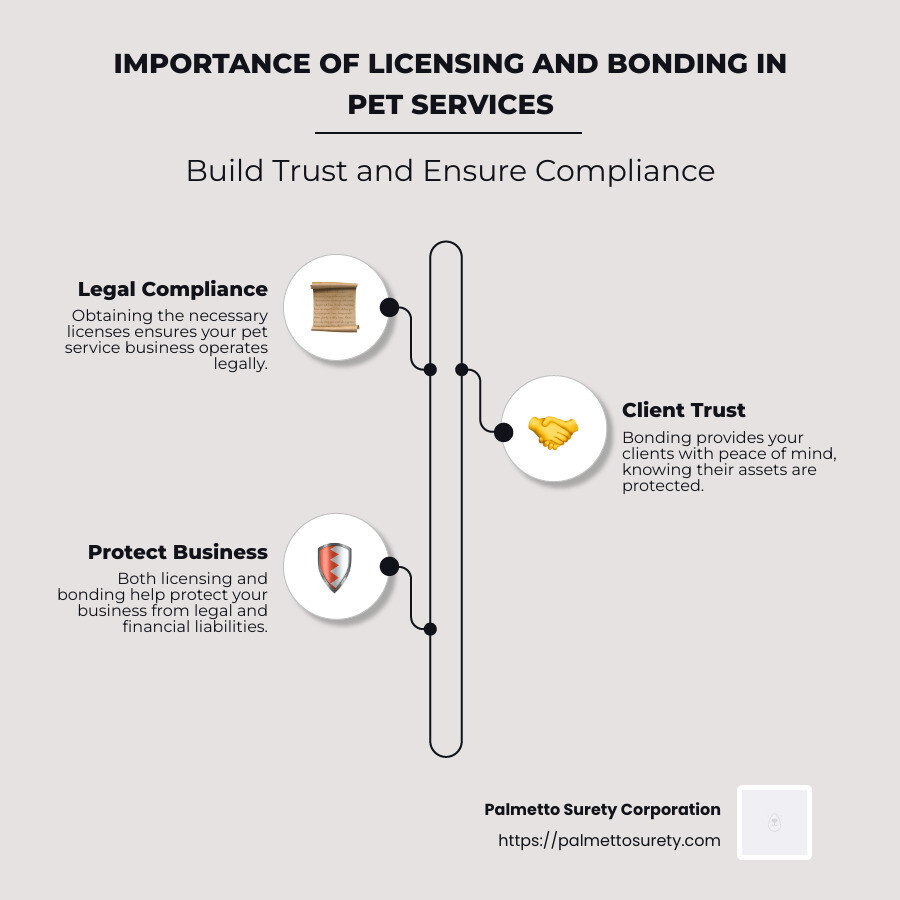
Licensing and bonding are more than just formalities in the pet services industry—they are key to building trust and credibility with clients. Here’s why these elements are so crucial:
Trust and Credibility
When pet owners look for someone to care for their furry family members, they want assurance that the service provider is reliable and trustworthy. Being licensed and bonded signals that a pet service provider takes their responsibilities seriously. It shows that they have met local requirements to operate legally and have taken steps to protect their clients’ interests.
Licensing acts as a basic credential. It indicates that a business has registered with local authorities and is recognized as a legitimate entity. This can be a deciding factor for clients comparing multiple service providers.
Bonding, particularly through a fidelity bond, adds another layer of trust. It reassures clients that any potential mishaps, like theft or damage, are covered. Knowing that there is a safety net in place can make clients more comfortable entrusting their pets and homes to a service provider.
Legal Compliance
Operating without a proper business license can lead to fines or even the shutdown of a business. Licensing ensures that pet services are compliant with local laws, which can vary by state or city. It is essential for pet service providers to check their state’s requirements to avoid any legal issues.
Client Peace of Mind
For many pet owners, their pets are like family. Knowing that a service provider is licensed and bonded gives them peace of mind. It assures them that the provider has met certain standards and is committed to resolving any issues that might arise.
A bonded pet service provider gives clients confidence that they are protected financially if something goes wrong. This protection is invaluable, especially when clients are leaving their pets and homes in someone else’s care.
In summary, licensing and bonding are not just bureaucratic steps—they are essential for establishing a trustworthy and credible pet service business. They help ensure legal compliance and provide clients with the peace of mind they need when choosing a pet service provider.
Types of Licenses for Pet Services
When starting a pet services business, understanding the types of licenses needed is crucial. This section will explain the differences between a business license and a professional license, and how local regulations affect your operations.
Business License
A business license is a permit issued by a governmental entity that allows you to operate your business within a specific geographical area. This can be at the city, county, or state level, and it is essential for legally conducting business.
-
Purpose: A business license ensures that your pet services business is recognized as a legitimate entity. It confirms that you’ve met all local regulations and requirements to operate legally.
-
Requirements: The requirements for obtaining a business license can vary by location. Generally, you’ll need to provide business details, pay a fee, and possibly undergo a background check.
-
Geographical Area: The license is specific to the area where you plan to operate. If you expand your services to new locations, you may need additional licenses.
-
Operation: Once obtained, the business license must be displayed prominently at your place of business. For pet sitters, this means having it visible for clients to see when they drop off or pick up their pets.
Professional License
Unlike a business license, a professional license requires specific coursework and testing to demonstrate expertise in a particular field. However, there are no professional licensing requirements for pet sitters in the United States.
-
Coursework and Testing: Professions like doctors or lawyers require specific educational qualifications and passing a licensing exam. For pet sitters, there are no such formal requirements.
-
Expertise: While not legally required, having specialized training or certification can improve your credibility. Organizations like Pet Sitters International (PSI) and the National Association of Professional Pet Sitters (NAPPS) offer certifications that include courses on pet care, health, and business management.
-
Optional Training: Many pet sitters choose to take courses in pet behavior, first aid, or business management to improve their skills and marketability. These are not mandatory but can make you more attractive to potential clients.
In summary, while a business license is essential for legal operation, a professional license is not required for pet services. However, obtaining certifications can provide additional credibility and reassure clients of your expertise.

Next, we’ll dig into the different types of bonds for pet services and how they protect both your business and your clients.
Types of Bonds for Pet Services
When operating a pet services business, understanding the different types of bonds available is crucial for protecting both your business and your clients. Let’s explore two key types of bonds: fidelity bonds and surety bonds.
Fidelity Bond
A fidelity bond is a form of insurance that protects businesses from losses due to employee theft or dishonesty. This bond acts as a safeguard for your clients, ensuring they are compensated if any fraudulent acts occur while their pets or property are under your care.
-
Employee Theft: If an employee steals from a client, a fidelity bond can cover the financial loss. This bond provides peace of mind to clients, knowing they’re protected against such risks.
-
Client Compensation: In the unfortunate event of theft or damage, the fidelity bond ensures that clients receive compensation, maintaining your business’s reputation and trustworthiness.
-
Business Protection: By having a fidelity bond, your pet services business is protected from potential legal and financial repercussions, allowing you to focus on providing quality care to your clients’ pets.
Surety Bond
A surety bond is a contractual agreement involving three parties: the obligee (usually the state or local government), the principal (your business), and the surety company. This bond ensures that your business meets all legal obligations and standards set by the governing body.
-
Contractual Obligations: A surety bond guarantees that your business will adhere to all local and state regulations, providing assurance to clients and authorities alike.
-
Reimbursement and Claims: If your business fails to meet its obligations, the surety company will cover the costs. However, you will be required to reimburse the surety company for any claims paid out, underscoring the importance of compliance.
-
Legal Compliance: Having a surety bond demonstrates your commitment to operating within legal parameters, enhancing your business’s credibility and reliability.
In summary, both fidelity and surety bonds are vital for pet services businesses, offering protection, ensuring compliance, and building trust with clients. We’ll dig into the steps involved in becoming licensed and bonded as a pet sitter.
How to Become Licensed and Bonded as a Pet Sitter
Starting a pet sitting business involves more than just a love for animals. It requires understanding the legal and financial aspects, including licensing and bonding. Here’s a simple guide on how to get started.
Steps to Obtain a Business License
-
Research Local Requirements: Begin by checking your state’s regulations on business licensing. Each state has its own rules, so know what’s required in your area. Visit your state government’s website for detailed information.
-
Choose Your Business Structure: Decide whether you will operate as a sole proprietor, partnership, or LLC. This decision impacts your tax obligations and liability.
-
Complete the Application: Fill out the necessary forms provided by your local government. These forms typically ask for your business name, address, and type of services offered.
-
Pay the Fees: Licensing involves fees that vary by location. Ensure you have budgeted for these costs. Fees are usually paid to the local government agency processing your application.
-
Display Your License: Once approved, display your business license where clients can see it. This not only complies with legal requirements but also builds trust with your clients.
Steps to Obtain a Fidelity Bond
-
Contact a Bonding Company: Reach out to a company like Palmetto Surety Corporation that specializes in fidelity bonds. They will guide you through the process.
-
Fill Out an Application: Provide details about your business, including any employees, to the bonding company. This information helps them assess the risk and determine the bond amount.
-
Submit Supporting Documents: You may need to provide financial statements or other documentation to support your application.
-
Pay the Bond Premium: Once your application is approved, pay the one-time premium. The cost is a small percentage of the total bond amount.
-
Receive and Submit Your Bond: After payment, you’ll receive your bond. Submit it to the obligee, typically a state or local government entity, to finalize the process.
By following these steps, you can ensure your pet sitting business is both licensed and bonded, providing peace of mind to your clients and protecting your business from potential risks. Next, we’ll explore frequently asked questions about licensing and bonding for pet services.
Frequently Asked Questions about Licensing and Bonding for Pet Services
Do Pet Sitters Need to be Licensed in Every State?
Pet sitters do not need a professional license in every state. However, business licenses are often required. The requirements vary widely by state and locality.
To comply with state regulations and local laws, check with your local government. This might involve visiting your city or county’s website or contacting a local business office. Ensuring compliance helps avoid legal issues and establishes credibility with clients.
What Does it Mean When a Pet Sitter is Bonded?
When a pet sitter says they are bonded, it means they have a fidelity bond. This bond protects clients against theft or damage caused by the pet sitter or their employees.
For example, if a pet sitter’s employee steals from a client’s home, the bonding company will compensate the client once the theft is proven. This client protection provides peace of mind and builds trust. However, bonding is not always required, especially for sole proprietors without employees.
How Much Does it Cost to be Bonded and Insured for Pet Sitting?
The cost of being bonded and insured varies based on several factors:
- Bonding Fees: The cost of a fidelity bond is usually a small percentage of the total bond amount. For instance, a $10,000 bond might cost between $100 and $300 annually.
- Insurance Premiums: Liability insurance premiums depend on the coverage amount and the specific risks associated with the pet sitting business. On average, premiums can range from $200 to $600 per year.
These cost factors ensure that pet sitters are financially protected and can handle potential claims. Investing in bonding and insurance not only safeguards the business but also improves its reputation.
By understanding the licensing and bonding requirements, pet sitters can operate legally, protect their clients, and build a trustworthy business. In the next section, we’ll discuss how to market your pet sitting services effectively.
Conclusion
In summary, understanding what is licensing and bonding for pet services is crucial for any pet sitter or pet care provider. Licensing ensures that your business meets local and state regulations, while bonding provides financial protection for your clients. Together, they build trust, credibility, and legal compliance, making your pet sitting business more appealing to potential clients.
At Palmetto Surety Corporation, we specialize in providing surety bonds for various industries, including pet services. With over 20 years of experience, we offer quick and efficient service, often approving applications within hours. Our goal is to help you meet your licensing and bonding requirements smoothly, so you can focus on what you do best—caring for pets.
In conclusion, obtaining the necessary licenses and bonds is not just a legal requirement; it’s a commitment to professionalism and trustworthiness. By investing in proper licensing and bonding, you protect your business, your clients, and the pets you care for. Contact us at Palmetto Surety Corporation to get started on securing your pet sitting business today.


