


How does a lost title bond work: 4 Steps to Save
Why Understanding Lost Title Bonds Is Critical for Vehicle Owners
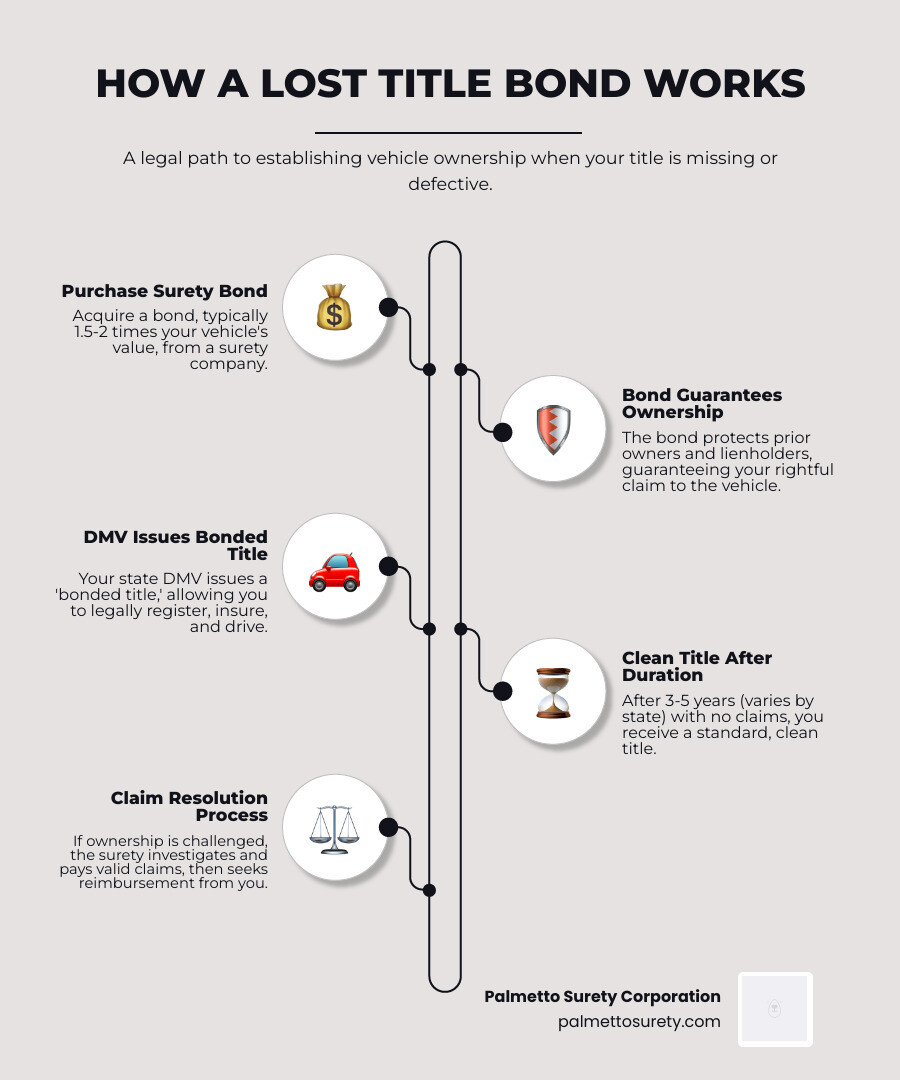
Thousands of vehicle owners face a common problem each year: no proper title for their car, truck, or motorcycle. The solution is often a lost title bond. Here’s how it works:
How a Lost Title Bond Works:
- You purchase a surety bond – typically 1.5-2 times your vehicle’s value.
- The bond guarantees you’re the rightful owner and protects previous owners.
- Your state DMV issues a “bonded title” – allowing you to register, insure, and drive legally.
- After 3-5 years (varies by state), if no claims are filed, you get a clean title.
- If someone challenges ownership, the surety company investigates and may pay valid claims.
If you bought a car with only a bill of sale, lost the title before transferring it, or received a defective title, a lost title bond creates a legal path to ownership. Without a proper title, you can’t register, insure, or legally drive your vehicle, making this bond essential.
The process involves you (the principal), your state’s DMV (the obligee), and a surety company. A bonded title is typically effective for three years, and the bond itself often costs only around $100, even for a much higher bond amount.
I’m Haiko de Poel Jr. At Palmetto Surety Corporation, I’ve helped countless vehicle owners steer this process. While it may seem complex, a bonded title is a straightforward solution to get you back on the road legally.
What is a Lost Title Bond and When Do You Need One?
Bought a car but can’t register it due to a missing title? It’s a frustrating but common problem. A lost title bond is a fast solution.
A lost title bond (also known as a certificate of title or defective title bond) is a type of surety bond that acts as a financial guarantee. It assures your state’s DMV that if you aren’t the rightful owner, any financial losses will be covered.

The bond guarantees your ownership while protecting prior owners and lienholders with legitimate claims. It also protects the DMV, allowing them to issue a “bonded title” without financial risk.
You’ll need a lost title bond in common situations, such as when you bought a car but never received the title, the seller is unreachable, or you received a defective title with errors or missing signatures. You might also need one if you lost the title before transferring it into your name or if you only have a bill of sale, which isn’t proof of legal ownership.
The consequences are significant. Without a proper title, you cannot register, insure, legally drive, or sell your vehicle. It effectively becomes an expensive paperweight.
A lost title bond breaks this cycle. It gives the DMV the financial backing needed to issue a bonded title, getting you back on the road legally.
How Does a Lost Title Bond Work? The Complete Mechanism
A lost title bond is a three-party agreement, which is standard for surety bonds. Understanding each party’s role is key to knowing how does a lost title bond work:
- The Principal (You): The vehicle owner purchasing the bond. You are responsible for any claims and guarantee you are the rightful owner.
- The Obligee (The State DMV): The entity requiring the bond, usually your state’s DMV. The bond protects the obligee from financial loss if your ownership claim is false.
- The Surety (Palmetto Surety Corporation): The company issuing the bond. We guarantee payment to the obligee for valid claims up to the bond amount, then seek reimbursement from you (the principal). This adds credibility to your ownership claim.

After filing the bond with the DMV, you’ll receive a “bonded title.” It functions like a regular title but has a “bonded” note. The bond is active for a set period (usually 3-5 years). If no claims arise during this time, the “bonded” note is removed, and you can get a clean, regular title.
How does a lost title bond work if a claim is filed?
If someone claims to be the rightful owner during the bond period, they can file a claim against it. Here’s the process:
- Claim Filing: The claimant submits a claim to the surety with proof of ownership.
- Surety Investigation: We investigate the claim by reviewing evidence from both you and the claimant, such as original titles or bills of sale.
- Valid Claims: If the claim is valid, we pay the claimant up to the bond amount, protecting them from financial loss.
- Principal Reimbursement: Unlike insurance, you (the principal) must reimburse us for any claim payments and legal costs. The bond guarantees your ownership claim; it doesn’t insure you against loss.
This process underscores the need to be the genuine owner. It encourages honesty and provides financial recourse against fraud or mistakes.
How does a lost title bond work to protect everyone?
The lost title bond system protects everyone involved:
- Financial Protection for the True Owner: Ensures the true owner can be financially compensated if a legitimate prior claim emerges.
- Fraud Prevention: Deters fraudulent titling attempts, as obtaining a bond involves checks and financial responsibility.
- DMV Liability Shield: Shields the DMV from liability for erroneously issued titles, shifting the financial risk to the surety and principal.
- Legal Ownership Path for You: Provides you with a legal path to establish ownership when other options fail, making your vehicle usable and valuable.
- Public Safety: Contributes to public safety by ensuring accurate vehicle records and preventing the use of stolen vehicles.
This system balances the owner’s need for a title with public protection against fraud.
The Step-by-Step Process to Get a Bonded Title
Getting a bonded title can seem daunting, but it’s a manageable four-step process: contact your DMV, determine your vehicle’s value, purchase your bond, and submit your paperwork. The process usually takes a few weeks, mostly due to DMV processing times. Understanding how does a lost title bond work reveals a straightforward process that most owners find easier than expected.
Step 1: Contact Your State’s DMV
Always start by contacting your local DMV. This is the most critical step because every state has different rules, and you want to avoid wasting time and money. Explain your situation clearly to the DMV representative—how you acquired the vehicle and why you lack a title. They will guide you through their specific process.
The DMV will first confirm your eligibility. Not every state offers this option. For example, Delaware, Kansas, Kentucky, Louisiana, Maryland, New Jersey, North Dakota, Oklahoma, Oregon, Pennsylvania, South Carolina, South Dakota, and Virginia do not issue title bonds. Others, like Indiana and Ohio, only accept court-ordered titles. The DMV will also provide the required application forms and determine the exact bond amount required, which is typically 1.5 to 2 times your vehicle’s fair market value. This initial DMV contact is essential to ensure you follow the correct process from the start.
Step 2: Determine Your Vehicle’s Value and Required Bond Amount
After the DMV confirms your eligibility, you must establish your vehicle’s fair market value. This is critical as it determines your required bond amount, and an incorrect value can cause delays. The bond amount calculation varies by state but is usually a multiple of the vehicle’s value (e.g., 1x, 1.5x, or 2x). Your DMV will specify acceptable valuation methods, which can include online resources like Kelley Blue Book, an appraisal from a licensed auto dealer, or a DMV inspection. My tip: be accurate. A low estimate may lead to rejection, while a high one might slightly increase your premium.
Step 3: Apply for and Purchase Your Lost Title Bond
Once you know the bond amount, you can purchase your lost title bond from a surety company like Palmetto Surety Corporation. We’ve streamlined this process to be quick and easy. The bond application is simple. You’ll provide personal information, key vehicle details (year, make, model, and VIN), the vehicle’s value, and the required bond amount from the DMV. For most bonds up to $25,000, a signed application and VIN are usually sufficient.
The bond premium payment is surprisingly affordable. Your cost is a small fraction of the total bond amount, often around $100 for a bond worth thousands. After approval and payment, you’ll receive your bond documents. Palmetto Surety Corporation offers a quick turnaround, often approving applications and issuing bonds the same day.
Step 4: Submit Your Bond to the DMV
With your official bond, you’re ready for the final submission to the DMV. Attention to detail is key to ensure it’s processed correctly on the first try. Your submission package should include the original signed bond, completed application forms, and any other documents the DMV requested. Be prepared to pay a small administrative fee.
The DMV will review your documents. If everything is correct, they will issue your bonded title. You can use this title to register, insure, and legally drive your vehicle. The title will have a “bonded” notation for three to five years. After this period, if no claims have been filed, you can apply for a clean, regular title.

Understanding the Costs and State-Specific Rules
Let’s discuss the cost. When people ask “how does a lost title bond work” regarding price, they’re often surprised by its affordability. The cost is much lower than most people expect.
How is the Cost of a Lost Title Bond Determined?
Understanding the finances of how a lost title bond works is simple. You pay a premium, which is a small fraction of the total bond amount. For smaller bond amounts (usually for vehicles valued up to $6,000), we use a flat rate, and most bonds in this range cost around $100. For larger bond amounts over $6,000, the premium is percentage-based, typically 1% to 3% of the bond amount. Your cost is impacted by the vehicle’s value and sometimes your credit score for very large bonds. Our minimum premium at Palmetto Surety Corporation is $100 for bonds up to $6,000.
State Requirements for Lost Title Bonds
State rules for bonded titles vary significantly, which is why you must check your local regulations. These varying rules impact your process and costs. Bond amount multipliers differ by state. California requires a bond equal to the vehicle’s value, Texas requires 1.5x the value, and Florida requires 2x. This directly affects your premium.
| State | Bond Name | Bond Amount Formula | DMV Resource |
|---|---|---|---|
| California | Motor Vehicle Ownership Surety Bond | Equal to fair market value | CA DMV |
| Texas | Certificate of Title Surety Bond | 1.5 times the vehicle’s value | TX DMV |
| Florida | Title Surety Bond for a Motor Vehicle | 2 times the vehicle’s value | FL HSMV |
| Georgia | Motor Vehicle Certificate of Title Bond | 2 times the average retail value | GA DOR |
Be aware that not all states offer bonded titles. States like Delaware, Kansas, and Kentucky do not. Others, like Indiana and Ohio, require a court-ordered title, which is a different and often more costly process. This is why contacting your DMV first is essential. State requirements can include specific eligibility, documentation, vehicle inspections, or dealer appraisals. Bond duration also varies by state, usually from three to five years. Understanding these state regulations helps you plan and budget effectively.
Frequently Asked Questions about Lost Title Bonds
Over our 20+ years in business, we’ve answered many questions about how a lost title bond works. Here are the most common ones.
Can I sell a vehicle that has a bonded title?
Yes, you can sell a vehicle with a bonded title, but both you and the buyer need to understand the details. The bonded status transfers with the vehicle, so the new owner inherits the bonded title for the remainder of the bond period. Crucially, you remain liable for any claims against the bond, even after the sale, because it is tied to your original ownership claim. Be transparent with potential buyers; an informed buyer knows a bonded title is a legitimate document. Always check with your DMV for specific rules on transferring a bonded title.
What’s the difference between a lost title bond and a lost title affidavit?
These terms are often confused, but they serve different purposes. A lost title affidavit is a sworn statement you use when you’re already the registered owner and just need a duplicate title. The DMV can verify your ownership and issue a replacement. A lost title bond is a financial guarantee required when there’s a gap in the ownership chain. Since the DMV cannot verify your ownership, the bond provides financial protection. In short: if you’re the registered owner, you need an affidavit. If there’s a gap in ownership history, you need a bond.
Lost Title Bond vs. Lost Title Affidavit
How long does it take to get a bonded title?
The timeline has two phases: getting the bond and DMV processing.
Getting your bond is fast. At Palmetto Surety Corporation, we often approve applications and issue bonds the same day, sometimes within minutes of an online application.
DMV processing takes longer. After you submit your paperwork, processing time varies by state, from a couple of weeks to over a month. The good news is that obtaining the bond is the hardest part. The rest is just administrative processing by the DMV.
Conclusion
If you’re wondering “how does a lost title bond work?” you’re not alone. It’s a common and solvable problem for vehicle owners. A lost title bond is your solution when you have a bill of sale but no title, lost the title, or received a defective one. It’s a financial guarantee that provides a legal path to proving ownership.
The process is straightforward: contact your DMV, determine your vehicle’s value, purchase your bond, and submit your paperwork. The premium is affordable, often around $100, even for valuable vehicles. The system works because it protects everyone: previous owners, the DMV, and you. It provides a legal path to ownership while mitigating risk for all parties.
At Palmetto Surety Corporation, our 20+ years of experience means we can help you steer this process efficiently. Our streamlined service provides approvals within hours, offering a quick solution to your title problems.
After the bond period (typically 3-5 years) ends without any claims, you can get a clean title. Until then, your bonded title functions like a regular one for registration, insurance, and driving purposes.

Don’t let a missing title keep your vehicle parked in the driveway. Understanding how does a lost title bond work is the first step toward getting back on the road legally and safely.


