


How to get a lost title bond: 4 Easy Steps 2025
Why Vehicle Owners Need Lost Title Bonds
How to get a lost title bond is a crucial process when you can’t prove ownership of your vehicle through a standard title. Whether you’ve lost your original title, bought a car without receiving proper paperwork, or inherited a vehicle without documentation, a lost title bond provides the legal pathway to establish ownership.
Quick Steps to Get a Lost Title Bond:
- Contact your state’s DMV – Confirm eligibility and bond amount requirements
- Determine vehicle value – Use KBB or NADA guides (bond typically 1.5-2x vehicle value)
- Apply for the bond – Provide VIN, vehicle details, and personal information
- Submit to DMV – File original bond documents with required state fees
- Receive bonded title – Processing takes 4-6 weeks in most states
Typical costs: $100-$250 for vehicles under $6,000, or 1-3% of bond amount for higher values.
Without proper title documentation, you cannot legally register, insure, or sell your vehicle. This creates serious problems for vehicle owners who find themselves stuck with an undrivable asset. A lost title bond acts as a financial guarantee to your state’s Department of Motor Vehicles, protecting previous owners and lienholders while allowing you to obtain a “bonded title.”
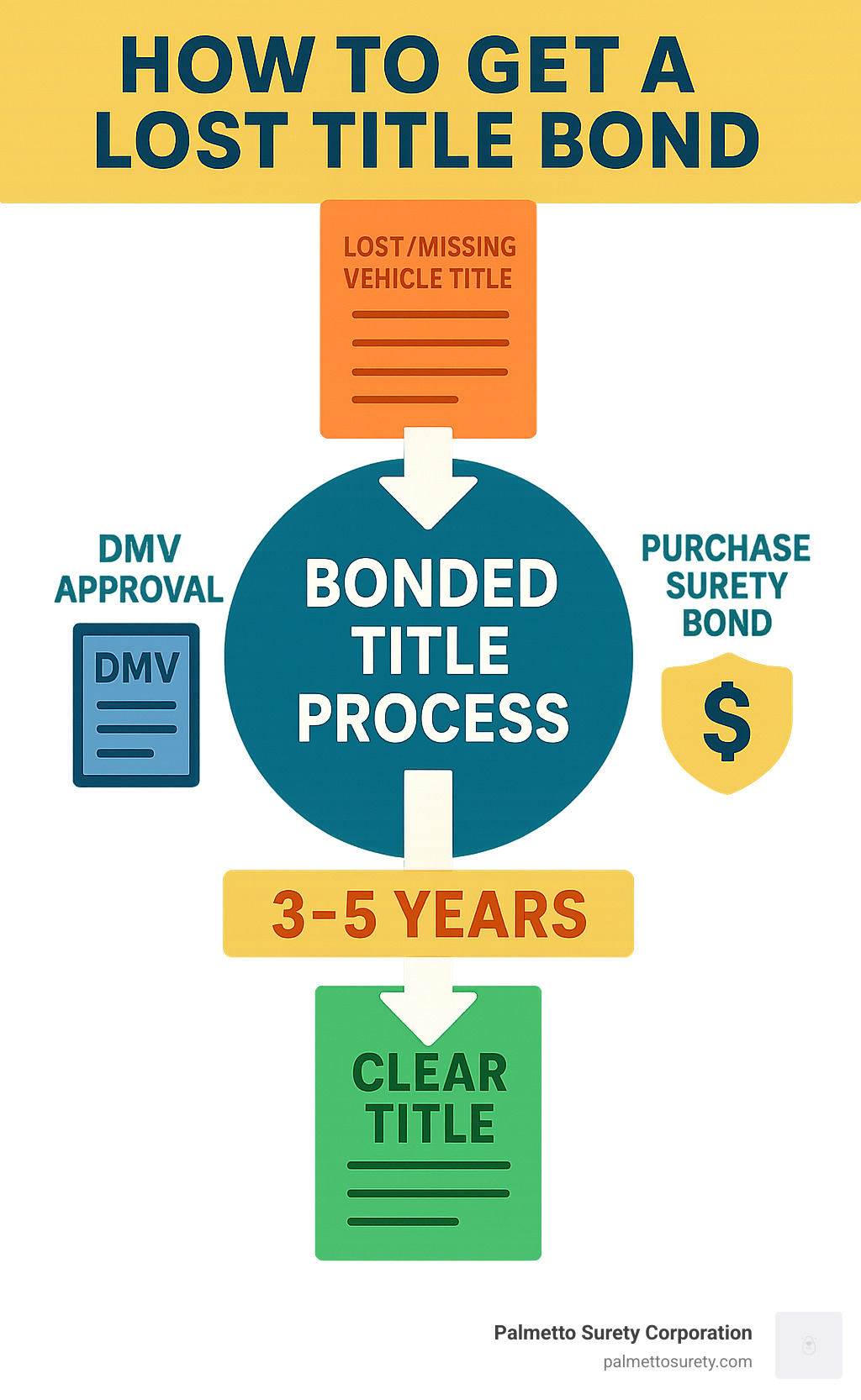
The bonded title gives you the same legal rights as a standard title, though it carries a “bonded” designation for typically 3-5 years. During this period, if someone proves they have a legitimate ownership claim, the surety company pays them and seeks reimbursement from you.
Most states require lost title bonds when the original title cannot be located and a duplicate title isn’t available through normal DMV processes. However, some states like Indiana and Ohio don’t offer bonded titles, instead requiring court-ordered title procedures.
I’m Haiko de Poel Jr., and through my work at Palmetto Surety Corporation, I’ve helped hundreds of vehicle owners steer how to get a lost title bond and restore their ability to legally own and operate their vehicles. My experience in surety bond solutions has shown me that while this process may seem complex, it’s often the fastest path to resolving title issues.

What is a Lost Title Bond and Why is it Required?
Think of a lost title bond as your financial promise to the state that you’re telling the truth about owning your vehicle. When you can’t produce the original title, the Department of Motor Vehicles (DMV) needs reassurance that you’re not trying to register someone else’s car or a stolen vehicle.
A lost title bond is a type of surety bond – essentially a three-way agreement that protects everyone involved. You might also hear it called a Certificate of Title Bond or Defective Title Bond, but they all serve the same purpose: helping you get legal ownership when your paperwork is missing or defective.

Here’s how the three-party agreement works in simple terms. You (the Principal) need the bond to prove ownership. The state DMV (the Obligee) requires the bond to protect itself and previous owners from fraud. The surety company (like Palmetto Surety Corporation) provides the financial guarantee that backs up your ownership claim.
The DMV isn’t being difficult when they require this bond – they’re actually protecting everyone from fraud and financial loss. Without proper safeguards, someone could easily claim ownership of vehicles they don’t actually own, leaving legitimate owners without recourse.
The bond serves as financial protection for prior owners who might have valid claims to the vehicle. If someone comes forward with proof they’re the real owner, the surety company will compensate them for their loss. However, here’s the important part: the surety company will then come to you for reimbursement since you guaranteed the claim was legitimate.
Common Situations Requiring a Bond
Most people who need to learn how to get a lost title bond find themselves in surprisingly common situations. Maybe you purchased a vehicle but never received the title from the seller – this happens more often than you’d think, especially in private sales where the seller can’t locate their paperwork.
Sometimes you lost the title before transferring ownership into your name. Picture this: you buy a car, tuck the title away for safekeeping, and then can’t find it when you’re ready to register. Now the seller has moved or changed their phone number, leaving you stuck.
You might have received an improperly assigned title where signatures are missing, information is wrong, or the document is too damaged to read. Inherited vehicles without titles create another common headache – when a family member passes away, important paperwork often goes missing during the transition.
Other situations include receiving a vehicle as a gift without a title or dealing with very old vehicles where the original paperwork has been lost to time. Classic car enthusiasts know this struggle well.
How a Lost Title Bond Works
When you get a lost title bond, you’re essentially guaranteeing your ownership claim with financial backing. The bond allows the state to issue you a “bonded title” that functions just like a regular title for registering, insuring, and selling your vehicle.
The bonded title carries a “bonded” designation for typically 3-5 years. During this period, if someone proves they have a legitimate ownership claim, the surety company pays them and then seeks reimbursement from you. Think of it as a legal agreement that provides peace of mind for everyone involved.
After the bond period expires without any claims, you can often convert your bonded title to a clean title, removing the “bonded” designation completely. This gives you full, clear ownership that’s identical to any standard vehicle title.
If you’re curious about how surety bonds work in other industries, you can find more info about the different types of surety bonds and their various applications.
The Step-by-Step Guide on How to Get a Lost Title Bond
Getting a lost title bond might feel overwhelming at first, but I promise it’s more straightforward than it seems. Think of it like following a recipe – each step builds on the last, and before you know it, you’ll have that bonded title in hand. Let me walk you through exactly how to get a lost title bond, step by step.
![a person filling out a DMV application form online – how to get a lost title bond]
Step 1: Contact Your State’s DMV to Confirm Eligibility
Your DMV is your best friend in this process, so start there. Every state has its own quirks when it comes to bonded titles, and some states don’t even offer them at all. You’ll want to call or visit your local DMV office and explain your situation clearly.
The DMV folks will tell you right away if a lost title bond is the right solution for your specific case. They’ll also let you know if your vehicle qualifies – and unfortunately, not all vehicles do. Vehicles with existing liens, salvage titles, or certain other complications often can’t get bonded titles. It’s better to find this out early rather than going through the whole process only to hit a roadblock.
During this conversation, make sure to ask about the required bond amount. This is crucial information you’ll need for the next steps. Most states calculate this as 1.5 to 2 times your vehicle’s appraised value. Also, grab a list of all the paperwork you’ll need – typically an application for certificate of title, proof of identification, and sometimes a written explanation of how you ended up with a vehicle but no title.
You can find your local DMV office online to get started.
Step 2: Determine Your Vehicle’s Value
Now comes the part where you figure out what your car is actually worth. This step is more important than you might think because the bond amount directly depends on your vehicle’s appraised value.
The good news is that determining your vehicle’s value is pretty straightforward these days. Kelley Blue Book and NADA Guides are the gold standards that most DMVs accept. You’ll need your vehicle’s year, make, model, mileage, and honest assessment of its condition.
Here’s where the math comes in. Let’s say your car appraises at $6,000 and your state requires a bond amount of 1.5 times the vehicle value. Your bond amount would be $9,000. Don’t panic about that number – you only pay a small percentage of the bond amount as your premium, typically between 1-3% or sometimes a flat rate of $100-$250 for less expensive vehicles.
You can check your vehicle’s value on Bluebook to get an accurate assessment.
Step 3: Apply for the Lost Title Bond
With your DMV requirements clear and your vehicle value determined, you’re ready to apply for the actual bond. This is where working with an experienced surety company like Palmetto Surety Corporation makes all the difference.
The application process is surprisingly simple. You’ll need your full legal name and address, plus detailed vehicle information including the VIN, make, model, and year. Most importantly, you’ll need that bond amount the DMV specified in Step 1.
Many surety companies offer online applications that can give you approval within hours. The process is designed to be quick and painless. Depending on the bond amount, you might go through a credit check, but for many vehicle bonds, especially those with flat-rate pricing, this isn’t always necessary.
Your credit score can affect your premium rate, but even if your credit isn’t perfect, you can still get a lost title bond. The key is working with a surety company that understands your situation and can find the right solution.
Step 4: Submit Your Bond and Get Your Bonded Title
The final stretch! Once your bond application is approved and you’ve paid the premium, you’ll receive the original bond document. This isn’t just any piece of paper – it’s an official document with a raised seal and wet signature that proves your financial guarantee to the state.
Take this original bond document, along with all the other paperwork from Step 1, and submit everything to your DMV. Don’t forget to bring payment for the state’s administrative fees – these are usually modest, around $15 in most states.
Now comes the waiting game. DMV processing typically takes 4 to 6 weeks, though this can vary depending on your state’s current workload. I know it feels like forever when you just want to get back on the road, but this processing time is normal.
Once everything is approved, you’ll receive your bonded title in the mail. This bonded title gives you the same legal rights as a regular title – you can register your vehicle, get insurance, and even sell it if needed. The only difference is the “bonded” designation, which typically stays on the title for 3 to 5 years before you can convert it to a clean title.
And that’s it! You’ve successfully steerd how to get a lost title bond and can finally put this whole title mess behind you.
Understanding the Costs, Terms, and Claims Process
Getting how to get a lost title bond isn’t just about following the steps—you also need to understand what you’re paying for, how long it lasts, and what could happen down the road. Let’s break down the financial side of things so you know exactly what to expect.

How much does a lost title bond cost?
Here’s where people often get confused, and I don’t blame them. There are two different numbers we’re talking about when it comes to lost title bond costs: the bond amount and what you actually pay (the bond premium).
The bond amount is the big number—usually 1.5 to 2 times your vehicle’s value. This is what the DMV requires as a financial guarantee, but here’s the good news: you don’t pay this full amount. Think of it like the coverage amount on an insurance policy. If your car is worth $5,000 and your state requires double the value, your bond amount would be $10,000. But you’re not writing a check for ten grand.
What you actually pay is called the bond premium, which is just a small percentage of that bond amount. For most everyday vehicles, surety companies keep things simple with flat rates ranging from $100 to $250. If your bond amount is $6,000 or less, you might pay as little as $100. Need coverage up to $7,500? You’re probably looking at $150 or less, including fees.
For pricier vehicles where the bond amount exceeds $6,000, the cost shifts to a percentage-based system. Depending on your credit score, you’ll typically pay between 1% and 3% of the total bond amount. So if you need a $15,000 bond, your premium might range from $150 to $450.
Your credit score plays a role here, especially for higher bond amounts. Better credit usually means lower premiums, while applications for bonds over $20,000 might require more detailed review.
Want to dive deeper into surety bond costs? Check out our detailed guide: Learn more about the cost of surety bonds.
How long is a lost title bond valid?
The “bonded” label on your title isn’t permanent—it’s more like a waiting period to make sure no one else comes forward claiming they own your vehicle.
Most states require the bond to remain active for 3 to 5 years. During this time, anyone who believes they have a legitimate claim to your vehicle can file against the bond. It’s essentially a safety net period for previous owners or lienholders.
Once this period passes without any claims, you can typically apply to remove the “bonded” brand from your title. The process varies by state, but it usually involves submitting a simple application to your DMV showing that the bond period has expired without incident.
After the bonded designation is removed, your title converts to a clean, regular title. At this point, you have the same clear ownership as if you’d had the original title all along.
What happens if a claim is made on the bond?
Nobody wants to deal with a claim, but understanding the process helps you know what you’re signing up for. A claim happens when someone comes forward saying they have a legitimate ownership interest in your vehicle.
When a claim is filed, the surety company doesn’t just cut a check—they investigate thoroughly. They’ll review all the documentation and evidence the claimant provides to determine if their claim is valid. This might involve examining sales records, lien documents, or police reports if the vehicle was reported stolen.
If the investigation shows the claim is legitimate, the surety company will pay the claimant up to the bond amount to cover their financial losses. This protects the rightful owner from suffering a loss because you unknowingly purchased and titled their vehicle.
Here’s the critical part that catches some people off guard: this isn’t insurance that protects you. If the surety pays out a valid claim, they’ll come to you for reimbursement. You’re legally responsible for paying back every penny the surety paid out, plus any legal fees or costs involved. In some cases, you might also have to return the vehicle to its rightful owner.
It sounds scary, but remember—the bond exists because most title issues are legitimate mistakes, not fraud. The vast majority of bonded titles go through their entire bond period without any claims.
For more information about legal obligations in surety bonds, you can explore our resources: Learn about court bonds and legal obligations.
State-by-State Guide: Requirements and Alternatives
Understanding how to get a lost title bond becomes more complex when you realize that each state has its own unique requirements and procedures. While most states offer bonded titles as a solution for missing vehicle documentation, the specific rules vary significantly from one state to another.
The bond amount calculation differs by state as well. Some states require the bond to equal 1.5 times the vehicle’s value, while others may require double the appraised amount. A few states use different multipliers or have flat fee structures for certain vehicle values.
Processing times also vary considerably. While most states take 4-6 weeks to issue a bonded title, some states like Texas can process applications more quickly, while others may take longer during busy periods.
Important state-specific differences include eligibility requirements, acceptable appraisal methods, and required documentation. For example, Florida doesn’t allow bonded titles for vehicles with existing liens, while other states may have different restrictions on vehicle age, value, or condition.
| State | Bond Required? | Bond Amount Rule | Alternative Process |
|---|---|---|---|
| Alabama | Yes | 2x vehicle value | Standard bonded title process |
| Arkansas | Yes | 1.5x vehicle value | Court-ordered title available |
| Florida | Yes | 2x vehicle value | No bonded titles for vehicles with liens |
| Georgia | Yes | 2x vehicle value | Standard bonded title process |
| Indiana | No | N/A | Court-ordered title through probate court |
| Kentucky | Yes | 2x vehicle value | Standard bonded title process |
| Louisiana | Yes | 2x vehicle value | Standard bonded title process |
| Mississippi | Yes | 2x vehicle value | Standard bonded title process |
| North Carolina | Yes | 2x vehicle value | Standard bonded title process |
| Ohio | No | N/A | Court-ordered title through common pleas court |
| South Carolina | Yes | 2x vehicle value | Standard bonded title process |
| Tennessee | Yes | 2x vehicle value | Standard bonded title process |
| Texas | Yes | 1.5x vehicle value | Fast processing available |
| Virginia | Yes | 2x vehicle value | Standard bonded title process |
What are the alternatives if a bonded title is not an option?
Not all states offer bonded titles as a solution for missing vehicle documentation. If you live in a state that doesn’t provide this option, or if your specific situation doesn’t qualify for a bonded title, you’ll need to explore alternative approaches.
Court-ordered titles represent the primary alternative in states like Ohio and Indiana. In Ohio, you must petition the court of common pleas in the county where you reside. The court will review your case and, if satisfied with your evidence of ownership, can order the Bureau of Motor Vehicles to issue you a title.
Indiana follows a similar process through their probate courts. You’ll need to provide substantial evidence of your rightful ownership, including bills of sale, previous registration documents, or affidavits from witnesses who can verify your ownership claim.
Other state-specific procedures may include administrative hearings with the DMV, special documentation requirements, or extended waiting periods. Some states require newspaper advertisements announcing your intent to title the vehicle, giving previous owners a chance to come forward with competing claims.
The timeline for court-ordered titles typically takes longer than bonded titles – often 8-12 weeks or more, depending on court schedules and the complexity of your case. Legal fees may also apply, potentially making this option more expensive than obtaining a surety bond.
If you’re unsure about your state’s specific requirements or alternatives, contacting your local DMV office directly will provide the most accurate and up-to-date information for your particular situation.


