


How to purchase a lost title bond: 3 Easy Steps
What is a Lost Title Bond and Why Do You Need One?
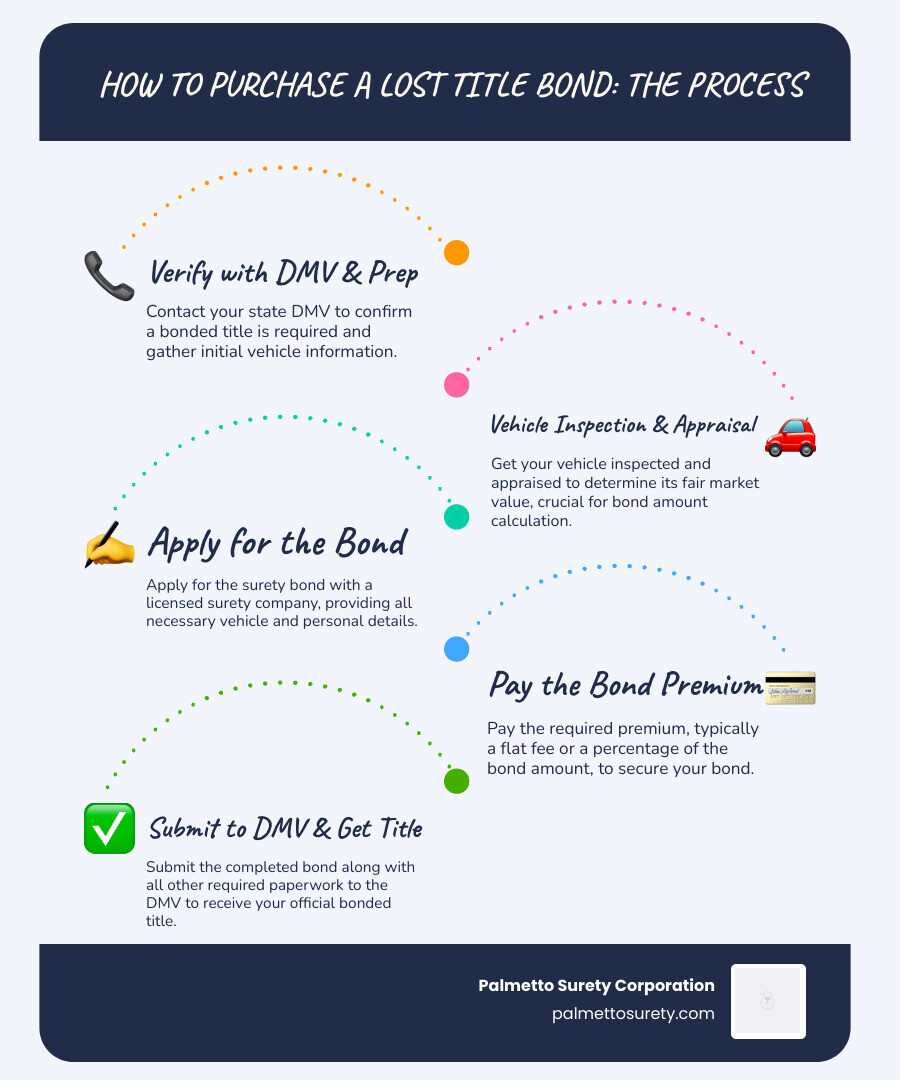
Understanding how to purchase a lost title bond is crucial when you need to prove ownership of a vehicle but don’t have the original title. Here’s the quick process:
- Contact your state DMV to confirm you need a bonded title (not just a duplicate)
- Get your vehicle inspected and appraised for fair market value
- Apply for the bond with a licensed surety company like Palmetto Surety
- Pay the premium (typically $100 for bonds up to $6,000)
- Submit the bond to your DMV along with required paperwork
- Receive your bonded title to legally own, register, and insure your vehicle
A lost title bond (also called a bonded title or certificate of title bond) is a surety bond that guarantees you’re the rightful owner of a vehicle when the original title is missing, damaged, or never received. This legal document involves three parties: you (the principal), your state’s DMV (the obligee), and the surety company that backs the bond.
Without a proper vehicle title, you face serious consequences. You cannot register your vehicle, get insurance, drive it legally, or sell it. The DMV requires proof of ownership before issuing a new title, and when standard documentation isn’t available, a surety bond serves as that proof.
In California, for example, you need a Motor Vehicle Ownership Surety Bond when your vehicle is worth $5,000 or more and you lack proper ownership documents. The bond amount typically equals 1.5 to 2 times your vehicle’s fair market value, protecting previous owners and lienholders if ownership disputes arise later.
I’m Haiko de Poel Jr., and through my work at Palmetto Surety Corporation, I’ve helped countless vehicle owners steer the process of how to purchase a lost title bond when traditional title replacement isn’t an option. My experience in surety bonds and digital marketing has shown me that understanding this process can save vehicle owners weeks of frustration and get them back on the road legally.
When is a Lost Title Bond Necessary?
Picture this: you’ve just bought your dream classic car from a private seller, but when you get home and sort through the paperwork, there’s no title—just a bill of sale. Or maybe you inherited your grandmother’s vintage truck, but the family can’t locate the original title anywhere. These frustrating situations are exactly when learning how to purchase a lost title bond becomes essential.


Here’s the key distinction many people miss: not every missing title situation requires a bonded title. If you previously had the title in your name and simply lost it, you can usually apply for a duplicate title directly through your state’s DMV. That’s the easy route—no bond needed.
However, a lost title bond becomes necessary when you face more complex ownership challenges. You’ll need a bonded title when the seller never gave you a title or provided a defective one that can’t be processed. This commonly happens with private sales where the seller claims they “lost” the title but never actually had it properly transferred to their name.
Another frequent scenario involves purchasing a vehicle with only a bill of sale. Maybe you bought from someone who inherited the car but never completed the title transfer, or you purchased from an estate sale without proper documentation. In these cases, the DMV can’t issue a standard duplicate because there’s no clear chain of ownership.
Older vehicles present their own challenges. Some classic cars predate modern title systems, while custom-built vehicles might never have had titles issued. Additionally, if you lost the title before transferring it into your name, you’re in bonded title territory since the DMV has no record of you as the legal owner.
Each state sets its own rules about when bonds are required. Take California as an example—The California Department of Motor Vehicles (DMV) handles lost title applications and requires a Motor Vehicle Ownership Surety Bond when your vehicle is worth $5,000 or more and you lack proper ownership documentation. For boats, that threshold drops to $2,000 or more.
California also requires bonds when a vehicle has nontransferable status or when you can’t obtain a release from a legal owner or lienholder. These specific conditions highlight why your first step should always be contacting your local DMV to determine if you actually need a bond.
The DMV staff can review your situation and tell you definitively whether a duplicate title application will work or if you need to go the bonded title route. This initial conversation can save you time and money by ensuring you choose the right path from the start.
Understanding how to purchase a lost title bond only matters if your situation actually requires one. Let the DMV make that determination before you begin the bonding process.
How to Purchase a Lost Title Bond: A Step-by-Step Guide
Securing a lost title bond might seem like a daunting task, but we’re here to guide you through it. This section outlines the complete process for securing your bond and proving ownership of your vehicle.
Step 1: What You Need Before You Purchase a Lost Title Bond
Before you even think about contacting a surety company, there are several crucial preliminary steps and documents you’ll need to gather. These preparations ensure a smooth application process and increase your chances of swift approval.

First, as we mentioned, you’ll need to contact your state’s DMV. They are the ultimate authority in determining whether a lost title bond is necessary and what specific requirements apply to your vehicle. The DMV will likely require a vehicle inspection. This inspection verifies the Vehicle Identification Number (VIN), ensuring it matches any existing records and that the vehicle isn’t stolen.
Next, you’ll need to prove your possession and claim to ownership of the vehicle. This typically involves:
- A bill of sale or receipt from the purchase.
- A canceled check or other proof of payment.
- A notarized statement explaining how you acquired the vehicle and why you don’t have the title.
For California residents, specific forms are necessary. You will need to complete the Application for Duplicate or Paperless Title (REG 227), marking the reason for replacement and providing detailed vehicle identification information. Additionally, you’ll likely need to fill out a Statement of Facts Form (REG 256), which provides more context about your situation and how you came into possession of the vehicle without a title. If a duplicate title was received within the last 90 days, a Verification of Vehicle (REG 31) form might also be required.
Gathering all these documents and completing the necessary DMV applications beforehand will significantly streamline the process of obtaining your lost title bond.
Step 2: Calculating the Bond Amount and Premium
Once the DMV confirms you need a lost title bond, they will determine the required bond amount. This amount is not what you pay for the bond, but rather the maximum liability the surety company will cover if a claim is filed against your bond.
The bond amount is almost always tied to the fair market value of your vehicle. Generally, the bond should be worth between 1 to 3 times the amount of the car, with many states requiring 1.5 to 2 times the vehicle’s value. For example, if your vehicle’s fair market value is $5,000, the DMV might require a bond amount of $7,500 to $10,000.
To determine the fair market value, the DMV may require:
- A written appraisal from a licensed auto dealer, motor vehicle insurance representative, or yacht and shipbroker.
- Valuation based on a recognized industry handbook, such as Kelley Blue Book, where you might average the lowest and highest prices.
- A Statement of Facts (REG 256) with valuation details.
Once the bond amount is determined by the DMV, you can then calculate the bond premium, which is the actual cost you pay for the bond. The premium is only a fraction of the total bond amount.
- For bonds covering $6,000 or less, the cost is typically a flat rate of $100. This covers the majority of vehicles.
- For bond amounts exceeding $6,000, the premium will increase. It’s usually calculated as a percentage of the bond amount, often around 1.5% of the bond’s value. For example, a $10,000 bond might cost you $150.
- For larger bond amounts, especially those over $25,000, a credit check might be required. While most lost title bonds don’t involve credit checks, for higher amounts, your credit standing could influence the premium rate.
We pride ourselves on offering competitive rates, with a minimum premium of $100.00 for bond amounts up to $6,000.00, increasing incrementally for amounts above that.
Step 3: The Final Steps to Purchase a Lost Title Bond
With your DMV requirements understood and the bond amount determined, you’re ready for the crucial step: purchasing the bond.
The first step is finding a reputable surety provider. Palmetto Surety Corporation has been a trusted name in commercial surety bonds for over 20 years, specializing in quick and efficient service. We are licensed in all 50 states and U.S. territories and are an A (Excellent) rated insurance company by A.M. Best. Our network of bond agents across the southeastern United States, including Georgia, Florida, Louisiana, Mississippi, South Carolina, Tennessee, and Texas, makes us an accessible choice for many.

The process of how to purchase a lost title bond with us is designed to be straightforward:
- Online Application: You can apply for your lost title bond online or over the phone. You’ll need to provide your name (as it appears on your driver’s license), address, and detailed vehicle information, including its year, make, model, VIN, and the fair market value you determined earlier.
- Submitting Payment: Once your application is approved—often instantly or within hours, thanks to our quick approval process—you’ll submit the premium payment.
- Receiving Bond Documents: After payment, your bond will be issued immediately. We can email digital copies the same day, and original documents with a raised seal and wet signature will be mailed to you. These original documents are vital, as the DMV will require them. The bond will also include a Power of Attorney form, which authorizes the surety company to act on your behalf if a claim is made.
Once you receive your bond documents, remember to sign them and prepare them for submission to your state’s DMV or licensing office. For more detailed information on our bond services, you can visit our website: https://www.palmettosurety.com/bonds/.
Life with a Bonded Title: What Happens Next?
Congratulations! You’ve successfully steerd the process of how to purchase a lost title bond. But what happens after you have the bond in hand? The journey isn’t quite over, but you’re certainly on the home stretch.
After receiving your bond documents, the next critical step is filing the bond with your state’s DMV. This typically involves submitting the original bond (with its raised seal and wet signature), along with all the other required DMV paperwork (like your completed application for a bonded title, proof of ownership, and vehicle inspection reports). For California residents, the completed bond form, including the power of attorney, should usually be mailed to the California DMV Registration Operations in Sacramento.
Once the DMV processes your submission and approves everything, you will officially be receiving your bonded title. This title will look much like a standard vehicle title, but it will have a “bonded” brand or notation stamped on it. This stamp signifies that a surety bond was purchased before the title was issued, indicating that there was some initial uncertainty about the vehicle’s ownership.

The bond validity period is typically for a set term, most commonly 3 years, though some states may require it for 5 years. During this period, the bond remains active, offering financial protection to any previous owners or lienholders who might come forward with a legitimate claim of ownership or interest in the vehicle.
What happens after the bond expires? If no claims are filed against your bond during its validity period, the bond simply becomes null and void. At this point, you can usually apply to the DMV to have the “bonded” brand removed from your title, converting it into a clear, traditional certificate of title. This means that after the bond term, the DMV is confident that no other parties have a legitimate claim, and you are fully recognized as the undisputed owner.
Understanding claims is crucial. A lost title bond is not an insurance policy for you; it’s a guarantee to others that if a legitimate claim arises, funds are available. If a claim is filed against your lost title bond by a party who proves they are the rightful owner or have a legitimate financial interest in the vehicle, the surety company will investigate. If the claim is found to be valid, the surety company will pay out the claim up to the bond amount. This payment, however, is not a gift. As the principal, you have a financial responsibility to indemnify the surety company. This means you are legally obligated to reimburse the surety for any amounts they pay out on your behalf, plus any legal fees incurred. This is a fundamental difference between a surety bond and traditional insurance. For more on this, you can explore What is surety bond insurance?.
Frequently Asked Questions about Lost Title Bonds
After helping thousands of vehicle owners through the process of how to purchase a lost title bond, we’ve heard just about every question you can imagine. Let me share the most common concerns that come up – and hopefully put your mind at ease about the whole process.
How much does a lost title bond cost?
Here’s the good news: the actual cost of your lost title bond (called the premium) is much less than you might think. Many people get confused between the bond amount and what you actually pay, but they’re completely different numbers.
The bond amount is what your state’s DMV determines based on your vehicle’s value – but that’s not what comes out of your pocket. What you actually pay is the premium, which is just a small fraction of that total amount.
For most everyday vehicles, you’ll pay a flat rate of $100 if your bond amount is $6,000 or less. This covers the majority of cars, trucks, and motorcycles that people need bonded titles for.
If your vehicle is worth more and requires a bond amount over $6,000, the premium typically runs about 1.5% of the bond amount. So if you need a $15,000 bond, you’d pay around $225 – not $15,000.
The main factors that affect your price are pretty straightforward: your vehicle’s value and what bond amount your state requires. For very expensive vehicles requiring large bonds (we’re talking $25,000+), some companies might run a credit check, but that’s pretty rare for typical lost title situations.
At Palmetto Surety, we keep things simple with competitive rates and that $100 minimum premium. You can learn more about The cost of surety bonds on our website.
How long is a lost title bond valid?
Most states require your lost title bond to stay active for 3 years, though some extend that to 5 years. This isn’t arbitrary – it gives plenty of time for anyone who might have a legitimate claim on your vehicle to come forward.
Think of it as a waiting period where your state is saying, “We’re pretty sure this person owns this vehicle, but we’re going to keep this safety net in place just in case.”
Once that time period expires and nobody has made any claims against your bond, you’re in the clear. The bond becomes inactive, and here’s the best part: you can usually apply to have that “bonded” stamp removed from your title. Your DMV will issue you a clean, regular title that looks just like any other vehicle title.
This post-expiration process of removing the bonded brand is usually straightforward – just another form and maybe a small fee to get your clear title.
Can I sell a car with a bonded title?
Absolutely! A bonded title gives you all the same rights as a regular title. You can register your vehicle, get insurance, drive it legally, and yes – sell it whenever you want.
But here’s something important to keep in mind during the selling process: that bond stays active for its full term regardless of who owns the car. So if you sell your vehicle two years into a three-year bond period, the new owner inherits that “bonded” status for the remaining year.
When you’re transferring the bonded title, the process works just like any other title transfer through your DMV. The main difference is in managing expectations with potential buyers.
Some buyers might hesitate when they see “bonded” on a title because they don’t understand what it means. Being upfront about the vehicle’s title history usually helps. You can explain that it simply means there was a paperwork issue when you got the car, not that there’s anything wrong with the vehicle itself.
Here’s the key thing about buyer’s responsibilities: while the new owner gets a bonded title, you (as the original bond purchaser) remain responsible for any claims that might arise during the bond’s term. It’s rare, but if someone did come forward with a legitimate ownership claim, you’d still be the one dealing with the surety company, not the new owner.
Most of the time, this is a non-issue. The bond period passes quietly, and everyone moves on with their lives. But it’s good to understand how the liability for claims works before you sell.
Conclusion: Drive with Confidence and Peace of Mind
Picture this: you’re finally behind the wheel of your vehicle, legally registered, properly insured, and completely stress-free. That’s the power of understanding how to purchase a lost title bond and taking action to secure your ownership rights.
What started as a frustrating situation – missing paperwork, confusing regulations, and the inability to legally drive your own vehicle – has transformed into a success story. Through the lost title bond process, you’ve not only solved an immediate problem but also gained valuable knowledge about vehicle ownership laws.
The benefits of securing your lost title bond extend far beyond just getting paperwork in order. You’ve achieved legal ownership that stands up in court, giving you the confidence to drive without worrying about potential legal issues. You can now register and insure your vehicle properly, protecting both yourself and other drivers on the road. Most importantly, you have peace of mind knowing that your ownership is legally recognized and protected.
At Palmetto Surety Corporation, we’ve seen thousands of vehicle owners go through this exact journey over our 20+ years in the surety bond business. What makes us proud isn’t just our quick approval times or our A-rated financial strength – it’s the relief and satisfaction our clients feel when they finally have that bonded title in their hands.
We understand that dealing with missing titles and government paperwork can feel overwhelming. That’s why we’ve streamlined our process to get you approved within hours, not days or weeks. Our network of experienced agents across the southeastern United States means you’re working with professionals who understand your local DMV requirements and can guide you through any state-specific challenges.
Don’t let a missing title keep your vehicle parked in the driveway any longer. Whether you’re dealing with an inherited classic car, a purchase gone wrong, or any other title issue, the solution is within reach. Take the first step today by contacting your local DMV to confirm you need a bonded title, then let us help you secure it quickly and affordably.
Ready to get back on the road legally? Learn more about the different types of commercial surety bonds we offer and find how our expertise can help you steer this process with confidence.


