


Difference between lost and bonded title: 1 Clear Answer
Understanding Vehicle Title Confusion: When Your Ownership Documentation Goes Missing
The difference between lost and bonded title situations can determine whether you spend $15 or $150 to get back on the road legally. Many vehicle owners face title problems but don’t know which path to take when their ownership documentation goes missing.
Quick Answer: Lost vs. Bonded Title
| Lost Title (Duplicate Title) | Bonded Title |
|---|---|
| When to use: Title was previously in your name but is now lost, stolen, or damaged | When to use: You never had the title in your name or there’s a broken chain of ownership |
| Cost: $15-25 administrative fee | Cost: ~$100 surety bond premium (for vehicles under $6,000) |
| Requirements: Proof of identity, vehicle registration | Requirements: Bill of sale, vehicle appraisal, surety bond, vehicle inspection |
| Timeline: 1-2 weeks | Timeline: 3-6 weeks |
| Result: Standard replacement title | Result: Title branded “BONDED” for 3-5 years |
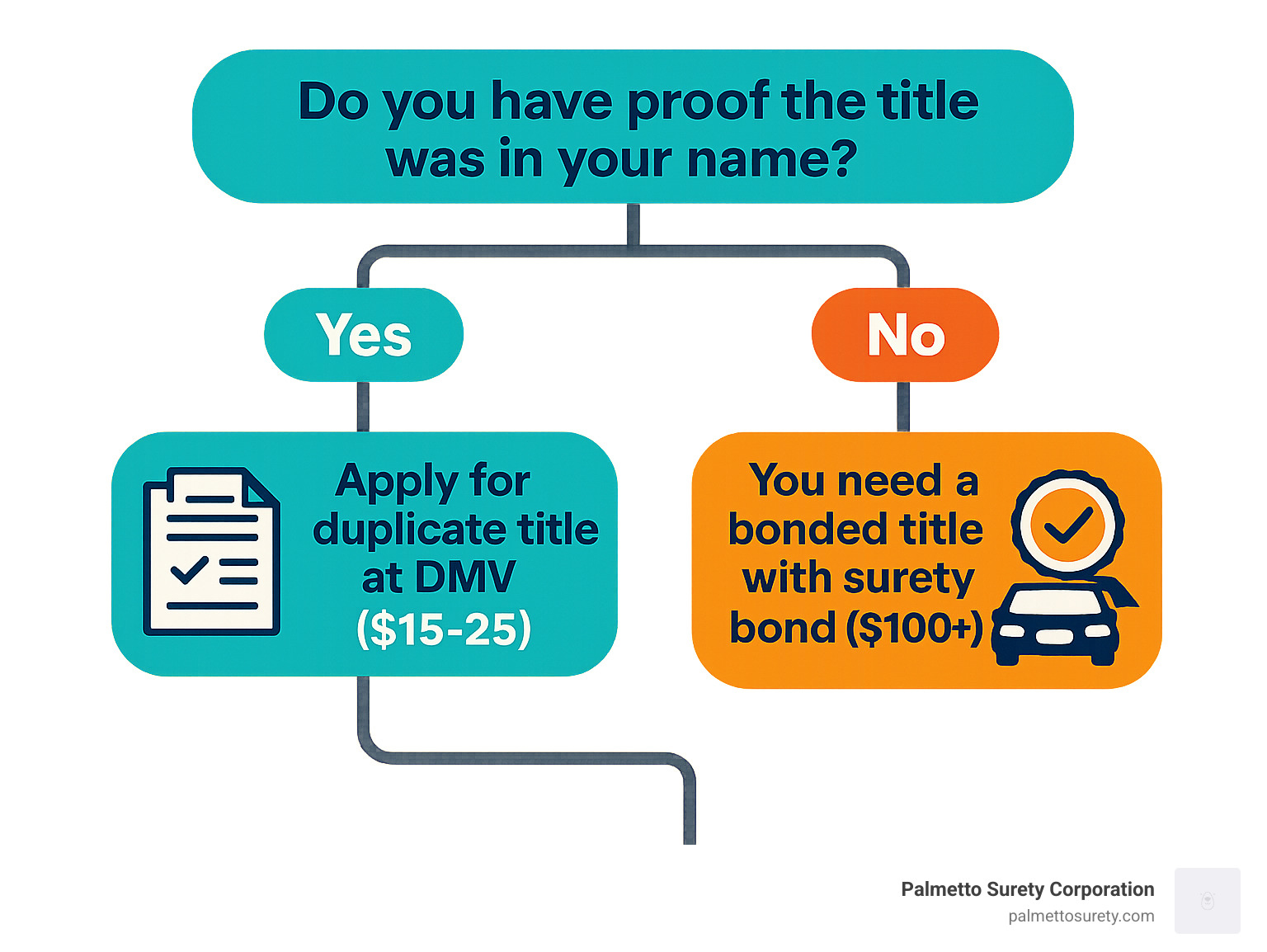
The core difference comes down to previous ownership in your name. If the title was already transferred to you and you simply misplaced it, you need a duplicate title from the DMV. If you bought a car but never received a proper title, or if there’s a gap in the ownership chain, you’ll need a bonded title backed by a surety bond.
A lost title refers to the common situation where you owned the vehicle with a proper title but the physical document is now missing, damaged, or destroyed. The solution is straightforward: apply for a duplicate title from your state’s DMV.
A bonded title is required when you can’t prove continuous ownership through normal channels. This happens when you buy a car but never receive the title, when there’s title jumping (seller’s name isn’t on the title), or when the ownership history has gaps. The state requires you to purchase a surety bond – typically 1.5 times the vehicle’s value – to protect against future ownership claims.
As Haiko de Poel Jr, I’ve helped hundreds of clients steer the difference between lost and bonded title scenarios during my tenure at Palmetto Surety Corporation, one of the fastest-growing surety bond companies in the US. My experience in rebranding and relaunching surety operations has given me deep insight into how title bonds protect both vehicle owners and state agencies.
Understanding the Basics: Lost Title vs. Bonded Title
Think of title problems like losing your house keys versus proving you actually live in the house. The difference between lost and bonded title situations comes down to whether the state already recognizes you as the rightful owner.

Let’s break down these two scenarios so you can quickly identify which path you need to take.
What is a Lost Title? (The Duplicate Title Process)
Picture this: you’re cleaning out your glove compartment and realize your vehicle title is nowhere to be found. Maybe it got tossed during spring cleaning, damaged in a coffee spill, or disappeared during your last move. If that title was already in your name – meaning you were the legal owner of record – then you simply need a duplicate title.
The good news? Getting a replacement title is refreshingly straightforward when you’re dealing with a true lost title situation.
You’ll head to your local DMV with proof of identity and fill out a standard DMV application for a duplicate title. Since the state’s records already show you as the owner, this is basically an administrative task – like getting a replacement driver’s license.
The administrative fee is typically modest, usually between $15 and $25. Most states can process your duplicate title within a week or two. It’s a simple solution when the paperwork goes missing but your ownership is crystal clear in the state’s database.
What is a Bonded Title? (The Path to Proving Ownership)
Now let’s consider a trickier scenario. You bought a car from someone, but they never gave you a proper title. Or maybe you have a bill of sale, but the title was damaged beyond recognition before it ever got transferred to your name. This creates what we call a broken chain of title.
Enter the bonded title – your pathway to proving ownership when the normal paperwork trail has gaps.
A bonded title requires you to purchase a Certificate of Title Surety Bond. This isn’t just bureaucratic red tape – it’s actually smart protection. The surety bond acts as a financial safety net, protecting the state and protecting prior owners if someone else shows up later claiming they’re the real owner.
Here’s how it works: if a legitimate ownership claim surfaces, the surety company pays the rightful owner, and you’re responsible for repaying that amount. It’s like having a financial guarantee backing up your ownership claim.

The resulting title will have “BONDED” stamped across it, showing that a surety bond backs your ownership. This branding stays on your title for three to five years, after which you can apply for a standard title if no claims arise.
While bonded titles require more paperwork and cost more upfront, they’re often the only way to establish legal ownership when you have a legitimate vehicle but incomplete documentation.
Want to learn more about how these financial instruments work? Check out more info about the types of surety bonds to understand the broader world of surety protection.
The Key Difference Between Lost and Bonded Title Scenarios
Here’s where things get interesting – and where many vehicle owners find themselves scratching their heads. The difference between lost and bonded title scenarios isn’t just about paperwork; it’s about the legal trail of ownership that led you to this moment.
Think of it like this: if your vehicle’s ownership history is a clean, unbroken chain, you’re dealing with a lost title situation. But if there’s a missing link in that chain – a gap where ownership wasn’t properly transferred – you’re in bonded title territory.
When to Apply for a Duplicate vs. a Bonded Title
The decision between these two paths comes down to one crucial question: Was the title ever legally in your name according to state records?
If you’re dealing with a misplaced title that was properly in your name, you need a duplicate title. This covers situations where you were the registered owner and simply lost the physical document, or where your title got damaged in a flood or fire. The DMV already recognizes you as the legal owner – you just need a replacement copy.
The same goes for a damaged or illegible title that was correctly assigned to you. As long as the state has you on record as the owner, a duplicate title will solve your problem quickly and affordably.
But here’s where it gets tricky. If you never received a title from the seller after buying a vehicle, you’re looking at a bonded title situation. This breaks the ownership chain because the DMV can’t verify your legal claim through normal channels.
Similarly, if you only have a bill of sale instead of an actual title, you’ll need to go the bonded route. A bill of sale proves you made a transaction, but it’s not a certificate of title – and that distinction matters to the state.
Improperly assigned titles also require bonded titles. This happens more often than you’d think, especially with “title jumping” – where the seller’s name isn’t actually on the title they’re trying to transfer to you. Even if you have the physical title document, it’s not legally valid for transfer.
If you lost the title before transferring it into your name, you’re also in bonded title territory. You might have received it from the seller but misplaced it before getting to the DMV. Since state records don’t show you as the owner, you’ll need that surety bond backing.
Gift situations without proper titles, inherited vehicles with missing documentation, and even abandoned vehicles on your property (after following proper legal procedures) typically require bonded titles. The common thread? The normal ownership chain has a gap that needs to be bridged with a surety bond.
Comparing the Application Process and Requirements
Getting a duplicate title feels almost refreshingly simple after dealing with more complex vehicle issues. You visit your local DMV, fill out a straightforward application, show your ID and any existing registration documents, pay a small fee, and you’re done. Most states will give you a temporary title on the spot, with the official duplicate arriving in your mailbox within a few weeks.
The bonded title process requires more legwork, but it’s designed to protect everyone involved – including you. Your first step is determining eligibility with your state’s DMV. Not all states offer bonded titles (some use court-ordered titles instead), so this conversation is crucial.
Next, you’ll become a detective of sorts, gathering any evidence of ownership you can find. Bills of sale, canceled checks, receipts, even text messages or emails about the purchase – everything helps build your case.
Your vehicle will need an appraisal to determine its value, which directly affects your bond amount. Find your vehicle’s value with Kelly Blue Book for a good starting point, though your state may have specific requirements for who can perform the official appraisal.
Most states also require a vehicle inspection to verify the VIN and ensure the vehicle isn’t stolen. This is typically done by a registered inspector or law enforcement officer – it’s a crucial step that protects both you and the state.
Once you’ve completed the DMV paperwork and they’ve determined your eligibility and required bond amount, you’ll purchase your surety bond from a company like Palmetto Surety Corporation. Finally, you submit everything back to the DMV for final processing.
This entire process typically takes 3 to 6 weeks, depending on how quickly you can gather documents and your state’s processing times.
Understanding the Costs: The Financial Difference Between Lost and Bonded Title
When it comes to your wallet, the difference between lost and bonded title costs is significant – but perhaps not as dramatic as you might expect.
Duplicate titles are refreshingly affordable, with administrative fees typically ranging from $15 to $25. That’s it – one simple fee covering the DMV’s processing and printing costs.
Bonded titles involve two cost components. First, there’s a similar DMV administrative fee (usually around $15) for processing your application. The real cost difference comes from the surety bond premium.
Here’s the good news: you don’t pay the full bond amount. Instead, you pay a premium – typically a small percentage of the total bond value. Most states require bonds worth 1.5 to 2 times your vehicle’s value, so a $5,000 car might need a $7,500 or $10,000 bond.
But here’s what you actually pay: for vehicles valued at $6,000 or less, the premium is often a flat $100. If your vehicle is worth more, the premium increases incrementally – perhaps $15 for every additional $1,000 of bond coverage.
So while you might need a $10,000 bond for a higher-value vehicle, you’re typically paying somewhere in the $100-200 range for the actual premium. It’s a reasonable investment for establishing legal ownership when traditional documentation has gone missing.
The bottom line? A duplicate title might cost you $20, while a bonded title typically runs around $115-125 total. That extra $100 buys you legal ownership protection and peace of mind when the normal paper trail has broken down.
For more details on how surety bond costs are calculated, check out Learn about the cost of surety bonds.
Living with a Bonded Title: Risks, Rights, and Resolutions
Getting your bonded title is just the beginning of the journey. While you’ve successfully steerd the difference between lost and bonded title processes, understanding what comes next is equally important. Think of a bonded title as your “learner’s permit” for vehicle ownership – it gives you most of the rights you need, but with some important conditions attached.
Can You Register, Insure, and Sell a Car with a Bonded Title?
Here’s the good news: a bonded title functions almost exactly like a regular title for most day-to-day purposes. You can absolutely register your vehicle with your state’s DMV, get those license plates, and drive legally on public roads. The bonded status doesn’t prevent you from enjoying your car – it’s still legally yours.
Getting insurance is also straightforward. Most insurance companies readily accept bonded titles as valid proof of ownership. They understand these situations happen, and they’re equipped to write policies based on bonded titles. You’ll pay the same rates as someone with a clear title, so there’s no financial penalty from insurers.
Selling a vehicle with a bonded title requires a bit more finesse, but it’s definitely possible. The key word here is transparency. You must disclose the bonded status to potential buyers – it’s not just ethical, it’s often legally required. Some buyers might be hesitant because they’ll inherit the bonded title for the remainder of its term, which could affect your selling price slightly.
Here’s something crucial to remember: even after you sell the vehicle, you typically remain responsible for any claims made against the original bond during its active period. It’s like being a co-signer – your obligation doesn’t disappear just because you no longer own the car.

From Bonded to Clear: Removing the “Bonded” Brand
The “bonded” stamp on your title isn’t a permanent scarlet letter. Think of it more like a temporary security measure that expires over time. Most states require a bond period of 3 to 5 years, during which the bond remains active and protects against potential ownership claims.
Once this claim-free period passes without any valid challenges to your ownership, you’ve essentially proven that you’re the rightful owner. At this point, you can apply to your DMV for a clear title – one without the bonded designation. This process transforms your provisional ownership into full, undisputed ownership.
The transition from bonded to clear title is usually simple. You’ll submit an application to remove the bond, possibly pay a small administrative fee, and receive a standard title that looks just like any other vehicle title. It’s like graduating from probation to full employee status – you’ve proven yourself, and now you have complete peace of mind.
What Happens if a Claim is Made or the Original Title is Found?
Life has a way of throwing curveballs, and bonded titles are designed to handle them. If someone comes forward during the bond’s active period with a legitimate ownership claim, the surety bond kicks into action. This is exactly why you purchased the bond in the first place – to protect against these situations.
When a valid claim is made, the surety bond claim process begins. The surety company investigates the claim, and if it’s found to be legitimate, they’ll pay the rightful owner up to the bond amount. However, this protection comes with a price: you become responsible for reimbursing the surety for any amounts they pay out. It’s like having insurance that covers the other party but then bills you for the claim.
Sometimes, Murphy’s Law strikes in reverse – you might actually find the original title after going through the entire bonded title process. Don’t panic! This is actually a good problem to have. Contact your DMV immediately to report the findy and ask about the process for voiding the bond and transitioning to the original title.
Most states have procedures for handling these situations. You’ll typically need to surrender the bonded title and provide the original title for verification. The DMV will then issue you a clear title based on the original documentation. It’s also courteous to inform your surety company about finding the original title, as this eliminates any future claim risk and helps keep everyone’s records straight.
Having both a bonded title and the original title floating around could create confusion down the road, so resolving this quickly protects everyone involved.
Frequently Asked Questions about Vehicle Titles
Vehicle title issues can feel overwhelming, especially when you’re dealing with missing paperwork or confusing ownership chains. Over the years at Palmetto Surety Corporation, we’ve helped countless clients steer these waters, and we’ve noticed the same questions coming up again and again. Let’s tackle the most common concerns to help you better understand the difference between lost and bonded title situations and what they mean for you.
Can I get a bonded title in any state?
Here’s where things get a bit tricky – not every state handles title problems the same way. While most states do offer bonded titles as a solution for missing ownership documentation, each state has its own rulebook. Some states have completely different approaches that might surprise you.
Take Ohio and Indiana, for example. These states typically don’t issue bonded titles at all. Instead, they use court-ordered titles, which means you’d need to go through the court system to establish ownership. It’s a different process entirely, but it serves the same purpose as a bonded title.
The requirements can vary dramatically too. One state might require a vehicle inspection by law enforcement, while another might accept an inspection from any licensed dealer. Some states have restrictions on vehicle age or value, and processing times can range from a few weeks to several months.
Your best bet? Contact your state’s DMV directly before you start the process. They’ll tell you exactly what’s available in your area and what documentation you’ll need. If you’ve recently moved states after buying a vehicle, you’ll generally need to apply for the bonded title in your current state of residence, where the vehicle is physically located.
Can I get a bonded title if there is a lien on the vehicle?
This is a great question that touches on a fundamental principle of vehicle ownership. The short answer is no – you typically cannot get a bonded title if there’s still an active lien on the vehicle.
Here’s why this makes sense: a lien means that a bank, credit union, or other financial institution has a legal claim to the vehicle until a loan is paid off. They’re essentially a partial owner until that debt is satisfied. Since the whole point of a bonded title is to establish clear ownership when it’s uncertain, having a lienholder in the picture creates a very clear ownership situation – just not the one you want.
Think of it this way: you can’t claim uncertain ownership on a vehicle when there’s already a known party with legal rights to it. The lienholder’s claim takes priority, and they need to release their interest before you can pursue a bonded title.
If you find yourself in this situation, you’ll need to work with the lienholder first. This might mean paying off the remaining loan balance, negotiating a settlement, or finding other ways to have the lien removed. Only then can you move forward with the bonded title process.
For more detailed information about how these financial claims work, you can learn more about vehicle liens.
What’s the difference between a bonded title and a salvage title?
This confusion comes up all the time, and it’s completely understandable. Both involve “branded” titles, but they’re addressing totally different problems. The difference between lost and bonded title issues and salvage title issues comes down to paperwork versus physical condition.
A bonded title is all about ownership uncertainty. The vehicle itself might be in perfect condition – maybe it’s a pristine classic car or a well-maintained daily driver. The problem isn’t with the car; it’s with the paperwork. Maybe the previous owner lost the title, or there was a mistake in the transfer process, or you only received a bill of sale when you bought it. The bonded title process helps you establish legal ownership when the documentation chain is broken.
A salvage title, on the other hand, is all about the vehicle’s condition and history. This brand appears when a vehicle has been severely damaged – think major accident, flood damage, fire, or theft recovery – and an insurance company has declared it a “total loss.” This happens when repair costs would exceed a certain percentage of the vehicle’s value, usually around 75-80%.
Here’s the key difference: a vehicle with a salvage title cannot be legally driven until it’s been properly repaired, inspected, and issued a “rebuilt” or “reconstructed” title. A vehicle with a bonded title can be driven, registered, and insured immediately – the only issue was proving who owns it.
You might even encounter both situations at once. For example, you could buy a rebuilt vehicle from someone who lost the title. In that case, you’d be dealing with both the salvage/rebuilt history and the ownership documentation problem, potentially requiring both types of title branding.
The bottom line? Bonded titles solve ownership puzzles, while salvage titles warn about damage history. Both are important, but they’re protecting you from completely different risks.
Conclusion: Securing Your Vehicle’s Ownership with Confidence
Mastering the difference between lost and bonded title scenarios puts you in the driver’s seat when ownership documentation goes missing. It’s really quite straightforward once you understand the key distinction: if the title was already in your name, you need a simple duplicate. If there’s a gap in the ownership chain, you’ll need a bonded title with a surety bond backing it up.
Think of it like this – a duplicate title is like getting a replacement driver’s license when yours falls out of your wallet. The state already knows you’re licensed, so it’s just paperwork. A bonded title is more like proving you deserve that license when your records are incomplete. You need to provide extra assurance through a surety bond.
The financial difference is significant too. While a duplicate title costs around $15-25, a bonded title requires a surety bond premium of typically $100 for vehicles valued under $6,000. But when you consider that this small investment gets you legal ownership of your vehicle, it’s money well spent.
Living with a bonded title isn’t complicated. You can register, insure, and even sell your vehicle just like any other owner. The “bonded” brand on your title will disappear after 3-5 years if no valid ownership claims arise, leaving you with a completely clear title.
At Palmetto Surety Corporation, we’ve been helping folks steer these exact situations for over 20 years. As a licensed insurance company specializing in commercial surety bonds, we understand how frustrating title problems can be. That’s why we’ve streamlined our process to approve most bonded title applications within hours, not days or weeks.
Whether you’re dealing with a seller who disappeared with your title or a damaged document that’s beyond recognition, don’t let title confusion keep your vehicle parked in the driveway. The right path forward exists, and it’s more affordable and straightforward than most people realize.
Ready to get your ownership sorted out? Get your commercial surety bonds today and let us help you transform that title headache into clear, confident ownership. Your vehicle is waiting, and the open road is calling.


