


130 U: Master 5 Easy Steps to Texas Titling
Why Form 130-U is Essential for Vehicle Ownership in Texas
Form 130 u is the official Application for Texas Title and/or Registration that every vehicle owner must complete to legally drive in the Lone Star State. Whether you’re buying your first car, moving to Texas, or receiving a vehicle as a gift, this form is your gateway to legal vehicle ownership.
Quick Answer for Form 130-U:
- What it is: Official Texas application for vehicle title and/or registration
- Who needs it: Anyone titling or registering a vehicle in Texas
- Where to get it: TxDMV website or County Tax Assessor-Collector offices
- Cost: Varies by county ($28-$33 title fee plus applicable taxes)
- Deadline: Must be filed within 30 days of purchase or establishing Texas residency
The Texas Department of Motor Vehicles (TxDMV) uses Form 130-U to collect all necessary information for processing vehicle titles and registrations. More importantly, both the TxDMV and the Texas Comptroller’s office rely on this form to calculate the exact amount of motor vehicle tax you owe.
Here’s what makes this form critical: It’s not just paperwork – it’s a legal document. Signing false information on Form 130-U is a third-degree felony in Texas. The form captures everything from your vehicle’s identification number to tax calculations, ensuring the state properly tracks vehicle ownership and collects required taxes.
The County Tax Assessor-Collector (CTAC) in your area processes these applications and must provide you with a detailed tax receipt. This system protects both you as the vehicle owner and the state’s interests in maintaining accurate vehicle records.
I’m Haiko de Poel Jr., and through my work with Palmetto Surety Corporation, I’ve helped countless clients steer complex government forms and bonding requirements, including situations where Form 130 u documentation affects surety bond applications for auto dealers and other licensed professionals. My experience in digital marketing and business consulting has given me deep insight into simplifying bureaucratic processes for everyday Americans.
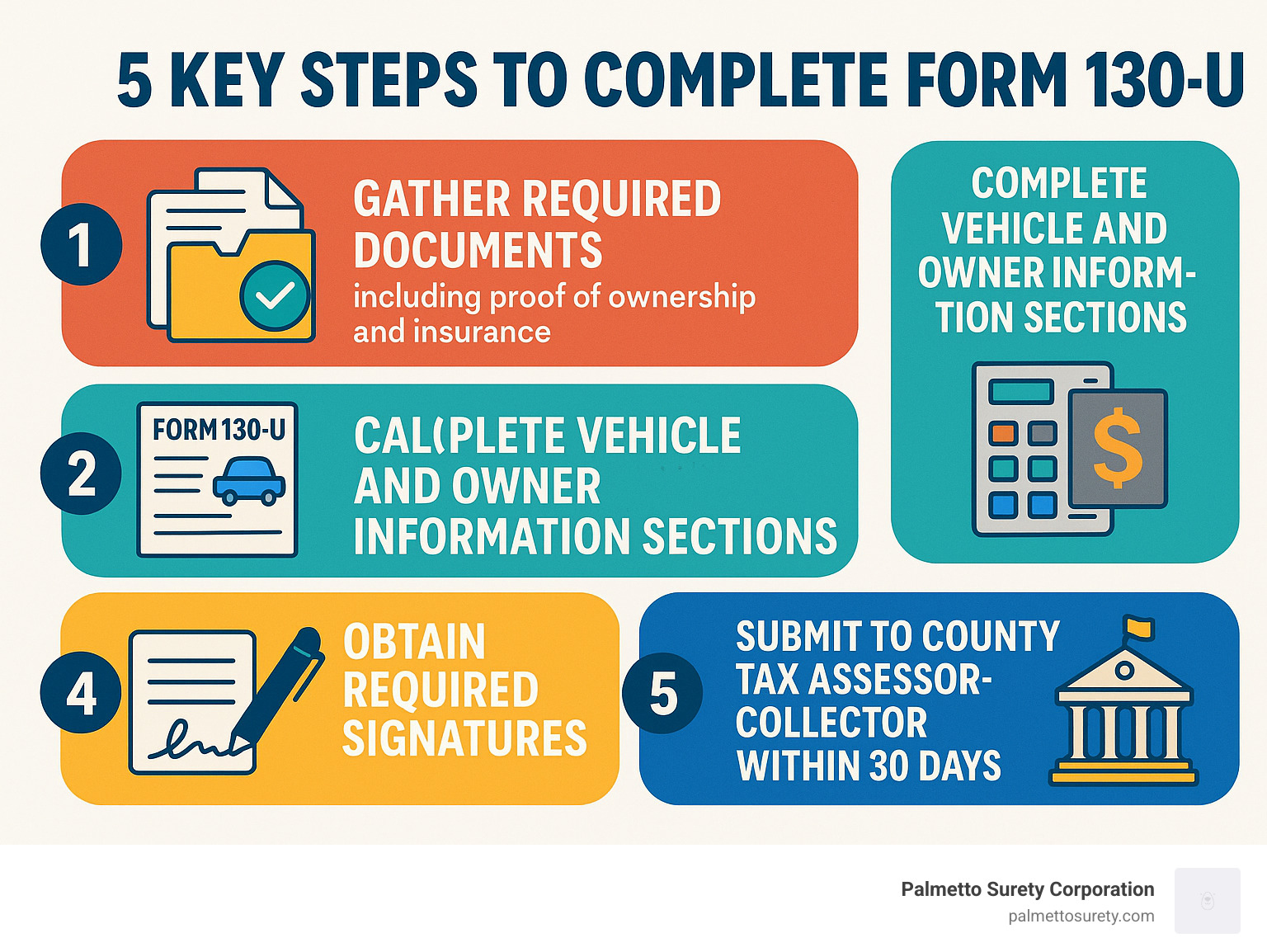
What is Form 130-U and Why Do You Need It?
At its core, Form 130 u, formally known as the “Application for Texas Title and/or Registration,” is the cornerstone document for legally owning and operating a motor vehicle in Texas. Its primary purpose is twofold: to apply for a Texas Certificate of Title and to register your vehicle within the state. Without a properly completed and submitted Form 130-U, your vehicle cannot be legally titled or registered, leaving you vulnerable to fines and legal complications.

This form serves as the official record for the TxDMV, capturing crucial details about the vehicle and its owner. But it’s not just about tracking ownership; it’s also a vital tool for the Comptroller’s office. The form includes a dedicated “Motor Vehicle Tax Statement” section, which is used to calculate and collect the appropriate motor vehicle tax. This ensures that the state receives its due revenue from vehicle sales, gifts, and transfers.
Understanding the difference between titling and registration is key here. The “title” proves legal ownership of the vehicle, much like a deed proves ownership of a house. “Registration,” on the other hand, permits the vehicle to be legally operated on public roads, typically involving license plates and an annual renewal process. Form 130-U allows you to apply for both simultaneously (“Title & Registration”), or for “Title Only” if you don’t intend to register the vehicle immediately, or even for “Registration Purposes Only” if you hold an out-of-state title. There’s also an option for “Nontitle Registration” for certain vehicles that aren’t typically titled but still require registration, such as some types of farm equipment.
The County Tax Assessor-Collector (CTAC) plays a pivotal role in this process. When you submit your Form 130 u, the CTAC reviews it, processes the application, calculates the tax due, and issues you a detailed tax receipt. They act as the local point of contact, ensuring that all state requirements are met before your title and registration can be issued. Without their involvement, the process simply cannot move forward.
What You’ll Need Before You Start
Before you dive into filling out Form 130 u, gathering the necessary documents and information is crucial. Think of it like preparing for a road trip – you wouldn’t just jump in the car without packing your bags, would you? Having everything ready beforehand will save you time, frustration, and potential delays.

At Palmetto Surety Corporation, we understand that navigating government forms can feel daunting. That’s why we emphasize preparation. For instance, if you’re an auto dealer, ensuring all your documentation is in order for vehicle transfers is as important as having the right commercial surety bonds in place to operate your business legally. A smooth, well-documented title and registration process is a sign of a professional operation.
The core items you’ll need include:
- Proof of Ownership: This is paramount. For a new vehicle, you’ll need the Manufacturer’s Certificate of Origin (MCO). For a used vehicle, it’s typically the properly assigned Certificate of Title from the previous owner. This document must clearly show the transfer of ownership to you.
- Proof of Insurance: Texas law requires proof of financial responsibility. If you’re applying for registration, you must show proof of Texas liability insurance. This is non-negotiable for getting your vehicle on the road.
- Photo ID: A valid government-issued photo identification is required for the applicant. This helps verify your identity and ensures the application is legitimate.
- Payment for Fees: Be prepared to pay the applicable title fee (which can be $28 or $33, depending on your county), registration fees, and any motor vehicle taxes. These fees vary, so it’s wise to contact your local CTAC office beforehand for the exact amount.
- Bonded Title (if applicable): In some unique situations, you might not have a traditional certificate of title (e.g., if it was lost, stolen, or improperly assigned). In these cases, you might need to apply for a bonded title. This involves obtaining a surety bond, which guarantees ownership. At Palmetto Surety Corporation, we specialize in providing various commercial surety bonds, and while a bonded title is a specific type, our expertise in the surety bond market means we understand the underlying principles of financial guarantees required for legal compliance. You can learn more about commercial surety bonds and how they function as a financial guarantee at our website: More info about commercial surety bonds.
List of Required Supporting Documents
To make it even clearer, here’s a checklist of the most common documents you’ll need to accompany your Form 130 u:
- Evidence of Ownership (e.g., properly signed Certificate of Title, Manufacturer’s Certificate of Origin, or a Bill of Sale if applying for a bonded title). This is the crucial document that legally transfers the vehicle to your name.
- Proof of Texas liability insurance. If you’re applying for registration, this is a must-have!
- Valid government-issued photo ID (like a driver’s license or state ID card).
- Vehicle Inspection Report (if you’re bringing in a vehicle from another state or country, you’ll need a VIN verification and safety inspection). This ensures the vehicle meets Texas safety standards.
- Lien information (if applicable). If you financed your vehicle, your lienholder’s details will need to be provided on the form, and they might require specific documentation from you.
- Payment for taxes and fees. This includes sales tax, title fees, and registration fees. Having the correct amount ready will prevent delays.
Having these items organized before you walk into the CTAC office will make the process significantly smoother and faster.
A Step-by-Step Guide to Filling Out Form 130 u
Think of Form 130 u like a detailed conversation with the state of Texas about your vehicle. The form wants to know three main things: what you’re trying to accomplish, what vehicle you’re dealing with, and who’s involved in the transaction. Let’s walk through each section together, making sure you get it right the first time.

At Palmetto Surety Corporation, we’ve helped countless clients steer complex paperwork over the past 20 years. Whether it’s commercial surety bonds for auto dealers or bail bonds, we know that accuracy matters. The same principle applies here – falsifying information on Form 130-U is a third-degree felony in Texas, so let’s make sure you get every detail right.
Section 1: Application Type and Vehicle Description
The very first thing Texas wants to know is what you’re trying to accomplish. Are you buying a car and need both the title and registration? Maybe you’re a dealer who just needs the title? Or perhaps you’re moving to Texas with a vehicle that’s already titled elsewhere?
Your application type choices are straightforward. Most people select “Title & Registration” because they want to own and drive their vehicle legally in Texas. If you’re not ready to put the vehicle on the road yet, “Title Only” establishes your ownership without the registration. New Texas residents often choose “Registration Purposes Only” to register their out-of-state vehicle while keeping their current title.
Now comes the detective work – describing your vehicle accurately. The Vehicle Identification Number (VIN) is like your car’s fingerprint. You’ll find this 17-character code on your dashboard (visible through the windshield on the driver’s side) or on the driver’s door jamb. Double-check every character because even one wrong digit can cause delays.
The year, make, and model might seem obvious, but be specific. “Ford” isn’t enough – is it a Ford F-150 or a Ford Mustang? The state also wants to know the body style, colors, and weight. Don’t worry about being too precise with the weight – just round up to the nearest 100 pounds.
Here’s where many people get nervous: the odometer disclosure. For most vehicles, you simply write down the current mileage (no decimal points). If your odometer shows 45,678.3 miles, just write 45,678. You’ll also check whether this is the actual mileage or if there’s something unusual about it. Good news – if your vehicle is 10 years old or older, or weighs more than 16,000 pounds, you can mark it as exempt mileage.
Section 2: Owner and Previous Owner Information
This section is all about who you are and where the vehicle came from. Start by identifying yourself as an individual, business, or other entity type. Most people are individuals, but if you’re buying the vehicle for your business, that’s important information for the state.
Your applicant name should match your photo ID exactly. If your driver’s license says “Robert” but everyone calls you “Bob,” use “Robert” on the form. The mailing address is where Texas will send any correspondence, so make sure it’s current and accurate.
Don’t forget your county of residence – this affects which County Tax Assessor-Collector office will process your application. Your photo ID number (usually your driver’s license number) helps verify your identity.
The previous owner details are equally important. If you bought from a dealer, they’ll provide their Dealer General Distinguishing Number (GDN). If you bought from an individual, you’ll need their name and location. This creates a clear chain of ownership that protects everyone involved.
Section 3: Lien and Electronic Title Information
If you financed your vehicle, this section ensures your lender’s interests are properly recorded. Your first lienholder is typically the bank or credit union that provided your auto loan. You’ll need their complete business name and mailing address – not just “Chase Bank” but the specific department that handles auto loans.
The lien date is when you signed your loan paperwork, not when you bought the vehicle (though they’re often the same day). Most Texas lienholders prefer electronic titles, which means no physical title document gets mailed around. Instead, everything stays digital until the loan is paid off. If your lender is set up for electronic titles, they’ll have an 11-digit Certified Lienholder ID number.
If you have multiple liens (maybe you financed part of the purchase and took a separate loan for taxes), you’ll need to check that box and complete additional paperwork. This is less common but important to note if it applies to your situation.
Each signature on this form carries legal weight. Take your time, double-check your work, and don’t hesitate to ask questions at your local tax office. You can always reference the official document for additional guidance: Application for Texas Title and/or Registration (Form 130-U).
Navigating Taxes, Fees, and Penalties
Let’s be honest – nobody gets excited about taxes and fees. But when it comes to Form 130 u, understanding these costs upfront can save you from some nasty surprises later. Think of it as knowing the total cost of your meal before you order, not just the sticker price.

The Motor Vehicle Tax Statement section on your Form 130 u is where the Texas Comptroller’s office calculates exactly what you owe. This isn’t just paperwork – it’s how the state tracks revenue and ensures everyone pays their fair share. Getting these numbers wrong doesn’t just delay your application; it can lead to penalties that’ll make your wallet cry.
Calculating Your Motor Vehicle Tax
The heart of Texas vehicle taxation is the 6.25% tax rate applied to most vehicle purchases. But here’s where it gets interesting – the state doesn’t just take your word for what you paid. They’ve built in several safeguards to ensure accuracy.
When you bought your vehicle, the sales price you paid forms the foundation of your tax calculation. Let’s say you bought a used truck for $15,000. Your base tax would be $937.50 (that’s $15,000 x 6.25%). But Texas gives you a break if you had a trade-in vehicle. If your old pickup was worth $5,000 as a trade-in, you’d only pay tax on $10,000, bringing your tax down to $625.
Here’s where Texas gets smart about preventing tax fraud. For private-party sales of used vehicles, the state uses something called Standard Presumptive Value (SPV). If you claim you bought that truck for $8,000 but the SPV says it’s worth $15,000, the state might calculate your tax based on 80% of the SPV ($12,000) instead of your claimed $8,000. You can challenge this, but you’ll need solid proof of the lower sales price.
New vehicle buyers from dealerships often benefit from manufacturer rebates that can reduce the taxable amount. That $2,000 cash-back offer? It typically comes off your taxable amount, not just your out-of-pocket cost.
The tax picture changes for special situations. Gift transfers between immediate family members carry just a $10 gift tax – a huge savings compared to the standard sales tax. New Texas residents face a flat $90 new resident tax on vehicles they bring into the state. Even trades of vehicles carry a modest $5 tax.
Don’t forget about emissions fees if you’re dealing with diesel vehicles. For diesel vehicles over 14,000 pounds, you’ll pay an additional 2.5% of the taxable amount for 1996 and older models, or 1% for 1997 and newer vehicles.
The legal requirements for signatures on tax statements are outlined in Texas Transportation Code Section 501.028, Signatures, which emphasizes the legal weight of the information you’re providing.
Understanding Fees and Penalties for Form 130 u
Beyond the motor vehicle tax, you’ll face several standard fees that vary by location and vehicle type. The title application fee runs $28 to $33 depending on your county – always check with your local County Tax Assessor-Collector for the exact amount. Registration fees vary based on your vehicle’s weight and type, and you’ll pay this annually to keep your plates current.
Now let’s talk about the penalties that can turn a routine transaction into an expensive lesson. Texas operates on a strict 30-day deadline for both tax payment and title applications. Miss this deadline, and the penalties start adding up fast.
Late payment penalties hit your wallet hard. Pay your motor vehicle tax 1 to 30 days late, and you’ll face a 5% penalty. Wait more than 30 days, and that penalty jumps to 10% of the tax owed, with a minimum $1 penalty even on small amounts.
The delinquent transfer penalty is separate from tax penalties and can climb all the way to $250 for severely late title applications. This penalty exists to encourage prompt ownership transfers, which helps the state maintain accurate vehicle records.
But here’s the penalty that should make you sit up and pay attention: falsifying information on Form 130 u is a third-degree felony in Texas. That’s not a slap on the wrist – that’s serious criminal territory. At Palmetto Surety Corporation, we’ve seen how legal troubles can cascade through someone’s professional life, affecting everything from business licenses to bonding eligibility. The lesson? Always be truthful on government forms.
The good news is that avoiding these penalties is straightforward. Complete your Form 130 u accurately, gather your supporting documents, and submit everything within 30 days of purchase or establishing Texas residency. Your County Tax Assessor-Collector will review your calculations and provide you with a detailed tax receipt, giving you peace of mind that everything’s been handled properly.
Special Cases: New Residents, Gifts, and Trade-Ins
Life isn’t always a straightforward car purchase, and thankfully, Form 130 u is designed to handle the unique situations that come up. Whether you’re a new Texan, receiving a family gift, or working out a trade deal, there are special provisions that can save you money and streamline your experience.
At Palmetto Surety Corporation, we’ve seen how important it is to understand these nuances. Just like how different types of commercial surety bonds serve different business needs, vehicle transactions come in many forms – and each has its own requirements.
| Scenario | Sales Price/Value Example | Tax Rate/Type | Tax Calculation Example | Notes |
|---|---|---|---|---|
| Standard Sale | $10,000 | 6.25% Sales Tax | $625 | Most common transaction type |
| New Resident | Vehicle valued at $15,000 | $90 New Resident Tax | $90 | Flat fee regardless of vehicle value |
| Gift Transfer | $8,000 (fair market value) | $10 Gift Tax | $10 | Requires Form 14-317 Affidavit |
New Texas Residents
Welcome to Texas! If you’ve just moved here and brought your vehicle with you, Form 130 u has specific provisions designed just for your situation. The state recognizes that you’ve already paid taxes elsewhere, so they’ve created a streamlined process.
The 30-day rule is crucial – you must file your Form 130 u within 30 days of establishing Texas residency. This isn’t just a suggestion; it’s a legal requirement that helps you avoid penalties down the road.
Instead of paying the standard 6.25% sales tax, new residents pay a flat $90 use tax. This is a significant benefit, especially if you’re bringing in a valuable vehicle. Whether your car is worth $5,000 or $50,000, you’ll only pay $90 in motor vehicle tax.
You’ll need to surrender your out-of-state title (unless you’re applying for “Registration Purposes Only”) and complete a VIN verification. This verification process ensures your vehicle identification number matches all your documentation – it’s a safety measure that protects both you and future buyers.
Gifting or Trading a Vehicle
Family generosity and smart trading can both lead to significant tax savings, but you need to follow the proper procedures to claim these benefits.
When receiving a genuine gift from an immediate family member – think parents, children, spouses, siblings, guardians, or from a deceased person’s estate – you can qualify for the $10 gift tax instead of the standard 6.25% sales tax. This can save you hundreds or even thousands of dollars.
The key word here is “genuine.” Both you and the person giving you the vehicle must sign Form 14-317, the Affidavit of Motor Vehicle Gift Transfer. This document must be filed in person by either party and serves as legal proof that no money changed hands. Texas takes gift transactions seriously, so make sure your situation truly qualifies before claiming this exemption.
Trade-ins work differently but can be equally beneficial. When you trade in a vehicle as part of purchasing another one, the trade-in value reduces the taxable amount of your new purchase. For example, if you buy a $20,000 car and trade in your old vehicle worth $8,000, you’ll only pay sales tax on $12,000.
On Form 130 u, you’ll need to provide complete details about your trade-in vehicle, including its year, make, model, and VIN. If you’re involved in an “even trade” where no money changes hands at all, you’ll pay just a $5 even trade tax.
These special provisions show how Form 130 u adapts to real-life situations. Whether you’re starting fresh in Texas, benefiting from family generosity, or making a smart trade, understanding these options can save you significant money while keeping you compliant with state law.


