


Illinois Notary Public Bond: 10 Powerful Facts for 2025 Success
Understanding Illinois Notary Public Bonds: Your Essential Guide
If you’re seeking information about an Illinois notary public bond, here’s what you need to know:
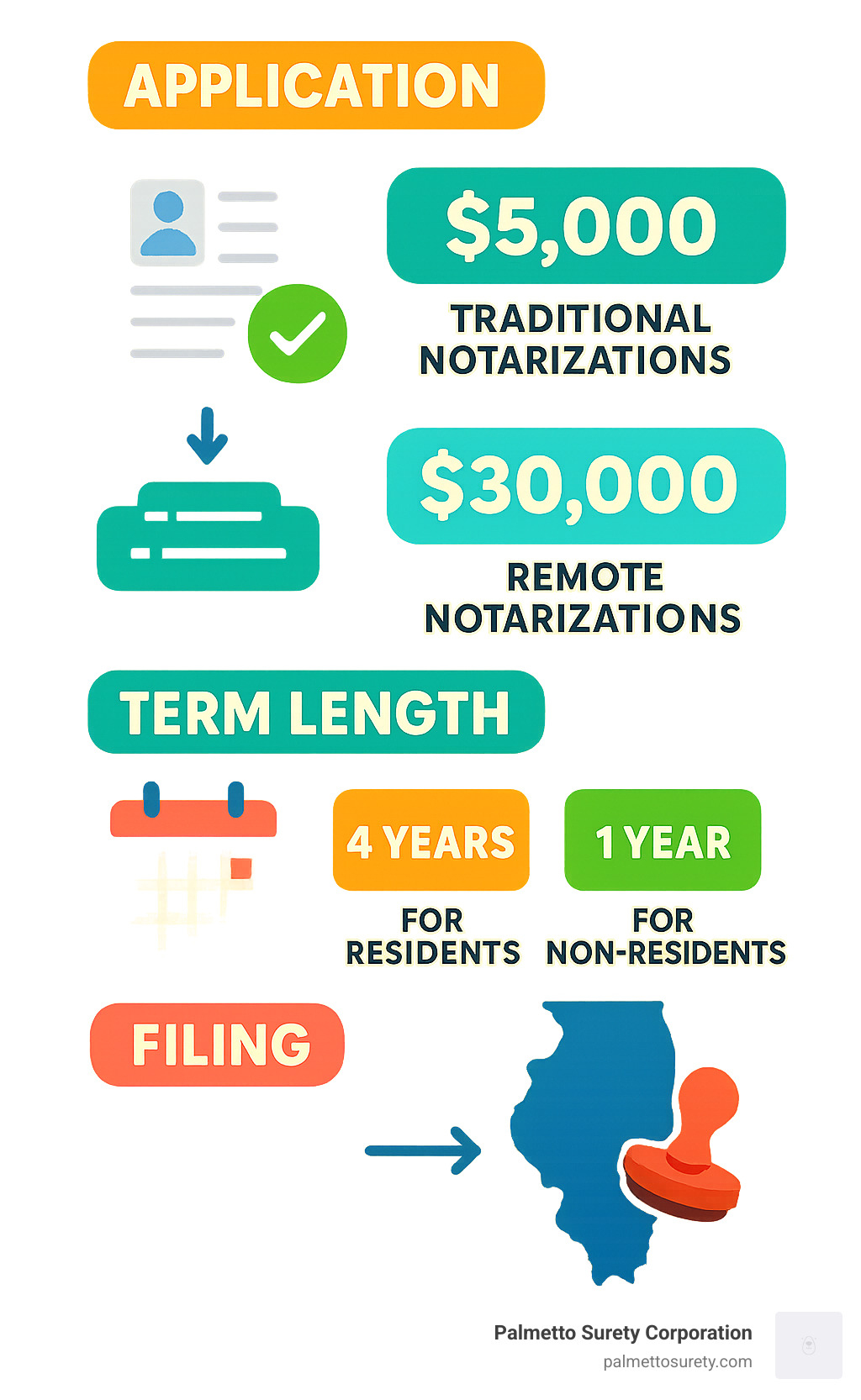
- Required Amount: $5,000 for traditional in-person notarizations; $30,000 for remote online notarizations
- Term Length: 4 years for Illinois residents; 1 year for non-residents from bordering states
- Average Cost: $20-$55 depending on coverage amount and provider
- Legal Requirement: Mandatory under Illinois Notary Public Act (5 ILCS 312)
- Purpose: Protects the public from financial harm caused by improper notarial acts
An Illinois notary public bond is a type of surety bond required by state law before you can be commissioned as a notary in Illinois. This bond isn’t insurance for you—it’s protection for the public. It provides financial recourse if your notarial actions cause someone harm.
The bond works as a three-party agreement between you (the notary), the state of Illinois (the obligee), and a surety company. If you fail to perform your duties properly and someone suffers financial loss, they can make a claim against your bond.
Think of it as a promise backed by financial security. Your bond guarantees that you’ll follow all notary laws and regulations. If you don’t, the surety company pays the claim up to your bond amount, but you’ll ultimately be responsible for reimbursing them.
I’m Haiko de Poel Jr, and through my work with Palmetto Surety Corporation, I’ve helped countless professionals steer the requirements for obtaining an Illinois notary public bond and understand the critical role these bonds play in maintaining the integrity of notarial acts.
Key terms for illinois notary public bond:
– bond for notary
– what is a notary public bond
What Is an Illinois Notary Public Bond?


When you’re stepping into the role of a notary public in Illinois, one of the first things you’ll need is an Illinois notary public bond. But what exactly is this bond, and why does it matter so much?
Think of this bond as a promise with financial backing. It’s not insurance that protects you—rather, it’s a safety net for the public. If someone experiences financial harm because you made a mistake in your notarial duties, this bond ensures they can recover their losses.
The state of Illinois takes this protection seriously. Under the Notary Public Act, every notary must secure this bond before receiving their commission. It’s a three-way agreement between:
- You (the notary and principal)
- The State of Illinois (the obligee)
- A surety company like Palmetto Surety Corporation (the guarantor)
Your bond will specify either a $5,000 or $30,000 penal sum—this is the maximum amount the surety would pay to someone harmed by improper notarial acts. And yes, if a claim is paid, you’ll ultimately be responsible for paying back the surety company.
Purpose & Protections
The Illinois notary public bond serves as your community’s shield against notarial misconduct. It’s designed to protect consumers who might otherwise have no recourse if a document was improperly notarized.
This financial safeguard covers losses from various scenarios—perhaps you notarized a signature without properly verifying someone’s identity, or maybe you notarized a document when the signer wasn’t actually present. These mistakes can have serious consequences for the parties involved.
Beyond just providing compensation, your bond acts as a powerful deterrent. Knowing you’re personally on the hook for reimbursing any claims tends to sharpen one’s attention to detail! This accountability helps maintain the integrity of notarial acts throughout Illinois.
Who Must Obtain One
If you’re wondering whether you need an Illinois notary public bond, the answer is almost certainly yes. The requirement applies to:
Illinois residents seeking a notary commission will need a bond that covers their full four-year term. If you’re renewing your commission, you’ll need a fresh bond—there’s no automatic renewal process.
Non-residents aren’t entirely excluded from becoming Illinois notaries. If you live in a bordering state (Indiana, Iowa, Kentucky, Missouri, or Wisconsin) and work for a business with an Illinois address, you can apply—but your bond will only be issued for one year.
First-time applicants often ask us at Palmetto Surety Corporation when in the process they should secure their bond. The answer is simple: before submitting your application. Your bond must be in place as part of your complete application package.
Having helped thousands of Illinois notaries secure their bonds over the years, we’ve seen how this simple financial guarantee helps maintain public trust in notarial acts across the state. It’s not just a bureaucratic requirement—it’s a cornerstone of notarial integrity.
Illinois Notary Public Bond Amounts & Costs
Let’s talk money! When you’re applying for an Illinois notary public bond, understanding the different amounts and costs helps you budget properly and choose the right coverage for your needs.
Illinois requires different bond amounts based on how you’ll be notarizing documents:
The standard $5,000 bond covers traditional in-person notarizations—where you and the signer are face-to-face. For notaries planning to perform remote notarizations through audio-video technology, you’ll need the larger $30,000 bond. Already have a $5,000 bond but want to add remote services? You can get a $25,000 supplemental bond to reach that $30,000 requirement.
Good news—these bonds are surprisingly affordable! For a four-year term (the standard commission period), you’ll typically pay between $20-$55 as a one-time payment. That breaks down to as little as $5 per year for basic coverage—a small price for the authority to notarize documents.
If you’re a non-resident from a bordering state like Indiana or Wisconsin, your bond will be issued for just one year, with the premium adjusted accordingly. You’ll need to work for a business with an Illinois address to qualify.
Several factors affect what you’ll pay: the bond amount you need, whether you live in Illinois or a neighboring state, if you bundle E&O insurance (more on that later), and which provider you choose.
At Palmetto Surety Corporation, we pride ourselves on competitive rates and quick approvals—often within hours rather than days. We understand that when you need a bond, you usually need it now!
$5,000 vs. $30,000 Illinois Notary Public Bond

The difference between these two Illinois notary public bond amounts comes down to how you’ll be performing your notarial duties.
With the $5,000 bond, you’re covered for traditional in-person notarizations only. This is the standard option if you’ll be meeting signers face-to-face to verify their identity and witness their signatures. The lower amount reflects the reduced risk that comes with in-person verification—you can see the person, check their ID directly, and confirm they understand what they’re signing.
The $30,000 bond is required if you’ll be performing remote notarizations via audio-video technology. This higher amount acknowledges the additional risks involved when verifying identities virtually. When you check that “remote notarization” box on your application, you’re triggering this statutory requirement. The good news? This bond covers both remote and in-person notarizations, giving you flexibility in how you serve your clients.
The state requires this significant difference in bond amounts because remote notarization involves additional technology considerations and identity verification challenges. It’s all about protecting the public from potential fraud or mistakes.
Typical Pricing Breakdown
Here’s what you can expect to pay for your Illinois notary public bond:
For a standard $5,000 bond, you’ll typically pay between $20-$30 for the entire four-year term. The larger $30,000 bond usually costs between $45-$55 for four years. If you’re adding remote services with a $25,000 supplemental bond, expect to pay around $40-$50.
The best part? Most surety providers, including us at Palmetto Surety Corporation, offer flat rates regardless of your credit history. Notary bonds are considered relatively low-risk, so you won’t face the same scrutiny as with larger commercial bonds.
Don’t forget to budget for the additional required fees: a $15 filing fee to the Illinois Secretary of State and a county clerk registration fee ($5 for in-person registration or $10 by mail).
Many notaries also choose to add Errors & Omissions (E&O) insurance for personal protection. While not required by law, it’s often bundled with bonds at various coverage levels for a discounted rate. These packages might also include essential supplies like stamps and journals—saving you both money and shopping time.
When you’re ready to secure your Illinois notary public bond, we make the process quick and painless. After all, the sooner you’re bonded, the sooner you can start notarizing!
Step-by-Step: Obtaining and Filing Your Illinois Notary Public Bond
Ready to secure your Illinois notary public bond? I’ll walk you through the process with clear, manageable steps that will have you notarizing in no time.
First, you’ll need to decide which bond amount fits your notarial plans. If you’ll only perform in-person notarizations, the $5,000 bond will suffice. Planning to offer remote services? You’ll need the $30,000 bond instead.
Once you’ve determined your needs, purchasing your bond is simple. At Palmetto Surety Corporation, we pride ourselves on quick approvals—often within hours rather than days. No lengthy waiting periods to start your notary journey!
After purchasing your bond, you’ll complete the bond form with your personal information. Both you and our authorized representative will sign this important document. With the 2024 requirements now in effect, you’ll also need to complete a state-approved study course before submitting your notary application (Form I-160).
Taking your notary oath of office comes next. You can handle this electronically for online applications or in person before another notary public. Then, simply upload your completed bond form during the online application process on the Illinois Secretary of State website and pay the $15 application fee.
Now comes the waiting game. The Secretary of State’s office typically processes applications within 4-8 weeks. Once your commission certificate arrives, you must register it with your county clerk’s office within 30 days. After that, you’re officially ready to begin your notarial duties!
For those renewing their commission, start this process about 60 days before your current expiration date to ensure smooth continuation of your notarial powers.
Information You’ll Need
Gathering the right information before applying for your Illinois notary public bond saves time and prevents frustrating delays.
Your legal name must match exactly as it appears on your driver’s license or state ID—no nicknames or variations allowed! Your home address needs to match your ID as well, and you’ll need to specify your county of residence where you’ll register your commission.
Be prepared to provide your business address where you’ll primarily perform notarial acts, along with any relevant employer information. Renewing notaries should have their current commission number and expiration date handy.
Don’t forget to include a photocopy of your driver’s license or state ID with your application. It might seem like a small detail, but consistency is crucial—all information must match across your bond, application, and identification documents. Even minor discrepancies can lead to delays or rejection.
Filing With the Illinois Secretary of State
Once your Illinois notary public bond is in hand, filing with the Secretary of State is straightforward.
Start by scanning your completed bond form and converting it to a PDF, JPEG, or TIF format. During the online notary application process on the Secretary of State’s website, you’ll upload this document and pay the $15 application fee.
After submission, the Secretary of State’s office will review your application and bond. Upon approval, they’ll mail your commission certificate to the address you provided. The final step is taking this certificate to your county clerk’s office within 30 days of the effective date. The county clerk will charge a registration fee—$5 for in-person registration or $10 if you register by mail.
At Palmetto Surety Corporation, we understand this process can seem complex, which is why we provide detailed instructions with each bond. Our goal is to ensure your filing process goes as smoothly as possible.
Keeping Your Bond Current & Updated
Life changes happen, and when they do, your Illinois notary public bond may need updating too.
If you move to a new address within the same county, simply contact us to update your bond information. A legal name change due to marriage, divorce, or other reasons requires notification to both the Secretary of State and your surety provider.
Moving to a different county? You’ll need to resign your commission and apply for a new one, including obtaining a new bond. And if you initially got a $5,000 bond but later decide to offer remote notarizations, you’ll need to secure a supplemental $25,000 bond.
I recommend setting calendar reminders about 60 days before your commission expires. This gives you plenty of time to renew both your bond and commission without any interruption to your notarial services.
Throughout your four-year term, we’re here to help with any questions or changes. At Palmetto Surety Corporation, we believe that maintaining your bond shouldn’t be complicated—after all, you have important notarial work to focus on!
Notary Bond vs. Errors & Omissions Insurance
When you’re setting up your notary practice in Illinois, you’ll encounter two important financial protection tools that sound similar but serve very different purposes. Let me explain the key differences between an Illinois notary public bond and Errors & Omissions insurance.
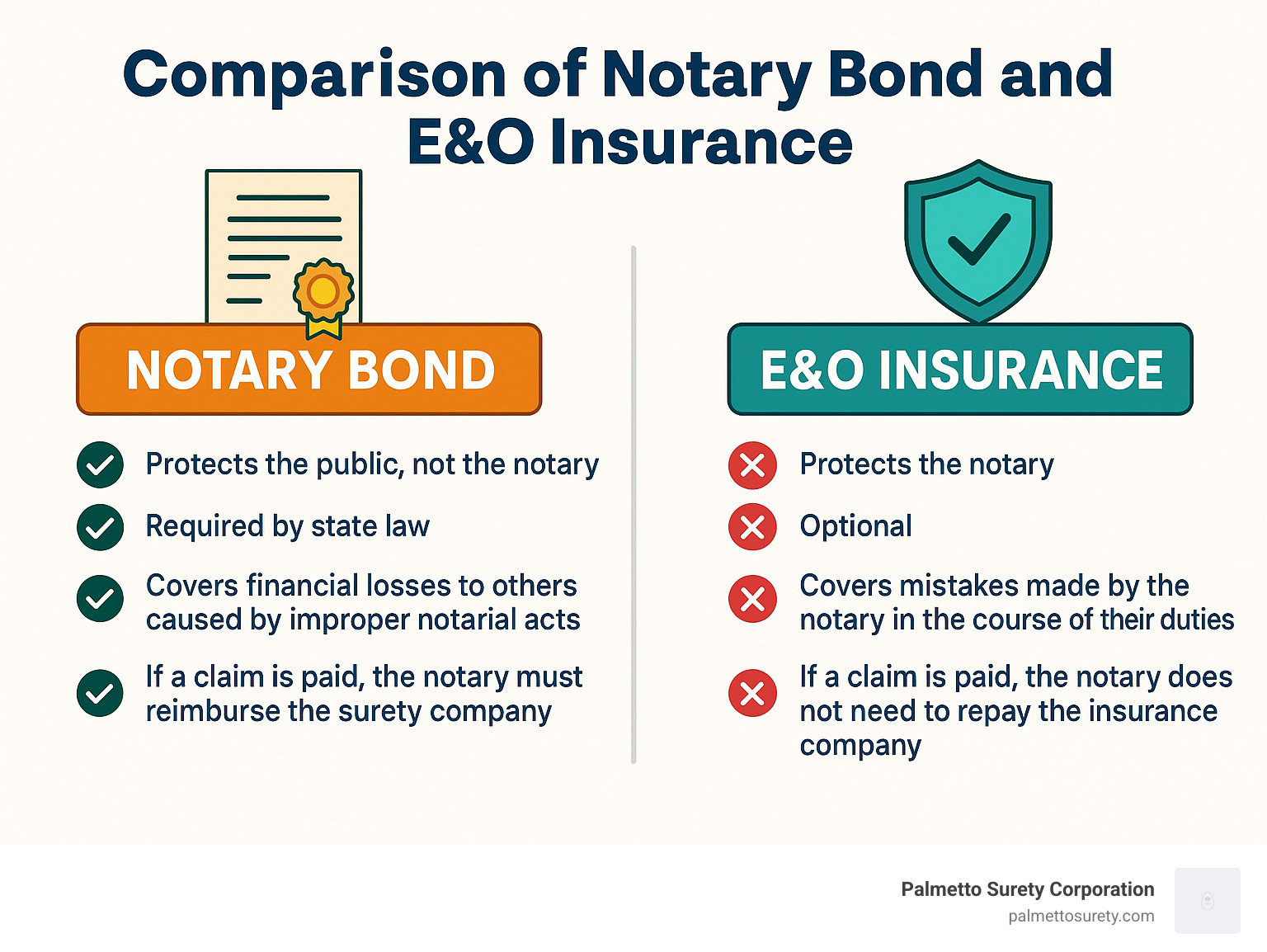
Think of your Illinois notary public bond as a promise to the public. It’s your financial guarantee that you’ll follow all the rules and regulations of being a notary. The state requires this bond because it protects the people who rely on your services—not you. If you make a mistake that causes someone financial harm, they can file a claim against your bond.
Here’s the catch many new notaries don’t realize: if your bond pays out a claim, you’ll need to pay that money back to the surety company. It’s like a loan that activates only when you’ve made a mistake.
Errors & Omissions insurance (E&O), on the other hand, is all about protecting you. While not required by law, this insurance covers your legal defense costs and damages if you make an unintentional error. The best part? You don’t have to pay back the insurance company if they cover a claim for you.
Let me share a real-world scenario: Imagine you accidentally notarize a document for someone using a fake ID. Later, that document is used in a fraudulent property transfer causing $4,000 in damages. Without E&O insurance, you’d first face the claim against your Illinois notary public bond, which would pay the victim. Then the surety company would turn around and require you to repay that $4,000, plus you’d be on your own for any legal fees to defend yourself.
With E&O insurance, you’d be covered for both the claim amount and your legal defense costs, typically without any deductible.
Many of our clients at Palmetto Surety Corporation choose to bundle their Illinois notary public bond with E&O insurance for comprehensive protection. We offer several coverage levels, starting from a basic $5,000 policy (sometimes included free with your bond purchase) up to $100,000 for those who handle high-value transactions.
Here’s a quick comparison of these two essential protections:
| Feature | Illinois Notary Public Bond | E&O Insurance |
|---|---|---|
| Required by law | Yes | No |
| Protects | The public | The notary |
| Cost | $20-$55 for 4 years | $20-$100+ for 4 years |
| Coverage amount | $5,000 or $30,000 | $5,000-$100,000 |
| Repayment required | Yes | No |
| Covers legal defense | No | Yes |
| Deductible | N/A | Typically none |
The modest cost of E&O insurance—often less than $10 per year for basic coverage—makes it one of the smartest investments you can make as a notary. When you consider that a single mistake could cost thousands out of your pocket, the peace of mind alone is worth the premium.
Your Illinois notary public bond fulfills your legal obligation to the state, while E&O insurance protects your personal finances. Together, they provide a safety net that allows you to perform your duties with confidence.
Handling Claims & Staying Compliant
Understanding how claims work and maintaining compliance is essential when you hold an Illinois notary public bond. Let’s examine common mistakes, the claims process, and best practices to avoid issues.
Common mistakes that can lead to claims against your Illinois notary public bond include:
- Incomplete identity verification: Failing to properly verify a signer’s identity
- Notarizing blank documents: Allowing signers to sign incomplete documents
- Inadequate journal keeping: Not maintaining detailed records of notarial acts
- Notarizing for family members: Creating potential conflicts of interest
- Missing signatures: Failing to obtain proper signatures on notarial certificates
- Remote notarization errors: Using improper technology or procedures for remote acts
If someone believes they’ve suffered financial harm due to your improper notarial act, they can file a claim against your Illinois notary public bond. Here’s what happens:
-
Claim filing: The injured party files a claim with the surety company that issued your bond.
-
Investigation: The surety company investigates the claim to determine its validity.
-
Determination: If the claim is valid, the surety company may pay the claimant up to the bond amount ($5,000 or $30,000).
-
Reimbursement: You are legally obligated to reimburse the surety company for any amount paid out on your behalf.
-
Potential commission revocation: Serious violations may result in the Secretary of State revoking your notary commission.
Allowing your Illinois notary public bond to lapse or operating without a valid bond can result in:
- Invalidation of your notarial acts
- Commission suspension or revocation
- Personal liability for damages
- Civil penalties
Preventive Best Practices
To avoid claims against your Illinois notary public bond and maintain compliance, follow these best practices:
-
Complete approved training: As of January 1, 2024, Illinois requires notaries to complete a state-approved study course. Even if you’re exempt from this requirement, proper training is invaluable.
-
Maintain detailed journals: Record all notarial acts in a secure journal, including:
- Date and time of the notarization
- Type of notarial act
- Document title or type
- Signer’s name, address, and identification details
- Signer’s signature
-
Any fees collected
-
Secure your notary seal: Keep your official seal in a secure location when not in use to prevent unauthorized access.
-
Verify identities thoroughly: Always properly verify signers’ identities using acceptable identification documents.
-
Stay updated on laws: Keep abreast of changes to Illinois notary laws and regulations.
-
For remote notarizations:
- Use only approved technology platforms
- Ensure proper recording and storage of sessions
- Follow improved identity verification procedures
- Maintain electronic journals as required
At Palmetto Surety Corporation, we provide resources and guidance to help you understand and follow these best practices, reducing your risk of claims against your Illinois notary public bond.
Frequently Asked Questions about Illinois Notary Bonds
What happens if a claim is made against my bond?
When someone files a claim against your Illinois notary public bond, it can feel intimidating, but understanding the process helps.
The surety company will first investigate the claim thoroughly. If they determine you did indeed improperly perform your duties and caused financial harm to someone, they may pay the claimant up to your full bond amount—either $5,000 or $30,000, depending on your bond type.
Here’s the crucial part many notaries don’t initially realize: unlike insurance, you’re legally obligated to reimburse the surety company for every penny they pay out on your behalf. This is why we at Palmetto Surety Corporation always take time to explain this difference to our clients.
If you’ve wisely invested in Errors & Omissions insurance, you may have coverage for this reimbursement, depending on your specific policy terms. This potential safety net is precisely why we strongly encourage all notaries to consider E&O coverage alongside their bond.
Is E&O insurance required for Illinois notaries?
No, Errors & Omissions insurance isn’t legally required in Illinois—only your Illinois notary public bond is mandated by state law.
That said, going without E&O insurance is like walking a tightrope without a safety net. Without it, you’re personally on the hook for:
- All legal defense costs if someone sues you
- Reimbursing the surety company for any bond claims they pay
- Any damages awarded that exceed your bond amount
I’ve seen too many notaries face financial hardship from honest mistakes that could have been covered by an affordable E&O policy. At Palmetto Surety Corporation, we offer convenient bundled packages that include both your required bond and E&O insurance at rates that won’t break the bank. Many of our clients tell us the peace of mind alone is worth the modest investment.
Can non-residents apply for an Illinois notary bond?
Yes, you can absolutely apply for an Illinois notary public bond as a non-resident, provided you meet three specific requirements:
First, you must live in a state that shares a border with Illinois—that’s Indiana, Iowa, Kentucky, Missouri, or Wisconsin. Second, you need employment with a business that has an Illinois address. And third, you must perform all your notarial acts within Illinois state lines.
There is one significant difference for non-resident notaries: your Illinois notary public bond will be issued for a one-year term instead of the standard four years that residents receive.
The application process requires a special non-resident form and proof of your employment at an Illinois business. The bond requirements remain the same—$5,000 for traditional in-person notarizations or $30,000 if you’ll be performing remote notarizations.
At Palmetto Surety Corporation, we’ve helped many non-resident notaries steer these specific requirements. We understand the unique challenges you face and can guide you through the process with our characteristic quick approval times—often within hours rather than days.
Conclusion & Next Steps

Congratulations! You now understand what it takes to secure an Illinois notary public bond – your gateway to serving as a trusted notary in the Prairie State. This bond isn’t just a box to check; it’s your promise to the public that you’ll uphold the integrity of this important role.
Think of your bond as a safety net for the people who will rely on your services. For just $20-$55, you’re providing four years of financial protection and peace of mind to everyone whose documents you’ll notarize. Whether you choose the standard $5,000 bond for in-person services or the $30,000 bond for remote notarization, you’re making a meaningful commitment to professional excellence.
While the bond protects the public, you’ll want to protect yourself too. Adding E&O insurance creates a shield around your personal finances if mistakes happen – and even the most careful notaries can make them!
Here at Palmetto Surety Corporation, we take pride in making the bonding process painless. Our team has spent over two decades perfecting the art of quick approvals – often getting you bonded within hours rather than the days you might wait elsewhere. We understand you’re eager to start your notarial journey, and we won’t keep you waiting.
Ready to take the next step? Here’s what to do:
- Decide which bond amount fits your notarial plans ($5,000 or $30,000)
- Contact us for a quick, no-obligation quote
- Complete the simple application process
- Receive your bond certificate promptly
- File with the Illinois Secretary of State and begin your notarial career with confidence
The Illinois notary public bond you secure today will support you through countless signatures, stamps, and satisfied clients over the next four years. By understanding and embracing your responsibilities under this bond, you’re setting yourself up for a successful and respected notarial practice.
For more information about our surety solutions and how we can help you secure your Illinois notary public bond with minimal hassle, visit our website. Our Charleston, SC team is standing by to answer your questions and provide the expert guidance you deserve. With Palmetto Surety Corporation, you’ll enjoy the confidence that comes from knowing your bonding needs are in capable, caring hands.


