


Bail Bond Agent Job Description: 7 Powerful Facts for 2025
Understanding the Bail Bond Agent’s Role in the Justice System
A bail bond agent job description involves acting as a financial intermediary in the criminal justice system, helping defendants secure release from jail while awaiting trial. If you’re considering this career or just want to understand what these professionals do, here’s a quick overview:
| Key Aspects of a Bail Bond Agent’s Role |
|---|
| 1. Posts bail on behalf of defendants who cannot afford the full amount |
| 2. Charges a non-refundable fee (typically 10-15% of the bail amount) |
| 3. Assesses defendant flight risk and financial creditworthiness |
| 4. Prepares and processes all bond paperwork and documentation |
| 5. Monitors defendants to ensure court appearances |
| 6. May employ bounty hunters if defendants fail to appear |
| 7. Maintains 24/7 availability for client emergencies |
| 8. Must be licensed according to state regulations |
Bail bond agents serve as crucial links between the court system, detention facilities, and defendants. They provide a valuable service for those who cannot afford to pay their full bail amount, allowing them to return to their families and jobs while awaiting trial.
The role requires strong interpersonal skills, detailed knowledge of legal procedures, and the ability to assess risk effectively. While the job can be demanding with irregular hours, it offers flexibility and the potential for good income, with the average annual salary around $72,480.
As a bail agent, you’ll need to complete state-required pre-licensing education (typically 8-20 hours), pass a background check, and obtain proper licensing and insurance before you can begin working in this field.
I’m Haiko de Poel Jr, and through my experience leading Palmetto Surety Corporation, I’ve gained extensive knowledge of the bail bond agent job description and the surety industry that supports it. My work has involved redesigning and relaunching one of America’s fastest-growing surety bond companies that serves bail agents across the southeastern United States.
Bail bond agent job description word guide:
– Experienced bail bondsman
– are bail bonds agents cops
– can a bail bonds agent arrest you
Why This Guide Matters
Navigating the criminal justice system can be overwhelming for defendants and their families. Bail bond agents serve as guides through this complex process, making their role vital to many Americans’ experience with the legal system.

With nearly 15,000 bail bondsmen currently working in the United States and handling approximately $14 billion in bond turnover annually, this profession plays a significant role in our justice system. The career outlook remains steady, with a projected 4.9% growth by 2024, adding approximately 7,100 new jobs to reach a total of 152,300 positions nationwide.
Understanding the bail bond agent job description is important whether you’re:
– Considering this as a career path
– Needing bail services for yourself or a loved one
– Working in an adjacent legal field
– Interested in criminal justice reform
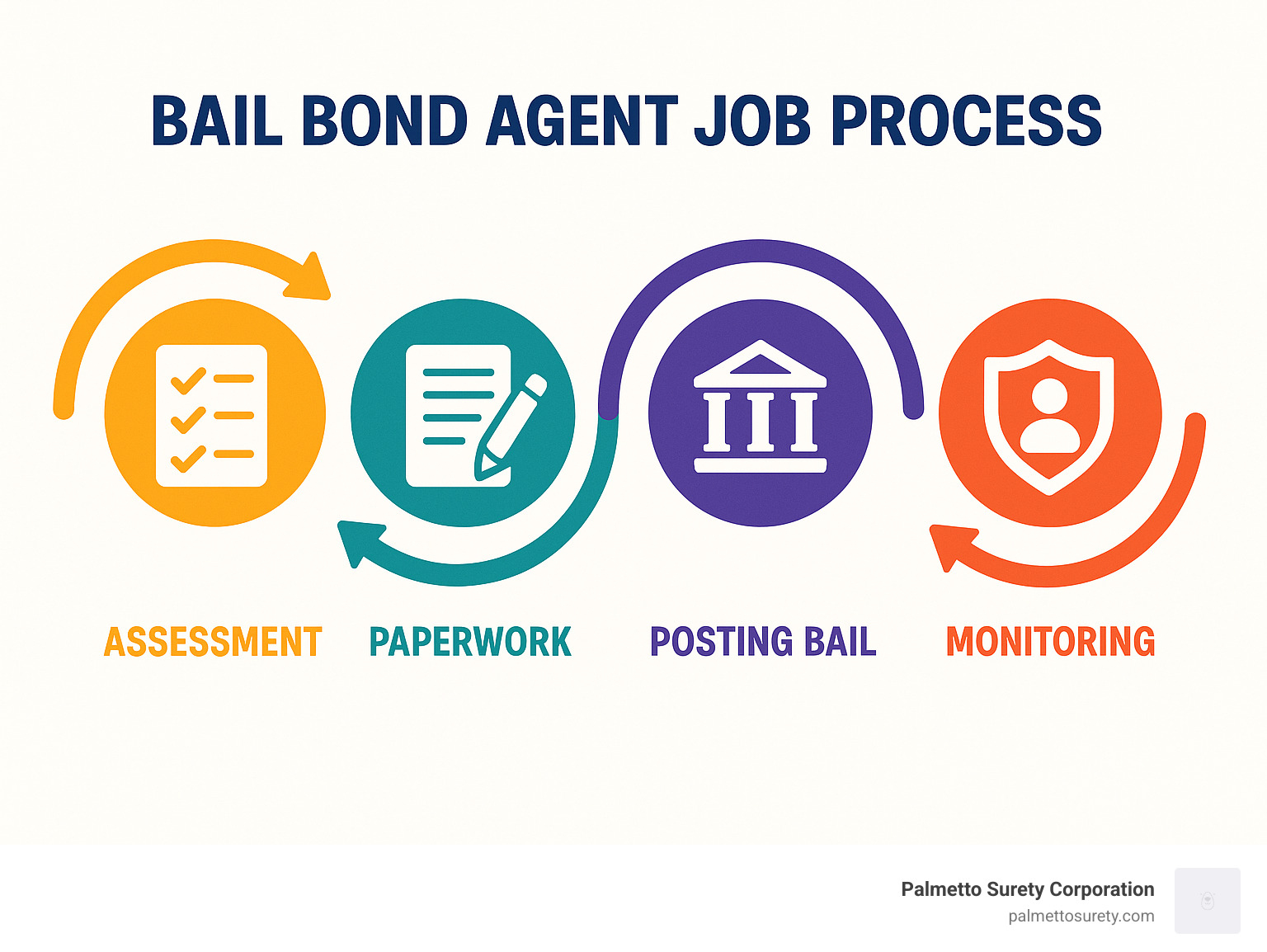
Bail Bond Agent Job Description: Core Duties & Daily Tasks
The heartbeat of a bail bond agent’s role is providing financial guarantees to courts that defendants will show up when they’re supposed to. But what does this actually look like day-to-day? Let’s walk through the real responsibilities that make up this unique profession.
Risk Assessment and Underwriting
Before putting their name (and money) on the line, bail agents become part-detective, part-financial advisor. They’ll carefully evaluate:
- The defendant’s likelihood of skipping town based on their ties to the community, job stability, and past behavior
- Financial reliability of both the defendant and anyone co-signing
- Whether collateral (like property or vehicles) might be needed as extra security
As one seasoned bail agent once told me, “Being a bail agent is more about who you know than what you know.” Your success in this field often comes down to your ability to read people and situations accurately—a skill that develops with experience.
Financial Transactions and Fee Structure
The bail bond agent job description includes a clear understanding of how they make their living. Most agents charge:
- A standard 10% non-refundable fee for state-level charges
- A higher 15% fee for federal bail bonds
- Minimum fees (typically around $100) in states with regulations like Florida
These rates aren’t arbitrary—they’re usually set by state law and represent the agent’s compensation for potentially risking the full bail amount if things go wrong.
Documentation and Paperwork
Paperwork might not be glamorous, but it’s the backbone of the bail business. Agents spend significant time preparing:
Bail bond applications that capture everything from the defendant’s personal details to their employment history
Promissory notes that spell out exactly how and when payments will be made
Indemnity agreements that protect the agent if the defendant disappears
Court receipts and release documents that facilitate the defendant’s freedom
The paperwork process requires meticulous attention to detail—one mistake could mean financial liability or legal complications down the road.
Court Liaison and Bail Posting
Once the paperwork is squared away, the bail bond agent job description gets more active:
“I spend a good chunk of my day at courthouses and jails,” explains a veteran agent from South Carolina. “Building relationships with court clerks and jail staff is essential—they can make your job much easier or much harder.”
The agent physically delivers the bond to the courthouse or jail, coordinates with staff to process it, and typically can get someone released within a couple of hours after everything’s submitted.

Defendant Monitoring and Compliance
The work doesn’t end when the defendant walks free. Agents must:
Stay on top of court dates and ensure defendants know when they need to appear
Conduct regular check-ins that might be in-person, by phone, or even electronic depending on the circumstances
Maintain contact with co-signers who have a financial stake in making sure the defendant follows through
Keep up with case developments that might affect their risk
This monitoring phase requires a balance of firmness and understanding—building rapport while still enforcing accountability.
Recovery Operations
When a defendant fails to appear (which thankfully is rare), the bail bond agent job description shifts into recovery mode:
The bond faces forfeiture, potentially making the agent liable for the full amount
The agent may work with recovery specialists (sometimes called bounty hunters) to locate and return the defendant
Coordination with law enforcement and courts becomes critical during the grace period
This aspect of the job can be stressful and unpredictable, but most experienced agents have systems in place to minimize these situations.
Bail Bond Agent Job Description vs Bail Bond Clerk
While these roles often overlap in smaller agencies, they involve distinct responsibilities:
| Bail Bond Agent | Bail Bond Clerk |
|---|---|
| Assesses risk and underwrites bonds | Handles administrative paperwork |
| Assumes financial liability | Maintains regulatory compliance |
| May employ bounty hunters | Coordinates with courts and law enforcement |
| Negotiates with clients and co-signers | Maintains accurate records and documentation |
| Often works irregular hours, on-call 24/7 | Typically works standard business hours |
| Requires state licensing | May not require specific licensing |
| Earns commission on bonds written | Usually earns a fixed salary |
In smaller operations, one person might wear both hats. In larger bail agencies, these roles are typically separate, with clerks handling the administrative backbone while agents focus on client-facing work and risk management.
Typical Paperwork in a Bail Bond Agent Job Description
The paperwork process is where the rubber meets the road in this profession. Bail bond agent job description always includes managing several critical documents:
-
Bail Bond Application – This comprehensive form captures the defendant’s full name, booking number, charges, employment history, financial information, references, and any co-signer details.
-
Promissory Note – This legal document outlines payment terms, schedules, penalties for non-payment, and any applicable interest rates.
-
Bond Agreement – Here, you’ll specify the bond amount, court jurisdiction, defendant’s obligations, and what constitutes a violation.
-
Terms and Conditions – This spells out requirements for check-ins, communication expectations, travel restrictions, and consequences for violations.
-
Indemnity Agreement – Perhaps the most important document for the agent, this protects against financial loss, requires signatures from all parties, and authorizes recovery actions if needed.
What Happens When a Defendant Skips Court?
Despite an agent’s best efforts, sometimes defendants fail to appear. When this happens:
The court immediately declares the defendant in default and issues a bench warrant for their arrest.
A grace period (typically 30-180 days depending on the jurisdiction) begins, giving the agent time to find and return the defendant before the bond is completely forfeited.
The agent kicks into high gear, contacting references and co-signers, potentially hiring recovery specialists, and working alongside law enforcement to locate the missing defendant.
If the grace period expires without the defendant’s return, the financial consequences kick in: the agent becomes liable for the full bail amount, any collateral may be seized, and civil actions against co-signers may begin.
The legal foundation for an agent’s authority to apprehend fugitives comes from the landmark 1872 Supreme Court case Taylor v. Taintor, which established that bail agents have the right to pursue and arrest those who’ve skipped bail.
The good news? According to industry data from The Fugitive study on bail jumping, approximately 97% of defendants released on surety bonds do make their court appearances. The dramatic bail-jumping scenarios portrayed in movies and TV shows are relatively rare in real practice.

Licensing, Qualifications & State Regulations
Becoming a bail bond agent isn’t as simple as hanging up a shingle and opening for business. The bail bond agent job description comes with a hefty side of regulatory requirements that vary quite a bit from state to state. Let’s break down what you’ll need to get started in this profession.
Basic Requirements
Most states share some common ground when it comes to basic qualifications. You’ll typically need to be at least 18 years old (though some states like Florida want you to be 21), have a high school diploma or GED, and be a U.S. citizen or legal resident.
Perhaps most importantly, you’ll need a clean criminal record. As one veteran bail agent told me, “It’s hard to help people steer the justice system when you’ve got your own rap sheet.” Felony convictions are almost always disqualifiers, and even misdemeanors can create problems depending on the state.
Having a solid reputation in your community matters too. References and character witnesses often play a role in the licensing process, as bail agents hold positions of significant trust.
Education and Training
The days of learning the bail business purely through apprenticeship are largely behind us. Most states now require formal education before you can get licensed:
Pre-licensing education typically ranges from 8-20 hours of coursework covering state-specific laws, ethical practices, and business operations. California, for instance, requires a full 20 hours of pre-licensing education, while other states might require less.
Many states also mandate continuing education to keep your license active. This usually means completing a certain number of approved courses every 1-2 years to stay current on changing laws and best practices.
Some jurisdictions still value hands-on experience, requiring new agents to complete an apprenticeship under an experienced bail bondsman before they can operate independently.
Financial Requirements
The bail bond agent job description includes being financially responsible for potentially large sums of money. To protect all parties involved, states typically require:
A relationship with a surety insurance company that will back the bonds you write. This is where companies like Palmetto Surety Corporation come in, providing the financial backing that makes your bail bond business possible.
You’ll likely need to submit financial statements and disclosures during the application process. States want to ensure you’re financially stable before allowing you to handle others’ money and freedom.
Many jurisdictions also require professional liability insurance to protect against claims of negligence or errors in your work.
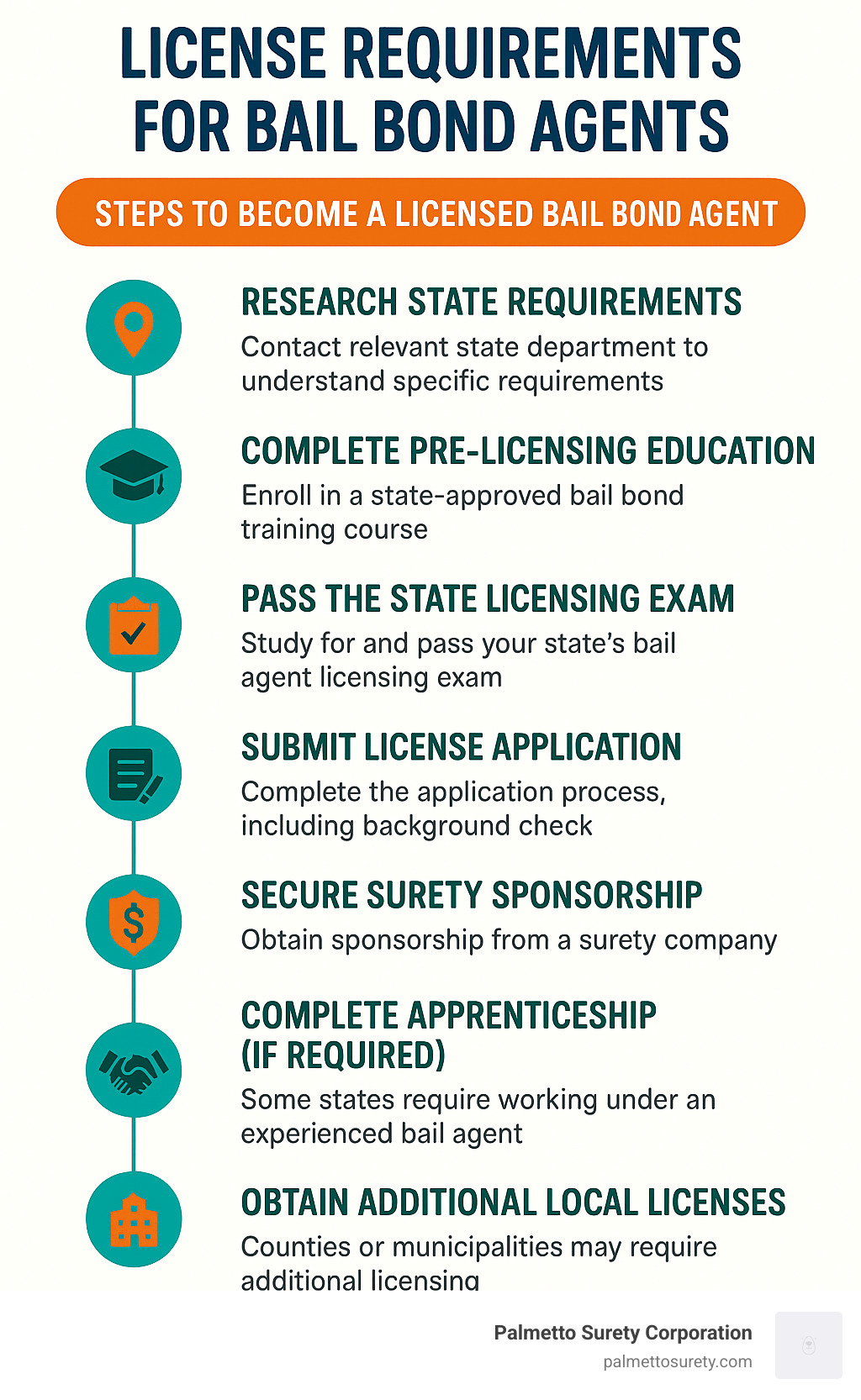
Steps to Become a Licensed Bail Bond Agent
Getting licensed isn’t a weekend project. Here’s the typical path:
-
Research State Requirements
Start by contacting your state’s regulatory body—usually the Department of Insurance, Department of Financial Services, or in some cases, the Sheriff’s Department. Each state has its own unique requirements and application processes. -
Complete Pre-Licensing Education
Enroll in state-approved bail bond training courses. These programs cover everything from legal terminology to ethical practices and business operations. -
Pass the State Licensing Exam
Once you’ve completed your education, you’ll need to pass a state licensing exam. This test evaluates your understanding of relevant laws, regulations, and procedures. -
Submit License Application
The application process typically includes background checks, fingerprinting, character references, financial disclosures, and application fees that can range from a few hundred to over $1,000 depending on your state. -
Secure Surety Sponsorship
This is a crucial step—finding a surety company willing to back your bonds. Palmetto Surety Corporation specializes in supporting new and established bail agents throughout the southeastern United States. -
Complete Apprenticeship (if required)
Some states want you to learn from the pros before going solo. This apprenticeship period can last from several months to a year. -
Obtain Additional Local Licenses
Don’t forget to check if your county or city requires additional licenses or registrations. Local requirements can sometimes be as stringent as state ones.
State-by-State Snapshots
The bail bond landscape varies dramatically across the country. Here’s how some key states handle regulation:
California takes bail regulation seriously, with oversight from the Department of Insurance. You’ll need 20 hours of pre-licensing education, and you’ll face strict rules about how and where you can solicit business—no hanging around jails looking for clients! California also closely monitors advertising practices and referral arrangements.
Florida has some of the most comprehensive educational requirements, with a whopping 120 hours of coursework required. The Department of Financial Services keeps a watchful eye on bail agents, requiring detailed records and reports. If you’re handling collateral in Florida, prepare for stringent rules about how it must be managed and returned.
Texas takes a unique county-based approach through local Bail Bond Boards. Your financial requirements will vary depending on which county you’re operating in. Texas also limits your liability to 5% if a defendant skips town, making it somewhat less risky than other states.
New York, regulated by its Department of Financial Services, wants to see your business plan and financial statements before handing over a license. They’re also particular about contract language and maintain strict control over premium rates.
Some states have decided to opt out of the commercial bail system entirely. Illinois, Kentucky, Oregon, and Wisconsin have banned commercial bail bonding, instead using alternative pretrial release methods like deposit bonds paid directly to the court.
When it comes to fees, most states cap what you can charge at 10% of the bond amount. Illinois and Oregon (in the limited circumstances where commercial bail is permitted) cap fees at 8%. Federal bonds typically allow for a higher 15% fee due to their increased complexity and risk.
Understanding these state-specific requirements is essential before you invest time and money in pursuing a bail bond career. The regulatory landscape continues to evolve, with bail reform efforts potentially changing how the industry operates in various states.
Income, Work Environment & Career Path
Let’s talk money and lifestyle in the bail bond world – it’s a unique career that blends financial opportunity with a distinctive work environment.
Income Potential
The financial side of a bail bond agent job description can be quite rewarding. The average bail agent earns around $72,480 annually, which works out to about $35 per hour. The range is pretty wide though – newer agents might start around $49,590 yearly, while experienced professionals can pull in six figures.
What makes this career financially interesting is the commission structure. Rather than a straight salary, most bail agents earn their income through:
- The non-refundable premiums they collect (typically that 10% of the bail amount)
- Additional service fees for things like paperwork processing or after-hours service
- Interest on payment plans in states where that’s permitted
“In this business, your income directly reflects your hustle,” explains a veteran bail agent with 15 years in the field. “Some weeks are slow, but then you might write several large bonds in a single weekend and make what others earn in a month.”
Work Environment
When you look at a bail bond agent job description, the work environment is unlike most 9-to-5 jobs. The criminal justice system never sleeps, which means bail agents often don’t either.
The job blends office work with field visits – one minute you’re processing paperwork, the next you’re heading to the county jail to post a bond. You’ll spend time in courthouses, detention facilities, and sometimes meeting clients in their homes to arrange collateral.
One of the biggest adjustments for new agents is the 24/7 nature of the work. Your phone might ring at 2 AM with a family desperate to get their loved one released. This aspect requires both flexibility and boundaries to prevent burnout.

A Day in the Life
No two days look exactly alike in this profession, but here’s what might fill your hours:
Morning often starts with checking court dockets to see which clients have appearances. You’ll follow up on overnight calls, process paperwork from recent bonds, and remind clients about upcoming court dates.
Afternoons might find you at the courthouse attending proceedings for active cases or back at the office meeting potential clients. This is also prime time for conducting risk assessments, completing paperwork, and networking with attorneys and court staff.
When evening rolls around, you might be responding to calls from jails about new arrests, traveling to detention facilities, or meeting with families to arrange payment and collateral. Some nights are quiet; others have you working until dawn.
“The unpredictability is actually what I love,” shares one bail agent. “I’m never bored, and I’m helping people through one of the worst moments of their lives.”
Long-Term Career Outlook & Specializations
The bail bond industry offers several paths as your career matures:
Agency Ownership becomes a natural progression for many successful agents. After learning the ropes, opening your own bail bond agency allows you to build a team and expand operations. This step requires additional business licenses and insurance, but the income potential increases substantially.
Many agents develop specializations over time. Some focus on federal bonds, which involve higher risk but come with higher premiums. Others become experts in immigration bonds, developing specialized knowledge of immigration court procedures. Some target large bonds exclusively, working with substantial collateral and higher-value cases.
The industry itself shows healthy signs of growth, with projections indicating a 4.9% increase by 2024, adding approximately 7,100 new positions nationwide. This growth comes despite bail reform movements in some states, as the majority of jurisdictions continue to rely on the commercial bail system.
Technology is changing the game for modern bail agents. Today’s professionals leverage:
– Sophisticated case management software
– Electronic signature platforms
– GPS monitoring systems
– Social media for skip-tracing and defendant verification
At Palmetto Surety Corporation, we’ve seen how technology transforms efficiency, allowing our partner agents to manage more cases with greater accuracy while maintaining the personal touch that defines this profession.
The bail bond agent job description continues to evolve, but the fundamentals remain: helping people steer a difficult system while managing risk and building a sustainable business.
Challenges, Ethics & FAQs
The bail bond profession faces various challenges and ethical considerations that are important to understand.
Key Challenges
- Risk Assessment
- Accurately evaluating flight risk is crucial but difficult
- Poor judgments can result in significant financial losses
-
Each case presents unique circumstances requiring careful evaluation
-
Personal Liability
- Agents are financially responsible if defendants fail to appear
- Recovery efforts can be costly and time-consuming
-
Collateral may be insufficient to cover losses
-
Safety Concerns
- Interactions with defendants can sometimes be dangerous
- Recovery operations carry inherent risks
-
Working in high-crime areas or at unusual hours
-
Regulatory Compliance
- Navigating complex and changing state regulations
- Maintaining proper licensing and education requirements
- Adhering to strict documentation standards
Ethical Considerations and Industry Debates
The bail bond industry faces ongoing scrutiny and reform efforts:
- Economic Discrimination Concerns
- Critics argue the system disadvantages low-income defendants
- Those who cannot afford bail or the premium may remain in jail
-
Organizations like the American Bar Association have raised concerns about this disparity
-
Reform Movements
- Several states have implemented or are considering bail reform
- California’s In Re: Humphrey decision (2021) set new standards for pretrial detention
-
Some jurisdictions are moving toward risk-assessment tools instead of cash bail
-
Alternatives to Commercial Bail
- Release on own recognizance (ROR)
- Pretrial services programs
- Charitable bail funds
-
Deposit bail systems (defendant pays percentage directly to court)
-
International Perspective
- Commercial bail bonding is almost exclusively a U.S. practice
- Most other countries consider it illegal or unnecessary
- Different approaches to pretrial release are used globally
Frequently Asked Questions about Bail Bond Agent Job Description
What skills are essential for success as a bail bond agent?
To excel as a bail bond agent, you need:
– Strong risk assessment abilities
– Excellent communication and negotiation skills
– Knowledge of criminal law and court procedures
– Financial management expertise
– Emotional intelligence and empathy
– Decision-making under pressure
– Basic investigative skills
How do bail agents make money?
Bail agents earn income through:
– Non-refundable premium fees (typically 10% of the bail amount)
– This fee is earned upon posting the bond, regardless of case outcome
– In most states, this percentage is regulated by law
– Some agents offer payment plans with additional fees where legally permitted
– Agents typically pay a portion of their earnings to their surety company
Can a bail bond agent enter a home without a warrant?
In many states, bail agents have broader authority than law enforcement to apprehend fugitives, based on the Supreme Court case Taylor v. Taintor. This often includes:
– Entering a residence without a warrant if they reasonably believe the defendant is inside
– Crossing state lines to apprehend fugitives
– Using reasonable force to detain someone who has skipped bail
However, bail agents:
– Cannot use excessive force
– Must identify themselves properly
– Cannot impersonate law enforcement
– Must follow state-specific regulations that may limit these powers
What happens to the premium fee if charges are dropped?
The premium fee is non-refundable, regardless of case outcome. Even if:
– Charges are dismissed
– The case is resolved quickly
– The defendant is found not guilty
This is because the fee compensates the agent for:
– Taking on the risk of the full bail amount
– Services provided in securing release
– Administrative costs and time
How is a bail bond agent different from a bounty hunter?
While related, these roles are distinct:
Bail Bond Agent:
– Licensed by the state to post bail bonds
– Assumes financial liability for the defendant’s appearance
– Handles paperwork, risk assessment, and client relationships
– May hire bounty hunters but doesn’t typically perform apprehensions
Bounty Hunter/Recovery Agent:
– Specializes in locating and apprehending fugitives
– Works on commission (typically 10-20% of the bond amount)
– May require separate licensing in some states
– Focuses on investigation and apprehension techniques
Some individuals may perform both roles if properly licensed, but they involve different skill sets and legal authorities.
Conclusion
The bail bond agent job description encompasses a unique combination of financial services, risk management, customer service, and legal knowledge. Agents serve as critical intermediaries in the criminal justice system, helping defendants secure release while ensuring courts that defendants will appear for their hearings.
This career offers flexibility, potential for good income, and the satisfaction of helping people steer difficult situations. However, it also comes with significant responsibilities, legal obligations, and sometimes challenging work conditions.
For those considering this career path, thorough research into your state’s specific requirements is essential. The licensing process varies significantly by location, as do the regulations governing daily operations.
At Palmetto Surety Corporation, we’ve been supporting bail agents across the southeastern United States for over 20 years. Our team understands the challenges and opportunities in this field, and we’re committed to providing the surety backing that agents need to succeed.
Whether you’re exploring a career as a bail bond agent or seeking to understand how these professionals fit into the criminal justice system, we hope this guide has provided valuable insights. The bail bond industry continues to evolve amid ongoing debates about criminal justice reform, but the fundamental role of helping defendants steer pretrial release remains essential.
For more information about our surety bond solutions and how we support bail agents throughout Georgia, Florida, Louisiana, Mississippi, South Carolina, Tennessee, and Texas, please visit our website or contact our team directly.


