


Contractor Bond Monthly Payment: Top 3 Crucial Benefits 2025
Understanding Contractor Bond Payment Options
Contractor bond monthly payment options are available through many surety providers, though most bonds are typically paid annually. Here is important information:
- Standard payment: Most contractor bonds require a one-time annual payment
- Monthly options: Some providers offer financing plans that allow monthly payments
- Typical costs: Monthly payments for a $25,000 contractor bond can start as low as $11/month
- Requirements: Monthly payment plans may require minimum premium thresholds (often $1,000+)
- Additional fees: Monthly payment plans may include interest or financing fees
Contractor bonds are financial guarantees required by state licensing boards to ensure contractors comply with regulations and fulfill their obligations to clients. While traditionally paid annually, many contractors prefer monthly payment options to manage cash flow more effectively.
The cost of a contractor bond depends primarily on a contractor’s credit score, years of experience, and license classification. For a standard $25,000 contractor license bond in California, premiums typically range from 1% to 10% of the bond amount, resulting in annual costs between $250 and $2,500.
Through experience in working with Palmetto Surety Corporation, numerous contractors have been guided through contractor bond monthly payment options that balance compliance requirements with practical business cash flow management. In the surety industry, understanding payment structures is crucial for maintaining a license while optimizing financial resources.
Understanding Contractor Bonds

If you’re new to the construction industry, contractor bonds might seem like just another piece of paperwork. But they’re actually a crucial part of doing business legally in California. Unlike insurance (which mainly protects you), a Contractor Bond Monthly Payment goes toward something that protects everyone else.
What is a Contractor Bond?
A contractor bond is essentially a promise you make to play by the rules. When you purchase one, you’re committing to follow state laws, building codes, and fulfill your contractual obligations to clients. It’s a three-way agreement between you (the contractor), the state licensing board, and a surety company like Palmetto Surety Corporation.

Here’s what makes it different from insurance: if someone makes a claim against your bond and the surety company pays out, you’ll need to pay that money back. This setup creates a powerful incentive to do quality work and honor your commitments.
Starting in January 2023, California’s Senate Bill 607 increased the required bond amount from $15,000 to $25,000. This change reflects rising construction costs and California’s commitment to protecting consumers. As the Contractors State License Board (CSLB) clearly states, “A Contractor’s Bond must be in place before CSLB can issue an active license, reactivate an inactive license, or renew an active license.”
Think of your bond as a vote of confidence from a financial institution. When a surety company issues you a bond, they’re telling the world they believe you’ll fulfill your obligations.
Why Contractor Bonds are Required in California
California doesn’t require bonds just to create paperwork. There are solid reasons behind this requirement:
First and foremost, these bonds provide real protection for consumers. If you were to abandon a project halfway through or do substandard work, your clients have financial recourse through your bond.
Bonds also help maintain the integrity of the construction industry as a whole. By requiring all contractors to be bonded, California ensures a baseline of professionalism and financial responsibility across the industry.
The stakes are serious. According to Business and Professions Code Section 7028, “Contracting without a license is a crime punishable by fines and imprisonment.” California doesn’t mess around when it comes to proper licensing and bonding.
The numbers tell the story: as of 2025, the CSLB oversees more than 300,000 licensed contractors and handles roughly 20,000 complaints each year about unlicensed contractors. Through enforcement actions, nearly $55 million is recovered annually for consumers who’ve been harmed.
Your Contractor Bond Monthly Payment is an investment in your business’s credibility. While it might feel like just another expense, it’s actually a powerful signal to potential clients that you’re a legitimate, trustworthy professional who stands behind your work.
How Does Contractor Bond Pricing Work?
Contractor bond monthly payment options revolve around how these bonds are priced. Unlike typical insurance premiums (which are mostly based on statistical risk), bond premiums are determined primarily by the contractor’s own creditworthiness and business credentials.
Think of the bond premium as the price tag for your bond \- it is calculated as a percentage of the total bond amount. For example, if a $25,000 contractor license bond is needed and the contractor qualifies for a 1% rate, the annual payment would be $250.
Factors Influencing Contractor Bond Premiums

Several key factors determine what a contractor might pay for a license bond:
• Credit score: Excellent credit (700+) often secures rates as low as 1-2% of the bond amount, while lower credit scores (below 600) can push rates to 5-10% or higher.
• Years of experience: Longer time in business typically earns more favorable rates.
• Type of contracting work: Some specialized trades are considered riskier.
• Financial strength: Strong, well-documented financials can help reduce premiums.
• Previous bond claims or judgments may increase rates.
An underwriter may point out that a contractor with a high 800s credit score can qualify for an ultra-preferred rate of 0.5%, while someone with a mid-500s score might pay 8-10% of the bond amount.
Typical Costs and Payment Options
For a standard $25,000 California contractor license bond, typical annual costs often fall within these ranges:
- Ultra-Preferred (Excellent Credit): $128-$250 annually
- Preferred (Good Credit): $250-$500 annually
- Standard (Average Credit): $500-$1,000 annually
- Credit Repair (Challenged Credit): $1,000-$2,500 annually
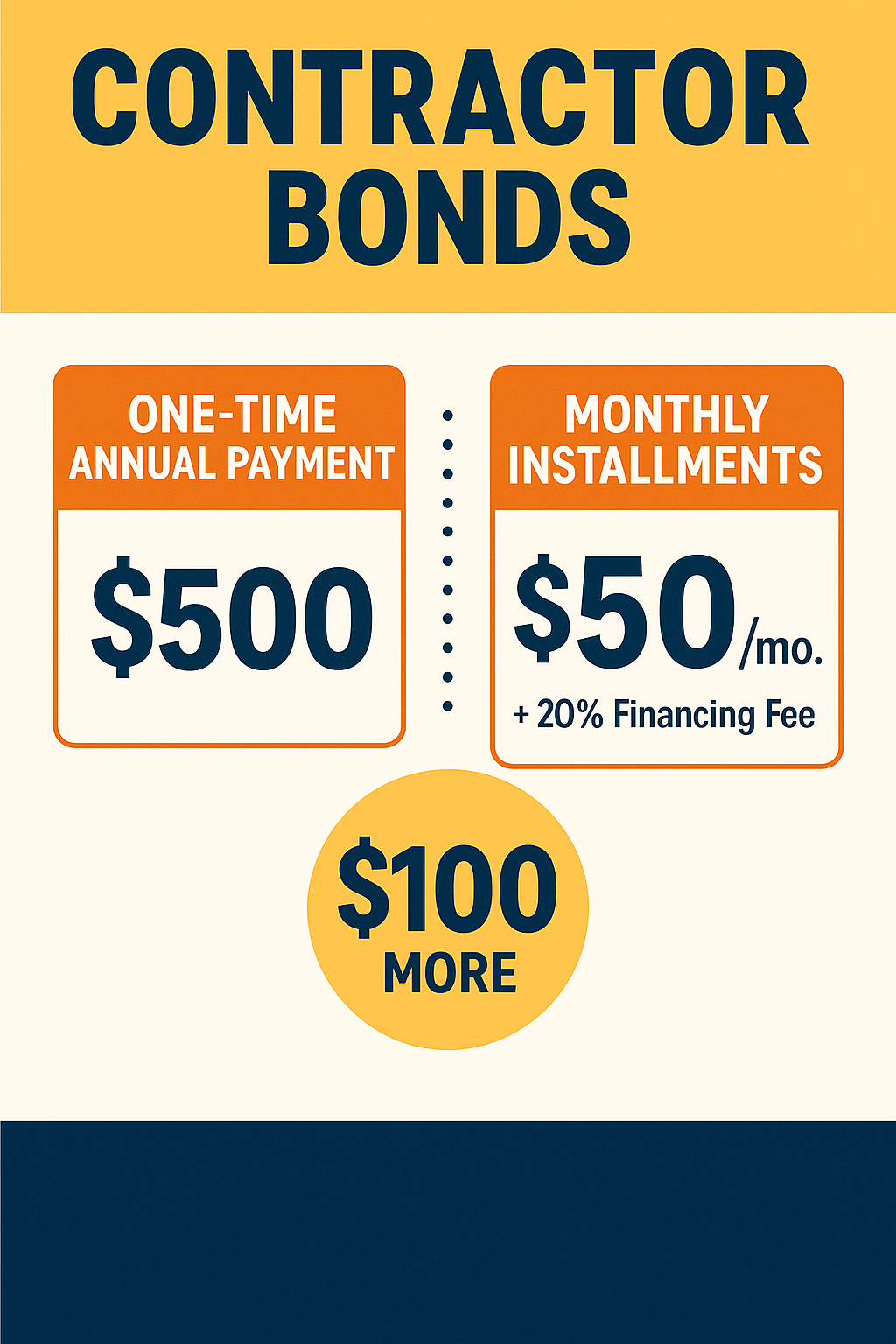
Traditionally, most surety companies require the full premium to be paid annually in one lump sum. However, many providers now recognize that contractors face real cash flow challenges, and contractor bond monthly payment options through financing plans have become increasingly available.
Monthly payment options are particularly popular for new contractors establishing themselves, businesses with seasonal revenue patterns, contractors operating on tight cash flow margins, and smaller businesses striving to maintain adequate working capital. Although these arrangements may cost slightly more overall because of added financing fees, the convenience of paying over time is often well worth it for many contractors.
Contractor Bond Monthly Payment Options

The surety bond industry now offers far more flexibility than in the past, when contractors had to make hefty upfront annual payments. Today, there are more Contractor Bond Monthly Payment options that can ease cash flow concerns for many businesses.
Can You Pay for Contractor Bonds Monthly?
Yes, it is possible to pay for a contractor bond in monthly installments, although the process works somewhat differently than a typical monthly bill.
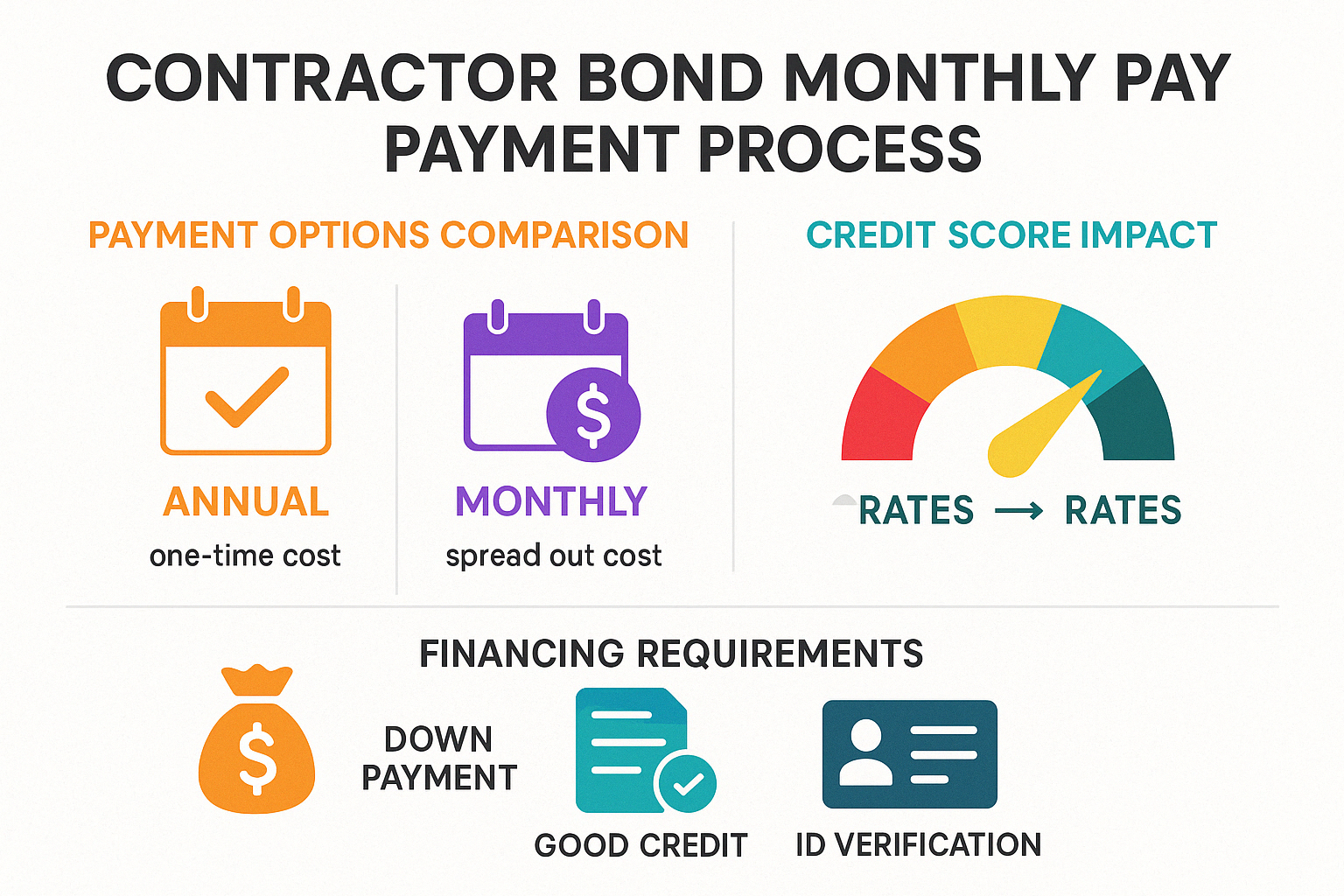
Most contractors opt for monthly payments through financing plans, making a down payment (usually 25-30% of the total) and then distributing the remaining amount over monthly installments. Some surety providers also offer direct in-house programs, allowing payments to be made directly to them without involving a third-party financing company.
For contractors with excellent credit, monthly payments can start as low as $11, whereas the annual premium might be around $109. Financing options generally require a minimum premium threshold (often $1,000+), a cancellable bond, and sometimes additional credit checks for approval.
Benefits and Drawbacks of Monthly Payment Plans
One of the primary benefits of paying monthly is improved cash flow management. Rather than paying a large sum in one installment, contractors can preserve working capital for other business activities. Monthly payments can also simplify budgeting by offering predictable, recurring expenses.
Another advantage is the possibility of accessing higher bond limits; a contractor who finds it difficult to pay large annual premiums at once may be able to handle more manageable monthly sums. This can be especially advantageous for those just getting established or operating in seasonal industries.
On the other hand, monthly payments may come with additional fees, such as interest or financing charges. Missing payments can lead to bond cancellation, which endangers a contractor’s license. In some cases, contractors with serious credit issues may not qualify. While an increasing number of surety providers offer monthly payment plans, not all do, so it is essential to verify options with each provider.
Navigating Monthly Payments for Your Contractor Bond

Some contractors find the process of setting up contractor bond monthly payment options overwhelming at first. However, it can be straightforward when approached with the right information.
How to Set Up a Monthly Payment Plan
Begin by selecting a surety company that specifically offers monthly payment options. Organizations such as Palmetto Surety Corporation often design payment plans with contractors’ cash flow needs in mind.
Before applying, gather essential documentation, such as a valid ID, business details (including license numbers), and financial statements. The online application process is typically streamlined: after choosing the bond type and amount, the contractor provides information, consents to a soft credit check (which does not harm credit scores), and reviews the payment terms.
While reviewing financing terms, pay close attention to the down payment amount, monthly installment details, and the total cost (including any financing fees). Once approved and the down payment is made, many surety companies file the bond electronically with state licensing boards, simplifying the paperwork process.
Setting up automatic payments can prevent missed payments and potential bond cancellations, safeguarding a contractor’s license and livelihood.
Impact of Credit Score on Monthly Payments
Credit scores significantly influence both the premium and the availability of monthly payment options. Contractors with excellent credit (700+) often qualify for low monthly payments, sometimes starting around $11 for a standard $25,000 bond. Good credit (650-699) may slightly increase costs, while average credit (600-649) can lead to higher fees. Even contractors with below average or challenged credit may qualify for financing, though higher down payments or specialized programs might be necessary.
Surety companies typically use a “soft” credit check, which should not negatively impact credit ratings. The monthly payment gap between excellent and challenged credit can be substantial— for example, $11 monthly versus $95-115 monthly for the same bond— so comparing quotes is highly recommended.
At Palmetto Surety Corporation, specialized programs have been developed for contractors rebuilding credit, with the goal of offering practical solutions that help them thrive in the construction industry. Access to affordable contractor bond monthly payment arrangements can be a real turning point for businesses working to grow and maintain compliance.
Consequences of Not Maintaining an Active Contractor Bond

Letting a contractor bond lapse, whether through missed contractor bond monthly payments or other issues, can have immediate and serious repercussions.
The Legal Fallout
When a bond lapses, the contractor’s license may be suspended or revoked immediately. In California, the Contractors State License Board (CSLB) treats a lapsed bond as operating without a proper financial guarantee to protect consumers. Working without an active license violates state regulations and can lead to misdemeanor charges, significant fines, and in severe cases, jail time.
For example, a contractor in San Diego who missed three monthly payments due to personal circumstances finded the bond was canceled and the license suspended. In that case, relatively minor missed payments escalated into thousands of dollars in lost projects, reinstatement fees, and emergency bond replacement costs.
The Business Impact
A suspended license means no legal ability to bid or work on new projects. Existing contracts may also be jeopardized if clients find the license is no longer valid. Word of license suspensions travels quickly, creating potential damage to a contractor’s professional reputation.
Repeated bond lapses or claims against the bond can also raise future bonding costs. Surety providers often view lapses as an indication of financial instability, leading to higher premiums or stricter underwriting requirements.
Without bond coverage, a contractor is directly responsible for damage claims that would otherwise be handled by the surety, creating a heightened level of personal and business liability.
Getting Back on Track
Reinstating a lapsed bond typically involves securing a new bond (or reinstating the old one) and paying any outstanding premiums plus reinstatement fees. The surety may require updated financial information and another credit check. Once the bond is approved and filed, the licensing board can reactivate the license, usually within days or weeks, depending on processing times.
At Palmetto Surety Corporation, safeguards are in place for clients on monthly payment plans, including payment reminders and grace periods. Emergency reinstatement services may also be available when necessary, preventing substantial losses from suspended licenses. The cost of maintaining a bond is minimal compared to the potential financial and professional harm of allowing coverage to lapse.
Frequently Asked Questions about Contractor Bond Monthly Payment
Are There Discounts for Multi-Year Bond Purchases?
When looking at contractor bond options, it can be helpful to consider multi-year bonds for potential cost savings. Many surety providers, including Palmetto Surety Corporation, offer discounts for bonds purchased for multiple years.
For a two-year bond, a 10-15% discount on the second year’s premium is common. A three-year bond often provides 10-15% off the second year and around 15-25% off the third. This can add up to meaningful savings over time. For instance, a one-year bond priced at $500 each year might cost only around $1,350 total when purchased for three years.
Multi-year bonds eliminate the hassle of yearly renewals and rate changes. Financing options may also be available, allowing contractors to spread out the cost of multi-year plans, balancing immediate cash flow needs with long-term savings.
How Do Surety Companies Handle Claims?
Understanding the claims process is essential when considering contractor bond monthly payment options. If a claim is filed, the surety conducts an investigation. If the claim is found to be valid, the surety pays the claimant and then seeks reimbursement from the contractor under the indemnity agreement.
Multiple or significant claims can lead to higher premiums and stricter underwriting in the future. Some surety providers may also require collateral or opt out of offering monthly financing if the risk is deemed too high.
What is the Difference Between Contractor Bonds and Other Surety Bonds?
• Contractor license bonds: Required by state boards for a valid license, often renewed annually, and well-suited for monthly payments.
• Bid bonds: Guarantee a contractor will enter into a contract if the bid is won; typically one-time short-term obligations, so monthly payments are less common.
• Performance bonds: Ensure the contractor completes the project as agreed. Premiums are typically a one-time fee tied to the contract amount.
• Payment bonds: Guarantee subcontractors and suppliers are paid, often bundled with performance bonds.
• Maintenance bonds: Cover workmanship for a stated period post-completion, also typically a single-payment bond.
Contractor license bonds are the best fit for monthly payment plans because they are continuous obligations. By contrast, project-based bonds (bid, performance, payment, and maintenance) typically involve one-time premiums linked to specific contracts or time frames.
Conclusion

Securing a suitable contractor bond monthly payment option no longer needs to be a complicated process. The bonding industry has evolved to offer flexible choices that support contractors’ day-to-day operations and compliance requirements, especially in 2025 and beyond.
Credit score remains a key factor in determining both premium rates and payment structures. Contractors with excellent credit can often qualify for monthly payments as low as $11, while those with credit challenges may pay closer to $95-$115. Even so, the option to pay monthly can ease financial strain and maintain steady business operations. For those who can manage a larger upfront payment, multi-year bonds offer valuable discounts over time.
It is critical to maintain active bond coverage to avoid license suspension, lost projects, and reputational damage. The relatively small cost of bonding is a safeguard against the severe consequences of working without proper coverage.
Contractor license bonds are typically the best candidates for monthly payment plans, whereas project-specific bonds like bid, performance, or maintenance bonds generally follow single-premium structures.
Palmetto Surety Corporation has more than two decades of experience assisting contractors with bonding requirements, offering payment solutions that fit varying financial situations. With a focus on quick approval time, the company supports contractors in Georgia, Florida, Louisiana, Mississippi, South Carolina, Tennessee, and Texas, among other areas.
For more information on obtaining a contractor bond with flexible payment options, contact Palmetto Surety Corporation.


